Artificial Intelligence (AI) refers to the capability of machines or computer systems to perform tasks that normally require human intelligence. These tasks include learning, reasoning, problem-solving, decision-making, understanding language, recognizing images, and even creating new content.
AI has become one of the most transformative technologies of the 21st century. It is increasingly influencing governance, education, healthcare, business, security, agriculture, and everyday life. Today, AI powers digital assistants like Siri and Google Assistant, recommendation systems on Netflix and YouTube, fraud detection in banks, autonomous vehicles, and advanced chatbots such as ChatGPT.

Definition of Artificial Intelligence
The term Artificial Intelligence (AI) was formally introduced by John McCarthy during the Dartmouth Summer Research Project on Artificial Intelligence in 1956, an event widely regarded as the birth of artificial intelligence as an academic discipline. McCarthy, who is often called the “Father of Artificial Intelligence”, defined AI as:
“The science and engineering of making intelligent machines, especially intelligent computer programs.”
— John McCarthy (1956)
This definition emphasizes two important aspects:
- Science refers to understanding the principles of intelligence and how intelligent behaviour can be modelled.
- Engineering refers to designing and developing machines and software capable of performing tasks that require intelligence.
Unlike conventional computer programs that execute predefined instructions, AI systems are designed to learn from experience, adapt to new situations, reason logically, solve complex problems, and improve their performance over time.
A Simple Definition
Artificial Intelligence (AI) is the ability of a machine or computer program to imitate human intelligence by learning from data, reasoning, solving problems, making decisions, understanding language, recognising patterns, and performing tasks autonomously with minimal human intervention.
Academic Definition
Artificial intelligence is a branch of computer science that focuses on creating intelligent systems capable of performing cognitive functions traditionally associated with human beings, such as:
- Learning from experience
- Logical reasoning
- Problem-solving
- Decision-making
- Perception and pattern recognition
- Natural language understanding
- Planning and prediction
- Creativity and content generation
Key Elements of the Definition
| Element | Explanation |
|---|---|
| Machine | Any computer, robot, or digital device capable of executing instructions. |
| Human Intelligence | The ability to think, learn, reason, understand, and make judgements. |
| Learning | AI improves its performance by analysing data and previous experiences without being explicitly programmed for every situation. |
| Reasoning | AI applies logical rules and algorithms to draw conclusions and solve problems. |
| Decision-making | AI evaluates multiple alternatives and selects the most appropriate action based on available information. |
| Autonomy | AI systems can perform tasks independently with little or no human intervention. |
Meaning of AI
To understand Artificial Intelligence (AI), it is useful to examine the meaning of the two words that constitute the term: Artificial and Intelligence. Together, they explain the essence of AI and distinguish it from natural human intelligence.
The term Artificial Intelligence consists of two words:
| Term | Meaning |
|---|---|
| Artificial | Something created, designed, or manufactured by human beings rather than occurring naturally. In the context of AI, it refers to computer systems, software, or machines that are developed by humans. |
| Intelligence | The ability to acquire knowledge, learn from experience, reason logically, understand information, solve problems, adapt to new situations, make decisions, and apply knowledge effectively. |
What Does “Artificial” Mean?
The word Artificial refers to anything that is human-made rather than naturally occurring. Artificial objects are created using scientific knowledge, engineering, and technology to perform specific functions.
Examples:
- Artificial flowers imitate natural flowers.
- Artificial limbs replace missing body parts.
- Artificial satellites are human-made objects placed in space.
- Artificial Intelligence refers to intelligence created by humans in machines.
Thus, in AI, artificial means that the intelligence is not biological but is developed through computer hardware, software, algorithms, and data.
What Does “Intelligence” Mean?
Intelligence is the mental ability to think, learn, reason, understand, and solve problems. It enables humans to analyze situations, make informed decisions, communicate effectively, and adapt to changing environments.
Human intelligence includes several cognitive abilities, such as:
- Learning from experience
- Logical reasoning
- Critical thinking
- Problem-solving
- Decision-making
- Memory and knowledge retention
- Creativity and innovation
- Language understanding and communication
- Emotional and social understanding
Artificial Intelligence attempts to replicate many of these cognitive functions using computational methods.
Combined Meaning of Artificial Intelligence
When the two terms are combined:
Artificial Intelligence (AI) refers to the human-created capability of machines and computer systems to simulate human intelligence by learning from data, reasoning, solving problems, making decisions, understanding language, recognizing patterns, and performing tasks with minimal human intervention.
In simple words,
Artificial Intelligence means human-made intelligence that enables machines to think, learn, reason, and act intelligently in ways that resemble human cognitive abilities.
Human Intelligence vs Artificial Intelligence
| Human Intelligence | Artificial Intelligence |
|---|---|
| Natural intelligence possessed by humans. | Human-created intelligence embedded in machines and software. |
| Learns through experience, observation, and education. | Learns through algorithms, data, and machine learning models. |
| Possesses emotions, consciousness, and creativity. | Operates through programmed logic and learned patterns; it lacks emotions and consciousness. |
| Can make judgments based on ethics, intuition, and social values. | Makes decisions based on data, algorithms, and predefined objectives. |
| Continuously evolves through life experiences. | Improves through training, updates, and exposure to new data. |
Why is AI Called “Artificial Intelligence”?
AI is called Artificial Intelligence because:
- It is artificial, as it is designed and developed by humans.
- It demonstrates intelligent behaviour, such as learning, reasoning, planning, recognizing speech or images, and making decisions.
- It performs tasks that traditionally required human cognitive abilities.
- It continuously improves its performance by learning from data and experience.
Although AI can mimic many aspects of human intelligence, it does not possess consciousness, emotions, self-awareness, or moral judgment like humans.
Examples of Artificial Intelligence in Everyday Life
The meaning of AI becomes clearer when we observe its applications in daily life:
| Application | How AI Demonstrates Intelligence |
|---|---|
| Voice Assistants (Siri, Google Assistant, Alexa) | Understand spoken language and respond to user commands. |
| Chatbots (ChatGPT, Gemini, Copilot) | Answer questions, generate content, and assist users in conversations. |
| Google Maps | Analyses traffic data to recommend the fastest routes. |
| Netflix and YouTube | Recommend movies and videos based on user preferences. |
| Online Shopping | Suggest products based on browsing and purchase history. |
| Email Services | Detect spam and automatically organize emails. |
| Banking Systems | Identify fraudulent transactions using pattern recognition. |
| Healthcare | Assist doctors in diagnosing diseases from medical images and patient data. |
Characteristics of Artificial Intelligence
Artificial Intelligence (AI) possesses a unique set of characteristics that distinguish it from traditional computer programs. Unlike conventional software, which operates strictly according to predefined instructions, AI systems are capable of learning from data, reasoning logically, adapting to new situations, making decisions, and continuously improving their performance. These characteristics enable AI to perform complex tasks that traditionally required human intelligence.
The following are the major characteristics of Artificial Intelligence:
| Characteristic | Explanation |
|---|---|
| Learning Ability | AI systems learn from data, previous experiences, and interactions. Using Machine Learning algorithms, they continuously improve their accuracy and performance without being explicitly programmed for every situation. |
| Reasoning | AI applies logical rules, mathematical models, and inference techniques to analyze information, solve problems, and make informed decisions in different situations. |
| Perception | AI can perceive and interpret information from the surrounding environment through images, videos, sounds, speech, sensors, and other inputs using technologies such as Computer Vision and Speech Recognition. |
| Language Understanding | Through Natural Language Processing (NLP), AI can understand, interpret, translate, summarize, and generate human language, enabling communication between humans and machines. |
| Decision-Making | AI evaluates available data, predicts possible outcomes, and selects the most appropriate course of action based on predefined objectives or learned patterns. |
| Automation | AI automates repetitive, time-consuming, and complex tasks with minimal human intervention, improving efficiency, productivity, and accuracy across various sectors. |
| Adaptability | AI systems can adapt to changing environments, new data, and evolving situations by updating their knowledge and modifying their behavior over time. |
Detailed Explanation of the Characteristics
1. Learning Ability
Learning is the most fundamental characteristic of Artificial Intelligence. Unlike traditional software that follows fixed instructions, AI systems learn from data and improve their performance through experience.
Machine Learning algorithms identify patterns within large datasets and use these patterns to make predictions or decisions without explicit programming.
Examples:
- Email services learn to identify spam messages.
- Netflix recommends movies based on viewing history.
- ChatGPT improves responses by learning language patterns from large datasets.
Importance: Learning enables AI to become more accurate, efficient, and useful over time.
2. Reasoning
‘Reasoning’ refers to the ability of AI to analyse information logically, draw conclusions, and solve problems.
AI systems use algorithms, probability models, and logical inference to evaluate different alternatives before making decisions.
Examples:
- Medical AI systems assist doctors in diagnosing diseases.
- Chess-playing AI evaluates millions of possible moves before selecting the best one.
- Financial systems analyse investment risks before recommending strategies.
Importance: Reasoning allows AI to make rational and evidence-based decisions.
3. Perception
Perception enables AI systems to collect and interpret information from the external environment using cameras, microphones, sensors, and other input devices.
This capability combines technologies such as computer vision, speech recognition, and sensor data processing.
Examples:
- Facial recognition in smartphones.
- Self-driving cars identifying pedestrians and traffic signs.
- AI-powered surveillance systems detecting unusual activities.
Importance: Perception allows AI to understand the physical world and interact effectively with it.
4. Language Understanding
Natural Language Processing (NLP) enables AI to understand, interpret, and generate human language.
It allows computers to communicate naturally with users through speech or text.
Examples:
- Google Translate translating languages.
- Voice assistants such as Siri and Alexa responding to spoken commands.
- Chatbots providing customer support.
Importance: Language understanding improves human-computer interaction and makes AI more accessible.
5. Decision-Making
AI systems can analyse multiple alternatives and select the best possible decision based on available information, objectives, and learned experiences.
Decision-making often involves predictive analytics, optimisation algorithms, and statistical reasoning.
Examples:
- Banks approving or rejecting loan applications.
- E-commerce platforms recommending products.
- Hospitals prioritizing emergency patients.
Importance: AI helps organizations make faster, data-driven, and more accurate decisions.
6. Automation
Automation is one of the most practical characteristics of AI. AI can perform repetitive and routine tasks without continuous human supervision.
Automation reduces errors, saves time, and improves productivity.
Examples:
- Industrial robots assembling automobiles.
- AI software processing invoices automatically.
- Smart irrigation systems watering crops based on soil conditions.
Importance: Automation allows humans to focus on creative, strategic, and high-value activities.
7. Adaptability
Adaptability refers to the ability of AI systems to adjust to changing environments, new information, and evolving situations.
Unlike traditional programs, AI systems can update their knowledge and improve performance as new data become available.
Examples:
- Navigation apps changing routes based on live traffic.
- AI cybersecurity systems learning new hacking techniques.
- Recommendation systems updating suggestions according to user preferences.
Importance: Adaptability enables AI to remain effective in dynamic and uncertain environments.
Summary of AI Characteristics
| Characteristic | Primary Function | Example |
|---|---|---|
| Learning Ability | Learns from experience and data | Netflix recommendations |
| Reasoning | Solves problems logically | Medical diagnosis systems |
| Perception | Recognizes images, speech, and surroundings | Facial recognition |
| Language Understanding | Understands and generates human language | ChatGPT, Siri |
| Decision-Making | Selects the best course of action | Loan approval systems |
| Automation | Performs tasks without continuous human intervention | Industrial robots |
| Adaptability | Improves with new information | Google Maps traffic updates |
Objectives of Artificial Intelligence
Artificial Intelligence (AI) has been developed with the primary goal of enabling machines to perform tasks that normally require human intelligence. Beyond simply automating processes, AI aims to enhance human capabilities, improve efficiency, support informed decision-making, and contribute to social and economic development. As AI continues to evolve, its objectives have expanded from solving technical problems to addressing complex challenges in governance, healthcare, education, business, and scientific research.
The major objectives of Artificial Intelligence are discussed below.
1. Simulating Human Intelligence
The foremost objective of AI is to simulate human intelligence by enabling machines to think, learn, reason, perceive, and make decisions in a manner similar to humans.
AI systems are designed to imitate cognitive functions such as:
- Learning from experience
- Logical reasoning
- Problem-solving
- Language understanding
- Pattern recognition
- Decision-making
Although AI can replicate many human intellectual abilities, it does not possess consciousness, emotions, or self-awareness like humans.
Example:
- ChatGPT generating human-like conversations.
- Virtual assistants such as Siri and Google Assistant understanding spoken commands.
2. Solving Complex Problems Efficiently
AI is capable of processing enormous volumes of data and identifying patterns that may not be apparent to humans. This enables AI to solve highly complex problems quickly and accurately.
AI assists in:
- Scientific research
- Weather forecasting
- Financial risk analysis
- Disease diagnosis
- Space exploration
- Disaster prediction
Example:
AI models analyze satellite images to predict cyclones and floods, helping governments prepare for natural disasters.
3. Improving Decision-Making
Another major objective of AI is to support data-driven and evidence-based decision-making.
AI systems analyze historical data, identify trends, predict future outcomes, and recommend the best possible course of action.
This is especially useful in:
- Business management
- Public administration
- Healthcare
- Agriculture
- Banking
- Defence
Example:
Banks use AI to evaluate credit risk before approving loans.
4. Automating Repetitive Tasks
AI seeks to reduce human involvement in repetitive, routine, and time-consuming tasks by automating them.
Automation improves:
- Speed
- Accuracy
- Productivity
- Cost efficiency
Common automated activities include:
- Data entry
- Customer support chatbots
- Invoice processing
- Manufacturing operations
- Traffic management
Example:
Factories use AI-powered robots to assemble products with greater precision and consistency.
5. Enhancing Productivity and Innovation
AI helps individuals, businesses, and governments accomplish more in less time by increasing operational efficiency and encouraging innovation.
AI contributes to:
- Faster research and development
- Improved industrial productivity
- Better resource management
- Smart manufacturing
- Digital transformation
Example:
Companies use AI to design new products, optimize supply chains, and improve customer services.
6. Supporting Scientific Research
Modern scientific research generates vast amounts of data that are difficult to analyze manually. AI enables researchers to process and interpret this data more efficiently.
AI supports research in areas such as:
- Medicine
- Biotechnology
- Climate science
- Physics
- Astronomy
- Environmental studies
Example:
AI assists scientists in discovering new medicines by analyzing millions of chemical compounds in a short period.
7. Providing Personalized Services
AI aims to deliver customized experiences by understanding individual preferences, behaviors, and needs.
Personalized AI services include:
- Educational recommendations
- Online shopping suggestions
- Entertainment recommendations
- Personalized healthcare
- Digital marketing
Example:
Netflix recommends movies based on a user’s viewing history, while online retailers suggest products according to previous purchases.
8. Assisting Governments in Policy Formulation and Public Administration
AI plays an increasingly important role in e-governance and public administration by improving policy formulation, service delivery, and administrative efficiency.
Governments use AI for:
- Smart governance
- Digital public services
- Traffic management
- Disaster management
- Crime prediction
- Welfare scheme implementation
- Resource allocation
AI enables governments to make better policy decisions based on real-time data and predictive analytics.
Example:
AI can analyze demographic, economic, and health data to help governments design targeted welfare programmes and improve public service delivery.
| Objective | Purpose | Example |
|---|---|---|
| Simulating Human Intelligence | Replicate human cognitive abilities | ChatGPT, Siri |
| Solving Complex Problems | Analyze complex data and generate solutions | Disease diagnosis, climate modelling |
| Improving Decision-Making | Support evidence-based decisions | Loan approval, policy analysis |
| Automating Repetitive Tasks | Reduce manual work and increase efficiency | Industrial robots, chatbots |
| Enhancing Productivity and Innovation | Improve efficiency and encourage creativity | Smart manufacturing |
| Supporting Scientific Research | Accelerate discoveries through data analysis | Drug discovery, space research |
| Providing Personalized Services | Offer customized user experiences | Netflix, Amazon recommendations |
| Assisting Governments | Improve governance and public administration | Smart cities, digital governance |
Types of Artificial Intelligence
Artificial Intelligence (AI) can be classified in different ways depending on its capabilities and functional characteristics. The two most widely accepted classifications are:
- Based on Capability – Classifies AI according to the level of intelligence it possesses.
- Based on Functionality – Classifies AI according to how it processes information and interacts with its environment.
Understanding these classifications helps us evaluate the present state of AI as well as its future potential.
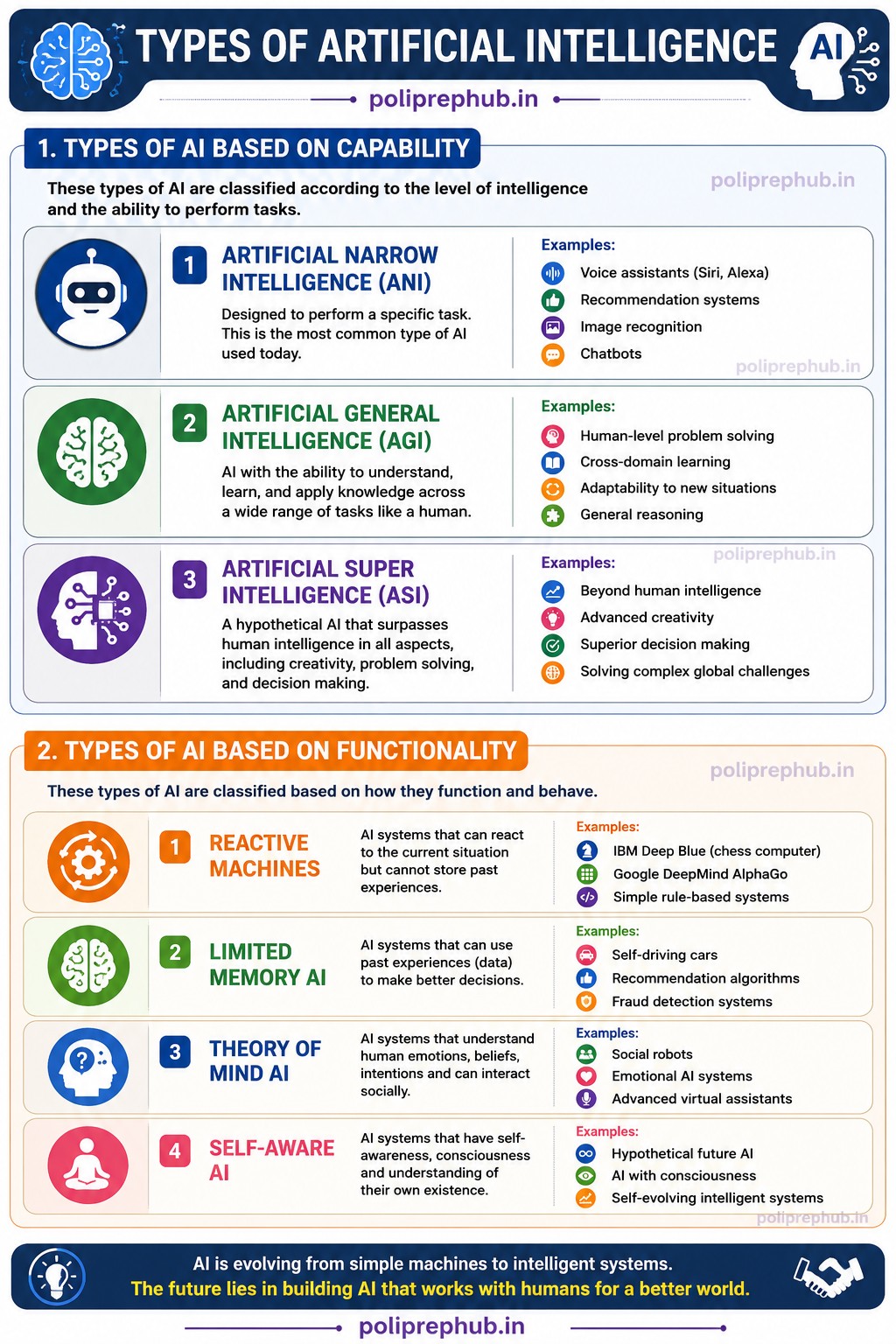
1. Types of AI Based on Capability
This classification focuses on the extent of intelligence that an AI system possesses compared to human intelligence.
| Type | Description |
|---|---|
| Artificial Narrow Intelligence (ANI) | AI designed to perform a specific task. It is the only type of AI currently in practical use. |
| Artificial General Intelligence (AGI) | A hypothetical AI capable of understanding, learning, and performing any intellectual task that a human being can perform. |
| Artificial Super Intelligence (ASI) | A theoretical AI that surpasses human intelligence in every aspect, including reasoning, creativity, emotional intelligence, and problem-solving. |
1. Artificial Narrow Intelligence (ANI)
Artificial Narrow Intelligence, also known as Weak AI, is designed to perform one specific task or a limited range of tasks. It cannot perform functions outside the area for which it has been trained.
ANI dominates today’s AI landscape and powers most modern AI applications.
Characteristics
- Specializes in a single task.
- Learns only within a limited domain.
- Cannot think or reason beyond its programming.
- Highly efficient for predefined applications.
- Lacks consciousness and self-awareness.
Examples
- ChatGPT
- Google Search
- Siri and Alexa
- Google Translate
- Netflix recommendation system
- Facial recognition software
- Spam email filters
- Self-driving vehicle assistance systems
Advantages
- High accuracy in specific tasks.
- Faster than humans for repetitive work.
- Widely used in business, healthcare, education, and governance.
Limitations
- Cannot transfer knowledge between unrelated tasks.
- Requires human supervision and training.
- Cannot understand situations beyond its domain.
Current Status: Almost all AI systems used today belong to Artificial Narrow Intelligence (ANI).
2. Artificial General Intelligence (AGI)
Artificial General Intelligence, often called Strong AI, refers to a machine that possesses human-level intelligence.
Unlike ANI, AGI would be capable of learning, reasoning, understanding, and applying knowledge across multiple domains without needing separate programming.
Characteristics
- Learns any intellectual task.
- Thinks and reasons like humans.
- Solves unfamiliar problems independently.
- Transfers knowledge across different fields.
- Continuously improves through learning.
Potential Applications
- Scientific research
- Medical diagnosis
- Education
- Space exploration
- Public administration
- Policy analysis
- Disaster management
Current Status
AGI remains hypothetical. No existing AI system has achieved true human-level intelligence.
Researchers around the world are actively working toward AGI, but significant scientific and technological challenges remain.
3. Artificial Super Intelligence (ASI)
Artificial Super Intelligence represents a stage where AI exceeds human intelligence in every conceivable field.
ASI would not only perform intellectual tasks better than humans but could also innovate, create new knowledge, and solve problems beyond current human capabilities.
Characteristics
- Superior reasoning ability.
- Exceptional creativity.
- Advanced scientific discovery.
- Instant learning.
- Autonomous decision-making.
- Continuous self-improvement.
Possible Applications
- Solving climate change.
- Discovering cures for diseases.
- Managing global economic systems.
- Deep space exploration.
- Advanced robotics.
Challenges
ASI also raises serious concerns:
- Loss of human control.
- Ethical issues.
- Security risks.
- Unpredictable behavior.
- Employment displacement.
- Global governance challenges.
Current Status: Artificial Super Intelligence is purely theoretical and does not exist today.
Comparison of AI Based on Capability
| Feature | ANI | AGI | ASI |
|---|---|---|---|
| Intelligence Level | Task-specific | Human-level | Beyond human |
| Learning Ability | Limited | General | Unlimited |
| Current Existence | ✔ Yes | ✖ No | ✖ No |
| Self-awareness | No | Uncertain | Possible (theoretical) |
| Example | ChatGPT, Siri | None | None |
2. Types of AI Based on Functionality
Another important classification categorizes AI according to how it processes information, stores knowledge, and responds to its environment.
| Type | Description |
|---|---|
| Reactive Machines | Respond only to present inputs without storing memories of past experiences. |
| Limited Memory AI | Uses past experiences and historical data to improve decisions. |
| Theory of Mind AI | A hypothetical AI capable of understanding emotions, beliefs, intentions, and social interactions. |
| Self-aware AI | A theoretical AI possessing consciousness, self-awareness, emotions, and independent thought. |
1. Reactive Machines
Reactive Machines are the simplest form of AI.
They respond only to current inputs and cannot remember previous experiences.
Characteristics
- No memory.
- No learning from experience.
- Responds only to present situations.
- Highly reliable for fixed tasks.
Example
IBM’s Deep Blue, the chess computer that defeated Garry Kasparov in 1997, analyzed current board positions but had no memory of previous games.
Applications
- Chess-playing systems
- Basic industrial robots
- Rule-based automation
2. Limited Memory AI
Limited Memory AI is the most common type of AI used today.
It stores and uses previous information for a limited period to improve future decisions.
Characteristics
- Learns from historical data.
- Improves through Machine Learning.
- Makes predictions using previous experiences.
- Continuously updates models.
Examples
- Self-driving cars
- ChatGPT
- Google Maps
- Recommendation systems
- Fraud detection software
Applications
- Healthcare
- Finance
- Transportation
- Smart cities
- Agriculture
3. Theory of Mind AI
Theory of Mind AI refers to AI systems capable of understanding human emotions, beliefs, intentions, motivations, and social interactions.
Such AI would communicate naturally and respond according to human emotional states.
Characteristics
- Understands emotions.
- Recognizes intentions.
- Predicts human behavior.
- Social intelligence.
Possible Applications
- Mental healthcare
- Personal assistants
- Education
- Customer service
- Elderly care
Current Status: This type of AI remains under development and has not yet been fully achieved.
4. Self-aware AI
Self-aware AI represents the most advanced stage of Artificial Intelligence.
It would possess:
- Consciousness
- Self-awareness
- Emotions
- Independent thinking
- Personal goals
- Understanding of its own existence
Characteristics
- Human-like consciousness.
- Emotional intelligence.
- Autonomous reasoning.
- Independent learning.
Potential Applications
If developed, it could revolutionize:
- Scientific research
- Space exploration
- Healthcare
- Governance
- Advanced robotics
Current Status: Self-aware AI is purely theoretical and remains a subject of scientific research and philosophical debate.
Comparison of AI Based on Functionality
| Feature | Reactive Machines | Limited Memory | Theory of Mind | Self-aware AI |
|---|---|---|---|---|
| Memory | ✖ No | ✔ Limited | ✔ Yes | ✔ Yes |
| Learning | ✖ No | ✔ Yes | ✔ Advanced | ✔ Continuous |
| Emotion Understanding | ✖ No | ✖ Limited | ✔ Yes | ✔ Yes |
| Consciousness | ✖ No | ✖ No | ✖ No | ✔ Yes (Theoretical) |
| Current Status | Exists | Exists | Under development | Theoretical |
Components of Artificial Intelligence
Artificial Intelligence (AI) is not a single technology but a combination of several advanced technologies that work together to create intelligent systems. These components enable machines to learn from data, understand human language, recognize images, make decisions, solve problems, and perform physical tasks. Each component plays a unique role, and together they form the foundation of modern AI applications used in healthcare, education, finance, agriculture, governance, manufacturing, and transportation.
The major components of Artificial Intelligence are discussed below.
| Component | Definition | Primary Function | Examples / Applications |
|---|---|---|---|
| Machine Learning (ML) | A branch of AI that enables computers to learn from data without explicit programming. | Learns patterns from data and improves predictions or decisions. | Email spam filters, recommendation systems, fraud detection, predictive analytics. |
| Deep Learning (DL) | A specialized subset of Machine Learning that uses multi-layered artificial neural networks. | Solves highly complex problems involving images, speech, text, and videos. | Face recognition, medical diagnosis, autonomous vehicles, image recognition. |
| Natural Language Processing (NLP) | A field of AI that enables machines to understand, interpret, and generate human language. | Facilitates communication between humans and computers. | ChatGPT, Google Translate, Siri, Alexa, customer service chatbots. |
| Computer Vision | A branch of AI that enables machines to interpret visual information from images and videos. | Detects, recognizes, and analyzes visual objects and environments. | Facial recognition, CCTV surveillance, medical imaging, autonomous vehicles. |
| Robotics | Integration of AI with mechanical systems to perform physical tasks intelligently. | Enables machines to sense, plan, and act in the physical world. | Industrial robots, surgical robots, warehouse automation, drones. |
| Expert Systems | AI programs that simulate the reasoning and decision-making abilities of human experts. | Provides expert advice and solutions using a knowledge base and inference rules. | Medical diagnosis, financial advisory systems, legal expert systems. |
Artificial Intelligence is an interdisciplinary field built upon several interconnected technologies. Machine Learning enables systems to learn from data, Deep Learning allows them to solve highly complex problems using neural networks, Natural Language Processing facilitates communication in human language, Computer Vision enables machines to interpret visual information, Robotics applies AI to perform physical tasks, and Expert Systems replicate the reasoning of human specialists. Together, these components form the technological foundation of modern AI, driving innovations across healthcare, education, finance, agriculture, governance, transportation, and industry. Understanding these components is essential for appreciating how AI systems are designed, developed, and applied to solve real-world problems.
Applications of Artificial Intelligence
Artificial Intelligence (AI) has emerged as one of the most transformative technologies of the twenty-first century. It is no longer confined to research laboratories or the technology industry but has become an integral part of everyday life. AI enables machines to learn from data, recognize patterns, make intelligent decisions, automate repetitive tasks, and solve complex problems with remarkable speed and accuracy.
Today, AI is widely used across diverse sectors such as education, healthcare, agriculture, banking, governance, transportation, defence, manufacturing, entertainment, and environmental management. By improving efficiency, reducing human error, and supporting data-driven decision-making, AI is revolutionizing the way individuals, businesses, and governments function.
The major applications of artificial intelligence are discussed below.
| Sector | Major Applications | Benefits |
|---|---|---|
| Education | Personalized learning, automated grading, virtual tutors, smart classrooms | Improves learning outcomes and educational efficiency |
| Healthcare | Disease diagnosis, medical imaging, robotic surgery, drug discovery | Better patient care and faster diagnosis |
| Agriculture | Precision farming, crop monitoring, pest detection, weather prediction | Higher productivity and sustainable farming |
| Banking & Finance | Fraud detection, credit scoring, algorithmic trading, chatbots | Improved security and financial decision-making |
| Government & Public Administration | Digital governance, smart cities, policy analysis, disaster management | Efficient governance and improved public service delivery |
| Transportation | Self-driving vehicles, traffic management, route optimization | Safer and more efficient transportation |
| Security & Defence | Cybersecurity, surveillance, intelligence analysis, autonomous systems | Enhanced national security and threat detection |
| Daily Life | Voice assistants, recommendation systems, smart homes, translation services | Greater convenience and personalized experiences |
Advantages of Artificial Intelligence
Artificial Intelligence (AI) has emerged as one of the most influential technologies of the modern era. By enabling machines to perform tasks that traditionally required human intelligence, AI has significantly improved efficiency, accuracy, productivity, and innovation across various sectors. From healthcare and education to banking, agriculture, governance, and manufacturing, AI is transforming the way individuals, organizations, and governments operate.
Unlike conventional computer systems that merely follow predefined instructions, AI systems can learn from data, recognize patterns, make intelligent decisions, and continuously improve their performance. These capabilities provide numerous advantages that contribute to economic growth, technological advancement, and improved quality of life.
The major advantages of Artificial Intelligence are discussed below.
| Advantage | Description | Examples |
|---|---|---|
| High Speed | Processes enormous amounts of data within seconds, far faster than humans. | Financial analysis, weather forecasting, medical diagnosis |
| High Accuracy | Reduces human errors by making precise and consistent decisions. | Disease detection, facial recognition, quality inspection |
| 24×7 Availability | Operates continuously without fatigue, breaks, or sleep. | Customer support chatbots, online banking, virtual assistants |
| Automation | Automates repetitive and routine tasks with minimal human intervention. | Manufacturing robots, document processing, payroll systems |
| Better Decision Support | Analyzes large datasets and provides evidence-based recommendations. | Business analytics, policy formulation, financial forecasting |
| Improved Productivity | Completes tasks faster and more efficiently, increasing overall output. | Smart factories, logistics management, office automation |
| Innovation | Enables the creation of new technologies, products, and services. | Autonomous vehicles, generative AI, smart healthcare systems |
Challenges and Limitations
Although Artificial Intelligence (AI) has revolutionized numerous sectors by improving efficiency, productivity, and decision-making, it also presents significant technical, economic, ethical, legal, and social challenges. AI systems are not free from limitations, and their widespread adoption has raised concerns about privacy, employment, fairness, transparency, security, and accountability. These challenges must be carefully addressed to ensure that AI is developed and used responsibly.
Understanding the limitations of AI is essential because it enables governments, businesses, researchers, and society to maximize its benefits while minimizing its potential risks.
| Challenge | Explanation | Possible Impact |
|---|---|---|
| Job Displacement | Automation replaces certain routine and repetitive jobs. | Unemployment and workforce restructuring |
| Bias and Discrimination | AI may inherit biases present in training data. | Unfair decisions and social inequality |
| Privacy Issues | AI relies on massive amounts of personal data. | Loss of privacy and data misuse |
| Cybersecurity Risks | AI systems may be attacked or exploited by cybercriminals. | Financial loss and security breaches |
| Lack of Transparency | Many AI models operate as “black boxes,” making decisions difficult to explain. | Reduced trust and accountability |
| Ethical Concerns | Questions arise regarding fairness, responsibility, and human rights. | Ethical dilemmas and legal disputes |
| High Development Cost | Developing advanced AI systems requires significant investment. | Limited accessibility for smaller organizations |
Ethical Issues in Artificial Intelligence
Artificial Intelligence (AI) has transformed modern society by improving efficiency, innovation, and decision-making across numerous sectors. However, the rapid development and widespread deployment of AI have also raised significant ethical concerns. Ethical issues in AI relate to the principles and values that should guide the design, development, deployment, and use of intelligent systems to ensure that they are fair, transparent, accountable, safe, and beneficial to humanity.
As AI systems increasingly influence decisions related to healthcare, education, finance, employment, criminal justice, governance, and national security, it becomes essential to ensure that these technologies respect human rights, privacy, equality, dignity, and democratic values.
The study of AI ethics seeks to answer important questions such as:
- How should AI make decisions?
- Who is responsible when AI causes harm?
- How can AI be made fair and unbiased?
- How should personal data be protected?
- What limits should be placed on autonomous AI systems?
The major ethical issues in Artificial Intelligence are discussed below.
| Ethical Issue | Meaning | Potential Risks | Possible Solutions |
|---|---|---|---|
| Protection of Personal Data | Safeguarding users’ personal information collected by AI systems. | Privacy violations, identity theft, surveillance. | Data protection laws, encryption, informed consent. |
| Algorithmic Fairness | Ensuring AI decisions are unbiased and equitable. | Discrimination and unequal treatment. | Fair datasets, bias testing, AI audits. |
| Transparency and Explainability | AI decisions should be understandable and interpretable. | Lack of trust and accountability. | Explainable AI (XAI), transparent algorithms. |
| Accountability for AI Decisions | Determining responsibility when AI causes harm. | Legal disputes and ethical uncertainty. | Clear legal frameworks and human oversight. |
| Human Oversight | Humans should retain control over important AI decisions. | Unsafe autonomous decision-making. | Human-in-the-loop systems and regulatory supervision. |
| Prevention of Misinformation and Deepfakes | Preventing AI from creating deceptive content. | Fake news, fraud, election interference. | Watermarking, fact-checking, digital literacy. |
| Responsible Military Use | Ensuring ethical use of AI in defence and warfare. | Autonomous weapons and civilian harm. | International treaties and human control. |
| Intellectual Property Rights | Protecting ownership of AI-generated and AI-trained content. | Copyright disputes and unauthorized use. | Updated copyright laws and licensing mechanisms. |
Artificial Intelligence in India
India has recognized Artificial Intelligence (AI) as a strategic technology capable of accelerating economic growth, improving public service delivery, enhancing industrial competitiveness, and addressing major socio-economic challenges. With one of the world’s largest digital populations, a rapidly expanding startup ecosystem, and strong government support, India is emerging as an important global player in AI research, innovation, and adoption.
The Government of India is actively promoting the development of responsible, ethical, inclusive, and trustworthy AI through national strategies, policy initiatives, digital infrastructure, research institutions, and public-private partnerships. AI is increasingly being integrated into sectors such as healthcare, agriculture, education, finance, governance, manufacturing, transportation, defence, and smart cities.
India’s vision is not merely to become a consumer of AI technologies but to emerge as a global hub for AI innovation, ensuring that AI contributes to inclusive development and improves the quality of life of its citizens.
| Initiative | Year | Objective |
|---|---|---|
| IndiaAI Mission | 2024 | Build a comprehensive AI ecosystem through computing infrastructure, innovation, research, startups, and skilled workforce. |
| National Strategy for Artificial Intelligence (AI for All) | 2018 | Promote socially inclusive AI for economic growth and public welfare. |
| Digital India Mission | 2015 | Strengthen digital infrastructure and expand digital public services. |
| National Data Governance Framework Policy | 2022 (Draft) | Facilitate responsible data sharing while protecting privacy and promoting AI innovation. |
| AI Centres of Excellence | Ongoing | Promote AI research, innovation, and industry collaboration in priority sectors. |
| IndiaAI FutureSkills Programme | Ongoing | Develop AI-related skills and promote AI education across the country. |
Applications of AI in India
Artificial Intelligence is increasingly being applied across multiple sectors.
| Sector | Major AI Applications |
|---|---|
| Agriculture | Precision farming, crop monitoring, pest detection, yield prediction, weather forecasting |
| Healthcare | Disease diagnosis, telemedicine, medical imaging, drug discovery |
| Education | Personalized learning, AI tutors, digital classrooms, language translation |
| Governance | Digital governance, grievance redressal, policy analysis, smart cities |
| Banking & Finance | Fraud detection, credit scoring, customer support, digital payments |
| Manufacturing | Smart factories, predictive maintenance, industrial automation |
| Transportation | Intelligent traffic management, logistics optimization, autonomous technologies |
| Defence | Surveillance, cybersecurity, autonomous drones, intelligence analysis |
Benefits of AI for India
| Benefit | Explanation |
|---|---|
| Economic Growth | AI can significantly contribute to India’s GDP by improving productivity and innovation. |
| Better Governance | AI improves public service delivery, policy formulation, and administrative efficiency. |
| Employment Opportunities | Creates new jobs in AI research, software development, robotics, and data science. |
| Agricultural Development | Enhances productivity and resource efficiency in farming. |
| Improved Healthcare | Supports faster diagnosis and better patient care. |
| Educational Transformation | Enables personalized and accessible learning opportunities. |
| Digital Inclusion | Expands access to digital services and financial inclusion. |
Challenges for AI Development in India
Despite significant progress, India faces several challenges in AI adoption.
| Challenge | Explanation |
|---|---|
| Shortage of Skilled Professionals | Demand for AI experts exceeds supply. |
| Data Privacy Concerns | Large-scale data collection requires strong privacy protection. |
| Limited High-Performance Computing Infrastructure | Advanced AI requires expensive computing resources. |
| Digital Divide | Unequal access to digital technologies across regions. |
| Ethical and Regulatory Issues | Need for comprehensive AI governance and legal frameworks. |
| High Development Costs | AI research and deployment require substantial investment. |
Future of Artificial Intelligence
Artificial Intelligence (AI) is expected to become one of the most transformative technologies of the twenty-first century. As advancements in Machine Learning, Deep Learning, Robotics, Quantum Computing, Big Data, and the Internet of Things (IoT) continue, AI will increasingly influence every aspect of human life. The future of AI extends far beyond automation; it will reshape economies, transform industries, improve public services, accelerate scientific discoveries, and redefine the relationship between humans and machines.
Experts believe that the future of AI lies not in replacing human beings but in augmenting human intelligence, where humans and intelligent machines collaborate to solve complex problems more efficiently. Governments, industries, educational institutions, and international organizations are therefore investing heavily in AI research, infrastructure, innovation, and ethical governance to harness its full potential.
The following sections highlight the major areas where Artificial Intelligence is expected to shape the future.
| Future Trend | Description | Expected Impact |
|---|---|---|
| Smarter Governance | AI-powered public administration and digital governance. | Better policy decisions and improved public services. |
| Personalized Education | Adaptive learning systems tailored to individual students. | Improved learning outcomes and accessibility. |
| Precision Medicine | AI-driven diagnosis and personalized treatment plans. | Better healthcare and reduced mortality. |
| Climate Modelling | AI for weather forecasting, climate prediction, and disaster management. | Improved environmental sustainability. |
| Scientific Research | AI-assisted research and innovation across disciplines. | Faster scientific discoveries. |
| Industrial Automation | Smart factories and intelligent manufacturing systems. | Higher productivity and economic growth. |
| Space Exploration | Autonomous spacecraft, planetary exploration, and satellite analysis. | Expansion of space science and exploration. |
| Human–AI Collaboration | Humans and AI working together in decision-making and innovation. | Enhanced creativity, efficiency, and problem-solving. |
Conclusion
Artificial Intelligence (AI) has emerged as one of the most revolutionary technologies of the twenty-first century, fundamentally transforming the way individuals, organizations, and governments operate. By enabling machines to learn from data, recognize patterns, reason logically, make intelligent decisions, and continuously improve their performance, AI has become a driving force behind the ongoing digital transformation of society. Its applications now extend across almost every sector, including education, healthcare, agriculture, finance, governance, manufacturing, transportation, defence, scientific research, and environmental management, demonstrating its immense potential to improve productivity, efficiency, and quality of life.
The study of Artificial Intelligence reveals that AI is not a single technology but a multidisciplinary field built upon interconnected components such as Machine Learning, Deep Learning, Natural Language Processing, Computer Vision, Robotics, and Expert Systems. These technologies work together to create intelligent systems capable of solving complex problems, automating repetitive tasks, supporting evidence-based decision-making, and generating innovative solutions to contemporary challenges.
Despite its remarkable advantages, Artificial Intelligence also presents significant technical, ethical, legal, economic, and social challenges. Concerns relating to job displacement, algorithmic bias, privacy protection, cybersecurity, lack of transparency, accountability, misinformation, intellectual property rights, and responsible military applications highlight the need for careful governance and responsible innovation. The rapid advancement of AI underscores the importance of developing robust legal frameworks, ethical standards, and regulatory mechanisms to ensure that AI systems remain transparent, fair, accountable, secure, and aligned with democratic values and fundamental human rights.
India has recognized AI as a strategic technology for national development and has launched several initiatives, including the IndiaAI Mission, the National Strategy for Artificial Intelligence (AI for All), the Digital India Mission, and AI Centres of Excellence, with the objective of creating a globally competitive and inclusive AI ecosystem. These initiatives reflect India’s commitment to harnessing AI for sustainable development, economic growth, improved governance, and enhanced public service delivery.
Looking ahead, the future of Artificial Intelligence lies in human–AI collaboration rather than human replacement. AI will increasingly augment human capabilities by supporting professionals, researchers, policymakers, educators, healthcare workers, and entrepreneurs in solving complex problems more efficiently. As emerging technologies such as Quantum Computing, the Internet of Things (IoT), Edge AI, Explainable AI, and Generative AI continue to evolve, AI is expected to play an even greater role in advancing scientific discovery, combating climate change, improving healthcare, strengthening governance, and fostering global innovation.
Ultimately, the success of Artificial Intelligence will depend not only on technological advancement but also on ethical responsibility, transparency, inclusiveness, sustainability, and international cooperation. Governments, industries, academic institutions, researchers, and civil society must work together to ensure that AI is developed and used for the benefit of humanity. When guided by the principles of fairness, accountability, human dignity, and social justice, Artificial Intelligence has the potential to become one of the greatest instruments for achieving sustainable development, inclusive economic growth, and the overall welfare of present and future generations.
Key Terms
- Artificial Intelligence (AI)
- Machine Learning (ML)
- Deep Learning
- Natural Language Processing (NLP)
- Computer Vision
- Neural Networks
- Expert System
- Artificial Narrow Intelligence (ANI)
- Artificial General Intelligence (AGI)
- Artificial Super Intelligence (ASI)
- AI Ethics
- Explainable AI (XAI)
Practice Questions
Short Answer Questions
- Define Artificial Intelligence.
- Explain the characteristics of AI.
- What are the different types of Artificial Intelligence?
- Distinguish between Machine Learning and Deep Learning.
- What is Natural Language Processing?
Long Answer Questions
- Discuss the applications of Artificial Intelligence in contemporary society.
- Explain the advantages and limitations of Artificial Intelligence.
- Examine the ethical challenges posed by Artificial Intelligence.
- Discuss the role of Artificial Intelligence in governance and public administration.
- Evaluate the future prospects of Artificial Intelligence in India.
Remember
Artificial Intelligence is not merely about making machines intelligent—it is about using intelligent systems responsibly to improve human life while safeguarding ethics, rights, and democratic values.