
The words state and government are often used as if they meant the same thing, but in political science they stand for two different ideas. The state is a permanent political community with population, territory, government and sovereignty, while the government is the agency through which the state makes, applies and interprets its laws. The state continues even when governments change, as India has remained the same state under many governments since 1947.
This note explains the difference between the state and the government, the organs and forms of government, and the Indian experience. It is written for undergraduate and postgraduate students and for those preparing for OPSC, UPSC and UGC NET, and it follows the topic as it appears in Unit II of the syllabus.
1. Difference between the state and the government
The core distinction. The state is the whole political community organised under a sovereign authority. The government is the machinery that acts in the name of the state for the time being. Gettell, Garner and MacIver all stress that the government is an agent or instrument of the state, while the state is the permanent body that the instrument serves. A useful comparison is that of a company and its managers: the managers change, but the company continues.
| Basis | State | Government |
|---|---|---|
| Nature | A permanent community with legal personality | A temporary agency of the state |
| Elements | Population, territory, government and sovereignty | One of the four elements of the state |
| Sovereignty | Holds sovereignty | Exercises sovereignty on behalf of the state |
| Membership | All citizens belong to it | Only the office-holders form it |
| Duration | Continues unless the state itself ends | Changes with elections, revolutions or dissolution |
| Character | Abstract and cannot be seen | Concrete and visible in ministers, officials, courts |
| Obedience | Citizens owe it loyalty | Citizens obey it because it speaks for the state; it may be criticised |
| Forms | Only one kind of state, with forms of union (unitary, federal) | Many forms: monarchy, republic, parliamentary, presidential |
| Example | India, France | The Union Government of India, the Government of Odisha |
Scholar-wise views.
- Garner treated government as the organisation through which the will of the state is formulated, expressed and realised.
- MacIver distinguished the state, which is the association that maintains order, from the government, which is the organisation of persons that conducts it, and held that the state is the larger unit.
- Gettell said the government is the agency through which the state attains its purposes.
- Laski argued that the state is a territorial society divided into government and subjects, and that the government is a body of persons who exercise power for the state.
- Gilchrist described government as the agency through which the will of the state is formulated, expressed and carried out.
These statements are paraphrased from standard textbooks and should be checked against the original works before being quoted word for word.
Why the difference matters. The distinction explains why a citizen may oppose a government and still be loyal to the state. In India, the opposition criticises the ruling party without being treated as disloyal to the country, and the Constitution protects this by guaranteeing freedom of speech under Article 19(1)(a), subject to reasonable restrictions. The distinction also explains why treaties and debts signed by one government bind its successors, because the state remains the party to them.
Where the two are confused. In authoritarian systems, rulers claim that criticism of the government is treason against the state, as in the saying attributed to Louis XIV, “I am the state”. In democratic systems, the opposite principle is accepted. The law of sedition in India (Section 124A of the Indian Penal Code) has been debated for this reason, and the Supreme Court in 2022 suspended its use until it is reviewed, while the Bharatiya Nyaya Sanhita (2023) replaced the Code with a different provision on acts endangering the sovereignty, unity and integrity of India. Students should check the present legal position before quoting it.
2. Organs of government and the separation of powers
Three organs. The government of a modern state is divided by function into three organs. The legislature makes laws and controls finance, the executive carries the laws into effect and runs the administration, and the judiciary interprets the laws and settles disputes. The diagram shows how the state acts through them.
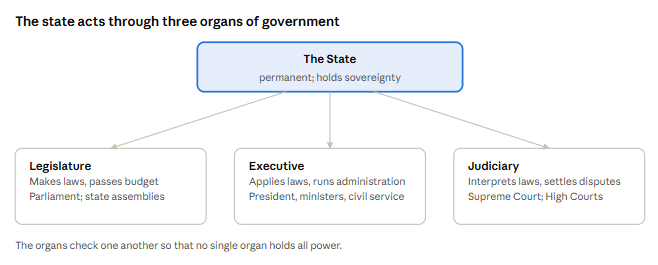
Reading the diagram. The state is placed above the organs because it is the permanent holder of sovereignty, and the organs are only its agents. In India, the legislature is Parliament (the President, Lok Sabha and Rajya Sabha) and the state legislatures, the executive is the President and Governors acting on the advice of the Councils of Ministers together with the civil services, and the judiciary is the Supreme Court, the High Courts and the subordinate courts.
Montesquieu and the separation of powers. In The Spirit of the Laws (1748), Montesquieu argued that liberty is safe only when legislative, executive and judicial powers are held by different hands, because a person who holds all three would be tempted to abuse them. He drew this idea from his reading of the English constitution, though Britain in fact fused legislature and executive through cabinet government. The framers of the American Constitution (1787) applied the idea strictly and added checks and balances, so that each branch can limit the others.
| System | Separation of powers | Example |
|---|---|---|
| Rigid separation with checks and balances | Different persons hold each organ; each can check the others | United States |
| Fusion of legislature and executive | Ministers sit in the legislature and are answerable to it | Britain, India |
| Independent judiciary in both | Courts can review acts of the other organs | United States, India |
The Indian position. The Constitution of India does not adopt a strict separation of powers. Ministers are members of the legislature, and the executive can make rules and ordinances. Yet the Supreme Court has held in Kesavananda Bharati (1973) and later cases that separation of powers and judicial review are part of the basic structure. The independence of the judiciary is protected by provisions such as Article 50, the security of tenure of judges, and the procedure of removal by impeachment under Articles 124 and 217.
Characteristics of government.
- It is an agency of the state. The government has no sovereignty of its own and acts by authority derived from the state and, in a democracy, from the people. This is why the Constitution, and not the government, is called supreme in India.
- It is temporary and changing. Governments change through elections, resignation, defeat in the legislature or revolution. India has seen changes from single-party governments to coalitions and back, while the state continued unchanged.
- It is organised in organs. The division of functions among legislature, executive and judiciary prevents a heap of power in one place and makes specialised work possible.
- It has the power to make binding rules. Government decisions are backed by law and by the machinery of enforcement, such as police and courts. A rule made by a private club does not have this force.
- It maintains law and order. Protection of life and property is the first duty of any government, and the Indian Constitution places police and public order in the State List, with the Union acting in aid.
- It provides public services. Modern governments run schools, health services, roads and welfare schemes, such as the Mahatma Gandhi National Rural Employment Guarantee Act (2005) and the National Food Security Act (2013).
- It is representative in a democracy. The government draws its authority from elections, and the Election Commission of India conducts them under Article 324.
- It is accountable. In a parliamentary system, the Council of Ministers is collectively responsible to the Lok Sabha under Article 75(3), and the executive answers to courts, audit bodies and the press.
- It operates under a constitution. Its powers are defined and limited by fundamental law, so that every act can be tested. Article 13 of the Indian Constitution makes laws that violate fundamental rights void.
- It represents the state in external affairs. The government negotiates treaties, sends and receives ambassadors, and speaks for the state in international bodies, though it acts as agent only.
- It may operate at several levels. In a federal state, government exists at Union, state and local levels, as in the three tiers of India after the 73rd and 74th Amendments (1992).
3. Forms of government
Why forms are classified. Governments differ in who rules, how power is distributed between the organs, and how power is divided between the centre and the parts. Writers have therefore classified them on several bases. The table gives the main classifications, and the paragraphs explain the ones most often asked in examinations.
| Basis | Forms | Examples |
|---|---|---|
| Number of rulers (Aristotle) | Monarchy, aristocracy, polity; and their corrupt forms: tyranny, oligarchy, democracy | Ancient Greek city-states |
| Source of authority | Monarchy and republic | Britain (constitutional monarchy); India (republic) |
| Extent of popular participation | Democracy and dictatorship | India; North Korea |
| Relation of executive and legislature | Parliamentary and presidential | India, Britain; United States |
| Distribution of power between centre and parts | Unitary, federal and confederal | France; India, United States; early United States under the Articles of Confederation |
| Constitutional character | Constitutional and authoritarian | Germany; military governments |
| Direct or indirect rule by the people | Direct and representative democracy | Swiss cantons; most modern states |
Aristotle’s classification. In the Politics, Aristotle classified governments by the number who rule and by whether they rule for the common good. Rule by one, few or many for the common good was called monarchy, aristocracy and polity, and when the rulers served only their own interest it became tyranny, oligarchy and democracy (in his meaning, rule of the poor majority). This classification is the starting point of all later discussion, though modern writers use “democracy” in a favourable sense.
Monarchy and republic. A monarchy is government by a king or queen whose office is usually hereditary, and it may be absolute, as in France before 1789, or constitutional, as in Britain and Japan. A republic is a state where the head of state is not hereditary and is elected, directly or indirectly. India is a republic, since Article 54 provides for the election of the President by an electoral college.
Parliamentary and presidential systems. The table compares the two forms most commonly asked about.
| Feature | Parliamentary | Presidential |
|---|---|---|
| Head of state and head of government | Different persons (President and Prime Minister in India) | Same person (President in the United States) |
| Executive and legislature | Fused; ministers come from and sit in the legislature | Separate; the executive is not a member of the legislature |
| Responsibility | Collective to the lower house; can be removed by a no-confidence vote | Fixed term; removed only by impeachment |
| Stability | Depends on majority support | Stable, but deadlock is possible |
| Strength | Quick lawmaking; responsible government | Clear separation; strong leadership |
| Weakness | Instability in coalitions | Conflict between the President and the legislature |
| Examples | India, Britain, Canada | United States, Brazil |
In the Constituent Assembly, the framers chose the parliamentary system because of India’s experience under the Government of India Act 1935 and their wish for a responsible executive. Ambedkar explained that a parliamentary executive is more responsible, though a presidential one is more stable, and that India needed responsibility more.
Unitary, federal and confederal forms. In a unitary state, all power rests with the central government, which may delegate authority to local bodies, as in Britain and France. In a federal state, power is divided between the centre and the units by a written constitution, which neither can change alone, and a court acts as umpire, as in the United States and India. In a confederation, sovereign states form a loose union for limited purposes, and the centre depends on them. The Indian Constitution describes India as a “Union of States” in Article 1, and scholars call it federal with a strong centre, or quasi-federal (K. C. Wheare), or cooperative federalism (Granville Austin).
Democracy and dictatorship. Democracy is government based on the consent of the people, expressed in free and fair elections, and with protection of rights. Dictatorship is rule by an individual or a small group without such consent, as in fascist Italy and Nazi Germany. A modern form is electoral authoritarianism, where elections are held but are not free or fair. Dahl called the working form of democracy polyarchy, meaning rule by many through competitive elections.
Direct and indirect democracy. In direct democracy, citizens themselves make laws, as in ancient Athens and in the assemblies of some Swiss cantons. In representative democracy, they elect representatives to do so. India uses the representative form, together with some devices of direct democracy at the local level such as the gram sabha under Article 243A.
4. State and government in the Indian context
The Constitution as the link. The Indian Constitution describes both the state and the government. Article 12 defines “the State” for the purposes of fundamental rights to include the Government and Parliament of India, the Government and legislature of each state, and all local and other authorities within the territory of India or under the control of the Government of India. This is a wider meaning than the political-science meaning, because it lists the organs through which the state acts. Courts have applied it to bodies such as public corporations and, in some cases, to companies controlled by the government.
| Aspect | Indian provision | Note |
|---|---|---|
| State as a polity | Preamble; Article 1 “Union of States” | Territory can be altered by Parliament under Article 3 |
| Government at the Union level | President (Article 52), Council of Ministers (Article 74) | President acts on the advice of the Council |
| Government at the state level | Governor (Article 153), Council of Ministers (Article 163) | Governor has limited discretion |
| Legislature | Parliament (Article 79); state legislatures (Article 168) | Bicameral at the Union level |
| Judiciary | Supreme Court (Article 124); High Courts (Article 214) | Independent; judicial review |
| “State” for fundamental rights | Article 12 | Includes local and other authorities |
| Local government | Articles 243 to 243ZG (Parts IX and IXA) | Added by the 73rd and 74th Amendments |
| Change of government | Article 75(3), Article 164(2); no-confidence motion | Collective responsibility |
Change of governments without change of state. Since 1947 India has had many governments, from the Congress governments under Nehru to coalition governments after 1989, and the Bharatiya Janata Party governments since 2014. The state remained the same, and the treaties, public debt and territorial claims continued across all of them. The example is useful to prove the difference between the state and the government in examination answers.
Anti-defection and stability of governments. The Tenth Schedule, added by the 52nd Amendment (1985), disqualifies legislators who defect from their party, and the 91st Amendment (2003) limited the size of Councils of Ministers. These measures show an attempt to protect the stability of government, though critics say that they also limit the freedom of members of the legislature.
Federalism and the governments of the states. The relations between the Union Government and state governments are regulated by Articles 245 to 263 and the Seventh Schedule. The Sarkaria Commission (1988) and the Punchhi Commission (2010) examined these relations, and the S. R. Bommai judgment (1994) laid down that the imposition of President’s Rule under Article 356 is subject to judicial review. The Goods and Services Tax Council, set up under Article 279A by the 101st Amendment (2016), is cited as an example of cooperative federalism.
Welfare state and the role of government. The Directive Principles of State Policy in Part IV direct the government to promote the welfare of the people, and the government has taken a large role in education, health, food and employment. After 1991, its role in industry was reduced, while its role as regulator and welfare provider continued. This shift is discussed in the notes on Politics and Economy and State and Globalization.
Accountability and checks on the government. The accountability of the Indian government is secured through Parliament (question hour, committees, no-confidence motions), the courts (judicial review, writ jurisdiction under Articles 32 and 226), independent bodies such as the Comptroller and Auditor General (Article 148) and the Election Commission (Article 324), and by the press and civil society. The Right to Information Act (2005) strengthens this accountability by allowing citizens to ask for official records.
5. Importance and limitations of the distinction
Importance of distinguishing state and government.
- It keeps loyalty to the state apart from support for a government. Citizens may oppose the policies of a ruling party without being disloyal to the country. In India, the opposition is a recognised part of parliamentary life, and the Leader of the Opposition holds a statutory position.
- It explains continuity. Treaties, debts and obligations pass from one government to the next because the state is the legal party. The Indus Waters Treaty and international loans of India are examples that continue across changes of government.
- It explains peaceful change of rulers. Because the state is permanent, governments can be replaced by elections without destroying the political order. The transfer of power after general elections in India since 1952 shows this.
- It supports the idea of limited government. If the government is only an agent, it can be given limited powers, and a constitution can define them. This is the basic principle behind the rule of law and judicial review in India.
- It supports democracy. Sovereignty belongs to the state and ultimately to the people, while government is only a servant, so rulers can be held accountable and removed. The Preamble’s opening words express this idea.
- It clarifies legal responsibility. The distinction allows courts to say when an act is that of the state, for example under Article 12, and when it is a private act. This decides whether fundamental rights can be claimed.
- It helps in understanding international law. The state is the subject of international law, and governments act for it. Recognition of a new government, as after a coup, is a different matter from recognition of a state.
- It helps classify political systems. Forms of government can be compared without changing the definition of the state itself. Students can then study parliamentary and presidential systems as variations within the same type of state.
- It protects public property and institutions. Public assets belong to the state, and not to the party in power. This is the basis of rules against misuse of public funds and of audit by the CAG.
- It clarifies the nature of political crisis. A fall of the government is a political change, while the fall of the state is a collapse of order, as in the break-up of the Soviet Union in 1991. Students need this distinction to describe revolutions, coups and state failure correctly.
Limitations and difficulties.
- The line is blurred in practice. The government alone acts and speaks for the state, so in daily life the two seem the same. A citizen meets the state only through its officials.
- Rulers may merge the two. Authoritarian leaders treat criticism of the government as an attack on the state. This is a danger even in democracies when national symbols are used for party purposes.
- The legal definitions differ. The meaning of “State” in Article 12 of the Indian Constitution is wider than the political-science meaning, so students can be confused between the two usages.
- The state is an abstraction. Because it cannot be seen, some writers, such as the behaviouralists, preferred to study governments and political processes. Easton declared the concept of the state too vague and suggested the political system instead.
- Marxists reject the neutral picture. For them, the government is not a mere agent of the whole community but an instrument of the ruling class, so the distinction hides class power.
- Pluralists dilute the importance of the state. They see many groups making policy, and so the sharp line between the state and other associations is weakened.
- Permanent officials form part of the state. The civil service and the armed forces continue across governments, which shows that the “government” is not only the elected ministers. This creates the idea of a “deep state” in some countries.
- Failed and collapsing states. Where the government loses control of the territory, as in Somalia in the 1990s, the distinction between the existence of the state and the existence of a government becomes unclear.
- Federal systems add complexity. With governments at several levels, it is hard to say which one stands for the state. In India, the Union Government, the state governments and local bodies all act for the same state.
- Globalisation shifts functions. International organisations and private actors now perform tasks once performed by governments, so the line between government and other agencies of rule is less clear. The idea of governance, as distinct from government, was introduced by writers to describe this change.
6. Examination guide
How this topic is asked.
| Exam level | Usual form of question | What to include |
|---|---|---|
| UG (university) | Distinguish between state and government; name the organs of government | Table of differences, three organs, example from India |
| PG (university) | Discuss separation of powers; compare parliamentary and presidential systems | Montesquieu, checks and balances, Indian practice |
| OPSC (Odisha) | Relation between Union and state governments; accountability of government | Articles on federal relations, Bommai, RTI, Odisha example |
| UPSC (Civil Services) | Is the separation of powers strictly followed in India? Does the state have an independent existence from government? | Basic structure, critical evaluation, recent cases |
| UGC NET | Match writers with ideas; identify classification of governments | Authors table below |
Practice questions.
- Distinguish between the state and the government. (UG)
- Explain the organs of government and their functions. (UG)
- Discuss Montesquieu’s theory of separation of powers. (PG)
- Compare the parliamentary and presidential forms of government. (PG/OPSC)
- Is the Indian government federal or unitary? Discuss. (OPSC/UPSC)
- “The government is the agent, the state is the principal.” Examine. (UPSC)
- Examine the meaning of “State” under Article 12 of the Constitution. (UPSC)
Answer outline for question 6.
- Introduction: Define the state and the government, and state the principal-agent relationship.
- Body point 1: Give the differences: permanence, sovereignty, membership, forms.
- Body point 2: Use the scholar views of Garner, MacIver and Gettell to show that government is an instrument of the state.
- Body point 3: Give Indian illustrations, such as continuity across governments and the Article 12 definition, and note the Marxist and pluralist objections.
- Conclusion: The distinction is useful for limited, accountable government, but in practice the two are closely linked.
Sample answer (UPSC style, 150 words).
Introduction. The state is a permanent community with population, territory, government and sovereignty, while the government is the agency through which the state works. The saying that government is the agent and the state is the principal expresses this relation.
Body. The state continues while governments change. India has had many governments since 1947, but the same state has been the party to its treaties and debts. Garner and Gettell call the government the instrument by which the will of the state is formulated and carried out. The Constitution also limits the government through fundamental rights and judicial review, which shows that its power is derived. Marxists, however, argue that government serves the ruling class, and pluralists point to many centres of power.
Conclusion. The principal-agent picture is a sound legal and moral principle, which supports accountable government, though in real politics the boundaries between the two can be blurred.
Common mistakes. Candidates often (a) write that the state and government are the same, (b) list differences without examples, (c) say that India has strict separation of powers, (d) forget that the Constitution’s meaning of “State” in Article 12 is wider, and (e) confuse the Head of State with the head of government.
Critical analysis for OPSC and UPSC. The distinction is easy to state but harder to maintain in practice. First, the state acts only through officials, so in daily life the citizen meets the government and not the state. Second, in democracies the executive has grown in power, through delegated legislation and ordinances, so the practical separation of powers is weaker than the constitutional design. Third, the Indian example shows both strengths and weaknesses of the distinction: governments have changed peacefully, yet debates continue on the use of ordinances, the role of Governors, and the limits of judicial review. A good answer will state the distinction and then test it against these realities.
Authors and books for UGC NET.
| Author | Work or idea |
|---|---|
| Aristotle | Politics; classification of constitutions by number and purpose of rulers |
| Polybius | Mixed constitution and cycle of governments (anacyclosis) |
| Montesquieu | The Spirit of the Laws (1748); separation of powers |
| John Locke | Two Treatises of Government (1689); legislative, executive and federative powers |
| James Madison and others | The Federalist Papers (1787–88); checks and balances |
| Walter Bagehot | The English Constitution (1867); dignified and efficient parts, cabinet government |
| A. V. Dicey | Law of the Constitution (1885); parliamentary sovereignty and rule of law |
| K. C. Wheare | Federal Government (1946); quasi-federal description of India |
| W. W. Willoughby | The Government of Modern States (1919) |
| Harold Laski | A Grammar of Politics; state and government |
| R. M. MacIver | The Modern State; state and government |
| J. W. Garner | Political Science and Government |
| Herman Finer | The Theory and Practice of Modern Government (1932) |
| Robert Dahl | Polyarchy (1971); democracy as competitive contestation |
| Arend Lijphart | Patterns of Democracy (1999); majoritarian and consensus models |
| David Easton | The Political System (1953); critique of state concept |
| Juan Linz | The Failure of Presidential Democracy (1994); critique of presidentialism |
| Fred Riggs | Presidentialism versus parliamentarism in developing countries |
| Granville Austin | The Indian Constitution: Cornerstone of a Nation (1966); cooperative federalism |
| B. R. Ambedkar | Constituent Assembly speeches on parliamentary government |
| Rasheed Kidwai / Subhash Kashyap | Writings on Indian parliamentary system (Kashyap, Our Parliament) |
7. Key takeaways
| Point | Summary |
|---|---|
| State | Permanent community with population, territory, government and sovereignty |
| Government | Temporary agency through which the state makes, applies and interprets law |
| Organs | Legislature, executive and judiciary; separation of powers (Montesquieu) |
| Forms | Monarchy/republic; parliamentary/presidential; unitary/federal; democracy/dictatorship |
| India | Parliamentary, quasi-federal republic; Article 12 gives a wider meaning of “State”; judicial review and basic structure |
| Key idea | The government is the agent, the state is the principal; change of government does not end the state |
8. Official sources, books and editorial note
Official and academic sources for further reading. The Constitution of India (Legislative Department, legislative.gov.in), especially Articles 1, 12, 50, 52 to 78, 79 to 122, 124 to 147, 153 to 213 and 243 to 243ZG; the Constituent Assembly Debates (Lok Sabha Secretariat, loksabhaph.nic.in); the reports of the Sarkaria Commission (1988) and the Punchhi Commission (2010) on Centre-State relations; judgments of the Supreme Court of India (sci.gov.in); eGyanKosh study material of IGNOU on political theory and Indian government; and the NCERT political science textbooks.
Twenty books for further study.
- Aristotle, The Politics (translated by T. A. Sinclair, Penguin).
- Montesquieu, The Spirit of the Laws (Cambridge University Press).
- John Locke, Two Treatises of Government.
- Alexander Hamilton, James Madison and John Jay, The Federalist Papers.
- Walter Bagehot, The English Constitution.
- A. V. Dicey, Introduction to the Study of the Law of the Constitution.
- K. C. Wheare, Federal Government, Oxford University Press.
- Herman Finer, The Theory and Practice of Modern Government.
- Robert A. Dahl, Polyarchy: Participation and Opposition, Yale University Press.
- Arend Lijphart, Patterns of Democracy, Yale University Press.
- Juan J. Linz and Arturo Valenzuela (eds.), The Failure of Presidential Democracy, Johns Hopkins University Press.
- Andrew Heywood, Politics, Palgrave Macmillan.
- J. W. Garner, Political Science and Government.
- R. M. MacIver, The Modern State.
- Granville Austin, The Indian Constitution: Cornerstone of a Nation, Oxford University Press.
- Granville Austin, Working a Democratic Constitution: A History of the Indian Experience, Oxford University Press.
- D. D. Basu, Introduction to the Constitution of India, LexisNexis.
- M. P. Jain, Indian Constitutional Law, LexisNexis.
- Subhash C. Kashyap, Our Parliament, National Book Trust.
- O. P. Gauba, An Introduction to Political Theory, Macmillan/Trinity.
Editorial note. This note was prepared by the PoliPrepHub editorial team for study purposes at undergraduate, postgraduate and competitive-examination levels. Readers should check articles, cases and dates against the official sources above before quoting them in an examination or a publication. For corrections and suggestions, please use the Contact page, and for the terms of use, please read the Disclaimer.
9. Frequently asked questions and related topics
1. What is the main difference between state and government? The state is the permanent political community with sovereignty, while the government is its temporary agency that exercises power. Governments change, but the state continues.
2. What are the three organs of government? The legislature makes laws, the executive implements them and the judiciary interprets them and settles disputes.
3. Does India follow the separation of powers? India follows a functional separation, not a strict one. Ministers sit in the legislature, but the Supreme Court has held that separation of powers and judicial independence belong to the basic structure.
4. What is the difference between parliamentary and presidential government? In the parliamentary system, the executive comes from the legislature and is responsible to it, as in India. In the presidential system, the executive is elected separately for a fixed term, as in the United States.
5. What does “State” mean in Article 12 of the Indian Constitution? It includes the Government and Parliament of India, the governments and legislatures of the states, and all local and other authorities within the territory of India or under the control of the Government of India.
6. Is India a federal or a unitary state? India is called a Union of States with a federal structure and a strong centre. Scholars describe it as quasi-federal or as cooperative federalism.