The state is the most important institution of political life. It makes laws that bind everyone within a territory, it collects taxes, keeps armies and police, runs courts and schools, and speaks for its people in the world. Almost every topic in Political Science, from rights and democracy to federalism and international relations, assumes some idea of the state. A student who understands what the state is, how it arose and how it has changed will find every later topic easier.
This note explains the meaning and definitions of the state, its elements and characteristics, the main theories of its origin, and its development from the ancient city-state to the modern nation-state and the welfare, post-colonial and Indian state. It also gives the importance and limitations of the concept, along with a critical analysis for mains answers. It appears in Unit II of the undergraduate NEP syllabus and is useful for the postgraduate course, OPSC, UPSC and UGC NET as well.
1. Meaning and definitions of the state
The word and the idea. The English word “state” comes from the Latin status, meaning a standing or condition. In its political sense, it came into wide use after Niccolò Machiavelli used the Italian lo stato in The Prince (1513) for the power that rules over a territory and its people. Before that, writers spoke of the polis (Greek city-state), the civitas or res publica (Roman), or the kingdom. In ancient India, the Arthashastra of Kautilya described the state through its seven elements (saptanga): the king (swami), minister (amatya), territory and people (janapada), fortified city (durga), treasury (kosha), army (danda) and ally (mitra).
Why definitions differ. Writers have defined the state differently because they stress different sides of it: some its legal personality, some its force, some its moral purpose, and some its class character. The definitions can be grouped as legal, sociological and Marxist, and the table gives a quick view before the scholar-wise explanation.
| Family of definitions | What is stressed | Representative scholars |
|---|---|---|
| Legal | Law, sovereignty and a legal person | Woodrow Wilson, Garner, Holland |
| Sociological | Power, force and legitimate authority | Weber, MacIver |
| Moral and organic | Common good and ethical life | Aristotle, Hegel, Barker |
| Marxist | Instrument of class rule | Marx, Engels, Lenin |
Legal definitions. Woodrow Wilson, in The State (1889), described the state as a people organised for law within a definite territory. J. W. Garner, in Political Science and Government (1928), defined it as a community of persons, more or less numerous, permanently occupying a definite portion of territory, independent of external control, and possessing an organised government to which the great body of inhabitants render habitual obedience. This is the best-known textbook definition because it names all four elements together. T. E. Holland described the state as a numerous assemblage of human beings, generally occupying a certain territory, among whom the will of the majority, or of an ascertainable class of persons, is made to prevail against any of their number who oppose it. These definitions stress law, territory and obedience.
Sociological definitions. Max Weber, in his lecture “Politics as a Vocation” (1919), defined the state as a human community that successfully claims the monopoly of the legitimate use of physical force within a given territory. The words “legitimate” and “monopoly” are the keys: the state is not the only body that may use force, but the only one whose use of force is accepted as rightful. R. M. MacIver, in The Modern State (1926), described the state as an association which, acting through law as promulgated by a government endowed to this end with coercive power, maintains within a community territorially demarcated the universal external conditions of social order. MacIver’s stress on the state as one association among many, with a special purpose, makes him a leading voice of the pluralist side.
Moral and organic definitions. Aristotle held that the state comes into being for the sake of life and continues for the sake of the good life, and that it is a community of equals aiming at the best life possible. Hegel, in the Philosophy of Right (1821), called the state the realisation of the ethical idea and of freedom. Ernest Barker described the state as a legal association of people for the purposes of law and the good life. These definitions treat the state as a moral community with a purpose that goes beyond force.
Marxist definitions. Marx and Engels, in The Communist Manifesto (1848), wrote that the executive of the modern state is a committee for managing the common affairs of the whole bourgeoisie. Engels, in The Origin of the Family, Private Property and the State (1884), described the state as a product of society at a certain stage of development, arising when society splits into classes with opposed interests. Lenin, in The State and Revolution (1917), called it an organ of class rule, for the oppression of one class by another. This view treats the state as an instrument of the dominant economic class.
Elements of the state. Most textbooks, following Garner, name four essential elements. The first is population: there must be a body of people, though no fixed number is required (tiny Nauru and large India are both states). The second is territory: a defined area of land, water and airspace. The third is government: the organisation through which the will of the state is made and enforced. The fourth is sovereignty: supreme power within and independence from outside control. Some modern writers add recognition by other states as a further condition of statehood, and the Montevideo Convention (1933) listed a permanent population, a defined territory, a government and capacity to enter into relations with other states as the qualifications of a state in international law.
State, nation, society and government. The four terms are often confused. A state is a political and legal organisation with sovereignty. A nation is a people bound by a sense of common identity and belonging. Society is the wider web of social relationships. Government is the agency through which the state acts. A state may contain several nations (the former Soviet Union), a nation may be spread across several states (the Kurds), and governments change while the state continues.
2. Elements and characteristics of the state
The four elements at a glance. The diagram shows the four essential elements. Population and territory give the state its physical base, government gives it an organisation, and sovereignty gives it supreme and independent power. A tribe has people and a territory but no sovereign government in the modern sense, and a government in exile has a government but no control of territory, so neither is a full state.
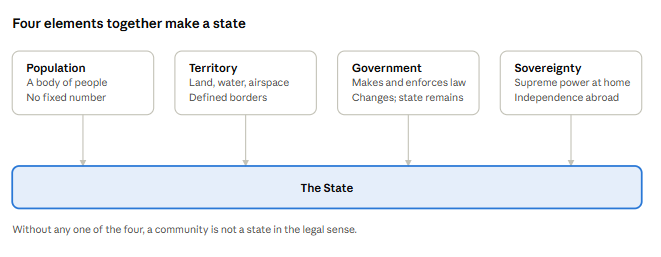
Reading the diagram. The first two elements are the “body” of the state, the third is its working organisation and the fourth is its distinguishing mark. Sovereignty is what separates the state from every other association, such as a company, a church or a university, which may also have members, premises and rules.
Characteristics of the state.
- A territorial organisation. The state exercises authority over a defined territory, and all who live in it, citizens and foreigners alike, are subject to its laws. A change of territory, as in the creation of Bangladesh in 1971 or the division of India in 1947, produces new states. Territory is also what makes jurisdiction clear: an Indian court can try an offence committed in India, whatever the nationality of the offender.
- Permanent in nature. Governments come and go, rulers die and constitutions change, but the state continues. When a ministry falls or an election changes the party in power, the contracts, debts and treaties of the state remain. The continuity of the Indian state across the change from colonial rule to independence in law, and across many governments since, is an example. This is why the state is called a permanent association.
- Sovereign power. The state is the highest authority within its territory and is free from the control of any other state. Its laws override those of all other bodies in the territory, and no outside authority can command it. Sovereignty is treated in the next note of this series, and it is the characteristic that most clearly separates the state from other associations.
- Compulsory membership. One becomes a member of the state by birth or naturalisation, and cannot freely leave it behind in the way one can leave a club or a company. Even those who renounce citizenship must go to another state. The state therefore binds its members in a way that voluntary associations cannot.
- Monopoly of legitimate force. The state alone can lawfully use coercion, through the police, army and courts, to enforce its laws, as Weber observed. If private persons were allowed to use force freely, there would be disorder. The word “legitimate” matters, because force without public acceptance becomes mere tyranny.
- A legal personality. In law, the state is a person that can own property, make contracts, sue and be sued, and sign treaties. The Government of India, for example, can be a party in court. This legal personality continues whoever happens to be in office, and it explains why the state, and not each minister, is responsible for its debts and agreements.
- Comprehensive authority. The state has authority over all persons and associations within its territory, and over all aspects of life that need public regulation, from crime and commerce to education and health. Other associations, such as families, religious bodies and firms, have authority only over their own members and purposes. The state’s laws apply to all of them.
- A power to tax and spend. The state alone has the right to impose compulsory taxes, as Article 265 of the Indian Constitution recognises, and to use public funds for public purposes. Without this power, it could not maintain armies, courts and welfare. The history of many revolutions, including the American Revolution, began with questions about taxation.
- Recognition by other states. In modern international law, statehood is confirmed by recognition and membership in the international community, for example in the United Nations. Kosovo and Palestine show that recognition can be partial and disputed. Recognition allows the state to enter treaties and take part in global affairs.
- Both an instrument and an institution. The state is the organised means by which a society pursues its common aims, such as security, justice and welfare, and also an institution with its own officials, interests and habits. Marxists stress its use by a ruling class, liberals its role as protector of rights, and state-centred writers such as Theda Skocpol its own interests. Seeing both sides avoids a one-sided view.
- Dynamic in form. The state changes over time: the city-state gave way to the empire, the feudal kingdom and then the nation-state, and in the twentieth century the welfare state arose. Its functions have grown and shrunk in turn, and today globalisation is changing them again. The next sections trace this development.
3. Origin of the state: theories
No one knows exactly when or how the first states arose, because they began long before written records. Writers have therefore offered theories, some based on myth and belief, some on reasoning, and some on history. The table gives a quick comparison, and the paragraphs that follow explain each theory with its supporters and criticisms.
| Theory | Basic idea | Key writers | Main criticism |
|---|---|---|---|
| Divine origin | The state is created by God, and the ruler holds office by divine right | Filmer, James I; Indian epics | Unscientific; supports tyranny |
| Patriarchal and matriarchal | The state grew out of the family under the father or mother | Maine, Filmer, McLennan | Not true of all societies |
| Force | The state arose through conquest and domination | Gumplowicz, Oppenheimer, Burgess | Force alone cannot explain consent |
| Social contract | The state arose by agreement among individuals | Hobbes, Locke, Rousseau | Unhistorical; imagined agreement |
| Evolutionary (historical) | The state grew slowly through many factors | Seeley, Burgess, Garner | Does not give a precise account |
| Marxist | The state arose with private property and class division | Marx, Engels | Economic reductionism |
| Feminist | Social contract left out women; state arose with patriarchy | Pateman, Okin | Varied schools and views |
Divine origin theory. This is the oldest theory. It holds that the state was created by God, that the ruler is God’s agent or himself divine, and that obedience to the ruler is a religious duty. Sir Robert Filmer’s Patriarcha (written before 1650 and published in 1680) argued that kings derive their power from Adam, the first father, and James I of England asserted the divine right of kings. In ancient Egypt the pharaoh was a god, and in ancient India some texts, such as the Manusmriti, describe the king as formed from the essences of the gods, although the epics also describe a human contract. The theory supported monarchy for centuries. It was challenged by the Reformation, by Locke’s reply to Filmer in the First Treatise (1689) and by the growth of reason and science. It is criticised because it cannot be proved, because it protects tyranny and because it does not explain republics.
Patriarchal and matriarchal theories. Sir Henry Maine, in Ancient Law (1861), argued from the study of early Roman, Hindu and other law that the earliest societies were patriarchal: the family under the eldest male grew into the clan, the tribe and then the state. John McLennan (Primitive Marriage, 1865) put forward the opposite, that early societies were matriarchal, since descent was traced through the mother. Modern anthropology has found both patterns and others. The theory is useful in pointing to the role of kinship in early political life, but it is criticised because the family is not the only source of political authority and because societies took many forms.
Force theory. According to this view, the state arose out of conquest, when stronger groups subdued the weaker and settled as a ruling class. Ludwig Gumplowicz and Franz Oppenheimer argued that the state is the organisation of the conquering group over the conquered, and John W. Burgess saw force as one factor. Modern writers have developed this idea in a more careful form. Robert Carneiro (1970) argued that states arose where land was limited by mountains or deserts, so that defeated groups could not flee and had to submit, and Charles Tilly (Coercion, Capital, and European States, 1990) argued that in Europe “war made the state, and the state made war”, as rulers raised taxes and armies for war and in the process built permanent institutions. The theory explains the role of conquest and war, but it cannot explain why people obey after the conquest unless they also accept the rulers’ right, and it neglects consent, religion and economic need.
Social contract theory. The theory holds that individuals, living in a state of nature without government, agreed together to form a state. The three classical versions differ. Thomas Hobbes, in Leviathan (1651), pictured the state of nature as a war of all against all in which life is “solitary, poor, nasty, brutish and short”, and so people gave up all their rights, except self-preservation, to an absolute sovereign. John Locke, in the Two Treatises of Government (1689), described the state of nature as one of reason and natural rights to life, liberty and property, and argued that people made the contract to protect these rights, so that government must be limited and may be resisted if it breaks the trust. Jean-Jacques Rousseau, in The Social Contract (1762), argued that people give up their natural freedom to the community as a whole and obtain civil freedom by obeying the general will. In ancient India, a similar idea appears in the Mahabharata and in Buddhist texts such as the Aggannasutta, which describe how people suffering from disorder, the “law of the fish” (matsyanyaya, where the strong eat the weak), chose a ruler. The theory supported ideas of consent and limited government, and influenced the American and French revolutions. It is criticised as unhistorical, since no such agreement is recorded, as an unreal picture of the individual before society, and, by Burke, Hume and Bentham, because obedience rests on habit and utility and not on a contract.
Evolutionary or historical theory. This is the theory accepted by most modern writers. It holds that the state is neither made by God nor produced by a single act but is the product of slow growth over centuries, through many forces working together. Burgess and Garner named kinship, religion, force, economic needs and political consciousness. Kinship gave early bonds and common authority, religion gave sanction and a sense of unity, force gave defence and conquest, economic activity (farming, trade, property) required rules, and political consciousness gave the idea of a common purpose and of law. Seeley’s remark that the state arose from many roots fits this view. Its strength is that it treats the origin as a process, but it is criticised for being general and for not saying which factor mattered most in which case.
Marxist theory. Engels, in The Origin of the Family, Private Property and the State (1884), argued that in early communal societies there was no state, since there were no classes. The state arose when private property and class division appeared, because the owning class needed an organisation to hold down the others. On this view, the state is an instrument of class rule and will “wither away” when classes disappear after a socialist revolution. The theory draws attention to the link between property and power, but is criticised for reducing the state to economics and for ignoring cases where the state has its own interests and is not just the servant of a class.
Feminist critiques. Carole Pateman, in The Sexual Contract (1988), argued that the social contract of the classical writers rested on a hidden “sexual contract” by which men secured power over women, so that the public world of the state was built on the exclusion of women from civil equality. Susan Moller Okin (Justice, Gender and the Family, 1989) added that theories of justice have ignored the family. These writers do not give a separate historical account but show that the origin story has left out half the people.
A balanced conclusion. For examinations, the evolutionary theory is usually presented as the most acceptable, with the other theories seen as emphasising one factor each: religion (divine), kinship (patriarchal), force (conquest), consent (contract), and property (Marxist). A good answer shows that each contains a part of the truth, and that modern research on early states, by Carneiro, Tilly and others, combines war, trade, agriculture and belief.
4. Development of the state
Early states and the Greek city-state. The earliest states appeared in river valleys, in Mesopotamia, Egypt, the Indus region and China, where farming surplus allowed rulers, priests and soldiers to be supported. In Greece, the city-state (polis) was a small community in which citizens took part directly in public life, as in Athens, though women, slaves and foreigners were excluded. Plato and Aristotle thought of the state in this form, and Aristotle held that a city-state should be small enough for citizens to know each other.
Empires and the Roman state. Large empires followed, such as the Persian, Mauryan and Roman. The Romans contributed the idea of law applying to all citizens and of citizenship extending across a wide territory, and their republic influenced later ideas of mixed government. In India, the Mauryan state under Chandragupta, advised by Kautilya, was a large centralised empire with a detailed administration, described in the Arthashastra, and the Gupta, Delhi Sultanate and Mughal states later developed their own systems of revenue and rule.
The medieval and feudal state. After the fall of Rome, Europe was divided into feudal estates in which authority was spread among kings, lords and the Church, and loyalty was personal and not to an abstract state. Law was local, and the Pope and the Emperor competed for the highest authority. The idea of a single, supreme, territorial state was therefore weak.
The Westphalian state and absolutism. The Peace of Westphalia (1648), which ended the Thirty Years’ War, is taken as the beginning of the modern system of sovereign states in Europe, in which each state is supreme within its borders and equal in law to others. Strong monarchies, such as that of Louis XIV of France, centralised power, built standing armies and bureaucracies and collected regular taxes. Machiavelli, Bodin and Hobbes supplied the ideas of the sovereign state during this period.
The nation-state. The French Revolution of 1789 spread the idea that sovereignty belongs to the nation and not to the king, and that the state should express the will of a people with a shared identity. Nationalism in the nineteenth century then led to the unification of Italy (1861) and Germany (1871), and to the break-up of multi-national empires after the First World War. The nation-state became the standard model of the state. The idea was powerful, but it also led to exclusion and conflict where states had many peoples.
The liberal and constitutional state. The revolutions in England (1688), America (1776) and France (1789) produced the liberal state, which is limited by a constitution, protects individual rights, separates powers and rests on consent. Over the nineteenth and twentieth centuries the right to vote widened, from property-owners to all adult citizens, and the liberal state became the democratic state. Locke, Montesquieu and Mill were its main thinkers. Its aim was to protect liberty by keeping the state limited, and it is often called the “night-watchman” state in its early form, concerned mainly with defence, law and order.
The welfare state. As industrial societies produced poverty and insecurity, the state took on wider tasks. Bismarck introduced social insurance in Germany in the 1880s, the Beveridge Report (1942) led to a comprehensive scheme in post-war Britain, and many countries accepted that the state should provide education, health care, pensions and employment support. T. H. Marshall (1950) saw social rights as the next stage of citizenship. The Indian Constitution’s Directive Principles and later laws such as MGNREGA (2005) reflect this approach. In the 1980s, a reaction (the neoliberal turn) sought to reduce the state’s role, but welfare remains a main function in most countries.
Socialist, fascist and authoritarian states. The twentieth century also saw other forms. The socialist state, first in the Soviet Union after 1917, put the means of production under state or collective ownership and claimed to rule for the working class. Fascist and Nazi states of the 1920s to 1940s made the state supreme over the individual, as in Mussolini’s slogan that everything lies within the state. Hannah Arendt (The Origins of Totalitarianism, 1951) analysed such states as using terror and ideology to control all of life. Both types collapsed or changed, but authoritarian states of other kinds continue.
The post-colonial state. After the Second World War, most of Asia and Africa gained independence. The United Nations had 51 members at its founding in 1945, and now has 193. The new states inherited colonial borders, administrations and economies, and often faced the task of building national unity, democracy and development at once. Hamza Alavi (1972) described the post-colonial state as “overdeveloped” because it inherited a strong military-bureaucratic apparatus relative to the weak society and economy below it, and Gunnar Myrdal (Asian Drama, 1968) used the term “soft state” for states that find it hard to enforce their own laws. Some such states became strong and democratic, as India, while others suffered coups, civil war and weak institutions, which the literature calls “failed” or “fragile” states.
The Indian state. The modern Indian state has roots in the colonial state of the East India Company (from the victory at Plassey in 1757 and the grant of the diwani in 1765) and of the Crown after 1858, which left a centralised administration, an army, law codes and railways. After 1947, India chose a democratic, federal and secular constitutional state with universal adult franchise, and pursued planned development through a mixed economy, then market reform from 1991, and expanded welfare from the 2000s. Sunil Khilnani (The Idea of India, 1997) described the democratic state as the central achievement of independent India, while Atul Kohli and Pranab Bardhan have studied its capacity and limits.
The state in the twenty-first century. Globalisation, digital technology, climate change and international institutions are again changing the state. Some writers say the state is losing power to markets and international bodies, while others say that it remains the key actor and has taken on new roles as regulator, facilitator and surveillance power. The note on State and Globalization takes up this debate.
| Phase | Main features | Examples and thinkers |
|---|---|---|
| Early states and city-states | Small units; kinship and religion; direct participation in Greece | Athens, Sparta; Plato, Aristotle |
| Empires | Large territory; law and bureaucracy | Mauryan, Roman, Mughal; Kautilya |
| Feudal state | Divided authority; personal loyalty | Medieval Europe |
| Westphalian and absolute state | Sovereignty; standing armies; centralised taxes | France under Louis XIV; Bodin, Hobbes |
| Nation-state | Sovereignty of the nation; shared identity | France 1789; Italy 1861; Germany 1871 |
| Liberal and welfare state | Rights, constitutions, democracy; social security | Britain, Scandinavia; Locke, Mill, Marshall |
| Post-colonial state | Independence after 1945; nation-building | India 1947; Alavi, Myrdal |
| Contemporary state | Regulator in a global economy | Debates on globalisation |
5. Nature and purpose of the state: main theories
Liberal view. Liberals see the state as a human creation to protect individual rights, and argue that it must be limited by a constitution and by consent. Locke, Mill and Nozick are leading names, with Nozick (Anarchy, State, and Utopia, 1974) defending a “minimal state” limited to protection against force, theft and fraud. Later liberals such as T. H. Green and Rawls accepted a larger role, in providing the conditions for real freedom and fair distribution.
Idealist view. Hegel regarded the state as the highest form of ethical life, in which individual freedom is realised through membership of a rational community. In Britain, Bernard Bosanquet argued that the state expresses the real will of its citizens. Critics, including Hobhouse and Popper, said that this view could excuse authoritarian rule by making the state an object of worship.
Marxist view. Marxists regard the state as an instrument of class rule, while later Marxists have allowed it “relative autonomy”. Gramsci stressed its role in winning consent through hegemony, and Miliband and Poulantzas debated how closely the state is tied to the capitalist class. The view explains why states often protect property and the powerful, but it may neglect their other roles.
Pluralist view. Pluralists such as Harold Laski, G. D. H. Cole and R. M. MacIver held that the state is one association among many, with no special claim to total loyalty, and that power is shared among groups. In the later American form, Robert Dahl treated the state as an arena where many groups compete. Critics point out that groups are not equal in resources, and that the state still holds the highest authority.
Elitist view. Mosca, Pareto and Michels held that in every state a small ruling minority governs, and C. Wright Mills described a “power elite” in the United States. The view warns against idealised pictures of rule by the people, though it can underrate the role of elections and public pressure.
Feminist view. Feminists argue that the state has often been patriarchal, with laws and institutions that kept women unequal in property, vote and family. Catharine MacKinnon (Toward a Feminist Theory of the State, 1989) argued that the state treats male interests as neutral. Others point out that the state can also be used for reform, as in laws on equal pay, dowry and violence against women.
Gandhian and anarchist critiques. Gandhi viewed the state as an organisation of force and wanted village-based self-rule (Gram Swaraj) with a minimum of centralised power, in the vision of “enlightened anarchy”. Anarchists such as Kropotkin and Proudhon argued for a stateless society of voluntary association. These critics raise the question of whether the state is necessary, and keep alive the ideal of power from below.
Welfare and developmental views. Keynesians and social democrats see the state as the agent of social security and economic management, and developmental writers (Johnson, Amsden, Wade) see it as a leader in industrial growth. In India, the Constitution’s Directive Principles and the planning period illustrate such roles.
6. Importance and limitations of the state
Importance of the state.
- Maintaining law and order. The state keeps peace within its territory and protects life and property, through police and courts. Without it, as Hobbes feared, society could fall into conflict. Even people who distrust governments depend daily on the state for security, and for the enforcement of contracts.
- Defence against external threats. The state organises the army, makes alliances and guards borders. India’s defence forces and its foreign policy illustrate this task. The state is the main body that can defend a community against outside attack.
- Protecting rights and delivering justice. Through its constitution and courts, the state protects liberty and settles disputes. In India, the Supreme Court and High Courts enforce Fundamental Rights under Articles 32 and 226. A strong legal order lets people live without fear of arbitrary force.
- Providing public goods. Roads, bridges, sanitation, public health and basic education benefit everyone but are hard for markets to supply on their own. The state raises taxes and provides them. These are the conditions on which private activity depends.
- Promoting economic development. The state makes the rules of the market, plans, invests in infrastructure and manages crises. Governments in India, from the Five Year Plans to the GST, have shaped the economy. Developmental states such as South Korea show how strongly it can promote growth.
- Social welfare and reducing inequality. Through taxation, subsidies and social laws, the state can reduce poverty and protect the weak. MGNREGA, the Food Security Act and reservation are examples. This function gives practical meaning to equality.
- Representing the nation abroad. The state speaks for its people in treaties, trade and international institutions. Only states can sign treaties and take seats in the United Nations. This gives people a voice and legal protection in global affairs.
- Providing identity and unity. Through a common citizenship, national symbols, a legal system and public education, the state helps to build a sense of belonging, especially in diverse societies. India’s Constitution seeks unity among many languages, religions and regions.
- Regulating social and economic life. The state regulates markets, the environment, labour and safety, and corrects market failures. It limits monopolies and pollution. These controls are needed in complex modern societies.
- Enabling democracy and participation. The state organises elections, protects free speech and allows citizens to take part in decisions. Institutions such as the Election Commission of India show how the state can safeguard democratic choice.
Limitations and criticisms.
- Danger of abuse of power. Because the state holds force, rulers may misuse it. History offers examples from absolute monarchies to totalitarian regimes. Lord Acton’s saying that power tends to corrupt and absolute power corrupts absolutely is the common warning, and it is why constitutions limit power.
- Class or group bias. Marxists argue that the state serves the dominant class, and feminists and others argue that it serves men or particular communities. Even if the claim is overstated, laws and policies often favour the organised and wealthy over the poor and scattered.
- Bureaucratic inefficiency and corruption. State organisations can be slow, rigid and corrupt, and public choice writers (Buchanan and Tullock) argue that officials pursue their own interests. India’s licence-permit system before 1991 is often cited.
- Limits on liberty. Taxes, regulation and compulsory service restrict individual freedom. Libertarians such as Nozick argue that redistribution violates rights, and defenders of freedom of speech worry about surveillance and censorship.
- Inability to solve all problems. The state cannot remove all poverty or change social attitudes by law. Caste discrimination persists in India despite Article 17. Society and markets also matter.
- Weak and failed states. In some countries the state cannot control its territory or provide order, as in Somalia or Afghanistan, which shows that statehood without capacity is empty.
- Nationalism and exclusion. The nation-state model may exclude minorities and lead to conflict, as with the Rohingya or in partition-era violence. Plural societies need a different balance.
- Threats to peace. Competition among sovereign states has led to wars and arms races, since there is no world government above them. The sovereign state system can make cooperation on global problems difficult.
- Limits from globalisation. Capital, technology and global problems cross borders, so a single state cannot manage climate change, pandemics or financial crises alone. This is taken up in the note on State and Globalization.
- Debates on its necessity. Anarchists and Gandhians question whether the state is needed at all, and argue for self-governing communities. Few go as far, but the question reminds us that state power must always be justified.
7. How to use this note in examinations
What each examination expects.
| Examination | What is usually expected | How to prepare |
|---|---|---|
| UG (NEP) | Meaning, definitions, elements and characteristics; theories of origin | Learn Garner’s definition, the four-element diagram and the table of origin theories |
| PG (MA) | Critical comparison of the origin theories and the nature of the state, with scholars and works | Master the table of theories and the section on nature and purpose of the state |
| OPSC | Structured answers on elements, origin and development, with Indian examples | Write 150 to 250 word answers with introduction, points and conclusion |
| UPSC (PSIR) | Analytical answers on evolution of the state, post-colonial and Indian state | Use Alavi, Myrdal, Khilnani and Kohli to add depth |
| UGC NET | Scholar–work matching, definitions and one-line facts | Revise the authors table and the Westphalia (1648), French Revolution (1789) and 1947 dates |
Practice questions.
- Define the state and explain its essential elements. (UG, long answer)
- Distinguish between state, nation, society and government. (UG, OPSC)
- Discuss the social contract theory of the origin of the state. (UG, PG)
- Why is the evolutionary theory considered the most acceptable theory of the origin of the state? (UG, OPSC)
- Explain the Marxist theory of the state. (PG, UGC NET)
- Trace the development of the state from the city-state to the welfare state. (PG, UPSC)
- What is a post-colonial state? Discuss the nature of the Indian state. (PG, UPSC)
Answer outline: the evolutionary theory of the origin of the state.
- Introduction. Say that the origin of the state lies in prehistory and that theories offer partial explanations; name the main ones in a line.
- Body, point 1: meaning of the theory. The state is a slow growth, not a creation, produced by many factors working together.
- Body, point 2: the factors. Kinship, religion, force, economic needs and political consciousness, each with one example.
- Body, point 3: why it is accepted. It combines the truths of the other theories and is supported by history and anthropology (Burgess, Garner, Carneiro, Tilly).
- Body, point 4: criticism. It is general and does not say which factor is most important in a given case.
- Conclusion. The state is a product of history, and the evolutionary theory is the most acceptable explanation, though it does not replace the study of each case.
Sample answer (about 200 words). Question: Why is the evolutionary theory considered the most acceptable theory of the origin of the state?
Introduction. Many theories explain the origin of the state: divine, force, social contract, patriarchal and Marxist. Each captures one aspect, but the evolutionary theory is generally treated as the most acceptable.
Meaning. According to this theory, the state is neither created by God nor formed by a single agreement. It is the product of slow historical growth over centuries.
Factors. Burgess and Garner named kinship, religion, force, economic needs and political consciousness. Kinship gave early bonds, religion gave sanction, force gave defence and conquest, economic needs required rules for property, and political consciousness gave the idea of common purpose and law.
Why accepted. It does not rely on a single cause and takes in the truth of the other theories. It is also supported by historical and anthropological evidence, such as Carneiro’s and Tilly’s work on war and state-making.
Criticism and conclusion. It is criticised as too general. Still, because the state is the product of many forces working over time, the evolutionary theory remains the most convincing account.
Common mistakes to avoid.
- Giving only one definition. Examiners expect Garner’s four elements along with Weber’s and at least one more.
- Confusing state, nation, society and government.
- Treating the social contract as history and not as a reasoned device, or mixing up Hobbes, Locke and Rousseau.
- Writing the divine right theory without noting that Indian epics also describe a human contract.
- Giving names without works and dates, such as Hobbes (1651), Locke (1689), Rousseau (1762) or Engels (1884).
- Ignoring Indian and post-colonial examples in OPSC and UPSC answers.
Critical analysis for OPSC and UPSC. Mains answers earn marks for balanced evaluation and not for description. Use the points below to argue, and cite scholars to support each.
- No single theory explains the state. Each origin theory stresses one factor, and modern research on early states uses several: agriculture, war, trade, religion and population pressure. A balanced answer treats the old theories as partial truths and the evolutionary account as a framework.
- Contract as justification, not history. The social contract is better seen as a way of asking when a state is legitimate than as a story of origin. Its value lies in the principles of consent and limited government that it gave to constitutional politics, including the Indian Constitution’s opening words, “We, the People of India”.
- Is the state neutral or biased? Liberals treat it as a neutral protector, Marxists as a class instrument, feminists as patriarchal, and state-centred writers as an actor with its own interests. India supports a mixed picture: the state has enacted reservation and welfare, but also reflects the power of dominant groups.
- The nation-state: universal or European? The Westphalian and nation-state models arose in Europe and were exported through colonialism, with borders that often cut across communities. Post-colonial writers such as Alavi, Chatterjee and Chakrabarty ask how far the model suits societies with different histories.
- Strong state or good state? Capacity (to tax, enforce, deliver) and accountability are different qualities. East Asian developmental states combined capacity with limited accountability, while India combines democracy with uneven capacity. Evaluate both.
- Is the state declining? Globalisation, regional integration and non-state actors reduce state autonomy, yet states remain the main providers of security, welfare and law. The state has changed role more than it has disappeared.
- Gandhian and anarchist challenge. The idea of a minimal or stateless society raises ethical questions about force and centralisation. Few accept it fully, but it supports decentralisation, as in panchayati raj.
A model concluding line: “The state is at once a necessity and a danger: it protects us from disorder only by holding a power that must itself be restrained by law, consent and the vigilance of its citizens.”
Authors and books: summary table for UGC NET.
| Author | Work (year) | Idea or relevance |
|---|---|---|
| Plato | Republic | Ideal state; justice |
| Aristotle | Politics | Man is a political animal; state for the good life; classification of constitutions |
| Kautilya | Arthashastra | Saptanga theory of the state |
| Machiavelli | The Prince (1513) | Early modern use of “state”; politics as power |
| Bodin | Six Books of the Commonwealth (1576) | Sovereignty |
| Filmer | Patriarcha (1680) | Divine right; patriarchal theory |
| Hobbes | Leviathan (1651) | Social contract; absolute sovereign |
| Locke | Two Treatises of Government (1689) | Natural rights; limited government |
| Rousseau | The Social Contract (1762) | General will |
| Hegel | Philosophy of Right (1821) | State as ethical life |
| Maine | Ancient Law (1861) | Patriarchal theory |
| McLennan | Primitive Marriage (1865) | Matriarchal theory |
| Marx and Engels | The Communist Manifesto (1848) | State as committee of the bourgeoisie |
| Engels | The Origin of the Family, Private Property and the State (1884) | Marxist theory of origin |
| Wilson | The State (1889) | State as people organised for law |
| Burgess | Political Science and Comparative Constitutional Law (1890) | Evolutionary theory; factors |
| Lenin | The State and Revolution (1917) | State as organ of class rule |
| Weber | “Politics as a Vocation” (1919) | Monopoly of legitimate force |
| MacIver | The Modern State (1926) | State as an association |
| Garner | Political Science and Government (1928) | Four elements of the state |
| Laski | A Grammar of Politics (1925) | Pluralism |
| Marshall | Citizenship and Social Class (1950) | Social rights |
| Arendt | The Origins of Totalitarianism (1951) | Totalitarian state |
| Myrdal | Asian Drama (1968) | Soft state |
| Alavi | “The State in Post-Colonial Societies” (1972) | Overdeveloped post-colonial state |
| Nozick | Anarchy, State, and Utopia (1974) | Minimal state |
| Skocpol | States and Social Revolutions (1979) | State autonomy |
| Pateman | The Sexual Contract (1988) | Feminist critique of contract |
| Tilly | Coercion, Capital, and European States (1990) | War and state-making |
| Khilnani | The Idea of India (1997) | Democratic state in India |
8. Key takeaways
- The state is a political and legal organisation with four essential elements: population, territory, government and sovereignty (Garner, 1928). Weber defines it by the monopoly of legitimate force.
- It differs from the nation, society and government: governments change, but the state continues.
- Theories of origin (divine, patriarchal, force, social contract, evolutionary, Marxist, feminist) each stress one factor, and the evolutionary theory is the most acceptable.
- The state developed from the city-state and empire through the feudal, Westphalian and nation-state to the liberal, welfare and post-colonial state.
- Theories of nature (liberal, idealist, Marxist, pluralist, elitist, feminist, Gandhian) differ on whether the state is neutral, class-based or necessary.
- The Indian state has colonial roots but is democratic, federal and secular, and combines developmental and welfare roles; Alavi, Myrdal, Khilnani and Kohli are the key names for exams.
9. Sources and further reading
Official course resources (to be checked against the current syllabus before use):
- Odisha State Higher Education Council, Model Curriculum for Three Year Degree Course in Political Science (NEP-2020).
- UGC NET Bureau, Syllabus: Political Science (Code No. 02).
- Union Public Service Commission and Odisha Public Service Commission syllabi for the optional subject Political Science and International Relations.
- eGyanKosh (IGNOU), study material on the state and political theory.
- NCERT, Political Theory, Class XI textbook.
- Constitution of India (Preamble; Part III; Part IV).
- Montevideo Convention on the Rights and Duties of States (1933), for the legal qualifications of statehood.
Books and articles.
- Heywood, A. Politics. London: Palgrave Macmillan (various editions).
- Garner, J. W. (1928). Political Science and Government. New York: American Book Company.
- MacIver, R. M. (1926). The Modern State. Oxford: Oxford University Press.
- Weber, M. (1919). “Politics as a Vocation”, in Gerth, H. H. and Mills, C. W. (eds.), From Max Weber. New York: Oxford University Press (1946).
- Hobbes, T. (1651). Leviathan. London: Crooke.
- Locke, J. (1689). Two Treatises of Government. London.
- Rousseau, J.-J. (1762). The Social Contract. Amsterdam: Rey.
- Engels, F. (1884). The Origin of the Family, Private Property and the State. Zurich.
- Maine, H. S. (1861). Ancient Law. London: John Murray.
- Burgess, J. W. (1890). Political Science and Comparative Constitutional Law. Boston: Ginn.
- Laski, H. J. (1925). A Grammar of Politics. London: Allen and Unwin.
- Nozick, R. (1974). Anarchy, State, and Utopia. New York: Basic Books.
- Skocpol, T. (1979). States and Social Revolutions. Cambridge: Cambridge University Press.
- Tilly, C. (1990). Coercion, Capital, and European States, AD 990–1990. Oxford: Blackwell.
- Pateman, C. (1988). The Sexual Contract. Cambridge: Polity Press.
- Myrdal, G. (1968). Asian Drama. New York: Pantheon.
- Alavi, H. (1972). “The State in Post-Colonial Societies: Pakistan and Bangladesh”, New Left Review, 74.
- Khilnani, S. (1997). The Idea of India. London: Hamish Hamilton.
- Johari, J. C. Principles of Modern Political Science. New Delhi: Sterling Publishers.
- Gauba, O. P. (2023). An Introduction to Political Theory. New Delhi: National Publication.
Editorial note. This note was written by Brajabandhu Mahanta from the sources listed above, and is revised when syllabi change. Titles and dates are given for study purposes; please check the original publication before citing it in your own work. To report a mistake, use the Contact page. PoliPrepHub is an independent educational resource; see the Disclaimer.
10. Frequently asked questions
What is the state? It is a political and legal organisation of a people occupying a definite territory, under a government and possessing sovereignty. Weber adds that it holds the monopoly of legitimate force.
What are the four elements of the state? Population, territory, government and sovereignty. Without any one of them, a community is not a state in the legal sense.
What is the difference between state and nation? The state is a legal and political organisation with sovereignty, while the nation is a people with a shared sense of identity. One state may contain many nations, and one nation may be spread across several states.
Which theory of the origin of the state is most accepted? The evolutionary or historical theory, which holds that the state grew slowly through the combined action of kinship, religion, force, economic needs and political consciousness.
What is the Marxist view of the state? Marx and Engels held that the state arises with private property and class division and works as an instrument of the ruling class, and that it will wither away in a classless society.
Which books should I start with? Begin with Heywood’s Politics or Gauba’s An Introduction to Political Theory, then read Garner and MacIver for classical definitions and Khilnani for the Indian state.