Political parties are the backbone of parliamentary democracy. They aggregate public opinion, contest elections, form governments, and provide political alternatives to the electorate. However, not every political party enjoys the same constitutional and electoral status.
In India, the Election Commission of India (ECI) classifies political parties into Recognised National Parties, Recognised State Parties, and Registered Unrecognised Parties based on their electoral performance. Recognition confers several privileges, including the reservation of election symbols, access to electoral rolls, free broadcast time on public broadcasters, and other campaign-related benefits.
The system of recognition ensures that political parties with sustained public support receive institutional advantages while maintaining a level playing field in electoral competition.
Table of Contents
Constitutional and Legal Basis
Although the Constitution does not expressly define political parties, their registration and recognition are governed by constitutional provisions and electoral laws.
| Provision | Significance |
|---|---|
| Article 324 | Superintendence, direction and control of elections vested in the Election Commission of India. |
| Representation of the People Act, 1951 (Section 29A) | Registration of political parties. |
| Election Symbols (Reservation and Allotment) Order, 1968 | Recognition of National and State Parties and reservation of election symbols. |
Classification of Political Parties
Political parties in India are broadly classified into three categories.
| Category | Meaning |
|---|---|
| National Party | Recognised by the ECI at the national level based on prescribed electoral performance. |
| State Party | Recognised only within one or more specific states based on electoral performance in those states. |
| Registered Unrecognised Party | Registered with the ECI but does not satisfy the criteria for recognition. |
Registration of Political Parties
Political parties seeking to contest elections must first register with the Election Commission of India under Section 29A of the Representation of the People Act, 1951.
Conditions for Registration
A political party must:
- Accept the Constitution of India.
- Uphold democracy, secularism, socialism, and the sovereignty, unity, and integrity of India.
- Follow constitutional methods in political activities.
- Submit its constitution, office bearers’ details, and other prescribed documents to the Election Commission.
Registration does not automatically confer recognition as a National or State Party.
Recognition of Political Parties
Recognition is granted solely by the Election Commission of India based on electoral performance.
Recognition is periodically reviewed after elections to the Lok Sabha and State Legislative Assemblies.
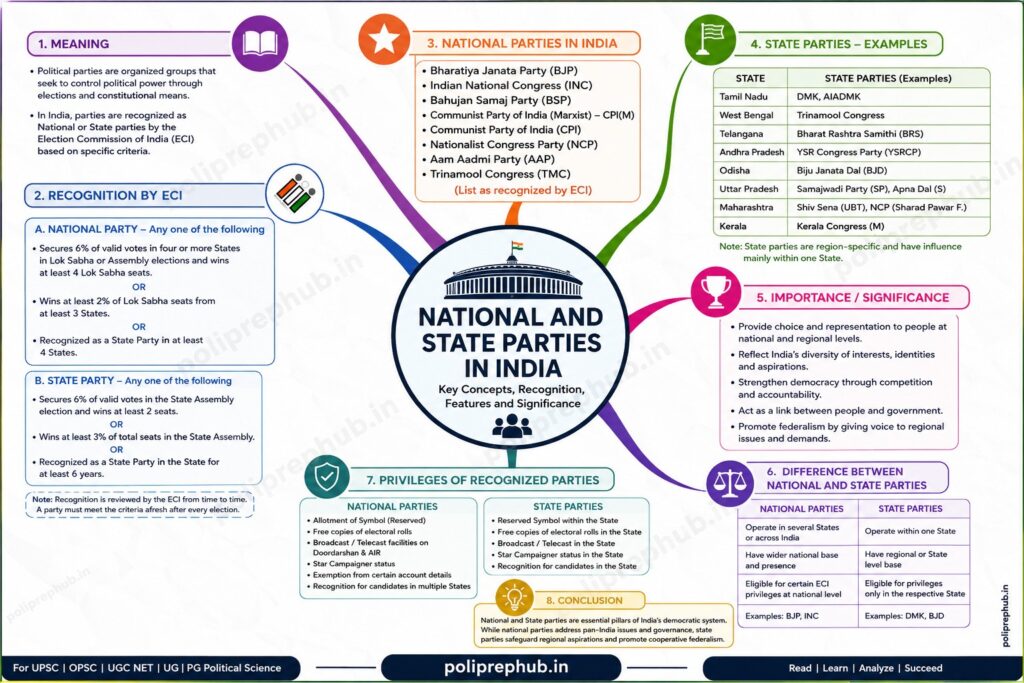
Criteria for Recognition as a National Party (Current ECI Rules)
A political party is recognised as a National Party if it satisfies any one of the following conditions:
Condition 1
- Secures at least 6% of valid votes in Lok Sabha or Legislative Assembly elections in four or more states, and
- Wins at least four seats in the Lok Sabha.
OR
Condition 2
- Wins at least 2% of the total seats in the Lok Sabha (currently at least 11 seats out of 543), and
- These elected members are returned from at least three different states.
OR
Condition 3
- Is recognised as a State Party in four or more states.
Criteria for Recognition as a State Party (Current ECI Rules)
A political party is recognised as a State Party if it fulfils any one of the following conditions in a particular state:
1. Vote Share + Assembly Seats
- At least 6% of valid votes in the Legislative Assembly election, and
- Wins at least 2 Assembly seats.
2. Vote Share + Lok Sabha Seat
- At least 6% of valid votes in Lok Sabha elections in that state, and
- Wins at least one Lok Sabha seat from that state.
3. Assembly Seat Criterion
- Wins 3% of total Assembly seats, or
- Wins 3 Assembly seats, whichever is higher.
4. Lok Sabha Seat Criterion
- Wins one Lok Sabha seat for every 25 seats, or any fraction thereof, allotted to the state.
5. Eight Percent Vote Criterion
- Secures 8% of the total valid votes in either:
- Assembly Election, or
- Lok Sabha Election
This criterion was introduced by the Election Commission in 2011.
Difference Between Registration and Recognition
| Basis | Registered Party | Recognised Party |
|---|---|---|
| Registration | Mandatory | Obtained after electoral performance |
| Election Symbol | Free symbols | Reserved symbol |
| Electoral Benefits | Limited | Extensive |
| Broadcast Time | No | Yes |
| Star Campaigners | Limited | Higher limit |
Privileges of Recognised Political Parties
Recognition provides several important benefits.
1. Reserved Election Symbol
Every recognised party receives an exclusive election symbol.
- National Parties use the symbol throughout India.
- State Parties use it only within the recognised state(s).
2. Free Broadcast Time
Recognised parties receive free airtime on:
- Doordarshan
- All India Radio
during general elections.
3. Access to Electoral Rolls
Recognised parties receive copies of electoral rolls free of cost.
4. Star Campaigners
Recognised parties may nominate up to 40 star campaigners, while registered unrecognised parties may nominate up to 20.
The travel expenditure of star campaigners is treated differently under election expenditure rules, subject to the ECI’s guidelines.
5. Reserved Election Symbol
Recognised parties enjoy exclusive use of their reserved election symbols, enhancing voter identification and party recognition.
6. Consultation by the Election Commission
Recognised parties are often consulted on important electoral reforms and procedural matters.
Election Symbols in India
Election symbols play an important role, especially in a country with varying literacy levels.
Types of Symbols
| Type | Description |
|---|---|
| Reserved Symbols | Exclusive to recognised National or State Parties. |
| Free Symbols | Available to registered unrecognised parties and independent candidates. |
Current National Parties (2025–26)
Following the Election Commission’s review after recent elections, six political parties are currently recognised as National Parties.
| National Party | Election Symbol |
|---|---|
| Bharatiya Janata Party (BJP) | Lotus |
| Indian National Congress (INC) | Hand |
| Bahujan Samaj Party (BSP) | Elephant* |
| Communist Party of India (Marxist) [CPI(M)] | Hammer, Sickle and Star |
| Aam Aadmi Party (AAP) | Broom |
| National People’s Party (NPP) | Book |
Note: The Nationalist Congress Party (NCP), Communist Party of India (CPI) and All India Trinamool Congress (AITC/TMC) lost their National Party status following the Election Commission’s review in 2023. However, these parties continue to be recognised as State Parties in the states where they satisfy the prescribed criteria.
*The BSP’s “Elephant” symbol has a special exception in Assam, where candidates may use an alternative symbol in accordance with the Election Symbols Order.
State Parties
State Parties are recognised only within specific states where they fulfil the prescribed criteria.
Examples include:
| State | Major State Parties |
|---|---|
| Odisha | Biju Janata Dal (BJD) |
| Tamil Nadu | DMK, AIADMK |
| Telangana | Bharat Rashtra Samithi (formerly TRS), AIMIM (state recognition in Telangana) |
| Andhra Pradesh | Telugu Desam Party (TDP), YSR Congress Party |
| Punjab | Shiromani Akali Dal (SAD) |
| Uttar Pradesh | Samajwadi Party (SP), Rashtriya Lok Dal (RLD) |
| Jammu & Kashmir | Jammu & Kashmir National Conference (JKNC), Jammu & Kashmir People’s Democratic Party (PDP) |
| Maharashtra | Maharashtra Navnirman Sena (MNS) |
The list of recognised State Parties changes periodically based on electoral performance and ECI review.
National Party vs State Party
| Basis | National Party | State Party |
|---|---|---|
| Recognition | Across India | One or more specific states |
| Election Symbol | Reserved nationwide | Reserved only in recognised state(s) |
| Electoral Influence | National | Regional/State-level |
| Recognition Criteria | National electoral performance | State electoral performance |
| Political Role | National governance | Regional representation |
Importance of Recognised Political Parties
Recognised political parties contribute significantly to India’s democratic process.
1. Strengthen Representative Democracy: They provide organised political competition and policy alternatives.
2. Ensure Stable Electoral Competition: Recognition encourages institutionalised party systems.
3. Facilitate Voter Identification: Reserved symbols help voters, particularly in areas with lower literacy.
4. Promote Political Accountability: Recognised parties operate under greater public scrutiny and electoral regulation.
5. Encourage Federal Democracy: State Parties provide institutional representation to regional aspirations and strengthen cooperative federalism.
Challenges
Despite the recognition framework, several challenges remain.
- Frequent changes in party status due to electoral volatility.
- Proliferation of registered but inactive parties.
- Money power and campaign finance concerns.
- Internal democracy deficits within parties.
- Personality-centred politics.
- Growing fragmentation of regional political space.
Recent Developments
Recent reviews by the Election Commission have highlighted the dynamic nature of India’s party system.
- 2023 ECI Review: The National Party status of the All India Trinamool Congress (AITC), Nationalist Congress Party (NCP), and Communist Party of India (CPI) was withdrawn because they no longer met the prescribed criteria.
- Aam Aadmi Party (AAP) was accorded National Party status after meeting the required conditions.
- Party recognition continues to be reviewed after major elections, ensuring that recognition reflects current electoral support.
Way Forward
- Strengthen internal democracy within political parties.
- Increase transparency in political funding.
- Improve public disclosure of party finances.
- Periodically review recognition criteria to reflect evolving electoral realities.
- Promote issue-based politics over personality- and identity-based mobilisation.
- Encourage greater participation of women and underrepresented groups in party structures.
Conclusion
The recognition of National and State Parties is a vital feature of India’s electoral democracy. By linking recognition to measurable electoral performance, the Election Commission ensures that institutional privileges are granted to parties with demonstrated public support. At the same time, the recognition framework preserves political pluralism by allowing regional parties to flourish alongside national parties.
As India’s party system continues to evolve, the balance between national integration and regional representation remains central to the health of Indian democracy. National Parties provide a pan-Indian political vision, while State Parties articulate local aspirations and strengthen India’s federal character.
UGC NET & UPSC Examination Highlights
| Topic | Provision |
|---|---|
| Election Commission | Article 324 |
| Registration of Political Parties | Section 29A, Representation of the People Act, 1951 |
| Recognition of Political Parties | Election Symbols (Reservation and Allotment) Order, 1968 |
| Election Symbols | Reserved and Free Symbols |