Liberalism is a foundational political and philosophical school of thought that envisions a society where the state serves as a means to achieve the goals and well-being of the individual. At its core, liberal thought prioritizes individual liberty and the belief in human rationality. Politically, it is strictly anchored in the principles of constitutionalism and consent-based governance.
A defining characteristic of liberal ideology is its historical adaptability. Over the centuries, it has evolved significantly while maintaining its fundamental commitment to individual freedom. This ideological evolution traces a path from classical liberalism, which advocates for a minimal government footprint, to modern liberalism (often associated with welfarism), which supports a more active state role in ensuring social and economic equity.
The Origins of Liberalism
- Historical Context: Liberal thought first emerged in 17th-century Europe as a direct challenge to the absolute authority of monarchies and the restrictive economic and cultural structures of the feudal system.
- Key Thinkers: Enlightenment philosophers such as John Locke, Montesquieu, and Voltaire were instrumental in shaping early liberal concepts, laying the intellectual groundwork for modern democratic theory.
- Ideological Maturation: While its roots lie in the 1600s, liberalism formally coalesced and gained prominence as a distinct, actionable political ideology during the 18th and 19th centuries.
Key Components of Liberalism
Liberalism is a set of principles that revolve around the individual . In a liberal society , the individual is the highest priority . There are legal and philosophical underpinnings that are the foundation of liberalism . The core components include:
1. Individualism:
- Individual liberty emerged as the central tenet of liberal philosophy as a reaction against monarchical and feudal societies.
- In those historical systems, individuals lacked opportunities for personal development.
- Merit was largely disregarded, and the distribution of property was based on birthright, overwhelmingly favoring aristocratic and noble classes.
- Liberal philosophers envisioned a new society where individuals are free to pursue their goals based strictly on their own capabilities and merit.
- According to these thinkers, individuals do not inherently owe anything to society or the state.
- This core idea is famously encapsulated by J. S. Mill, who stated, “Over himself, over his own body and mind, the individual is Sovereign.”
Critique: C. B. Macpherson criticized these extreme individualistic tendencies using the concept of “Possessive Individualism.” This term describes the belief that a person is the sole owner of their capabilities and talents, completely devoid of social responsibility.
2. Constitutionalism: The principle that the powers of government must be defined and limited by a supreme, fundamental law (the Constitution). Liberal constitutionalism establishes the “rule of law” rather than the rule of men, ensuring that government authority is predictable, non-arbitrary, and subject to established rules that protect individual freedoms.
3. Contract Philosophy (The Social Contract):
- John Locke introduced the social contract theory to explain the rationale and primary objectives behind the formation of the state.
- Locke posited that prior to the existence of a formal state (in a “state of nature”), individuals inherently possessed natural rights to life, liberty, and property.
- However, a purely natural society could not guarantee the adequate protection of these rights.
- Consequently, people rationally chose to establish a civil society and form a state specifically to safeguard their natural rights.
- Because of this origin, the state’s role must inherently be limited, and it must operate strictly according to the consent of its citizens.
- Liberal philosophers utilized this contract philosophy to firmly challenge the medieval Divine Theory of State.
- They conceptualized a political society built upon trust in the rational capabilities of individuals.
- Ultimately, this philosophy established a constitutional rule of law, which serves to prevent governmental abuse of power and ensures that the government remains limited in its scope.
4. Limited Government: Directly linked to constitutionalism, limited government is the principle that government power is restricted to its essential functions: protecting rights, enforcing contracts, and providing public goods. A liberal state is not an absolute authority but a minimalist entity that ensures a neutral, stable framework for private, economic, and social interaction, with minimal interference in the private lives of its citizens.
5. Separation of Power: The institutional arrangement designed to check the potential for tyranny and the concentration of power. Based on the philosophy of Montesquieu, this structure ensures that the three primary branches of government—legislative (lawmaking), executive (law enforcing), and judicial (law interpreting)—are co-equal, independent, and utilize “checks and balances” to ensure no single branch can become absolute or abusive.
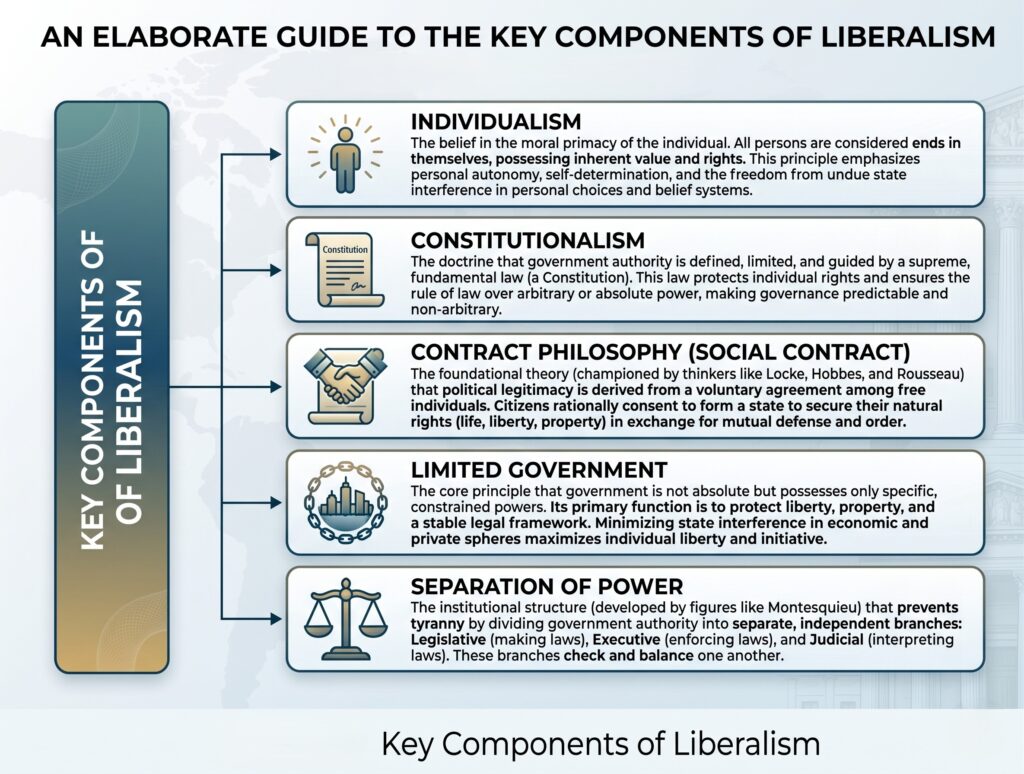
Types of Liberalism
Classical Liberalism
- Foundational Philosophy: Classical liberalism is fundamentally rooted in the Natural Right Theory. Early liberal thinkers posited that humans possess inherent rational capabilities, granting them natural and inalienable rights to life, liberty, and property.
- Historical Context: The ideology emerged during the seventeenth and eighteenth centuries and reached its absolute climax in the nineteenth century. It originated as a direct reaction against oppressive historical systems, specifically theocracy, monarchy, and feudalism.
- Role of the State: According to classical liberals, the state exists solely to protect the natural rights of its people; therefore, the scope of its power must be strictly limited. The state is often viewed merely as a “necessary evil,” reflecting a core belief in “negative liberty” (freedom from external interference).
- Economic Stance: Classical liberalism advocates for keeping the state out of the economic sphere. It heavily supports the concept of Laissez-faire (a free-market economy), a model prominently propagated by Adam Smith.
- Key Proponents: Major figures in classical liberal thought include John Locke, Montesquieu, Voltaire, Adam Smith, Thomas Paine, Thomas Jefferson, David Ricardo, and Alexis de Tocqueville.
Modern Liberalism
- Philosophical Shift: Emerging in the twentieth century, modern liberalism marks a transition from a strictly “negative” view of the state to a “positive” one. It is frequently referred to as “social liberalism” or “positive liberalism” because it advocates for the concept of “positive liberty”.
- Integration of Welfare: Modern liberal thinkers argue that while a restrictive state role is important for individual liberty, social welfare is equally crucial. This ideology effectively blends the classical view of individual freedom with contemporary aspects of social welfarism.
- Role of the State: It recommends a proactive role for the government in establishing the socio-economic conditions necessary for individuals to truly realize their liberty.
- Economic Stance: Moving away from the strict non-interference of Laissez-faire, modern liberalism supports economic management strategies, drawing heavy inspiration from the theories of Maynard Keynes.
- Key Proponents: Prominent advocates include T. H. Green, L. T. Hobhouse, J. A. Hobson, John Rawls, and Ronald Dworkin.
Libertarianism
- Historical Context: Libertarianism developed in the twentieth century as a direct critique of the growing trend of welfarism and expanding state power enacted in the name of citizen welfare.
- Core Philosophy: Thinkers in this tradition revived the classical liberal concepts of a minimal state and negative liberty. They assert that the state should largely leave people alone, believing that personal responsibility will naturally guide individuals toward success.
- Ideological Distinctions: While classical liberalism was a response to archaic systems like monarchy and feudalism, libertarianism specifically evolved to oppose modern liberalism, state intervention, and welfarism. Additionally, some extreme libertarian thinkers, such as David Friedman, pushed the boundaries of liberty to support an anarchist perspective known as anarcho-capitalism.
- Key Proponents: Leading figures in libertarian thought include Ludwig Von Mises, Murray Rothbard, Friedrich Hayek, David Friedman, Milton Friedman, and Robert Nozick.
Neo-Liberalism
- Modern Hegemony: Developed in the late twentieth century, neo-liberalism serves as an updated iteration of liberal philosophy and has become a hegemonic view of the global order in the twenty-first century. It is considered an extended branch of libertarian philosophy featuring minor progressive tendencies, rather than a totally distinct ideology.
- Economic Framework: It retains the core ingredients of classical liberalism and libertarianism by championing a minimal state and a free-market economy. However, it crucially trusts the state to actively lead and implement these free-market reforms within a country.
- View on Welfarism: Unlike strict libertarianism, neo-liberalism does not entirely reject state welfarism. It relies on the state to utilize progressive taxation to ensure basic living standards and preserve human dignity.
- Historical Examples: The neo-liberal theory of the state was prominently introduced by the government of Margaret Thatcher in the UK and the presidency of Ronald Reagan in the USA. Furthermore, India’s adoption of a new economic policy focused on liberalization, privatization, and globalization in 1991 stands as a primary living example of the neo-liberal perspective in action.
Based on the provided file image_3cf487.jpg, here is a revised, updated, and properly formatted version of the table. I have corrected minor historical and typographical errors from the original text (such as updating “Treaties” to “Treatises” for Locke’s and Voltaire’s works) and formatted the book titles for better readability.
Important Thinkers, Key Concepts, and Famous Books
| Thinker | Key Concepts / Specialty | Famous Books (Publication Year) |
| John Locke | • Government as a Fiduciary Trust • Social Contract Theory • Recognized as the “Father of Liberalism” | Two Treatises of Government (1689) |
| Montesquieu | • Separation of Powers | The Spirit of the Laws (1748) |
| Voltaire | • Freedom of Religion and Speech | Treatise on Tolerance (1763) |
| Adam Smith | • Laissez-faire (Free market economy) • The “Invisible Hand” | An Inquiry into the Nature and Causes of the Wealth of Nations (1776) |
| Thomas Paine | • The concept that the “State is a necessary evil” | Rights of Man (1791) |
| David Ricardo | • Theory of Wages • Theory of Capital Accumulation | On the Principles of Political Economy and Taxation (1817) |
| Benjamin Constant | • Widely known as the “Father of Modern Liberalism” | The Liberty of Ancients Compared with that of Moderns (1819) |
| J. S. Mill | • The Harm Principle | On Liberty (1859) |
| T. H. Green | • Idea of Social Liberalism | Prolegomena to Ethics (1883) |
| John Rawls | • Equality and Difference Principle • Overlapping Consensus | A Theory of Justice (1971) Political Liberalism (1993) |
| Ludwig von Mises | • Prominent figure in the Austrian School of Economics • Criticized the idea of a centrally planned economy | Liberalism: The Classical Tradition (1927) Human Action (1949) |
| Murray Rothbard | • Coined the term “Anarcho-capitalism” | Man, Economy, and State (1962) |
| Friedrich Hayek | • Advocate for Free Market Capitalism | The Road to Serfdom (1944) The Constitution of Liberty (1960) |
| Milton Friedman | • Prominent figure in the Chicago School of Economics | Capitalism and Freedom (1962) |