
No government works in empty space. Laws are made for people who belong to castes, classes, religions, regions and families, and those people in turn shape the laws through their votes, protests, demands and silences. To study politics without society is like studying a river without its banks: the course of the water makes sense only when we see the ground that guides it. This is why the study of the relationship between politics and society stands near the very beginning of the Political Science course.
This note explains how politics and society are connected, how social structures such as family, religion, caste, class and gender influence political life, and how politics reshapes society in return. It then takes up the main theoretical perspectives, the role of political socialisation, political culture, civil society and social movements, and the Indian experience. It appears in Unit I of the undergraduate NEP syllabus and is useful for the postgraduate course, OPSC, UPSC and UGC NET as well.
1. Understanding society and its link with politics
The idea of society. Society is a wide and organised network of social relationships among people who share a territory, a way of life and common institutions. R. M. MacIver and Charles Page, in their book Society (1949), described it as a web of social relationships, and stressed that it is the relationships and not the individuals that make a society. Anthony Giddens, in his textbook Sociology, describes society as a group of people who live in a particular territory, are subject to a common system of political authority, and are aware of having a distinct identity. Marx saw society as made up of an economic base (the ways in which goods are produced) and a superstructure of law, politics and ideas that rises on that base. These descriptions are different, but each of them places human relationships, and not mere numbers of people, at the centre.
Society, state and government. Three terms should be kept apart. Society is the wider community of social relationships. The state is the political organisation within society that holds supreme authority over a territory, and government is the group of persons and institutions that run the state at a given time. Society is older than the state, and in modern life it is also larger, because families, religions, markets and associations exist beyond the reach of the state. Yet the state shapes society through laws, taxes, education and welfare, so each side acts on the other.
Why the link is close. Politics is concerned with who gets what, when and how (Lasswell, 1936), and these questions arise because society is divided by different interests, identities and resources. If society were wholly united and had unlimited resources, there would be little to quarrel over. Because it is not, groups compete for power, jobs, land, schooling and recognition, and politics is the process through which such competition is settled. The state then uses authority to make decisions that society accepts as binding. A simple way to remember the relationship is that society supplies the demands, support and conflicts of politics, and politics supplies the rules, resources and recognition that society needs.
Why the topic matters in Political Science. Early writers such as Aristotle already saw the connection. In the Politics, he said that the form of government depends on the social make-up of a city, and he argued that a large middle class gives stability, because it stands between the rich and the poor. Modern political sociology, developed by writers such as Max Weber, Robert Michels, Seymour Martin Lipset and Barrington Moore, made the link a field of study of its own. Today most research on elections, parties, movements and public policy begins with the social groups that stand behind them.
2. The two-way relationship between politics and society
Influence runs in both directions. Society shapes politics, and politics shapes society. Social groups send demands, votes, support and protest to the political system, and the system returns laws, welfare, schooling and rights. Caste and religion influence how parties choose candidates, while a policy such as reservation changes the opportunities of castes and the way they take part in politics. This is why neither side can be understood fully when studied alone.
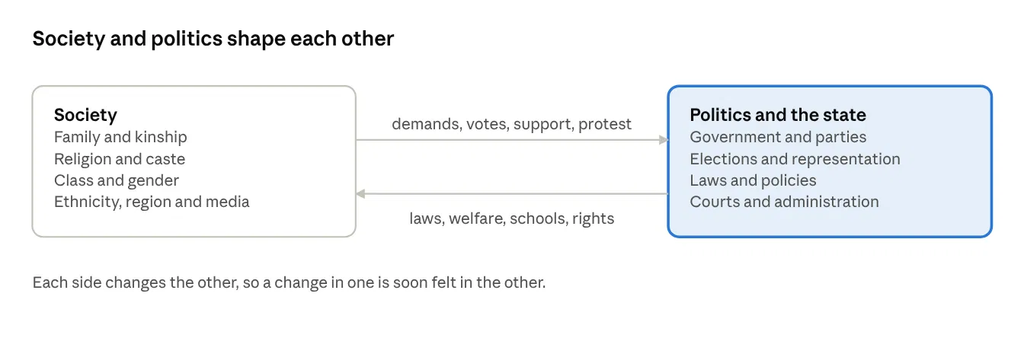
Reading the diagram. The top arrow stands for pressure from below: people vote, organise, petition and protest, and their social identities decide the form of that pressure. The lower arrow stands for pressure from above: the state taxes, regulates, educates and protects, and these actions slowly change social habits. A good answer in an examination shows both arrows and gives one Indian example for each.
Characteristics of the relationship between politics and society.
- Mutual and continuous influence. Politics and society are in constant interaction, and neither is fixed. When the Constitution banned untouchability under Article 17, it changed a social practice by law, and when social movements later demanded stronger action, the state had to respond with new laws. A student should therefore describe the relationship as a continuing exchange and not as a one-time cause and effect.
- Society comes first in time, but the state grows strong. Families, tribes and communities existed before the state, and the state arose to settle their conflicts. In the modern period, however, the state has become powerful enough to reshape them through education, taxation and welfare. Aristotle’s remark that the human being is a political animal captures the first part, while the modern welfare state illustrates the second.
- Social diversity creates political conflict and cooperation. Differences of class, caste, religion, language and region produce competing demands, but they also give rise to alliances and compromise. Indian coalition politics shows how diverse groups combine to form governments. Examiners often ask how diversity affects politics, and this point answers it directly.
- Social structure gives politics its form. The shape of society, for example the size of the middle class or the strength of caste hierarchy, decides the form that politics takes. Barrington Moore (1966) argued that the relative strength of landlords, peasants and the middle class decided whether countries became democracies, fascist regimes or communist states. This shows that political outcomes have social roots.
- Politics gives society its rules and resources. Laws on marriage, property, education and employment, and public spending on health and schools, shape social life directly. The Hindu Code Bills of the 1950s, for instance, altered family law, and compulsory schooling under the Right to Education Act changed childhood in poor households.
- Power is present in both. Power exists in families, castes, markets and religious bodies as well as in the state. Weber’s study of authority and Foucault’s idea of power in everyday institutions show that politics does not stop at the doors of Parliament. This is why the personal is said to be political.
- Change in one brings change in the other. Industrialisation, urbanisation and literacy alter political attitudes, while political changes such as universal adult franchise or panchayati raj reshape social relations. Lipset (1959) argued that economic development tends to support stable democracy, which is an instance of social change influencing politics.
- Legitimacy comes from society. A government is stable when society accepts its authority as rightful. If people think a system unjust, as Indians thought of colonial rule, they withdraw support through protest or non-cooperation. Gandhi’s non-cooperation movement showed that rulers depend on the consent of those they rule.
- Different in different places and times. The relationship is not the same everywhere. Where caste or religion is strong, as in much of India, these identities enter politics more openly, while in other countries class or ethnicity may matter more. Comparative study therefore requires attention to local social conditions.
- Both stability and change. Society can give politics stability through shared values and institutions, and it can also drive change through movements and new ideas. Politics can protect the social order or reform it. A balanced answer notes that the relationship can lead either to order or to transformation, depending on the groups involved and the pressures at work.
3. Social structures and politics
Society is not a single block. It is made up of institutions and groups, each of which influences political life in its own way. The paragraphs below take the main ones in turn, and the table gives a quick comparison.
| Social structure | How it influences politics | How politics affects it | Indian illustration |
|---|---|---|---|
| Family and kinship | First school of political attitudes; kin networks help in elections | Family law, education and welfare change family life | Dynastic politics; Hindu Code Bills |
| Religion | Shapes values, identity and party appeals | State decides its relation to religion | Secularism in the Constitution; debates on personal laws |
| Caste | Basis of voting blocs, candidate selection and mobilisation | Reservation and anti-discrimination laws alter caste status | Mandal Commission; Dalit and OBC parties |
| Class | Interests of workers, farmers and business shape policy demands | Taxation, land reform and labour laws change class position | Farmers’ movements; land reforms |
| Gender | Unequal participation; women as a distinct voting group | Quotas, laws on violence and rights | Panchayat reservation for women; Women’s Reservation Act, 2023 |
| Ethnicity, language and region | Identity politics, regional parties, demands for states | Reorganisation of states; language policy | Linguistic reorganisation of states, 1956 |
| Media | Shapes opinion and the agenda of debate | Regulation, censorship and the right to information | Role of television and social media in elections |
Family and kinship. The family is the first school of political life. Children learn from parents their first ideas of authority, obedience and loyalty, and often their first party preferences. In India, family and kin networks also matter directly in politics, through support in local elections and the pattern of family succession in parties. The State in turn shapes the family through marriage and inheritance laws, such as the Hindu Succession Act, 1956, and its 2005 amendment that gave daughters equal rights in ancestral property.
Religion. Religion gives people values, a sense of belonging and a language of moral argument, and it can be a powerful force in politics. Political questions then arise on the relationship between the state and religion: the Indian Constitution adopts a secular state which neither establishes any religion nor stays away from reform, as seen in the law against untouchability and the debates on personal laws. Religion can support peaceful social service and reform movements, but it can also be used to mobilise communities against one another, which is why communal politics is a standing concern of Indian democracy.
Caste. In India, caste is among the most important social structures in politics. It forms the basis of social hierarchy, voting blocs and the demands of groups for representation. Ambedkar argued that political democracy cannot last without social democracy, and the Constitution therefore provides reservations for Scheduled Castes, Scheduled Tribes and, through the Mandal Commission recommendations accepted in 1990, Other Backward Classes in central services. M. N. Srinivas described how dominant castes with land, numbers and local power often control village and regional politics.
Class. Class refers to groups divided by their place in the economy: workers, peasants, landowners, professionals and owners of business. Marx held that class conflict drives political change, while others argue that class interests are only one among many. Class interests shape demands on taxation, wages, subsidies and land. In India, class is often mixed with caste, so that rich and poor members of the same caste may vote differently, and the state’s land reforms, labour laws and welfare schemes alter class relations.
Gender. Gender shapes who takes part in politics and whose concerns reach the agenda. For a long time women were excluded from voting in most countries, and even today they are a small share of legislators. India gave women the vote in 1950 along with men, reserved one-third of seats for them in panchayats through the 73rd Amendment (1992), and passed the Women’s Reservation Act in 2023 for legislatures. These measures show politics changing the position of women, while women’s movements show society pressing on politics.
Ethnicity, language and region. Where people share a language, tribal identity or regional history, they often demand a political voice. In India, agitations for linguistic states led to the reorganisation of states in 1956, and regional parties give political form to regional identities. These demands can strengthen democracy by giving voice to diversity, but they may also lead to conflict when identities are seen as mutually exclusive.
Media and communication. Newspapers, radio, television and social media shape public opinion, set the agenda of public debate and carry political messages to voters. The Right to Information Act, 2005, strengthened public access to official records. At the same time, misinformation, paid news and algorithmic echo chambers raise questions about the quality of democratic debate.
4. Theoretical perspectives on politics and society
Scholars have explained the relationship between politics and society in different ways. Each perspective chooses a different starting point and a different key actor, and examiners expect students to compare them. The table gives a quick view, and the paragraphs explain each.
| Perspective | Core idea | Key scholars | Main criticism |
|---|---|---|---|
| Liberal-pluralist | Society consists of many competing groups, and politics is their bargaining | Bentley, Truman, Dahl | Ignores inequality of resources between groups |
| Marxist | Economic base shapes politics; the state serves the ruling class | Marx, Engels, Gramsci, Miliband | Economic reductionism |
| Elite theory | Every society is ruled by a small organised minority | Mosca, Pareto, Michels, C. Wright Mills | Underrates popular pressure and elections |
| Structural-functional | Society is a system of parts that meet needs; politics is one of the parts | Parsons, Almond | Favours stability and neglects conflict |
| Modernisation | Economic and social development leads to democratic politics | Lipset | Assumes a Western path of development |
| State-society relations | The state and society constrain each other | Skocpol, Migdal | Difficult to measure; varies by case |
Liberal-pluralist perspective. Pluralists see society as a large number of groups, such as unions, business associations, professional bodies and religious communities, each pursuing its interests. Politics is the process in which these groups bargain, and the state acts as a referee. Arthur Bentley (The Process of Government, 1908) and David Truman (The Governmental Process, 1951) developed the idea that politics is essentially group activity, and Robert Dahl (Who Governs?, 1961) found that in New Haven different groups influenced different decisions, so that power was dispersed. The strength of this view is that it explains why democracies tolerate organised interests. Critics reply that groups are unequal in money, organisation and access, and that poor and scattered interests often lose.
Marxist perspective. Marx argued that the economic base, meaning the way in which goods are produced and who owns the means of production, shapes the legal, political and cultural superstructure. In The Communist Manifesto (1848), he and Engels wrote that the executive of the modern state is a committee for managing the common affairs of the whole bourgeoisie, which expresses the view that the state serves the dominant class. Gramsci later added that the ruling class also governs through hegemony, that is, by winning consent through schools, religion, media and civil society. Ralph Miliband (The State in Capitalist Society, 1969) studied how business interests and state personnel are linked. The merit of this view is that it connects politics with economic inequality. Its weakness is that it may reduce politics to economics and neglect religion, caste, gender and the independent role of the state.
Elite theory. Gaetano Mosca (The Ruling Class, 1896) and Vilfredo Pareto argued that in every society a small, organised minority rules over a disorganised majority. Robert Michels (Political Parties, 1911) studied European socialist parties and put forward the “iron law of oligarchy”: even democratic organisations come to be run by a few leaders. C. Wright Mills (The Power Elite, 1956) described a power elite of corporate, military and political leaders in the United States. The perspective is valuable as a warning against naive ideas of rule by the people, but critics point out that elections and public pressure can and do hold elites to account.
Structural-functional perspective. Talcott Parsons viewed society as a system of connected parts, such as the economy, the family, culture and the polity, each of which performs functions needed for the whole system to continue. In politics, Gabriel Almond developed this idea and asked what functions every political system performs. This approach explains how institutions fit together and why systems last, but it is criticised for favouring stability and treating conflict and change as disturbances.
Modernisation perspective. Seymour Martin Lipset (Political Man, 1960) argued that economic development, urbanisation, literacy and a growing middle class make stable democracy more likely. Barrington Moore (Social Origins of Dictatorship and Democracy, 1966) offered a historical version, showing that the paths to democracy, fascism or communism depended on the relations between landlords, peasants and the middle class. Critics note that India has sustained democracy at low levels of income, which challenges a simple link between wealth and democracy.
State-society relations. Theda Skocpol (States and Social Revolutions, 1979) and the volume Bringing the State Back In (1985, edited by Evans, Rueschemeyer and Skocpol) argued that the state is not just a mirror of society. It has its own officials, interests and capacities, and can act on society. Joel Migdal (Strong Societies and Weak States, 1988) argued that in many developing countries social groups such as chiefs, landlords and communities limit the reach of the state. These writers shift the question from “who controls the state” to how states and societies bargain and constrain each other.
Other critical perspectives. Feminist writers (Pateman, Okin) show how the family and the supposed private sphere carry unequal power, and argue that politics cannot be understood without gender. Postcolonial writers (Chakrabarty, Chatterjee) argue that Western models of society and state do not fit societies shaped by colonial rule. Both urge students not to treat one social theory as universal.
How to use the perspectives. A good answer does not choose one perspective as the whole truth. It shows what each explains: pluralism explains competition among groups, Marxism explains economic inequality, elite theory explains concentration of power, functionalism explains stability, and the state-society approach explains the mutual limits of state and society.
5. Channels linking society and politics
Social influence does not reach the political system by itself. It travels through certain channels, namely political socialisation, political culture, civil society and social movements. Understanding these channels explains how a social attitude becomes a political demand.
Political socialisation. Political socialisation is the process through which individuals learn the beliefs, values and habits of their political system. Herbert Hyman (Political Socialization, 1959) gave the term its early form, and David Easton and Jack Dennis (Children in the Political System, 1969) studied how children develop attitudes to authority. The main agencies are the family, schools, peer groups, religious bodies, workplaces, the mass media and political parties. In India, a child may learn respect for the national flag in school, a party preference at home, and views on other communities in the neighbourhood. Socialisation passes political values from one generation to the next and so supports continuity, but it may also pass on prejudice and hostility.
Political culture. Political culture is the pattern of attitudes, beliefs and feelings that people hold about politics. Gabriel Almond and Sidney Verba (The Civic Culture, 1963) studied five countries and distinguished three types: the parochial culture, in which people are hardly aware of the national political system; the subject culture, in which people know the system but see themselves as receivers of its decisions; and the participant culture, in which people believe they can influence politics. They argued that stable democracy needs a mixed “civic culture”, in which participation is balanced by respect for authority. Political culture explains why the same institutions work differently in different societies, and it is a link between social attitudes and the working of the state.
Civil society. Civil society means the space of voluntary associations between the family and the state, such as trade unions, professional bodies, clubs, religious and charitable organisations and citizens’ groups. Alexis de Tocqueville, in Democracy in America (1835–40), praised American associations as schools of democracy. Gramsci saw civil society as the terrain where ruling groups win consent, and Robert Putnam (Making Democracy Work, 1993) argued that dense networks of association build “social capital”, meaning trust and cooperation that improve government performance. In India, Partha Chatterjee (The Politics of the Governed, 2004) distinguished the formal civil society of rights-bearing citizens from “political society”, where poor groups negotiate with the state through informal claims, which shows that the Western idea of civil society must be adapted.
Social movements. A social movement is an organised, continuing effort by a group of people to bring about or resist social and political change, usually outside regular party channels. The Chipko movement (1970s) in the Himalayan region, led largely by village women, drew national attention to forest protection. The Narmada Bachao Andolan, active from the mid-1980s, questioned the costs of large dams for displaced people. The Right to Information campaign led by the Mazdoor Kisan Shakti Sangathan in Rajasthan helped to bring about the Right to Information Act, 2005. The farmers’ protests of 2020–21 against three farm laws led to the laws being withdrawn in 2021. Such movements show society acting on politics directly. The “new social movements” studied by Alain Touraine and Alberto Melucci centre on identity, environment, gender and rights, and not only on class and wages.
Parties and pressure groups as links. Political parties gather social demands and turn them into programmes and policies, while pressure groups press particular interests on the government without seeking office. In India, parties built on caste, region or language, such as many regional parties, show how social identities become political organisations. Together with elections, they form the most formal channel between society and the state.
Public opinion and the media. Public opinion is the combined view of citizens on public matters, and it is shaped by family, education and the media. Governments watch it through elections, polls and protests. Social media has made opinion faster and more visible, but it has also increased the spread of rumours and the formation of closed groups.
6. Politics and society in the Indian context
A deeply plural society. India has many castes and communities, hundreds of languages, several major religions and large regional differences, together with deep inequalities of class and gender. This plurality gives Indian politics its character. The framers of the Constitution tried to answer it through universal adult franchise, fundamental rights, special provisions for the weaker sections, a federal structure and a secular state. Politics in India has therefore always been a politics of negotiating social diversity.
Gandhi and Ambedkar on society and politics. Gandhi held that political freedom was empty without social and moral reform, and his programme joined the struggle against colonial rule with the removal of untouchability, village self-reliance and communal harmony. Ambedkar, in Annihilation of Caste (1936), argued that caste divided Hindu society and made political unity impossible, and in his closing speech to the Constituent Assembly on 25 November 1949 he warned that India would enter a “life of contradictions” of political equality and social and economic inequality, and that democracy must become social as well as political. Both thinkers treated society and politics as parts of one task.
Caste and the political process. Rajni Kothari, in Politics in India (1970) and in the volume he edited, Caste in Indian Politics (1970), argued that caste was not simply an obstacle to democracy but entered politics as a resource: parties and leaders mobilised caste groups, and the groups used politics to gain power and status. He described this as the politicisation of caste, and not the casteisation of politics. M. N. Srinivas introduced the idea of the “dominant caste”, a caste that has land, numbers and local power and so controls village politics, and the idea of “Sanskritisation”, by which lower castes adopt the customs of upper castes to rise in status. Lloyd and Susanne Rudolph (The Modernity of Tradition, 1967) argued that traditional identities such as caste could serve modern democratic ends. Christophe Jaffrelot (India’s Silent Revolution, 2003) described how lower castes gained power through the ballot after the Mandal Commission and the rise of parties such as the Bahujan Samaj Party.
Religion and secular politics. Religion has been present in Indian public life from the time of the national movement, and the Constitution chose a secular state that treats all religions with equal respect and permits state action to reform religious practice, as in the abolition of untouchability. Debates on personal laws, temple entry, minority institutions and conversion show the continuing tension. Rajeev Bhargava describes Indian secularism as “principled distance” between state and religion. Ashutosh Varshney (Ethnic Conflict and Civic Life, 2002) found that cities with strong inter-community civic associations were more likely to stay peaceful in times of communal tension, which shows a link between social networks and political stability.
Region, language and federalism. The reorganisation of states on a linguistic basis in 1956 gave political form to regional identities, and regional parties such as the DMK and others later became important partners in national politics. The federal structure allowed linguistic and regional pride to be accommodated within one nation. Where regional demands were met in time, they strengthened the Union; where they were ignored, tension rose.
Class, rural society and the economy. Land reforms, the Green Revolution, liberalisation and the growth of the middle class have changed rural and urban politics. Farmers’ movements and trade unions press economic demands, while welfare schemes build direct links between voters and governments. In many states, richer farming castes and poor landless groups have different political interests, though both are often counted within the same caste group.
Gender and politics. Women vote at rates close to or even above those of men in many recent elections, and the 73rd and 74th Amendments reserved one-third of local body seats for women. Their presence in the legislatures remains low until the Women’s Reservation Act, 2023, which provides one-third reservation in the Lok Sabha and State Assemblies once it is brought into effect. Women’s movements have also led to laws on dowry, domestic violence and workplace harassment, which is a clear case of society pressing the state to change.
Political society and the state. Partha Chatterjee argues that large parts of the Indian population, such as slum dwellers or street vendors, do not deal with the state as full rights-bearing citizens in formal civil society, but negotiate with it through informal claims, party support and local leaders, which he calls “political society”. This idea helps explain how democracy works in a society marked by deep inequality.
Why this matters for examinations. UPSC and OPSC increasingly ask about caste, religion, region and gender in Indian politics, and UGC NET asks about Kothari, Srinivas, Rudolph and Chatterjee. A strong answer on politics and society uses these Indian scholars and examples along with the general theories.
7. Importance and limitations of studying politics and society together
Importance of the study.
- A fuller explanation of political events. An election result, a protest or a policy failure cannot be explained by institutions alone. The vote share of a party in a district, for example, often reflects the caste, religion and class composition of that district. Examiners reward answers that give a social explanation along with an institutional one.
- Understanding why the same institutions work differently. The parliamentary system works differently in Britain, India and Nigeria because the societies are different. Studying society explains this variation and warns against copying institutions without considering the social ground in which they are planted.
- Understanding diversity and conflict. Politics in plural societies is shaped by identities such as caste, religion and language. A student who knows how these identities form and how they are mobilised can better understand conflict and also the ways in which it can be reduced, such as power-sharing, federalism and reservation.
- Guiding policy and reform. Laws succeed only when they take account of social conditions. The abolition of child marriage or dowry by law has had mixed results because social attitudes did not change as quickly. Knowledge of society helps legislators and administrators to design policies that work and to predict resistance.
- Explaining the sources of legitimacy. A government is stable when society accepts it as rightful. The study of politics and society shows why people obey, and why they sometimes revolt, as in the national movement against colonial rule. This helps to understand both the strength and the weakness of regimes.
- Showing how citizens take part. The subject explains how people take part in politics through voting, parties, associations and movements, and why participation differs between groups. It points to the ways of widening participation among women, the poor and minorities.
- Linking the individual with the community. Politics begins in the family, school and neighbourhood, where individuals learn political values. The study of socialisation and culture shows how personal beliefs become public action, and gives meaning to the idea that democracy depends on the habits of citizens.
- Understanding change. Industrialisation, education, migration, urbanisation and communication change society, and political change follows. By studying these links, students can understand the causes of revolutions, reforms and shifts in party support, and anticipate future trends.
- Strengthening democracy. Democracy needs a society with trust, tolerance and associations (Putnam, 1993). Studying how social conditions help or hinder democracy suggests ways of building them, such as civic education, strong local bodies and a free press.
- Foundation for later papers. Topics in the course, such as political parties, federalism, public policy, comparative politics and Indian political processes, rest on an understanding of social structure. It is also useful for careers in the civil services, teaching, research and social work.
Limitations and criticisms.
- Difficulty of separating cause and effect. Since politics and society influence each other, it is hard to say which one is the cause of a given change. A rise in literacy may produce political awareness, or political programmes may have produced the literacy. This makes clear conclusions difficult.
- Risk of social determinism. If we say that politics merely reflects society, we neglect the independent role of leaders, ideas and institutions. Skocpol and others showed that states have their own capacities. India’s Constitution, for example, changed social relations in ways that society alone would not have brought about at that time.
- Risk of political determinism. The opposite mistake is to think that laws can remake society at will. The persistence of caste discrimination after its legal prohibition shows the limits of state power.
- Problem of measurement. Social factors such as culture, trust, identity and attitudes are hard to measure, so findings often rest on surveys that may be affected by wording and sample. Different scholars may reach different conclusions from the same society.
- Over-simplification of groups. Caste, religion or class are often treated as single blocks that vote together, but within each group there are differences of income, region, gender and age. Voting in India often shows that the same caste may split between parties, so group labels can mislead.
- Western bias in concepts. Many theories of civil society, class and modernisation come from Western history and may not fit India. Chatterjee’s idea of political society and Kothari’s analysis of caste arose partly as correctives to such assumptions.
- Variation across time and place. Findings from one society or period may not apply to another. Lipset’s link between wealth and democracy, for example, is challenged by India’s democratic survival at low income levels.
- Neglect of the individual. Emphasis on groups and structures may hide the choices of individuals. Voters may decide on grounds of personal experience or the performance of a leader and not only on group identity.
- Danger of reinforcing stereotypes. Writing about groups can harden stereotypes if it ignores diversity within them, and political parties may use such images to polarise voters. Scholars must be careful in how they describe communities.
- Changing nature of society. Digital media, migration and globalisation alter social relationships rapidly, so older theories may become outdated. Theories need to be revised with changing evidence.
8. How to use this note in examinations
What each examination expects.
| Examination | What is usually expected | How to prepare |
|---|---|---|
| UG (NEP) | The relationship between politics and society, with examples of caste, religion, class and gender | Learn the two-way diagram, the ten characteristics and two Indian examples |
| PG (MA) | Comparison of pluralist, Marxist, elite and state-society perspectives, with scholars and works | Master the perspectives table and the channels (socialisation, culture, civil society, movements) |
| OPSC | Structured answers with Indian illustrations of caste, region and religion in politics | Write 150 to 250 word answers with introduction, points and conclusion |
| UPSC (PSIR) | Analytical answers linking theory to Indian social realities and recent movements | Use Kothari, Srinivas, Chatterjee and recent movements in every answer |
| UGC NET | Scholar–work matching and one-line concepts | Revise the authors table and the political culture types |
Practice questions.
- Explain the relationship between politics and society. (UG, long answer)
- How do caste and religion influence Indian politics? (UG, OPSC)
- Compare the pluralist and Marxist views of the relationship between state and society. (PG, UPSC)
- What is political socialisation? Discuss its agencies. (UG, PG)
- Explain Almond and Verba’s typology of political culture. (PG, UGC NET)
- Evaluate the role of social movements in Indian democracy. (OPSC, UPSC)
- Discuss Partha Chatterjee’s idea of political society. (PG, UPSC)
Answer outline: the relationship between politics and society.
- Introduction. State that politics and society are closely linked, and define society, the state and politics in a line each.
- Body, point 1: society shapes politics. Social structures (family, religion, caste, class, gender, region) influence voting, parties and demands; give an Indian example such as caste mobilisation.
- Body, point 2: politics shapes society. Laws, welfare and education change social life; give examples such as Article 17, reservation or the Hindu Code Bills.
- Body, point 3: the channels. Political socialisation, political culture, civil society and social movements carry influence both ways.
- Body, point 4: perspectives. Pluralist, Marxist and elite views, each in a line, and the state-society approach as a synthesis.
- Conclusion. The relationship is a two-way, continuing exchange, and the same pattern varies from society to society.
Sample answer (about 200 words). Question: Explain the relationship between politics and society.
Introduction. Society is a network of social relationships among people who share a territory and common institutions. Politics is the process by which collective decisions are made and enforced in such a society. The two are so closely linked that neither can be fully understood alone.
Society shapes politics. Family, religion, caste, class, gender and region decide the demands that reach the political system, the groups that vote together and the leaders who are chosen. In India, caste groups and regional identities influence the formation of parties and the choice of candidates.
Politics shapes society. The state changes social life through law and policy. Article 17 abolished untouchability, reservation changed the opportunities of backward groups, and the Hindu Code Bills changed family law. Education and welfare schemes alter social habits over time.
Channels. Political socialisation, political culture, civil society and social movements carry influence in both directions, as the Chipko movement and the Right to Information campaign show.
Conclusion. The relationship is two-way and continuous. Pluralists, Marxists and state-society writers stress different aspects, but together they show that politics and society constantly shape each other, and that the pattern differs from one society to another.
Common mistakes to avoid.
- Describing only one direction of influence, usually society acting on politics, and forgetting how the state reshapes society.
- Treating caste, religion or class as the single cause of political behaviour without showing other factors.
- Giving theories without scholars, works and dates, such as Dahl (1961), Mills (1956), Almond and Verba (1963) or Moore (1966).
- Using only Western examples in OPSC and UPSC answers.
- Forgetting to separate the terms society, state and government.
- Describing movements and recent events without linking them to the theory.
Critical analysis for OPSC and UPSC. Mains answers earn marks for balanced evaluation and not for description. Use the points below to argue, and cite scholars to support each.
- Society-first or state-first? Marxists and sociologists begin with society and treat the state as its product, while state-centred writers (Skocpol) argue that states have their own aims and capacities. The Indian experience supports both: the Constitution reshaped caste relations from above, yet caste groups reshaped party politics from below. A balanced answer treats the relationship as interactive.
- Does caste explain Indian politics? Caste is a strong factor, as Kothari and Srinivas showed, but it is not the only one. Class, region, religion, leadership and performance also matter, and voters are not mechanical members of caste blocs. Treat caste as an important resource and not as a complete explanation.
- Is civil society a Western idea? Tocqueville and Putnam link civil society with trust and democracy, but Chatterjee argues that in India a large part of the population relates to the state in political society. Discuss what is gained and lost by applying the Western concept.
- Pluralism versus inequality. The pluralist picture of balanced group competition is challenged by evidence that wealthy groups have greater access to power. Compare Dahl with Mills and Miliband.
- Movements: pressure or disruption? Movements such as RTI widened accountability and Chipko widened environmental awareness, while others have been accused of blocking development projects. Evaluate by results and by legitimacy of method.
- Social media and the new public sphere. Digital media allows new voices to enter politics but also spreads misinformation and polarisation. Examine whether it strengthens or weakens the link between society and the state.
- Social change and democratic stability. Modernisation theory expects development to deepen democracy, but India has sustained democracy at modest income, while some richer states have not. This suggests that institutions, leadership and political culture matter as much as wealth.
A model concluding line: “Politics is not a separate world above society; it is society’s own way of arguing about power, and in turn the state is among the most powerful forces that shape the society it governs.”
Authors and books: summary table for UGC NET.
| Author | Work (year) | Idea or relevance |
|---|---|---|
| Aristotle | Politics | Link between social classes and constitutions; value of the middle class |
| Tocqueville | Democracy in America (1835–40) | Associations as schools of democracy |
| Marx and Engels | The Communist Manifesto (1848) | Economic base and political superstructure; class struggle |
| Mosca | The Ruling Class (1896) | Rule by an organised minority |
| Bentley | The Process of Government (1908) | Group approach to politics |
| Michels | Political Parties (1911) | Iron law of oligarchy |
| Weber | “Politics as a Vocation” (1919) | Authority and the state |
| Ambedkar | Annihilation of Caste (1936) | Caste and the need for social democracy |
| Truman | The Governmental Process (1951) | Interest groups in politics |
| Mills | The Power Elite (1956) | Corporate, military and political elite |
| Hyman | Political Socialization (1959) | Early study of socialisation |
| Lipset | Political Man (1960) | Social bases of democracy |
| Dahl | Who Governs? (1961) | Pluralism in New Haven |
| Almond and Verba | The Civic Culture (1963) | Parochial, subject and participant cultures |
| Kothari | “The Congress ‘System’ in India” (1964) | Dominant party system and its social base |
| Moore | Social Origins of Dictatorship and Democracy (1966) | Class coalitions and paths to democracy |
| Rudolph and Rudolph | The Modernity of Tradition (1967) | Caste and tradition in modern politics |
| Miliband | The State in Capitalist Society (1969) | Marxist analysis of state and business |
| Easton and Dennis | Children in the Political System (1969) | Political socialisation of children |
| Kothari (ed.) | Caste in Indian Politics (1970) | Politicisation of caste |
| Skocpol | States and Social Revolutions (1979) | State capacity and revolutions |
| Migdal | Strong Societies and Weak States (1988) | Social limits on state power |
| Putnam | Making Democracy Work (1993) | Social capital and civic traditions |
| Varshney | Ethnic Conflict and Civic Life (2002) | Civic networks and communal peace |
| Jaffrelot | India’s Silent Revolution (2003) | Rise of lower castes in North Indian politics |
| Chatterjee | The Politics of the Governed (2004) | Civil society and political society |
9. Key takeaways
- Society is a network of social relationships; the state is its political organisation, and government is the group that runs the state. Politics and society influence each other in a continuing, two-way exchange.
- Family, religion, caste, class, gender, ethnicity, region and media all shape politics, and politics reshapes them through law, welfare and education.
- Pluralists (Bentley, Truman, Dahl), Marxists (Marx, Gramsci, Miliband), elite theorists (Mosca, Michels, Mills), structural-functionalists (Parsons, Almond), modernisation writers (Lipset, Moore) and state-society writers (Skocpol, Migdal) explain the link in different ways.
- Political socialisation, political culture (parochial, subject and participant, Almond and Verba, 1963), civil society and social movements carry social influence into politics.
- In India, caste (Kothari, Srinivas), religion, region, class and gender are central, and Chatterjee’s idea of political society shows how the poor deal with the state.
- The relationship varies across time and place, so answers should combine theory with Indian examples and avoid determinism in either direction.
10. Sources and further reading
Official course resources (to be checked against the current syllabus before use):
- Odisha State Higher Education Council, Model Curriculum for Three Year Degree Course in Political Science (NEP-2020).
- UGC NET Bureau, Syllabus: Political Science (Code No. 02).
- Union Public Service Commission and Odisha Public Service Commission syllabi for the optional subject Political Science and International Relations.
- eGyanKosh (IGNOU), study material on political sociology and Indian politics.
- NCERT, Politics in India since Independence, Class XII textbook.
- Constitution of India (Part III, Fundamental Rights; Articles 15, 16 and 17).
- Indian Council of Social Science Research (ICSSR), surveys of research in political science and sociology.
Books and articles.
- MacIver, R. M. and Page, C. H. (1949). Society: An Introductory Analysis. London: Macmillan.
- Giddens, A. Sociology. Cambridge: Polity Press (various editions).
- Heywood, A. Politics. London: Palgrave Macmillan (various editions).
- Bottomore, T. B. (1979). Political Sociology. London: Hutchinson.
- Lipset, S. M. (1960). Political Man. New York: Doubleday.
- Dahl, R. A. (1961). Who Governs? New Haven: Yale University Press.
- Almond, G. A. and Verba, S. (1963). The Civic Culture. Princeton: Princeton University Press.
- Moore, B. (1966). Social Origins of Dictatorship and Democracy. Boston: Beacon Press.
- Srinivas, M. N. (1966). Social Change in Modern India. Berkeley: University of California Press.
- Rudolph, L. I. and Rudolph, S. H. (1967). The Modernity of Tradition. Chicago: University of Chicago Press.
- Miliband, R. (1969). The State in Capitalist Society. London: Weidenfeld and Nicolson.
- Kothari, R. (1970). Politics in India. New Delhi: Orient Longman.
- Kothari, R. (ed.) (1970). Caste in Indian Politics. New Delhi: Orient Longman.
- Skocpol, T. (1979). States and Social Revolutions. Cambridge: Cambridge University Press.
- Migdal, J. S. (1988). Strong Societies and Weak States. Princeton: Princeton University Press.
- Putnam, R. D. (1993). Making Democracy Work. Princeton: Princeton University Press.
- Varshney, A. (2002). Ethnic Conflict and Civic Life. New Haven: Yale University Press.
- Jaffrelot, C. (2003). India’s Silent Revolution. New Delhi: Permanent Black.
- Chatterjee, P. (2004). The Politics of the Governed. New York: Columbia University Press.
- Bhargava, R. and Acharya, A. (eds.) (2008). Political Theory: An Introduction. New Delhi: Pearson Longman.
Editorial note. This note was written by Brajabandhu Mahanta from the sources listed above, and is revised when syllabi change. Titles and dates are given for study purposes; please check the original publication before citing it in your own work. To report a mistake, use the Contact page. PoliPrepHub is an independent educational resource; see the Disclaimer.
11. Frequently asked questions
What is the relationship between politics and society? It is a two-way relationship. Society supplies the demands, support and conflicts of politics, while politics supplies the laws, resources and recognition that shape society.
How do caste and religion influence Indian politics? They form the basis of identities, voting blocs and demands for representation, and parties mobilise them. At the same time, the state changes caste and religious relations through laws such as Article 17 and reservation policies.
What is political socialisation? It is the process by which people learn the political beliefs, values and habits of their society, through the family, school, peers, religion, media and parties.
What are the three types of political culture in Almond and Verba? Parochial, subject and participant. They argued that stable democracy needs a mixed civic culture that balances participation with respect for authority.
What is the difference between civil society and political society? Civil society refers to voluntary associations of rights-bearing citizens between the family and the state. Partha Chatterjee uses political society for the informal negotiations by which poor groups deal with the state.
Which books should I start with? Begin with Heywood’s Politics and Giddens’s Sociology for the basics, then read Kothari’s Politics in India and Chatterjee’s The Politics of the Governed for the Indian context.