India’s foreign policy did not begin on 15 August 1947. Its roots lie in the long history of the subcontinent, in its contacts with other lands by trade, religion and learning, in its experience of colonial rule, and in the outlook of the national movement. After independence, these roots met the realities of a divided country, a poor economy and a world split by the Cold War. The result was a policy of non-alignment, peace and development, which has since changed in many ways while keeping its main aims.
This note traces that evolution from the ancient and medieval background, through the colonial period and the freedom struggle, to the Nehru years, the period of realism after 1962, the changes of 1991 and 1998, and the multi-alignment of recent years. It is written for students of UG and PG courses and for those preparing for OPSC, UPSC and UGC NET. The aim is to explain what changed, why it changed, and what has remained constant.
1. Meaning and definitions
Foreign policy is the course of action by which a state deals with other states and international bodies in order to protect its interests. The study of its evolution asks how the aims, the methods and the partners of that course of action have changed over time, and how far the change was caused by events inside the country and in the world outside.
Summary of definitions
| Writer | Work or source | Main idea |
|---|---|---|
| George Modelski | A Theory of Foreign Policy (1962) | A system of activities by which a state changes the behaviour of others and adjusts itself to the international environment |
| Jawaharlal Nehru | Speech in the Constituent Assembly, December 1947 | Foreign policy is in the end the outcome of economic policy |
| Padelford and Lincoln | International Politics | Policy is the sum of goals and the means chosen to reach them |
| A. Appadorai | The Domestic Roots of India’s Foreign Policy (1981) | Foreign policy has roots in the history, society and economy of the country |
| J. Bandyopadhyaya | The Making of India’s Foreign Policy (1970) | Policy is a process of adjusting national aims to external conditions |
| K. P. Misra | Writings on India’s foreign policy | Policy grows out of continuity of interests and changing circumstances |
Scholar-wise definitions
George Modelski. Modelski defined foreign policy as the system of activities evolved by communities for changing the behaviour of other states and for adjusting their own activities to the international environment. The definition is useful for a study of evolution, because it shows two sides: a state tries to influence others, and it also has to change itself as the world changes. India’s shift from non-alignment to multi-alignment is an example of the second side.
Jawaharlal Nehru. Speaking in the Constituent Assembly in December 1947, Nehru said that foreign policy is in the end the result of economic policy, and that until India had built up its economy it could not have a firm foreign policy. This links the early policy with the need for development and with a long period of peace.
Padelford and Lincoln. They treated foreign policy as the sum of the goals a state sets and the means it uses to reach them, shaped by the state’s own conditions and by the outside world. For India, the goals have been security, development and a voice in world affairs, while the means have changed from moral appeal to economic, military and diplomatic tools.
A. Appadorai. Appadorai stressed the domestic roots of India’s policy: its history, its society, its Constitution and its economy. In his view, a study that looked only at the outside world would miss why India chose the policies it did.
J. Bandyopadhyaya. He described the making of foreign policy as a process in which decision-makers fit national aims to the demands of the external environment. The idea fits the evolution of Indian policy, which has repeatedly changed its tools after events such as the 1962 war, the end of the Cold War and the rise of China.
K. P. Misra. Misra and other scholars of this tradition pointed to a mix of continuity and change: the basic interests of the country remain, but the methods change with circumstances.
A note to the student
The wording of these definitions differs in books, and several of them are given here in substance rather than word for word. In an answer, write the idea in your own simple sentences, name the scholar, and then link it to India’s experience. This earns more marks than copying a long quotation. Always check the exact wording in the book prescribed by your university.
What the definitions share
- Foreign policy has aims (interests, security, development, status) and means (diplomacy, trade, force, alliances).
- It is shaped by both domestic and external conditions.
- It changes over time, but its core interests tend to last.
- Hence, an account of its evolution must show what stayed the same and what changed.
2. Characteristics of the evolution of India’s foreign policy
Deep roots in history
India’s foreign policy did not start from a blank page. Ancient trade with Rome, West Asia and Southeast Asia, the spread of Buddhism to Sri Lanka, China and Southeast Asia, and the cultural links of the medieval period gave the country a habit of contact with the outside world. These memories later supported the claim that India could speak for Asia. In an examination, this point helps a student answer questions which ask whether Indian policy is a product of 1947 alone.
Influence of the colonial experience
British rule decided India’s foreign relations for nearly two centuries. India’s soldiers fought in wars not of its choosing, its trade was shaped for the benefit of Britain, and its borders were drawn by imperial strategy. The memory of this lost control produced a strong wish for independent judgement. This explains why anti-colonialism became a permanent feature of the policy after 1947, as in the support for Indonesia’s independence and the fight against apartheid.
Continuity of the core aims
The aims of security, territorial integrity, economic development and a larger voice in the world have remained from 1947 to the present. What has changed is the method. A student can show this by comparing Nehru’s moral appeals with the use of defence, trade and technology in recent decades, while the aims stayed the same.
A strong idealist beginning
The early policy under Nehru stressed peace, equality of nations and the end of colonialism. India took an active part in the United Nations, held the Asian Relations Conference in 1947 and pressed for disarmament. These ideas came from Gandhian thought and the freedom movement. The idealism was real but it was also useful, because a weak state needed moral standing to protect its interests.
Non-alignment as the anchor
Non-alignment is the thread which joins the phases. It started as a refusal to join the military blocs, then became a movement of newly independent states, and later changed into strategic autonomy and multi-alignment. Examiners often ask how non-alignment evolved, so this point must be explained with dates and examples.
Movement from idealism to realism
The war with China in 1962 showed that moral claims could not replace military strength. After it, India raised its defence spending, fought wars in 1965 and 1971 and tested a nuclear device in 1974. This change did not mean that ideals were dropped, but they were joined with a harder view of power.
Strong role of leaders
Nehru shaped the early policy, Indira Gandhi gave it a firmer regional and security character, Narasimha Rao turned it towards the economy and East Asia, Vajpayee made India a declared nuclear state, and later leaders have stressed partnerships and the global role of India. The evolution can be marked by the names of its leaders, although each worked within limits set by the world.
Growing weight of the economy
In the first decades, the policy was linked to self-reliance and aid. After the crisis and reforms of 1991, trade, investment, energy and technology became central. India joined the World Trade Organization, looked to East Asia and now uses economic partnerships as a main tool of diplomacy. This fits Nehru’s own remark that foreign policy follows economic policy.
Response to the changing world order
The policy has changed with each stage of the international order: the bipolar Cold War, the short unipolar period after 1991 and the more uncertain multipolar world of today. Each change forced new choices, such as closer ties with the Soviet Union in 1971, new ties with the USA and Israel in the 1990s, and the Quad in recent years.
Importance of the neighbourhood
Partition, the dispute over Kashmir, the border with China and the smaller states around India kept the neighbourhood at the centre. The policy moved from the Panchsheel idea to the Indira Doctrine, then to the Gujral Doctrine, and later to Neighbourhood First. The pattern is a search for a balance between leadership and goodwill.
Gradual change in nuclear policy
India first stressed nuclear disarmament and peaceful use of atomic energy, then conducted the 1974 test, and finally declared itself a nuclear weapon state in 1998 with a doctrine of credible minimum deterrence and no first use. This one theme shows how the policy moved from moral appeal to security, while still claiming responsibility.
Pragmatism and flexibility
India’s treaty with the Soviet Union in 1971 and its ties with the USA after 2005 may look unlike each other, yet both show a practical effort to safeguard national interest. The willingness to change partners without giving up autonomy is a mark of the policy’s maturity.
Growing multilateral and global role
From a founding member of the UN, India has become a member of groups such as BRICS, the G20, the SCO and the Quad, and has sought a permanent seat on the Security Council. Its role in peacekeeping and in the Global South has grown with its economy.
Wider tools of diplomacy
Early policy relied on speeches and the work of a small diplomatic service. Today it also uses the diaspora, cultural and soft power, development assistance, defence cooperation, technology and humanitarian aid. A student can use this point to show that the policy has become wider as well as more practical.
3. Evolution at a glance
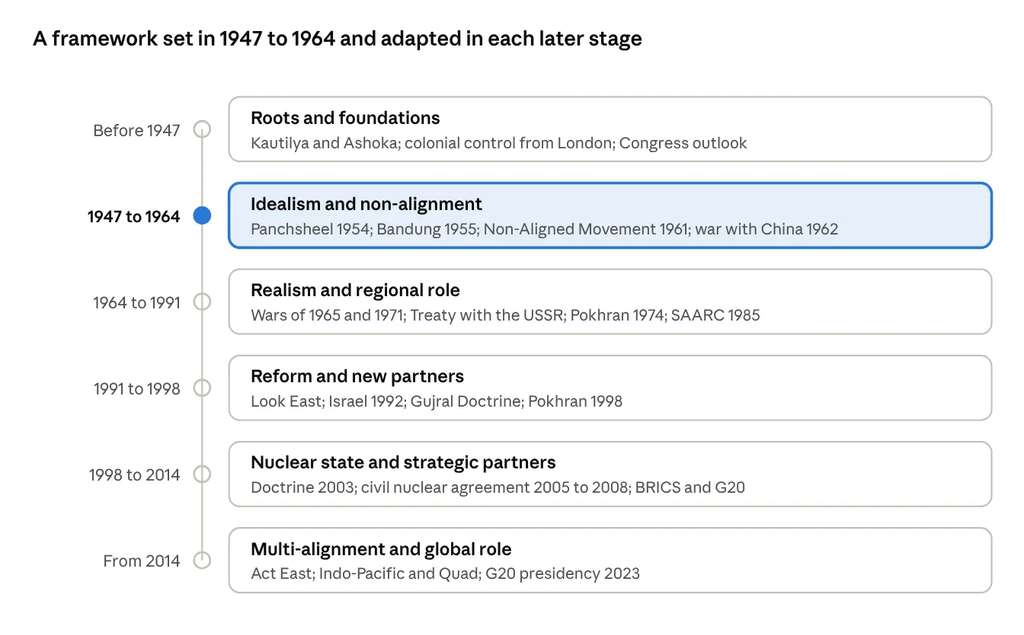
The stages are not sharply divided, and the dates are markers. The framework of non-alignment and autonomy was set in the first stage, and each later stage changed the means while keeping the aims.
4. Pre-independence foundations
To understand the policy after 1947, one must look at what came before. The pre-independence background has three layers: the ancient and medieval outlook, the colonial period, and the early international contacts of the national movement.
The ancient outlook
The ancient Indian state system did not have a single foreign policy, but it had ideas on how states should deal with each other. Kautilya’s Arthashastra (usually dated to the late first millennium BCE, with the date and authorship debated by scholars) set out the mandala theory, in which the neighbouring state is a likely enemy and the state beyond it a likely friend. It also listed six methods of policy: peace, war, neutrality, march, alliance and double policy. The text treats foreign policy as a calculation of power and interest, a realist view.
At the same time, another tradition stressed peace and moral conduct. Emperor Ashoka, after the Kalinga war (about 261 BCE), gave up conquest by force, and his edicts speak of dhamma and sent missions to Sri Lanka and other lands. Taken together, the two traditions show the mix of realism and idealism that later appears in the policy of independent India.
Trade and cultural contact
Indian traders took part in the Indian Ocean trade with the Roman world, Arabia, Southeast Asia and China. Buddhism spread to Central Asia, China, Korea, Japan and Southeast Asia, and Indian influence in the arts, language and law shaped Southeast Asia. These contacts were mainly peaceful, and they supported the later claim that India had always dealt with the world through exchange rather than conquest.
The medieval period
In the medieval period, India’s relations with Central Asia, Persia, West Asia and later Europe were shaped by invasions, trade routes and diplomacy. The Delhi Sultanate and the Mughal empire kept envoys and trade ties, and the arrival of European trading companies from the end of the fifteenth century, starting with the Portuguese at Calicut in 1498, brought a new kind of contact backed by sea power. The Mughal state could not control the seas, and this weakness helped the rise of the East India Company.
The colonial period and the loss of control
Under British rule, India had no foreign policy of its own. Its external relations were run from London through the India Office and the Government of India’s foreign department. The rulers used India as a base for the empire, for example by sending Indian troops to China, Africa, the Middle East and Southeast Asia, and by defending the North-West Frontier against the fear of Russian advance. The frontier policies produced boundaries such as the Durand Line (1893) with Afghanistan and the McMahon Line (1914) in the east, which have remained sources of dispute.
India was also made to take part in the two world wars. Over a million Indian soldiers served in the First World War, and the country was brought into the Second World War by the Viceroy’s declaration in 1939 without consulting Indian leaders. These experiences left a strong wish for control over external decisions.
Economic effects
The colonial economy was arranged for the benefit of Britain: raw materials went out, manufactured goods came in, and the drain of wealth, as argued by Dadabhai Naoroji, weakened India. This explains why post-independence leaders linked foreign policy with economic self-reliance and with the end of colonial rule elsewhere.
Summary of the pre-independence foundations
| Layer | Main feature | Later influence |
|---|---|---|
| Ancient thought | Realism of Kautilya; moral appeal of Ashoka | Mix of power and principle |
| Trade and culture | Contacts with Asia, West Asia and Rome | Claim to a civilisational role in Asia |
| Medieval period | Land routes, envoys, arrival of European sea power | Awareness of the importance of the sea |
| Colonial period | Policy controlled from London; imperial frontiers | Strong wish for autonomy; border disputes |
| Colonial economy | Drain of wealth; trade in the interest of Britain | Link of foreign policy with economic self-reliance |
5. The freedom movement and its outlook on the world
The Indian National Congress, founded in 1885, was at first concerned with reforms at home. Over time it developed a view of the world, which was later turned into the policy of the free state.
Early nationalists and the world
Early leaders such as Dadabhai Naoroji and Gopal Krishna Gokhale criticised the use of Indian money and soldiers in imperial wars. The Congress passed resolutions against the treatment of Indians in South Africa and against the use of Indian troops abroad. These were the first signs of an Indian view on external matters.
Gandhi and the ideas of non-violence and peace
Mahatma Gandhi brought the principles of truth and non-violence into politics. His experience in South Africa made him aware of racial discrimination, and the movement under his leadership linked India’s struggle with that of other oppressed peoples. In foreign policy, this led to a preference for peaceful settlement of disputes and a moral element in dealing with other states, though the state after 1947 could not be as absolute in non-violence as Gandhi.
The Congress and international anti-imperialism
In 1927, Jawaharlal Nehru attended the Congress of Oppressed Nationalities in Brussels, and the League against Imperialism, where he met leaders of other colonial movements. The Congress that year passed a resolution against any war in which India might be used by Britain. In the 1930s, the Congress condemned fascist aggression against Abyssinia, Spain and China, and sent a medical mission to China in 1938. These acts show that the movement saw India’s freedom as part of a wider struggle against imperialism and fascism.
Nehru’s role in shaping external views
Nehru was the leading voice. In the 1920s and 1930s he wrote about world affairs, and from 1936 he headed the Congress’s foreign department, working out its stand on international questions. His book The Discovery of India (1946), written in prison, expressed the view of India as a country with a long history of contact with the world, and a role in building peace. On 7 September 1946, as head of the interim government, he broadcast the outline of the coming foreign policy: keeping away from power blocs, friendship with all, and support for freedom for dependent peoples.
The Asian dimension
K. M. Panikkar and others stressed India’s links with Asia and the importance of the Indian Ocean. The Asian Relations Conference was held in New Delhi in March and April 1947, a few months before independence, with delegates from many Asian countries. It showed the movement’s wish to give India a role as a leader of Asia and as a friend of its neighbours.
The Congress’s foreign policy resolutions
The Congress passed resolutions on the Indians overseas, on the Middle East and on the fight against fascism, and in 1942 stressed that a free India would be a partner in a world federation. The Quit India Movement of 1942 was a domestic struggle, but it also came from the refusal to let India be pulled into the war without its consent.
The interim government of 1946 to 1947
The interim government, with Nehru in charge of external affairs, started to create a diplomatic service and to open missions in several countries. India sent delegates to the United Nations in 1946 and raised the issue of the treatment of Indians in South Africa. This was the first use of the UN platform by India, before independence.
Summary of the freedom movement’s contribution
| Idea or event | Period | Effect on later policy |
|---|---|---|
| Criticism of imperial wars | 1880s to 1910s | Independent judgement on war and peace |
| Gandhi’s non-violence | 1915 onwards | Preference for peaceful settlement |
| Brussels Congress, League against Imperialism | 1927 | Anti-colonialism; links with other movements |
| Support for China and Abyssinia | 1930s | Opposition to aggression |
| Nehru’s broadcast | 7 September 1946 | Outline of non-alignment and friendship with all |
| Asian Relations Conference | March to April 1947 | Asian solidarity |
6. The Nehru era (1947 to 1964): idealism and non-alignment
The first seventeen years set the framework of the policy. Nehru was both Prime Minister and Minister of External Affairs, and for most of this period he made foreign policy himself, with help from a small group of officials such as V. K. Krishna Menon and Girija Shankar Bajpai.
Aims at the start
The aims of the new state were to protect its independence and territory, to build the economy in peace, to end colonial rule elsewhere, and to gain a voice in world affairs. India was poor, had just been divided, and was faced with the problem of Kashmir. It could not afford to take sides in a war between the blocs, and it needed aid and technology from both.
Non-alignment
Non-alignment meant not joining the military blocs led by the USA and the Soviet Union, while forming one’s own judgement on each issue. Nehru did not like the word neutrality, which suggests keeping out of everything. India joined the Commonwealth in 1949 as a republic, took part in the UN and gave moral and diplomatic support to many causes. Non-alignment gave India room to receive aid from both sides, for example steel plants from the Soviet Union and Germany (the Bhilai and Rourkela plants), and food aid from the USA.
Panchsheel and the policy towards China
India recognised the People’s Republic of China in 1949, and supported its claim for a seat in the UN. The Agreement on Trade and Intercourse between the Tibet region of China and India, signed on 29 April 1954, included the five principles of Panchsheel: mutual respect for territorial integrity and sovereignty, mutual non-aggression, non-interference in each other’s internal affairs, equality and mutual benefit, and peaceful coexistence. The slogan Hindi-Chini bhai bhai described the friendly mood of those years, but the boundary question was not settled.
Role in world conflicts
India took an active part in efforts at peace. In the Korean War (1950 to 1953), India sought a settlement, and it chaired the Neutral Nations Repatriation Commission and sent a Custodian Force for the exchange of prisoners. After the Geneva Conference of 1954, India chaired the International Control Commissions for Vietnam, Laos and Cambodia. In 1956, India criticised the attack on Egypt by Britain, France and Israel after the nationalisation of the Suez Canal, while its reaction to the Soviet action in Hungary in the same year was mild, which drew criticism. In 1960, India sent troops to the UN force in the Congo.
Asian and African solidarity
India called for the Asian Relations Conference in 1947 and a conference on Indonesia in 1949, and it was one of the sponsors of the Afro-Asian Conference at Bandung in April 1955. Along with Yugoslavia’s Tito, Egypt’s Nasser, Indonesia’s Sukarno and Ghana’s Nkrumah, Nehru took part in founding the Non-Aligned Movement at Belgrade in September 1961. India led the opposition to apartheid in South Africa at the UN.
The Kashmir question and Pakistan
After the tribal invasion of Kashmir in October 1947 and its accession to India, the first Indo-Pakistan war broke out. India took the matter to the Security Council in January 1948, a step which it later regarded as a mistake because the issue became a Cold War question. A ceasefire followed on 1 January 1949. The Indus Waters Treaty with Pakistan was signed in 1960 with the help of the World Bank.
Relations with the Western and Soviet blocs
The USA found India’s stand hard to understand, and in 1954 it signed a military pact with Pakistan, which became a member of SEATO and CENTO. The Soviet Union under Khrushchev, after Stalin’s death, supported India on Kashmir and offered economic help. Hence, a closeness with the USSR began in this period.
The use of force: Goa
In December 1961, India took action to end Portuguese rule in Goa, Daman and Diu after years of failed talks. It showed that non-violence in policy had limits, and that force could be used for territorial integrity.
The war with China in 1962
The dispute over the boundary in Aksai Chin and in the east grew after China’s action in Tibet and India’s grant of asylum to the Dalai Lama in 1959. The Chinese attack in October 1962 led to a defeat for India. The war damaged the faith in Panchsheel, led to a loss of prestige for the government, and changed India’s defence outlook. Nehru died in May 1964.
Assessment
The Nehru years gave India a distinct voice, set non-alignment and peaceful coexistence as aims, and gave the country influence beyond its size. At the same time, they left unsolved the problems of Kashmir and the boundary, and they put too much trust in moral power. This balance is the usual point of any critical answer.
Summary of the Nehru era
| Event | Year | Significance |
|---|---|---|
| Recognition of the People’s Republic of China | 1949 | Support for Asian solidarity |
| Entry into the Commonwealth as a republic | 1949 | Flexible ties without giving up autonomy |
| Panchsheel agreement | 1954 | Five principles of coexistence |
| Bandung Conference | 1955 | Afro-Asian unity |
| Suez and Hungary crises | 1956 | Test of an independent stand |
| Goa action | 1961 | Use of force for territory |
| Non-Aligned Movement, Belgrade | 1961 | Institutional form for non-alignment |
| War with China | 1962 | End of the early idealism |
7. From 1962 to 1991: realism and a regional role
The three decades after the war with China are often called a period of realism. India built up its defence, fought wars, developed its nuclear capacity and took on the role of the main power in South Asia, while remaining formally non-aligned.
Defence build-up after 1962
India increased its defence spending, expanded the army, and bought arms, mainly from the Soviet Union, because Western states were unwilling to give them without conditions. The border war was followed in 1963 by the agreement of China and Pakistan on their boundary, which showed the risk of a two-front problem.
The Shastri years and the war of 1965
Under Lal Bahadur Shastri, who became Prime Minister in 1964, India faced the war with Pakistan in 1965, which began in Kashmir and spread to the Punjab border. The Tashkent Declaration of January 1966, reached with Soviet mediation, ended the war, and Shastri died there. The Soviet role in Tashkent increased its weight in the region. India also, in this period, faced food shortages and a dependence on US grain under PL-480, which made it keen to build self-reliance in food.
Indira Gandhi and a firmer policy
Indira Gandhi, Prime Minister from 1966, placed more stress on national interest, security and self-reliance. The crisis in East Pakistan after the election of 1970 and the flow of about ten million refugees into India led to a new test. India recognised the importance of a political settlement and also strengthened its position.
The treaty of 1971 and the Bangladesh war
The USA under Nixon was friendly with Pakistan, and its opening to China, through Henry Kissinger’s secret visit in July 1971, made India fear isolation. India signed the Treaty of Peace, Friendship and Cooperation with the Soviet Union in August 1971. The war of December 1971 ended with the surrender of the Pakistani forces in Dhaka and the creation of Bangladesh. The USA sent a naval task force to the Bay of Bengal, and the Soviet Union used its veto in the Security Council to support India. Critics said that the treaty was a departure from non-alignment, while supporters said it was a reasonable step for security.
The Simla Agreement
In July 1972, India and Pakistan signed the Simla Agreement, which committed them to settle disputes bilaterally and to respect the Line of Control in Kashmir. India has used it as a reason to resist third-party mediation.
The nuclear test of 1974
On 18 May 1974, India conducted an underground nuclear test at Pokhran and described it as a peaceful nuclear explosion. The test showed its technical ability and led the USA and others to form the Nuclear Suppliers Group in 1975 and to place limits on nuclear trade with India. India did not sign the Non-Proliferation Treaty, which it regarded as discriminatory.
The Janata government and genuine non-alignment
The Janata government (1977 to 1979), with Morarji Desai as Prime Minister and Atal Bihari Vajpayee as External Affairs Minister, spoke of genuine or true non-alignment, meaning equal distance from both blocs, and tried to improve relations with neighbours and China. Vajpayee visited China in 1979. The policy did not change the basic framework.
Indira Gandhi again: the 1980s
When Indira Gandhi returned in 1980, the Soviet entry into Afghanistan in December 1979 had changed the region. India did not condemn the action strongly, and Pakistan became a front-line state for the USA. The Siachen conflict began in 1984. The Indira Doctrine, a term used by scholars rather than an official document, describes India’s view that outside powers should not interfere in South Asia and that India had a special role there.
Rajiv Gandhi and a more active style
Rajiv Gandhi (1984 to 1989) wished to modernise the country and used technology and diplomacy. India helped to form the South Asian Association for Regional Cooperation in 1985. It sent a peacekeeping force to Sri Lanka in 1987 under the Indo-Sri Lanka Accord, which ended in 1990 without success, and it sent troops to the Maldives in 1988 (Operation Cactus) at the request of the government to defeat a coup attempt. Rajiv Gandhi visited China in 1988, the first visit by an Indian Prime Minister since 1954, and this began a gradual thaw.
The decline of the Soviet Union and the end of the period
By the end of the 1980s the Soviet Union was weak, and its collapse in December 1991 removed India’s main partner. The Gulf War of 1990 to 1991 and the economic crisis of 1991 forced a rethinking. India’s foreign reserves were so low that it had to pledge gold to meet its payments.
Summary of the period
| Event | Year | Significance |
|---|---|---|
| War with Pakistan | 1965 | Test of the army; Tashkent in 1966 |
| Treaty with the Soviet Union | 1971 | Security assurance; critics saw a tilt |
| Creation of Bangladesh | 1971 | India’s regional pre-eminence |
| Simla Agreement | 1972 | Bilateral settlement with Pakistan |
| Pokhran I | 1974 | Nuclear capability; limits on technology |
| SAARC formed | 1985 | Regional cooperation |
| Sri Lanka and the Maldives | 1987 and 1988 | Use of military power in the region |
| Visit to China | 1988 | Start of the thaw |
8. From 1991 to 1998: reform and new partnerships
The end of the Cold War and the economic crisis of 1991 forced India to rethink its policy. The period was short, but the changes were large.
The context
The collapse of the Soviet Union ended the bipolar world and left the USA as the strongest power. India lost a major supplier of arms and a political friend, and its trade with the former Soviet states fell. At the same time, the balance of payments crisis forced the government of P. V. Narasimha Rao, with Manmohan Singh as Finance Minister, to begin economic reforms: the abolition of most industrial licensing, a lower tariff, a devalued rupee and an opening to foreign investment.
Economy as a driver of foreign policy
With reforms, economic ties became central. India sought investment, technology and markets, and it joined the WTO as a founding member in 1995. Diplomats were asked to work for trade and capital. This is a clear instance of Nehru’s statement that foreign policy is the result of economic policy, now in a different form.
The Look East policy
Announced in 1991 to 1992, Look East aimed to build economic and strategic relations with Southeast Asia and East Asia. India became a sectoral dialogue partner of ASEAN in 1992, a full dialogue partner in 1996, and a member of the ASEAN Regional Forum in 1996. The policy gave India a new region of partnership and later developed into Act East.
Relations with Israel and the USA
India established full diplomatic relations with Israel in January 1992, after decades of restraint. The step opened defence and technology cooperation. Ties with the USA improved with trade, investment and the growth of the Indian-American community, though differences remained over nuclear policy, Kashmir and human rights.
Relations with Russia and China
India signed a new treaty of friendship with Russia in 1993, without the security clauses of the 1971 treaty. With China, India signed the Agreement on the Maintenance of Peace and Tranquillity along the Line of Actual Control in 1993 and the Agreement on Confidence-Building Measures in the Military Field in 1996. Trade grew, even though the boundary question remained.
Policy in the neighbourhood: the Gujral Doctrine
I. K. Gujral, as External Affairs Minister and then Prime Minister (1996 to 1997), set out five principles for relations with smaller neighbours: no reciprocity in what India gives to Bangladesh, Bhutan, Maldives, Nepal and Sri Lanka; no use of territory against each other; no interference in internal matters; respect for territorial integrity and sovereignty; and settlement of disputes by peaceful bilateral talks. The Ganga Waters Treaty with Bangladesh (December 1996) and the Mahakali Treaty with Nepal (1996) were concluded in this spirit.
Nuclear policy and the CTBT
In 1995 India opposed the indefinite extension of the Non-Proliferation Treaty and in 1996 it refused to sign the Comprehensive Test Ban Treaty because it was not linked to a time-bound plan for disarmament. These choices prepared the ground for the tests of 1998.
The tests of May 1998
On 11 and 13 May 1998, India conducted a series of nuclear tests at Pokhran under the government of Atal Bihari Vajpayee. Pakistan tested in the same month. The USA, Japan and others placed sanctions on India, but the sanctions had little lasting effect. India declared a moratorium on further testing and set out a policy of credible minimum deterrence.
Summary of the period
| Development | Year | Significance |
|---|---|---|
| Economic reforms | 1991 | The economy becomes central to policy |
| Look East | 1991 to 1992 | New regional focus on Asia-Pacific |
| Diplomatic relations with Israel | 1992 | End of long restraint; defence ties |
| Agreements with China on the LAC | 1993 and 1996 | Management of the border |
| WTO membership | 1995 | Participation in global trade rules |
| Gujral Doctrine | 1996 to 1997 | Goodwill towards smaller neighbours |
| Pokhran II | 1998 | India declares itself a nuclear weapon state |
9. From 1998 to 2014: a nuclear state and strategic partnerships
This period joined two things: India’s open status as a nuclear weapon state, and a steady growth in its economy and its partnerships. Governments of different parties, led by Atal Bihari Vajpayee (1998 to 2004) and Manmohan Singh (2004 to 2014), kept the main line of policy.
Nuclear doctrine
After the tests of 1998, the government set out a policy of credible minimum deterrence and no first use. A draft doctrine was released in 1999, and the Cabinet Committee on Security adopted an official doctrine in January 2003. It states that nuclear weapons are to deter, that India will not be the first to use them against a nuclear state, that retaliation to a first strike would be massive, and that civilian command will control nuclear forces. A National Security Council was set up in 1998.
The dialogue with the United States
The sanctions after the tests were followed by a long dialogue between Jaswant Singh and the American official Strobe Talbott. President Bill Clinton visited India in March 2000, the first visit by an American President in over two decades. The partnership developed in 2004 with the Next Steps in Strategic Partnership. The Joint Statement of July 2005 by Manmohan Singh and George W. Bush led to the civil nuclear agreement. The Nuclear Suppliers Group gave India a special waiver in September 2008, and the agreement was signed in October 2008. This ended India’s isolation in nuclear trade without requiring it to sign the NPT.
Pakistan: conflict and talks
In February 1999, Prime Minister Vajpayee travelled by bus to Lahore, and a declaration was signed. In the summer of 1999, Pakistani forces occupied heights in the Kargil sector, and India succeeded in removing them after a limited war. The attack on Parliament in December 2001 led to a long military stand-off called Operation Parakram. A peace process, the Composite Dialogue, began in 2004. The terrorist attack in Mumbai in November 2008 ended much of this and made terrorism a central issue.
Relations with China and Russia
In 2003, Vajpayee visited China and the two countries agreed on a mechanism of Special Representatives on the boundary question. In 2005 they agreed on political parameters and guiding principles for a settlement, and China became one of India’s largest trading partners, although the boundary stayed unsettled. India and Russia signed a Declaration on Strategic Partnership in October 2000, and defence supply remained a large part of the relationship.
Strategic partnerships with other states
India built strategic partnerships with France (1998), Russia (2000), the European Union (2004), Japan (global partnership in 2006) and others. The idea was that India would work with all major powers on common interests, without a formal alliance.
New groupings
India took part in the IBSA forum with Brazil and South Africa (2003), and in BRICS from 2009 to 2010, the East Asia Summit from 2005, and the G20 leaders’ meetings from 2008, where it spoke for developing states. The policy was a mix of cooperation with the great powers and a claim for a voice in reforms of the world order.
Neighbourhood and the wider region
India gave aid to Afghanistan after 2001, including the road from Zaranj to Delaram and the Parliament building in Kabul. In Sri Lanka, the war ended in 2009, and India’s role turned to reconstruction and to the Tamil question. In Bangladesh, relations improved after 2009 with cooperation on security and transit. The South Asian Free Trade Area came into force in 2006.
Economy and energy
Growth of 8 to 9 per cent a year in the mid-2000s raised India’s weight. Energy security became a main concern, which led to new ties with West Asia, Africa and Central Asia, and to the nuclear agreement. Remittances and the services sector tied India more closely to the global economy.
Assessment
The period saw India accepted as a major power by many states. Critics said that it still lacked a clear strategy, with caution on China and slow reform of the diplomatic and defence systems. Supporters point to how well it used the post-Cold War situation without losing autonomy.
Summary of the period
| Development | Year | Significance |
|---|---|---|
| National Security Council | 1998 | Better institutional structure |
| Lahore Declaration and Kargil | 1999 | Peace effort and limited war |
| Clinton’s visit | 2000 | Start of the US partnership |
| Operation Parakram | 2001 to 2002 | Coercive diplomacy after the Parliament attack |
| Nuclear doctrine | 2003 | Credible minimum deterrence, no first use |
| Joint Statement with the USA | 2005 | Basis of the civil nuclear agreement |
| NSG waiver and the agreement | 2008 | End of nuclear isolation |
| BRICS and G20 | 2008 to 2010 | Role in new groupings |
10. From 2014 onwards: multi-alignment and a wider global role
Since 2014, under Prime Minister Narendra Modi, the policy has had a more active style, with stress on partnerships, the economy, the diaspora and the claim to leadership of the Global South. Students should check the latest official sources for recent events.
Neighbourhood First
The leaders of the SAARC states were invited to the swearing-in ceremony in May 2014, which showed the priority given to the region. India has stressed connectivity, energy trade, lines of credit and help in emergencies, and it has turned to sub-regional groups such as BIMSTEC and BBIN, since SAARC summits have been held up by tension with Pakistan. Relations with Bangladesh were helped by the Land Boundary Agreement, which came into force in 2015. Neighbours such as Sri Lanka, the Maldives, Nepal and Bangladesh have at times shown concern about India’s influence and have sought balance through China.
Act East and the Indo-Pacific
The Look East policy was renamed Act East in November 2014, with more stress on strategic and security cooperation and on connectivity with Myanmar and Thailand. India has used the term Indo-Pacific, and the Prime Minister set out its vision in a speech at the Shangri-La Dialogue in Singapore in 2018, with ASEAN centrality as a main principle. The Quad of India, the USA, Japan and Australia was revived at the officials’ level in 2017, and the first leaders’ summit was held in 2021.
Multi-alignment
In recent years, the term multi-alignment has been used to describe India’s practice of working with many partners at once: the USA and Quad members, Russia, the Gulf states, Israel, France and the European Union, and BRICS and the SCO (membership from 2017). The idea is that India does not join any alliance but builds issue-based partnerships to serve national interest. External Affairs Minister S. Jaishankar has called this a policy of many options and of national interest first.
Relations with China
The period has included summits and agreements, as well as crises. The standoff at Doklam in 2017 and the violent clash in the Galwan Valley in June 2020, in which Indian and Chinese soldiers died, led to a long military deployment and a fall in trust. Talks have continued, and a patrolling understanding was reached in October 2024, after which high-level contact resumed. The relationship remains one of competition and cooperation.
Security and Pakistan
In response to terrorist attacks, India carried out the surgical strikes of 2016 and the Balakot air strike of February 2019, and in May 2025 it launched Operation Sindoor after the attack at Pahalgam in April 2025. The revocation of the special status of Jammu and Kashmir in August 2019 changed the domestic position, and India states that talks and terror cannot go together. Students should check the official record on the events of 2025.
Economic and technological diplomacy
Programmes such as Make in India, the push for defence production at home, trade agreements with states such as the United Arab Emirates and Australia, and the use of digital public goods such as the Unified Payments Interface in other countries are part of economic diplomacy. In September 2023, a plan for an India-Middle East-Europe Economic Corridor was announced at the G20 summit.
Humanitarian and soft power
India has used evacuation operations (Yemen in 2015, Ukraine in 2022), disaster relief, the Vaccine Maitri programme from 2021 and the International Day of Yoga (adopted by the UN in 2014) as part of its image. The diaspora is used as a strategic asset, through events and outreach.
Global leadership and the Global South
India held the G20 presidency in 2023, hosted the Voice of the Global South Summit (January 2023), and secured the admission of the African Union as a permanent member of the G20 at the New Delhi summit in September 2023. It has pressed for reform of the UN Security Council and of the global financial institutions, while keeping a stand of strategic autonomy on questions such as the war in Ukraine, where it has called for dialogue and has continued to buy Russian oil.
Climate and energy leadership
India co-founded the International Solar Alliance (launched in 2015 with France), and announced at COP26 in 2021 a target of net zero emissions by 2070 and the Panchamrit goals. It describes itself as a voice for climate justice and for common but differentiated responsibilities.
Assessment
The recent phase shows continuity in the aim of strategic autonomy, but also a more open pursuit of power and a larger role. Observers ask whether this multi-alignment can last if the rivalry between the USA and China sharpens, and whether India’s capacity can support its ambitions.
Continuity and change at a glance
| Aspect | 1947 to 1964 | 1964 to 1991 | 1991 to 2014 | After 2014 |
|---|---|---|---|---|
| Dominant idea | Idealism, non-alignment | Realism, regional power | Economy, strategic partnerships | Multi-alignment, global role |
| Main partners | Both blocs; Afro-Asian states | Soviet Union; neighbours | USA, EU, Japan, ASEAN | Quad, Russia, Gulf, Global South |
| Security approach | Peaceful coexistence | Defence build-up; 1974 test | Nuclear state; deterrence | Active use of force in response to terrorism; border readiness |
| Economic stance | Self-reliance and aid | Mixed economy | Liberalisation | Make in India; trade agreements |
| Key leaders | Nehru | Shastri, Indira Gandhi, Rajiv Gandhi | Rao, Vajpayee, Manmohan Singh | Modi |
11. Importance and limitations of studying the evolution
A study of how India’s foreign policy has evolved gives a base for understanding the present. It also has limits, which examiners often ask about in questions that start with the word “critically”.
Importance
It shows continuity and change together. By following the policy over time, a student sees that aims such as autonomy and security have lasted, while methods and partners have changed. This prevents the mistake of treating a current policy as new.
It explains the present through the past. India’s attitude to border disputes, its insistence on bilateral talks with Pakistan and its caution on alliances have origins in the colonial experience, the Simla Agreement and the experience of 1962.
It links ideas with events. The principles of Panchsheel, non-alignment and peaceful settlement are seen in relation to real events such as the Korean War mediation or the Bangladesh war, so ideas are tested against practice.
It highlights the role of leaders and institutions. Nehru, Indira Gandhi, Narasimha Rao, Vajpayee and Modi each left a mark, and the growth of institutions such as the National Security Council shows how decision-making has changed.
It shows the effect of the world order. The phases of the policy correspond to the Cold War, the end of bipolarity and the rise of multipolarity, which helps to explain external determinants.
It helps to understand the shift from idealism to realism. The stages after 1962 show how security needs corrected the early moral stress, an important point in theory-based questions.
It explains the rise of the economy as a tool. The movement from aid and self-reliance to trade, investment and economic partnerships shows why economic diplomacy is now central.
It supports comparison with other states. A student can compare India’s phases with those of China, Japan or Brazil, to see how states respond to a changing world.
It provides a base for judging policy. Knowing past successes and failures, such as the Goa action or the Sri Lanka mission, helps in evaluating present choices.
It prepares for examinations and public service. Chronological knowledge with dates, treaties and doctrines is useful in prelims, mains, NET and interviews.
Limitations
Periods are not sharply divided. The division into phases is a convenience. Realism was present under Nehru, and idealism has been present in later years, so dates such as 1962 or 1991 are only markers.
It may overstate the role of leaders. Reading history through the names of Prime Ministers can hide the effect of structures, such as geography, the economy and the world order.
Official records are incomplete. Many documents are not yet open to scholars, so some accounts rely on memoirs and speeches which may be partial.
It may read the past from the present. Writers who know the end of the story may judge earlier decisions by what was known later. For example, the early trust in China may look naive only after 1962.
It can neglect the domestic side. A narrative of external events may not give enough attention to parties, federalism, public opinion and the economy.
It can neglect small states and non-state actors. The story often focuses on great powers and neighbours, and leaves out regions such as Africa and Latin America, and actors such as firms and the diaspora.
It may present a smooth story. Some choices were made by accident, in a crisis or under pressure, but a neat account of evolution may hide this.
Assessments depend on the writer’s view. Realist, liberal and critical writers judge the same events differently, for example the Treaty of 1971 or the non-aligned stand on Hungary.
Recent events are close and disputed. For the latest period, sources are news reports and official statements, and judgements may change when more evidence is available.
Comparison across periods is difficult. India in 1950 and in 2020 differ in size, wealth and capacity, so measuring them by the same standard may not be fair.
Illustrations
| Theme | Illustration | What it shows |
|---|---|---|
| Continuity | Strategic autonomy from non-alignment to multi-alignment | Same aim, changed method |
| Idealism | Panchsheel agreement, 1954 | Moral stress under Nehru |
| Realism | Treaty with the Soviet Union, 1971 | Security first |
| Nuclear policy | 1974 test; 1998 tests; 2003 doctrine | Movement from restraint to deterrence |
| Economy | Reforms of 1991; Look East | Economy as a driver |
| Neighbourhood | Indira, Gujral and Neighbourhood First | Change in style of regional policy |
| Partnerships | Civil nuclear agreement with the USA, 2005 to 2008 | End of isolation; new partner |
| Global role | G20 presidency, 2023 | Claim to leadership of the Global South |
12. Use in examinations
What examiners expect
| Examination | Typical expectation | How to answer |
|---|---|---|
| UG semester papers | Phases of the policy with dates and examples | Short introduction, four or five phases, one example for each |
| PG (MA Political Science) | Theory plus India-specific analysis | Cite scholars; link phases to determinants |
| OPSC (OCS and OAS Mains) | Balanced account of continuity and change | Introduction, phases, assessment, conclusion |
| UPSC Mains (GS Paper 2) | Link of past policy with present issues | Facts, dates, doctrines; a view on national interest |
| UGC NET Paper 2 | Names, books, treaties, doctrines | Know the sequence of events and authors |
Practice questions
- Trace the evolution of India’s foreign policy from the pre-independence period to the present.
- Examine the contribution of the freedom movement and the ancient tradition to India’s foreign policy.
- “The year 1962 was a turning point in India’s foreign policy.” Discuss.
- Explain how the end of the Cold War changed India’s foreign policy.
- Discuss the shift from non-alignment to multi-alignment, with examples.
- Compare the foreign policy of the Nehru era with that of the period after 1991.
- Critically assess the continuity and change in India’s foreign policy since independence.
Structured outline for a long answer
Question: Trace the evolution of India’s foreign policy from the pre-independence period to the present.
Introduction
- Define foreign policy and state that its roots lie before 1947.
- Mention the main phases.
Body
- Pre-independence background: Kautilya and Ashoka, colonial control, the Congress and Nehru’s views.
- 1947 to 1964: non-alignment, Panchsheel, NAM, the war of 1962.
- 1964 to 1991: realism, the wars, the 1971 Treaty, the 1974 test, regional role.
- 1991 to 1998: reforms, Look East, Israel, Gujral Doctrine, Pokhran II.
- 1998 to 2014: nuclear doctrine, strategic partnerships, the nuclear agreement with the USA.
- After 2014: multi-alignment, Act East, Indo-Pacific, the Global South.
Conclusion
- The aims of autonomy, security and development have continued while the means changed.
- The policy is a mix of idealism and realism, adapted to the world order.
Sample answer (about 200 words)
Introduction. Foreign policy is the course of action by which a state protects its interests in dealing with others. India’s policy has roots before 1947, and it has changed in stages while keeping its main aims.
Body. Ancient thought gave both the realism of Kautilya and the moral appeal of Ashoka. Under British rule, India’s external affairs were controlled from London, and the national movement under Gandhi and Nehru developed an outlook of anti-imperialism and peace.
From 1947 to 1964, Nehru’s policy stressed non-alignment, Panchsheel and Afro-Asian solidarity. The defeat of 1962 led to a more realist phase with defence build-up, the Treaty with the Soviet Union in 1971, the creation of Bangladesh and the nuclear test of 1974. After the end of the Cold War and the reforms of 1991, the policy gave more place to the economy, Look East and relations with the USA and Israel. The tests of 1998 and the nuclear agreement of 2008 made India a recognised nuclear power. Since 2014, the policy has stressed multi-alignment, Act East and a larger role for the Global South.
Conclusion. The aims of security, development and autonomy have remained, but the means have shifted from moral appeal to a wider use of economic, military and diplomatic tools.
Quick check
- Which text of ancient India sets out the mandala theory?
- In which year was the Panchsheel agreement signed with China?
- Name two events which made 1962 a turning point.
- Which policy was announced in 1991 to 1992 for relations with Southeast Asia?
- What is the difference between non-alignment and multi-alignment?
Common mistakes
- Starting the story only from 1947 and leaving out the pre-independence background.
- Writing a list of events without explaining the reason for each change.
- Calling non-alignment neutrality or isolation.
- Ignoring the continuity of aims and presenting each phase as a complete break.
- Mixing up dates, such as the Panchsheel agreement and the Bandung Conference.
- Ending with a conclusion which only repeats the introduction.
13. Critical analysis
Idealism or realism under Nehru?
Critics, especially after 1962, argued that Nehru relied on moral appeal and neglected defence. Defenders reply that non-alignment was a realistic way of protecting a weak state, and that the constraints of poverty and Partition left few other choices. Many scholars now say that Nehru’s policy mixed both, and that the label of idealism hides the careful calculation behind it.
Was 1962 a break or a test?
Some see the war as the end of the early policy. Others note that the main aims of non-alignment remained, and that the defence build-up was a change in tools. The better view is that 1962 changed the balance between ideals and force, but not the framework of autonomy.
Is there a strategic culture?
The American scholar George Tanham argued in 1992 that India lacked a tradition of strategic thinking. Indian scholars have replied that Kautilya’s Arthashastra and later practice show an older tradition, though it was not written down in one doctrine. The debate matters for the question whether Indian policy has deep roots or is a creation of the twentieth century.
Continuity and change
One view stresses continuity: autonomy, a wish for status and a cautious use of force. Another, associated with C. Raja Mohan, speaks of breaks, such as 1991 and 1998, after which India broke from the earlier ideological style and moved towards power politics. The balanced position is that the aims continued while the means changed.
Was 1991 a watershed?
The reforms and the end of the Cold War changed the economy and partnerships, but the idea of autonomy was kept. Some argue that the main change came earlier, with the realism of the 1970s, and others that the real change came after 2005 with the partnership with the USA. The question shows that dating a watershed depends on what one counts as change.
Non-alignment: success or failure?
Supporters say that non-alignment kept India out of wars of the blocs, allowed aid from both sides and gave it moral influence. Critics say that it was often a pose, that it ended in a treaty with one bloc in 1971 and that it did not prevent isolation in 1962 or the failure to build strong ties with the West. Defenders reply that autonomy, rather than neutrality, was the goal, and it was kept.
Multi-alignment: strength or drift?
The present policy is praised for flexibility and for allowing India to benefit from many partners. It is criticised for lacking a clear core, and for the risk that if great-power rivalry becomes sharper, India may be pressed to choose. This question remains open.
Capacity and ambition
India’s ambitions have often been larger than its means. Its diplomatic service is small, defence production still relies on imports, and its trade with China shows a large deficit. Many analysts say that the next stage of evolution depends on building capacity as much as on diplomacy.
Theory and evolution
Realism explains the changes after 1962 and the strategic partnerships. Liberalism explains the importance of trade, institutions and the Gujral Doctrine. Constructivism explains the persistence of identity and ideas such as Panchsheel and civilisational claims. An answer which uses all three earns more marks.
Model concluding paragraph
The evolution of India’s foreign policy shows a country adjusting to a changing world while holding to a few lasting aims. The ancient tradition, the colonial experience and the freedom movement gave it a wish for autonomy, peace and a role in the world. After independence, the policy moved from the idealism of the Nehru years to the realism of the post-1962 period, then to economic engagement after 1991 and to the nuclear and strategic partnerships of the next two decades, and now to multi-alignment. The aims have remained steady, though the methods have been changed by events. The long-term success of the policy will depend on whether India’s capacity grows to match its ambitions.
14. UGC NET: authors and books
The following works are often named in syllabi and reading lists. Check the edition and exact title before citing them in an answer.
| Author | Work | Relevance |
|---|---|---|
| Kautilya | Arthashastra | Mandala theory; the six methods of foreign policy |
| Romila Thapar | Asoka and the Decline of the Mauryas | Ashoka’s dhamma and policy |
| Bipan Chandra and others | India’s Struggle for Independence | The national movement and its outlook |
| Jawaharlal Nehru | The Discovery of India (1946); India’s Foreign Policy: Selected Speeches | Primary source of the early policy |
| K. M. Panikkar | India and the Indian Ocean (1945) | Sea power and geography |
| Bimal Prasad | The Origins of Indian Foreign Policy (1960) | The Congress and external affairs before 1947 |
| S. Gopal | Jawaharlal Nehru: A Biography | Nehru’s role in the policy |
| A. Appadorai and M. S. Rajan | India’s Foreign Policy and Relations (1985) | General survey of phases |
| J. Bandyopadhyaya | The Making of India’s Foreign Policy (1970) | Process and determinants |
| J. N. Dixit | India’s Foreign Policy 1947-2003 | Insider’s account of phases |
| Srinath Raghavan | War and Peace in Modern India (2010) | The Nehru years and security |
| C. Raja Mohan | Crossing the Rubicon (2003); Modi’s World (2015) | Shift towards power politics and partnerships |
| Shivshankar Menon | Choices (2016) | Decision-making in recent decades |
| S. Jaishankar | The India Way (2020) | Multi-alignment and strategic autonomy |
Revision tip
Make a timeline with six rows: pre-independence, 1947 to 1964, 1964 to 1991, 1991 to 1998, 1998 to 2014 and after 2014. For each row, write the main idea, two events with dates, and one author. NET questions often ask for the correct order of events, so practise placing dates in sequence, and revise the doctrines (Panchsheel, Indira, Gujral) along with their years.
15. Takeaways, sources and further reading
Key takeaways
- India’s foreign policy has roots in ancient thought, the colonial experience and the freedom movement.
- The Nehru years (1947 to 1964) set the framework of non-alignment, Panchsheel and Afro-Asian solidarity.
- After 1962, the policy became more realist, with a defence build-up, the 1971 Treaty, the creation of Bangladesh and the 1974 test.
- The reforms of 1991 and the end of the Cold War brought the economy to the centre, with Look East and new ties with the USA and Israel.
- The nuclear tests of 1998, the doctrine of 2003 and the civil nuclear agreement made India a recognised nuclear power.
- Since 2014, the policy has been described as multi-alignment, with a larger global and regional role.
- The aims of security, development and autonomy have continued while the means have changed.
Official sources
- Ministry of External Affairs, Government of India
- Constitution of India, Legislative Department
- Press Information Bureau
- Parliament of India (Sansad)
- Ministry of Defence
- Indian Council of World Affairs
- United Nations
Twenty books for further reading
- Kautilya, Arthashastra (translated by L. N. Rangarajan).
- Romila Thapar, Asoka and the Decline of the Mauryas.
- Bipan Chandra and others, India’s Struggle for Independence.
- Jawaharlal Nehru, The Discovery of India.
- Jawaharlal Nehru, India’s Foreign Policy: Selected Speeches, September 1946 to April 1961.
- K. M. Panikkar, India and the Indian Ocean.
- Bimal Prasad, The Origins of Indian Foreign Policy.
- S. Gopal, Jawaharlal Nehru: A Biography.
- A. Appadorai and M. S. Rajan, India’s Foreign Policy and Relations.
- V. P. Dutt, India’s Foreign Policy since Independence.
- J. Bandyopadhyaya, The Making of India’s Foreign Policy.
- J. N. Dixit, India’s Foreign Policy 1947-2003.
- Srinath Raghavan, War and Peace in Modern India.
- Ramachandra Guha, India After Gandhi.
- C. Raja Mohan, Crossing the Rubicon.
- C. Raja Mohan, Modi’s World.
- Sumit Ganguly (ed.), India’s Foreign Policy: Retrospect and Prospect.
- Shivshankar Menon, Choices: Inside the Making of India’s Foreign Policy.
- S. Jaishankar, The India Way.
- Kanti Bajpai and Harsh V. Pant (eds.), India’s Foreign Policy: A Reader.
Editorial note
This note is prepared for study and general information. We try to rely on official and standard academic sources, but facts, dates and policies change. If you find an error or wish to suggest an improvement, please write to us through the Contact page. Please read our Disclaimer before using the material for any examination or official purpose.
Frequently asked questions
When did India’s foreign policy begin? Its roots go back before 1947, but the policy of the sovereign state began after independence, with the interim government of 1946 to 1947 laying the first groundwork.
What are the main phases of India’s foreign policy? The pre-independence background, the Nehru era (1947 to 1964), the period of realism (1964 to 1991), economic reform and new partnerships (1991 to 1998), the nuclear state and strategic partnerships (1998 to 2014), and multi-alignment (from 2014).
Why is 1962 important? The defeat in the war with China showed the limits of moral appeal and led to a build-up of defence and a more realist approach.
What changed after 1991? The economy became central, relations with the USA, Israel and East Asia grew, and the policy moved away from reliance on the Soviet Union.
What is the difference between non-alignment and multi-alignment? Non-alignment meant staying out of military blocs during the Cold War. Multi-alignment means working with many powers at the same time on issues of national interest.
What has remained constant? The aims of security, development, autonomy and a larger voice in world affairs.