
India is a land of many faiths, and religion has been a part of its politics from the nineteenth century. Some writers and movements have used religion as the basis of national identity, and some scholars have studied how religion and nationalism became joined. Both are called religious nationalist approaches. They ask whether the Indian nation was one nation of many faiths, or a Hindu nation, or two nations, one Hindu and one Muslim, and how colonial rule, social reform and political competition shaped these answers.
This note is written for UG, PG, OPSC, UPSC and UGC NET students. It explains the religious nationalist approaches in a neutral and academic way, as bodies of ideas to be understood and examined, and not to be advocated. It covers the Hindu and Muslim nationalist views, the composite view of Gandhi, Azad and others, the scholarly study of religion and nationalism, and the criticisms made of each. It belongs to Core V, Colonialism and Nationalism in India, and should be read with the notes on Nationalism and on the liberal nationalist approach.
1. Meaning and definitions
Religious nationalism is the idea that a nation is defined, wholly or in large part, by a shared religion, together with the politics based on this idea. In the study of Indian nationalism, religious nationalist approaches are those which explain the rise of the national movement, or the division of the country, through religious identity, or which themselves put forward a religious basis for the nation. They include Hindu nationalism, Muslim nationalism and, in a different way, Sikh and other community nationalisms. The word is also used for the scholarly field which studies these movements. It is different from communalism, a term used by critics for the politics of religious community interests, which is discussed below.
| Writer | Work | Core idea |
|---|---|---|
| V. D. Savarkar | Essentials of Hindutva (1923) | The Hindu nation is defined by common land, race and culture |
| M. S. Golwalkar | We, or Our Nationhood Defined (1939) | A nation of one culture and religion; minorities must accept it |
| Muhammad Iqbal | Allahabad address (1930) | Muslims as a nation with the right to a state in the north-west |
| M. A. Jinnah | Lahore address (1940) | Hindus and Muslims as two nations with different civilisations |
| Abul Kalam Azad | Ramgarh address (1940) | One Indian nation with many faiths; composite nationalism |
| Mark Juergensmeyer | The New Cold War? (1993) | Religious nationalism challenges the secular nation-state |
| Peter van der Veer | Religious Nationalism (1994) | Hindu and Muslim nationalisms are made together in the colonial setting |
| Bipan Chandra | Communalism in Modern India (1984) | Communalism as a modern ideology, shaped by colonial conditions |
Scholar-wise definitions
V. D. Savarkar.
Savarkar, in Essentials of Hindutva, defined a Hindu as a person who regards the land from the Indus to the seas as his fatherland and holy land. He held that Hindutva is wider than Hinduism as a religion and rests on a common land, a common blood and a common culture. On this basis, he treated the Hindus as a nation.
M. S. Golwalkar.
Golwalkar, the second head of the Rashtriya Swayamsevak Sangh, held in We, or Our Nationhood Defined that a nation is made of territory, race, religion, culture and language, and that in India the Hindu culture is the national culture. His views on the place of minorities are strongly debated, and the authorship of the book is also disputed.
Muhammad Iqbal and M. A. Jinnah.
Iqbal held that Islam is a social and political order, and in 1930 he proposed a single Muslim state in the north-west of India. Jinnah argued in 1940 that Hindus and Muslims belonged to two different religious philosophies, social customs and literatures, and so were two nations, not minorities of one.
Abul Kalam Azad.
Azad, a Muslim scholar and Congress leader, held that Muslims, while proud of their faith, were also Indians, and that centuries of common life had produced a single Indian nationality of which Islam was one part.
Mark Juergensmeyer.
Juergensmeyer defined religious nationalism as the use of religion as the base of national identity and of opposition to the secular, Western model of the nation-state, which, in his view, had lost the trust of many people in the third world.
Peter van der Veer.
Van der Veer, an anthropologist, held that Hindu and Muslim nationalisms in India were not old and natural, but were formed in the colonial period, through public debate, new forms of organisation, and conflict over places and rituals.
Bipan Chandra.
Chandra defined communalism as an ideology with three stages: the belief that people of one religion have common secular interests; then that these interests differ from those of other religions; and finally that they are opposed. He held that it was a modern ideology of the colonial period, and not the continuation of old religious feeling.
Note to the student
The definitions above are given in substance and not as exact quotations. The term religious nationalism covers very different positions, and some writers, such as Azad, are listed because they offered a different answer to the same question. Use the neutral terms of the discipline in an answer, and attribute each view to its author.
What the definitions share
- Religion is treated as a main basis of political identity, either by the writers themselves or by those who study them.
- Indian nationalism is seen as split into competing visions of the nation, not as a single movement.
- Colonial rule and its policies, such as the census and separate electorates, are held to have helped shape these visions.
- The question of how a state should treat its religious minorities runs through all of them.
- Each view has also been challenged by the others, and by secular and scholarly critics.
2. Characteristics of religious nationalist approaches
Religion as the base of national identity.
The first mark is the view that religion, and the culture which goes with it, is the main ground on which a people form a nation. Savarkar’s Hindutva and Jinnah’s two-nation idea are both of this kind, though they point to different nations. In an answer, state this first, with an example.
Competing definitions of the nation.
The approaches do not agree. One holds that India is a Hindu nation, another that Muslims are a separate nation, a third that India is one nation of many faiths. The study of religious nationalism is thus the study of rival visions of the same land.
Use of history to prove the claim.
Each view tells a history to support itself. Hindu nationalist writers speak of an ancient Hindu civilisation and a long struggle against foreign rule. Muslim nationalist writers speak of a separate Muslim community with its own rulers, law and culture. Both pick certain periods and events, and they often read the present into the past.
Sacred geography and cultural symbols.
Rivers, mountains, cities, festivals, languages and songs are given a sacred and national meaning, such as the idea of the land as fatherland and holy land, or the use of Vande Mataram. Symbols create a feeling of belonging, and they also mark who is outside.
Revival and reform of religion.
The approaches grew with movements of reform and revival, such as the Arya Samaj, the Aligarh movement and the Deoband school. These movements gave a new shape to religious community, with printed texts, schools and associations, and so prepared a base for political mobilisation.
The place of the minority.
A central question is how minorities are treated in a nation defined by the majority religion, and how a minority protects its interests in a state of numbers. The demands for separate electorates and for safeguards, and the claim that minorities must adopt the national culture, are two sides of this issue.
Political organisation and mobilisation.
The approaches rely on organisations such as the Hindu Mahasabha (1915), the Muslim League (1906), the Rashtriya Swayamsevak Sangh (1925), the Jamiat Ulama-i-Hind and the Akali Dal. They use festivals, processions, the press and elections to reach followers.
Link with colonial policy.
Scholars point out that colonial categories, such as the census, separate electorates and the writing of history in religious periods, gave these approaches material to work with. Colonial rule did not create religious difference, but it shaped how it entered politics.
Tension with secular nationalism.
The approaches stand in contrast with the liberal and Congress idea of a secular nation which includes all faiths. The debate between them is one of the central themes of modern Indian politics.
Emotion and identity.
Religious nationalism draws on feelings of belonging, loss, pride and fear, and it uses the language of honour, sacrifice and danger. This is one reason why it can move large numbers of people.
Different forms, from cultural to political.
Some versions stress culture and ways of life, and others the demand for a state. The same word covers the cultural nationalism of Tilak and Aurobindo, the political Hindutva of Savarkar and the demand for Pakistan.
A subject of scholarly dispute.
Writers differ on whether such identities are old or new, natural or made, and whether they are mainly religious or political. This makes it a good topic for questions which ask for an evaluation.
3. Diagram at a glance
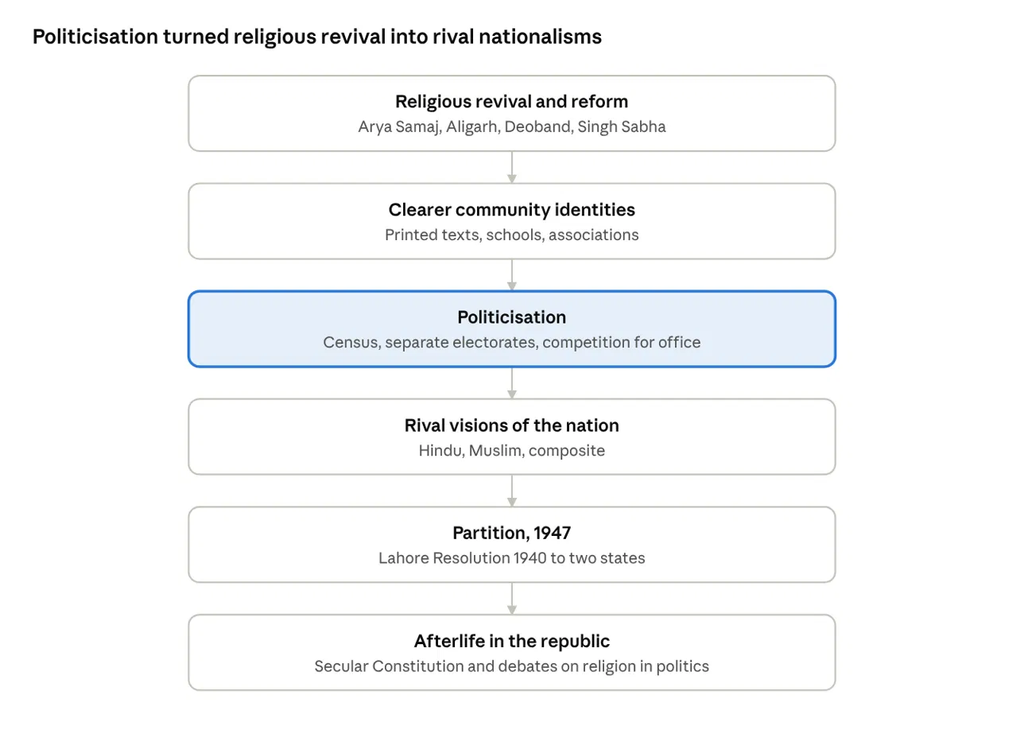
Read from the top: reform and revival defined communities, politicisation gave them a stake in power, and rival visions of the nation followed.
4. Roots of religious nationalist approaches
The approaches came out of changes in the nineteenth century. A student should know the social and political conditions which made religion a basis of national feeling.
Religious reform and revival. The Brahmo Samaj (1828), the Arya Samaj (1875), the Ramakrishna Mission (1897), the Aligarh movement of Sayyid Ahmad Khan, the Deoband school (1866), the Singh Sabha movement of the Sikhs (1873) and others gave each community a more defined sense of itself. Reformers defined their faiths in terms of texts and beliefs, and this made boundaries clearer than in earlier times, as Harjot Oberoi has argued for the Sikhs.
Colonial census and classification. From 1871 and regularly from 1881, the census asked people for their religion and counted them, and the results were published as the share of each community. Numbers became important in politics. Scholars such as Gyanendra Pandey, Bernard Cohn and Nicholas Dirks hold that this made religious communities into fixed political groups.
Colonial writing of history. James Mill’s History of British India divided the past into Hindu, Muslim and British periods, and his scheme was taken into schoolbooks. Later writers on each side used the same scheme to tell the story of their own community. The note on the liberal view of colonialism describes this division.
Competition for jobs, education and office. Under colonial rule, access to government posts, schools and councils depended on education and on community numbers. The demand for quotas and safeguards, such as the Muslim demand in the Simla Deputation of 1906, shaped political identity. Francis Robinson and Paul Brass argue that elites used religious identity to win these advantages.
Separate electorates. The Morley-Minto reforms of 1909 gave Muslims separate electorates, and the system was widened by the Montagu-Chelmsford reforms of 1919 and the Communal Award of 1932. It gave rewards for organising along religious lines. The Poona Pact of 1932 set the reserved seats for the depressed classes in a different form.
Cultural nationalism and the Hindu revival. The novel Anandamath (1882) of Bankim Chandra Chatterjee and its song Vande Mataram, the Ganapati and Shivaji festivals begun by Tilak in 1893 and 1895, and the spiritual nationalism of Aurobindo and Vivekananda gave a religious style to the national movement. This was meant to unite Indians, but it also made some Muslims feel left out.
Pan-Islamic ideas. The Khilafat movement of 1919 to 1924, which was concerned with the Ottoman Caliph, linked Indian Muslims with a world community of Islam. It brought Muslims and Hindus together for a time under Gandhi, but its collapse was followed by riots.
European ideas of nationality. Nineteenth-century European ideas that a nation is a people of one race, language and culture came to India through education. Savarkar and others read the works of European nationalists, and the example of Italian and German unification, and applied the idea of the nation as a cultural unit to India.
| Root | Content | Effect |
|---|---|---|
| Religious reform and revival | Arya Samaj, Aligarh, Deoband, Singh Sabha | Defined and organised communities |
| Census | Religion counted from 1871 and 1881 | Numbers become political |
| History writing | Hindu, Muslim and British periods | Communal framing of the past |
| Competition for office | Posts, schools and councils | Identity used to claim shares |
| Separate electorates | 1909, 1919, 1932 | Politics organised by community |
| Cultural nationalism | Anandamath; festivals; Aurobindo | Religious style in the national movement |
| Pan-Islamic ideas | Khilafat, 1919 to 1924 | Link with the world of Islam |
| European nationalism | Nation as one race, language and culture | Model for definitions of the nation |
5. The Hindu nationalist approach
The Hindu nationalist approach holds that India is, in its basic character, a nation of the Hindus. It has a political form, called Hindutva, and a cultural form, which has older roots. This section describes its main thinkers and its way of reading history.
Early cultural nationalism. Before the term Hindutva, writers such as Bankim Chandra, Tilak, Aurobindo, Bipin Chandra Pal and Vivekananda connected the national awakening with Hindu religion and culture. They stressed spiritual strength and the glory of the past. Aurobindo, for example, spoke of nationalism as a religion. Most of them wished to include all Indians, but their language was drawn from the Hindu tradition.
The Arya Samaj and the shuddhi movement. Dayananda Saraswati founded the Arya Samaj in 1875 and called for a return to the Vedas. His followers ran schools, such as the Dayanand Anglo-Vedic colleges, and started the shuddhi movement of reconversion. Its competition with Muslim and Christian missions sharpened community lines in Punjab and the United Provinces.
The Hindu Mahasabha. Founded in 1915, with Madan Mohan Malaviya and Lajpat Rai among its leaders, it claimed to protect Hindu interests. In the 1920s, after the end of the Khilafat movement and the riots, it grew, and under Savarkar’s presidency from 1937 it took up the demand for a Hindu nation.
V. D. Savarkar and Hindutva. Savarkar, who had been a revolutionary and was jailed in the Andamans, wrote Essentials of Hindutva (1923) in Ratnagiri jail. He defined the Hindu as one who treats India as fatherland and holy land, and so included Sikhs, Jains and Buddhists, but left out Muslims and Christians whose holy land lay elsewhere. He wrote The Indian War of Independence of 1857 (1909) to present the revolt as a national war, and his later works, such as Six Glorious Epochs of Indian History, read Indian history as a long Hindu resistance to foreign rule.
The Rashtriya Swayamsevak Sangh and Golwalkar. K. B. Hedgewar founded the RSS at Nagpur in 1925, with an aim to build disciplined Hindu volunteers. M. S. Golwalkar led it from 1940 to 1973. His We, or Our Nationhood Defined (1939) and later Bunch of Thoughts (1966) held that the Hindu culture is the base of the nation and that others must respect it. The RSS was banned after Gandhi’s assassination in 1948 and the ban was lifted in 1949.
Deendayal Upadhyaya and integral humanism. The Bharatiya Jana Sangh was formed in 1951 under Syama Prasad Mookerjee. Upadhyaya’s Integral Humanism (1965) gave it a philosophy, which called for a rooted Indian approach to politics and economy, between capitalism and communism, and with the idea of cultural nationalism.
Hindu nationalist historiography. Writers in this stream, such as R. C. Majumdar, in the series The History and Culture of the Indian People (1951 to 1969), and K. M. Munshi, tell of an ancient and continuous Indian civilisation. They give weight to the Vedic and classical ages, to resistance to invaders, and to figures such as Shivaji and Rana Pratap. They hold that the Muslim period involved conquest and religious conflict and that Hindu culture survived against it, though other scholars read the period as one of both conflict and exchange. Majumdar also held that the Congress and Gandhi had been given too much credit and the revolutionaries too little.
Cultural nationalism in later politics. The Vishva Hindu Parishad (1964), the Bharatiya Janata Party (1980) and the Ayodhya movement of the 1980s and 1990s took the ideas into electoral politics. The demolition of the Babri Masjid on 6 December 1992 was a major event, followed by riots. The Supreme Court decided the title case in 2019.
| Thinker or body | Work or date | Main idea |
|---|---|---|
| Bankim, Tilak, Aurobindo | Anandamath (1882); festivals; writings | Spiritual and cultural nationalism |
| Dayananda Saraswati | Arya Samaj (1875) | Return to the Vedas; shuddhi |
| Hindu Mahasabha | 1915 | Organised Hindu political interest |
| V. D. Savarkar | Essentials of Hindutva (1923) | Nation defined by fatherland and holy land |
| K. B. Hedgewar; M. S. Golwalkar | RSS (1925); We, or Our Nationhood Defined (1939) | Hindu culture as national culture |
| Deendayal Upadhyaya | Integral Humanism (1965) | Rooted political philosophy |
| R. C. Majumdar; K. M. Munshi | History and Culture of the Indian People | Hindu nationalist historiography |
| VHP; BJP | 1964; 1980 | Cultural nationalism in electoral politics |
6. Muslim nationalist approaches and the two-nation idea
The Muslim nationalist approach holds that the Muslims of India form a community with its own identity and political interests, which in its strongest form led to the demand for a separate state. This section describes the stages, using neutral terms.
Sayyid Ahmad Khan and Aligarh. Sayyid Ahmad Khan founded the Muhammadan Anglo-Oriental College at Aligarh in 1875. He urged Muslims to take up modern education and loyalty to the British, and advised them to stay away from the Congress, which he feared would be dominated by the Hindu majority. His speeches at Lucknow (1887) and Meerut (1888) described Hindus and Muslims as separate communities with different interests. His view is read by some as a call for protection of a minority and by others as the root of separatism.
The Simla Deputation and the Muslim League. In October 1906, a Muslim delegation led by the Aga Khan met the Viceroy Minto at Simla to ask for separate electorates and fair weight in the councils. The All-India Muslim League was founded at Dhaka in December 1906. The separate electorates granted in 1909 gave the League a platform.
Cooperation and the Lucknow Pact. In 1916 the Congress and the League made the Lucknow Pact, which accepted separate electorates and set out the share of Muslim seats in the councils. The Khilafat movement of 1919 to 1924 brought Muslim and Hindu leaders together. Both were signs that the story was not simply one of conflict.
Iqbal and the idea of a Muslim state. Muhammad Iqbal, the poet and philosopher, in his address to the Muslim League at Allahabad in December 1930, proposed that the Muslims of the north-west should have a consolidated state within or beside an Indian federation. His thought combined the idea that Islam is a total way of life with the need for a political home.
Choudhry Rahmat Ali and the name Pakistan. In a pamphlet of 1933, Now or Never, Rahmat Ali and some students at Cambridge used the name Pakistan for a Muslim state. It was a student proposal at first and was not accepted by leaders of the League.
Jinnah and the two-nation theory. M. A. Jinnah, once an ambassador of Hindu-Muslim unity and a member of the Congress, became the leader of the League. After the elections of 1937 and the formation of Congress ministries in the provinces, the League alleged that Muslim interests were not safe. In his presidential address at Lahore in March 1940, Jinnah argued that Hindus and Muslims were two nations, and the Lahore Resolution of 23 March 1940 called for independent states in the Muslim-majority areas. In 1946 the League took Direct Action on 16 August, which was followed by violence in Calcutta.
Muslim historiography of the movement. Writers such as I. H. Qureshi, in The Muslim Community of the Indo-Pakistan Subcontinent (1962), told the history of Muslim India as that of a distinct community. This became the base of the official history of Pakistan.
Revisionist scholarship. Ayesha Jalal, in The Sole Spokesman (1985), argued that Jinnah used the demand for Pakistan as a bargaining counter to win equal power for Muslims in a united India, and that the final Partition was not what he fully intended. Her view is debated. Francis Robinson argued that the roots of Muslim separatism lay in the politics of the United Provinces Muslims, who defended their position in government service and education.
| Stage | Date | Event or thinker | Main idea |
|---|---|---|---|
| Aligarh | 1875 to 1888 | Sayyid Ahmad Khan | Modern education; caution about the Congress |
| Simla Deputation | 1906 | Aga Khan | Separate electorates and weight |
| Muslim League | 1906 | Dhaka | Organised Muslim political interest |
| Lucknow Pact | 1916 | Congress and League | Cooperation; separate electorates accepted |
| Iqbal | 1930 | Allahabad address | A Muslim state in the north-west |
| Rahmat Ali | 1933 | Now or Never | The name Pakistan |
| Jinnah | 1940 | Lahore address and resolution | Two-nation theory |
| Jalal | 1985 | The Sole Spokesman | Pakistan as bargaining counter |
7. Composite nationalism, Gandhi and other religious strands
Not all approaches which used religion held that the nation was based on one faith. Some argued for a nation of many faiths, and others spoke for smaller communities.
Composite nationalism of Azad and Madani. Maulana Abul Kalam Azad, in his presidential address at the Congress session of Ramgarh in 1940, said that he was a Muslim, proud of the heritage of Islam, and also an Indian, proud of the common heritage of India, so that a single Indian nationality had been formed from centuries of common life. Husain Ahmad Madani, a leader of the Deoband school and of the Jamiat Ulama-i-Hind, argued in Muttahida Qaumiyat aur Islam (1938) that Muslims and Hindus could be one nation in the sense of a common homeland, while keeping their religions. This is the main religious alternative to the two-nation theory.
Gandhi’s religious politics. Gandhi’s politics was based on his religious beliefs, and he used terms such as Ram Rajya, ahimsa and satyagraha. He held that religion and politics could not be separated, but he meant a religion of truth and non-violence, shared by all faiths, and he held prayer meetings with texts of many religions. He supported the Khilafat movement in 1919 to 1924 in order to join Hindu and Muslim causes. Critics have said that his religious language gave comfort to Hindu revivalism and alienated some Muslims, while others hold that he was the main figure against communal politics. He was shot by Nathuram Godse, who had been linked with Hindu nationalist groups, on 30 January 1948.
Tagore’s critique. In his lectures on Nationalism (1917), Rabindranath Tagore criticised the idea of the nation as a political and military machine, and warned against narrow nationalism. He pleaded for a society based on cultural and human values. His view is often used against religious and ethnic nationalism.
Ambedkar’s analysis. B. R. Ambedkar, in Pakistan or the Partition of India (1940, enlarged 1945), examined the Muslim demand for Pakistan and the Hindu response with care. He held that the League’s claim was based on real fears, and argued that the Hindu social order, with caste, was a main obstacle to a national feeling. His conversion to Buddhism in 1956 was a religious step linked to a political claim for equality.
Sikh religious nationalism. The Singh Sabha movement (1873) defined Sikh identity as separate from Hindu. The Akali movement for the control of gurdwaras led to the formation of the Shiromani Gurdwara Parbandhak Committee in 1920 and the Sikh Gurdwaras Act of 1925. The Akali Dal later asked for protection for the Sikhs. In the later twentieth century, the demand for Punjabi Suba and, in the 1980s, for Khalistan, led to a period of violence. Harjot Oberoi, in The Construction of Religious Boundaries (1994), argues that Sikh identity was made sharper in the colonial period.
Other community movements. Christian communities in the north-east and elsewhere, Parsis and the Dravidian movement of Periyar, which rejected Brahminical Hinduism, show that religious and cultural identity appeared in many forms and was not limited to the Hindu and Muslim cases.
| Strand | Leader or text | Idea of the nation |
|---|---|---|
| Composite nationalism | Azad (1940); Madani (1938) | One nation of many faiths |
| Gandhi | Ram Rajya; satyagraha | Politics grounded in a shared ethical religion |
| Tagore | Nationalism (1917) | Critique of the narrow nation |
| Ambedkar | Pakistan or the Partition of India (1940, 1945) | Caste and social equality central |
| Sikh | Singh Sabha; Akali Dal | A distinct community; protection and autonomy |
| Dravidian and other | Periyar; community movements | Cultural identity against a single national model |
8. Scholarly study of religion and nationalism
A second meaning of the approach is the academic study of how religion and nationalism join. Scholars have given several answers, and a student should know the main schools.
Primordialist and modernist views. Primordialists hold that religious and ethnic identities are old and deeply rooted. Modernist writers, such as Ernest Gellner in Nations and Nationalism (1983), Benedict Anderson in Imagined Communities (1983) and Eric Hobsbawm, hold that nations and their identities are made in the modern period by print, schools, markets and states. Most scholars of India take a modernist or constructivist view.
Instrumentalist view. Paul Brass, in Language, Religion and Politics in North India (1974), argued that elites choose and use symbols of language and religion to compete for power and resources. Francis Robinson’s study of Muslim politics in the United Provinces is of the same kind. Critics say that this view underrates sincere belief.
Communalism as ideology. Bipan Chandra, in Communalism in Modern India (1984), and Romila Thapar, Harbans Mukhia and Chandra in Communalism and the Writing of Indian History (1969), held that communalism is a modern ideology, formed under colonial conditions and by competition for jobs and power, and that the old picture of an eternal Hindu-Muslim conflict is a colonial and communal myth. In their view, it is not true religion but its use in politics.
Construction of communalism. Gyanendra Pandey, in The Construction of Communalism in Colonial North India (1990), argued that colonial records and categories described conflicts as religious, and so helped to fix them. Sandria Freitag, in Collective Action and Community (1989), traced how public ceremonies and riots created community feeling in the north.
Peter van der Veer. In Religious Nationalism (1994), van der Veer studied Hindu and Muslim nationalisms together, and argued that they were formed in the same process, through new religious organisations, the colonial public sphere and the competition over sacred sites such as Ayodhya.
Christophe Jaffrelot and Thomas Blom Hansen. Jaffrelot’s The Hindu Nationalist Movement and Indian Politics (1996) traced the history of the Hindu nationalist family of organisations, and the strategies they used. Hansen’s The Saffron Wave (1999) studied the rise of Hindu nationalism in democratic politics. Both are standard works.
Mark Juergensmeyer on the global pattern. In The New Cold War? (1993), Juergensmeyer compared religious nationalism in India, the Middle East and elsewhere, as a reaction against secular nationalism in the third world. He treated it as a response to the failure of the secular state to satisfy people’s needs for identity and meaning.
The debate on secularism. Ashis Nandy, in An Anti-Secularist Manifesto (1985), and T. N. Madan, in Secularism in Its Place (1987), argued that Western secularism did not fit Indian society and that the state’s attempts to enforce it could produce conflict. Rajeev Bhargava and others, in Secularism and Its Critics (1998), defended a form of principled distance between religion and the state. The debate links directly with the study of religious nationalism.
| Scholar | Work | Argument |
|---|---|---|
| Gellner; Anderson | Nations and Nationalism (1983); Imagined Communities (1983) | Nations and identities are modern constructs |
| Paul Brass | Language, Religion and Politics (1974) | Elites use religion and language as resources |
| Bipan Chandra | Communalism in Modern India (1984) | Communalism as a modern ideology |
| Gyanendra Pandey | Construction of Communalism (1990) | Colonial categories fixed religious conflict |
| Peter van der Veer | Religious Nationalism (1994) | Hindu and Muslim nationalisms formed together |
| Jaffrelot; Hansen | The Hindu Nationalist Movement (1996); The Saffron Wave (1999) | History and politics of Hindu nationalism |
| Juergensmeyer | The New Cold War? (1993) | Religious nationalism as reaction to secular state |
| Nandy; Madan; Bhargava | Secularism debate | Fit of secularism in India |
9. Religion, Partition, the secular state and legacy
The religious nationalist approaches have not remained only historical. They shaped the end of colonial rule and still shape debates over the state.
The road to Partition. The Cabinet Mission of 1946, the elections of 1945 and 1946 in which the League won most Muslim seats, the Direct Action Day of 16 August 1946, the riots in Calcutta, Noakhali, Bihar and Punjab, and the Mountbatten Plan of June 1947 led to the Partition of the country on 15 August 1947. Historians still debate the roles of the Congress, the League, the British and the local forces in this outcome.
Human cost. The Partition caused one of the largest forced movements of people in history, with deaths estimated at between several hundred thousand and a million or more, and about fifteen million displaced. Scholars such as Urvashi Butalia in The Other Side of Silence (1998) and Gyanendra Pandey in Remembering Partition (2001) have recovered the experience of ordinary people, women in particular.
The secular Constitution. The Constituent Assembly adopted a Constitution with fundamental rights, including freedom of religion in Articles 25 to 28, equality before law and non-discrimination in Articles 14 and 15, and the rights of minorities in Articles 29 and 30. The word secular was added to the Preamble by the 42nd Amendment in 1976. The framers chose a civic nationhood over a religious one, as Nehru’s Objectives Resolution had stated.
Nehru’s secularism and the debate on it. Nehru held that the state should treat all religions equally and keep religion out of politics. Critics from the Hindu nationalist side hold that this has meant favour to minorities, a charge they call pseudo-secularism, while critics such as Nandy and Madan hold that it is too Western. Defenders reply that it has protected minorities and kept the country together.
The Hindu nationalist rise. After the Emergency, the Janata government of 1977 included the Jana Sangh, which became the Bharatiya Janata Party in 1980. The Ayodhya movement of the late 1980s, the demolition of 1992 and the electoral success of the party since the 1990s made religious nationalism a main force in politics. In 2019 the Supreme Court gave its judgment on the Ayodhya title case.
Religion and nationalism in the neighbourhood. The 1971 war and the independence of Bangladesh showed that religion alone did not hold a state together, since language and economic issues also mattered. In Pakistan, the debate on the role of Islam in the state has continued, and in Sri Lanka and elsewhere similar questions have arisen.
The continuing questions. The religious nationalist approaches leave open questions that appear in every examination of the subject: how far can a state be neutral between religions, how are minority rights to be protected, how is a common identity built in a plural society, and how should history be taught.
| Theme | Content | Point for the student |
|---|---|---|
| Partition | 1946 to 1947; League, Congress, British | Causes still debated |
| Human cost | Mass migration and violence | Oral histories of survivors |
| Constitution | Articles 25 to 30; secular Preamble | Civic nationhood chosen |
| Secularism | Nehru’s model and its critics | Principled distance versus Western import |
| Hindu nationalist politics | Jana Sangh; BJP; Ayodhya | Religion in electoral politics |
| Regional comparison | Bangladesh, Pakistan, Sri Lanka | Religion alone does not hold a state together |
10. Critiques of religious nationalist approaches
These approaches have been criticised from several positions, and a student should state the main objections along with the school which makes them. The criticisms are directed both at the nationalisms themselves and at the way they write history.
The liberal and secular nationalist critique. The Congress, Gandhi, Nehru and Azad held that India was a nation of many faiths, and that defining the nation by one religion would divide the people and betray the movement’s common struggle against colonial rule. The liberal nationalist approach, described in a separate note, explains communal division mostly as a result of colonial policy.
The Marxist critique. Marxist writers, including R. P. Dutt and Bipan Chandra, argued that religious politics hid class interests and served the elites of each community, who used religion to win office and divert attention from economic issues. For them, communalism is a form of false consciousness.
The modernist and constructivist critique. Scholars such as Pandey, Freitag and Oberoi argued that religious identities were not old and fixed, but were shaped in the colonial period, and that the stories of ancient Hindu-Muslim enmity were read back from the present. They also note that earlier times were marked by a good deal of mixed practice, shared saints and shrines, and local cooperation.
The critique of the use of history. Romila Thapar and others in Communalism and the Writing of Indian History (1969) argued that communal historiography began with colonial writers and was taken over by Hindu and Muslim nationalists, who selected facts to support their views. Writers on the Hindu nationalist side reply that the secular and Marxist historians have themselves been one-sided, and have played down the harm done in some periods. The debate on school textbooks has shown this conflict in public.
The Dalit and anti-caste critique. Ambedkar held that Hindu nationalism, by speaking of Hindu unity, passed over the injustice of caste. Later writers add that the idea of a single Hindu nation needs to explain the inequality inside it, and that for Dalits the nation has sometimes been a place of exclusion.
The feminist critique. Feminist scholars, such as Tanika Sarkar and Urvashi Butalia in Women and the Hindu Right (1995), and others writing on Muslim and Sikh cases, have shown that women are made symbols of community honour and purity, and that their rights are sometimes set aside for the sake of identity. They also note that women took part in these movements in their own right.
The critique from minorities. Muslim, Christian and Sikh critics of Hindu nationalism hold that it casts them as outsiders in their own country. Some Hindu critics of Muslim and Sikh separatism say that it threatened the unity of the country. The debates are, therefore, about the rights of citizens as well as theory.
The critique of the instrumental view. Writers who stress faith say that the elite manipulation theory treats believers as if they were only pawns, and that religion has its own force. This critique asks for attention to belief, ritual and feeling as well as to interest.
The limits of Partition explanations. Historians point out that many Muslims, including those of the Deoband school, Pashtun leaders such as Abdul Ghaffar Khan, and the Unionists of Punjab, opposed the League’s demand for some time. A view that places all Muslims behind the two-nation theory is therefore incomplete.
| Critic | School | Main objection |
|---|---|---|
| Gandhi, Nehru, Azad | Liberal and secular nationalist | One nation of many faiths; division betrays the struggle |
| Dutt; Bipan Chandra | Marxist | Religion hides class interest |
| Pandey; Freitag; Oberoi | Constructivist | Identities made in colonial times |
| Thapar and others | Historians | Communal history selects facts |
| Hindu nationalist writers | Critics of secular history | Secular and Marxist history is one-sided |
| Ambedkar | Anti-caste | Caste inequality inside the nation |
| Feminist scholars | Feminist | Women made symbols of community honour |
| Scholars of faith | Anti-instrumentalist | Belief has its own force |
11. Importance and limitations of the study of religious nationalism
Importance
Explains the making of the Indian state. The study shows why India chose a secular civic nationhood in 1950 and why Pakistan was formed in 1947. Without it, the Partition and the Constitution cannot be understood.
Shows that nationalism has many forms. It teaches that Indian nationalism was not one movement with one idea, but a field of rival visions, such as the Hindu, Muslim, composite and Dalit-Bahujan ones.
Helps in reading the colonial period. It draws attention to the part played by the census, separate electorates, history writing and reform movements in shaping religious identities.
Links religion and politics. It supplies concepts for understanding how faith, community and power are connected, and why religion remains a strong force in modern politics.
Gives tools for comparison. The concepts of religious nationalism, communalism and secularism can be used to compare India with Pakistan, Bangladesh, Sri Lanka, Israel and others.
Corrects one-sided histories. By setting out Hindu, Muslim and composite views side by side, it helps a student see how each tells the past and what it leaves out.
Throws light on minority questions. It brings to the fore the problems of minority rights, representation and safeguards, which are still live in public life.
Prepares for the study of secularism. It leads directly to the debates on the meaning of secularism in India, on principled distance and on personal laws.
Helps understand contemporary politics. The rise of Hindu nationalist politics, the Ayodhya dispute and debates on citizenship and textbooks cannot be followed without this background.
Trains critical and neutral reading. It asks the student to study contested views without taking sides, to separate claims from evidence, and to read sources with care. This is a valuable academic skill.
Limitations
Risk of treating religion as the only factor. A focus on religion can hide class, caste, language, region and gender, which also shaped political choices.
Contested terms. Words such as communalism, Hindu nationalism, Muslim nationalism and secularism are used in different ways, and each carries political weight. Care is needed when using them.
Danger of reading the present into the past. Writers may find the roots of present conflicts in medieval or ancient times, though identities in those periods were not the same as modern ones.
Partisan uses of history. Hindu, Muslim and secular historians have each been accused of selecting evidence. A student needs to read several authors.
Elite focus. Many studies are of leaders, organisations and texts, and say less about the beliefs and practice of ordinary people, especially women, peasants and Dalits.
Difficulty of sources. Records are mostly colonial or written by elites, and oral histories of Partition are partial and later in date. Evidence on motives, such as Jinnah’s real aims, is disputed.
Problem of generalisation. Hindus, Muslims and Sikhs were not blocks with a single opinion. Many Muslims opposed the League for a time and many Hindus opposed Hindu nationalism.
Tension between explanation and justification. To explain a movement is not to approve it, but the line is sometimes blurred in public debate. Notes such as this one aim at the first.
Limited coverage of other faiths. Most accounts centre on Hindu and Muslim cases, and Christian, Buddhist, Jain, tribal and other traditions receive less attention.
Changing scholarship. New work on Partition, Hindutva and secularism appears often, so that conclusions held today may be revised.
Illustrations
| Illustration | Event or text | What it shows |
|---|---|---|
| Hindutva defined | Savarkar, Essentials of Hindutva (1923) | Nation defined by fatherland and holy land |
| Separate electorates | 1909; Lucknow Pact 1916 | Politics organised by religion |
| Two-nation claim | Lahore Resolution, 23 March 1940 | Muslim state demanded |
| Composite nationalism | Azad, Ramgarh address, 1940 | One nation of many faiths |
| Partition | 15 August 1947 | Cost of religious division |
| Secular Constitution | Articles 25 to 30 | Civic nationhood chosen |
| Ayodhya | 1992 demolition; 2019 judgment | Religion and politics in the present |
12. Using this topic in examinations
What examiners expect
| Question type | What to do | Key points to include |
|---|---|---|
| Define religious nationalism | Give a definition, a scholar and an example | Religion as basis of national identity; Savarkar or Jinnah; van der Veer |
| Explain the Hindu nationalist approach | Name thinkers and ideas | Savarkar 1923; RSS 1925; Golwalkar; Upadhyaya |
| Explain the Muslim nationalist approach | Give stages | Aligarh; League 1906; Iqbal 1930; Lahore 1940 |
| Discuss composite nationalism | Contrast with two-nation view | Azad 1940; Madani 1938; Gandhi |
| Critically examine | Give views and critiques | Constructivist, Marxist, secular and Hindu nationalist replies |
| Short note | Keep to one idea, with dates | Sources and examples |
Practice questions
- Define religious nationalism and explain its main characteristics in the Indian context.
- Examine the roots of religious nationalist approaches in colonial India.
- Discuss the Hindu nationalist approach with reference to Savarkar and Golwalkar.
- Trace the development of Muslim nationalist thought from Sayyid Ahmad Khan to the Lahore Resolution.
- Compare composite nationalism with the two-nation theory.
- Critically assess the view that communalism is a product of colonial rule.
- Write short notes on: (a) Hindutva, (b) the Lahore Resolution, (c) Azad’s Ramgarh address.
Structured outline for a long answer
Introduction. Define religious nationalism, state that India saw rival visions of the nation, and name the main approaches.
Body. Describe the roots in colonial India, then the Hindu, Muslim and composite approaches with thinkers and dates, then the scholarly interpretations and critiques, and then the legacy in Partition and the Constitution.
Conclusion. State that these approaches shaped the history of the subcontinent, that scholars differ on their origins, and that a balanced study explains them without endorsing any.
Sample answer (about 200 words)
Question: Explain the Hindu nationalist approach to the study of nationalism in India.
The Hindu nationalist approach holds that India is, in its basic character, a nation of the Hindus, bound by a common culture, territory and history. Its roots lie in the cultural nationalism of Bankim Chandra, Tilak and Aurobindo, and in the Arya Samaj of 1875. V. D. Savarkar gave it a political form in Essentials of Hindutva (1923), defining the Hindu as one who regards India as fatherland and holy land. The Hindu Mahasabha (1915) and the Rashtriya Swayamsevak Sangh (1925) organised its followers, and M. S. Golwalkar and Deendayal Upadhyaya added statements of its ideas. Its historians, such as R. C. Majumdar, stressed an ancient, continuous civilisation and resistance to foreign rule. The approach has been criticised by secular nationalists, Marxists and constructivist scholars, who hold that it reads modern identities into the past and overlooks diversity, while its supporters reply that secular history has been one-sided. Studies of it by Jaffrelot and Hansen show its growth in democratic politics. A student should treat it as an idea to be understood, with its evidence and its critics, and not as a creed to be endorsed.
Quick check
Can you state, in one line each, the difference between Hindutva, the two-nation theory and composite nationalism? Can you give one date and one text for each? If yes, you are ready for most questions on this topic.
Common mistakes
Treating religion and communalism as the same. Communalism is the use of religious identity in politics, not religion itself.
Taking sides. An examination answer should describe and weigh views, not praise or condemn them.
Mixing up dates and works. Learn the dates of the Simla Deputation (1906), Essentials of Hindutva (1923), Iqbal’s address (1930) and the Lahore Resolution (1940).
Treating Muslims or Hindus as one block. Show that there were many views inside each community.
Forgetting the colonial context. Mention the census, separate electorates and history writing.
Ignoring composite nationalism. The Azad-Madani position is an essential part of the picture.
13. Critical analysis
Religion as cause or as resource. The main question is whether religious nationalism came from deep religious difference or whether religion was used by leaders as a resource in struggles for power. The instrumentalist and constructivist views stress the second, and those who stress belief give weight to the first. A careful answer holds that both played a part.
Colonial role. Colonial rule did not invent religious difference, but it gave it new political forms through the census, electorates and history writing. The claim that the British alone caused communal division is therefore too simple, as is the claim that they had no part.
Old or new. Whether Hindu and Muslim identities are ancient or modern is a core dispute. Evidence of shared practice and local cooperation in earlier times, along with evidence of conflict, suggests that identities were more fluid than modern definitions allow.
Agency of Indian leaders. The Partition was not only the work of the British. The Congress, the League, the Mahasabha and local leaders each made choices, and historians still debate their weight.
Secularism and its meanings. The Indian state follows a secular model of its own, which is neither a strict separation nor a state religion. Debates continue on whether it protects minorities, whether it favours some groups, and whether it suits Indian society.
Majority and minority. A basic problem for any nation defined by a majority faith is the place of those outside it. A basic problem for any minority is how to protect its interests without creating separate nations.
Gender, caste and class. A full analysis must ask who is left out of the story. Women, Dalits and the poor figure little in the main texts but were deeply affected by the movements and by Partition.
Historiography and bias. Each stream of writing has its own presuppositions. A student should compare accounts, check the sources and note where the language is partisan.
Contemporary relevance. The questions raised by these approaches are not only historical. They arise again in debates on citizenship, personal law and school textbooks, which shows why a neutral understanding is useful.
Model concluding paragraph
Religious nationalist approaches show that the idea of the Indian nation was contested from the start. Hindu nationalists, Muslim nationalists and the advocates of composite nationalism each offered a vision, drawing on history, faith and the conditions of colonial rule. Scholars disagree on how far these identities were old or made, and how far they came from belief or from interest, but most accept that colonial policy, reform movements and competition for power all played a part. The Partition and the secular Constitution were two answers to the same problem. A balanced study explains each view with its evidence and its critics, and it recognises that questions about the place of religion in a plural nation remain open.
14. UGC NET: key authors and books
| Author | Book | Year | Relevance |
|---|---|---|---|
| V. D. Savarkar | Essentials of Hindutva | 1923 | Definition of Hindu and Hindutva |
| M. S. Golwalkar | Bunch of Thoughts | 1966 | RSS ideology |
| Deendayal Upadhyaya | Integral Humanism | 1965 | Jana Sangh philosophy |
| Muhammad Iqbal | Reconstruction of Religious Thought in Islam | 1930 | Islam and political thought |
| Ayesha Jalal | The Sole Spokesman | 1985 | Jinnah and Pakistan demand |
| Francis Robinson | Separatism among Indian Muslims | 1974 | Muslim politics in United Provinces |
| Abul Kalam Azad | India Wins Freedom | 1959 | Composite nationalism and Partition |
| B. R. Ambedkar | Pakistan or the Partition of India | 1940 | Analysis of Pakistan demand |
| Bipan Chandra | Communalism in Modern India | 1984 | Communalism as modern ideology |
| Gyanendra Pandey | The Construction of Communalism in Colonial North India | 1990 | Colonial categories |
| Paul Brass | Language, Religion and Politics in North India | 1974 | Instrumentalist view |
| Peter van der Veer | Religious Nationalism | 1994 | Hindu and Muslim nationalisms |
| Christophe Jaffrelot | The Hindu Nationalist Movement and Indian Politics | 1996 | History of the Sangh family |
| Thomas Blom Hansen | The Saffron Wave | 1999 | Hindu nationalism and democracy |
| Mark Juergensmeyer | The New Cold War? | 1993 | Religious nationalism worldwide |
| Harjot Oberoi | The Construction of Religious Boundaries | 1994 | Sikh identity |
Revision tip. Make a one-page chart with three columns for the Hindu, Muslim and composite approaches, and fill it with thinkers, texts, dates and critics. Then add a fourth column for scholarly interpretations.
15. Key takeaways, sources and further reading
Key takeaways
- Religious nationalism takes religion and the culture linked with it as the base of national identity.
- There were rival visions: a Hindu nation, a separate Muslim nation, and one nation of many faiths.
- The roots lie in religious reform, the census, separate electorates, history writing and competition for office.
- Savarkar (1923), the RSS (1925), Iqbal (1930) and the Lahore Resolution (1940) are key points.
- Azad and Madani argued for composite nationalism.
- Scholars such as Bipan Chandra, Pandey, Brass, van der Veer, Jaffrelot and Hansen offer major interpretations.
- The Partition and the secular Constitution were two responses to the same problem.
- A neutral academic study explains each view with evidence and critics, without endorsing any.
Official sources
- Constitution of India, Legislative Department
- National Archives of India
- Ministry of External Affairs, Government of India
- Lok Sabha, Constituent Assembly Debates
Twenty books for further reading
- V. D. Savarkar, Essentials of Hindutva.
- M. S. Golwalkar, Bunch of Thoughts.
- Deendayal Upadhyaya, Integral Humanism.
- Abul Kalam Azad, India Wins Freedom.
- B. R. Ambedkar, Pakistan or the Partition of India.
- Ayesha Jalal, The Sole Spokesman: Jinnah, the Muslim League and the Demand for Pakistan.
- Francis Robinson, Separatism among Indian Muslims.
- Paul Brass, Language, Religion and Politics in North India.
- Bipan Chandra, Communalism in Modern India.
- Gyanendra Pandey, The Construction of Communalism in Colonial North India.
- Sandria Freitag, Collective Action and Community.
- Peter van der Veer, Religious Nationalism: Hindus and Muslims in India.
- Christophe Jaffrelot, The Hindu Nationalist Movement and Indian Politics.
- Thomas Blom Hansen, The Saffron Wave.
- Mark Juergensmeyer, The New Cold War? Religious Nationalism Confronts the Secular State.
- Harjot Oberoi, The Construction of Religious Boundaries.
- Urvashi Butalia, The Other Side of Silence.
- Rajeev Bhargava (ed.), Secularism and Its Critics.
- Romila Thapar, Harbans Mukhia and Bipan Chandra, Communalism and the Writing of Indian History.
- Sumit Sarkar, Modern India, 1885 to 1947.
Editorial note
These notes are prepared for study and revision. Readers should check facts, dates and quotations against the original sources before citing them. For corrections or suggestions, please use the contact page. See also the disclaimer.
Frequently asked questions
What is religious nationalism? It is the view or movement which makes religion and its culture the base of national identity.
Is Hindutva the same as Hinduism? No. Savarkar defined Hindutva as a political and cultural identity, and it is distinct from the religion as a set of beliefs and practices.
What is the two-nation theory? It is the claim, put forward by Jinnah and the Muslim League, that Hindus and Muslims are two nations, which was the basis of the Lahore Resolution of 1940.
What is composite nationalism? It is the idea, held by Azad and Madani, that people of many faiths form one Indian nation.
Did the British create communalism? Scholars say that colonial policy shaped it, but did not create religious difference, and that Indian leaders also made choices.
How should a student write on this topic? In a neutral, descriptive way, with dates, texts, thinkers and critics.


