
Whose nationalism was the Indian national movement? The liberal nationalist answer is that it was the work of an educated leadership and of a Congress which spoke for all Indians. Marxist writers ask which classes led it, which classes gained from it, and what economic interests lay behind its demands. Subaltern writers ask a different question: where are the peasants, tribals, workers and women who made up most of the people, and why have histories of the movement told them only as followers of leaders?
This note describes both approaches in a neutral academic way. It shows what each argues, the evidence each uses, how they differ from and challenge one another, and how they have been criticised. The aim is to understand them as schools of thought, not to endorse any one of them. It belongs to Core V, Colonialism and Nationalism in India, and should be read with the notes on Marxism and on Post-colonialism as perspectives on colonialism.
1. Meaning and definitions
| Writer | Approach | Core idea about nationalism |
|---|---|---|
| Karl Marx and Friedrich Engels | Marxist | Ideas and movements arise from material and class conditions |
| R. P. Dutt | Marxist | Nationalism as the movement of a rising Indian bourgeoisie against imperial rule |
| A. R. Desai | Marxist | Nationalism as the product of new classes formed by colonial economy |
| Bipan Chandra | Marxist | Nationalism as a broad anti-imperialist movement, with a dominant bourgeois leadership |
| Antonio Gramsci | Western Marxist | Rule through consent and cultural leadership, called hegemony |
| Ranajit Guha | Subaltern Studies | An autonomous politics of the people, apart from the elite |
| Partha Chatterjee | Subaltern Studies | Nationalism as both derived from the West and a claim of difference |
| Gyanendra Pandey | Subaltern Studies | Peasants and the nation’s mainstream; fragments against the grand narrative |
Scholar-wise definitions
Marx and Engels. They did not write a theory of Indian nationalism. In his articles of 1853 on British rule in India, Marx wrote of a double mission of Britain, to destroy old Indian society and to lay the material base of a new one. Later writers built on the idea that political movements are connected with the class structure and the mode of production.
R. P. Dutt. In India Today (1940), Dutt presented colonial rule as an economic system of exploitation, and the national movement as the expression of the Indian capitalist class and middle class as they came into conflict with imperial interests. He also criticised the leadership for compromise with the British.
A. R. Desai. In The Social Background of Indian Nationalism (1948), Desai traced nationalism to the material conditions of colonial rule: the new transport, the English education, the press, the new classes. For him it was the outcome of the objective changes in Indian society.
Bipan Chandra. In The Rise and Growth of Economic Nationalism in India (1966) and India’s Struggle for Independence (1988), Chandra held that the main contradiction was between the Indian people and colonialism, that the movement was a broad one with many classes, and that its leadership was largely bourgeois but pursued the interest of the nation as a whole.
Antonio Gramsci. In the Prison Notebooks, Gramsci used the idea of hegemony for the way in which a class rules through the consent of others, shaped by culture and institutions as well as force. It has been widely used in Indian studies for the ways in which the Congress led a coalition of classes.
Ranajit Guha. In Elementary Aspects of Peasant Insurgency in Colonial India (1983) and his programmatic note in Subaltern Studies I (1982), Guha described the politics of the people as an autonomous domain, which neither came from the elite nor depended on it, and that elite history had not recorded.
Partha Chatterjee. In Nationalist Thought and the Colonial World (1986), Chatterjee argued that Indian nationalism was in part a derivative discourse, which took over the ideas of the West, and in part a claim of difference, held first in the inner and spiritual domain of culture.
Gyanendra Pandey. In The Construction of Communalism in Colonial North India (1990) and later work, Pandey asked how the nation was written as a unity, and what was left out of it in this process, especially the experience of subordinate groups.
Note to the student
The two schools are often paired, but they are not the same. Subaltern Studies began in 1982 partly as a critique of the elite and of older Marxist history, and many later subalternists moved away from Marxism towards post-colonial and cultural ideas. The definitions above are paraphrased, and students should not quote them as exact wording.
What the definitions share
- Nationalism is studied in relation to social groups and power, and not only as ideas or leaders.
- Colonial rule is seen as an economic and political system of domination.
- Class, and in the subaltern case also caste, gender and community, matter for understanding who took part.
- History is read critically, with attention to whose voice is recorded and whose is missing.
2. Characteristics of Marxist and Subaltern approaches
Attention to social groups and not only to leaders. Both schools ask which social groups made the movement, and what they wanted. They move away from stories of great leaders and of the Congress alone.
Material base of politics. The Marxist approach connects ideas and movements with the economy: land, trade, industry, taxes and the class structure. Nationalism is explained by the new classes and interests which colonial rule produced.
Colonialism as an economic system. Marxist writers treat colonial rule as a system of drain and exploitation, with effects such as the decline of handicrafts and the commercialisation of agriculture. Nationalism is then the response of those whose interests were hurt.
Class analysis of the movement. Marxist writers study the bourgeoisie, the landlords, the peasantry, the working class and the middle class, and ask how each took part, gained or lost. The role of the bourgeoisie in leading and limiting the movement is a central question.
The principal contradiction. Bipan Chandra and others hold that the main contradiction under colonial rule was between the Indian people and colonialism, and that other contradictions were secondary. This allowed them to explain the unity of a movement with many classes.
History from below. The Subaltern school took over, from British social historians such as E. P. Thompson, the idea of writing about ordinary people. It looked for the peasant, tribal and worker as a maker of history and not as a follower.
An autonomous domain of the people. Guha argued that alongside elite politics there was a politics of the people, which had its own forms, idioms and organisation, such as rumour, community action and religious language, and was not simply guided from above.
Critique of elitism. Subaltern writers held that colonialist, nationalist and even earlier Marxist histories shared an elite viewpoint, since each treated mass action as a result of elite leadership or of economic want.
Close reading of sources. The Subaltern school read official records, such as police and court papers, against the grain, and used folklore, oral accounts and rumour. This was a change of method as well as of theme.
Concern with culture, consciousness and power. Subaltern writing, and later Marxist writing too, gave attention to religion, caste, language and ideas, and to the question of how dominant groups rule through consent as well as force.
Nationalism questioned. Later subalternists, such as Chatterjee and Pandey, asked whether nationalism was a universal story of liberation, or a project which gave priority to one kind of nation and left out others.
Internal debate and change. The two schools differ, and the Subaltern school itself changed from a Marxist beginning to a post-colonial and cultural turn. This is why it is wrong to treat them as the same.
3. Diagram at a glance
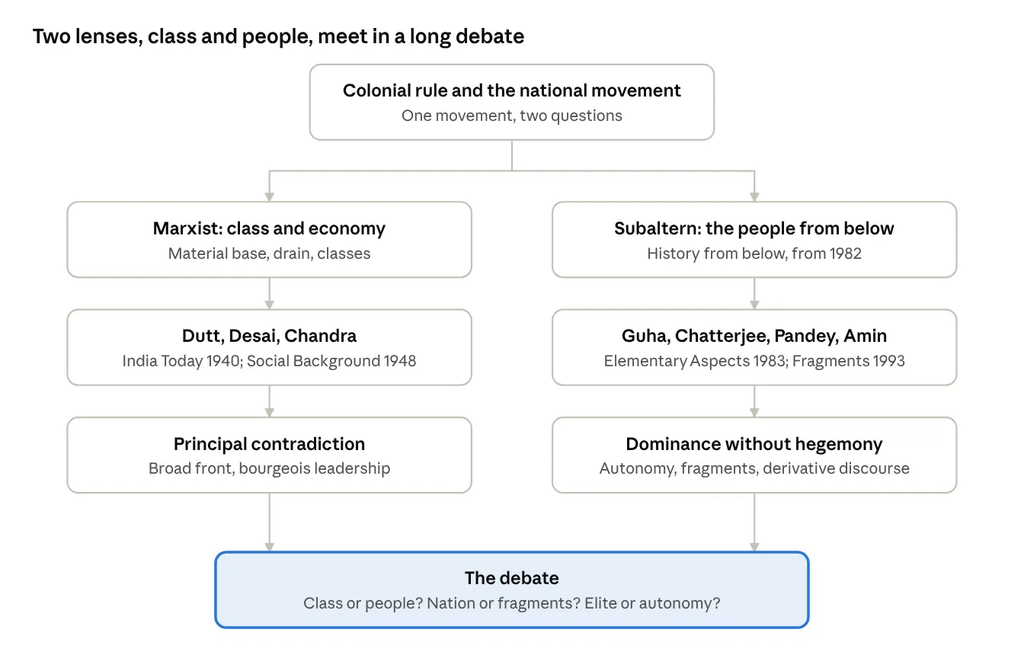
Read down each column: the Marxist lens asks about class and economy, the Subaltern lens about the people from below, and both meet in the debate at the foot.
4. Intellectual roots
The two approaches come from several streams of thought. A student should know their sources and the order in which they came.
Marx on British rule in India. In articles for the New York Daily Tribune in 1853, Marx described British rule as destructive, because it broke the old village and handicraft base, and also as the unconscious tool of a social revolution, because it brought railways, the press and new classes. He also stressed the suffering which this caused. These writings were the starting point for later Marxist reading of colonial India.
Lenin on imperialism. Lenin’s Imperialism, the Highest Stage of Capitalism (1916) presented colonies as a part of the world system of capital. At the Second Congress of the Communist International in 1920, the debate between Lenin and M. N. Roy raised the question of how far communists should support bourgeois nationalist movements in colonies. Roy had argued for an independent communist line, and Lenin’s theses allowed support for national-revolutionary movements.
Indian communist and Marxist writing. M. N. Roy’s India in Transition (1922), R. P. Dutt’s India Today (1940), and the writings of E. M. S. Namboodiripad, set out a class reading of colonialism and nationalism. The Communist Party of India, formed in the early 1920s, took different positions towards the Congress at different times.
Gramsci and Western Marxism. Gramsci’s ideas of hegemony, civil society, passive revolution and the subaltern widened Marxism from an economic reading to one of culture and consent. The word subaltern, taken from him, referred to groups of subordinate social position.
British social history. E. P. Thompson’s The Making of the English Working Class (1963), Eric Hobsbawm’s work on primitive rebels, and the programme of history from below, inspired Guha and others. They sought to bring the people into Indian history.
Dissatisfaction with existing histories. By the 1970s many scholars felt that the nationalist school, the Cambridge school and the older Marxist work all left out the mass of the people, or explained them only through leaders and interest. This was a main cause of the founding of Subaltern Studies.
Post-structuralist and post-colonial ideas. Later, writers in the Subaltern group drew on Foucault, Said and others to ask about power, knowledge and the colonial archive. This is where the link with the post-colonial approach arises.
| Source | Date | Idea | Used by |
|---|---|---|---|
| Marx, Tribune articles | 1853 | Destructive and regenerative effects of British rule | Marxist writers |
| Lenin, Imperialism | 1916 | Colonies in the system of capital | Communist movement |
| Second Comintern Congress | 1920 | Lenin and Roy on national movements | Indian communists |
| Gramsci, Prison Notebooks | 1929 to 1935 | Hegemony, subaltern | Subaltern writers; Chatterjee |
| E. P. Thompson | 1963 | History from below | Guha and others |
| Foucault and Said | 1970s | Power and knowledge | Later Subaltern Studies |
5. The Marxist approach
The Marxist approach explains Indian nationalism through the class structure of colonial society and the interests of the classes in it. Its writers differ among themselves, so a student should note the main positions.
R. P. Dutt. In India Today (1940), Dutt argued that British rule had drained wealth and broken the traditional economy, and that the national movement came from the middle class and the rising bourgeoisie, who had a conflict with imperial interests. He criticised the Congress leadership for compromise, and the Gandhian leadership for restraining the mass movement.
A. R. Desai. In The Social Background of Indian Nationalism (1948), Desai described how the new conditions, such as modern education, the press, communications and new classes, produced a national consciousness. He treated nationalism as the product of material changes, and he noted the part played by the new bourgeoisie and the middle class.
Bipan Chandra. Chandra gave a different emphasis from Dutt. In Nationalism and Colonialism in Modern India (1979) and India’s Struggle for Independence (1988), written with colleagues, he held that the primary contradiction was between the Indian people and colonialism, that early nationalists such as Dadabhai Naoroji and R. C. Dutt had made a real economic critique of colonial rule, and that the Congress was a broad platform with a bourgeois leadership which still served national interests. He also held that Gandhi’s strategy of mass struggle and compromise had a place in a long hegemonic movement, drawn from Gramsci, and was not a simple betrayal.
Sumit Sarkar. In The Swadeshi Movement in Bengal (1973) and Modern India, 1885 to 1947 (1983), Sarkar gave detailed study of the movements, with attention to the middle class, peasants and workers, and to the limits of the leadership. He was a Marxist historian who later was also a member of the Subaltern group before moving away from it.
Irfan Habib and agrarian history. Habib’s work on the agrarian system of Mughal India (1963) and his essays on the colonial economy are a major part of the Marxist account of the pre-colonial base and of the effects of colonial rule. He has also criticised the Subaltern school.
K. N. Panikkar and E. M. S. Namboodiripad. Panikkar’s Against Lord and State (1989), on religion and peasant uprisings in Malabar, and Namboodiripad’s A History of the Indian Freedom Struggle (1986), give an account from within the communist tradition, with attention to the peasant movements and the role of the party.
Economic nationalism and the drain. Marxist writers give weight to the economic critique made by Naoroji, Ranade and R. C. Dutt of the drain of wealth, which they treat as a main source of anti-colonial feeling. Chandra’s The Rise and Growth of Economic Nationalism in India (1966) is the standard study.
The communist position on the Congress. The CPI’s stand changed over time: from criticism of the Congress as bourgeois in the 1920s and 1930s, to the United Front in 1935 to 1939, to the support for the war effort after the Soviet Union entered the war in 1941 and the opposition to the Quit India movement in 1942. Historians have debated these choices.
| Writer | Work | Main argument |
|---|---|---|
| R. P. Dutt | India Today (1940) | Nationalism as a bourgeois and middle-class movement; leadership compromise |
| A. R. Desai | Social Background of Indian Nationalism (1948) | Nationalism from material change and new classes |
| Bipan Chandra | Nationalism and Colonialism (1979); India’s Struggle for Independence (1988) | Principal contradiction with colonialism; broad movement |
| Sumit Sarkar | Swadeshi Movement in Bengal (1973); Modern India (1983) | Movements studied with attention to class and limits |
| Irfan Habib | Agrarian System of Mughal India (1963) | Agrarian base and colonial economy |
| K. N. Panikkar | Against Lord and State (1989) | Peasant uprisings and religion in Malabar |
| E. M. S. Namboodiripad | History of the Indian Freedom Struggle (1986) | Communist account of the movement |
6. The Subaltern Studies approach
Subaltern Studies began in 1982 with a series of volumes edited by Ranajit Guha, and it set out to write the history of those who were left out of elite accounts.
The founding programme. In the preface and in his essay On Some Aspects of the Historiography of Colonial India in the first volume (1982), Guha said that the historiography of Indian nationalism had been dominated by elitism, both colonialist and bourgeois-nationalist, and that it had failed to explain the contribution of the people on their own. He called for a study of the politics of the people as an autonomous domain.
Guha and peasant insurgency. In Elementary Aspects of Peasant Insurgency in Colonial India (1983), Guha studied peasant revolts from the late eighteenth to the early twentieth century, such as the Santhal hool of 1855. He argued that peasants acted through a consciousness of their own, with features such as negation of elite authority, solidarity, and religion, and that these revolts were not mere reaction to hunger.
Pandey, Hardiman and Amin on the peasants and nationalism. Gyanendra Pandey’s study of the peasant movement in Awadh in 1919 to 1922, David Hardiman’s Peasant Nationalists of Gujarat (1981) and Shahid Amin’s studies of Gandhi’s image and of Chauri Chaura (1922) showed that peasants took their own meaning from the Congress and from Gandhi, and used the idea of the Mahatma in ways which the leaders did not intend.
Chakrabarty on labour. Dipesh Chakrabarty’s Rethinking Working-Class History: Bengal 1890 to 1940 (1989) argued that jute workers in Bengal were bound by loyalties of community, religion and kinship, and that a Western model of class consciousness did not fully fit them. This was an early sign of the later turn to culture.
Chatterjee and the nation’s fragments. In Nationalist Thought and the Colonial World (1986), Chatterjee argued that nationalism took over the thought of its colonial rulers in its political aims, but claimed difference in the inner domain of culture and spirit. In The Nation and Its Fragments (1993), he studied how the nationalist project handled women, peasants, lower castes and communities, and how it tried to bring them into a single national narrative.
Guha on dominance without hegemony. In Dominance without Hegemony (1997), Guha argued that the colonial state in India ruled through dominance, a mix of force and persuasion in which force was greater, and that it never won the hegemony of persuasion which a bourgeois state in Europe had. This is a use of Gramsci’s concepts in a reverse way.
Method: the colonial archive. The group read official sources against the grain, and gave attention to the codes of elite documents, such as police reports, which describe peasants as criminals or fanatics. They also used songs, rumours and oral accounts.
The turn from Marxism. From the later 1980s, the group moved from a Marxist concern with class and consciousness towards post-colonial criticism of Western knowledge and the idea of the nation, as in the work of Chakrabarty, Pandey and Gyan Prakash, and in Spivak’s essay Can the Subaltern Speak? (1988). Chakrabarty’s Provincializing Europe (2000) is a main text of this turn.
| Writer | Work | Main argument |
|---|---|---|
| Ranajit Guha | Subaltern Studies I (1982); Elementary Aspects (1983) | Autonomous politics of the people; critique of elitism |
| Ranajit Guha | Dominance without Hegemony (1997) | Colonial state as dominance with weak persuasion |
| Gyanendra Pandey | Peasant movement in Awadh (1982) | Peasants and the Congress in 1919 to 1922 |
| David Hardiman | Peasant Nationalists of Gujarat (1981) | Peasant politics within nationalism |
| Shahid Amin | Gandhi as Mahatma (1984); Event, Metaphor, Memory (1995) | Popular images of Gandhi; Chauri Chaura |
| Dipesh Chakrabarty | Rethinking Working-Class History (1989) | Jute workers and community loyalties |
| Partha Chatterjee | Nationalist Thought and the Colonial World (1986); The Nation and Its Fragments (1993) | Derivative discourse; inner and outer domains |
| Dipesh Chakrabarty | Provincializing Europe (2000) | Critique of European models of history |
7. Debates among the schools
The Marxist and Subaltern approaches differ from one another, and both differ from the nationalist and Cambridge approaches. A student should be able to set out these debates.
With the nationalist school. The older nationalist history, written by Congress leaders and by historians such as R. C. Majumdar in one stream, told a story of a united people led by great leaders against colonial rule. Marxist writers accepted the broad anti-colonial character of the movement but asked about class interests, and the Subaltern writers asked about the voice of the people.
With the Cambridge school. Anil Seal’s The Emergence of Indian Nationalism (1968) and the essays in Locality, Province and Nation (1973) explained nationalism as a competition among elites for the benefits of the colonial state, through networks of patronage. Marxists answered that this left out the economic exploitation of colonialism and the real anti-imperial feeling, and Bipan Chandra criticised the Cambridge view as a denial of the ideas and aims of the movement. Guha argued that the Cambridge and nationalist views shared an elitism.
Marxists and Subalterns: elite or people. The Subaltern group charged that Marxist history, like others, explained peasant action by economic want or by leaders, and treated consciousness as mere reflection of class position. Marxist critics replied that the Subaltern view split the people from the national movement too sharply, made too little of class and economic structure, and risked romanticising the peasantry.
The place of Gandhi and the Congress. Dutt tended to see the Congress leadership as a brake on the masses. Chandra saw a broad strategy with real gains. Guha and the subalternists saw the Congress as an elite force which both mobilised and controlled the peasants, and held that the people used Gandhi’s name in ways he did not intend. Amin’s studies of Chauri Chaura, which Gandhi condemned, are an example.
Hegemony. Chandra used hegemony to explain the Congress’s long leadership of many classes. Guha used it to deny that the colonial state was hegemonic, and Chatterjee used passive revolution to describe how the nationalist elite brought the masses within its order without changing the structure of power. The same concept was used in different ways.
Nation or fragment. Marxists generally took the nation as the unit of an anti-colonial struggle. Subaltern writers, especially in the later phase, asked whether the nation’s single story had been made at the cost of other groups’ stories, which is why Pandey and Chatterjee write of fragments.
Departures from the group. Sumit Sarkar, in The Decline of the Subaltern in Subaltern Studies (in his Writing Social History, 1997), argued that the group had moved too far from social history to cultural criticism. Others, such as Rosalind O’Hanlon, asked how a recovery of the subaltern voice could be justified, and Habib and others from the Marxist tradition criticised the group more strongly.
| Debate | One position | Another position |
|---|---|---|
| Nationalist school | Movement united under great leaders | Marxist: class interests; Subaltern: voice of the people |
| Cambridge school | Elite competition for the state’s patronage | Marxist: colonial exploitation and real anti-imperialism |
| Marxists and Subalterns | Marxist: class structure explains action | Subaltern: people’s own consciousness and culture |
| Gandhi and Congress | Chandra: broad strategy; Dutt: brake on masses | Subaltern: elite mobilised and controlled people |
| Hegemony | Chandra: Congress hegemony | Guha: colonial state without hegemony |
| Nation | Marxist: unit of anti-colonial struggle | Subaltern: nation’s story hides fragments |
8. Evidence: peasants, tribals, workers and women
Both approaches rely on case studies of social movements. These give the student examples to use in answers.
Peasant movements. The indigo revolt of 1859 to 1860 in Bengal, the Deccan riots of 1875, the Champaran satyagraha of 1917, the Kheda campaign of 1918, the Awadh Kisan Sabha and Eka movements of 1919 to 1922, the Bardoli campaign of 1928, and the Tebhaga and Telangana movements of 1946 to 1951 are the main cases. Marxist writers treat them as signs of agrarian class struggle, and Subaltern writers read them as expressions of a rural consciousness.
Tribal uprisings. The Santhal hool (1855 to 1856), the Munda ulgulan led by Birsa Munda (1899 to 1900), and other revolts, such as those of the Bhils and the Kols, are used by Guha and K. S. Singh to show that tribal people rebelled against moneylenders, landlords and officials, using religious ideas and kin ties. Singh’s Dust-storm and Hanging Mist (1966) is a standard study of Birsa.
Religion and mass action. The Moplah rebellion of 1921 in Malabar, studied by Panikkar and by Conrad Wood, and the Chauri Chaura incident of 1922, show how religious language and local grievance combined, and how colonial and elite accounts classified them as fanatical or criminal.
Workers. The Bombay textile strikes of 1928 and 1929, the formation of the All India Trade Union Congress in 1920, the jute workers of Bengal, studied by Chakrabarty, and the railway strikes, show the growth of a labour movement. Marxist writers look for class consciousness, while Chakrabarty found that workers’ loyalties were also of community and religion.
Women. Women took part in the Swadeshi movement, the non-cooperation and civil disobedience movements, the Quit India movement, and in the Tebhaga and Telangana struggles. Writers such as Tanika Sarkar, Kumkum Sangari and Sudesh Vaid, and Radha Kumar have studied the ways in which nationalist ideology treated women, and the difference between women as symbols and as participants.
Lower castes and Dalits. The Self-Respect movement in Tamil Nadu, the Satyashodhak Samaj of Jotirao Phule, the Namasudra movement in Bengal and Ambedkar’s movement raise the question of whose nation was imagined. Subaltern studies have given less attention to caste than critics expected, and later writers such as Sarkar have pointed this out.
Princely states and local movements. Praja mandal movements in the princely states and local movements in regions such as Kerala and Hyderabad show that the national movement had regional forms.
Method point. Both schools use local studies, but they differ in what they find. The same revolt can be read as class conflict, as a people’s own politics, or as a religious movement, and a good answer should say how the reading depends on the school.
| Case | Date | Marxist reading | Subaltern reading |
|---|---|---|---|
| Santhal hool | 1855 to 1856 | Agrarian protest against landlords and moneylenders | Rebellion with its own religious and kin idiom |
| Indigo revolt | 1859 to 1860 | Peasants against planters | Collective refusal across groups |
| Awadh Kisan Sabha | 1919 to 1922 | Peasant class organisation | Peasants and the meaning of Gandhi |
| Chauri Chaura | 1922 | Mass militancy limited by leadership | Memory and meaning of violence |
| Jute workers | 1890 to 1940 | Growth of working-class organisation | Community loyalties shape labour |
| Tebhaga and Telangana | 1946 to 1951 | Class struggle led by communists | Peasant agency and local forms |
9. Gramsci, hegemony and the nation’s fragments
Some of the main concepts used by both approaches come from Gramsci and from the later Subaltern debates. A student should be able to explain them briefly.
Hegemony. For Gramsci, hegemony is the leadership of a class which wins the consent of other groups through culture, ideas and institutions, and not only force. Bipan Chandra used it to explain how the Congress led a coalition of classes, with Gandhian methods drawing the peasantry into a movement of the middle class.
Passive revolution. Gramsci used the term for a change from above, in which a ruling group brings in reforms and absorbs the demands of others without a popular revolution. Chatterjee, in The Nation and Its Fragments and later works, used it for the Indian nationalist elite’s way of bringing the masses under its leadership and later under the state’s planning.
Dominance without hegemony. Guha held that colonial rule in India could not win hegemony of the European kind, because the colonial state could not take the Indian people into its own culture and law, so it ruled by force and by some persuasion. The nationalist elite sought the people for its own cause, and in this the story of the national movement is also a story of an attempt to win the hegemony which the colonial state lacked.
Subaltern. The term, from Gramsci, means a group of subordinate rank, and in Guha’s usage means the people of the lower strata as against the elite, in terms of class, caste, age, gender and office. It names a relation of dominance and subordination, not a fixed group.
Derivative discourse. Chatterjee’s phrase for the claim that anti-colonial nationalism used the same categories of reason, progress and state as the colonial thinkers it opposed, and so remained within the framework of Western thought, though it also claimed a difference.
Inner and outer domains. In The Nation and Its Fragments, Chatterjee described how nationalism separated a material domain of the state, economy and science, in which it took over Western ways, from a spiritual domain of family, religion and culture, in which it claimed to be sovereign even under colonial rule. This helps to explain the role given to women as the guardians of the inner domain.
Fragments. Chatterjee and Pandey used the word for the stories of communities, castes and groups which do not fit the main national narrative. Pandey’s work on communalism and on the memory of Partition asks how the nation’s history is told and what it leaves out.
The colonial archive. Following later subalternists and post-colonial writers, the colonial archive is itself a way of making knowledge and is read for what it conceals. Guha’s essay The Prose of Counter-Insurgency (1983) is a model of reading official documents for how they describe rebels.
| Concept | Source | Meaning | Use in India |
|---|---|---|---|
| Hegemony | Gramsci | Leadership by consent | Chandra on Congress leadership |
| Passive revolution | Gramsci | Change from above absorbing demands | Chatterjee on the nationalist elite |
| Dominance without hegemony | Guha | Rule by force with weak persuasion | The colonial state |
| Subaltern | Gramsci; Guha | Subordinate groups | The people as against the elite |
| Derivative discourse | Chatterjee | Nationalism using Western categories | Nationalist thought |
| Inner and outer domains | Chatterjee | Spiritual domain claimed as sovereign | Women, family, culture |
| Fragments | Chatterjee; Pandey | Stories outside the main narrative | Community and caste histories |
10. Critiques of the two approaches
Both approaches have been criticised from several sides. A student should state each criticism with the school which makes it.
Economic reductionism in the Marxist view. Critics, including Subaltern writers, hold that Marxist accounts explained ideas and movements too closely by class position and economic interest, and neglected culture, religion, caste, gender and the consciousness of actors.
The bourgeois label. Writers have questioned whether the Congress can be described as a bourgeois party. The Congress included many classes, and the Indian business groups, though they gave it funds and support, were not a single bloc, and sometimes took different positions from it. Other writers reply that the label describes the leading social base, not every member.
Fit of European models. Chakrabarty and others argued that Marxist history in India often applied a European model of the transition to capitalism and the making of a working class to Indian conditions, and treated differences as a lack. This is part of the argument in Provincializing Europe.
Party politics. Critics of the communist stand towards the Congress, especially during the Quit India movement of 1942, argue that the party’s position cut it off from popular feeling. Defenders explain it in terms of the anti-fascist war and of the Comintern line.
Elite bias, according to Subaltern writers. Subalterns charged earlier Marxist work with taking the nationalist leadership and the party as the main actors. In their turn they have been charged with exaggerating the gap between the elite and the people.
The autonomy claim. Critics, including Sarkar and Habib, argue that the people’s politics was not wholly separate from the elite’s. Peasants and workers often took part in the national movement with leaders and with organisations, and the evidence for a fully autonomous consciousness is not strong. Others note that the evidence of Awadh and Gujarat shows both links and independence.
Recovering the subaltern voice. O’Hanlon and others asked whether a historian can speak for the subaltern, and whether the sources let one find a consciousness separate from the official record. Spivak’s essay raised a related doubt, about whether the subaltern can be heard within the structures of knowledge.
The silence on caste, gender and region. Later writers observed that the Subaltern group paid little attention to caste, gender and the Dalit movement, and that its early work was mainly concerned with Bengal and north India.
The turn to culture. Marxist critics, such as Sarkar and Habib, held that the later work of the group moved away from social and economic history into criticism of discourse, and risked treating colonialism as a matter of ideas alone. Defenders say it opened new questions.
Nationalist and Hindu nationalist critics. Writers on the nationalist side and the Hindu nationalist side have charged both schools with undervaluing the national movement, and have argued that left historians dominated the academy. Defenders reply that the schools produced evidence-based studies and are open to criticism like any other.
| Critic | School | Main objection |
|---|---|---|
| Subaltern writers | Against Marxists | Economic reductionism; elite focus |
| Marxist writers | Against Subalterns | Autonomy overstated; culture over economy |
| Sumit Sarkar | Insider critic | Decline of social history in Subaltern Studies |
| Irfan Habib | Marxist | Strong criticism of the group’s method |
| O’Hanlon | Feminist and post-colonial | Problem of recovering the subaltern voice |
| Chakrabarty | Post-colonial | European models do not fit |
| Nationalist and Hindu nationalist writers | Outside the left | Undervaluing the national movement |
11. Importance and limitations of the two approaches
Importance
Brings class into the study of nationalism. The Marxist approach shows that nationalism was shaped by the economic interests of classes, and links the movement with the colonial economy, the drain of wealth and the new social groups.
Explains the breadth of the movement. By naming the principal contradiction with colonialism, Chandra and others explain how a movement of many classes with different interests held together over decades.
Gives weight to economic nationalism. The study of Naoroji, Ranade and R. C. Dutt shows that the early nationalist critique of colonialism was grounded in economic analysis and not only in political demands.
Recovers the people. The Subaltern school made peasants, tribals, workers and women visible as actors in the history of nationalism, and showed that they did not merely follow leaders.
Challenges elitist history. It brought the question of whose voice is recorded into the centre of the discipline, and its criticism applies to nationalist, colonial and Marxist writing alike.
Introduces new methods and sources. Reading official documents against the grain, and using songs, rumours, oral accounts and local archives, widened the range of evidence used by historians.
Supplies useful concepts. Hegemony, passive revolution, dominance without hegemony, subaltern, derivative discourse and fragments are widely used tools, in India and elsewhere.
Connects India with global scholarship. Subaltern Studies influenced work on Latin America, Africa and Europe, and moved debates on colonialism and nationalism beyond South Asia.
Opens the links among class, caste, gender and community. Both approaches, and the debates between them, draw attention to the many lines along which Indian society was divided, and to the ways in which nationalism both used and concealed them.
Trains critical reading. The disputes show students that each reading of the past depends on a standpoint, and that one should ask who writes, from what evidence and for whom.
Limitations
Economic reductionism. Marxist accounts have been charged with explaining beliefs and actions too closely by class interest, leaving too little room for culture, religion and ideas.
Problems with the class labels. Terms such as bourgeois and feudal do not fit Indian social groups easily, and the role of caste and community is hard to place in class categories.
Party and ideological commitments. Some Marxist writing was tied to the positions of political parties, and its reading of events, such as the Quit India movement, has been questioned.
Overstating autonomy. The Subaltern claim of a separate domain of the people’s politics has been questioned on the ground that popular and elite politics were often linked.
Problem of sources. Most records are written by officials or elites, and the voice of the subaltern has to be inferred, which leaves room for doubt about what the evidence shows.
Regional and thematic gaps. Early Subaltern work centred on Bengal and north India and gave little attention to caste, gender and the South, until later critics asked for it.
Turn away from social history. Critics hold that the later cultural and discursive emphasis weakened the study of economic and social structure.
Heavy theoretical language. Much writing in this field is dense and uses terms from philosophy and literary theory, which makes it hard for beginning students.
Risk of romanticising the people. Both schools can present peasants and workers as either heroes or victims, and so miss the variety of their motives and conflicts, including violence among them.
Contested conclusions. Findings are disputed within each school and between them, so a student should treat them as interpretations to be weighed.
Illustrations
| Illustration | Event or text | What it shows |
|---|---|---|
| Drain of wealth | Naoroji; R. C. Dutt | Economic basis of early nationalism |
| Class reading of Congress | Dutt, India Today (1940) | Bourgeois leadership and its limits |
| Principal contradiction | Chandra, India’s Struggle (1988) | Broad movement against colonialism |
| Peasant consciousness | Guha, Elementary Aspects (1983) | Autonomous politics of the people |
| Chauri Chaura | 1922; Amin (1995) | Memory and meaning of popular violence |
| Derivative discourse | Chatterjee (1986) | Nationalism and Western categories |
| Dominance without hegemony | Guha (1997) | Colonial state’s weak persuasion |
12. Using this topic in examinations
What examiners expect
| Question type | What to do | Key points to include |
|---|---|---|
| Define the Marxist approach | Define, name writers, give an example | Class and material base; Dutt; Desai; Chandra |
| Define Subaltern Studies | Date, founder, aim | 1982; Guha; history from below; critique of elitism |
| Compare the two | Use a table or paired paragraphs | Class versus subaltern; elite versus people; method |
| Discuss Subaltern critique of elitism | Explain claim, evidence, reply | Guha 1982; Elementary Aspects; critics |
| Critically examine | Give strengths and limits | Reductionism; autonomy claim; archive problem |
| Short note | One idea with a name and a date | Hegemony; derivative discourse; fragments |
Practice questions
- Explain the main features of the Marxist approach to Indian nationalism.
- Discuss the contribution of R. P. Dutt, A. R. Desai and Bipan Chandra.
- What is Subaltern Studies? Examine its critique of elitist historiography.
- Compare the Marxist and Subaltern approaches to the study of nationalism in India.
- Explain Partha Chatterjee’s idea of nationalism as a derivative discourse and of the inner and outer domains.
- Critically assess the view that Indian nationalism was a bourgeois movement.
- Write short notes on: (a) hegemony, (b) dominance without hegemony, (c) the nation’s fragments.
Structured outline for a long answer
Introduction. State that the national movement has been explained by Marxist writers through class and by Subaltern writers through the politics of the people, and name the main figures.
Body. Set out the Marxist approach with its writers, the Subaltern approach with its programme and works, the debates between them and with other schools, and the main concepts and evidence.
Conclusion. Give a balanced judgement: both enlarged the study of nationalism, each has limits, and together they show that nationalism was shaped by many groups and interests.
Sample answer (about 200 words)
Question: What is the Subaltern Studies approach to Indian nationalism?
Subaltern Studies began in 1982 with a series of volumes edited by Ranajit Guha. Its aim was to write the history of the subordinate groups, such as peasants, tribals and workers, who had been left out or treated only as followers in earlier accounts. Guha argued that colonialist and bourgeois-nationalist histories shared an elitist view, and that besides the politics of the elite there was an autonomous politics of the people, with its own idioms and organisation. His Elementary Aspects of Peasant Insurgency (1983) studied peasant revolts in this light, and others, such as Pandey, Hardiman and Amin, studied the peasants’ own readings of Gandhi and the Congress. The group read official records against the grain and used oral and folk sources. Later, writers such as Chatterjee and Chakrabarty moved towards post-colonial criticism, asking how nationalism used Western categories and left out fragments. The approach has been criticised by Marxist writers, such as Sarkar and Habib, who held that it overstated the autonomy of the people and neglected economic structure. It remains important for widening the sources and the subjects of history.
Quick check
Can you say in a sentence each what Dutt, Chandra, Guha and Chatterjee argued, and give one book and one date for each? If you can, you are ready for most questions on this topic.
Common mistakes
Treating the two as one school. The Subaltern group began partly as a critique of older Marxist history and later moved away from Marxism.
Describing Subaltern Studies as only about peasants. It also covers workers, women, communities and later the colonial archive.
Calling the Congress simply bourgeois. Even Marxist writers differ on this, and Chandra stressed its broad character.
Mixing up concepts. Keep hegemony, passive revolution and dominance without hegemony distinct, and say who used each.
Missing dates and titles. Learn 1853, 1940, 1948, 1982, 1983, 1986 and 1993 with the works.
Giving no criticism. An examination answer should give the debates and the critiques, and should not praise either school without limit.
13. Critical analysis
Class and people as two lenses. The Marxist and Subaltern approaches ask different questions of the same movement. One asks which classes led it and gained from it, and the other asks who made it from below. A full account needs both, and each corrects the blind spots of the other.
Unity and division. Chandra’s stress on the principal contradiction explains the unity of the movement. The Subaltern emphasis on fragments explains its limits and silences. Both are true in part, since the movement was at once a broad front and a field of tension.
Leadership and masses. The old picture of leaders mobilising followers is too simple. Studies of Awadh, Gujarat and Chauri Chaura show that the masses acted for their own reasons and read the leaders in their own way, and also that they joined the movement and often needed its organisation.
Consent and force. The idea of hegemony helps to explain the long leadership of the Congress and the weakness of the colonial state’s persuasion. It also leads to the question of whether the Congress’s own hegemony was incomplete, and over whom.
Culture and economy. The cultural turn corrected the neglect of ideas and identities, but a study of nationalism that leaves out the colonial economy loses a main cause. The best recent work combines them.
The archive and its limits. Reading records against the grain gives new knowledge, but it cannot remove the fact that the sources were produced by those in power. Claims about the subaltern mind should be held with care.
Caste, gender and region. The two approaches left gaps, which later writers, such as feminist and Dalit scholars, have begun to fill. A student should say which groups remain thinly covered.
Politics of the schools. Both schools have been drawn into public debate on history and the left in the universities. A balanced answer sets out the evidence and the arguments, and avoids reading them as a party matter.
Present uses. The concepts are now used well beyond the history of nationalism, in studies of caste, labour, development and protest, which shows their reach and also the risk of using them loosely.
Model concluding paragraph
The Marxist and Subaltern approaches have each widened the study of Indian nationalism. The Marxist approach tied the movement to the colonial economy and to the interests of classes, and it explained its breadth through the main contradiction with colonialism. The Subaltern approach asked whose history had been told, and recovered the politics of peasants, tribals, workers and others. They differ on the weight of class, the autonomy of the people and the meaning of the nation, and each has been criticised, the first for reductionism and the second for overstating autonomy and turning from social history. A balanced study uses both, together with attention to caste, gender, culture and region, and treats their findings as interpretations open to argument.
14. UGC NET: key authors and books
| Author | Book | Year | Relevance |
|---|---|---|---|
| R. P. Dutt | India Today | 1940 | Marxist class reading of colonialism and nationalism |
| A. R. Desai | The Social Background of Indian Nationalism | 1948 | Material roots of nationalism |
| Bipan Chandra | The Rise and Growth of Economic Nationalism in India | 1966 | Economic critique of colonialism |
| Bipan Chandra | Nationalism and Colonialism in Modern India | 1979 | Principal contradiction |
| Bipan Chandra and others | India’s Struggle for Independence | 1988 | Standard account of the movement |
| Sumit Sarkar | Modern India, 1885 to 1947 | 1983 | Movements and their social base |
| K. N. Panikkar | Against Lord and State | 1989 | Religion and peasant revolt in Malabar |
| Ranajit Guha (ed.) | Subaltern Studies, vol. I | 1982 | Founding programme |
| Ranajit Guha | Elementary Aspects of Peasant Insurgency in Colonial India | 1983 | Peasant consciousness |
| Ranajit Guha | Dominance without Hegemony | 1997 | Colonial state and hegemony |
| Partha Chatterjee | Nationalist Thought and the Colonial World | 1986 | Derivative discourse |
| Partha Chatterjee | The Nation and Its Fragments | 1993 | Inner and outer domains |
| Dipesh Chakrabarty | Rethinking Working-Class History | 1989 | Jute workers in Bengal |
| Dipesh Chakrabarty | Provincializing Europe | 2000 | Critique of European models |
| Shahid Amin | Event, Metaphor, Memory | 1995 | Chauri Chaura |
| Gyanendra Pandey | The Construction of Communalism in Colonial North India | 1990 | Colonial categories; fragments |
Revision tip. Make a table with two columns, Marxist and Subaltern, and rows for aim, key writers, concepts, evidence and critics. Then add a row for the debates between them.
15. Key takeaways, sources and further reading
Key takeaways
- The Marxist approach explains nationalism through the colonial economy and the interests of classes.
- Dutt, Desai and Chandra give the main Marxist accounts, with different views on the Congress and the bourgeoisie.
- Subaltern Studies began in 1982 under Ranajit Guha, and asks for the history of those left out of elite accounts.
- Guha argued for an autonomous politics of the people, and for dominance without hegemony in the colonial state.
- Chatterjee described nationalism as a derivative discourse with inner and outer domains, and later writers turned to fragments.
- The two approaches differ from one another and from the nationalist and Cambridge schools.
- Critics say the first is reductionist and the second overstates autonomy and turns from social history.
- A balanced answer uses both and treats their findings as interpretations.
Official sources
- Constitution of India, Legislative Department
- National Archives of India
- Ministry of External Affairs, Government of India
- Lok Sabha, Constituent Assembly Debates
Twenty books for further reading
- R. P. Dutt, India Today.
- A. R. Desai, The Social Background of Indian Nationalism.
- Bipan Chandra, The Rise and Growth of Economic Nationalism in India.
- Bipan Chandra, Nationalism and Colonialism in Modern India.
- Bipan Chandra and others, India’s Struggle for Independence.
- Sumit Sarkar, Modern India, 1885 to 1947.
- Sumit Sarkar, The Swadeshi Movement in Bengal, 1903 to 1908.
- K. N. Panikkar, Against Lord and State.
- E. M. S. Namboodiripad, A History of the Indian Freedom Struggle.
- Ranajit Guha, Elementary Aspects of Peasant Insurgency in Colonial India.
- Ranajit Guha, Dominance without Hegemony.
- Ranajit Guha and Gayatri Chakravorty Spivak (eds.), Selected Subaltern Studies.
- Partha Chatterjee, Nationalist Thought and the Colonial World.
- Partha Chatterjee, The Nation and Its Fragments.
- Dipesh Chakrabarty, Rethinking Working-Class History.
- Dipesh Chakrabarty, Provincializing Europe.
- Shahid Amin, Event, Metaphor, Memory: Chauri Chaura, 1922 to 1992.
- David Hardiman, Peasant Nationalists of Gujarat.
- Gyanendra Pandey, The Construction of Communalism in Colonial North India.
- Anil Seal, The Emergence of Indian Nationalism.
Editorial note
These notes are prepared for study and revision. Readers should check facts, dates and quotations against the original sources before citing them. For corrections or suggestions, please use the contact page. See also the disclaimer.
Frequently asked questions
What is the Marxist approach to Indian nationalism? It explains nationalism through the colonial economy and the class structure.
What is Subaltern Studies? It is a school of historians, begun in 1982 under Ranajit Guha, which studies the history of subordinate groups and criticises elitist history.
Who are the main subalternist writers? Ranajit Guha, Partha Chatterjee, Gyanendra Pandey, Shahid Amin, David Hardiman and Dipesh Chakrabarty are among the main names.
Are the two approaches the same? No. The Subaltern group began partly as a critique of older Marxist history and later moved towards post-colonial ideas.
What did Guha mean by dominance without hegemony? That the colonial state ruled mainly by force with limited persuasion, and did not win the consent of the governed as a European bourgeois state did.
How should a student write on this topic? With the writers, works and dates, the main concepts, the debates between the schools, and the criticisms of both.


