
India was one of the great manufacturing regions of the world before the eighteenth century. Its cotton and silk cloth, iron and steel, shipbuilding, metalwork and crafts were sold across Asia, Africa and Europe. Under colonial rule, the pattern of industry changed. Handicrafts faced competition from machine-made British goods, trade policy favoured imports, and modern factories grew slowly and mainly in a few cities. The question whether India was de-industrialised, and why modern industry came late, has been among the most debated in Indian economic history.
This note explains the meaning of colonial industrial change, its main features, the fate of handicrafts, tariff policy, the rise of modern industry, railways, labour, and the views of historians. It belongs to Core V, Colonialism and Nationalism in India, and should be read with the notes on agriculture, land relations, forests and ecology.
1. Meaning and definitions of colonial de-industrialisation and industrial change
| Scholar | Work | Idea in substance |
|---|---|---|
| Dadabhai Naoroji | Poverty and Un-British Rule in India (1901) | Foreign trade and the drain of wealth ruined Indian industry and left the country poor |
| R. C. Dutt | The Economic History of India (1901 and 1903) | British trade policy destroyed Indian handicrafts to open a market for British goods |
| Bipan Chandra | The Rise and Growth of Economic Nationalism in India (1966) | Colonial policy blocked modern industry and caused de-industrialisation |
| Amiya Kumar Bagchi | Private Investment in India, 1900 to 1939 (1972) | Colonial rule held back industrial growth and made India dependent on Britain |
| Morris D. Morris | The Emergence of an Industrial Labor Force in India (1965) | The decline of handicrafts was exaggerated, and modern industry had real if slow growth |
| Tirthankar Roy | Traditional Industry in the Economy of Colonial India (1999) | Traditional industry adapted and changed, and did not simply decline |
| Prasannan Parthasarathi | Why Europe Grew Rich and Asia Did Not (2011) | South Indian textile production was strong in the eighteenth century, and its later decline was linked to policy and competition |
Scholar-wise definitions
Dadabhai Naoroji. Naoroji held that Britain drew wealth from India through trade, salaries and profits, and that free entry of British goods harmed Indian industry. He called the result the drain. His account is the first full statement of the nationalist view of industry. In exams, give Naoroji for the origin of the argument.
R. C. Dutt. Dutt argued that British policy in the early nineteenth century encouraged imports of cloth and discouraged Indian manufactures through heavy duties on Indian goods in Britain. In his view, the Indian weaver was made to give way to the Lancashire mill. His book is the standard nationalist history of the economy.
Bipan Chandra. Chandra explains how nationalist leaders built a theory of colonial underdevelopment and de-industrialisation. He holds that colonial policy kept India a source of raw materials and a market for British goods. His work is the most widely used account in Indian universities.
Amiya Kumar Bagchi. Bagchi, an economic historian, studied private investment and showed that Indian industry grew slowly, was dominated by European firms and managing agencies, and depended on British capital goods. He treats the structure of colonial industry as the cause of its weakness.
Morris D. Morris. Morris argued that the decline of traditional industry was less than the nationalists said, since census data do not show a clear fall in the number of workers in crafts. He also stressed the problem of a shortage of skilled labour and entrepreneurs. His view started the revisionist school.
Tirthankar Roy. Roy holds that traditional industries, such as handloom weaving, changed rather than died, by using new yarn, new markets and new techniques. He sees a diverse picture with winners and losers. His reading is a main alternative to the nationalist account.
Prasannan Parthasarathi. Parthasarathi argues that South Indian weavers and merchants were competitive with European producers in the eighteenth century, and that later changes in trade policy and technology put Indian goods at a disadvantage. His book places the Indian story in a global frame.
Note to the student
The definitions above are given in substance and should be checked against the books before they are quoted in a thesis or paper. In an examination, give the idea with the name of the scholar and the title. The terms de-industrialisation, free trade, protection, managing agency and drain should be explained in your own words.
What the definitions share
All these writers accept that Indian industry did not develop as fully under colonial rule as it might have, and that British industry gained from the connection. They differ on the extent and cause of the decline of handicrafts, and on the role of policy compared with market forces. Naoroji, Dutt, Chandra and Bagchi stress policy and structure. Morris and Roy stress adaptation and limits within India. A good answer states the common ground first and then the debate.
2. Characteristics of colonial industrial change
Decline of some traditional crafts. Handloom spinning and weaving in many regions lost markets to cheap machine-made cloth from Lancashire. The decline of the muslin trade of Dacca and of the spinners of Bengal is the best-known case. Not all crafts fell, since coarse cloth and local products held on. In an answer, give this as the first feature, with the caution that it varied.
Free trade and low tariffs. After the Charter Act of 1813 and 1833 ended the Company’s monopoly, British goods entered India at low duties. Indian goods faced high duties in Britain. This one-sided trade is central to the nationalist critique. A student should link the feature with the cotton duties of 1879 to 1882.
India as a source of raw materials. India exported raw cotton, jute, indigo, oilseeds, hides and wheat, and imported machine-made goods, mostly textiles. The pattern is that of a colony in the world division of labour. It ties the note on industry to the note on agriculture.
Slow and late growth of modern industry. Factories began in the 1850s with cotton mills in Bombay and jute mills near Calcutta. Growth was slow until the First World War, and heavy industry came very late, as the Tata Iron and Steel Company began production only in 1911. The delay is a main point in the debate.
Regional concentration. Modern industry was clustered in a few places: Bombay and Ahmedabad for cotton, Calcutta for jute and coal, Jamshedpur for steel, and Kanpur for leather and wool. Most of the country stayed agrarian. This unevenness shaped later regional differences.
European and Indian capital. European firms, working through managing agencies, controlled jute, tea, coal and engineering. Indian businessmen, such as the Tatas, Birlas, Walchand Hirachand and the Parsi and Gujarati traders, led cotton mills and later steel, sugar and cement. The pattern of ownership is important for the study of capital.
The managing agency system. Firms called managing agencies ran a group of companies for a fee or commission, and provided capital and management. The system helped to raise money in a thin capital market, but it also gave the agents control and allowed them to put their own interest first.
Dependence on imported machinery. Mills used machines, engines and parts from Britain. There was no capital goods industry of any size. The dependence on imports limited the growth of technical skill and of related industries.
Role of the state. The state built railways and ports but gave little direct help to industry. Policy changed in the twentieth century, with discriminating protection from 1923, but throughout it favoured British interests. A student should note the role of the state as an enabler of trade more than of industry.
Rise of the factory labour force. Factories created a new class of workers, drawn from villages, who worked long hours at low pay. Housing and conditions were poor. This class grew in importance after 1900 and formed trade unions.
Role of the nationalist movement. The Swadeshi movement of 1905 and later Gandhi’s call for khadi tied industrial questions to politics. Indian businessmen supported the Congress, in part to press for tariff protection. The link between industry and nationalism is a standard exam theme.
Limited structural change. By 1947, the share of industry in national income and employment was small, perhaps about one-tenth, and most people lived by farming. The economy changed little in structure over two centuries. This fact is the starting point of the post-independence plans.
3. Diagram at a glance
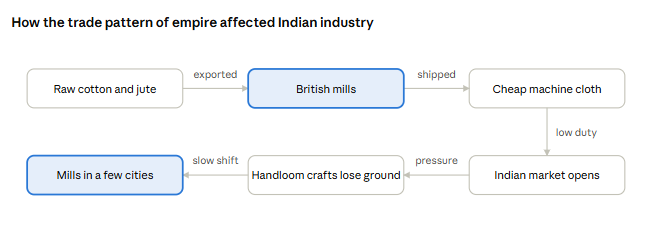
Read along the top row and then back along the bottom: raw materials went out, machine goods came in, and crafts lost ground while a few mills grew.
4. Indian industry before and in the early colonial period
To judge the colonial change, a student must first know what Indian industry was like and how the Company dealt with it.
Textile skills. India produced some of the finest cloth in the world. Dacca was known for its muslin, Kasimbazar and Murshidabad for silk, the Coromandel coast for painted and printed cotton, and Gujarat for dyed and woven goods. Cloth was made by weavers working in homes and small workshops, using yarn spun by women. This industry was the largest in the country after farming. In an answer, name at least two centres.
Iron, steel and other crafts. Indian smiths made wootz steel, used for swords and tools, and were known abroad. Small furnaces smelted iron in many regions, and metalwork, pottery, leather and jewellery were made in towns and villages. India also built ocean-going ships at Surat, Bombay, Bengal and on the Malabar coast. These crafts show that India had skills and markets before British rule.
Organisation of production. Artisans were often organised by caste and trade, and many worked for merchants who gave advances of money and materials. Production was for local use, for the courts and for export. Capital was in the hands of merchants and bankers. This system was flexible and able to respond to demand. A student should note that the base was not backward, as colonial writers claimed.
Demand from Europe. From the seventeenth century, Indian calicoes and silks were sold in large quantities in Europe. They became so popular that British weavers complained, and Parliament passed Calico Acts in 1700 and 1720 to limit imports. This shows that Indian cloth was competitive in the world market. It is a useful point to open a discussion.
The Company and the weavers. After Plassey in 1757, the Company gained control of Bengal. It bought cloth for export through agents, called gomasthas, who gave advances to weavers and tied them to the Company. Weavers often had to sell at low prices fixed by the Company, and could be punished for dealing with others. Many left the trade. The Company’s political power thus altered the market for weavers.
Changes in Britain. From the 1760s and 1770s, the spinning jenny, water frame and later the power loom made cotton cloth cheaper in Britain. By the early nineteenth century, Britain no longer needed Indian cloth and began to sell its own in India. The Industrial Revolution thus reversed the old flow of goods. A student should place this change at the centre.
Heavy duties on Indian goods. In Britain, high duties and prohibitions blocked Indian cloth. R. C. Dutt cited duties of seventy to eighty per cent on some goods. The figures are debated, but the policy of protecting British industry is clear. By contrast, British goods entered India at low rates.
The end of the Company’s trade monopoly. The Charter Act of 1813 ended the Company’s monopoly of India trade, except for China and tea, and the Act of 1833 ended its commercial role. Private British merchants then brought in machine-made cloth in growing amounts. This marks the start of the open competition that hit handicrafts.
| Period | Feature | Meaning |
|---|---|---|
| Before 1750 | Cloth, iron and ships exported and used | A skilled and competitive industry |
| 1700 and 1720 | Calico Acts in Britain | Indian cloth seen as a threat |
| After 1757 | Company control of weavers | Lower prices, loss of freedom |
| 1760s to 1800s | Mechanised spinning and weaving in Britain | Cheaper British cloth |
| 1813 and 1833 | End of the Company’s monopoly | Open entry for British goods |
5. De-industrialisation: the debate
The decline of traditional industry is among the most disputed questions in Indian economic history. A student should know the claim, the evidence and the critics.
The meaning of de-industrialisation. The term means a fall in the share of manufacturing in output and employment, with a shift of workers back to farming. The nationalists used it to describe what happened to Indian crafts after 1800. It is a claim about the structure of the economy, not only about the fate of single crafts. A student should define it before arguing.
Evidence of decline. Writers such as Dutt and Bipan Chandra point to the fall in the population of Dacca and other cloth towns, the fall in the export of Indian cloth, and the rise in imports of British cotton goods. They cite the remark attributed to Governor-General Bentinck in the 1830s that the bones of the cotton weavers were bleaching the plains of India. The quotation should be used with care, since its exact wording is debated.
The case of spinning. Hand spinning, done mostly by women, fell sharply when mill yarn became cheap. This loss of work was large and fell on poor households. It is the clearest example of decline. In an answer, separate the fate of spinning from the fate of weaving.
The survival of handloom weaving. Handloom weaving did not vanish. Weavers used imported mill yarn, made coarse cloth for local markets, and adopted improved tools such as the fly shuttle. In the 1930s, handlooms still supplied about a quarter of the cloth used in India. Tirthankar Roy and others stress this adaptation.
Evidence from the census. Morris D. Morris and Daniel and Alice Thorner used census data from 1881 to 1931 and found that the share of workers in manufacturing did not fall as much as claimed. They argued that the decline had been exaggerated. Critics reply that the census data are doubtful and the period starts late, after much of the decline had occurred.
Other crafts. Shipbuilding lost ground with the rise of steamships and the Navigation Acts, which favoured British ships. Iron smelting by small furnaces declined with the import of cheap British iron and steel. Some luxury crafts lost their patrons with the fall of the courts. Each case had its own causes.
Decline of towns. Murshidabad, Dacca, Surat and other centres lost population and trade as old courts and markets declined. New port cities such as Calcutta, Bombay and Madras grew. The urban map of India was redrawn.
Regional and sectoral variety. The effects differed. Bengal and the Gangetic plain suffered more, while the south and the west held up better in some crafts. A. K. Bagchi’s study of Bihar finds a decline in the Gangetic region in the nineteenth century. A balanced answer notes that both the nationalist and the revisionist views are partly right.
| View | Writers | Main claim |
|---|---|---|
| De-industrialisation occurred | Dutt, Chandra, Bagchi | Imports and policy ruined crafts |
| Overstated | Morris, Thorner | Census shows little fall in workers |
| Adaptation | Roy | Handlooms changed and survived |
| Eighteenth-century strength | Parthasarathi | Indian weavers were competitive until policy and technology changed |
6. Trade, tariffs and fiscal policy
Policy on trade was the main way in which the state affected industry. A student should know the stages in order.
The ideology of free trade. British thinkers, from Adam Smith to Ricardo and Cobden, held that open trade benefited all countries. The Manchester merchants pressed for access to the Indian market. Free trade in India meant that British goods came in at low duties while India had no power to protect its own industry. In exams, link this ideology with the interest of Lancashire.
Cotton duties, 1859 to 1882. Import duties on cotton cloth were small and often lowered under pressure from Lancashire. In 1879, Lytton, the Viceroy, removed duties on coarse cloth, and in 1882, Ripon abolished almost all import duties. Indian mill owners and nationalists protested. This is a standard example of a policy that favoured Britain.
The duties of 1894 and 1896. The fall of the rupee and the need for revenue led the Government to bring back a five per cent import duty in 1894. When cotton cloth was included in 1896, Lancashire demanded a matching excise on Indian mill cloth, so that no protection could result. The excise of 3.5 per cent angered Indian opinion. It was removed in 1925.
Currency and exchange. The Government fixed the rupee at one shilling and four pence in 1899 and raised it to one shilling and six pence in 1927. Indian businessmen said that the high rate made exports dearer and imports cheaper. The currency policy therefore favoured British exporters. This point links with the drain argument.
Fiscal autonomy and protection. The Government of India Act of 1919 allowed the Government of India to have a say in tariff policy, by a convention that the Secretary of State would not interfere where the Indian legislature and government agreed. The Fiscal Commission of 1921 to 1922 recommended discriminating protection for industries that met set tests. A Tariff Board was set up in 1923.
Protection in practice. Steel received protection from 1924, cotton textiles from 1930, and sugar from 1932. These measures helped the Tata steel company, the cotton mills and sugar factories. The beneficiaries were largely Indian firms. In an answer, give this as a change from earlier free trade.
Imperial preference. At Ottawa in 1932, India agreed to give preference to British goods in return for access to the British market, and the Indo-British Trade Agreement of 1935 followed. Indian industrialists and nationalists opposed it. The case shows that the interest of Britain still shaped tariff policy.
Home charges and the drain. The costs of the India Office, pensions, interest on debt and army expenses in Britain were paid from Indian revenue. Naoroji’s drain argument rests on this. It affected industry by taking away capital that might have been invested at home.
| Year | Measure | Effect |
|---|---|---|
| 1813 and 1833 | End of the Company’s monopoly | Open entry of British goods |
| 1879 and 1882 | Import duties removed | Free entry of British cloth |
| 1894 and 1896 | Revenue duty and cotton excise | Lancashire blocks protection |
| 1899 | Rupee fixed at 1s 4d | Exchange policy favoured imports |
| 1921 to 1923 | Fiscal Commission; Tariff Board | Discriminating protection |
| 1924 to 1932 | Protection for steel, cotton, sugar | Support for Indian industry |
| 1932 and 1935 | Ottawa and Indo-British Trade Agreement | Imperial preference |
7. The rise of modern industry
Modern factory industry began in the 1850s. A student should know each industry, its date, its place and its owners.
Cotton mills. The first successful cotton mill in Bombay was started in 1854 by Cowasjee Nanabhoy Davar, and Ahmedabad followed in 1861. The mills used cheap local cotton, cheap labour and the nearness of the port. They first made coarse yarn for China and for Indian handlooms, and later cloth. By 1914 there were over two hundred mills. The Swadeshi movement of 1905 raised the demand for Indian cloth. In an answer, name Bombay and Ahmedabad and the Parsi and Gujarati owners.
Jute mills. The first jute mill was set up at Rishra near Calcutta in 1855. Jute was grown in Bengal, and the mills on the Hooghly competed with Dundee in Scotland. Most mills were owned by Scottish firms, working through managing agencies, and the Indian Jute Mills Association, formed in 1884, controlled output. Indian investors held a small share until later. The jute industry is the best example of European control.
Coal. Coal mining began at Raniganj in Bengal in the 1770s and grew with the railways, which needed fuel. Jharia in Bihar became a major field from the 1890s. Mining was done by contract labour from tribal and low-caste groups under hard conditions. European firms led, and Indian firms such as those of Dwarkanath Tagore and later others took part. This industry supplied the railways and the factories.
Iron and steel. The Bengal Iron Works at Barakar began in 1870. The Tata Iron and Steel Company was founded in 1907 by Dorabji Tata, following the plans of Jamsetji Tata, who had died in 1904, and the first steel was made in 1912 at Jamshedpur. The Indian Iron and Steel Company followed in 1918, and the Mysore Iron Works in 1923. The government gave help through orders and, from 1924, protection. TISCO is a leading example of an Indian industrial enterprise.
Sugar, cement and others. After protection in 1932, sugar mills spread in the United Provinces and Bihar. Cement works began in 1914 and grew. Paper, glass, matches, soap, chemicals and engineering workshops were also started, mostly by Indian capital, from the 1920s and 1930s. These industries served the home market.
Railway workshops and engineering. Railway workshops, such as those at Jamalpur from 1862, trained skilled workers and produced some parts. Yet locomotives and major parts were imported. The workshops gave skills but did not lead to a capital goods industry.
Role of the world wars. In the First World War, demand for jute, steel and other goods rose, and imports fell, which helped Indian industry. The Second World War had a similar effect. Profits made in the wars were invested in new ventures. The student can note that war helped industry more than policy did.
Business communities. Parsis, Gujaratis, Marwaris, Chettiars and Bania groups moved from trade and banking into industry. Families such as the Tatas, Birlas, Walchand Hirachand and the Mafatlals built large groups. Their ties with the Congress and their wish for protection shaped politics. Medha Kudaisya and Dwijendra Tripathi have studied these groups.
| Industry | First step | Place | Main owners |
|---|---|---|---|
| Cotton | Bombay mill, 1854 | Bombay, Ahmedabad | Parsi and Gujarati businessmen |
| Jute | Rishra mill, 1855 | Hooghly belt | Scottish firms |
| Coal | Raniganj, 1770s; Jharia, 1890s | Bengal, Bihar | European and Indian firms |
| Steel | TISCO, 1907 | Jamshedpur | Tata family |
| Sugar | Protection, 1932 | United Provinces, Bihar | Indian firms |
| Cement | 1914 | Western and central India | Indian firms |
8. Railways, capital and infrastructure
Railways, banks and communications formed the frame of the colonial economy. A student should know their purpose and their effects on industry.
The beginning of railways. The first passenger line ran from Bombay to Thane in 1853, a distance of about thirty-four kilometres. Lord Dalhousie’s Minute of 1853 set out a plan for trunk lines to link the main ports and cities. The aims were to move troops, to bring raw materials to ports and to carry imported goods inland.
The guarantee system. The first lines were built by British companies, to which the Government guaranteed a return of five per cent on capital and provided free land. If profits fell short, Indian revenue made up the difference. The system encouraged waste and put the risk on India, while the profit went to British investors. Nationalists often cited it as an example of exploitation.
Extent of the network. From 1869, the state built more lines directly, and the network grew to over fifty thousand kilometres by 1947. The figures vary by source, and a student should use them with care. The railway was the largest public investment of the period.
Effects on trade. Railways lowered the cost of moving goods and linked markets. They helped the export of cotton, jute and wheat and the import of British cloth into the interior. J. Hurd has argued that they brought real gains to the economy. Others say that the gains went mainly to export trade and to British suppliers.
Purchases from Britain. Rails, locomotives, wagons and bridge materials were bought from British firms. India had the iron and coal but did not make locomotives in any number. Daniel Headrick, in The Tentacles of Progress, argues that the railways served imperial needs and gave limited benefit to Indian industry. Bipan Chandra makes the same point from the nationalist side.
Banking and credit. The Presidency Banks, set up between 1806 and 1843, served the government and European trade. Exchange banks financed foreign trade. Indian industrialists found it hard to raise credit and depended on private bankers and on managing agencies. The Imperial Bank was formed in 1921, and the Reserve Bank of India began in 1935.
Foreign capital. British capital went into railways, tea, jute, coal and public debt. Its returns flowed out of India as profits and interest. A. K. Bagchi has shown the scale of this foreign hold on key sectors. In an answer, link foreign capital with the drain.
Telegraph, post and ports. The telegraph began in 1851, the postal system was extended, and ports such as Bombay, Calcutta and Madras were improved. These services helped trade and administration. They are often named among the benefits of colonial rule, and a balanced answer states who gained most.
| Element | Date | Purpose | Criticism |
|---|---|---|---|
| First railway line | 1853 | Link ports with the interior | Built for trade and troops |
| Guarantee system | 1850s | Attract British capital | Risk borne by India |
| State railways | From 1869 | Cheaper expansion | Orders mostly to Britain |
| Presidency Banks | 1806 to 1843 | Government and trade finance | Little credit for Indian industry |
| Reserve Bank | 1935 | Central banking | Late and under British influence |
9. Labour, trade unions and urbanisation
Industry created a new working class. A student should know where workers came from, their conditions and their organisation.
Origins of the workers. Most factory workers were migrants from villages, many of them poor peasants and artisans who had lost their former work. They often kept ties with the village and returned in the sowing season. Recruitment was through jobbers or sirdars, who found workers, gave advances and controlled them. Morris studied this in his book on the industrial labour force.
Conditions of work. Hours were long, wages were low and the workplace was often unsafe. Housing in Bombay was in crowded chawls. Women and children worked in mills and mines. The conditions caused anger and led to strikes. In an answer, give the details of hours and housing.
Factory legislation. The Factory Act of 1881 banned work by children under seven and limited hours for children. The Act of 1891 limited women’s work to eleven hours a day and gave a weekly rest day. The Acts of 1911, 1922 and 1934 reduced hours further. British manufacturers in Lancashire supported these laws partly because they wished to raise Indian costs. The student should note this mixed motive.
Royal Commission on Labour. The Whitley Commission of 1929 to 1931 reviewed conditions and proposed reforms in wages, housing and welfare. Its recommendations were carried out only in part. The Commission’s report is a main source on labour in this period.
Rise of trade unions. The Madras Labour Union of 1918 under B. P. Wadia was one of the first. The All India Trade Union Congress began in 1920, with Lajpat Rai as its first president and leaders such as N. M. Joshi and Dewan Chaman Lall. The Trade Unions Act of 1926 gave legal status to unions. These bodies linked labour with the national movement.
Strikes and the left. The Bombay textile strike of 1928, led by the Girni Kamgar Union, was a major event, and the Tata steel strike of 1928 at Jamshedpur was another. The Meerut Conspiracy Case of 1929 was brought against communist and trade union leaders. The Trade Disputes Act of 1929 restricted strikes. These events show the clash between labour and the state.
Caste, community and gender. Workers came into mills with caste and regional ties, and these shaped hiring and disputes. Women were pushed out of many jobs over time. Dipesh Chakrabarty, in Rethinking Working-Class History, and Rajnarayan Chandavarkar, in The Origins of Industrial Capitalism in India, stress that class feeling was mixed with these ties.
Urbanisation. Cities such as Bombay, Calcutta, Madras, Kanpur and Jamshedpur grew fast. Overcrowding, poor sanitation and disease were common. Yet overall urbanisation stayed low, since most people stayed in the villages. A student should note that the growth was concentrated and limited.
| Issue | Detail | Response |
|---|---|---|
| Long hours, low pay | Mill and mine labour | Strikes, unions |
| Child and women labour | Factory work | Acts of 1881 and 1891 |
| Jobber system | Control through advances | Criticised by the Whitley Commission |
| Organisation | AITUC, 1920 | Trade Unions Act, 1926 |
| Major strikes | Bombay 1928; Jamshedpur 1928 | Trade Disputes Act, 1929 |
10. Scholarly interpretations and critiques
Historians differ on why India did not industrialise fully under colonial rule. A student should know the main positions.
The nationalist reading. Naoroji, Dutt, Ranade and Gokhale argued that British policy destroyed crafts and blocked new industry. They pressed for protection and for state support. Their arguments shaped the demand for swadeshi and the later plans for planned industrialisation.
Gandhi and the critique of machinery. Gandhi, in Hind Swaraj (1909), criticised modern industrial civilisation itself and preferred village industry and the spinning wheel. His position is different from other nationalists, who wanted industry under national control. A student should keep the two apart.
The Marxist and dependency reading. R. P. Dutt, in India Today (1940), Bipan Chandra and A. K. Bagchi hold that colonial rule produced underdevelopment, since the economy served the needs of Britain. Bagchi’s work on investment and on de-industrialisation is the most detailed. This reading is common in Indian universities.
The revisionist reading. Morris D. Morris argued that colonial rule did not block industry, that India lacked skilled labour, capital and enterprise, and that growth was real. B. R. Tomlinson, in The Political Economy of the Raj, and Angus Maddison gave similar views. Tirthankar Roy stresses the adaptation of traditional industry. Critics say this reading underplays the role of policy.
Business history. Rajat Ray, Medha Kudaisya, Claude Markovits, Dwijendra Tripathi and Maria Misra studied Indian business groups and their relations with the state. They show how Indian capital grew, bargained with the colonial state and supported the Congress. Basudev Chatterji studied the Lancashire lobby in Trade, Tariffs and Empire (1992).
Labour history. Chandavarkar, Chakrabarty and others studied workers and their organisations. They reject a simple picture of a united working class and show the role of caste, community and the jobber. Their work enriches the story beyond business and policy.
Global history. Prasannan Parthasarathi, and Giorgio Riello and Tirthankar Roy in How India Clothed the World, study Indian textiles in a world frame. They show that India led world textile trade until the late eighteenth century and ask why Britain overtook it.
Limits of the debate. Data on output and employment are poor, and it is hard to know what would have happened without colonial rule. A balanced answer says that policy, resource, skill and market forces all played a part, and that scholars differ on weights.
| Position | Main writers | Reading |
|---|---|---|
| Nationalist | Naoroji, Dutt, Ranade, Gokhale | Policy ruined crafts and blocked industry |
| Gandhian | Gandhi | Critique of industrial civilisation |
| Marxist and dependency | R. P. Dutt, Chandra, Bagchi | Underdevelopment for the benefit of Britain |
| Revisionist | Morris, Tomlinson, Maddison, Roy | Real but limited growth; adaptation |
| Business history | Ray, Kudaisya, Tripathi, Chatterji | Capital, state and lobbies |
| Labour history | Chandavarkar, Chakrabarty | Class mixed with caste and community |
| Global history | Parthasarathi, Riello and Roy | Indian textiles in world trade |
11. Importance and limitations
Importance
It explains economic backwardness. The topic shows how a country with skilled crafts and large resources came to have a small industrial base. A student can use it to explain poverty and low income in 1947. In an answer, link it to the drain and to land policy.
It is central to the nationalist critique. Naoroji, Dutt and Gokhale built their case against British rule on the state of Indian industry. Knowing the topic helps to understand the demand for protection and swadeshi. It also helps to see why economic questions were political.
It explains the Swadeshi movement. The boycott of 1905 aimed to protect Indian crafts and mills. The topic shows the economic roots of the movement. A candidate can then link economy and politics.
It shows the working of free trade. The case of cotton shows how tariff and currency policy served the home industry of Britain. This helps students see how a colonial economy was organised. The Lancashire lobby is a good illustration.
It shows the rise of Indian capital. The story of Tata, Birla and others shows that Indian business grew despite limits. This corrects the view that the colonial economy was only a story of loss. A balanced answer needs both sides.
It explains the growth of the working class. Factories created workers who formed unions and joined strikes. This links industry to labour history and to the left movement. The student can draw on the AITUC and the Bombay strike.
It is linked to the planning ideas of later years. The Bombay Plan of 1944 and the National Planning Committee of 1938 drew on this experience. Independent India chose heavy industry and state planning partly because of it. The topic therefore helps with post-1947 study.
It shows regional differences. Bombay, Calcutta and a few other places gained industry while most regions did not. This explains uneven development. A student can mention it in discussions on regional inequality.
It builds skill in using historical debate. The disputes between nationalist, Marxist and revisionist writers train students to weigh evidence. This is a skill useful in the examination. It also serves better writing in essays.
It connects to colonialism in general. Industry sits beside land, forest and ecology in the study of colonial impact. The topic shows common features such as extraction and control. This makes it a base for comparison.
Limitations
Data are weak. Statistics on output, employment and trade were collected unevenly. Estimates of craft decline rest on census figures that changed in method. A student should use numbers with care.
Regional variation is large. Conditions in Bengal differed from those in Gujarat or Madras. A general claim can mislead. Local studies are needed to see the true pattern.
Causes are mixed. Craft decline came from imports, from changes in demand, from the loss of court patronage and from technical change. It is hard to give each cause its weight. An answer should avoid a single cause.
The counterfactual is unknown. No one can say what would have happened without colonial rule. Claims about what India might have achieved are therefore open to doubt. Revisionists press this point.
Nationalist writing was political. Writers like Dutt aimed to build a case against the rulers. Their data and conclusions were shaped by that aim. Later scholars have corrected some of their claims.
Revisionist writing has its own limits. It can underplay the effects of policy and the power of the colonial state. It also relies on aggregate figures that hide local suffering. A reader should weigh both sides.
The informal sector is poorly known. Much of the work was done in homes and small workshops that left few records. This makes it hard to measure change. Studies by Roy and others have only begun to fill the gap.
Business groups are better studied than workers. Records of firms are fuller than records of labour. The view of industry may therefore lean towards owners. Newer labour studies aim to correct this.
The story is not only economic. Culture, caste and politics shaped industry too, and a narrow economic view misses them. A student should not reduce everything to markets. Social history adds the missing parts.
Comparisons are difficult. Japan, Germany and Russia industrialised under different conditions. Comparing them with India needs care about state role and timing. Simple comparisons can mislead.
Illustrations
| Case | What it shows |
|---|---|
| Dacca muslin | Skilled craft hit by cheap imports and loss of patronage |
| Bombay cotton mills, 1854 | Beginning of Indian-owned factory industry |
| Jute mills of Hooghly | European control through managing agencies |
| TISCO, 1907 | Indian enterprise in heavy industry, helped by protection |
| Guarantee system | Risk borne by India, profit by British investors |
| Cotton duties of 1894 and 1896 | Lancashire influence on tariff policy |
| Bombay strike, 1928 | Rise of organised labour |
| Bombay Plan, 1944 | Business plan for post-colonial industry |
12. Using this topic in examinations
What examiners expect
| Level | What is expected |
|---|---|
| UG | Clear account of de-industrialisation, new industries, tariffs and the main writers |
| PG | Debate between nationalist, Marxist and revisionist readings with evidence |
| OPSC and UPSC | Facts and dates, balanced judgment, link with drain, planning and the present |
| UGC NET | Names of authors, titles and the position of each school |
Practice questions
- Discuss the debate on the de-industrialisation of India in the nineteenth century.
- How did tariff and currency policy under colonial rule affect Indian industry?
- Describe the rise of modern industries in India before 1947. Who owned them?
- Examine the role of railways in the colonial economy. Did they help Indian industry?
- Trace the growth of the working class and trade unions in colonial India.
- Compare the nationalist and revisionist views on colonial industrial policy.
- Assess the role of Indian business groups in the national movement.
Structured outline for a long answer
Introduction. Define colonial industrial impact and state the debate between those who see ruin and those who see limited growth. Give the main dates, from the Calico Acts to 1947.
Body. Describe the state of Indian crafts before 1757 and the effect of British trade. Explain the de-industrialisation thesis and the objections to it. Discuss tariff, currency and railway policy. Give the rise of cotton, jute, steel and other industries and the role of Indian capital. Add labour and the working class. Close the body with the main interpretations.
Conclusion. State that colonial rule weakened old crafts and limited new industry, but that Indian business and labour grew in spite of it. Say that scholars differ on weights, and that the legacy shaped planning after 1947.
Sample answer (about 200 words)
Introduction. Before British rule India had large crafts, especially cotton cloth, and exported widely. The impact of colonial rule on industry is debated: nationalists speak of ruin, while revisionists see limited growth.
Body. After 1813, the Company lost its monopoly and British machine cloth entered India at low duty. Indian cloth had met high duties in Britain, and earlier laws such as the Calico Acts kept it out. Craft towns like Dacca and Murshidabad declined, and many weavers moved to farming. Dadabhai Naoroji and R. C. Dutt called this a ruin caused by policy. Morris D. Morris and Tirthankar Roy reply that handlooms survived and that the loss was uneven. From 1854, Indian businessmen built cotton mills in Bombay and Ahmedabad, and Tata began steel at Jamshedpur in 1907. Jute stayed under Scottish firms. Railways were built with imported materials under a guarantee system, so they gave limited help to Indian industry. Tariffs were set partly for Lancashire, as in 1894 and 1896. Protection came after 1923, and industry grew in the wars. A working class and unions such as the AITUC arose.
Conclusion. Colonial policy weakened crafts and held back heavy industry, yet Indian capital and labour grew. The record was mixed and shaped the planning of later years.
Quick check
- Who started the first successful cotton mill in Bombay and when? Cowasjee Nanabhoy Davar, in 1854.
- Where was the first jute mill set up? At Rishra near Calcutta, in 1855.
- What was the guarantee system? A promise of a five per cent return to British railway companies, paid from Indian revenue if profits fell short.
- Who wrote Industrialization in India and what is its main point? Morris D. Morris and others hold that colonial rule did not simply block industry, and that India lacked skills and capital.
- When was the All India Trade Union Congress formed? In 1920.
Common mistakes
Calling all craft decline the result of imports. Changes in demand, loss of patronage and cheaper local goods also mattered. State several causes.
Mixing the dates of mills. Bombay cotton is 1854 and Rishra jute is 1855. Learn them as a pair.
Ignoring Indian capital. Many answers show only loss. Mention Tata, Birla and the mill owners of Bombay and Ahmedabad.
Giving one side of the debate. A complete answer states the nationalist and revisionist views and then a judgment.
Forgetting the role of tariffs. Many students write only about railways. Add the duties of 1894 and 1896 and protection after 1923.
Using figures without caution. Employment and output data are uncertain. Write “estimates suggest” instead of exact numbers.
13. Critical analysis
The central question. The main question is whether colonial rule caused the lack of industrial growth or only failed to prevent it. The answer depends on the weight given to policy, to the market and to local conditions. A strong answer states this question at the start.
Evidence for the ruin thesis. The fall of craft towns, the high duties against Indian cloth in Britain, the free entry of British goods into India and the pattern of railway purchases support the nationalist case. These are also facts cited by contemporaries. They show that policy favoured Britain.
Evidence against it. Handloom output survived into the twentieth century, and the cotton mills and steel works grew with Indian capital. The market for cheap imports also helped poor consumers. These points complicate the nationalist picture.
The role of the state. The colonial state did not plan industry and gave little technical education. Yet it also did not block all new enterprises. Policy was shaped by the interests of Britain, by revenue needs and by pressure from Indian business after 1920. A balanced view sees a state that was indifferent more often than hostile, and sometimes hostile.
Indian business and the Congress. Indian capitalists wanted protection and later supported the national movement. Their support was often cautious and tied to their interests. The topic shows that nationalism had an economic base as well as a moral one.
Labour and class. The working class grew slowly and was split by caste and region. The state met strikes with new laws and arrests. A critical answer notes both the power and the limits of labour action.
Link with the drain. The flow of profit, interest and pay out of India lowered the funds available for investment. This connects industry with the drain theory. The student can use it to show how topics join.
What the debate leaves open. Better data on small industry, women’s work and regional markets are needed. New global histories ask why Britain, and not India, became the centre of cotton manufacturing. These questions continue to shape research.
Model concluding paragraph
The colonial impact on Indian industry was uneven and contested. Policy on trade, tariffs and railways favoured British interests and hurt old crafts, as Naoroji and Dutt argued, yet handlooms survived and Indian business built mills, steel works and large firms, as revisionists show. The truth lies in the mix of limits and openings. Colonial rule did not allow a full industrial transformation, and the legacy of this uneven growth shaped both the national movement and the planning of independent India.
14. Preparing for UGC NET
| Author | Work | Main idea |
|---|---|---|
| Dadabhai Naoroji | Poverty and Un-British Rule in India (1901) | Drain and poverty under British rule |
| R. C. Dutt | The Economic History of India (1901, 1903) | Policy ruined crafts and held back industry |
| R. Palme Dutt | India Today (1940) | Marxist view of colonial exploitation |
| Bipan Chandra | The Rise and Growth of Economic Nationalism in India (1966) | Economic ideas of the early nationalists |
| A. K. Bagchi | Private Investment in India, 1900–1939 (1972) | Investment, foreign capital and de-industrialisation |
| Morris D. Morris | Indian Economy in the Nineteenth Century (1969) | Limits on growth other than policy |
| B. R. Tomlinson | The Political Economy of the Raj, 1914–1947 (1979) | Economy of the late colonial period |
| Tirthankar Roy | The Economic History of India, 1857–1947 (2000) | Adaptation and survival of traditional industry |
| Rajnarayan Chandavarkar | The Origins of Industrial Capitalism in India (1994) | Bombay mills and workers |
| Dipesh Chakrabarty | Rethinking Working-Class History (1989) | Jute workers, community and class |
| Basudev Chatterji | Trade, Tariffs and Empire (1992) | Lancashire and Indian tariffs |
| Dharma Kumar and Meghnad Desai (eds.) | The Cambridge Economic History of India, vol. 2 (1983) | Survey of the colonial economy |
| Prasannan Parthasarathi | Why Europe Grew Rich and Asia Did Not (2011) | Global comparison of textiles |
Revision tip. Learn each author with one work and one idea, and arrange them under nationalist, Marxist, revisionist, business and labour history. Remember the dates 1813, 1854, 1855, 1894, 1907 and 1920.
15. Key takeaways
- Before 1757 India had large crafts and a strong place in world textile trade.
- British policy after 1813 opened India to machine goods and weakened many crafts, though the extent is debated.
- Tariff, currency and railway policies often served British interests.
- Cotton, jute, coal and steel industries grew from 1854, with Indian capital strong in cotton and steel and European capital in jute.
- A working class and trade unions arose, and the state met them with both laws and repression.
- Nationalist, Marxist, revisionist, business, labour and global historians give different readings.
- A good answer states dates, names and both sides of the debate.
Official sources
- National Archives of India
- Census of India
- Ministry of Commerce and Industry
- Ministry of Labour and Employment
- Reserve Bank of India
- eGyanKosh
Twenty books for further reading
- Dadabhai Naoroji, Poverty and Un-British Rule in India (1901)
- R. C. Dutt, The Economic History of India, 2 vols. (1901, 1903)
- R. Palme Dutt, India Today (1940)
- Bipan Chandra, The Rise and Growth of Economic Nationalism in India (1966)
- A. K. Bagchi, Private Investment in India, 1900–1939 (1972)
- A. K. Bagchi, The Political Economy of Underdevelopment (1982)
- Morris D. Morris, Indian Economy in the Nineteenth Century (1969)
- B. R. Tomlinson, The Political Economy of the Raj, 1914–1947 (1979)
- Tirthankar Roy, The Economic History of India, 1857–1947 (2000)
- Tirthankar Roy, Traditional Industry in the Economy of Colonial India (1999)
- Dharma Kumar and Meghnad Desai (eds.), The Cambridge Economic History of India, vol. 2 (1983)
- Rajnarayan Chandavarkar, The Origins of Industrial Capitalism in India (1994)
- Dipesh Chakrabarty, Rethinking Working-Class History: Bengal 1890–1940 (1989)
- Basudev Chatterji, Trade, Tariffs and Empire (1992)
- Daniel Headrick, The Tentacles of Progress (1988)
- Prasannan Parthasarathi, Why Europe Grew Rich and Asia Did Not (2011)
- Giorgio Riello and Tirthankar Roy (eds.), How India Clothed the World (2009)
- Medha Kudaisya, The Life and Times of G. D. Birla (2003)
- Rajat Kanta Ray (ed.), Entrepreneurship and Industry in India, 1800–1947 (1992)
- Sumit Sarkar, Modern India, 1885–1947 (1983)
Editorial note
This note is prepared for study and is revised from time to time. Readers who find an error may write through the contact page. Please also read the disclaimer.
Frequently asked questions
What is de-industrialisation in the Indian context? It is the decline of traditional crafts, mainly cotton weaving and spinning, under the pressure of imports and policy, which reduced the share of manufacture in the economy.
When did modern industry begin in India? The first successful cotton mill in Bombay was started in 1854, and the first jute mill at Rishra in 1855.
Who founded the Tata Iron and Steel Company? Dorabji Tata founded it in 1907, following plans of Jamsetji Tata, and steel was made in 1912.
What was the guarantee system for railways? The Government promised British companies a five per cent return on capital, and Indian revenue paid if profits fell short.
Did colonial rule cause India’s industrial backwardness? Scholars differ. Nationalists and Marxists say yes, revisionists point to other limits, and many hold that both policy and local conditions played a part.
When was the AITUC formed? In 1920, with Lajpat Rai as its first president.


