
The colonial period changed the relation between people and nature in India more deeply than any earlier age. The British state wanted revenue, timber, cotton, indigo, tea and cheap transport, and it built a system of laws, surveys, railways and canals to obtain them. Forests were mapped and reserved, rivers were dammed and embanked, wild animals were hunted for sport and for bounty, and large areas were turned to cash crops. These acts altered soil, water, vegetation and animal life, and they altered the rights and livelihoods of the people who depended on them.
This note studies the ecological impact of colonial rule. It explains the meaning of ecology and environmental history, the main features of colonial environmental change, and the effects on wildlife, water, land, health and communities. It then presents the scholarly debate, from the work of Madhav Gadgil and Ramachandra Guha to the studies of Richard Grove, K. Sivaramakrishnan and David Arnold. It is meant for undergraduate, postgraduate and competitive examinations, and it should be read together with the notes on forests, agriculture and land relations.
1. Meaning and definitions
Ecology is the study of the relations between living things and their surroundings. Environmental history applies this idea to the past and asks how human societies changed nature, and how nature in turn shaped human life. In the Indian setting, colonial ecology means the changes in forests, waters, soils, animals and health that followed British rule, together with the ideas and policies behind them.
| Scholar | Work | Idea in substance |
|---|---|---|
| Madhav Gadgil and Ramachandra Guha | This Fissured Land (1992) | Indian history is a story of ecological prudence in the past and of resource conflict under colonial and modern rule |
| Richard Grove | Green Imperialism (1995) | Colonial rule produced early conservation ideas, drawn from island and tropical experience |
| Mahesh Rangarajan | Fencing the Forest (1996) | The colonial state treated forest and wildlife as property to be controlled and used |
| K. Sivaramakrishnan | Modern Forests (1999) | Environmental rule shaped the state itself and local politics |
| David Arnold | The Problem of Nature (1996) | Nature, disease and empire were closely linked in colonial India |
| Alfred Crosby | Ecological Imperialism (1986) | European expansion carried plants, animals and diseases that remade distant lands |
Scholar-wise definitions
Madhav Gadgil and Ramachandra Guha. In This Fissured Land, they describe ecological history as the study of how patterns of resource use shaped Indian society, and they argue that colonial rule broke older systems of local control and shifted resources from village communities to the state and to the market. They also hold that colonial and later policies set the pattern for conflict over land, water and forest. The words are a paraphrase, and the student should read the book for its exact wording.
Richard Grove. In Green Imperialism, Grove argues that colonial rule was not only a force of destruction. Company doctors, botanists and officials who saw the damage of deforestation and drought on tropical islands and in India developed early ideas of conservation. These ideas later spread to Europe and America. The point is useful for a balanced answer.
Mahesh Rangarajan. In Fencing the Forest and other works, Rangarajan shows how the colonial state took control of forest and wildlife in central India, and how this was done for timber, revenue and prestige. He stresses that the rights of local people were reduced as state control grew.
K. Sivaramakrishnan. In Modern Forests, he studies how forest policy in Bengal shaped relations between the state and local society. He shows that forest management was a part of the making of the colonial state and was shaped by local resistance and bargaining.
David Arnold. Arnold studies nature, medicine and empire. In The Problem of Nature, he shows that the British saw India as a land of climate, disease and abundance, and that these views shaped policy on health, land and settlement.
Alfred Crosby. In Ecological Imperialism, Crosby argues that Europeans spread across the world partly through the plants, animals and germs they carried. The idea is often applied to the movement of crops, such as tea, cinchona and rubber, into colonial lands.
Note to the student
The words used in this field are close, and a student should keep them apart. Ecology is the study of living things and their surroundings. Environmental history is the study of the changing relation between people and nature over time. Environmentalism is the later movement to protect nature. Conservation means careful use, while preservation means protection from use. Colonial officials often used the first word, but their acts served revenue and timber supply more than protection of nature. In an answer, define the main term at the start and then use it with care.
What the definitions share
The writers differ in emphasis, yet they agree on several points. Colonial rule changed nature on a large scale. The state claimed control over forests, water and wildlife, and it turned natural resources into sources of revenue. Local communities lost rights and faced new rules. At the same time, ideas of conservation and science grew under colonial rule. A complete answer should state both the damage and the new ideas.
2. Characteristics of colonial ecological change
State control of resources. The colonial state claimed ownership of forests, waste land, rivers and minerals, and it made laws to regulate their use. This ended older systems in which villages managed commons by custom. In an answer, give the Forest Acts as the main example.
The revenue motive. Land revenue, timber sale, water rates and licence fees made nature a source of income. Policies were framed with the treasury in view. Forests were valued for timber, canals for the water rate, and wild animals for the bounty paid on their death.
Commercialisation of nature. Forests, rivers, land and wildlife were linked to the market. Teak, sal, indigo, tea, cotton and jute were grown or cut for sale in Europe. Local use, which had been for subsistence, became subordinate to trade.
Imperial needs. Railways needed sleepers, ships needed teak, and armies needed supplies. These needs set the pace of felling and of building. The student can see how imperial war and trade reached into the Indian forest.
Scientific management. Surveyors, botanists, foresters and engineers entered the field, and they brought maps, working plans, rain gauges and canal designs. Science gave authority to state control. Yet it was often applied without regard to local knowledge.
Reduction of common rights. Grazing, hunting, collecting wood, fishing and shifting cultivation were restricted or banned. Customary rights were turned into privileges that could be taken away. This caused hardship and protest.
Hunting as sport and as policy. Shikar was a mark of rank and a sport of the ruling class. The state also paid bounties to kill tigers, leopards and wolves. This reduced the number of large animals in many regions.
Large engineering works. Canals, embankments, dams and railway lines changed the flow of rivers and the drainage of land. Some works brought water to dry areas, while others caused waterlogging, salt and floods.
Plantations and cash crops. Tea in Assam, coffee in the south, indigo in Bengal and Bihar, and cotton in the Deccan changed the use of land. Forest was cleared for plantations, and soil was used for one crop.
Spread of new species. Plants and animals were moved from one region to another. Cinchona, tea, teak and eucalyptus were planted on a large scale. This changed the plant cover and, in some cases, the local balance of species.
Environment and disease. Railways, canals, ports and cities changed the pattern of disease. Malaria followed embankments and irrigation, plague travelled by rail and ship, and cholera followed pilgrimage and trade. Health policy then became a part of environmental policy.
Unequal burdens. The cost of change fell on peasants, pastoralists, tribes and fishing groups, while the gain went to the state, to traders and to planters. Gadgil and Guha speak of this as a shift of resources from the poor to the powerful.
Mixed effects and new ideas. Colonial rule also brought new ideas of conservation, wildlife protection and scientific survey. Some forests were saved from felling, and some species were protected. The picture is therefore of loss and of limited protection together.
3. Diagram at a glance
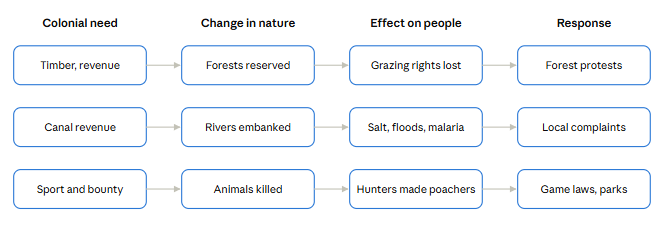
The diagram below shows how a colonial need led to a change in nature, how that change affected people, and how they responded. Read it from left to right.
4. Colonial attitudes to nature
The policies on nature rested on ideas that officials carried from Europe and developed in India. A student should know these ideas, since they explain why the state acted as it did.
Nature as a resource. Under the influence of the Enlightenment and of political economy, nature was seen as a store of wealth to be surveyed, measured and used. Forests meant timber, rivers meant irrigation and power, and waste land meant land waiting for the plough. In an answer, use the term “improvement” to describe this idea, since officials often spoke of improving the land.
Waste land and improvement. Land that was not under the plough was called waste, even when it served as pasture, fuel ground or a base for shifting cultivation. The British held that such land should be brought under settled farming or under managed forest. This view overlooked the uses of the commons and led to their loss. The student can link this with the rules on forest and grazing.
Fear of deforestation. From the late eighteenth century, doctors and botanists of the Company noted that clearing forests reduced rain and dried up streams. Richard Grove, in Green Imperialism, shows that this belief grew from experience in St Helena, Mauritius and the Western Ghats. It led to early rules on tree cutting, such as those on Mauritius, and later to forest conservancy in India. In an answer, state that conservation had a colonial root, but that it served the state.
Science and expertise. The Botanical Garden at Calcutta (1787), the Geological Survey (1851) and the Forest Department (1864) show the growth of a scientific state. Experts claimed the right to decide how land and water should be used. Local knowledge was seldom asked. This reliance on expert rule is a common theme in the work of Sivaramakrishnan.
The picturesque and the wild. British writers saw the Indian jungle as both dangerous and beautiful. They described hunting as a manly sport and the tiger as an enemy to be subdued. Mahesh Rangarajan and John MacKenzie show how hunting and landscape were tied to ideas of rule and rank.
Climate, race and health. Many officials thought that the tropical climate harmed European health and that Indians were suited to it. This view shaped the building of hill stations, cantonments and sanitary rules. David Arnold has examined how such ideas of climate and race guided medical and land policy.
Contested ideas. These ideas were not held by all. Some officials, like Dietrich Brandis, sought to protect the interests of villagers within forest policy, while others, like many engineers and revenue men, wished to use nature for revenue alone. A balanced answer shows that colonial thought was divided.
| Attitude | Meaning | Result in policy |
|---|---|---|
| Improvement | Waste land should be made to yield | Spread of cultivation and loss of commons |
| Resource thinking | Nature is wealth to be used | Timber extraction, mining, irrigation |
| Fear of drought | Forest loss harms rain and water | Early conservation rules |
| Scientific rule | Experts know best | Surveys, working plans, departments |
| Hunting and rule | Mastery of wild animals shows power | Shikar and bounties |
| Climate and race | Climate shapes health and fitness | Hill stations and sanitary policy |
5. Wildlife, hunting and the beginning of protection
Wildlife shows both sides of colonial ecology, since the same state that killed animals in large numbers also began the first laws of protection.
Shikar as sport and rank. Hunting had been a royal pastime in India before the British. Under colonial rule it became a mark of imperial authority, and officials, army officers and princes took part in large hunts. Tigers, leopards, elephants and rhinoceros were killed in large numbers. Hunting guides and guns were part of the imperial display.
Bounties and vermin. The state paid rewards for killing tigers, leopards, wolves and snakes, since these were seen as threats to people and cattle. Thousands of animals were killed each year in the nineteenth century. Rangarajan notes that these rewards helped open forest land to settlement. The student should give this as an example of policy that reduced wildlife.
Clearing land for settlement and revenue. Forests and grassland were cleared for farming and plantations. Wild habitats shrank, and animals such as the Asiatic lion, the cheetah and the one-horned rhinoceros declined sharply. The cheetah became extinct in India in the twentieth century. These facts show how habitat loss added to hunting.
First protection laws. The Elephants Preservation Act of 1879 limited the capture and killing of wild elephants. The Wild Birds and Animals Protection Act of 1887 protected some species in the breeding season, and the Act of 1912 widened this. These laws were weak in force, and sport hunters were largely exempt.
Game reserves and sanctuaries. In the early twentieth century the idea of game preservation grew. Kaziranga was declared a reserve forest in 1908 and later a game sanctuary, to save the rhinoceros. The Hailey National Park (later Corbett) was set up in 1936 in the United Provinces, as the first national park of India. The Indian Board for Wildlife and other bodies came after 1947. The student should note that the early parks served the interest of sportsmen as much as conservation.
The Society for the Preservation of the Fauna of the Empire. Founded in 1903, this body pressed colonial states for game reserves. Its members included hunters and officials who wished to keep animals for sport. Rangarajan and MacKenzie note the link between hunting and conservation.
Effects on communities. Hunting bans and park boundaries cut the access of tribal and village people to game and forest produce. Communities that had hunted for food or for ritual were now treated as poachers. This is a theme that Gadgil and Guha stress in their work on conflict over resources.
Indian hunting and protection traditions. Before colonial rule, India had sacred groves, tanks and restrictions on killing animals in many places. Gadgil and Guha point to such customs as a form of local prudence. The colonial state set aside many of these while it made new rules.
| Element | Detail | Note |
|---|---|---|
| Bounty system | Rewards for tigers, wolves and snakes | Reduced predators and opened land |
| Elephants Preservation Act | 1879 | First law of this kind |
| Wild Birds and Animals Protection Acts | 1887, 1912 | Weak protection |
| Kaziranga | Reserve forest 1908 | Aimed to save the rhinoceros |
| Hailey National Park | 1936 | Later Corbett National Park |
| Society for the Preservation of the Fauna of the Empire | 1903 | Link between hunters and conservation |
6. Water, rivers, irrigation and embankments
Water works were the largest engineering effort of the colonial state. They show how the same project could bring gain and harm.
Early canals. The Western Yamuna Canal was repaired in the 1820s, and the Ganga Canal was opened in 1854 under Proby Cautley. The Upper Bari Doab Canal, in the Punjab, followed. These canals brought water to the dry plains of the north-west. The student should know that they were built mainly for revenue and for famine protection.
Canal colonies. In the Punjab, new canals from the 1880s, such as the Lower Chenab Canal, allowed settlement on waste land. Farmers were brought in from other districts and given land on strict terms. The area became a rich wheat and cotton belt. Yet the new settlers displaced the pastoral groups who used the land before.
Waterlogging and salt. Canals without good drainage raised the water table. In parts of Punjab, Uttar Pradesh and Sindh, land became waterlogged or covered with salt, called reh or kallar. Elizabeth Whitcombe, in Agrarian Conditions in Northern India, studies the effects of canals on the north Indian plains. The student can give this as a harm of canal works.
Embankments in Bengal and Bihar. The Company and later the government built embankments along rivers such as the Damodar to control floods. Rohan D’Souza, in Drowned and Dammed, argues that this attempt to control rivers disrupted natural flooding and silt deposit in Orissa and Bengal, and increased damage from floods in some places. The old systems of channels that let the water spread over fields were blocked.
Railway embankments and drainage. Railway lines, built on raised banks, often cut across the natural flow of water. Water collected on one side of the line and caused flooding and malaria. Officials at times added culverts and drains, but these were often inadequate. Writers such as Ian Stone and David Arnold note this link between railways and local ecology.
Deccan and southern tanks. In the south, the older tank systems were kept up by village communities and by the state. Under colonial rule, the revenue system and a lack of care led to decay in many tanks. Irrigation then relied more on state canals, such as the Cauvery delta works and the Godavari and Krishna anicuts built in the 1840s and 1850s by Arthur Cotton.
Famine protection and revenue. The Famine Commission of 1880 recommended irrigation as a means to guard against famine. Works were classed as productive if they paid a return, and as protective if they were meant to save lives. The test of revenue guided the choice of works, and this left dry regions with fewer works.
Impact on communities and fishing. Embankments and canals changed river flow and fish stocks, and fishing groups lost their livelihoods in some places. Boatmen, whose trade depended on free rivers, also suffered from barrages and canals. These effects are less studied but show the cost of river control.
| Work | Date | Effect |
|---|---|---|
| Ganga Canal | 1854 | Water for the doab and revenue gains |
| Godavari and Krishna anicuts | 1840s and 1850s | Delta irrigation and rice growth |
| Lower Chenab Canal | 1890s | Punjab canal colonies |
| Damodar embankments | Nineteenth century | Flood control with side-effects on silt and drainage |
| Reh and kallar | Late nineteenth century | Salt and waterlogging in canal areas |
| Famine Commission | 1880 | Linked irrigation to famine protection |
7. Land use, soil, mining and plantations
The extension of farming, mines and plantations changed the surface of the land. A student should link these with the economic policies of the period.
Expansion of cultivation. Population grew, the land revenue demand was fixed in cash, and cash crops paid well. Farmers cleared forest, grazing land and waste to bring in more fields. Between 1860 and 1920 the cultivated area rose markedly, though the exact figures differ by region. This reduced pasture and tree cover, and it was often encouraged by the state through remission of revenue on newly cleared land.
Soil and the single crop. Cotton in the Deccan, indigo in Bengal and Bihar, jute in eastern Bengal and wheat in the Punjab were grown year after year for the market. Where the same crop was grown without rest, soil lost its richness. Cattle dung, once used as manure, was in some areas used as fuel when wood grew scarce. This shows how forest policy and soil were connected.
Plantations. Tea in Assam from the 1830s and in Darjeeling, coffee in Mysore, Coorg and the Nilgiris, and rubber in the south needed large tracts of cleared forest. Planters were given land on easy terms, and labour was recruited from other regions under harsh contracts. The plantations replaced mixed forest with one crop, and the cleared slopes eroded. Sunil Amrith and Prasannan Parthasarathi note that plantation labour and ecology were closely tied.
Mining. Coal at Raniganj and Jharia, iron ore in Bihar and Orissa, and manganese in the central provinces were mined on a rising scale. Mining took forest land and brought dust, smoke and water pollution. Tribal groups, such as the Santals and Mundas, were drawn in as labour. The student can cite this as an early case of industrial damage.
Fuel and timber for industry. Railways, mills and mines consumed large quantities of wood and charcoal before coal came into wide use. This extended the felling of forests around towns and lines. Iron smelting, the traditional craft of groups such as the Agarias, declined partly through forest rules that cut access to charcoal.
Shifting cultivation. The colonial state saw shifting cultivation as wasteful and as a danger to forests. It banned or limited it in many areas, and moved people to settled farming. Gadgil and Guha record that this caused hunger and unrest among hill and tribal groups, while the ecological case for the ban was often weak.
New crops and species. Potato, maize, tobacco, chillies and the prickly pear, along with cinchona and eucalyptus, spread widely. Some of these crops fed people, while some weeds and exotic trees changed local plant life. This shows Crosby’s idea of ecological exchange in action.
Hill stations and urban growth. Shimla, Darjeeling, Ooty and Mussoorie were built on forested slopes for rest and rule. They needed roads, wood and water and altered the local forest. Towns and ports grew with little control over waste, which added to the pressure on rivers.
| Land use change | Place | Ecological effect |
|---|---|---|
| Extension of cultivation | Plains and plateaus | Loss of pasture and tree cover |
| Cash and single crops | Deccan, Bengal, Punjab | Soil exhaustion and debt |
| Tea and coffee plantations | Assam, Nilgiris, Coorg | Clearance of forest and soil erosion |
| Coal and ore mining | Raniganj, Jharia, Bihar | Land loss, dust, water pollution |
| Ban on shifting cultivation | Hills and central India | Hunger and unrest |
| Hill stations | Shimla, Darjeeling, Ooty | Felling and pressure on water |
8. Disease, health and the environment
Colonial changes in land and water altered the pattern of disease. The topic joins ecology with medical history and is often asked in an examination.
Malaria and canals. Irrigation canals, embankments and railway lines created pools of standing water. Malaria spread in these places, and in parts of Bengal it was linked to the decay of the old river channels. Ronald Ross showed in 1897 that the mosquito carried malaria. Officials argued whether the cause was local land change or climate. Historians such as Sheldon Watts and Ira Klein have studied the link.
Cholera and pilgrimage. Cholera was long present in Bengal. Railways and steamers carried it, together with pilgrims, soldiers and traders, to wider areas. Major epidemics arose after the Kumbh fairs and at Puri. Sanitary control of pilgrim sites became a topic of policy.
Plague. Plague appeared in Bombay in 1896 and spread by rail and ship to many provinces. The government used segregation, inspection and removal, which led to fear and protest, as in Poona in 1897, when the officer Rand was killed. Rats and fleas, the real carriers, were identified later. Millions died between 1896 and 1914. Arnold and Ira Klein have written on the political effects of plague policy.
Famine and disease. In years of famine, hungry people moved, camps were crowded, and cholera and fever followed. A large part of the deaths in famines came from disease and not only from hunger. This shows that famine was a health as well as a food crisis.
Influenza of 1918. The influenza epidemic of 1918 and 1919 killed millions in India, with figures often placed at about twelve to eighteen million, though estimates vary. It followed trade and troop movement. It remains one of the greatest disasters of the period.
Public health policy. A Sanitary Commission was set up in the 1860s in the presidencies. Vaccination against smallpox was spread, but with resistance. Public health spending was small, and the funds went mainly to the army and to cantonments. Mark Harrison and Arnold point to the link of medicine with the aims of the state.
Hill stations and segregation. Colonial towns kept European areas separate from Indian quarters and treated the latter as sources of disease. This divided town planning and left Indian areas without water or drains. The student can mention this as an effect on urban ecology.
Indigenous medicine and local knowledge. Local healers, such as the practitioners of Ayurveda and Unani, were pushed to the side by state medicine, though they continued to serve most people. In the later period some institutions were created for them. The topic shows how colonial science did not always welcome local knowledge.
| Disease | Link with environment | Note |
|---|---|---|
| Malaria | Canals, embankments, standing water | Mosquito link shown by Ross, 1897 |
| Cholera | Pilgrimage, rail, rivers | Frequent epidemics |
| Plague | Ports, rail, rats and fleas | From 1896; policy led to protest |
| Famine fever | Famine camps and movement | Disease caused large deaths |
| Influenza | Troop and trade movement | 1918 and 1919 |
| Smallpox | Poor vaccination reach | Vaccination spread with resistance |
9. Pastoral, tribal and fishing communities, and conflicts over resources
The burden of ecological change fell most on groups that lived on common resources. Gadgil and Guha call this a clash between ecosystem people and omnivores.
Pastoralists. Herders such as the Gujjars, Bakarwals, Gaddis, Raikas and Maldharis moved their flocks over long distances. Forest closure, canal colonies and restrictions on grazing reduced their routes. Grazing fees and the Criminal Tribes Act of 1871, which treated some wandering groups as criminal, increased the pressure. Studies by Neeladri Bhattacharya and Ravi Agrawal show the effect on Himalayan and western Indian herders.
Tribal communities. Adivasi groups in central and eastern India, including the Gonds, Santals, Mundas and Oraons, depended on forest produce and shifting cultivation. Reservation of forests, new land rights and the entry of outsiders weakened their position. Rebellions arose, such as the Santal rising of 1855, the Munda ulgulan of 1899 and 1900 under Birsa and the Bastar rising of 1910. These show the link between ecology and protest.
Fishing and river communities. Embankments, barrages and fishing rules took away the rights of fishing groups. Boatmen and fishermen lost income when rivers were controlled. Their story is less written about, but it is part of the ecological record.
Peasants and the commons. Villagers used groves, ponds, pasture and fuel lands as a common resource. Revenue settlement and the declaring of waste land as state property reduced this common use. Peasants then became more dependent on private fields and on the market.
Women and ecology. Women collected fuel, fodder and water, and they suffered most from forest closure and the loss of commons. Their work lengthened as resources moved further from the village. The point has been stressed in later studies of gender and environment.
Forms of protest. People resisted by petitions, by breaking forest rules, by setting fires, by grazing in closed forests and by open revolt. The Kumaon forest protests of 1916 to 1921 and the forest satyagrahas of the 1930s are well known. Ramachandra Guha and James Scott have written about such everyday resistance.
Environmentalism of the poor. Ramachandra Guha and Joan Martinez-Alier use this term for the struggles of poor people to protect the resources on which their life depends. They hold that such struggles began under colonial rule and continue in the present, as in the Chipko movement of the 1970s.
Contested interpretation. Some historians ask whether colonial rule created a break or whether older conflicts continued. Others show that local people were not only victims but also used the law and the market. A balanced answer notes both.
| Group | Resource lost or limited | Response |
|---|---|---|
| Pastoralists | Grazing routes and fees | Migration, evasion, petitions |
| Adivasi communities | Forest produce and shifting cultivation | Risings in 1855, 1899 to 1900, 1910 |
| Fishing groups | River rights | Little recorded protest |
| Peasants | Commons and waste land | Petitions and breaking of rules |
| Women | Fuel, fodder and water | Greater labour and burden |
| Hill villagers | Kumaon forests | Protest, 1916 to 1921 |
10. Scholarly interpretations and critiques
Historians do not agree on the meaning of colonial ecological change. The student should know the main schools.
The ecological prudence and rupture thesis. Madhav Gadgil and Ramachandra Guha, in This Fissured Land (1992), argue that before colonial rule village communities and castes had used resources with care, and that colonial rule broke this order and shifted resources to the state and to the market. The thesis was influential in India. Critics say it paints the pre-colonial past too kindly.
Green imperialism. Richard Grove, in Green Imperialism (1995), holds that the first environmental ideas of the modern world grew in the colonies, as officials saw the damage of deforestation and drought. This view treats colonial rule as a source of conservation, not only of harm. Critics say it underplays the revenue motive and the local cost.
State and forest. K. Sivaramakrishnan, in Modern Forests (1999), and Mahesh Rangarajan, in Fencing the Forest (1996), study how the state shaped forest rule and how local people shaped it in turn. They stress bargaining and regional difference.
Wildlife and empire. John MacKenzie, in The Empire of Nature (1988), and Rangarajan study hunting and wildlife policy. They show how hunting served the display of power and later led to protection. Ezra Rashkow and others have studied the role of tribal communities in these debates.
Medicine and ecology. David Arnold, in The Problem of Nature (1996) and Colonizing the Body (1993), and Mark Harrison, in Climates and Constitutions (1999), link disease, medicine and the environment. They show that science served the aims of rule while also giving real knowledge.
Water and rivers. Rohan D’Souza, Ian Stone, Elizabeth Whitcombe and David Gilmartin study canals and rivers. They show that irrigation brought gains and harm at once, and that the engineering state shaped society and politics. Gilmartin’s Blood and Water (2015) extends the story to the Indus basin.
Subaltern and community voices. Ajay Skaria, Amita Baviskar, Sumit Guha and Shahid Amin study how tribal and village people knew and used nature, and how they resisted. They question both the colonial and the nationalist view of the forest as a space to be managed.
Limits of the debate. Sources on pre-colonial nature are thin, and it is difficult to measure change in forest cover, wildlife and soil. Scholars differ on how far to blame colonial rule and how far to point to population growth, trade and later state action. A good answer states this care.
| Position | Main writers | Reading |
|---|---|---|
| Prudence and rupture | Gadgil and Guha | Older community care was broken by colonial and modern rule |
| Green imperialism | Grove | Early conservation ideas grew in the colonies |
| State and forest | Rangarajan, Sivaramakrishnan | Forest rule shaped the state and local politics |
| Wildlife and empire | MacKenzie, Rangarajan | Hunting, power and protection |
| Medicine and environment | Arnold, Harrison | Disease, climate and policy |
| Water and rivers | D’Souza, Stone, Whitcombe, Gilmartin | Gains and harms of irrigation |
| Community voices | Skaria, Baviskar, Sumit Guha | Local knowledge and resistance |
11. Importance and limitations
Importance
It shows the hidden cost of colonial economy. Revenue, trade and empire were bought partly at the price of forests, rivers and soil. The topic helps a student see that colonial exploitation was ecological as well as economic. In an answer, link it with the drain and with land revenue.
It explains the roots of present conflicts. Disputes over forests, dams, mines and grazing today follow laws and categories made in the colonial period. The Indian Forest Act of 1927 still shapes forest law. Knowing the past helps in understanding the present.
It links social history with nature. The story of tribal risings, pastoral movements and peasant protest cannot be understood without the resource base. This joins ecology with the study of subaltern groups. It enlarges the field of Indian history.
It gives a view of the colonial state. The way the state surveyed, mapped and managed nature shows how it ruled. Forest departments and irrigation services were instruments of power. Sivaramakrishnan stresses this point.
It explains famine and disease. Changes in land and water altered health and hunger. The topic helps a candidate to answer questions on famine, plague and malaria with reasons. It joins medicine with economy.
It shows the origin of conservation. The first laws on forests and wildlife came in the colonial period. The student can see both the gain and the limits of these laws. This gives balance to a discussion on environmental policy.
It connects with the national movement. Forest satyagrahas and protests over land and water were a part of nationalist politics. The topic shows how resource grievances fed the freedom struggle. This is a useful link for an essay.
It helps in comparing regions. Himalaya, central India, the Deccan, the Gangetic plain and the south each had a different experience. A comparison trains the student to avoid broad claims. It is a good skill for the examination.
It supports the study of development. Planning in independent India continued many colonial approaches to dams, forests and mines. The topic helps to understand the choices made after 1947. It connects history with policy.
It adds a method. Environmental history uses maps, gazetteers, working plans and oral accounts. Learning these sources trains the student in research. This is useful for postgraduate work.
Limitations
Sources are uneven. Records come mostly from the state, and the voice of villagers and tribes is faint. Oral histories and local sources help but are not always available. A student should be careful in using official reports.
Measuring change is hard. Forest cover, wildlife numbers and soil quality were not measured well before the twentieth century. Claims of large loss rest on a few records. Exact figures should be used with care.
The pre-colonial past is not simple. It is easy to picture old India as in harmony with nature. Yet kings, armies and cultivators had also cleared forests and hunted. The view of a harmonious past can be too neat.
Colonial rule is not the only cause. Population growth, trade and later state action also changed nature. It is hard to say how much belongs to colonial policy alone. A balanced answer avoids a single cause.
Regional variation is large. The experience of Assam differs from that of the Punjab or Kerala. Broad claims can mislead. Local studies are needed.
Local people were not all alike. Landholders, herders, women, tribes and artisans were affected in different ways, and some groups gained. Treating villagers as one body hides these differences.
Science was both helpful and harmful. Colonial surveys and medical research gave real knowledge. Yet the same science served revenue and control. A student should avoid both praise and blame without reasons.
The field is still young. Environmental history in India grew mainly after the 1980s. Many topics, such as air, urban waste and fisheries, are little studied. The picture will change with new work.
Terms can mislead. Words such as conservation, protection and development meant different things to different actors. A student should explain the sense in which a source uses them.
Present concerns shape the past. Modern worries about climate and loss of species colour how the past is read. Scholars should be careful not to treat colonial officials as modern environmentalists or villains.
Illustrations
| Case | What it shows |
|---|---|
| Forest Acts of 1865, 1878 and 1927 | State claim over forest and loss of common rights |
| Ganga Canal, 1854 | Irrigation brought revenue and also change in the plains |
| Lower Chenab canal colonies | New settlement and displacement of pastoral groups |
| Damodar embankments | Flood control with unintended effects |
| Elephants Preservation Act, 1879 | First wildlife law, limited in reach |
| Kaziranga, 1908 | Early protection of the rhinoceros |
| Plague policy, 1896 to 1897 | Disease control and popular protest |
| Kumaon forest protests, 1916 to 1921 | Peasant resistance to forest rules |
12. Using this topic in examinations
What examiners expect
| Level | What is expected |
|---|---|
| UG | Clear account of forests, water, wildlife and health with main acts and dates |
| PG | Debate between Gadgil and Guha, Grove and others with evidence |
| OPSC and UPSC | Facts and dates, links with famine and protest, balanced judgment and present relevance |
| UGC NET | Names of authors and titles, and the position of each scholar |
Practice questions
- Discuss the impact of colonial rule on the ecology of India.
- Examine the effects of canal irrigation and embankments in colonial India.
- How did colonial hunting and wildlife policy change India’s fauna?
- Assess the link between colonial economic change and disease in India.
- Compare the views of Gadgil and Guha and of Richard Grove on colonial ecology.
- Describe the response of pastoral and tribal groups to colonial resource control.
- Was colonial conservation protection of nature or control of resources? Discuss.
Structured outline for a long answer
Introduction. Define ecology and environmental history and state that colonial rule altered forests, water, wildlife and health. Mention the debate between those who see rupture and those who see early conservation.
Body. Begin with colonial attitudes to nature. Explain forest control, wildlife and hunting, irrigation and embankments, and land use. Add disease and health. Describe the response of communities and the main protests. Close the body with the scholarly debate.
Conclusion. State that colonial rule changed the human relation with nature on a large scale, that it brought both damage and the beginning of conservation, and that its legacy continues in present law and conflict.
Sample answer (about 200 words)
Introduction. Colonial rule changed the relation between people and nature in India. The British state valued nature as a source of revenue, timber and trade, and it reshaped forests, rivers, wildlife and health.
Body. Forests were reserved by the Acts of 1865, 1878 and 1927, which cut the rights of villagers and tribes. Canals such as the Ganga Canal of 1854 brought water to the plains, but waterlogging and salt also followed, and embankments in Bengal changed the pattern of floods. Hunting for sport and bounty reduced tigers and other animals, though the Elephants Preservation Act of 1879 and Kaziranga in 1908 began protection. Plantations and mines cleared land. Railways, canals and cities changed disease, and malaria, cholera and plague spread. Pastoralists, tribal groups and fishing communities lost resources and resisted, as in the rising of 1910 in Bastar. Gadgil and Guha speak of a rupture from community care, while Richard Grove stresses early conservation ideas born in the colonies.
Conclusion. Colonial ecological change was uneven. It brought loss and some protection, and it left a legacy of state control that still shapes law and conflict.
Quick check
- Who wrote This Fissured Land? Madhav Gadgil and Ramachandra Guha, in 1992.
- Which book argues that colonial rule produced early conservation ideas? Green Imperialism by Richard Grove.
- When was the Elephants Preservation Act passed? In 1879.
- Which was the first national park of India and when was it set up? Hailey National Park, later Corbett, in 1936.
- Who showed that the mosquito carries malaria? Ronald Ross, in 1897.
Common mistakes
Treating colonial rule as only destructive. Mention the early conservation ideas and laws too. A balanced answer scores better.
Describing pre-colonial India as perfectly harmonious. Point out that older societies also cleared forests and hunted. Use the word “relative” with care.
Mixing up forest and wildlife laws. The Forest Acts are 1865, 1878 and 1927, while the wildlife laws are 1879, 1887 and 1912. Learn them in two groups.
Giving no names. Many answers describe change but cite no scholar. Add Gadgil and Guha, Grove, Rangarajan and Arnold.
Forgetting disease. Students often write only about forests and water. Add malaria, cholera and plague with dates.
Ignoring community response. Always mention at least one protest, such as Birsa in 1899 to 1900 or the Kumaon protests of 1916 to 1921.
13. Critical analysis
The central issue. The main issue is whether colonial rule created a new and harmful relation with nature or only sped up changes already under way. A strong answer states this question and weighs both views.
Evidence for rupture. Forest laws, the end of community rights, the growth of plantations and the clearing of land point to a break. The pace of change also rose after railways and canals. These facts support Gadgil and Guha.
Evidence for continuity. Kings and cultivators had cleared forests before the British, and local conflicts over land were old. Population growth would have raised pressure on nature in any case. This supports the caution of later writers.
The place of conservation. The Forest Department, the wildlife laws and the survey of plants show real concern for nature. Yet each was tied to revenue, timber or sport. A critical answer says that conservation was real but bound by the aims of the state.
The role of science. Botany, medicine and engineering brought new knowledge and also served rule. Science was not neutral, and it was often used to justify control. The student should say so with examples.
Unequal burdens. Planters, contractors and the state gained, while herders, tribes, fishers and poor peasants lost. This unevenness is the main moral point of the topic. It links ecology with the study of justice.
Link with the national movement and with later history. Resource grievances fed protest in the colonial period, and similar disputes continue in independent India over dams, mines and forests. The topic therefore connects the past with present debate on development.
What remains open. Better data on forest cover, rainfall and wildlife, more study of fishing, urban waste and air, and more attention to women and tribal voices are still needed. Global history, which links Indian nature to world trade, offers new ways to ask these questions.
Model concluding paragraph
The ecological impact of colonial rule was deep, uneven and contested. The state turned forests, rivers and wildlife into resources for revenue, trade and sport, and it reduced the rights of the people who lived by them, as Gadgil and Guha argue. Yet it also produced surveys, parks and early conservation laws, as Grove and others show. Colonial ecology was therefore a story of loss and limited protection together, and its legacy still shapes the laws, the conflicts and the choices of independent India.
14. Preparing for UGC NET
| Author | Work | Main idea |
|---|---|---|
| Madhav Gadgil and Ramachandra Guha | This Fissured Land (1992) | Ecological history of India; rupture under colonial rule |
| Ramachandra Guha | The Unquiet Woods (1989) | Chipko and the history of Himalayan forests |
| Richard Grove | Green Imperialism (1995) | Colonial roots of environmentalism |
| Mahesh Rangarajan | Fencing the Forest (1996) | Forest policy in central India |
| K. Sivaramakrishnan | Modern Forests (1999) | State making and forests in Bengal |
| David Arnold | The Problem of Nature (1996) | Nature, disease and empire |
| Mark Harrison | Climates and Constitutions (1999) | Climate, health and empire |
| John MacKenzie | The Empire of Nature (1988) | Hunting and imperial conservation |
| Rohan D’Souza | Drowned and Dammed (2006) | Colonial control of rivers in eastern India |
| Ian Stone | Canal Irrigation in British India (1984) | Perspectives on irrigation policy |
| Alfred Crosby | Ecological Imperialism (1986) | Biological spread of Europeans |
| Ajay Skaria | Hybrid Histories (1999) | Forests, wilderness and tribal society in western India |
| David Gilmartin | Blood and Water (2015) | Indus basin and the making of a modern state |
Revision tip. Place each author under one of the schools: prudence and rupture, green imperialism, state and forest, medicine and environment, water and rivers, community voices. Learn the Acts in groups: forests (1865, 1878, 1927) and wildlife (1879, 1887, 1912).
15. Key takeaways
- Colonial rule treated nature as a resource for revenue, timber, trade and sport.
- Forests were reserved, rivers were embanked and canalled, and wildlife was hunted and later protected in part.
- Plantations, mines and the extension of farming changed land use and soil.
- Changes in land and water altered the pattern of disease, including malaria, cholera and plague.
- Pastoral, tribal and fishing communities lost resources and resisted.
- Gadgil and Guha stress rupture, Grove stresses early conservation, and others stress state making, medicine and water.
- A good answer names the Acts, the dates and the scholars, and states both loss and limited protection.
Official sources
- Ministry of Environment, Forest and Climate Change
- Forest Survey of India
- National Archives of India
- Wildlife Institute of India
- Census of India
- eGyanKosh
Twenty books for further reading
- Madhav Gadgil and Ramachandra Guha, This Fissured Land (1992)
- Madhav Gadgil and Ramachandra Guha, Ecology and Equity (1995)
- Ramachandra Guha, The Unquiet Woods (1989)
- Richard Grove, Green Imperialism (1995)
- Mahesh Rangarajan, Fencing the Forest (1996)
- K. Sivaramakrishnan, Modern Forests (1999)
- David Arnold, The Problem of Nature (1996)
- David Arnold, Colonizing the Body (1993)
- David Arnold and Ramachandra Guha (eds.), Nature, Culture, Imperialism (1995)
- Mark Harrison, Climates and Constitutions (1999)
- John MacKenzie, The Empire of Nature (1988)
- Rohan D’Souza, Drowned and Dammed (2006)
- Ian Stone, Canal Irrigation in British India (1984)
- Elizabeth Whitcombe, Agrarian Conditions in Northern India (1972)
- Alfred Crosby, Ecological Imperialism (1986)
- Ajay Skaria, Hybrid Histories (1999)
- Amita Baviskar, In the Belly of the River (1995)
- Ravi Rajan, Modernizing Nature (2006)
- Sumit Guha, Environment and Ethnicity in India, 1200–1991 (1999)
- David Gilmartin, Blood and Water (2015)
Editorial note
This note is prepared for study and is revised from time to time. Readers who find an error may write through the contact page. Please also read the disclaimer.
Frequently asked questions
What is colonial ecology? It is the study of how colonial rule changed forests, waters, soils, animals and health in India, and the ideas and policies behind these changes.
Who wrote This Fissured Land? Madhav Gadgil and Ramachandra Guha, in 1992.
What is green imperialism? It is the idea, from Richard Grove, that early conservation ideas grew in colonial settings as officials saw the damage of deforestation and drought.
Which was the first law to protect a wild species in colonial India? The Elephants Preservation Act of 1879 is usually named as an early one.
How did canal irrigation harm the land? Without drainage, canals raised the water table and caused waterlogging and salt in parts of the Punjab, Uttar Pradesh and Sindh.
What is the environmentalism of the poor? It is a term used by Ramachandra Guha and Joan Martinez-Alier for the struggles of poor people to protect the resources on which they live.


