
Waves of democratisation is the idea that the spread of democracy in the modern world has not been a straight line, but has come in surges, each followed by a period in which some of the new democracies fell back to authoritarian rule. The idea was set out by Samuel P. Huntington in his book The Third Wave: Democratization in the Late Twentieth Century (1991), and it remains the standard starting point for the study of regime change.
Huntington counted three waves of democratisation and two reverse waves between 1828 and the end of the twentieth century. The pattern helps students to see that democratic progress is possible, but that it can also be lost, and that the reasons for success and failure differ from period to period and from country to country.
This note is written for students of UG, PG, OPSC, UPSC and UGC NET. It follows the usual order of a textbook: meaning, characteristics, the three waves and reverse waves, theories of transition, consolidation and backsliding, the Indian case, and then exam guidance, a critical analysis and a reading list.
1. Meaning and definitions
The topic uses five key terms: wave, democratisation, transition, consolidation and reverse wave. The table gives the main writers at a glance. The paragraphs after it explain each idea in simple words. The wording is a paraphrase, so students should give the idea and not claim it as a word-for-word quotation.
| Writer | Work and year | Core idea | Position |
|---|---|---|---|
| Samuel P. Huntington | The Third Wave, 1991 | A wave of democratisation is a group of transitions from non-democratic to democratic regimes that occur within a period and significantly outnumber transitions in the opposite direction | Comparative politics |
| Joseph Schumpeter | Capitalism, Socialism and Democracy, 1942 | Democracy is a method in which leaders gain power by competing for the people’s vote | Procedural democracy |
| Robert Dahl | Polyarchy, 1971 | Real-world democracy (polyarchy) rests on contestation and participation | Procedural democracy |
| Seymour Martin Lipset | “Some Social Requisites of Democracy”, 1959 | Economic development favours democracy | Modernisation theory |
| Dankwart Rustow | “Transitions to Democracy”, 1970 | Transitions need national unity, a prolonged struggle, a decision to compromise and habituation | Genetic approach |
| Guillermo O’Donnell and Philippe Schmitter | Transitions from Authoritarian Rule, 1986 | Transitions begin with splits in the regime and pacts among elites | Transitology |
| Juan Linz and Alfred Stepan | Problems of Democratic Transition and Consolidation, 1996 | Democracy is consolidated when it becomes the only game in town | Consolidation |
| Adam Przeworski | Democracy and the Market, 1991 | Democracy is a system in which parties lose elections | Rational choice |
| Larry Diamond | The Spirit of Democracy, 2008 | Since about 2006, the world has been in a democratic recession | Democratic decline |
| Steven Levitsky and Lucan Way | Competitive Authoritarianism, 2010 | Many regimes hold elections but tilt the field against the opposition | Hybrid regimes |
Wave
In Huntington’s use, a wave of democratisation is a group of transitions from non-democratic to democratic regimes that occur within a specified period of time and that significantly outnumber transitions in the opposite direction during that period. A wave usually also involves liberalisation or partial democratisation in political systems that do not become fully democratic. The word wave is a picture: like a sea wave, the movement rises, reaches a height and then falls back, though never completely to the old level.
Democratisation
Democratisation is the process by which a regime becomes more democratic. Huntington said that it has three parts: the end of an authoritarian regime, the installation of a democratic regime, and the consolidation of the democratic regime. Other writers also include liberalisation, which means the opening of political space and the grant of civil rights, as a step that may come before or alongside democratisation.
Transition and consolidation
A transition is the interval between one regime and another. O’Donnell and Schmitter described it as the time from the first signs of the breakdown of the old regime to the establishment of a new one. Consolidation is the later stage when democracy becomes routine and accepted. Linz and Stepan said that it is reached when democracy is the only game in town, in three senses: behavioural (no major group tries to overthrow it), attitudinal (most people believe it is the best form of rule) and constitutional (all conflicts are settled by democratic rules).
Reverse wave
A reverse wave is a period in which a greater number of democracies fall back to authoritarian rule than new democracies appear. Huntington counted two such waves, one after the First World War and one in the 1960s and early 1970s. Some scholars, such as Larry Diamond, use the term democratic recession for the more recent period of stagnation after about 2006.
Scholar-wise definitions
The ideas below are in simple words, scholar by scholar, and are paraphrases.
On democracy as the measure
- Joseph Schumpeter: democracy is an institutional arrangement for reaching political decisions, in which individuals gain the power to decide by means of a competitive struggle for the people’s vote.
- Robert Dahl: a polyarchy is a regime with high public contestation and high inclusiveness. It needs elected officials, free and fair elections, inclusive suffrage, the right to run for office, freedom of expression, alternative information and freedom of association.
- Adam Przeworski: democracy is a system in which parties lose elections, which means that results are uncertain and rulers can be removed.
- Larry Diamond: a liberal democracy needs free and fair elections and also the rule of law, civil liberties and checks on power.
On waves and transitions
- Samuel Huntington: a wave is a cluster of transitions to democracy that clearly outnumber transitions away from it in the same period.
- Dankwart Rustow: transitions are not a single step. They need a background condition of national unity, a preparatory phase of struggle, a decision phase of compromise and a habituation phase.
- O’Donnell and Schmitter: a transition begins when the authoritarian rulers split into hardliners and softliners, and ends when a new democratic order is set up, often through pacts among elites.
- Philippe Schmitter and Terry Karl: a modern political democracy is a regime in which rulers are held accountable for their actions in the public realm by citizens, acting through the competition and cooperation of their representatives.
On consolidation and decline
- Juan Linz and Alfred Stepan: a consolidated democracy is one in which democracy is the only game in town, in behaviour, attitude and constitution.
- Larry Diamond: consolidation is the process by which democracy becomes so broadly and deeply legitimate that it is unlikely to break down.
- Steven Levitsky and Lucan Way: competitive authoritarian regimes have formal democratic institutions, but rulers abuse state power so that the opposition cannot compete fairly.
- Fareed Zakaria: an illiberal democracy is a regime with elections but without constitutional liberalism, meaning limits on the power of the state.
Note to the student. In an answer, define a wave with Huntington, say what a reverse wave is, give the dates of the three waves and two reverse waves, and give one cause and one example for each. Add Schumpeter and Dahl when you explain what Huntington means by democracy, and Linz and Stepan when you discuss consolidation.
What the definitions share
All the writers agree that democracy needs competitive elections in which the rulers can lose, and that regime change is a process and not a single event. They differ on how much beyond elections, such as liberties, rule of law and social equality, should count, and on whether democracy is mainly caused by economic growth, by elite choices, by class forces or by international influence.
2. Characteristics of waves of democratisation
Huntington’s waves are a pattern, not a law. The points below describe what is common to them, and each is followed by an example and a note on exam use.
Clustering in time
The first feature is that transitions come in groups. Portugal’s change in 1974 was followed within a few years by Greece, Spain, Argentina, Brazil and others. The reason is that events in one country change the beliefs of people in others, and that the same economic or international conditions act on many states at once. In an exam, this clustering is the reason for using the word wave.
Net gain of democracies over a period
A wave is counted only when moves to democracy clearly outnumber moves away from it in the same period. This makes the idea a matter of numbers. Huntington estimated that the number of democracies rose from about 30 at the end of the second wave to about 60 by the early 1990s. Students should note that the figures depend on the definition of democracy that is used.
Partial retreat in a reverse wave
Each wave was followed by a reverse wave in which some, but not all, new democracies broke down. Huntington described the pattern as two steps forward and one step back. After the first reverse wave, the number of democracies fell from about 29 to about 12, and after the second, from about 36 to about 30, according to his count. Therefore, the net level after each cycle was higher than before.
Procedural definition of democracy
Huntington used the definition of Schumpeter: a political system is democratic to the extent that its most powerful decision-makers are chosen through fair, honest and periodic elections in which candidates freely compete and almost all adults can vote. This is a minimal, procedural meaning. Its advantage is that it can be counted and compared, and its weakness is that it leaves out liberties, rule of law and social rights.
Many causes at work together
No single factor caused any wave. Huntington gave several for the third wave: a legitimacy crisis of authoritarian regimes, economic growth and urbanisation, changes in the Catholic Church, the action of outside powers and the snowball or demonstration effect. This means that answers should offer a list of causes and weigh them, not name one.
Role of war and international change
The first and second waves were helped by the outcomes of wars, when victors imposed or encouraged democracy, as with Germany, Japan and Italy after 1945. The third wave was helped by the end of the Cold War. Examples show how the international order can push or restrain regime change. This links the topic to international relations.
Importance of elite choices and bargains
Within states, transitions often depend on the decisions of rulers and opposition leaders. Huntington described three modes of transition: transformation, where the rulers lead the change, replacement, where the opposition overthrows the regime, and transplacement, where the two negotiate. Spain’s reform from within after Franco and Poland’s round table of 1989 are examples of negotiated change.
Mass mobilisation and civil society
In many cases, change was driven by popular action: the People Power movement in the Philippines in 1986, the Solidarity movement in Poland, the protests in South Korea in 1987, the anti-apartheid movement in South Africa. Civil society builds pressure and widens the space for politics. Exam answers should mention both elites and masses.
Uneven regional spread
Waves do not reach all regions at once. The first wave was mostly in Europe and the settler societies. The second was marked by decolonisation in Asia, and the third touched Southern Europe, Latin America, East and South Asia, Eastern Europe and sub-Saharan Africa, with the Middle East largely untouched until the Arab Spring of 2011. This pattern shows that cultural and economic conditions and regional influences matter.
Difference between transition and consolidation
A wave counts transitions, but a new democracy may not survive. Linz and Stepan stressed that consolidation is a different and harder task. The third wave produced many cases that were elected but not consolidated, which made scholars ask about hybrid regimes and democratic backsliding. Students should keep the two ideas apart.
Possibility of reversal
The wave idea reminds us that democracy can be lost. The interwar period, the military coups of the 1960s and 1970s and the recent rise of authoritarian populism are warnings. This feature gives the idea a practical value for policy and for the study of democratic breakdown.
Learning and demonstration effects
People and leaders learn from others. The fall of the Berlin Wall in 1989 led to quick change in Eastern Europe, and the Tunisian protests in 2010 and 2011 inspired others in the Arab world. Huntington called this the snowballing effect. At the same time, failures can discourage others, as the later events in Egypt and Syria showed.
Dependence on timing and sequence
The order in which events come matters. States that built institutions and the rule of law before mass voting, such as Britain, had a slower and safer path than those which had to build all at once. Scholars such as Fareed Zakaria and Edward Mansfield and Jack Snyder argue that early elections in weak states can bring conflict. This point is useful in critical answers.
3. The waves at a glance
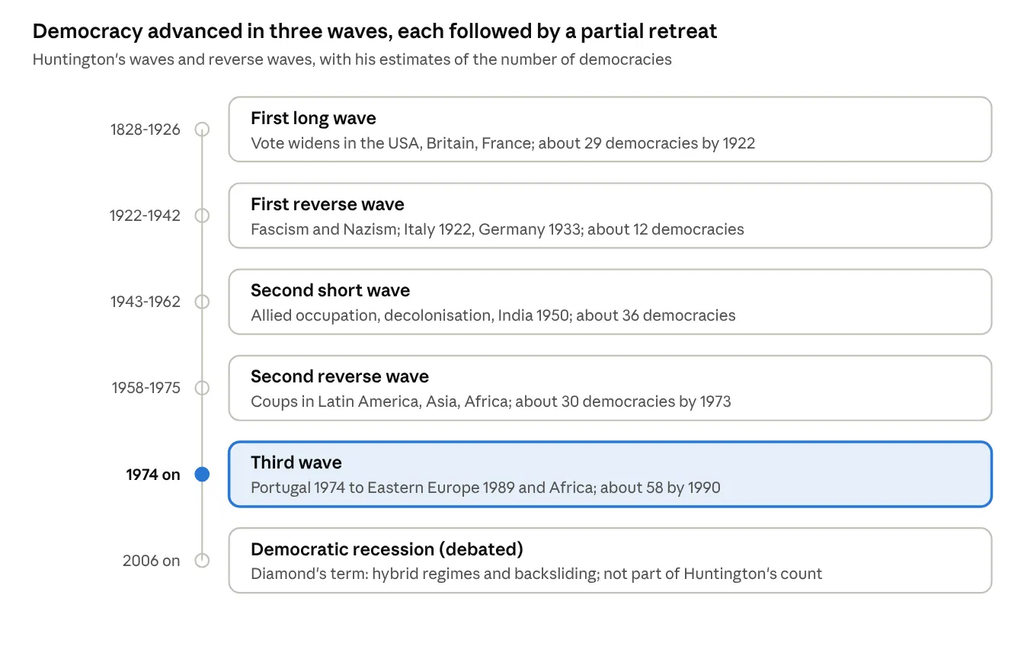
The picture shows Huntington’s pattern of two steps forward and one step back: each wave left more democracies than before, and each reverse wave cut the number. The third wave is highlighted because it is the one examined most. Sections 4 to 9 explain each stage.
4. Huntington’s framework
To use the idea of waves, a student needs to know how Huntington defined a democracy, how he dated the waves, and how he counted them.
Which democracy is counted?
Huntington followed Schumpeter and Dahl. He called a twentieth-century political system democratic to the extent that its most powerful collective decision-makers are selected through fair, honest and periodic elections in which candidates freely compete for votes and in which virtually all the adult population is eligible to vote. Such a system also implies the civil and political freedoms of speech, publication, assembly and organisation that are needed for debate and campaigns. He explained that the definition is narrow on purpose, since it leaves out the question of how good the government is, how much equality exists and whether the state serves the people well.
Huntington counted a system as democratic from the time at which it first met a lower threshold, based on Dahl’s idea of 50 per cent of men having the vote and a responsible executive. He used this to date the first wave in the nineteenth century, a period when voting rights for women and the poor were not yet universal.
The dating of the waves and reverse waves
| Period | Name | Main features |
|---|---|---|
| 1828 to 1926 | First, long wave of democratisation | Extension of the vote in the United States, Britain, France and others; about 29 democracies by 1922 |
| 1922 to 1942 | First reverse wave | Rise of fascism and communism; democracies fall to about 12 |
| 1943 to 1962 | Second, short wave | Post-war occupation and decolonisation; about 36 democracies by 1962 |
| 1958 to 1975 | Second reverse wave | Coups in Latin America, Asia and Africa; democracies fall to about 30 |
| From 1974 | Third wave | Southern Europe, Latin America, East Asia, Eastern Europe, parts of Africa; about 58 by 1990 |
The dates overlap because Huntington took the start of a wave when a country first made the shift, and the start of a reverse wave when a country first broke down. The figures are his estimates and depend on his criteria.
How waves are measured
Huntington used a rough method: for each period, he counted how many states were democratic at the start and end, and how many transitions went in each direction. He noted that the percentage of democratic states among all independent states in the world did not rise in a straight way. In his table, the share of democracies among independent states was about 45 per cent in 1922, fell to about 20 per cent in 1942, rose to about 32 per cent in 1962, dipped to about 25 per cent in 1973, and rose to about 35 per cent in 1990. In more recent work, scholars use data from Freedom House, Polity and V-Dem, which show a third wave that peaked around the mid-2000s.
Types of transition in the third wave
Huntington divided third wave transitions into three types, which are helpful for answers.
| Type | Who leads the change | Examples |
|---|---|---|
| Transformation (reforma) | The rulers in the regime decide to lead the change | Spain, Brazil, Taiwan, Hungary |
| Replacement (ruptura) | The opposition gains strength, the regime collapses or is overthrown | Portugal 1974, Argentina 1983, Greece, Romania, the Philippines |
| Transplacement (ruptforma) | Government and opposition act together and negotiate | Poland, Czechoslovakia, Uruguay, South Korea, South Africa, Bolivia |
Huntington’s main arguments
In the book, Huntington said that democracy spreads in waves, that each wave has its own causes, and that causes of a wave may differ from causes of its end. He also offered ‘guidelines for democratisers’, such as the need to keep a base of support and to avoid turning to the army. In the last chapters, he warned that consolidation would be hard because of problems such as the legacy of past rulers, poverty and ethnic conflict. In a famous test he set out, a country has consolidated when it has passed the ‘two-turnover test’, meaning that the party that first came to power at the transition has lost an election and handed power over, and the winners have done the same again. This test is often asked in exams.
Criticisms of the framework
Students should be able to state four criticisms. First, the minimal definition leaves out the quality of democracy. Second, the idea of a wave suggests a common cause, but the causes differ by country. Third, the dating is somewhat arbitrary, with overlaps. Fourth, the focus on countries as units misses cases in which different parts of a state have different degrees of democracy.
5. The first wave and the first reverse wave
The first long wave, 1828 to 1926
Huntington dated the start to 1828, when Andrew Jackson was elected in the United States, in an era in which most white men had the vote. The wave grew through the nineteenth century as voting rights widened and executives became answerable to elected bodies. It covered Britain after the Reform Acts of 1832, 1867 and 1884, France after the revolutions of 1830 and 1848 and the Third Republic from 1870, the Scandinavian states, the self-governing parts of the British Empire such as Canada, Australia and New Zealand, and Switzerland. After the First World War, new democracies appeared in Germany (the Weimar Republic of 1919), Austria, Poland, Czechoslovakia and other states created from the collapsed empires, and the vote was extended to women in many countries, such as Britain in 1918 and 1928, and the United States in 1920.
Causes of the first wave
- Economic change. The Industrial Revolution created a new middle class and a working class that demanded a share in government.
- Social change. Urbanisation, literacy and the press spread political awareness.
- Ideas. The American and French Revolutions gave strong ideas of popular sovereignty, rights and equality. The liberal writings of John Stuart Mill and others added to them.
- Pressure from below. Movements such as the Chartists in Britain, trade unions and suffrage movements for women pressed for the vote.
- Gradual reform by elites. In Britain and Scandinavia, ruling groups made concessions in steps to avoid revolution.
- Effects of war. The First World War ended the German, Austro-Hungarian, Russian and Ottoman empires and brought a surge of new constitutions, with Wilson’s principle of self-determination as a guide.
Barrington Moore, in Social Origins of Dictatorship and Democracy (1966), linked the path to democracy in Britain, France and the United States to the role of the commercial middle class, the weakening of landed elites, and revolution or reform from above or below. This helps to explain why the first wave was concentrated in the societies where such conditions held.
The first reverse wave, 1922 to 1942
The start of the reverse wave is dated to Mussolini’s march on Rome in 1922. In the following years, democracies fell in many places:
| Country | Year of breakdown | Outcome |
|---|---|---|
| Italy | 1922 to 1925 | Fascist rule under Mussolini |
| Portugal | 1926 | Military coup; Salazar’s Estado Novo from 1932 |
| Poland | 1926 | Pilsudski’s coup |
| Germany | 1933 | Hitler’s Nazi regime |
| Austria | 1934 | Authoritarian regime, then Nazi annexation in 1938 |
| Spain | 1936 to 1939 | Civil war and Franco’s rule |
| Baltic states, Balkans | 1920s and 1930s | Royal and military dictatorships |
| Japan | 1930s | Military dominance |
By 1942, Huntington counted only about a dozen democracies in the world.
Causes of the first reverse wave
Several reasons are given. Democracy was new and weak in states that lacked a democratic tradition, a strong middle class or a shared national identity. The Great Depression after 1929 caused mass unemployment and anger, and the established parties seemed unable to respond. Extreme movements of the right and left offered order and quick action. Fear of communism after the Russian Revolution of 1917 led propertied groups and the army to back authoritarian rule. Divisions among democratic parties, as in Weimar Germany, with its many small parties and its use of emergency powers under Article 48, made governments unstable. The Treaty of Versailles was seen by many Germans as unjust, and gave fuel to nationalism. Finally, the new authoritarian ideologies of fascism and Nazism claimed to be a better, more modern alternative to democracy.
Juan Linz, in The Breakdown of Democratic Regimes (1978), gave a detailed theory of how democracies fall: loss of legitimacy, polarisation, disloyal oppositions that do not accept the rules, and failure of leaders to solve problems. The Weimar case is the most taught example.
Lessons from the first cycle
The first cycle showed that the spread of the vote does not guarantee a lasting democracy, that economic crisis can quickly destroy support for it, and that the loyalty of key groups, such as the army and conservative elites, to the rules is vital. These lessons were used later by the designers of post-war institutions in Germany and Japan.
6. The second wave and the second reverse wave
The second, short wave, 1943 to 1962
The second wave began with the Allied victories in the Second World War. Huntington dated it from 1943, when Italy’s fascist regime fell, to 1962. Its main features were:
- Imposed or encouraged democracy after defeat. West Germany (1949), Italy, Austria, Japan (1947 Constitution) and, later, South Korea were given democratic institutions under Allied influence. The Marshall Plan and the example of the United States helped.
- Return of democracy in Western Europe. France, Belgium, the Netherlands, Norway and Denmark restored their systems after Nazi occupation.
- Decolonisation. Many new states in Asia and Africa began with democratic constitutions, as in India (1950), Sri Lanka, Burma, Indonesia, Malaya, Israel and the Philippines. India is the largest and most lasting example.
- Latin America. A short rise of democracy in the mid-1940s and 1950s, as in Venezuela, Colombia, Argentina under Peron, Brazil’s 1946 constitution and Costa Rica after 1948.
- Turkey and Greece. Moves towards multi-party politics under Cold War pressure.
By 1962, Huntington counted about 36 democracies.
Causes of the second wave
The military defeat of fascist regimes ended their claims. The Allied powers, especially the United States, had the power and wish to rebuild democracy in occupied areas, as part of their struggle with the Soviet Union. Economic recovery and welfare states in Western Europe gave support. In the colonies, nationalist movements demanded democratic rights from their rulers, and the departing imperial powers left behind parliamentary models. Lipset’s idea that wealth supports democracy also gained support from the long boom of the 1950s and 1960s in the West.
The second reverse wave, 1958 to 1975
The second reverse wave began, in Huntington’s account, with the military coup in Peru in 1962 (some date it from Pakistan’s coup of 1958), and continued through the 1960s and early 1970s.
| Region | Examples of breakdown |
|---|---|
| Latin America | Brazil (1964), Argentina (1966, 1976), Peru (1968), Chile (1973), Uruguay (1973), Bolivia |
| South Asia | Pakistan (1958), Bangladesh later (1975); India’s Emergency (1975 to 1977) as a temporary suspension |
| Southeast Asia | Indonesia (Sukarno’s Guided Democracy 1957, Suharto from 1965-66), Burma (1962), Thailand, South Korea (1961), the Philippines (martial law 1972) |
| Africa | Many one-party and military regimes after independence: Ghana (1966), Nigeria (1966), Uganda (1971), Zaire (1965) |
| Europe and the Middle East | Greece (the colonels’ junta, 1967 to 1974); Turkey’s military interventions (1960, 1971) |
By 1973, the number of democracies had fallen to about 30, and the number of authoritarian regimes had risen sharply.
Causes of the second reverse wave
Several explanations are offered. In many Third World states, new democracies were set up before the conditions for them had been built: weak institutions, poverty, ethnic divisions and a shortage of educated leaders. Huntington’s own work, Political Order in Changing Societies (1968), argued that rapid social mobilisation without strong institutions leads to disorder and gives the army a reason to take power. The Cold War led the United States and the Soviet Union to support friendly regimes, and the USA backed coups against leftist governments, as in Guatemala (1954), Brazil (1964) and Chile (1973). Economic problems, particularly the exhaustion of import-substitution policies in Latin America, led Guillermo O’Donnell to describe a new type of regime, bureaucratic-authoritarianism, in which the army and technocrats ruled together in the name of order and economic modernisation, as in Brazil after 1964 and Argentina after 1966. Finally, the example of coups encouraged more coups, and the professionalised army in many states considered itself the guardian of the nation.
India in the second wave and the second reverse wave
India is an exception to the pattern. It became independent in 1947, adopted a Constitution in 1950 with universal adult franchise, and held its first general election in 1951 to 1952, with about 170 million voters, mostly illiterate. It continued as a democracy through the second reverse wave, with the exception of the Emergency declared on 25 June 1975 under Article 352 and lifted in March 1977. Huntington himself noted India as a case where democracy survived in a poor country. The reasons are discussed in section 10.
Lessons from the second cycle
The second cycle showed that democracy can be given from outside, as in Germany and Japan, where it lasted because it joined growth and a stable society. It also showed that democracy was fragile in poor, divided states without strong institutions, and that international power politics can make a difference in whether democracy survives.
7. The third wave
The third wave began on 25 April 1974, when army officers overthrew the dictatorship in Portugal in the Carnation Revolution. Within fifteen years, about thirty countries moved from authoritarian rule to democracy, and by the early 1990s, many others had started to liberalise. It is the most studied of the three waves.
Huntington’s five causes
Huntington gave five main reasons, and this list is the most asked part of the topic.
- Deepening legitimacy problems of authoritarian regimes. In a world where democratic values were widely accepted, regimes that claimed to be legitimate by results lost support when they failed. Defeat in war, as for Argentina in the Falklands in 1982, economic failure, as in Latin America in the debt crisis of the 1980s, and the loss of a charismatic leader, as in Spain after Franco’s death in 1975, undermined authority.
- Global economic growth in the 1960s. Rapid growth raised living standards, education and urbanisation, and enlarged the middle class, which wanted a voice. At the same time, the economic crises of the 1970s and the oil price shocks brought hardship that damaged the claims of some rulers.
- A change in the Catholic Church. After the Second Vatican Council (1962 to 1965), the Church, which had often supported conservative rulers, turned to defend human rights. In Brazil, Chile, Poland, the Philippines and Latin America, bishops and priests became critics of dictatorship. Pope John Paul II’s visits to Poland in 1979 and later gave courage to many.
- Changes in the policies of outside actors. The European Community made democracy a condition for the entry of Greece, Spain and Portugal. The United States, under President Carter and later Reagan, put human rights and democracy on its agenda in Latin America and the Philippines. The Soviet Union under Gorbachev withdrew its support for the communist regimes of Eastern Europe, in 1988 to 1989.
- Snowballing or demonstration effect. Success in one country gave hope and a model to others, helped by faster communication and television. The fall of Marcos in 1986 was followed by changes in Korea and Taiwan, and Eastern Europe’s changes followed one after another in 1989.
Other explanations
Later writers added further causes. Larry Diamond and others stressed the growth of civil society, and the role of trade unions, students, churches and associations. Economists pointed to the debt crisis and structural adjustment. Scholars of the end of the Cold War stressed that the collapse of the Soviet system removed the main alternative model and cut the support for authoritarian allies. Finally, the move of the world economy towards open markets, and the spread of human rights norms through the United Nations and regional bodies, created a more favourable environment.
The regions of the third wave
| Region | Period | Main cases | Notes |
|---|---|---|---|
| Southern Europe | 1974 to 1977 | Portugal, Greece, Spain | The start of the wave; EC membership acted as an anchor |
| Latin America | 1979 to 1990 | Ecuador, Peru, Bolivia, Argentina, Uruguay, Brazil, Chile | Military regimes withdrew after economic crisis and defeat; pacts and elections |
| East and South Asia | 1986 to 1990s | Philippines, South Korea, Taiwan, Thailand, Bangladesh, Nepal, Indonesia (1998) | People power movements and growth of the middle class |
| Eastern Europe and Soviet Union | 1989 to 1991 | Poland, Hungary, Czechoslovakia, East Germany, Romania, the Baltic states, Russia and others | The end of communism, with many different outcomes |
| Sub-Saharan Africa | 1989 to 1990s | Benin, Zambia, Malawi, Mali, South Africa (1994), Ghana, Nigeria (1999) | National conferences, the end of apartheid and pressure from donors |
Modes of transition
Huntington’s three types, transformation, replacement and transplacement, were given in section 4. The outcome often depended on the type. Transformations kept more of the old elite in place and gave the rulers a say in the rules. Replacements produced sharper breaks and sometimes more instability. Transplacements involved pacts, such as Spain’s Moncloa Pacts of 1977, which gave a basis for consolidation, though some scholars say that such pacts also limited later change.
Why the third wave was different
It covered more regions, was more global, and was connected to large changes in the international order. It also differed in the stress on elections as the key sign of democracy, and in the strength of international bodies. At the same time, unlike earlier waves, it produced many regimes that fell between full democracy and dictatorship.
Case table
| Country | Year | Mode | Notes |
|---|---|---|---|
| Portugal | 1974 | Replacement | Military officers overthrow Caetano; democratic constitution of 1976 |
| Spain | 1975 to 1978 | Transformation | Franco dies; reform led by King Juan Carlos and Adolfo Suarez; Constitution of 1978 |
| Argentina | 1983 | Replacement | Military defeated in Falklands; Alfonsin elected |
| Brazil | 1985 | Transformation or transplacement | Gradual opening by the army; civilian president in 1985 |
| Philippines | 1986 | Replacement | People Power ousts Marcos |
| South Korea | 1987 | Transplacement | Mass protests; direct presidential elections |
| Poland | 1989 | Transplacement | Round Table talks; Solidarity wins elections |
| Chile | 1988 to 1990 | Transplacement | Pinochet loses plebiscite of 1988; elections of 1989 |
| South Africa | 1990 to 1994 | Transplacement | End of apartheid; Mandela elected 1994 |
| Indonesia | 1998 | Replacement | Suharto resigns after protests and the Asian crisis |
8. Theories of democratisation
Scholars have offered many explanations of why and how states become democratic. The main theories can be grouped as structural, process-centred and cultural or international. A good answer states the author, the main claim and a criticism.
Modernisation theory: Lipset
Seymour Martin Lipset, in his essay of 1959, argued that the more well-to-do a nation, the greater the chances that it will sustain democracy. He used indicators of wealth, industrialisation, education and urbanisation, and found that stable democracies scored higher than unstable ones. The reasons given are that wealth reduces the intensity of class conflict, that education encourages tolerance, and that a large middle class supports moderation. Criticisms are that correlation does not prove cause, and that many poor states, such as India, are democratic while rich oil states are not.
Adam Przeworski and Fernando Limongi (1997) found that wealth does not cause transitions to democracy, but that once a country is democratic, wealth helps it to survive. Higher income, they said, makes a democracy very unlikely to fall: no democracy with income above about US$6,000 (in 1985 prices) has been seen to fail.
Class and historical paths: Barrington Moore
In Social Origins of Dictatorship and Democracy (1966), Moore traced three routes to the modern world: the democratic route, through a bourgeois revolution, as in Britain, France and the United States; the fascist route, through a revolution from above in alliance of landed elites and the state, as in Germany and Japan; and the communist route, through a peasant revolution, as in Russia and China. His famous line is: no bourgeois, no democracy. Critics say that the book takes too few cases and neglects other factors, such as the working class.
The transition approach: Rustow
Dankwart Rustow, in 1970, objected to the focus on social prerequisites and proposed to study how democracies actually begin, which he called the genetic approach. He said the only background condition is national unity. Then come three phases: a long and inconclusive struggle, a decision to accept diversity and compromise, and habituation, in which the new rules become routine. He also said that democracy may be started for reasons other than those that sustain it.
Elite pacts and transitology: O’Donnell and Schmitter
In Transitions from Authoritarian Rule (1986), a four-volume study of Southern Europe and Latin America, Guillermo O’Donnell and Philippe Schmitter concentrated on the actions of elites. A transition begins when rulers split into hardliners and softliners, and the softliners open talks with moderates in the opposition. The moderate groups make pacts, which limit what each side can do. A phase of liberalisation is followed by the resurrection of civil society, and then by elections. They said that uncertainty is high, and that no transition is sure to succeed. This approach is known as transitology and has been used for later cases.
Rational choice and conflict approaches: Przeworski, Boix, Acemoglu and Robinson
Adam Przeworski, in Democracy and the Market (1991), treated democratisation as a strategic game among rulers and opposition, in which democracy is accepted when groups cannot do better by other means and when its results are uncertain but limited. Carles Boix (2003) argued that democracy is more likely when inequality is low, and when assets are mobile and hard to tax unfairly, since the rich then fear democracy less. Daron Acemoglu and James Robinson, in Economic Origins of Dictatorship and Democracy (2006), said that elites give democracy as a commitment to avoid revolution, when the threat from the poor is real and repression is costly. These models are formal, and are criticised for being hard to test and for ignoring culture and ideas.
Culture and values: Almond and Verba, Inglehart and Welzel
Gabriel Almond and Sidney Verba, in The Civic Culture (1963), argued that stable democracy needs a civic culture that mixes participation with deference. Ronald Inglehart and Christian Welzel (Modernization, Cultural Change, and Democracy, 2005) argued that economic development changes values from survival to self-expression, and that this change brings pressure for democracy. Critics note that the same values appear in non-democratic states with high incomes, and that culture is hard to measure.
International and diffusion approaches
Scholars such as Laurence Whitehead (The International Dimensions of Democratization, 1996), Kristian Gleditsch and Michael Ward and Steven Levitsky and Lucan Way (on linkage and leverage to the West) point to the effect of outside forces. Democratisation can come from contagion, from conditions attached to aid or membership in the European Union, from conquest, and from the example of neighbours. Huntington’s snowballing effect belongs to this group.
Consolidation theory: Linz and Stepan
Juan Linz and Alfred Stepan in Problems of Democratic Transition and Consolidation (1996) argued that consolidation needs five arenas to be in good order: civil society, political society, the rule of law, a usable state bureaucracy, and an economic society. They stressed that a democratic transition cannot be complete if the state is not agreed upon, which they called the stateness problem, as in the former Soviet states and Yugoslavia. They also pointed out that the path of the old regime, whether it was totalitarian, authoritarian, post-totalitarian or sultanistic, shapes the transition.
Comparing the theories
| Approach | Main writers | What explains democracy | Chief weakness |
|---|---|---|---|
| Modernisation | Lipset, Przeworski and Limongi | Wealth, education, urbanisation | Many exceptions; wealth may sustain more than cause |
| Class and history | Moore, Rueschemeyer, Stephens | Balance of power among classes | Few cases; deterministic |
| Genetic or transition | Rustow, O’Donnell and Schmitter | Elite choices, pacts, compromise | Underrates structure and mass action |
| Rational choice and conflict | Przeworski, Boix, Acemoglu and Robinson | Strategy, inequality and threat of revolution | Hard to test; thin on culture |
| Culture | Almond and Verba, Inglehart and Welzel | Civic culture, self-expression values | Hard to measure; reversible |
| International | Whitehead, Levitsky and Way | Diffusion, linkage, conditions | Different in each case |
| Consolidation | Linz and Stepan | Five arenas and the state | Mainly about what follows the transition |
9. Consolidation, hybrid regimes and democratic recession
By the mid-1990s, scholars saw that many new democracies were not becoming mature liberal democracies. The attention of research moved from transition to what came after.
The task of consolidation
To become consolidated, a democracy must pass several tests. Linz and Stepan’s test of the only game in town, and Huntington’s two-turnover test, are the main ones. Other signs include the acceptance of election results by the losers, civilian control of the army, a working judiciary, the growth of political parties and an economy that does not give strong reasons to turn to authoritarian rule. Larry Diamond (Developing Democracy, 1999) added that consolidation is also about deepening: making institutions more accountable, transparent and responsive to citizens.
States that did well include Spain, Portugal, Poland, Czechia, Hungary (until it later declined), South Korea, Taiwan, Chile and Uruguay. Many other third wave states stayed incomplete in their democracy.
Hybrid regimes and the grey zone
Thomas Carothers, in an article of 2002 called The End of the Transition Paradigm, argued that the idea of a smooth path from dictatorship to democracy was wrong, and that most countries called transitional were in a grey zone, neither fully democratic nor openly dictatorial. Several terms describe these cases:
| Term | Writer | Meaning |
|---|---|---|
| Illiberal democracy | Fareed Zakaria (1997) | Elections are held, but there is little constitutional liberalism or limit on power |
| Delegative democracy | Guillermo O’Donnell (1994) | An elected president claims to embody the nation and rules with few checks from other institutions |
| Competitive authoritarianism | Levitsky and Way (2002, 2010) | Elections are real and contested, but the field is tilted by abuse of state resources, media and courts |
| Electoral authoritarianism | Andreas Schedler (2006) | Regimes that hold elections to stay in power without allowing real risk |
| Semi-democracy, partly free | Freedom House and others | Categories for the middle of the scale |
| Dominant-party system | Giovanni Sartori and others | One party wins repeatedly, even though others are allowed |
Examples cited include Russia under Putin, Venezuela under Chavez and Maduro, Turkey under Erdogan, Egypt, Pakistan at times, Hungary after 2010, and several states in Africa and Central Asia.
Democratic recession
Larry Diamond argued in 2008 and later work that the world entered a democratic recession from about 2006. Freedom House has reported a fall in global freedom for many years in a row, and the V-Dem project at the University of Gothenburg has noted that the level of democracy enjoyed by the average citizen in the world has fallen back to levels of earlier decades, and that autocratisation has become the main trend. The Economist Intelligence Unit’s Democracy Index shows the same pattern. Causes cited include the financial crisis of 2008, the rise of China as an authoritarian model, the return of Russian power, polarisation, the effects of social media and disinformation, and populist leaders who reduce limits on power.
Democratic backsliding
Backsliding is a gradual decline in the quality of democracy, usually by elected leaders themselves. Nancy Bermeo called it executive aggrandisement and said that it works through many small steps: changing rules on elections, packing courts, pressure on the press and attack on opposition. Steven Levitsky and Daniel Ziblatt, in How Democracies Die (2018), stressed the loss of the unwritten norms of mutual toleration and forbearance. Cases frequently mentioned are Hungary, Poland (partly reversed after 2023), Turkey, India (in the views of some indices), Brazil under Bolsonaro, the Philippines, El Salvador and Tunisia since 2021. Students should note that the rating of India differs by source, and that Indian government agencies dispute the findings of foreign indices.
The Arab Spring: a missed wave?
The protests that began in Tunisia in December 2010 led to the fall of rulers in Tunisia, Egypt, Libya and Yemen. Some scholars called it a possible fourth wave. But the results were poor: Tunisia made a democratic transition that later reversed after President Kais Saied’s actions of 2021, Egypt returned to military rule in 2013, and Libya, Syria and Yemen fell into civil war. Explanations include strong armies, the lack of organised opposition, oil rents, foreign intervention and weak civil society.
Reasons why consolidation fails
- Weak institutions and state capacity, so that governments cannot deliver services or order.
- Economic problems and inequality, which make citizens turn to strong leaders.
- Ethnic and religious division, and unsettled questions of national identity.
- A political culture of patronage and corruption.
- Interference by the army or other unelected powers.
- Leaders who weaken checks once in office.
- Outside influences, including the support of powerful states for authoritarian allies.
Does democracy deliver?
A related concern is whether new democracies satisfy citizens. Surveys by Afrobarometer, Latinobarometro and others show strong support for democracy as a principle, but low trust in parties and governments, which gives a base for populists. The question of how to improve the quality of democracy, with indicators of rule of law, accountability, participation and equality (Diamond and Morlino), is now a major field of research.
10. India and the waves of democratisation
India is the most important case for Indian students, and it is also a puzzle for the theory of waves.
India and Huntington’s scheme
India belongs to the second wave, as a democracy created with independence. Unlike many states of its wave, it did not experience a reverse wave. The only major break was the Emergency of 1975 to 1977, after which the electors voted out the ruling party in the elections of March 1977, and the Janata government restored civil liberties through the 44th Amendment (1978). This shows both the weakness and the self-correcting strength of the system. Huntington himself noted that India, together with a few others such as Sri Lanka, Jamaica and Costa Rica, was among the poor states that kept democracy in the second reverse wave.
Why democracy took root in India
Scholars have offered several explanations, which can be used as points in an answer.
- The nationalist movement. The Indian National Congress, founded in 1885, trained generations of leaders in constitutional methods, mass mobilisation and compromise, and gave the new state legitimacy.
- Leaders who valued democracy. Nehru, Patel, Ambedkar, Azad and others were committed to constitutional rule, civilian control of the army and secularism.
- The Constitution of 1950. It was written by a representative Constituent Assembly after long debate, gave universal adult franchise, fundamental rights, an independent judiciary and a federal structure.
- Federalism and accommodation. The reorganisation of states on linguistic lines after 1956, and later arrangements such as the Sixth Schedule and reserved seats for the Scheduled Castes and Tribes, gave regional and social groups a stake. Alfred Stepan called India a state-nation. Arend Lijphart treated India as a case of consociational features in a plural society.
- Institutions. The Election Commission, the courts, a free press and a civil service were inherited and adapted.
- A professional army kept out of politics. The Indian army is under civilian control, unlike the Pakistani army.
- Social change through politics. Rajni Kothari and others noted that democratic politics drew caste groups and the poor into the political process, and Yogendra Yadav described a democratic upsurge of lower groups from the 1990s. Ashutosh Varshney has argued for the role of inter-community civic ties in keeping communal peace.
- Dispersed power. Many sources of power, among castes, regions, languages and religions, prevented any one group from controlling the state.
The case contradicts Lipset’s modernisation thesis, since India was poor and had low literacy in 1947, and also Dahl’s argument that democracies need cultural homogeneity. Adam Przeworski and others have called it an exception to the link between income and democracy.
Problems and criticisms
Indian democracy has also faced difficulties, including the Emergency, communal violence, the use of the army in internal conflicts, the criminalisation of politics, the influence of money, caste and gender inequality, and uneven delivery of services. In recent years, some indices such as V-Dem and Freedom House have rated India lower, citing pressure on the media, civil society and minorities, while others point to strong electoral participation and a competitive party system. Students should present both views with care and cite the source of any rating.
Comparing neighbours
| Country | Independence | Democratic record | Main reasons given |
|---|---|---|---|
| India | 1947 | Continuous, except the Emergency of 1975 to 1977 | Nationalist movement, constitution, civilian control of the army, federalism |
| Pakistan | 1947 | Civilian and military rule in turn | Weak parties, strong army and bureaucracy, early death of the founder, wars with India |
| Sri Lanka | 1948 | Long democratic record, but civil war 1983 to 2009 and later crises | Ethnic conflict, majoritarian measures such as the Sinhala Only Act (1956) |
| Bangladesh | 1971 | Alternating military and civilian rule; elections since 1991 | Polarised parties, army role; contested elections |
| Nepal | Never colonised | Monarchy, republic since 2008 | Maoist insurgency and the end of the monarchy |
| Myanmar | 1948 | Military rule from 1962; short opening 2011 to 2021; coup in February 2021 | Strong army; ethnic conflicts |
Regional comparison of the third wave
| Region | Common pattern | Result |
|---|---|---|
| Southern Europe | Transition anchored by EU membership | Mostly consolidated |
| Latin America | Exit of the army after the debt crisis; pacts | Democracy continues, with populism and weak institutions |
| East Asia | Growth, middle class and protest | South Korea and Taiwan consolidated; Thailand and the Philippines unstable |
| Eastern Europe | End of communism, EU accession | Central Europe largely democratic, with backsliding in Hungary; Russia and Belarus authoritarian |
| Sub-Saharan Africa | National conferences, donor pressure | Mixed: Ghana, Botswana and Mauritius stable; many hybrid regimes and coups in the Sahel |
| Middle East and North Africa | Arab Spring of 2011 | Largely reversed, with Tunisia a partial early success |
11. Importance and limitations
Importance of the idea of waves
It gives a simple picture of a complex history. Over almost two centuries, the story of democracy can be held in mind as three surges and two retreats. This helps a student to organise facts and to place any country in a period.
It shows that democracy can be lost as well as won. The reverse waves warn that progress is not automatic. This is useful for understanding democratic breakdown and backsliding today.
It directs attention to causes at the global level. War, the Cold War, economic crises and the policy of great powers shaped the waves. The idea reminds us that national politics happens in an international setting.
It encourages comparison across regions. The waves connect Southern Europe, Latin America, Asia, Eastern Europe and Africa, and help students to compare cases with similar timing but different outcomes.
It gave birth to transition and consolidation studies. The third wave led to the large literature of transitology and consolidation, with Linz, Stepan, O’Donnell, Schmitter, Diamond and others.
It offers a practical guide for policy. Huntington’s guidelines for democratisers and later work on democracy promotion, constitutional design and election support are based on the study of waves.
It helps to explain the role of timing and diffusion. Why states change together, through demonstration effects, outside pressure and regional ties, is made clear.
It sets a baseline for measuring democratic recession. The claim that the world is in a recession is meaningful only against the earlier rise. Indices such as Freedom House, Polity and V-Dem can be read in this light.
It puts India in a global context. India’s survival through the second reverse wave is a leading example of a case that does not fit the general pattern, and so it is a subject of research.
It links democracy with other topics. Modernisation, political culture, civil society, the army, hybrid regimes and populism are all connected to the waves.
It is high-yield for examinations. The three waves, five causes, three modes of transition and the two-turnover test are asked regularly in UPSC, UGC NET, OPSC and university papers.
Limitations and criticisms
The definition of democracy is minimal. Counting a state as democratic because it holds fair elections leaves out liberties, the rule of law and equality, so the numbers of democracies can be too high.
The wave metaphor may suggest too much uniformity. Causes differ by country, and the neat grouping can hide unique features.
Dating is rough and sometimes arbitrary. The waves overlap, and a change of the threshold for democracy would change the dates and counts.
Eurocentric basis. The first two waves are based on Europe and North America, and non-Western experiences, such as the Indian one, are treated as exceptions.
The focus on the state as the unit. Within a state, regions may differ, for example the southern US states during the era of Jim Crow, or conflict zones within democratic states.
Neglect of the quality of democracy. The approach counts transitions, not what happens afterward, and the third wave produced many hybrid regimes.
Possible teleology. The idea of waves can suggest that democracy is the natural end point. The recent recession shows that the direction is not certain.
Evidence on causes is mixed. Huntington’s five causes are descriptive and not tested in a formal way, and some writers say they cannot be ranked.
Underrates domestic class and structural factors. Moore, Rueschemeyer and Boix stress class relations and inequality, which the wave account treats lightly.
Underrates internal agency and mass action. The stress on international and elite factors may not give enough credit to popular movements in places such as South Africa, the Philippines or India.
Faces a challenge from recent events. Whether there is a fourth wave, a third reverse wave or a long plateau is argued, and data sources disagree.
Illustrations
| Case | What it illustrates | Key point |
|---|---|---|
| Britain, 1832 to 1928 | First wave, gradual reform | Reform Acts; elite concession; extension to women |
| Weimar Germany | First reverse wave | Depression, polarisation, Hitler in 1933 |
| West Germany and Japan | Second wave, imposed democracy | Allied occupation, economic recovery |
| India | Survival in the second reverse wave | Constitution, Congress, civilian control of the army |
| Chile, 1973 and 1990 | Second reverse wave, then third wave | Pinochet coup; plebiscite of 1988 |
| Portugal, 1974 | Start of the third wave | Carnation Revolution; EC anchor |
| Poland, 1989 | Transplacement | Round Table; Solidarity |
| South Africa, 1994 | Negotiated transition | End of apartheid; Mandela |
| Hungary since 2010 | Backsliding in a consolidated state | Executive pressure on courts and media |
| Egypt, 2011 to 2013 | Arab Spring reversed | Mubarak ousted, military return |
12. How to use this topic in examinations
What each exam expects
| Exam | What is usually asked | How to prepare |
|---|---|---|
| UG university papers | Meaning of waves, dates of the three waves, causes of the third wave | Learn the dates, a list of causes and one example for each |
| PG university papers | Huntington’s thesis, transition theories, consolidation, criticism | Compare Huntington with Lipset, Rustow, O’Donnell and Schmitter, and Linz and Stepan |
| OPSC (OCS/OAS) | India and democratisation, causes of survival, backsliding debates | Link global patterns with Indian cases and recent events |
| UPSC (Political Science optional; GS II) | Waves, democratic recession, India’s case, hybrid regimes | Structured answers with dates, thinkers and examples |
| UGC NET Political Science | Authors and books, concepts such as two-turnover test, transplacement, delegative democracy | Match authors with ideas and dates |
Seven practice questions
- What is meant by a wave of democratisation? Discuss Huntington’s three waves and two reverse waves. (about 250 words)
- Explain the main causes of the third wave of democratisation. (about 250 words)
- Distinguish transformation, replacement and transplacement with examples. (about 200 words)
- What is democratic consolidation? Discuss the views of Linz and Stepan. (about 200 words)
- Examine the idea of democratic recession and backsliding. (about 250 words)
- Why did the first reverse wave occur? Explain with examples. (about 200 words)
- How far does the Indian case fit Huntington’s account of waves? (about 250 words)
Structured answer outline (Question 2)
Question. Explain the main causes of the third wave of democratisation.
- Introduction. State that the third wave began with Portugal in 1974 and that about thirty countries became democratic within fifteen years. Mention that Huntington gave five causes.
- Body.
- Legitimacy problems of authoritarian regimes: defeat in war, economic failure.
- Global economic growth and the rise of the middle class.
- The change in the Catholic Church after Vatican II.
- Changes in the policy of outside actors: the EC, the USA, the Soviet Union under Gorbachev.
- Snowballing effect, such as the 1989 changes in Eastern Europe.
- One example for each, and other factors such as civil society.
- Conclusion. Say that no single factor explained all cases, and that the mix differed by region. Mention the later difficulty of consolidation.
Sample answer (about 200 words)
Question. Explain the main causes of the third wave of democratisation.
Introduction. The third wave began in Portugal in April 1974, and within about fifteen years some thirty states moved from authoritarian rule to democracy. Samuel Huntington, in The Third Wave (1991), gave five main causes.
Body. First, authoritarian regimes faced a legitimacy problem. When they failed in war or in the economy, as Argentina did in the Falklands in 1982, they lost support. Second, rapid economic growth in the 1960s created a larger urban and educated middle class that demanded a voice. Third, the Catholic Church, after the Second Vatican Council, turned from supporting rulers to defending human rights, as seen in Brazil, Chile, Poland and the Philippines. Fourth, outside actors changed their policies. The European Community demanded democracy from Greece, Spain and Portugal, the United States stressed human rights, and the Soviet Union under Gorbachev gave up support for communist regimes in 1989. Fifth, the snowball effect spread change, as success in one country inspired others, from the Philippines to South Korea and then Eastern Europe. Other writers add the growth of civil society.
Conclusion. No single cause explained all cases, and the mix differed by region. Still, the third wave showed that transition does not mean consolidation, and many new democracies later became hybrid regimes.
Quick check
- Can I give the dates of the three waves and two reverse waves?
- Can I list the five causes of the third wave in order?
- Can I explain the three modes of transition with one example each?
- Can I state the two-turnover test and the only game in town idea?
- Can I name two hybrid regime concepts and their authors?
- Can I give three reasons why democracy survived in India?
Common mistakes to avoid
- Writing that the third wave began in 1989 (it began in 1974).
- Confusing the first reverse wave with the second.
- Treating transition and consolidation as one thing.
- Forgetting that Huntington used a minimal, procedural definition of democracy.
- Naming a cause of the third wave with no example.
- Mixing up the authors Rustow, O’Donnell and Schmitter, and Linz and Stepan.
- Ending with no comment on recession and backsliding, or no mention of India in an Indian exam.
13. Critical analysis
The theory of waves is widely used, but it is also debated. A student who can state the debates and take a reasoned position will do well in analytical questions.
Is the wave a real pattern or a convenient label?
Supporters say that transitions do cluster in time, and that the data from Polity and Freedom House confirm a surge from the mid-1970s to the early 2000s. Critics say that the clusters are partly the result of how Huntington drew the lines, and that it is more accurate to speak of many processes with some shared causes. A balanced view is that the idea is useful as a description and a starting point, but weak as a causal theory.
Are the waves driven by structure or by choice?
Structural writers such as Lipset, Moore and Boix stress wealth, class and inequality. Transition writers such as Rustow, O’Donnell and Schmitter stress elite decisions and pacts. Huntington’s own list mixes both, with the economy and the Church on one side, and demonstration effects and leader decisions on the other. The better view is that structure sets the range of what is possible and choices decide the outcome within that range.
Do outside forces matter most?
The role of the Cold War, the European Community and the United States was large, which supports an international view. However, the most important changes in the Philippines, South Korea, South Africa and Poland were driven by domestic movements. The wave idea should therefore not hide internal action.
Is a minimal definition enough?
The procedural definition gives clarity but counts states as democratic even when liberties and the rule of law are weak. Larry Diamond and others have asked for a more demanding test, and Zakaria’s concept of illiberal democracy points to the difference between voting and liberty. The reply is that Huntington needed a measurable concept, but that later work must go beyond it.
Is there a fourth wave or a third reverse wave?
Some writers see the Arab Spring as a short fourth wave. Others, following Diamond’s democratic recession, speak of a reverse tendency from about 2006, shown by hybrid regimes and backsliding. Still others see a plateau. Because data sources differ, the best answer is to state that the evidence is disputed, and to cite the sources. It is also worth noting that in many states, authoritarian rulers learned to survive by holding managed elections.
Does India fit the pattern?
India is both a second wave case and an exception to the second reverse wave. It also shows that a wave account written for the Western world has to be adjusted for post-colonial states, where democracy began with the nation itself, led by a mass movement and not by elites alone. The question of whether Indian democracy is now in decline depends on the index and the definition used.
Linking to Indian thought
B. R. Ambedkar warned in his speech of 25 November 1949 that political democracy cannot last unless it rests on social democracy, and that equality in politics must be joined with equality in social and economic life. Gandhi’s idea of swaraj and village self-rule and Nehru’s belief in parliamentary rule are other Indian views. These help in giving an Indian angle to answers on consolidation and the quality of democracy.
Model concluding paragraph
Huntington’s idea of waves gives a clear picture of how democracy spread and retreated over nearly two centuries: a long first wave, a short second wave and a global third wave, each followed by a partial reversal. Its strength is its simplicity and its stress on international and historical settings. Its weaknesses are a thin definition of democracy, rough dating, and little attention to the quality and consolidation of the regimes that arose. The later work of Linz, Stepan, Diamond, Levitsky and Way has shown that many new democracies stayed incomplete and that backsliding is now a main concern. India’s survival through the second reverse wave shows that democracy can take root in a poor and plural society, yet it also shows that no wave explains a country without attention to its own institutions and history.
14. Authors and books for UGC NET
| Author | Work | Key idea |
|---|---|---|
| Samuel P. Huntington | The Third Wave: Democratization in the Late Twentieth Century (1991) | Three waves, two reverse waves, five causes of the third wave |
| Samuel P. Huntington | Political Order in Changing Societies (1968) | Political decay; order before participation |
| Joseph Schumpeter | Capitalism, Socialism and Democracy (1942) | Democracy as competition for votes |
| Robert Dahl | Polyarchy: Participation and Opposition (1971) | Contestation and inclusiveness |
| Seymour Martin Lipset | “Some Social Requisites of Democracy” (1959) | Wealth favours democracy |
| Barrington Moore | Social Origins of Dictatorship and Democracy (1966) | Three routes to the modern world |
| Dankwart Rustow | “Transitions to Democracy” (1970) | Phases of transition: preparatory, decision, habituation |
| Gabriel Almond and Sidney Verba | The Civic Culture (1963) | Civic culture and stable democracy |
| Juan Linz | The Breakdown of Democratic Regimes (1978) | Why democracies fall |
| Guillermo O’Donnell and Philippe Schmitter | Transitions from Authoritarian Rule: Tentative Conclusions about Uncertain Democracies (1986) | Elite pacts, liberalisation, uncertainty |
| Guillermo O’Donnell | “Delegative Democracy” (1994) | Presidents with few checks |
| Adam Przeworski | Democracy and the Market (1991) | Democracy as institutionalised uncertainty |
| Przeworski, Alvarez, Cheibub and Limongi | Democracy and Development (2000) | Income does not cause transitions but sustains democracy |
| Juan Linz and Alfred Stepan | Problems of Democratic Transition and Consolidation (1996) | Only game in town; five arenas |
| Larry Diamond | Developing Democracy: Toward Consolidation (1999) | Consolidation and deepening |
| Larry Diamond | “Facing Up to the Democratic Recession” (2015) | Democratic recession |
| Fareed Zakaria | “The Rise of Illiberal Democracy” (1997) | Elections without liberalism |
| Thomas Carothers | “The End of the Transition Paradigm” (2002) | Grey zone regimes |
| Steven Levitsky and Lucan Way | Competitive Authoritarianism (2010) | Hybrid regimes with uneven competition |
| Carles Boix | Democracy and Redistribution (2003) | Inequality and the cost of democracy to the elite |
| Daron Acemoglu and James Robinson | Economic Origins of Dictatorship and Democracy (2006) | Elites and the threat of revolution |
| Ronald Inglehart and Christian Welzel | Modernization, Cultural Change, and Democracy (2005) | Self-expression values |
| Steven Levitsky and Daniel Ziblatt | How Democracies Die (2018) | Backsliding and loss of norms |
| Laurence Whitehead (ed.) | The International Dimensions of Democratization (1996) | Outside influences |
Revision tip. Make a one-page chart with five columns: waves and dates (Huntington), causes of the third wave, modes of transition, theories (Lipset, Moore, Rustow, O’Donnell and Schmitter, Przeworski, Linz and Stepan) and recent debates (Diamond, Levitsky and Way, Zakaria). Under each author, write the book, the year and the idea in one line.
15. Key takeaways, sources, books and FAQ
Key takeaways
- A wave of democratisation is a group of transitions to democracy within a period that clearly outnumber transitions in the opposite direction (Huntington).
- Huntington’s dating: first wave 1828 to 1926, first reverse wave 1922 to 1942, second wave 1943 to 1962, second reverse wave 1958 to 1975, third wave from 1974.
- He used a minimal, procedural definition of democracy from Schumpeter and Dahl: free, fair and periodic elections with competition and nearly universal adult suffrage.
- Five causes of the third wave: legitimacy problems of authoritarian regimes, economic growth, the change in the Catholic Church, the policy of outside actors, and the snowball effect.
- Three modes of transition: transformation, replacement and transplacement.
- Transition is not consolidation; Linz and Stepan’s only game in town and Huntington’s two-turnover test are the main criteria.
- Many third wave states became hybrid regimes, described by Zakaria, O’Donnell, Carothers and Levitsky and Way.
- Since about 2006, scholars such as Diamond have spoken of a democratic recession, with backsliding as a main concern.
- India survived the second reverse wave except for the Emergency of 1975 to 1977, because of its nationalist movement, constitution, federalism and civilian control of the army.
- A good answer gives dates, causes, theory, an example and a critical view.
Official and reliable sources
- Constitution of India, Ministry of Law and Justice
- Election Commission of India
- Freedom House: Freedom in the World
- V-Dem Institute, University of Gothenburg
- International IDEA: Global State of Democracy
- United Nations, Human Rights and Democracy
Twenty books for further reading
- Samuel P. Huntington, The Third Wave: Democratization in the Late Twentieth Century
- Samuel P. Huntington, Political Order in Changing Societies
- Robert A. Dahl, Polyarchy
- Robert A. Dahl, On Democracy
- Seymour Martin Lipset, Political Man
- Barrington Moore, Social Origins of Dictatorship and Democracy
- Guillermo O’Donnell and Philippe Schmitter, Transitions from Authoritarian Rule
- Juan Linz and Alfred Stepan, Problems of Democratic Transition and Consolidation
- Juan Linz, The Breakdown of Democratic Regimes
- Adam Przeworski, Democracy and the Market
- Larry Diamond, Developing Democracy: Toward Consolidation
- Larry Diamond, The Spirit of Democracy
- Steven Levitsky and Lucan Way, Competitive Authoritarianism
- Steven Levitsky and Daniel Ziblatt, How Democracies Die
- Daron Acemoglu and James Robinson, Economic Origins of Dictatorship and Democracy
- Carles Boix, Democracy and Redistribution
- Ronald Inglehart and Christian Welzel, Modernization, Cultural Change, and Democracy
- Fareed Zakaria, The Future of Freedom
- Ashutosh Varshney, Battles Half Won: India’s Improbable Democracy
- Atul Kohli (ed.), The Success of India’s Democracy
Editorial note
This note has been prepared by the PoliPrepHub editorial team from standard textbooks, primary documents and official sources, to help students of UG, PG, OPSC, UPSC and UGC NET levels. It is for educational use. Readers may confirm names, dates and figures with the sources listed above and with their own course books. For corrections or suggestions, please use the Contact Us page, and for terms of use, please read the Disclaimer.
Frequently asked questions
What is a wave of democratisation? A group of transitions from non-democratic to democratic regimes within a period that clearly outnumber transitions the other way, as defined by Samuel Huntington.
How many waves did Huntington identify? Three waves (1828 to 1926, 1943 to 1962, and from 1974) and two reverse waves (1922 to 1942 and 1958 to 1975).
When and where did the third wave begin? In Portugal on 25 April 1974, with the Carnation Revolution.
What are the causes of the third wave? Legitimacy problems of authoritarian regimes, rapid economic growth, a change in the Catholic Church, the changed policy of outside actors, and the snowball effect.
What are transformation, replacement and transplacement? Three modes of transition in Huntington’s account: change led by the rulers, change forced by the opposition after the regime collapses, and change by joint action of government and opposition.
What is democratic consolidation? The stage at which democracy becomes routine and widely accepted. Linz and Stepan call it the only game in town; Huntington suggests the two-turnover test.
What is democratic recession? Larry Diamond’s term for the period since about 2006 in which the world has seen more decline than gain in democracy, with backsliding and hybrid regimes.
Where does India fit in the waves? India belongs to the second wave and survived the second reverse wave, except for the Emergency of 1975 to 1977, which makes it an important exception.