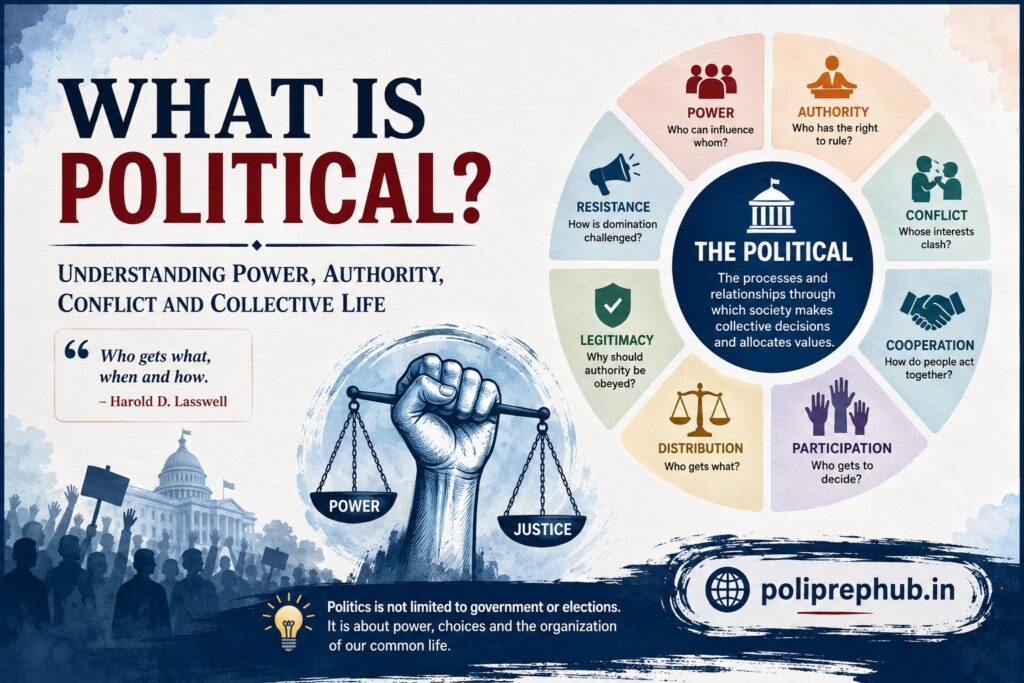
“What is political?” looks like a simple question, but it is the first question of the whole discipline of political science. Before we discuss the state, democracy, power or justice, we must first decide what kind of activity we are talking about. Is politics only what governments, parties and legislatures do? Is it any struggle over power, wherever it takes place? Does it include the family, the workplace, the village and the internet? Different answers lead to different subjects of study, different methods and different political conclusions. This is why scholars from Aristotle to Hannah Arendt, and from Max Weber to feminist writers, have returned to this question again and again.
This note explains the meaning of politics and of the political. It sets out the main conceptions, perspectives and elements, shows how Indian thinkers have understood the question, and ends with guidance for examinations. The topic appears at the very beginning of the undergraduate NEP course, in the postgraduate paper on Political Theory, in the OPSC and UPSC optional syllabi and in Unit 1 of UGC NET. It should be read together with the notes on Political Theory and Political Philosophy.
1. Politics and the political: meaning and definitions
The word. The word “politics” comes from the Greek word polis, meaning the city-state, and politika, meaning the affairs of the city. For the Greeks, the polis was not only a government. It was a whole community of citizens who shared a way of life, and a politikos was a citizen who took part in its decisions. This origin is important for students, because it shows that politics was first understood as shared, public decision-making by people who lived together. The modern word still carries this idea, although the state it describes today is far larger than a Greek city, and the citizens who take part in it are far more numerous.
Politics and the political. Two terms are often used together in recent writing, and students must keep them apart. Politics usually means the activities, institutions and processes through which decisions are made and power is exercised, such as elections, parties, legislatures and administration. The political refers to a wider dimension of social life, namely the presence of power, conflict and collective choice, which can appear in any setting. Chantal Mouffe, in On the Political (2005), draws this distinction sharply. For her, politics is the set of practices and institutions that organise human life together, while the political is the dimension of antagonism that is always present in human societies. In an examination answer, it is enough to say that politics is the more familiar and institutional term, and the political is the broader and more conceptual one. A short example helps: a Lok Sabha election belongs to politics, while the quarrel over who may draw water from a village well belongs to the political, even though no election or government is directly involved.
| Scholar | Work | Definition or idea |
|---|---|---|
| Aristotle | Politics | The human being is “by nature a political animal” who can reach the good life only in a political community |
| Max Weber | “Politics as a Vocation” (1919) | Striving to share power or to influence its distribution, among states or among groups within a state |
| Harold Lasswell | Politics: Who Gets What, When, How (1936) | The process by which the question of who obtains what is settled |
| David Easton | The Political System (1953) | The “authoritative allocation of values for a society” |
| Bernard Crick | In Defence of Politics (1962) | Activity by which differing interests in a unit of rule are conciliated by giving them a share in power in proportion to their importance to the community |
| Hannah Arendt | The Human Condition (1958) | Free and equal action in a shared public space |
| Carl Schmitt | The Concept of the Political (1932) | The political lies in the distinction between friend and enemy |
| Adrian Leftwich | What Is Politics? (2004) | Politics is found in all collective social activity, formal and informal, public and private |
| Andrew Heywood | Politics | The activity through which people make, preserve and amend the general rules under which they live |
Definitions to remember. Aristotle, in the Politics, described the human being as “by nature a political animal”, meaning that a person can reach the good life only inside a political community, and cannot do so alone. Weber, in “Politics as a Vocation” (1919), defined politics as striving to share power or to influence the distribution of power. Lasswell, in Politics: Who Gets What, When, How (1936), saw politics as the process that settles who gets what, and when and how. Easton, in The Political System (1953), called it the “authoritative allocation of values for a society”, which stresses that political decisions are binding on everyone. Crick, in In Defence of Politics (1962), treated it as the peaceful conciliation of different interests. Arendt, in The Human Condition (1958), saw it as free and equal action in a shared public space. Schmitt, in The Concept of the Political (1932), located the political in the distinction between friend and enemy. Leftwich, in What Is Politics? (2004), argued that politics is found in all collective activity, whether formal or informal. Heywood, in Politics, described it as the activity through which people make, preserve and amend the general rules under which they live.
Why the definitions differ. These definitions emphasise different things. Weber stresses power, Easton decision-making, Crick conciliation, Arendt participation, Schmitt conflict and Leftwich breadth. The disagreement is not a defect of the subject. It shows that “political” is what W. B. Gallie (1956) called an essentially contested concept, a concept whose meaning is disputed because people hold different views about what politics is for. A good answer therefore names several definitions, explains what each of them includes and what each leaves out, and then gives a reasoned view of its own.
2. Four conceptions of politics
Andrew Heywood, in Politics, grouped the many definitions into four broad conceptions. They are useful because almost every definition fits into one of them, and because each leads to a different idea of what the study of politics should cover.
Politics as the art of government. In this oldest conception, politics is what rulers, governments and officials do: making laws, running the administration and conducting foreign relations. Aristotle’s classification of constitutions and the Indian Arthashastra, with its detailed account of the duties of the king and his ministers, belong to this tradition. It is also the common meaning in daily speech, as in the phrase “the politics of the ruling party”. Its strength is that it is clear and focuses on institutions that can be seen and studied. Its limit is that it excludes the many groups, movements and everyday relations that influence government but are not part of it, and it suggests that politics is something done to citizens and not something done by them.
Politics as public affairs. Here the political is the public sphere, as opposed to the private. Politics is the life of the community, that is, the matters that concern all citizens. Aristotle’s polis, Arendt’s public realm and the liberal separation of the state and civil society from the family and the market follow this idea. Its strength is that it links politics to citizenship and the common good. Its limit is that it leaves the family and the private economy outside politics, although both are shaped by law and by power. Feminist writers have made this point with great force.
Politics as compromise and consensus. In this view, politics is the peaceful settlement of conflict through discussion, bargaining and compromise, in contrast to force or violence. Bernard Crick’s In Defence of Politics (1962) is the classic statement, in which politics is the alternative to both tyranny and civil war. It appears wherever rulers must listen to differing interests. Its strength is that it values tolerance and debate. Its limit is that it tends to identify politics with the liberal democratic model, and it says little about the politics of authoritarian states, revolution and war.
Politics as power. This broadest conception treats politics as the production, distribution and use of power in all areas of social life. Weber, Lasswell, Lukes (1974) and Foucault belong here, together with Marxists and feminists who see power in class, gender and caste relations. Kate Millett’s Sexual Politics (1970) treated the relations between men and women as political for this reason. Its strength is that it explains why politics appears in families, workplaces, schools and online spaces. Its limit is that if everything that involves power is political, the term may lose its precision.
| Conception | Politics is | Typical scholars | Main limit |
|---|---|---|---|
| Art of government | What rulers and officials do | Aristotle, Kautilya, Machiavelli | Ignores groups outside government |
| Public affairs | Life of the public sphere | Aristotle, Arendt | Excludes the private sphere |
| Compromise and consensus | Peaceful conciliation | Crick | Too tied to liberal democracy |
| Power | Power in all social relations | Weber, Lasswell, Lukes, Foucault, Millett | May become too broad |
3. Nature of the political: characteristics
Collective. The political concerns decisions that affect a group, and not purely individual choices. A person deciding what to eat makes a private choice, but a community deciding how to share water makes a political one. The word “political” therefore always points to a shared life and to rules that bind many people. For an examination, a good example is a village deciding how to use a common pond, since the decision affects every household and cannot be left to one person.
Involves power. Wherever some people can shape the conduct of others, the political is present. Weber (1919), Lasswell (1936) and Lukes (1974) all place power at the centre of politics. Power may be exercised by force, by persuasion, by control of the agenda or by shaping what people want, and each of these forms belongs to the study of politics. A student should remember that power is not only the power of the police or the army, but also the power of ideas, of money and of social custom.
Arises from disagreement. If everyone agreed on everything, there would be no need for politics. Differences of interest, belief and value create the need for decisions. Crick (1962) saw politics as the civilised way of handling this diversity, while Schmitt (1932) and Mouffe (2005) stress that disagreement may take the form of lasting antagonism. The debate over reservation or over the language of instruction in India shows how such disagreement is a normal part of political life.
Involves both conflict and cooperation. People compete over resources and values, but they must also cooperate to make rules that all can follow. Politics is the field where the two meet. Rival parties compete in elections but agree to abide by the results, and rival groups bargain over laws that all of them will obey. A student should not describe politics only as conflict, because without cooperation no rule or institution could last.
Authoritative. Political decisions are binding on the community and are backed, in the last resort, by legitimate force. Easton’s phrase “authoritative allocation of values” (1953) and Weber’s definition of the state as holding a monopoly of legitimate force express this feature. It separates a political decision from the decision of a club or society, which members may leave if they disagree. A citizen cannot leave the law of the land in the same way, and this is why political authority needs justification.
Concerned with values. Politics decides not only who gets resources but also which values the community will promote: liberty or security, equality or efficiency, tradition or change. This is why political questions cannot be settled by facts alone, and why political theory is needed. For example, a decision to give free ration to the poor depends on a value, namely that society has a duty to protect the hungry, and not only on figures of cost.
Present in many settings. Government is the central setting, but the political can also appear in parties, trade unions, the family, schools, religious bodies and online platforms. The feminist slogan “the personal is political” (Carol Hanisch, 1969) expresses this idea. It teaches the student that politics is not limited to the Parliament and the Secretariat.
Contested. The boundaries of the political are themselves disputed. Liberals tend to confine politics to the public sphere, while Marxists, feminists and Foucault extend it to social and private relations. Hence the word is an essentially contested concept (Gallie, 1956). A student should not take any one boundary as final, and should be ready to explain why different thinkers draw the line in different places.
Dynamic. What counts as political changes over time. Issues once treated as private, such as domestic violence, caste discrimination inside the household or personal data, have become political as movements and laws have drawn them into public debate. The history of the women’s movement in India shows this clearly, since matters like dowry and domestic violence moved from the home to the courts and the legislature.
Both descriptive and evaluative. Politics can be described as it is actually practised, which is the aim of political science, and it can be judged as it ought to be, which is the aim of political philosophy. The word “political” itself carries moral colouring in daily speech, as in “that is politics” meaning something dishonest. A student should keep the neutral and analytical sense apart from this colloquial sense, and should say clearly which one is being used.
4. Traditional and modern understanding: the public–private divide
The traditional view. In the classical liberal and Greek traditions, politics belongs to the public sphere, that is, the state, the law, the market of ideas and the life of the citizen. The private sphere, meaning the household, the family, personal belief and, for many liberals, the economy, is treated as a protected area in which the state should not interfere. Aristotle separated the polis from the oikos, the household, where the head of the family ruled over wife, children and slaves. Locke separated political power from paternal power, and Mill defended a private area of individual liberty. In all these writers, politics was a matter for free male citizens, and the household was seen as lying outside the field of justice.
The challenge to the divide. Critics argue that the divide hides power. Marxists hold that the apparently private economy, with its ownership of property and the wage relation, is a source of political power. Feminists hold that the family is a site of unequal power between women and men, and that law and custom support this inequality. Carole Pateman, in The Sexual Contract (1988), argued that the liberal separation of public and private excluded women from citizenship and left the household outside justice. Susan Moller Okin, in Justice, Gender and the Family (1989), criticised liberal theories of justice for ignoring the family. Foucault argued that power operates through knowledge, medicine, schooling and discipline in everyday life, and not only through the state. Dalit and anti-caste writers in India argue that caste, though it is often described as a private or religious matter, is a system of power enforced in the village, the temple and the household.
The modern understanding. Today most scholars accept that the boundary between public and private is itself a political decision, since laws on marriage, domestic violence, inheritance, child labour or data privacy decide what is treated as private. This does not mean that everything is political in the same way. Many writers distinguish between the narrow view, in which politics is government, the wider view, in which politics is the public life of a society, and the widest view, in which politics is power wherever it appears, and they ask which is most useful for the question at hand. In practice, modern political science studies government and the state most closely, while modern political theory supplies the wider concepts that help us see what the narrow view misses.
| View | Where politics lies | Main supporters |
|---|---|---|
| Traditional | In the public sphere of the state and citizens | Aristotle, Locke, Mill |
| Marxist challenge | Also in property and the wage relation | Marx, Engels, Gramsci |
| Feminist challenge | Also in the family and personal life | Pateman, Okin, Millett |
| Foucauldian challenge | In knowledge, schools, clinics and prisons | Foucault |
| Anti-caste challenge | In caste relations in village, temple and home | Ambedkar and Dalit writers |
| Modern position | Boundary itself is decided politically | Most contemporary scholars |
5. Major perspectives on the political
Thinkers have understood the political in very different ways. A student should learn each perspective with its main idea, its key scholars and its main criticism.
Aristotelian and classical view. For Aristotle, politics is the highest practical science, because it concerns the good of the whole community. The human being is a political animal, and the polis exists for the good life and not merely for survival. Politics is therefore moral as well as practical, since it asks how people should live together. The main criticism is that the Greek polis excluded women, slaves and foreigners, so its idea of citizenship was narrow and cannot be applied to modern democracies without change.
Liberal view. Liberals treat politics as a way of protecting individual liberty and rights by limiting the power of the state and by settling differences through law and representation. Locke and Mill are the main sources, and in modern times Rawls and Berlin. Politics is mainly public and procedural, which means it is about fair rules and not about a single idea of the good life. The main criticism is that this view neglects power in the private sphere and treats citizens as if they were already equal, although in practice they differ greatly in wealth, caste and gender.
Marxist view. Marx and Engels held that politics reflects class conflict, and that the state is, in the Communist Manifesto (1848), “a committee for managing the common affairs of the whole bourgeoisie”. Gramsci added that the ruling class also governs by consent, through hegemony in schools, media and culture, and not only through force. The main criticism is that this view may reduce politics to economics and underestimate the role of ideas, institutions and identity, which have their own influence on political life.
Feminist view. Feminists argue that politics must include gender relations, the family, reproduction and care work. Hanisch’s “the personal is political” (1969), Millett’s Sexual Politics (1970), Pateman (1988) and Okin (1989) are the key sources. They show how the unequal division of household work and the control over women’s bodies are matters of power. The main criticism is that feminism has many schools, and that the experiences of women differ by class, caste and race, so no single feminist account can speak for all.
Arendt: politics as public action. Hannah Arendt, in The Human Condition (1958), distinguished labour, which meets biological needs, work, which makes durable things, and action, which means speaking and acting together as equals. Politics belongs to action. It is the realm of freedom, plurality and public appearance. For her, matters of economic necessity are not truly political. The main criticism is that this sharp separation of the social and the political seems to leave out poverty and inequality, which are central to modern politics, especially in a country like India.
Schmitt: the friend–enemy distinction. Carl Schmitt, in The Concept of the Political (1932), argued that the political is defined by the distinction between friend and enemy, the point at which a community is ready to fight. The sovereign, for him, is the one who decides in the exception. The main criticism is that this view reduces politics to hostility, and that Schmitt’s ideas were used to justify authoritarian rule, so students should treat them with care.
Mouffe: agonistic politics. Chantal Mouffe, in On the Political (2005), accepted that conflict is permanent, but argued that a democracy should turn enemies into adversaries who contest one another within shared rules. This is called agonistic pluralism, and it differs from the consensus ideals of Habermas and Rawls. It is useful for understanding how a democracy like India can contain sharp political rivalry and still keep its institutions.
Foucault: power everywhere. Michel Foucault, in Discipline and Punish (1975) and The History of Sexuality (1976), argued that power is not held by a single centre but is spread through institutions, knowledge and practices such as the prison, the clinic and the school. Politics then includes the study of how people are governed and how they govern themselves. The main criticism is that this view offers little guidance on what ought to be done to improve a situation.
Postcolonial view. Fanon, Said and Spivak argued that colonialism was a political system that shaped economy, knowledge and identity, and that the political cannot be understood without reference to empire. Partha Chatterjee’s idea of “political society” (2004) describes how the poor in postcolonial states deal with the state through negotiation and not through the formal rights of civil society, and this is easily seen in the way slum dwellers and street vendors in Indian cities bargain with officials.
| Perspective | The political is | Key scholars |
|---|---|---|
| Classical | Pursuit of the good life in the polis | Aristotle |
| Liberal | Protection of liberty through law | Locke, Mill, Rawls |
| Marxist | Expression of class conflict | Marx, Engels, Gramsci |
| Feminist | Gender power, including the household | Hanisch, Millett, Pateman, Okin |
| Arendt | Free public action among equals | Arendt |
| Schmitt | Friend–enemy antagonism | Schmitt |
| Agonistic | Regulated adversarial contest | Mouffe |
| Foucauldian | Power spread through knowledge and institutions | Foucault |
| Postcolonial | Power shaped by empire and negotiation by the poor | Fanon, Said, Spivak, Chatterjee |
6. Elements of the political
Although definitions differ, six elements recur in most accounts. They can be used as a checklist: if an issue involves several of these elements, it is probably political.
Power. Power is the ability to influence the conduct of others or to shape decisions. It may be coercive, persuasive, institutional or ideological. A policeman using a lathi, a teacher shaping what children believe and a rich landlord controlling a village are all examples of different forms of power. The note on Power treats this element in detail.
Authority and legitimacy. Authority is power that is accepted as rightful, and legitimacy is the quality of being justified in the eyes of those who are subject to it. Weber’s three types, namely traditional, charismatic and legal-rational authority, are the standard classification. A government that wins an election has legal-rational authority, while a respected saint may have charismatic authority.
Conflict. Conflict means disagreement over resources, values and identity. It may be settled by force, by bargaining or by law, and the politics of a society is largely the way it settles such conflict. The disputes over river water between states and over reservation among castes are common Indian examples.
Cooperation and order. People also need common rules for security, trade and welfare. Even bitter rivals cooperate in agreeing on the rules of competition, such as free and fair elections. Without such cooperation, conflict would turn into disorder, and nobody would gain.
Collective decision-making. The political becomes visible when a community makes a binding choice, such as a budget, a law or a policy on language. The decision may be taken by one person, by a few or by many, and this is the basis of the classification of governments into monarchy, aristocracy and democracy.
Values and ends. Every political decision expresses a view on what is good, such as liberty, equality, security, prosperity, tradition or protection of the environment. Political theory and philosophy examine these ends and ask which of them should be preferred when they conflict.
7. The political in the Indian context
Indian traditions understood politics in ways that match, and sometimes go beyond, Western conceptions. A student writing for OPSC or UPSC should always bring in at least one Indian thinker.
Kautilya and the science of governance. Kautilya’s Arthashastra treats politics as dandaniti, the science of the rod, meaning the use of authority to maintain order and to secure the welfare of the subjects. Its seven elements of the state (saptanga) and its detailed advice on administration, taxation and foreign policy follow the first conception, politics as the art of government. Scholars date the text between about the fourth century BCE and the third century CE.
Dharma and politics. The Dharmashastra tradition and the epics treat politics as bound by duty (dharma). The ruler must protect his people, and he may be criticised, or even removed, when he fails in this duty. Politics is thus tied to a moral order and not only to power.
Buddhist and Ashokan ideas. Buddhist texts present the ruler as one chosen to protect the people, and Ashoka’s edicts proclaim dhamma as the ruler’s guiding principle. In this way politics becomes a moral responsibility, and the king’s task is to care for the welfare of all his subjects.
Gandhi. For Gandhi, politics could not be separated from ethics. “Those who say that religion has nothing to do with politics do not know what religion means,” he wrote in his autobiography. In Hind Swaraj (1909), he criticised modern state politics as a contest for power and put forward swaraj, or self-rule, as a politics of self-discipline, truth and non-violence. His idea of politics reaches into daily life, since the spinning wheel, village self-reliance and personal conduct all become political acts.
Ambedkar. B. R. Ambedkar argued that politics rests on social foundations. In his speech to the Constituent Assembly on 25 November 1949, he warned that India was entering a “life of contradictions”, with political equality but with social and economic inequality. For him, caste was a system of power, and political democracy required social democracy. This is a clear case of the wider view in which the social is political.
Nehru. Jawaharlal Nehru, in The Discovery of India (1946), treated politics as the means of nation-building and social change, and linked it with planning, science and secularism.
Modern scholars. Rajni Kothari, in Politics in India (1970), showed how caste and community entered electoral politics and how the dominant party system accommodated them. Partha Chatterjee, in The Politics of the Governed (2004), argued that most of the population relates to the state not as rights-bearing citizens of civil society but through negotiation, as groups in “political society”. Ashutosh Varshney has studied ethnic conflict and civic life, and Yogendra Yadav and others have studied electoral behaviour through the Lokniti-CSDS surveys.
Why it matters for examinations. Pairing a general conception with an Indian one supplies the depth that OPSC and UPSC examiners look for. Politics as power can be paired with Kautilya, politics as ethics with Gandhi, and the social as political with Ambedkar.
| Thinker | Work | Understanding of politics |
|---|---|---|
| Kautilya | Arthashastra | Dandaniti; art of government and welfare |
| Dharmashastra and epics | Various | Politics bound by duty (dharma) |
| Ashoka | Edicts | Dhamma as moral duty of the ruler |
| Gandhi | Hind Swaraj (1909) | Ethical politics; swaraj |
| Ambedkar | Constituent Assembly speech (1949) | Political democracy needs social democracy |
| Nehru | The Discovery of India (1946) | Politics as nation-building |
| Kothari | Politics in India (1970) | Caste and community in electoral politics |
| Chatterjee | The Politics of the Governed (2004) | Political society of the poor |
8. Narrow and broad views: merits and limitations
Students are often asked to compare the narrow view, which confines politics to government and the state, with the broad view, which finds politics wherever power and collective decisions occur. The first set of ten points below gives the merits of the broad view, which are also the limitations of the narrow view. The second set of ten gives the limitations of the broad view, which are also the merits of the narrow view.
Merits of the broad view
It explains hidden power. The broad view brings into the open forms of power, such as caste, patriarchy and economic dependence, which a government-centred view does not notice. For example, the control of a landlord over his labourers does not appear in any law, yet it decides how the labourers vote and live. In an answer, this point can be linked with Ambedkar’s analysis of caste.
It includes the excluded. Women, Dalits, workers and minorities were kept out of formal politics for a long time. When we recognise the politics of the household, the workplace and the village, their experience becomes a part of the subject. This is why the broad view is favoured by feminist and subaltern writers.
It matches real life. People experience politics in schools, offices, unions and online spaces, and not only in the Parliament and the assemblies. A broad view fits their daily experience and makes the subject meaningful for students. An examiner will value an answer that connects theory with such examples.
It links society and state. The broad view shows that the state is shaped by social structures, as Ambedkar argued, and that laws change social relations in return. For example, the reservation of seats in panchayats has changed who can speak in the village. A student can use this to show that the state and society cannot be studied apart.
It supports criticism. By asking who benefits from the boundary between public and private, the broad view allows us to criticise arrangements that appear natural. The old belief that domestic violence is a family matter was challenged in this manner, and the law was changed.
It encourages participation. If politics is found everywhere, citizens can act in many places, such as movements, associations and local bodies, and not only by voting once in five years. This idea is helpful for the study of democracy and civil society.
It is richer for analysis. Concepts such as hegemony (Gramsci), power and knowledge (Foucault) and the personal as political (Hanisch) are available only on a broad view. A student who knows them can write deeper answers at the postgraduate level.
It fits global politics. Corporations, international organisations, NGOs and digital platforms hold power that the narrow state-centred view misses. For example, the decisions of a technology company about speech or data can affect millions of people in many countries.
It brings ethics back. The broad view ties politics to questions of justice and care, instead of reducing it to a technical activity of rulers. This follows the old idea of Aristotle and Gandhi that politics is about how people should live together.
It explains change. Social movements, from the national movement to the women’s and Dalit movements, changed politics from outside the formal institutions, and a broad view can account for this. A narrow view would see these movements only as pressures on government, and would miss their own political character.
Limitations of the broad view
Loss of precision. If everything that involves power is political, the term no longer separates politics from other activities. A clear boundary is needed for research and for teaching. Without it, the word may become too vague to be useful.
Difficulty of measurement. Government, elections and laws can be studied with data and records, but diffuse power in everyday life is hard to measure. A researcher can count votes but cannot easily count the effect of a custom. This makes the narrow view more convenient for empirical work.
Confusion of levels. A family dispute and a national election differ in scale and in consequence. Treating both as politics without any distinction may hide this difference. A student should say that the political appears at different levels with different weight.
Risk of overpoliticising. Treating all personal relations as political may reduce the space for private life and intimacy. Liberals warn that this invites the state to interfere in homes and beliefs. The question is where the line should be drawn, and not whether there should be a line at all.
Overlap with other subjects. Sociology, anthropology and gender studies already study social power, so a broad view risks making political science indistinct from them. Defenders of the narrow view say that the subject needs its own centre, which is the state.
Weaker focus on the state. The state still holds a monopoly of legitimate force (Weber), and a view that spreads attention too widely may understate its importance. For example, only the state can imprison a citizen, and this fact must stay at the heart of political study.
Ambiguity for teaching. Beginners find a narrow, institutional definition easier to learn and apply, and syllabi are organised around institutions such as the Parliament, the executive and the judiciary. A broad definition is harder to examine.
Normative bias. The broad view often presupposes a critical or radical standpoint, and so may not be neutral. It begins by assuming that hidden power exists and that it is unjust. A student should note that this is a position to be argued, and not a fact to be assumed.
Risk of making conflict the essence. The extensions of Schmitt and Foucault may hide the role of cooperation, law and routine administration. Most of daily government is quiet work, such as issuing certificates and collecting taxes, and not struggle.
Practical limits on action. If politics is everywhere, it is hard to say where reform should begin, and priorities may be lost. A narrow view gives a clear target, such as changing a law or winning an election.
9. Illustrations: is it political?
A useful test for “political” is to ask whether a situation involves power, collective decisions that bind people, disagreement over values or resources, and a possibility of change through public action. The examples below apply this test.
The family. Who cooks, who earns, who owns the house and who decides about the children are questions of power inside the home. Feminists argue that the answers are shaped by law, custom and the economy, and are therefore political. The Protection of Women from Domestic Violence Act, 2005, shows that the law has treated one part of family life as a matter of public concern, and so has moved the boundary between the private and the political.
The workplace. Wages, hours of work, hiring and the right to form a union involve power between employer and worker. The Industrial Disputes Act and the labour codes show that the state regulates these matters, and strikes and bargaining show that conflict is settled through political means. A narrow view would call this an economic matter, while a broad view would call it political as well.
The campus. Student union elections, fee decisions, seat reservation and campus rules involve collective decisions that bind students and rest on contested values such as merit, equity and free speech. Student movements, from the freedom struggle to recent protests, have shaped national politics.
Caste in the village. Who can draw water from a well, enter a temple or sit on the panchayat is decided by relations of power that the law now forbids but custom may continue. Ambedkar treated this as a political and constitutional question. Article 17 abolishes untouchability, and the 73rd Amendment reserves seats for Scheduled Castes in panchayats. A government-only definition of politics would miss these conflicts entirely.
The digital space. Platforms decide what speech is visible, collect personal data and shape public debate. Governments regulate them, citizens campaign on them, and the Supreme Court, in K. S. Puttaswamy v. Union of India (2017), recognised privacy as a fundamental right. Algorithms and data policy are therefore political issues, even though they began as private technology choices.
A case that is not political. If a person decides privately which book to read or which dish to cook, with no wider consequence and no binding rule on others, the matter is not political in the usual sense. This shows that the political is wide but not unlimited. It concerns shared life and power.
| Setting | Why it can be political | Example |
|---|---|---|
| Family | Unequal power and law | Domestic Violence Act, 2005 |
| Workplace | Power between employer and worker | Labour codes; strikes |
| Campus | Collective decisions on contested values | Student union elections; reservation |
| Village | Caste power and constitutional remedy | Article 17; panchayat reservation |
| Digital space | Platform power and regulation | Puttaswamy judgment, 2017 |
| Private reading choice | No binding effect on others | Not political |
10. How to use this note in examinations
What each examination expects
| Examination | What is usually expected | How to prepare |
|---|---|---|
| UG (NEP) | Meaning and definitions of politics, the four conceptions, nature and scope | Learn definitions with names, the characteristics and the conceptions table |
| PG (MA) | Critical comparison of perspectives and the public–private debate | Master sections 4 and 5 and write comparative answers |
| OPSC | Structured answers of 150 to 250 words with Indian illustrations | Use sections 7 and 9 |
| UPSC (PSIR) | Analytical and critical answers linking concepts to current issues | Use the critical analysis in section 11 |
| UGC NET | Matching of scholar and work, and one-line concepts | Revise the authors and books table in section 12 |
Practice questions
- What do you understand by politics? Explain its nature. (UG, short essay)
- Explain the four conceptions of politics given by Andrew Heywood. (UG, OPSC)
- Distinguish between politics and the political. (PG, UGC NET)
- “The personal is political.” Discuss with reference to feminist writers. (PG, UPSC)
- Compare the liberal and Marxist views of the political. (PG)
- Examine the understanding of politics in Gandhi and Ambedkar. (OPSC, UPSC)
- Is it useful to treat all social relations as political? Discuss. (UPSC)
Structured outline for a long answer: “The personal is political”
Introduction. Explain the slogan and its origin in the feminist movement of the late 1960s (Hanisch, 1969). State that it challenges the old division between private and public.
Body. First describe the traditional divide in Aristotle, Locke and Mill, which kept the household outside politics. Then explain the feminist critique in Millett (1970), Pateman (1988) and Okin (1989), covering power in the family, the division of labour and domestic violence. Give evidence from law and policy, such as the domestic violence law of 2005 and laws on marriage and inheritance. Add criticism, namely the risk of losing privacy, the vague boundaries and the differences among women.
Conclusion. State that the slogan widened the meaning of the political without making everything the same. It shows that the boundary of politics is itself a political decision.
Sample answer (about 200 words)
Question. What do you understand by politics? Explain its nature.
Introduction. Politics is the activity by which a community makes, preserves and changes the rules under which it lives (Heywood). Definitions differ. Weber stresses power, Easton the authoritative allocation of values, Crick the conciliation of interests, and Arendt free public action. Aristotle described man as a political animal because the good life is possible only in a political community.
Body. Its nature can be stated briefly. Politics is collective, because it concerns decisions for a group. It involves power and authority, and it arises from disagreement over interests and values. It combines conflict and cooperation, and its decisions are binding. It occurs in many settings, from the state to the family, and what counts as political is itself contested (Gallie, 1956). The scope is disputed. The narrow view confines politics to government, while the broad view, supported by feminists and Foucault, finds it wherever power operates. In India, Kautilya treated politics as the science of governance, Gandhi as an ethical practice and Ambedkar as inseparable from social equality.
Conclusion. A balanced view uses the wide concept to see hidden power, and uses the narrow one for clear study.
Quick check
- Who defined politics as “the authoritative allocation of values for a society”? David Easton (1953).
- Who wrote Politics: Who Gets What, When, How? Harold Lasswell (1936).
- Who wrote In Defence of Politics? Bernard Crick (1962).
- Who located the political in the friend–enemy distinction? Carl Schmitt (1932).
- Who wrote The Human Condition? Hannah Arendt (1958).
- Who wrote On the Political? Chantal Mouffe (2005).
- Who wrote Sexual Politics? Kate Millett (1970).
- Who wrote The Sexual Contract? Carole Pateman (1988).
- Which Indian scholar developed the idea of “political society”? Partha Chatterjee (2004).
- Who grouped definitions into four conceptions? Andrew Heywood.
Common mistakes
Giving a single definition. Many students give one definition and ignore that the term is contested. Name at least three scholars and show how they differ.
Treating politics as only government or corruption. The word has a wider academic meaning. State the narrow view and the broad view, and give a reasoned position.
Confusing politics with the political. Students use the two words as if they were the same. Explain the difference in one or two sentences, with an example.
Quoting names without works and dates. An examiner, especially in UGC NET, expects the name with the title and the year. Learn them as a set.
Ignoring Indian thinkers. In OPSC and UPSC answers, add Kautilya, Gandhi or Ambedkar. This gives depth and shows range.
11. Critical analysis for OPSC and UPSC
Mains answers earn marks for balanced evaluation. The points below can be used to argue a position, with scholars cited in support.
Where should the boundary be drawn? A definition that is too narrow, such as government only, misses the hidden power of caste, patriarchy and capital. A definition that is too broad, such as all power relations, loses its analytical edge. The sensible position is a layered view, with the state and government at the core, civil society and public life around it, and everyday power relations at the margin. These everyday relations are to be examined as political when they become matters of collective decision or contest. This layered view allows a student to use both the narrow and the broad idea without contradiction.
Is the boundary itself political? The decision to treat domestic violence, personal data or caste discrimination as private or public is made by laws and movements. The domestic violence law of 2005 and the privacy judgment of 2017 show the boundary moving. The public–private divide is therefore better seen as a contested line than as a natural fact, and the very act of drawing it is a political act.
Consensus or conflict? Crick and Habermas stress conciliation and reasoned agreement, while Schmitt and Mouffe stress permanent antagonism. A good answer evaluates both. Democratic institutions work by turning conflict into regulated contest, which is Mouffe’s idea of agonism, and this needs some shared rules and some agreement about those rules. The working of Indian elections, where rivals fight bitterly but accept the verdict, is a useful illustration.
Western bias and Indian sources. Most definitions come from Greek and European thought. Kautilya’s dandaniti, Gandhi’s ethical politics and Ambedkar’s social democracy offer alternative accounts. Chatterjee’s political society explains forms of politics that the liberal model of civil society misses. An answer that uses these sources shows that the idea of the political is not the property of one tradition.
Description or evaluation? Political science tries to describe politics as it is, while philosophy asks what it ought to be. The word “politics” is often used with a bad meaning in daily speech, so students should separate the analytical sense from the colloquial one. This separation helps to avoid the common mistake of equating politics with corruption.
Politics and ethics. Machiavelli and Weber treat politics as having its own logic of power, while Aristotle and Gandhi tie it to the good life. Weber’s distinction between an ethic of conviction and an ethic of responsibility is a useful bridge between the two positions. It shows that a politician must think about the results of an act, and not only about the purity of the intention.
Contemporary relevance. Digital platforms, global corporations and climate negotiations show power exercised outside the traditional state. A broad view is needed to study them, but state authority still matters, as the regulation of platforms shows. The question of where politics begins and ends therefore remains alive in current debates.
Model concluding paragraph
The political is best understood not as a fixed territory but as a dimension of social life, present wherever power, disagreement and collective choice meet. The question of where it begins is itself a political one. A balanced student will therefore use the narrow view for clear study of the state and the broad view to see hidden power in the family, the workplace and the village.
12. Authors and books for UGC NET
| Author | Work (year) | Idea or relevance |
|---|---|---|
| Aristotle | Politics | Man as a political animal; the polis |
| Kautilya | Arthashastra | Dandaniti; saptanga theory of the state |
| Machiavelli | The Prince (1513) | Politics as the practice of power |
| Marx and Engels | The Communist Manifesto (1848) | State as the executive of the ruling class |
| Weber | “Politics as a Vocation” (1919) | Power; monopoly of legitimate force |
| Gandhi | Hind Swaraj (1909) | Ethical politics; swaraj |
| Schmitt | The Concept of the Political (1932) | Friend–enemy distinction |
| Lasswell | Politics: Who Gets What, When, How (1936) | Politics as distribution of benefits |
| Ambedkar | Annihilation of Caste (1936) | Social democracy; caste as power |
| Easton | The Political System (1953) | Authoritative allocation of values |
| Arendt | The Human Condition (1958) | Politics as public action |
| Crick | In Defence of Politics (1962) | Politics as conciliation |
| Millett | Sexual Politics (1970) | Patriarchy as political |
| Kothari | Politics in India (1970) | Caste and community in Indian politics |
| Lukes | Power: A Radical View (1974) | Three dimensions of power |
| Foucault | Discipline and Punish (1975) | Power spread through institutions |
| Pateman | The Sexual Contract (1988) | Public–private divide and gender |
| Okin | Justice, Gender and the Family (1989) | Family and justice |
| Leftwich | What Is Politics? (2004) | Politics in all collective activity |
| Heywood | Politics | Four conceptions of politics |
| Mouffe | On the Political (2005) | Agonistic pluralism |
| Chatterjee | The Politics of the Governed (2004) | Political society |
Revision tip. Learn each author with one work and one idea, and arrange them under the four conceptions of politics and the main perspectives. Practise matching the scholar with the work and the year, since NET questions are often framed in this way.
13. Key takeaways, sources and further reading
- Politics is the activity by which a community makes and changes the rules of shared life, while the political is the wider dimension of power, conflict and collective choice.
- Heywood’s four conceptions are politics as the art of government, as public affairs, as compromise and consensus, and as power.
- The political is collective, involves power and disagreement, combines conflict and cooperation, and is authoritative, value-laden, present in many settings and contested.
- The public–private divide is itself political, and Marxists, feminists, Foucault and anti-caste writers challenge it.
- Arendt stresses public action, Schmitt antagonism, Mouffe agonistic contest and Foucault dispersed power.
- Indian thought adds Kautilya’s dandaniti, Gandhi’s ethical politics, Ambedkar’s social democracy and Chatterjee’s political society.
- A balanced answer uses the broad view to see hidden power and the narrow view for clear study.
Official sources
- eGyanKosh (IGNOU), study material on Political Theory
- NPTEL, Mithilesh Kumar Jha, Introduction to Political Theory
- SWAYAM, Sibaji Pratim Basu, MOOC on Introduction to Political Theory
- Odisha State Higher Education Council, Model Curriculum for Three Year Degree Course in Political Science (NEP-2020); UGC NET, UPSC and OPSC syllabi for Political Science and International Relations
- Stanford Encyclopedia of Philosophy, entries on political philosophy and feminist political philosophy
Twenty books for further reading
- Andrew Heywood, Politics (Palgrave Macmillan, various editions)
- Andrew Heywood, Political Theory: An Introduction (Bloomsbury, 2022)
- Rajeev Bhargava and Ashok Acharya (eds.), Political Theory: An Introduction (Pearson Longman, 2008)
- Adrian Leftwich (ed.), What Is Politics? (Polity, 2004)
- Bernard Crick, In Defence of Politics (Weidenfeld and Nicolson, 1962)
- David Easton, The Political System (Knopf, 1953)
- Harold D. Lasswell, Politics: Who Gets What, When, How (McGraw-Hill, 1936)
- Hannah Arendt, The Human Condition (University of Chicago Press, 1958)
- Carl Schmitt, The Concept of the Political (1932; English translation, University of Chicago Press, 1996)
- Chantal Mouffe, On the Political (Routledge, 2005)
- Max Weber, “Politics as a Vocation” (1919), in H. H. Gerth and C. W. Mills (eds.), From Max Weber (Oxford University Press)
- Steven Lukes, Power: A Radical View (Macmillan, 1974)
- Kate Millett, Sexual Politics (Doubleday, 1970)
- Carole Pateman, The Sexual Contract (Polity, 1988)
- Susan Moller Okin, Justice, Gender and the Family (Basic Books, 1989)
- Michel Foucault, Discipline and Punish (Gallimard, 1975)
- W. B. Gallie, “Essentially Contested Concepts”, Proceedings of the Aristotelian Society, 56 (1956)
- Rajni Kothari, Politics in India (Little, Brown, 1970)
- Partha Chatterjee, The Politics of the Governed (Columbia University Press, 2004)
- O. P. Gauba, An Introduction to Political Theory (National Publication, 2023)
Editorial note
This note is written from the sources listed above and is revised when syllabi change. Titles and dates are given for study purposes, so please check the original publication before citing it in your own work. To report a mistake, use the contact page. PoliPrepHub is an independent educational resource; please read the disclaimer.
Frequently asked questions
What is the difference between politics and the political? Politics usually means the institutions and activities of government and collective decision-making. The political is the wider dimension of power, conflict and collective choice that may appear in any setting.
Is politics only about government? No. The narrow view limits it to government, but the broader views treat it as the public life of society, or as power in all social relations. The best answer explains these views and their limits.
What does “the personal is political” mean? It means that matters usually treated as private, such as housework, marriage and domestic violence, involve power and are shaped by law and custom, so they belong to political analysis.
Who said man is a political animal? Aristotle, in the Politics. He meant that human beings reach their full development only in a political community.
Why is “political” called an essentially contested concept? W. B. Gallie used this phrase because people disagree about what politics is for, and so they disagree about its meaning and boundaries.
Which books should I start with? Begin with Heywood’s Politics and Bhargava and Acharya (2008), then read Crick (1962) and Arendt (1958) for contrasting views, and use the eGyanKosh and SWAYAM resources alongside.