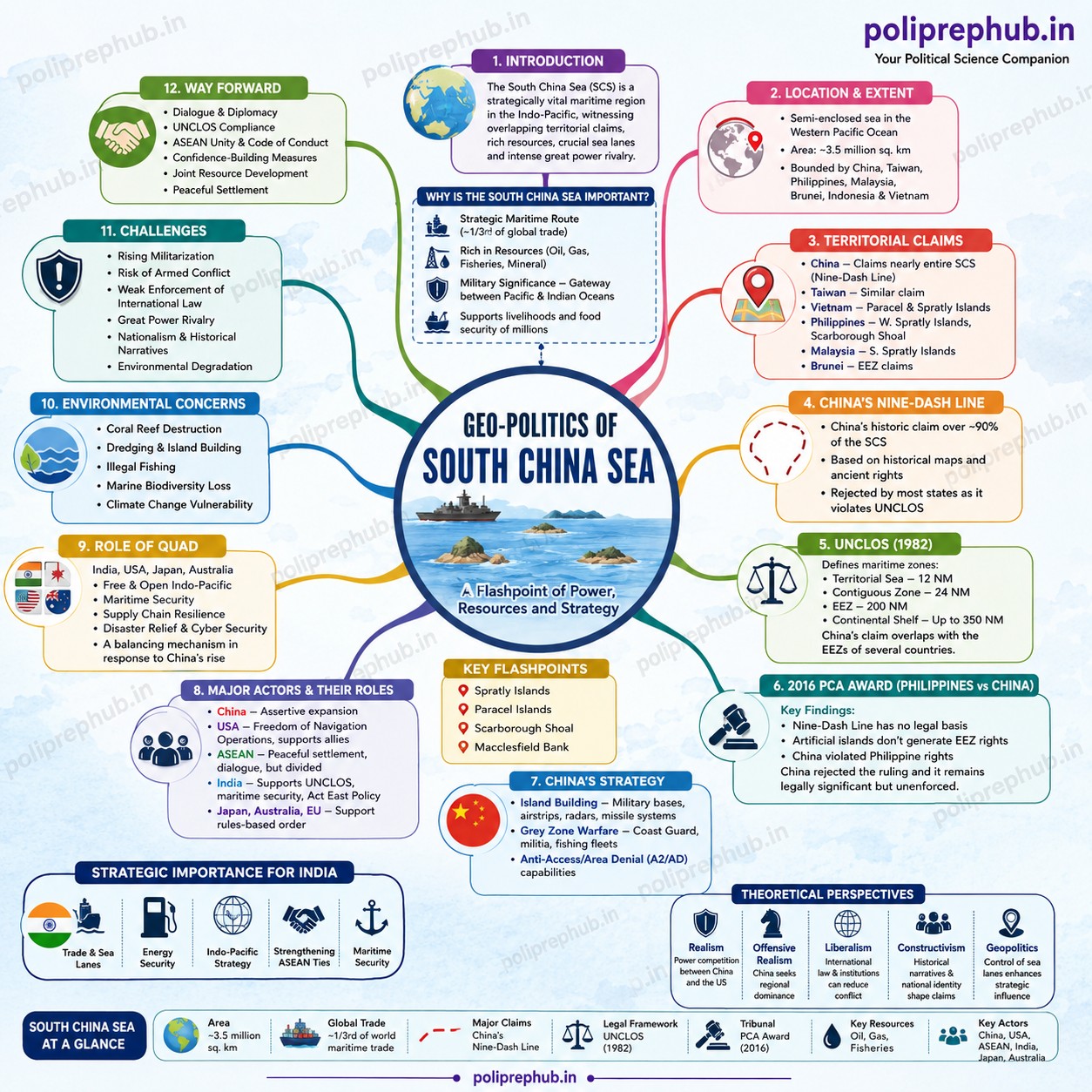
The South China Sea (SCS) is one of the world’s most strategically significant maritime regions. Although it covers only about 3.5 million square kilometres, it has become the centre of intense geopolitical competition involving regional powers, global powers, and international institutions.
The South China Sea is not merely a territorial dispute; it represents a complex interaction of power politics, maritime law, resource competition, strategic security, trade routes, nationalism, and great power rivalry, particularly between China and the United States.
For students preparing for UPSC, OPSC, UGC-NET Political Science, International Relations, Defence Studies, and University examinations, understanding the geopolitics of the South China Sea is essential.
Location of the South China Sea
The South China Sea (SCS) is a semi-enclosed marginal sea of the Western Pacific Ocean, extending from the Taiwan Strait in the north to the Strait of Malacca and the Karimata Strait in the south. It serves as a strategic maritime link between the Indian Ocean and the Pacific Ocean, making it one of the world’s busiest and most geopolitically significant sea routes.
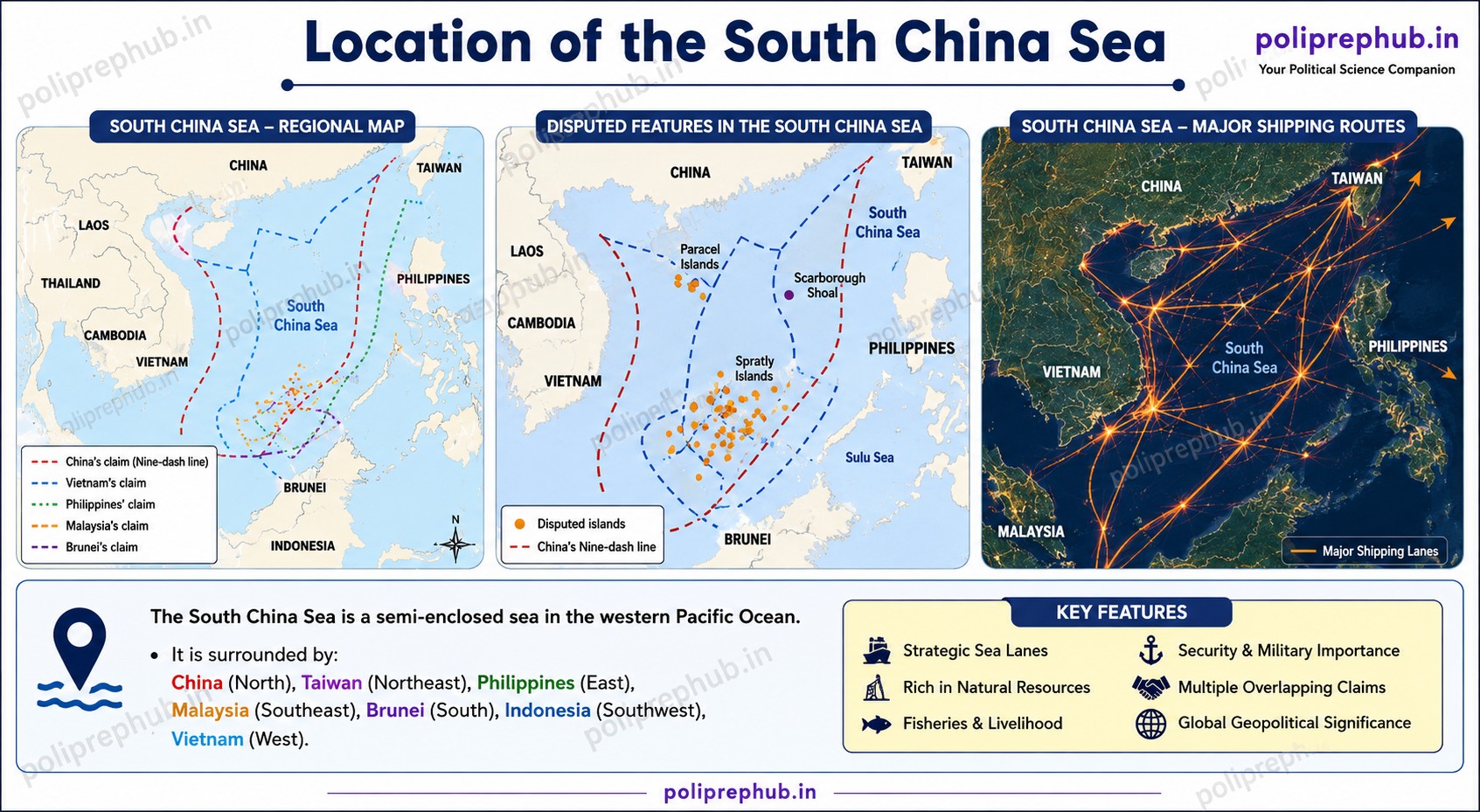
The sea is surrounded by several East and Southeast Asian countries, each of which has important strategic, economic, or territorial interests in the region.
It is surrounded by:
| Country/Region | Geographical Position | Strategic Importance |
|---|---|---|
| China | North | Claims most of the South China Sea through the Nine-Dash Line; major naval and economic power in the region. |
| Taiwan | Northeast | Occupies Itu Aba (Taiping Island) in the Spratly Islands and maintains claims similar to those of China. |
| Philippines | East | Claims parts of the Spratly Islands and Scarborough Shoal; a key claimant under UNCLOS. |
| Malaysia | Southeast | Claims the southern Spratly Islands within its Exclusive Economic Zone (EEZ); active in offshore oil and gas exploration. |
| Brunei | South | Claims a portion of the southern South China Sea within its EEZ, mainly for energy resources. |
| Indonesia | Southwest | Although not a claimant to the Spratly Islands, China’s Nine-Dash Line overlaps with Indonesia’s EEZ around the Natuna Islands. |
| Vietnam | West | Claims both the Paracel and Spratly Islands based on historical and legal grounds; one of the principal claimant states. |
Major Islands
The South China Sea contains hundreds of islands, reefs, shoals, atolls, and submerged banks, many of which are disputed by neighboring countries. These maritime features are strategically important because they influence territorial sovereignty, Exclusive Economic Zones (EEZs), fisheries, energy exploration, military deployment, and control over international shipping lanes.
- Spratly Islands
- Paracel Islands
- Scarborough Shoal
- Pratas Islands
- Macclesfield Bank
| Island/Feature | Location | Claimant(s) | Strategic Importance |
|---|---|---|---|
| Spratly Islands (Nansha Islands) | Central and Southern South China Sea | China, Taiwan, Vietnam, Philippines, Malaysia, and Brunei (overlapping claims) | The most contested island group, believed to be rich in oil, natural gas, and fisheries. China has constructed artificial islands with military infrastructure, making it the principal flashpoint in the region. |
| Paracel Islands (Xisha Islands) | Northern South China Sea | China, Taiwan, and Vietnam | Controlled by China since 1974 but claimed by Vietnam and Taiwan. Strategically important for naval operations, surveillance, and energy exploration. |
| Scarborough Shoal (Huangyan Island) | West of Luzon (Philippines) | China, Taiwan, and Philippines | A traditional fishing ground and a major source of tension between China and the Philippines. China has maintained effective control since 2012. |
| Pratas Islands (Dongsha Islands) | Northeastern South China Sea | Administered by Taiwan; claimed by China | Important for monitoring maritime activities in the northern South China Sea and the approaches to the Taiwan Strait. |
| Macclesfield Bank (Zhongsha Islands) | Central South China Sea | China and Taiwan (Philippines has expressed maritime interests nearby) | A submerged bank with no permanent habitation. Although it cannot support human settlement, it remains strategically significant because of competing maritime jurisdiction claims. |
Why is the South China Sea Important?
The South China Sea (SCS) is one of the world’s most strategically significant maritime regions due to its immense economic, geopolitical, military, and environmental importance. It serves as a critical hub for global trade, energy security, food security, and regional power competition, making it central to Indo-Pacific geopolitics.
| Aspect | Key Features | Significance |
|---|---|---|
| 1. Strategic Maritime Route | • Nearly one-third of global maritime trade passes through the South China Sea. • Facilitates US$3–5 trillion worth of international trade annually. • Serves as the principal sea route connecting the Indian Ocean and the Pacific Ocean through key chokepoints such as the Strait of Malacca. • Major importer and exporter economies—including China, Japan, South Korea, India, Taiwan, and ASEAN countries—depend heavily on these sea lanes. | Ensures uninterrupted global commerce, energy transportation, and supply chain connectivity, making freedom of navigation a vital international concern. |
| 2. Rich Energy Resources | • Estimated to contain billions of barrels of crude oil. • Possesses large offshore natural gas reserves. • Believed to have significant deposits of methane hydrates, a potential future energy source. | Competition over these resources is a major driver of overlapping territorial claims and regional strategic rivalry. |
| 3. Fisheries and Food Security | • Contributes approximately 10–12% of the world’s total fish catch. • Supports the livelihoods of millions of fishermen across Southeast Asia. • Serves as a vital source of protein and food security for coastal populations. | Overfishing, illegal fishing, and competing maritime claims have intensified disputes over access to marine resources. |
| 4. Military and Strategic Importance | • Functions as a strategic maritime gateway between the Pacific Ocean and the Indian Ocean. • Enables deployment of naval fleets, submarines, aircraft carriers, air defence systems, and missile installations. • Provides strategic depth for surveillance and power projection across the Indo-Pacific. | Control over the South China Sea enhances military influence, deterrence capabilities, and regional dominance, making it a focal point of great-power competition, particularly between China and the United States. |
Territorial Claims
The South China Sea dispute is one of the most complex territorial and maritime conflicts in the world. Several countries have overlapping claims over islands, reefs, shoals, and surrounding maritime zones, primarily because of their strategic location, abundant natural resources, and control over important international shipping routes.
Most disputes involve the Spratly Islands, Paracel Islands, Scarborough Shoal, and surrounding Exclusive Economic Zones (EEZs) as defined under the United Nations Convention on the Law of the Sea (UNCLOS), 1982.
| Country | Areas Claimed | Basis of the Claim | Current Status |
|---|---|---|---|
| China | Claims nearly 90% of the South China Sea through the Nine-Dash Line, including the Spratly Islands, Paracel Islands, Scarborough Shoal, and surrounding waters. | Historical maps, ancient navigation records, and the Nine-Dash Line. | Controls the Paracel Islands and several features in the Spratly Islands; has built artificial islands and military installations. |
| Taiwan | Claims almost the same maritime area as China, including the Spratly and Paracel Islands. | Historical claim inherited from the Republic of China (ROC). | Administers Itu Aba (Taiping Island), the largest natural island in the Spratly group. |
| Vietnam | Claims the Paracel Islands and the Spratly Islands along with adjacent maritime zones. | Historical occupation, continuous administration, and provisions of UNCLOS. | Occupies several islands and reefs in the Spratly Islands but disputes China’s control of the Paracels. |
| Philippines | Claims the Kalayaan Island Group (western Spratly Islands) and Scarborough Shoal within its EEZ. | UNCLOS-based EEZ (200 nautical miles) and geographical proximity. | Occupies several Spratly features; the 2016 PCA ruling supported many of its legal arguments against China’s claims. |
| Malaysia | Claims the southern Spratly Islands located within its EEZ and continental shelf. | UNCLOS provisions on EEZ and continental shelf rights. | Occupies a number of reefs and conducts offshore oil and gas exploration. |
| Brunei | Claims part of the southern South China Sea within its Exclusive Economic Zone. | EEZ rights under UNCLOS. | Does not occupy disputed islands but asserts sovereign rights over offshore maritime resources. |
| Indonesia (Not a formal claimant to the islands) | Does not claim the Spratly or Paracel Islands, but rejects China’s Nine-Dash Line where it overlaps with Indonesia’s EEZ around the Natuna Islands. | UNCLOS-based EEZ rights. | Regularly confronts Chinese fishing vessels and coast guard ships near the Natuna Sea. |
China’s Nine-Dash Line
The Nine-Dash Line is China’s expansive maritime claim in the South China Sea (SCS), encompassing nearly 90% of the sea’s area. It is represented by a U-shaped line consisting of nine dashed segments that extend far beyond China’s mainland coastline and overlap with the Exclusive Economic Zones (EEZs) of several Southeast Asian countries.

Originally published by the Republic of China (ROC) in 1947 as the Eleven-Dash Line, it was later adopted and modified by the People’s Republic of China (PRC) into the present Nine-Dash Line. China uses this line to justify its claims over numerous islands, reefs, shoals, and surrounding waters in the South China Sea.
China’s Basis for the Nine-Dash Line Claim
| Basis of the Claim | Explanation |
|---|---|
| Historical Navigation | China argues that Chinese sailors and traders have navigated and used the South China Sea for more than two thousand years, establishing long-standing historical links with the region. |
| Ancient Maps and Historical Records | Chinese governments cite historical maps, imperial documents, and administrative records to support their claim of historical sovereignty over the islands and surrounding waters. |
| Traditional Fishing Rights | China contends that Chinese fishermen have traditionally fished throughout the South China Sea for centuries, giving rise to historic fishing rights. |
| Historical Administration | China maintains that successive Chinese governments exercised administrative authority over several islands through official patrols, mapping, and governance activities. |
| National Sovereignty and Security | China argues that the South China Sea is essential to its national security, territorial integrity, and maritime interests, making the claims part of its core national interests. |
Why is the Nine-Dash Line Controversial?
| Issue | Explanation |
|---|---|
| Conflicts with UNCLOS | The Nine-Dash Line overlaps with the 200-nautical-mile Exclusive Economic Zones (EEZs) of countries such as the Philippines, Vietnam, Malaysia, Brunei, and Indonesia, contrary to the principles of the United Nations Convention on the Law of the Sea (UNCLOS), 1982. |
| Lack of Clear Legal Definition | China has never precisely defined whether the line represents sovereignty over land features, maritime rights, or both, creating legal ambiguity. |
| Overlapping Territorial Claims | The claim conflicts with the maritime entitlements and sovereignty claims of several Southeast Asian states, leading to frequent diplomatic and maritime disputes. |
| Militarization of the Region | China has strengthened its claims by constructing artificial islands, airstrips, naval facilities, and missile systems, raising regional security concerns. |
| Threat to Freedom of Navigation | Many countries fear that excessive maritime claims could affect the freedom of navigation and overflight in one of the world’s busiest sea lanes. |
International Response
| Country/Organization | Position |
|---|---|
| Philippines | Challenged China’s claim before the Permanent Court of Arbitration (PCA) under UNCLOS. |
| Permanent Court of Arbitration (2016) | Ruled that the Nine-Dash Line has no legal basis under UNCLOS and that China’s historic rights claim is not supported by international law. |
| China | Rejected the tribunal’s jurisdiction and refused to recognize or implement the ruling. |
| ASEAN | Supports peaceful dispute resolution, dialogue, and adherence to international law. |
| United States | Conducts Freedom of Navigation Operations (FONOPs) and supports a rules-based maritime order. |
| India | Supports freedom of navigation, respect for UNCLOS, and peaceful settlement of disputes without taking sides on sovereignty claims. |
UNCLOS and Maritime Law
The United Nations Convention on the Law of the Sea (UNCLOS), 1982, is often regarded as the “Constitution of the Oceans.” It establishes the legal framework governing the use of the world’s oceans, including maritime boundaries, navigation rights, resource exploitation, marine environmental protection, and dispute settlement.
In the context of the South China Sea dispute, UNCLOS provides the internationally accepted legal basis for determining territorial seas, Exclusive Economic Zones (EEZs), and continental shelf rights. The convention is central to resolving competing maritime claims among the coastal states of the region.
Maritime Zones under UNCLOS (1982)
| Maritime Zone | Extent | Rights of the Coastal State | Rights of Other States |
|---|---|---|---|
| Territorial Sea | Up to 12 Nautical Miles from the baseline | Full sovereignty over waters, seabed, subsoil, and airspace. | Foreign ships enjoy the Right of Innocent Passage. |
| Contiguous Zone | Up to 24 Nautical Miles (12 NM beyond the Territorial Sea) | May enforce laws relating to customs, immigration, fiscal matters, and sanitation. | Freedom of navigation remains subject to coastal state’s enforcement powers. |
| Exclusive Economic Zone (EEZ) | Up to 200 Nautical Miles | Sovereign rights for exploring, exploiting, conserving, and managing living and non-living marine resources. | Other states retain freedom of navigation, overflight, and laying submarine cables and pipelines. |
| Continental Shelf | Normally up to 200 Nautical Miles, extendable to 350 Nautical Miles under specified geological conditions | Exclusive rights to explore and exploit seabed and subsoil mineral resources. | Other states may navigate freely above the continental shelf waters. |
| High Seas | Beyond national jurisdiction | No state has sovereignty; governed by the principle of freedom of the seas. | Open to all states for navigation, fishing (subject to international law), scientific research, and overflight. |
Why UNCLOS is Important in the South China Sea
| Issue | Role of UNCLOS |
|---|---|
| Maritime Boundary Delimitation | Defines the extent of Territorial Seas, EEZs, and Continental Shelves of coastal states. |
| Exclusive Economic Zones (EEZs) | Grants coastal states sovereign rights over marine resources within 200 nautical miles of their coastlines. |
| Freedom of Navigation | Protects the right of ships and aircraft of all nations to move through international waters. |
| Resource Exploitation | Regulates exploration and exploitation of offshore oil, natural gas, fisheries, and seabed minerals. |
| Dispute Settlement | Provides legal mechanisms through bodies such as the International Tribunal for the Law of the Sea (ITLOS) and arbitration under Annex VII of UNCLOS. |
| Marine Environmental Protection | Requires states to protect and preserve the marine environment and prevent pollution. |
UNCLOS vs. China’s Nine-Dash Line
| UNCLOS Principle | China’s Nine-Dash Line Claim |
|---|---|
| Maritime rights are determined primarily by distance from the coastline (EEZ and Continental Shelf). | Based largely on historical rights and historical usage rather than distance-based maritime zones. |
| Coastal states enjoy an EEZ of up to 200 Nautical Miles. | The Nine-Dash Line overlaps the EEZs of the Philippines, Vietnam, Malaysia, Brunei, and Indonesia. |
| Maritime disputes should be resolved according to international law. | China rejects international arbitration in relation to the Nine-Dash Line and maintains its historical claims. |
| Artificial islands do not generate new EEZs under UNCLOS. | China has constructed artificial islands and strengthened its administrative and military presence in disputed waters. |
Key Legal Issues in the South China Sea
| Legal Question | UNCLOS Position |
|---|---|
| Can historical claims override EEZ rights? | UNCLOS gives priority to maritime zones established under the Convention rather than broad historical claims. |
| Do artificial islands create an EEZ? | No. Artificial islands do not generate Territorial Seas or Exclusive Economic Zones. |
| Can submerged reefs be claimed as sovereign territory? | Generally No. Low-tide elevations and submerged features cannot independently generate maritime zones unless they are part of a state’s territorial sea. |
| Which law governs the South China Sea? | The United Nations Convention on the Law of the Sea (UNCLOS), 1982, is the principal legal framework. |
Significance for India
| Area | Importance for India |
|---|---|
| Freedom of Navigation | Essential for India’s maritime trade and energy imports passing through the South China Sea. |
| Rules-Based Order | India consistently supports adherence to UNCLOS and peaceful settlement of disputes. |
| Act East Policy | Stable sea lanes strengthen India’s economic and strategic engagement with ASEAN. |
| Maritime Security | Ensures secure Sea Lines of Communication (SLOCs) across the Indo-Pacific. |
2016 Permanent Court of Arbitration (PCA) Judgment
The 2016 Permanent Court of Arbitration (PCA) Award is one of the most significant legal decisions in contemporary international maritime law. The case was initiated by the Philippines against China under Annex VII of the United Nations Convention on the Law of the Sea (UNCLOS), 1982, to clarify maritime rights and the legal validity of China’s Nine-Dash Line claim in the South China Sea.
On 12 July 2016, the tribunal delivered its final award, which became a landmark ruling for the interpretation and application of UNCLOS.
Background of the Case
| Aspect | Details |
|---|---|
| Applicant | Philippines |
| Respondent | China |
| Legal Basis | Annex VII of the United Nations Convention on the Law of the Sea (UNCLOS), 1982 |
| Tribunal | Permanent Court of Arbitration (PCA), The Hague, Netherlands |
| Case Filed | January 2013 |
| Final Award | 12 July 2016 |
| Objective | To determine the legality of China’s maritime claims and clarify the maritime rights of the Philippines under UNCLOS. |
Major Findings of the Tribunal
| Issue | PCA Ruling | Significance |
|---|---|---|
| China’s Nine-Dash Line | The tribunal ruled that China’s historic rights claim has no legal basis under UNCLOS. | Invalidated the legal foundation of China’s expansive maritime claim. |
| Historical Rights | Any historical rights claimed by China were superseded by the maritime zones established under UNCLOS. | Reinforced UNCLOS as the governing legal framework for maritime disputes. |
| Status of Artificial Islands | Artificial islands and reclaimed features do not generate Territorial Seas or Exclusive Economic Zones (EEZs). | Limited China’s ability to claim extensive maritime rights from artificial structures. |
| Status of Spratly Features | None of the disputed features in the Spratly Islands qualified as a fully entitled island capable of generating a 200-nautical-mile EEZ. | Reduced the scope of maritime entitlements from disputed features. |
| Philippines’ Sovereign Rights | China violated the Philippines’ sovereign rights by interfering with fishing, petroleum exploration, and resource exploitation within the Philippine EEZ. | Upheld the Philippines’ rights under UNCLOS. |
| Marine Environment | China caused severe environmental damage through large-scale land reclamation and destruction of coral reefs. | Emphasized states’ obligation to protect the marine environment under UNCLOS. |
| Navigation and Safety | Chinese law enforcement vessels acted in a manner that increased the risk of dangerous maritime incidents. | Highlighted the importance of peaceful maritime conduct. |
China’s Response
| Issue | China’s Position |
|---|---|
| Jurisdiction of the Tribunal | China rejected the tribunal’s jurisdiction, arguing that the dispute concerned territorial sovereignty, which falls outside the scope of UNCLOS arbitration. |
| Acceptance of the Award | China declared the award “null and void” and refused to recognize its legal validity. |
| Compliance | China has not implemented the tribunal’s findings and continues to assert its claims and maintain a military presence in disputed areas. |
| Official Policy | China maintains that disputes should be resolved through bilateral negotiations rather than third-party arbitration. |
International Reactions
| Country/Organization | Position |
|---|---|
| Philippines | Welcomed the ruling as a victory for international law. |
| United States | Supported the award and called for compliance with international law. |
| Japan, Australia, European Union | Urged respect for UNCLOS and the tribunal’s decision. |
| ASEAN | Favoured peaceful settlement of disputes but adopted a cautious approach due to differing member-state interests. |
| India | Emphasized adherence to UNCLOS, freedom of navigation, and peaceful dispute resolution without taking a position on sovereignty claims. |
Why the PCA Award is Important
| Dimension | Importance |
|---|---|
| International Law | Reaffirmed UNCLOS as the primary legal framework governing maritime disputes. |
| Maritime Boundaries | Clarified the legal status of islands, reefs, low-tide elevations, and artificial islands. |
| Rules-Based International Order | Strengthened the principle that maritime claims must comply with international law rather than historical assertions alone. |
| Regional Stability | Provided a legal basis for peaceful dispute resolution in the South China Sea. |
| Future Maritime Disputes | Established an important precedent for interpreting UNCLOS in similar maritime disputes worldwide. |
Limitations of the PCA Award
| Limitation | Explanation |
|---|---|
| No Enforcement Mechanism | The tribunal has no authority to compel states to comply with its decisions. |
| Non-Participation of China | China did not participate in the arbitration and continues to reject the award. |
| Territorial Sovereignty Not Decided | The tribunal did not determine sovereignty over disputed islands; it only interpreted maritime rights under UNCLOS. |
| Continuing Geopolitical Tensions | Despite the ruling, military activities and territorial disputes continue in the region. |
China’s Strategy
China has adopted a multi-dimensional strategy to strengthen its influence and consolidate its claims in the South China Sea. Rather than relying solely on conventional military force, Beijing combines infrastructure development, military modernization, maritime law enforcement, economic leverage, and diplomatic initiatives to establish effective control over the disputed region.
Major Elements of China’s Strategy
| Strategy | Key Features | Strategic Objective |
|---|---|---|
| 1. Artificial Island Building and Militarization | China has reclaimed reefs and shoals to construct artificial islands, equipped with airstrips, naval facilities, ports, radar systems, missile batteries, communication infrastructure, and military bases. Major developments have taken place on Fiery Cross Reef, Subi Reef, and Mischief Reef. | To establish a permanent military presence, strengthen territorial claims, improve surveillance, and project power across the South China Sea. |
| 2. Grey Zone Warfare | China frequently deploys Coast Guard vessels, Maritime Militia (civilian fishing fleets with military support), survey ships, and fishing vessels instead of conventional naval forces. These activities remain below the threshold of open armed conflict. | To gradually expand control over disputed waters while avoiding direct military confrontation or escalation. |
| 3. Anti-Access/Area Denial (A2/AD) | China has developed advanced military capabilities such as anti-ship ballistic missiles (ASBMs), long-range surface-to-air missile systems, anti-ship cruise missiles, electronic warfare capabilities, submarines, and integrated air defence systems. | To deter or restrict the entry and operations of rival naval forces, particularly those of the United States and its allies, within the South China Sea. |
| 4. Maritime Law Enforcement | China uses the China Coast Guard and domestic maritime laws to patrol disputed waters, regulate fishing, escort Chinese vessels, and challenge foreign ships operating in areas claimed by Beijing. | To reinforce administrative control and normalize China’s jurisdiction over disputed maritime areas. |
| 5. Civilian Infrastructure Development | Construction of lighthouses, ports, weather stations, research facilities, communication networks, and civilian settlements on disputed features. | To demonstrate effective occupation and strengthen sovereignty claims under international practice. |
| 6. Economic and Diplomatic Engagement | China combines maritime assertiveness with initiatives such as the Belt and Road Initiative (BRI), investment, trade, and bilateral negotiations with ASEAN countries. | To increase regional influence, reduce opposition, and discourage multilateral or external intervention. |
| 7. Legal and Historical Narrative | China consistently emphasizes its historical rights, the Nine-Dash Line, and historical administration of the islands while rejecting international arbitration. | To legitimize its maritime claims domestically and internationally despite legal challenges under UNCLOS. |
China’s Military Infrastructure on Artificial Islands
| Infrastructure | Purpose |
|---|---|
| Artificial Islands | Permanent occupation and administrative control |
| Airstrips | Deployment of fighter aircraft and military transport planes |
| Naval Bases | Support for naval patrols and logistics |
| Missile Installations | Area denial and strategic deterrence |
| Radar & Surveillance Systems | Maritime domain awareness and intelligence gathering |
| Deep-water Harbours | Berthing of warships and Coast Guard vessels |
Grey Zone Warfare: China’s Preferred Approach
| Instrument | Role |
|---|---|
| China Coast Guard | Conducts patrols, escorts fishing vessels, and challenges foreign ships. |
| Maritime Militia | Civilian fishing vessels operating under state direction to assert maritime claims. |
| Fishing Fleets | Establish a continuous Chinese presence in disputed waters. |
| Survey and Research Ships | Conduct hydrographic and seabed surveys that reinforce China’s maritime claims. |
Grey Zone Warfare refers to coercive actions that remain below the threshold of conventional armed conflict, making it difficult for rival states to justify a military response.
Anti-Access/Area Denial (A2/AD) Strategy
| Capability | Strategic Purpose |
|---|---|
| Anti-Ship Ballistic Missiles (ASBMs) | Deter aircraft carriers and large naval vessels. |
| Surface-to-Air Missile Systems | Protect Chinese military installations and control airspace. |
| Submarine Fleet | Enhance sea denial and strategic deterrence. |
| Electronic Warfare | Disrupt enemy communications, radar, and navigation systems. |
| Integrated Air Defence Network | Strengthen control over disputed maritime and aerial zones. |
Objectives of China’s Strategy
| Objective | Explanation |
|---|---|
| Strengthen Sovereignty Claims | Reinforce China’s claim over disputed islands and maritime zones. |
| Secure Sea Lines of Communication (SLOCs) | Protect vital trade and energy routes. |
| Expand Strategic Influence | Establish China as the dominant maritime power in the Western Pacific. |
| Enhance National Security | Create strategic depth against potential military threats. |
| Access Natural Resources | Secure fisheries, offshore oil, natural gas, and seabed minerals. |
| Counter External Powers | Limit the military presence of the United States and its allies in the region. |
Challenges to China’s Strategy
| Challenge | Impact |
|---|---|
| 2016 PCA Award | Declared the Nine-Dash Line inconsistent with UNCLOS. |
| Freedom of Navigation Operations (FONOPs) | Continued naval patrols by the United States and partner countries challenge China’s maritime claims. |
| ASEAN Opposition | Several Southeast Asian claimant states continue to contest China’s actions. |
| Regional Security Concerns | Militarization has increased tensions and the risk of unintended conflict. |
| International Criticism | Many countries view China’s actions as inconsistent with the rules-based international order. |
United States’ Role
Although the United States is not a claimant state in the South China Sea territorial disputes, it plays a critical strategic, military, diplomatic, and economic role in the region. The United States considers the South China Sea essential to maintaining a free, open, and rules-based Indo-Pacific, ensuring freedom of navigation, protecting international trade routes, and preserving the regional balance of power.
The U.S. opposes any unilateral attempts to alter the status quo through coercion or the use of force and supports the peaceful settlement of disputes in accordance with international law, particularly the principles of UNCLOS (although the U.S. has signed but not ratified UNCLOS).
Objectives of the United States in the South China Sea
| Objective | Explanation |
|---|---|
| Freedom of Navigation | Ensure that international waters remain open for commercial and military vessels in accordance with international law. |
| Free and Open Indo-Pacific (FOIP) | Promote a region where all countries can exercise their sovereign rights without coercion. |
| Rules-Based International Order | Support the application of international law, particularly UNCLOS, for resolving maritime disputes. |
| Regional Stability | Prevent unilateral changes to the status quo and maintain peace and security in the Indo-Pacific. |
| Support for Allies and Partners | Strengthen defence cooperation with allies such as Japan, the Philippines, Australia, and South Korea, and deepen partnerships with ASEAN countries. |
| Balance of Power | Prevent any single country from dominating the South China Sea and threatening regional security. |
Freedom of Navigation Operations (FONOPs)
One of the most significant aspects of U.S. policy is the conduct of Freedom of Navigation Operations (FONOPs).
These are regular naval and aerial operations carried out by the U.S. Navy to challenge what it considers excessive maritime claims that are inconsistent with international law. FONOPs are conducted worldwide and are not directed exclusively at China.
Objectives of FONOPs
| Objective | Purpose |
|---|---|
| Protect Freedom of Navigation | Ensure unrestricted movement of commercial and military vessels through international waters. |
| Challenge Excessive Maritime Claims | Demonstrate that claims inconsistent with international law will not be accepted as established practice. |
| Maintain Open Sea Lanes | Safeguard vital global trade routes and energy supply chains. |
| Support Allies and Partners | Reassure regional allies of continued U.S. security commitments. |
| Preserve International Law | Reinforce the principle that maritime rights must conform to UNCLOS and customary international law. |
| Deter Coercive Actions | Discourage the unilateral militarization or occupation of disputed maritime features. |
Instruments of U.S. Strategy
| Strategy | Key Actions | Purpose |
|---|---|---|
| Military Presence | Deployment of the Seventh Fleet, aircraft carriers, submarines, and surveillance aircraft. | Maintain credible deterrence and rapid response capability. |
| Freedom of Navigation Operations (FONOPs) | Regular naval patrols near disputed islands and maritime features. | Uphold freedom of navigation and challenge excessive claims. |
| Alliance Network | Defence cooperation with Japan, Australia, South Korea, and the Philippines; expanded partnerships with ASEAN members. | Strengthen collective regional security. |
| Security Assistance | Military training, joint exercises, intelligence sharing, and defence modernization support. | Enhance maritime capabilities of regional partners. |
| Diplomatic Engagement | Participation in ASEAN-led forums, East Asia Summit, and Indo-Pacific initiatives. | Promote peaceful dispute resolution and regional cooperation. |
| Economic Strategy | Support resilient supply chains and economic partnerships across the Indo-Pacific. | Reduce strategic vulnerabilities and promote regional prosperity. |
U.S. Alliances and Strategic Partnerships
| Country/Group | Nature of Cooperation |
|---|---|
| Philippines | Mutual Defense Treaty (1951), joint military exercises, maritime security cooperation. |
| Japan | Indo-Pacific security cooperation, naval exercises, intelligence sharing. |
| Australia | AUKUS partnership, QUAD, joint naval operations. |
| South Korea | Regional security coordination and maritime cooperation. |
| India | Strategic partnership through the QUAD, defence cooperation, and support for a free and open Indo-Pacific. |
| ASEAN Countries | Capacity building, maritime domain awareness, and diplomatic engagement. |
U.S. Position on the 2016 PCA Award
| Issue | U.S. Position |
|---|---|
| 2016 PCA Award | Supports the tribunal’s ruling as legally binding under UNCLOS. |
| China’s Nine-Dash Line | Does not recognize China’s expansive maritime claims. |
| Dispute Resolution | Advocates peaceful settlement through international law rather than coercion or force. |
| Freedom of Navigation | Continues regular FONOPs regardless of China’s objections. |
Criticism of U.S. Policy
| Criticism | Explanation |
|---|---|
| China’s View | China accuses the U.S. of interfering in regional affairs and provoking military tensions. |
| UNCLOS Ratification | Critics argue that the U.S. advocates UNCLOS principles despite not having ratified the Convention. |
| Great Power Rivalry | Increased U.S. military presence has contributed to strategic competition with China in the Indo-Pacific. |
| Risk of Escalation | Frequent military patrols by both China and the United States increase the possibility of accidents or unintended confrontation. |
Significance for India
| Area | Importance |
|---|---|
| Indo-Pacific Strategy | Aligns with India’s vision of a Free, Open, Inclusive, and Rules-Based Indo-Pacific. |
| Maritime Security | Supports secure Sea Lines of Communication (SLOCs) essential for India’s trade and energy imports. |
| QUAD Cooperation | Enhances strategic coordination among India, the United States, Japan, and Australia. |
| Regional Stability | Contributes to maintaining a favourable balance of power in the Indo-Pacific. |
ASEAN’s Position
The Association of Southeast Asian Nations (ASEAN) plays a central role in managing tensions in the South China Sea. As several ASEAN member states—Vietnam, the Philippines, Malaysia, and Brunei—are claimant states, the organization seeks to promote peace, stability, dialogue, and adherence to international law rather than military confrontation.
ASEAN’s approach is guided by the principles of peaceful dispute resolution, regional cooperation, respect for sovereignty, non-use of force, and a rules-based international order.
ASEAN’s Approach to the South China Sea Dispute
| Principle | Explanation | Objective |
|---|---|---|
| Peaceful Settlement of Disputes | Encourages negotiations, mediation, and diplomatic dialogue instead of military confrontation. | Maintain regional peace and stability. |
| Dialogue and Consultation | Promotes continuous discussions among claimant states, China, and external partners through ASEAN-led forums. | Build trust and prevent escalation of tensions. |
| Respect for International Law | Supports the application of UNCLOS (1982) as the legal framework for resolving maritime disputes. | Ensure maritime claims are based on international law rather than unilateral assertions. |
| Multilateral Diplomacy | Prefers regional and multilateral mechanisms over bilateral coercion. | Strengthen ASEAN’s centrality in regional security architecture. |
| Freedom of Navigation and Overflight | Supports unrestricted movement of commercial and military vessels in accordance with international law. | Protect global trade and maritime connectivity. |
| Self-Restraint | Calls upon all parties to avoid actions that increase tensions, such as militarization or the use of force. | Reduce the risk of conflict and maintain the status quo. |
ASEAN Initiatives in the South China Sea
| Initiative | Purpose | Current Status |
|---|---|---|
| Declaration on the Conduct of Parties in the South China Sea (DOC), 2002 | Encourage peaceful behaviour, confidence-building, and self-restraint among claimant states. | Politically important but not legally binding. |
| Code of Conduct (COC) | Establish legally or politically binding rules governing conduct in the South China Sea. | Negotiations between ASEAN and China are ongoing but remain incomplete. |
| ASEAN Regional Forum (ARF) | Promote dialogue on political and security issues involving regional and external powers. | Continues as a major platform for confidence-building. |
| East Asia Summit (EAS) | Discuss strategic and security challenges in the Indo-Pacific, including maritime disputes. | Regularly addresses the South China Sea issue. |
| ASEAN Defence Ministers’ Meeting-Plus (ADMM-Plus) | Enhance defence cooperation and maritime security among ASEAN and dialogue partners. | Supports joint exercises and confidence-building measures. |
Challenges Facing ASEAN
| Challenge | Impact on ASEAN |
|---|---|
| Divergent National Interests | Not all ASEAN members are claimant states, leading to differing priorities and policy preferences. |
| Economic Dependence on China | Several member states rely heavily on Chinese trade, investment, and infrastructure projects, limiting ASEAN’s ability to adopt a unified position. |
| Consensus-Based Decision Making | ASEAN operates on the principle of consensus, making it difficult to issue strong collective responses. |
| China’s Bilateral Approach | China often prefers bilateral negotiations with individual claimant states, reducing ASEAN’s collective bargaining power. |
| Growing Great-Power Rivalry | Competition between China and the United States places ASEAN under increasing strategic pressure. |
ASEAN Claimant States
| ASEAN Member | Status in the South China Sea Dispute |
|---|---|
| Vietnam | Claims the Paracel and Spratly Islands. |
| Philippines | Claims the Kalayaan Island Group (Spratly Islands) and Scarborough Shoal. |
| Malaysia | Claims the southern Spratly Islands within its EEZ. |
| Brunei | Claims part of the southern South China Sea within its EEZ. |
| Indonesia | Not an island claimant, but rejects China’s Nine-Dash Line where it overlaps Indonesia’s EEZ around the Natuna Islands. |
| Singapore, Thailand, Cambodia, Laos, Myanmar | Non-claimant states that generally support ASEAN’s collective approach and regional stability. |
ASEAN’s Position on Major Issues
| Issue | ASEAN’s Position |
|---|---|
| Territorial Disputes | Should be resolved peacefully through dialogue and diplomacy. |
| UNCLOS (1982) | Supports UNCLOS as the primary legal framework for maritime governance. |
| 2016 PCA Award | ASEAN as a bloc has been cautious; some member states have welcomed the legal clarification, while others have avoided explicit endorsement due to differing national interests. |
| Militarization | Expresses concern over military build-up and activities that may increase tensions. |
| Freedom of Navigation | Supports freedom of navigation and overflight in accordance with international law. |
| Code of Conduct (COC) | Continues negotiations with China to establish an effective and substantive Code of Conduct. |
Significance of ASEAN’s Role
| Dimension | Importance |
|---|---|
| Regional Stability | Helps reduce tensions and encourages peaceful conflict management. |
| Diplomatic Platform | Provides an institutional mechanism for dialogue among regional and external powers. |
| Rules-Based Order | Reinforces respect for international law and multilateralism. |
| Conflict Prevention | Promotes confidence-building measures and crisis management. |
| Indo-Pacific Security | Plays a central role in shaping the regional security architecture of the Indo-Pacific. |
India’s Position
Although India is not a claimant state in the South China Sea dispute, the region holds immense strategic, economic, and geopolitical importance for India’s national interests. As a major Indo-Pacific power, India advocates a rules-based maritime order, supports freedom of navigation, and emphasizes the peaceful resolution of disputes in accordance with international law, particularly the United Nations Convention on the Law of the Sea (UNCLOS), 1982.
India does not take sides on competing sovereignty claims but consistently supports the resolution of disputes through dialogue, diplomacy, and international legal mechanisms.
India’s Core Position
| Principle | India’s Position | Significance |
|---|---|---|
| Freedom of Navigation | Supports unrestricted navigation and overflight in accordance with international law. | Ensures the security of international shipping and maritime commerce. |
| UNCLOS (1982) | Recognizes UNCLOS as the legal framework governing maritime rights and dispute resolution. | Reinforces the rules-based international maritime order. |
| Peaceful Resolution of Disputes | Encourages dialogue, diplomacy, and adherence to international law rather than coercion or the use of force. | Promotes regional peace and stability. |
| Rules-Based Maritime Order | Supports respect for sovereignty, territorial integrity, and international legal norms. | Strengthens stability in the Indo-Pacific region. |
| Strategic Autonomy | Maintains neutrality on sovereignty disputes while protecting India’s strategic interests. | Preserves India’s independent foreign policy. |
Why the South China Sea Matters to India
| Area of Interest | Importance for India |
|---|---|
| Maritime Trade | Nearly 55% of India’s merchandise trade and a substantial share of its maritime commerce pass through the South China Sea and adjoining sea lanes, making uninterrupted navigation critical. |
| Energy Security | India imports energy from East Asia and has invested in offshore oil and gas exploration projects, particularly through ONGC Videsh Ltd. in Vietnam’s offshore blocks. |
| Act East Policy | The South China Sea is a vital maritime corridor linking India with ASEAN and East Asian economies under the Act East Policy. |
| Indo-Pacific Strategy | Supports India’s vision of a Free, Open, Inclusive, and Rules-Based Indo-Pacific. |
| Maritime Security | Secure Sea Lines of Communication (SLOCs) are essential for India’s trade, energy supplies, and naval mobility. |
| Regional Connectivity | Facilitates economic integration with ASEAN and strengthens India’s engagement with East and Southeast Asia. |
India’s Strategic Engagement in the Region
| Area | Key Initiatives | Objective |
|---|---|---|
| Defence Cooperation | Joint naval exercises, defence dialogues, and capacity-building with ASEAN countries, Japan, Australia, and the United States. | Enhance maritime security and interoperability. |
| QUAD | Cooperation with the United States, Japan, and Australia through the Quadrilateral Security Dialogue (QUAD). | Promote a free, open, and resilient Indo-Pacific. |
| Naval Presence | Regular deployment of Indian naval ships for goodwill visits, exercises, and anti-piracy operations. | Maintain India’s maritime presence in the Indo-Pacific. |
| Economic Engagement | Expansion of trade and investment with ASEAN and East Asian partners. | Strengthen economic integration and regional connectivity. |
| Capacity Building | Maritime training, humanitarian assistance, disaster relief (HADR), and coast guard cooperation. | Support regional maritime governance. |
India’s Relations with Major Stakeholders
| Stakeholder | India’s Approach |
|---|---|
| ASEAN | Supports ASEAN Centrality and the ASEAN Outlook on the Indo-Pacific. |
| Vietnam | Strategic partnership, defence cooperation, and offshore energy exploration. |
| United States | Cooperation on Indo-Pacific security, maritime awareness, and freedom of navigation. |
| Japan | Joint initiatives on maritime security, infrastructure, and regional connectivity. |
| Australia | Naval exercises (e.g., Malabar), maritime cooperation, and Indo-Pacific partnership. |
| China | Maintains dialogue while expressing concerns over actions that threaten freedom of navigation or regional stability. |
India’s Official Stand on Key Issues
| Issue | India’s Position |
|---|---|
| Territorial Claims | Does not support or reject any country’s sovereignty claims; remains neutral. |
| UNCLOS (1982) | Strongly supports UNCLOS as the legal basis for maritime governance. |
| 2016 PCA Award | India has not explicitly endorsed the ruling but consistently emphasizes respect for international law and UNCLOS. |
| Freedom of Navigation | Supports unhindered navigation and overflight in international waters. |
| Militarization | Advocates restraint and opposes actions that increase regional tensions. |
Challenges for India
| Challenge | Impact |
|---|---|
| China’s Growing Maritime Presence | Expands China’s strategic influence in the Indo-Pacific, affecting India’s maritime security. |
| Energy Security Risks | Regional instability could disrupt energy imports and offshore investments. |
| Trade Vulnerability | Any disruption in the South China Sea could affect India’s global trade and supply chains. |
| Balancing Major Powers | India must balance strategic partnerships with the United States and ASEAN while managing its complex relationship with China. |
Significance for India’s Foreign Policy
| Policy | Role of the South China Sea |
|---|---|
| Act East Policy | Strengthens India’s economic and strategic engagement with East and Southeast Asia. |
| Indo-Pacific Oceans Initiative (IPOI) | Promotes maritime security, sustainable development, and regional cooperation. |
| SAGAR (Security and Growth for All in the Region) | Reinforces India’s vision of a secure, inclusive, and cooperative maritime neighbourhood. |
| Neighbourhood First | Complements India’s broader maritime engagement in the Indian Ocean and Indo-Pacific. |
Role of QUAD
The Quadrilateral Security Dialogue (QUAD) is an informal strategic partnership comprising India, the United States, Japan, and Australia. Although the QUAD is not a military alliance and does not officially target any specific country, it plays an increasingly significant role in promoting a Free, Open, Inclusive, and Rules-Based Indo-Pacific.
The South China Sea occupies a central place in QUAD’s strategic outlook because it is vital for global trade, maritime security, freedom of navigation, and regional stability. Many analysts view the QUAD as an important balancing mechanism in response to China’s growing strategic influence in the Indo-Pacific.
QUAD at a Glance
| Aspect | Details |
|---|---|
| Full Name | Quadrilateral Security Dialogue (QUAD) |
| Members | India, United States, Japan, Australia |
| Established | Initially in 2007; revived in 2017 |
| Nature | Informal strategic partnership (not a military alliance) |
| Primary Focus | Free, Open, Inclusive, and Rules-Based Indo-Pacific |
| Relevance to South China Sea | Maritime security, freedom of navigation, regional stability, and international law |
QUAD Member Countries
| Country | Role in the Indo-Pacific |
|---|---|
| India | Promotes maritime security, UNCLOS, and strategic stability in the Indian Ocean and Indo-Pacific. |
| United States | Conducts Freedom of Navigation Operations (FONOPs), supports regional allies, and maintains military presence. |
| Japan | Supports a Free and Open Indo-Pacific (FOIP), maritime capacity building, and infrastructure development. |
| Australia | Strengthens regional maritime security, naval cooperation, and humanitarian assistance. |
Objectives of QUAD
| Objective | Purpose | Relevance to the South China Sea |
|---|---|---|
| Free and Open Indo-Pacific (FOIP) | Promote an Indo-Pacific region based on openness, transparency, and respect for sovereignty. | Supports freedom of navigation and opposition to coercive maritime claims. |
| Maritime Security | Enhance maritime surveillance, naval cooperation, and maritime domain awareness. | Ensures secure Sea Lines of Communication (SLOCs) and deters unlawful maritime activities. |
| Freedom of Navigation | Uphold international law governing navigation and overflight. | Protects one of the world’s busiest shipping corridors. |
| Rules-Based International Order | Promote respect for international law, particularly UNCLOS (1982). | Supports peaceful settlement of maritime disputes. |
| Supply Chain Resilience | Build secure and diversified global supply chains. | Reduces vulnerabilities arising from geopolitical tensions in the South China Sea. |
| Disaster Relief & Humanitarian Assistance (HADR) | Coordinate responses to natural disasters and humanitarian emergencies. | Enhances regional resilience and cooperation. |
| Cyber Security & Emerging Technologies | Strengthen cooperation in cybersecurity, critical technologies, and digital infrastructure. | Improves resilience against emerging security challenges. |
QUAD’s Activities in the Indo-Pacific
| Area of Cooperation | Examples |
|---|---|
| Naval Exercises | Malabar Naval Exercise involving India, the United States, Japan, and Australia. |
| Maritime Domain Awareness (MDA) | Information sharing, satellite surveillance, and monitoring of maritime activities. |
| Critical Technologies | Cooperation in semiconductors, artificial intelligence, quantum technologies, and secure digital infrastructure. |
| Infrastructure Development | Promotion of sustainable and transparent infrastructure projects across the Indo-Pacific. |
| Climate and Disaster Response | Joint humanitarian assistance, disaster relief operations, and climate resilience initiatives. |
| Supply Chain Cooperation | Diversification of critical supply chains for strategic industries. |
QUAD and the South China Sea
| Issue | QUAD’s Position |
|---|---|
| Freedom of Navigation | Supports unrestricted navigation and overflight in accordance with international law. |
| UNCLOS (1982) | Recognizes UNCLOS as the legal basis for maritime rights and dispute settlement. |
| Peaceful Resolution of Disputes | Encourages diplomacy, dialogue, and adherence to international law. |
| Militarization | Expresses concern over activities that increase regional tensions and instability. |
| Regional Stability | Supports a secure, stable, and inclusive Indo-Pacific. |
| Maritime Security | Enhances maritime cooperation and capacity building among regional partners. |
Why QUAD is Important
| Dimension | Significance |
|---|---|
| Strategic Balance | Contributes to maintaining a favourable balance of power in the Indo-Pacific. |
| Protection of Global Trade | Helps secure critical maritime trade routes through the South China Sea. |
| Support for International Law | Reinforces the importance of UNCLOS and the rules-based international order. |
| Regional Cooperation | Strengthens collaboration among democratic maritime powers and regional partners. |
| Economic Security | Improves resilience of global supply chains and critical infrastructure. |
Major Geopolitical Theories Applicable
The South China Sea dispute is one of the most important case studies in International Relations (IR) because it illustrates how different theoretical perspectives explain the behaviour of states, the role of international institutions, the significance of identity, and the strategic value of geography.
Each major IR theory offers a distinct explanation for the actions of China, the United States, ASEAN, India, and other regional actors.
Geopolitical Theories and Their Interpretation
| Theory | Core Idea | Application to the South China Sea | Example |
|---|---|---|---|
| Classical Realism | States pursue power and national interest in an anarchic international system. | The South China Sea reflects a struggle for power, security, and strategic dominance among major powers. | Strategic rivalry between China and the United States. |
| Structural (Neo) Realism | International anarchy compels states to maximize security through balancing or military capability. | Regional states strengthen military capabilities and strategic partnerships to balance China’s growing influence. | QUAD, AUKUS, and U.S. alliances with Japan and the Philippines. |
| Offensive Realism | Great powers seek regional hegemony whenever possible. | China attempts to establish dominance over the South China Sea through island-building, militarization, and the Nine-Dash Line. | Construction of artificial islands and deployment of missiles and naval bases. |
| Defensive Realism | States seek sufficient power for security rather than expansion. | China argues that its military presence is defensive and necessary to protect sovereignty and maritime security. | Development of Anti-Access/Area Denial (A2/AD) capabilities. |
| Liberalism | International institutions, economic interdependence, and cooperation can reduce conflict. | International law, diplomacy, and regional institutions provide mechanisms for peaceful dispute resolution. | UNCLOS, ASEAN, and the Permanent Court of Arbitration (PCA). |
| Neoliberal Institutionalism | Institutions facilitate cooperation even among rival states. | ASEAN-led mechanisms and negotiations on the Code of Conduct (COC) aim to reduce tensions and build confidence. | ASEAN–China negotiations on the South China Sea Code of Conduct. |
| Constructivism | State behaviour is shaped by identities, historical narratives, norms, and ideas. | Competing historical narratives influence territorial claims and national policies. | China’s historical rights argument and the Nine-Dash Line. |
| Geopolitics | Geography shapes political power and strategic behaviour. | Control of strategic sea lanes and maritime chokepoints enhances geopolitical influence. | Competition to control one of the world’s busiest maritime trade routes. |
Challenges
The South China Sea remains one of the world’s most volatile geopolitical hotspots due to overlapping territorial claims, strategic competition among major powers, weak enforcement of international law, and increasing environmental degradation. These challenges not only threaten regional peace and stability but also have significant implications for global trade, energy security, and international maritime governance.
| Challenge | Description | Implications |
|---|---|---|
| Rising Militarization | Claimant states, particularly China, have expanded military infrastructure through artificial islands, airstrips, missile systems, naval bases, and surveillance facilities. The United States and its allies have increased naval deployments and military exercises in response. | Heightens regional tensions, increases the risk of military confrontation, and fuels an arms race in the Indo-Pacific. |
| Risk of Accidental Conflict | Frequent encounters between naval vessels, coast guards, military aircraft, and fishing fleets increase the likelihood of miscalculation or unintended escalation. | A minor maritime incident could trigger a broader regional or international crisis. |
| Weak Enforcement of International Law | Although UNCLOS and the 2016 Permanent Court of Arbitration (PCA) Award provide legal guidance, there is no effective international mechanism to enforce compliance. | Encourages unilateral actions and weakens confidence in the international legal order. |
| Great Power Rivalry | Strategic competition between China and the United States, along with the growing involvement of India, Japan, Australia, and other Indo-Pacific partners, has intensified geopolitical tensions. | Transforms the South China Sea into a major arena of strategic competition in the Indo-Pacific. |
| Competition for Natural Resources | The region contains abundant oil, natural gas, fisheries, and seabed mineral resources, leading to overlapping EEZ claims and resource disputes. | Increases tensions among claimant states and threatens regional resource security. |
| Nationalism and Historical Claims | Governments often invoke historical narratives and national identity to justify territorial claims, making compromise politically difficult. | Reduces the scope for diplomatic negotiations and peaceful settlement. |
| Environmental Degradation | Land reclamation, coral reef destruction, illegal fishing, marine pollution, and climate change have severely damaged marine ecosystems. | Threatens biodiversity, fisheries, food security, and the long-term sustainability of the marine environment. |
| Challenges to Freedom of Navigation | Expansive maritime claims and increased military activities raise concerns over unrestricted access to international sea lanes. | May disrupt global maritime trade and affect international commerce. |
| ASEAN’s Internal Divisions | Divergent national interests and varying economic dependence on China have limited ASEAN’s ability to adopt a unified approach. | Weakens regional diplomacy and delays progress on a binding Code of Conduct (COC). |
| Absence of a Binding Code of Conduct (COC) | Negotiations between ASEAN and China continue, but no legally binding Code of Conduct has yet been finalized. | Leaves the region without a comprehensive framework to regulate state behaviour and prevent disputes. |
Possible Solutions
Given the complex nature of the South China Sea dispute—characterized by overlapping territorial claims, strategic rivalry, legal disagreements, and resource competition—no single solution is sufficient. A sustainable resolution requires a combination of diplomatic engagement, adherence to international law, regional cooperation, confidence-building measures, and environmental governance.
| Solution | Description | Significance |
|---|---|---|
| Peaceful Dialogue and Negotiation | Encourage continuous bilateral and multilateral dialogue among claimant states to resolve disputes through diplomacy rather than coercion or military force. | Reduces tensions, builds mutual trust, and minimizes the risk of armed conflict. |
| ASEAN-Led Diplomacy | Strengthen ASEAN’s central role in facilitating negotiations between China and Southeast Asian claimant states through ASEAN-led mechanisms. | Promotes regional consensus, multilateral cooperation, and ASEAN centrality in Indo-Pacific security. |
| Compliance with UNCLOS (1982) | Ensure that all maritime claims and dispute resolution processes conform to the United Nations Convention on the Law of the Sea (UNCLOS). | Reinforces the rules-based international order and provides a legally accepted framework for maritime governance. |
| Implementation of the 2016 PCA Award | Although politically contested, greater respect for the tribunal’s legal findings can guide future negotiations and clarify maritime entitlements. | Strengthens international maritime law and encourages peaceful settlement based on legal principles. |
| Confidence-Building Measures (CBMs) | Develop mechanisms such as military hotlines, advance notification of naval exercises, joint search-and-rescue operations, and information sharing. | Reduces misunderstandings, prevents accidental military incidents, and promotes strategic stability. |
| Joint Resource Development (JRD) | Establish cooperative arrangements for the exploration and exploitation of fisheries, oil, and natural gas without resolving sovereignty disputes immediately. | Allows equitable sharing of economic benefits while temporarily setting aside contentious sovereignty issues. |
| Early Conclusion of a Binding Code of Conduct (COC) | Finalize a legally effective and enforceable ASEAN–China Code of Conduct governing behaviour in the South China Sea. | Creates clear rules of engagement, reduces tensions, and promotes peaceful maritime conduct. |
| Demilitarization and Self-Restraint | Limit military expansion, avoid further militarization of disputed features, and refrain from provocative actions. | Decreases the likelihood of escalation and contributes to regional peace. |
| Freedom of Navigation and Overflight | Respect internationally recognized rights of navigation and overflight consistent with UNCLOS. | Ensures uninterrupted global trade, maritime connectivity, and regional economic stability. |
| Environmental Cooperation | Promote joint conservation of coral reefs, fisheries management, marine pollution control, and climate resilience. | Protects marine biodiversity and ensures sustainable use of shared ocean resources. |
Significance for India
Although India is not a claimant state in the South China Sea, the region holds immense strategic, economic, diplomatic, and security significance for India’s foreign policy and national interests. As an emerging Indo-Pacific power, India views the South China Sea as essential for maritime trade, energy security, regional connectivity, and maintaining a rules-based international order.
India’s approach is guided by the principles of freedom of navigation, respect for UNCLOS (1982), peaceful dispute resolution, and ASEAN centrality.
| Area | Significance | Importance for India |
|---|---|---|
| Trade and Commerce | The South China Sea is one of the world’s busiest maritime trade routes. Nearly 55% of India’s merchandise trade and a significant share of its maritime commerce pass through these sea lanes. | Ensures uninterrupted trade, supply chains, and connectivity with East and Southeast Asia. |
| Energy Security | India imports crude oil, liquefied natural gas (LNG), and other energy resources through the South China Sea. Indian companies such as ONGC Videsh Ltd. are involved in offshore oil and gas exploration in Vietnam’s Exclusive Economic Zone (EEZ). | Supports India’s long-term energy security and diversification of energy sources. |
| Maritime Security | The region is vital for safeguarding Sea Lines of Communication (SLOCs) and maintaining secure maritime trade routes. | Protects India’s maritime interests and supports a stable Indo-Pacific security environment. |
| Indo-Pacific Strategy | The South China Sea is central to India’s vision of a Free, Open, Inclusive, and Rules-Based Indo-Pacific. | Strengthens India’s strategic role as a leading Indo-Pacific power. |
| Act East Policy | The South China Sea provides the principal maritime link connecting India with ASEAN and East Asian economies. | Deepens economic integration and strategic engagement with Southeast Asia. |
| Diplomatic Relations | India has strengthened strategic partnerships with ASEAN, Vietnam, Japan, Australia, and the United States while supporting ASEAN Centrality. | Enhances regional cooperation and India’s diplomatic influence in the Indo-Pacific. |
| Defence and Naval Cooperation | The Indian Navy regularly participates in joint naval exercises, port visits, anti-piracy missions, and humanitarian assistance operations in the Indo-Pacific. | Expands India’s maritime presence and improves interoperability with strategic partners. |
| Rules-Based International Order | India consistently advocates respect for UNCLOS (1982), freedom of navigation, and peaceful settlement of maritime disputes. | Reinforces international law and supports regional stability. |
Conclusion
The South China Sea has emerged as one of the defining geopolitical theatres of the 21st century. It illustrates the intersection of territorial sovereignty, maritime law, economic interests, military strategy, and great-power competition. While China seeks to consolidate its influence through expansive maritime claims and strategic infrastructure, regional states, supported by external powers such as the United States and partners in the Indo-Pacific, continue to emphasize a rules-based order grounded in international law.
For India, the South China Sea is important not because of territorial claims but because of its implications for freedom of navigation, regional stability, energy security, and the broader Indo-Pacific strategy. A durable solution will depend on sustained diplomacy, adherence to UNCLOS, confidence-building measures, and cooperative regional mechanisms that balance national interests with international norms.