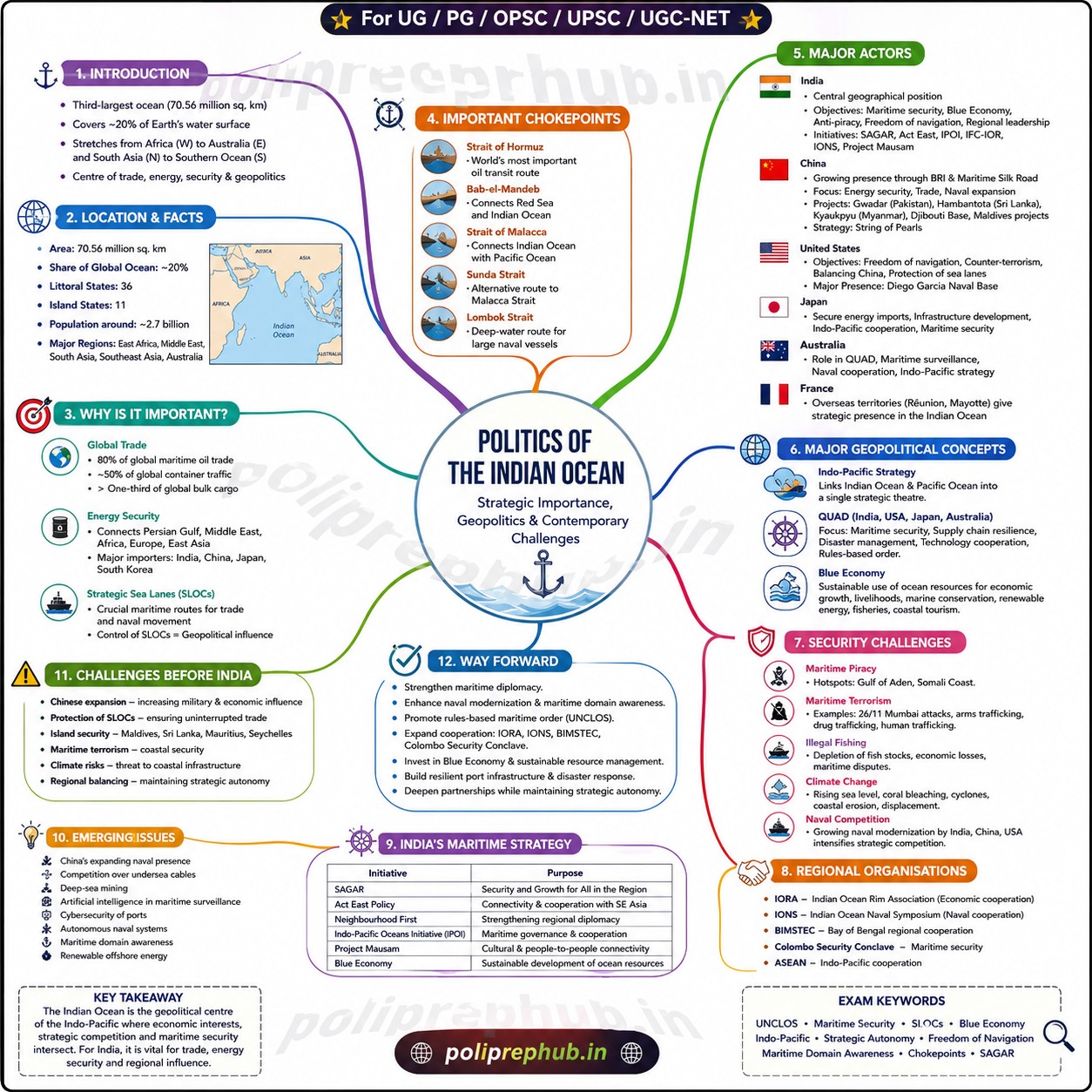
The Indian Ocean is the world’s third-largest ocean, covering approximately 70.56 million sq. km, accounting for nearly 20% of the Earth’s water surface. It stretches from Africa in the west to Australia in the east, and from South Asia in the north to the Southern Ocean.
The politics of the Indian Ocean revolves around strategic competition, maritime security, international trade, naval power, energy security, and geopolitical rivalry among regional and extra-regional powers. Today, the Indian Ocean has become one of the most significant theatres of global geopolitics due to the rise of China, India’s maritime ambitions, and increasing involvement of the United States and other major powers.
Location of the Indian Ocean
The Indian Ocean is the third-largest ocean in the world, occupying a central position between Africa, Asia, Australia, and the Southern Ocean. It is one of the most strategically important oceans because it connects the Atlantic and Pacific Oceans through vital maritime routes. Nearly 2.7 billion people live in countries surrounding the Indian Ocean, making it a hub of global trade, energy transportation, fisheries, and geopolitics.

| Feature | Description | Significance |
|---|---|---|
| Area | 70.56 million sq. km | Third-largest ocean after the Pacific and Atlantic Oceans; covers about one-fifth of the Earth’s ocean surface. |
| Share of Global Ocean | Around 20% | Accounts for nearly one-fifth of the world’s total ocean area and hosts some of the busiest international sea routes. |
| Number of Littoral States | 36 | Countries having coastlines along the Indian Ocean. These states play a major role in regional security, trade, and maritime governance. |
| Number of Island States | 11 | Includes island nations such as Maldives, Sri Lanka, Mauritius, Seychelles, Comoros, Madagascar, etc., many of which are strategically located. |
| Population Around the Ocean | Nearly 2.7 billion | Home to almost one-third of the world’s population, making it economically and strategically significant. |
| Major Regions | East Africa, Middle East, South Asia, Southeast Asia, Australia | Links resource-rich regions with major manufacturing and consumer markets through maritime trade. |
Major Water Bodies Connected to the Indian Ocean
| Water Body | Location | Importance |
|---|---|---|
| Arabian Sea | Northwest | Major oil shipping route and India’s western maritime gateway. |
| Bay of Bengal | Northeast | Important for trade, fisheries, and connectivity with Southeast Asia. |
| Red Sea | Northwest | Connected through the Bab-el-Mandeb Strait to the Suez Canal. |
| Persian Gulf | Northwest | World’s leading oil-exporting region connected via the Strait of Hormuz. |
| Andaman Sea | East | Connects the Bay of Bengal with the Strait of Malacca. |
| Mozambique Channel | Southwest | Important shipping route between Madagascar and mainland Africa. |
Major Islands in the Indian Ocean
| Island / Island Group | Country | Strategic Importance |
|---|---|---|
| Sri Lanka | Sri Lanka | Controls sea routes close to India’s southern coast. |
| Maldives | Maldives | Located along major east-west shipping lanes. |
| Mauritius | Mauritius | Important for maritime security and the Blue Economy. |
| Seychelles | Seychelles | Strategic location for naval surveillance in the western Indian Ocean. |
| Madagascar | Madagascar | Fourth-largest island in the world; overlooks the Mozambique Channel. |
| Andaman & Nicobar Islands | India | Oversee the Strait of Malacca and support India’s maritime strategy. |
| Réunion | France | Enables France to maintain a permanent strategic presence in the Indian Ocean. |
Why is the Indian Ocean important?
The Indian Ocean occupies a pivotal position in the global geopolitical landscape, serving as the maritime bridge between Europe, Africa, the Middle East, South Asia, Southeast Asia, and Australia. It hosts some of the world’s busiest shipping lanes and critical maritime chokepoints, making it indispensable for global trade, energy transportation, security cooperation, and sustainable development. Its strategic location has transformed it into the focal point of the Indo-Pacific and the arena of competition and cooperation among major powers.
| Dimension | Strategic Importance | Examples / Key Facts |
|---|---|---|
| Global Trade | The Indian Ocean is one of the world’s busiest maritime trade corridors, facilitating the movement of goods between Asia, Europe, Africa, and the Middle East. Nearly half of global container traffic and a substantial share of bulk cargo transit through its Sea Lines of Communication (SLOCs). | • Around 50% of global container traffic passes through the Indian Ocean. • Connects major ports such as Singapore, Dubai, Mumbai, Colombo, and Durban. • Vital route for international supply chains. |
| Energy Security | The ocean serves as the principal corridor for transporting crude oil, natural gas, and petroleum products from the Middle East to Asia and Europe. Any disruption can significantly affect global energy prices and economic stability. | • Nearly 80% of global seaborne oil trade transits the Indian Ocean. • Key importers include India, China, Japan, and South Korea. • Strategic chokepoints: Strait of Hormuz and Bab-el-Mandeb. |
| Geopolitics | The Indian Ocean has become the centre of strategic competition among major powers seeking influence over maritime routes, ports, and regional partnerships. It is a core component of the Indo-Pacific geopolitical framework. | • Strategic rivalry involving India, China, the United States, Japan, Australia, and France. • China’s Maritime Silk Road and India’s SAGAR initiative reflect competing maritime visions. |
| Maritime Security | Ensuring the safety of shipping lanes is essential for uninterrupted trade and regional stability. The region faces threats from piracy, maritime terrorism, arms trafficking, and illegal fishing, requiring coordinated naval cooperation. | • Anti-piracy operations in the Gulf of Aden. • Protection of Sea Lines of Communication (SLOCs). • Naval exercises such as MALABAR and IONS strengthen maritime security. |
| Blue Economy | The Indian Ocean possesses immense marine resources that contribute to sustainable economic growth through fisheries, offshore energy, seabed minerals, tourism, marine biotechnology, and renewable energy. | • Rich fishing grounds. • Offshore oil and natural gas reserves. • Potential for deep-sea mining and offshore wind energy. • Coastal tourism supports millions of livelihoods. |
| Climate and Environment | The ocean significantly influences regional and global climate systems, especially the Indian monsoon. It supports rich marine biodiversity but is increasingly vulnerable to climate change, sea-level rise, coral bleaching, and marine pollution. | • Drives the Southwest and Northeast Monsoons. • Home to diverse coral reefs and marine ecosystems. • Climate change threatens island nations such as the Maldives and Seychelles. |
Additional Strategic Dimensions
| Dimension | Importance |
|---|---|
| Maritime Chokepoints | Control over the Strait of Hormuz, Bab-el-Mandeb, Malacca, Sunda, and Lombok Straits directly influences global trade and energy security. |
| Naval Power Projection | The Indian Ocean hosts several major naval bases, including Diego Garcia, enabling rapid military deployment and strategic deterrence. |
| Regional Connectivity | Acts as the maritime bridge linking Africa, the Middle East, South Asia, Southeast Asia, and Oceania through shipping and digital connectivity. |
| Strategic Partnerships | Encourages multilateral cooperation through organisations such as IORA, IONS, BIMSTEC, QUAD, and the Colombo Security Conclave. |
Why is the Indian Ocean Called the “Ocean of the 21st Century”?
| Reason | Explanation |
|---|---|
| Centre of Global Commerce | The majority of east-west maritime trade flows through the Indian Ocean. |
| Energy Lifeline | The world’s most important oil and LNG transportation routes pass through its waters. |
| Indo-Pacific Strategy | The Indian Ocean forms the western pillar of the Indo-Pacific strategic architecture. |
| Great Power Competition | Increasing strategic engagement by India, China, the United States, Japan, Australia, and European powers. |
| Blue Economy Potential | Marine resources offer enormous opportunities for sustainable economic development. |
| Maritime Security | Protection of shipping lanes has become central to international peace and security. |
Important Chokepoints
A maritime chokepoint is a narrow sea passage connecting two larger bodies of water, through which a substantial proportion of global maritime trade, energy supplies, and naval movements pass. These chokepoints act as strategic gateways for international shipping and are critical to the global economy. Any disruption caused by conflict, piracy, terrorism, or geopolitical tensions can significantly affect global trade, energy security, and supply chains.

The Indian Ocean contains some of the world’s most strategically significant chokepoints, linking the Atlantic, Mediterranean, and Pacific Oceans. These routes facilitate the transportation of oil, liquefied natural gas (LNG), manufactured goods, and raw materials between Asia, Europe, Africa, and the Middle East.
| Chokepoint | Location / Connects | Strategic Importance | Major Concerns |
|---|---|---|---|
| Strait of Hormuz | Connects the Persian Gulf with the Gulf of Oman and the Arabian Sea | World’s most important oil transit route; gateway for Middle Eastern oil exports | Iran-US tensions, military confrontations, disruption of oil supplies |
| Bab-el-Mandeb Strait | Connects the Red Sea with the Gulf of Aden and the Indian Ocean | Vital link between Europe and Asia via the Suez Canal; major trade and energy corridor | Piracy, conflicts in Yemen, attacks on commercial vessels |
| Strait of Malacca | Connects the Indian Ocean with the South China Sea and the Pacific Ocean | One of the world’s busiest shipping lanes; crucial for Asian trade and energy imports | Maritime piracy, congestion, geopolitical competition |
| Sunda Strait | Connects the Java Sea with the Indian Ocean between Java and Sumatra | Alternative route to the Strait of Malacca for regional shipping | Shallow waters, volcanic activity, limited capacity for large vessels |
| Lombok Strait | Connects the Bali Sea with the Indian Ocean | Deep-water route suitable for large container ships and naval vessels | Strategic naval competition and increasing military activity |
Comparative Analysis of Indian Ocean Chokepoints
| Chokepoint | Primary Function | Major Users | Strategic Value |
|---|---|---|---|
| Strait of Hormuz | Energy transportation | Gulf countries, India, China, Japan | Global energy security |
| Bab-el-Mandeb | Europe–Asia trade | Europe, Asia, Middle East | Suez Canal connectivity |
| Strait of Malacca | International trade | ASEAN, China, Japan, India | Global commerce and Indo-Pacific connectivity |
| Sunda Strait | Alternative shipping route | Indonesia, regional shipping | Reduces dependence on Malacca |
| Lombok Strait | Deep-water navigation | Naval fleets, large commercial vessels | Strategic military mobility |
Major Actors in Indian Ocean Politics
| Major Actor | Strategic Objectives | Key Policies / Initiatives | Strategic Presence / Projects | Strategic Significance |
|---|---|---|---|---|
| India | • Maritime security • Blue Economy • Anti-piracy operations • Freedom of Navigation (FON) • Regional leadership • Indo-Pacific cooperation | • SAGAR (Security and Growth for All in the Region) • Mission-Based Deployments (MBD) • Information Fusion Centre–Indian Ocean Region (IFC-IOR) • Indian Ocean Naval Symposium (IONS) • Act East Policy • Indo-Pacific Oceans Initiative (IPOI) | • Andaman & Nicobar Command • Naval cooperation with IOR countries • Humanitarian Assistance and Disaster Relief (HADR) • Coastal surveillance radar network | India views the Indian Ocean as central to its national security, economic prosperity, and strategic influence. It seeks to promote a free, open, inclusive, and rules-based Indo-Pacific while ensuring regional stability. |
| China | • Energy security • Protection of Sea Lines of Communication (SLOCs) • Expansion of maritime influence • Securing overseas trade routes • Naval modernization | • Belt and Road Initiative (BRI) • Maritime Silk Road (MSR) • PLA Navy modernization | Strategic Projects (String of Pearls): • Pakistan – Gwadar Port • Sri Lanka – Hambantota Port • Myanmar – Kyaukpyu Port • Djibouti – Overseas Naval Base • Maldives – Infrastructure projects | China’s expanding presence has altered the strategic balance in the Indian Ocean. The String of Pearls Strategy is viewed by many analysts as a network of ports and infrastructure capable of supporting both commercial activities and future military operations. |
| United States | • Freedom of Navigation (FON) • Balancing China’s influence • Counter-terrorism • Protection of global sea lanes • Strengthening security partnerships | • Indo-Pacific Strategy • QUAD cooperation • Maritime security partnerships | • Diego Garcia Naval Base (British Indian Ocean Territory) • Regular naval deployments • Joint military exercises | The United States seeks to preserve a rules-based maritime order, maintain open sea lanes, and ensure stability through alliances and strategic partnerships across the Indo-Pacific. |
| Japan | • Secure energy imports • Safe maritime trade • Indo-Pacific cooperation • Infrastructure connectivity • Maritime security | • Free and Open Indo-Pacific (FOIP) • Official Development Assistance (ODA) • Maritime capacity building | • Infrastructure financing • Port development • Naval exercises with India, Australia, and the United States | Japan’s economy depends heavily on uninterrupted maritime trade through the Indian Ocean, making maritime security and regional cooperation key foreign policy priorities. |
| Australia | • Regional security • Maritime surveillance • Naval cooperation • Protection of sea lanes • Indo-Pacific stability | • QUAD • Indo-Pacific Strategy • Defence partnerships | • Joint naval exercises (MALABAR) • Maritime domain awareness initiatives • Defence cooperation with India and ASEAN | Australia plays an important role in maintaining a stable Indo-Pacific by strengthening maritime security, supporting international law, and deepening strategic partnerships. |
| France | • Protect overseas territories • Maritime security • Freedom of navigation • Regional stability • Indo-Pacific engagement | • French Indo-Pacific Strategy • Defence cooperation with India and IOR countries | • Overseas territories: Réunion and Mayotte • Permanent naval presence • Exclusive Economic Zone (EEZ) in the Indian Ocean | France is the only European power with permanent territories in the Indian Ocean, enabling it to project military power, safeguard its EEZ, and contribute to regional security and humanitarian operations. |
Major Geopolitical Concepts
The Indian Ocean Region (IOR) has emerged as the centre of global geopolitics due to the convergence of international trade, energy security, strategic competition, and maritime governance. Several geopolitical concepts have become central to understanding the evolving political dynamics of the region. Among these, the Indo-Pacific Strategy, QUAD, and the Blue Economy are the most influential.
| Concept | Meaning | Major Participants | Objectives | Significance in Indian Ocean Politics |
|---|---|---|---|---|
| Indo-Pacific Strategy | A geopolitical framework that integrates the Indian Ocean and Pacific Ocean into a single strategic theatre. | India, USA, Japan, Australia, France, ASEAN, European Union | • Free and open Indo-Pacific • Freedom of navigation • Maritime security • Regional connectivity • Rules-based international order | Shapes the strategic architecture of the 21st century by promoting stability, balancing regional power, and securing global trade routes. |
| QUAD (Quadrilateral Security Dialogue) | A strategic partnership among four democratic maritime nations. | India, USA, Japan, Australia | • Maritime security • Supply chain resilience • Disaster management (HADR) • Critical and emerging technologies • Cybersecurity • Rules-based international order | Strengthens strategic cooperation in the Indo-Pacific and enhances regional security through joint exercises and policy coordination. |
| Blue Economy | Sustainable use of ocean resources for economic development while conserving marine ecosystems. | Coastal and island nations, IORA members, UN agencies | • Sustainable economic growth • Employment and livelihoods • Marine conservation • Fisheries development • Renewable ocean energy • Coastal and marine tourism | Promotes sustainable development, food security, climate resilience, and long-term prosperity in the Indian Ocean Region. |
Security Challenges
The Indian Ocean Region (IOR) is one of the world’s most strategically important maritime spaces, carrying a significant share of global trade and energy supplies. However, its strategic importance also makes it vulnerable to a wide range of traditional and non-traditional security threats. These include maritime piracy, maritime terrorism, illegal fishing, climate change, and growing naval competition among major powers.
These challenges threaten maritime security, economic development, freedom of navigation, regional stability, and sustainable use of marine resources, making international cooperation essential.
| Security Challenge | Nature of the Threat | Major Areas / Examples | Impact |
|---|---|---|---|
| Maritime Piracy | Armed attacks, hijacking, and robbery against ships | Gulf of Aden, Somali Coast | Threatens shipping, increases insurance costs, disrupts trade |
| Maritime Terrorism | Terrorist attacks using the sea, trafficking of weapons and people | 26/11 Mumbai Attacks (2008), Arms, Drugs & Human Trafficking | Endangers national security and maritime commerce |
| Illegal, Unreported and Unregulated (IUU) Fishing | Unauthorized exploitation of marine resources | Indian Ocean fisheries | Depletes fish stocks, causes economic losses, creates maritime disputes |
| Climate Change | Environmental degradation affecting coastal and marine ecosystems | Rising sea level, Coral bleaching, Cyclones | Threatens island nations, biodiversity, and coastal communities |
| Naval Competition | Expansion and modernization of naval forces | India, China, USA | Intensifies geopolitical rivalry and strategic competition |
Indian Ocean Regional Organisations
The Indian Ocean Region (IOR) is strategically important for global trade, energy security, maritime connectivity, and geopolitical stability. To address common regional challenges such as maritime security, economic development, disaster management, sustainable use of marine resources, and regional integration, several multilateral organisations have emerged.
These organisations promote cooperation among littoral and island states, strengthen maritime governance, and contribute to a free, open, secure, and rules-based Indian Ocean Region.
| Organisation | Year Established | Headquarters | Members | Primary Objective | Significance in the Indian Ocean Region |
|---|---|---|---|---|---|
| Indian Ocean Rim Association (IORA) | 1997 | Ebene, Mauritius | 23 Member States + 12 Dialogue Partners | Promote regional economic cooperation and sustainable development | Premier regional organisation of the Indian Ocean focusing on trade, Blue Economy, maritime safety, fisheries, disaster management, and academic cooperation. |
| Indian Ocean Naval Symposium (IONS) | 2008 | Rotational Secretariat | 35 Navies (Members & Observers) | Strengthen naval cooperation and maritime security | Enhances interoperability among regional navies through joint exercises, information sharing, HADR, anti-piracy operations, and confidence-building measures. |
| BIMSTEC (Bay of Bengal Initiative for Multi-Sectoral Technical and Economic Cooperation) | 1997 | Dhaka, Bangladesh | 7 Member States | Promote regional cooperation in the Bay of Bengal | Acts as a bridge between South Asia and Southeast Asia by promoting connectivity, trade, maritime transport, disaster management, and security cooperation. |
| Colombo Security Conclave (CSC) | 2011 (revitalised in 2020) | Rotational | India, Sri Lanka, Maldives, Mauritius (Member); Bangladesh & Seychelles (Observers) | Enhance maritime and regional security | Focuses on maritime security, counter-terrorism, cybersecurity, trafficking, humanitarian assistance, and disaster relief in the Indian Ocean. |
| ASEAN (Association of Southeast Asian Nations) | 1967 | Jakarta, Indonesia | 10 Member States | Promote regional peace, economic integration, and Indo-Pacific cooperation | Plays a central role in the Indo-Pacific through the ASEAN Outlook on the Indo-Pacific (AOIP) and contributes to maritime connectivity and regional stability. |
India’s Maritime Strategy
India’s Maritime Strategy is a comprehensive framework aimed at safeguarding its maritime interests, ensuring national security, promoting economic growth, and strengthening regional cooperation in the Indian Ocean Region (IOR). As a country with a coastline of over 7,500 km, more than 1,380 islands, and an Exclusive Economic Zone (EEZ) of over 2 million sq. km, India considers the Indian Ocean central to its strategic, economic, and geopolitical interests.
India’s maritime vision is guided by the principles of Security and Growth for All in the Region (SAGAR), the Indo-Pacific Oceans Initiative (IPOI), the Act East Policy, the Neighbourhood First Policy, and the promotion of the Blue Economy.
Major Pillars of India’s Maritime Strategy
| Initiative | Year Launched | Primary Purpose | Major Components | Strategic Significance |
|---|---|---|---|---|
| SAGAR (Security and Growth for All in the Region) | 2015 | Regional maritime cooperation and security | Maritime security, disaster relief, capacity building, Blue Economy, regional connectivity | India’s flagship maritime vision for ensuring a secure, stable, and prosperous Indian Ocean Region. |
| Act East Policy | 2014 (upgraded from Look East Policy) | Strengthen connectivity with Southeast Asia and the Indo-Pacific | Trade, infrastructure, maritime cooperation, defence diplomacy | Enhances India’s engagement with ASEAN and strengthens its Indo-Pacific presence. |
| Neighbourhood First Policy | 2014 | Strengthen relations with neighbouring countries | Maritime diplomacy, economic cooperation, humanitarian assistance, connectivity | Promotes regional stability and strengthens India’s influence among Indian Ocean neighbours. |
| Indo-Pacific Oceans Initiative (IPOI) | 2019 | Promote rules-based maritime governance | Maritime security, disaster risk reduction, marine ecology, capacity building, science & technology | Supports a free, open, inclusive, and rules-based Indo-Pacific region. |
| Project Mausam | 2014 | Revive India’s historical maritime and cultural links | Cultural diplomacy, heritage conservation, people-to-people connectivity | Reinforces India’s soft power by highlighting its historical maritime connections across the Indian Ocean. |
| Blue Economy | Ongoing | Sustainable development of ocean resources | Fisheries, offshore energy, marine biotechnology, tourism, renewable energy | Balances economic growth with marine conservation and supports long-term maritime sustainability. |
Emerging Issues
The Indian Ocean Region (IOR) is undergoing rapid geopolitical and technological transformation. While traditional concerns such as maritime security and energy security remain important, a range of emerging issues is reshaping regional politics. These include China’s expanding naval presence, competition over undersea digital infrastructure, deep-sea resource exploitation, artificial intelligence, cybersecurity, autonomous naval systems, maritime domain awareness, and renewable offshore energy.
These emerging challenges will significantly influence the future of Indo-Pacific geopolitics, maritime governance, and the global Blue Economy.
- China’s expanding naval presence
- Competition over undersea cables
- Deep-sea mining
- Artificial intelligence in maritime surveillance
- Cybersecurity of ports
- Autonomous naval systems
- Maritime domain awareness
- Renewable offshore energy
| Emerging Issue | Meaning | Strategic Importance | Challenges |
|---|---|---|---|
| China’s Expanding Naval Presence | Expansion of Chinese naval deployments and overseas infrastructure in the Indian Ocean. | Protects China’s trade and energy routes; enhances power projection. | Strategic rivalry with India, USA, and regional powers. |
| Competition over Undersea Cables | Contest for control and protection of submarine communication cables carrying global internet traffic. | Critical for digital economy, financial systems, and global communications. | Cyberattacks, sabotage, espionage, and geopolitical competition. |
| Deep-Sea Mining | Exploration and extraction of minerals from the ocean floor. | Access to rare earth elements, cobalt, nickel, manganese, and polymetallic nodules. | Environmental degradation, legal disputes, and sustainability concerns. |
| Artificial Intelligence (AI) in Maritime Surveillance | Use of AI for monitoring maritime activities and improving decision-making. | Enhances maritime security, surveillance, and threat detection. | Data security, ethical concerns, algorithmic bias, and cyber risks. |
| Cybersecurity of Ports | Protection of digital infrastructure used in ports and maritime logistics. | Ensures uninterrupted trade and secure port operations. | Cyberattacks on ports, shipping systems, and logistics networks. |
| Autonomous Naval Systems | Deployment of unmanned surface, underwater, and aerial military platforms. | Improves surveillance, mine detection, and naval operations. | Arms race, legal uncertainty, and operational risks. |
| Maritime Domain Awareness (MDA) | Comprehensive understanding of activities occurring in the maritime domain. | Enables effective monitoring, maritime security, and disaster response. | Data sharing, technological capacity, and regional coordination. |
| Renewable Offshore Energy | Development of offshore wind, tidal, wave, and ocean thermal energy. | Supports clean energy transition and energy security. | High investment costs, technological challenges, and environmental impacts. |
Challenges Before India
India occupies a central geographical position in the Indian Ocean Region (IOR) and considers the Indian Ocean vital for its national security, economic development, energy security, and regional influence. More than 95% of India’s trade by volume and around 80–85% of its crude oil imports are transported by sea, making maritime security a strategic necessity.
However, India’s growing maritime ambitions face several traditional and emerging challenges, including China’s expanding presence, protection of Sea Lines of Communication (SLOCs), security of island nations, maritime terrorism, climate change, and maintaining strategic autonomy amid great-power rivalry.
| Challenge | Explanation | Strategic Impact | India’s Response |
|---|---|---|---|
| Chinese Expansion | China’s growing military, economic, and naval presence through the Belt and Road Initiative (BRI), Maritime Silk Road, and the “String of Pearls” strategy. | Challenges India’s regional influence and increases strategic competition in the Indian Ocean. | SAGAR, Naval Modernization, QUAD, Indo-Pacific Oceans Initiative (IPOI), strengthening partnerships with IOR countries. |
| Protection of Sea Lines of Communication (SLOCs) | Securing major maritime trade routes that carry India’s trade and energy imports. | Disruption could affect trade, energy supplies, and economic stability. | Mission-Based Deployments, anti-piracy patrols, Information Fusion Centre–IOR (IFC-IOR), enhanced naval surveillance. |
| Island Security | Strengthening strategic partnerships with island nations such as Maldives, Sri Lanka, Mauritius, and Seychelles. | Prevents external powers from gaining strategic footholds and ensures regional stability. | Defence cooperation, coastal radar systems, infrastructure development, HADR assistance, capacity building. |
| Maritime Terrorism | Threats from sea-borne terrorism, piracy, arms trafficking, drug trafficking, and human trafficking. | Endangers coastal security, ports, shipping, and national security. | Coastal Security Scheme, Indian Coast Guard, maritime intelligence, joint naval exercises, coastal surveillance network. |
| Climate Risks | Rising sea levels, cyclones, coastal erosion, coral bleaching, and extreme weather events affecting coastal regions. | Threatens coastal infrastructure, ports, fisheries, island territories, and livelihoods. | Climate-resilient infrastructure, Blue Economy initiatives, disaster preparedness, coastal protection projects. |
| Regional Balancing | Managing relations among major powers such as the USA, China, Japan, Australia, ASEAN, and France while preserving India’s strategic autonomy. | Balancing strategic partnerships without aligning exclusively with any bloc. | Multi-alignment diplomacy, QUAD participation, ASEAN engagement, IORA, BIMSTEC, strategic autonomy. |
Way Forward
The Indian Ocean Region (IOR) has emerged as the geopolitical centre of the Indo-Pacific, making maritime security, economic cooperation, environmental sustainability, and regional stability global priorities. As geopolitical competition intensifies and non-traditional threats such as climate change, piracy, cyber threats, and illegal fishing continue to evolve, countries must adopt a comprehensive, cooperative, and rules-based maritime strategy.
For India, the way forward lies in strengthening its maritime capabilities while promoting regional cooperation, sustainable development, and strategic autonomy.
- Strengthen maritime diplomacy.
- Enhance naval modernization and maritime domain awareness.
- Promote a rules-based maritime order consistent with international law, including the principles reflected in the United Nations Convention on the Law of the Sea (UNCLOS).
- Expand regional cooperation through IORA, IONS, BIMSTEC, and the Colombo Security Conclave.
- Invest in the Blue Economy and sustainable marine resource management.
- Build resilient port infrastructure and improve disaster response capabilities.
- Deepen partnerships while maintaining India’s strategic autonomy.
| Policy Recommendation | Objectives | Expected Outcomes |
|---|---|---|
| Strengthen Maritime Diplomacy | Deepen engagement with Indian Ocean littoral and island states through diplomatic, economic, and security partnerships. | Greater regional trust, stronger partnerships, and enhanced Indian leadership in the Indian Ocean Region. |
| Enhance Naval Modernization and Maritime Domain Awareness (MDA) | Modernize the Indian Navy, Coast Guard, and surveillance capabilities using satellites, AI, drones, and integrated radar networks. | Improved maritime security, rapid response to threats, and protection of India’s maritime interests. |
| Promote a Rules-Based Maritime Order (UNCLOS) | Uphold international maritime law, freedom of navigation, peaceful dispute resolution, and respect for Exclusive Economic Zones (EEZs). | Stable and predictable maritime governance, reduced conflicts, and secure international trade. |
| Expand Regional Cooperation | Strengthen cooperation through IORA, IONS, BIMSTEC, Colombo Security Conclave, ASEAN, and QUAD. | Better maritime security, disaster response, economic integration, and regional stability. |
| Promote the Blue Economy | Encourage sustainable fisheries, offshore renewable energy, marine biotechnology, eco-tourism, and responsible resource management. | Economic growth, employment generation, environmental sustainability, and climate resilience. |
| Develop Resilient Port Infrastructure | Upgrade ports with smart technologies, cybersecurity, green infrastructure, and climate-resilient facilities. | Efficient logistics, secure maritime trade, and reduced vulnerability to disasters and cyberattacks. |
| Maintain Strategic Autonomy | Build partnerships with multiple countries while preserving an independent foreign policy and balanced diplomacy. | Greater strategic flexibility, regional influence, and balanced engagement among major powers. |
Conclusion
The Indian Ocean has emerged as the geopolitical and geoeconomic centre of the Indo-Pacific, serving as the lifeline of global trade, energy transportation, maritime connectivity, and strategic competition. Its strategic Sea Lines of Communication (SLOCs), critical maritime chokepoints, and vast marine resources make it indispensable to the global economy and international security.
For India, the Indian Ocean is far more than a geographical entity—it is central to the country’s national security, economic prosperity, energy security, and regional leadership. As a major maritime power, India seeks to ensure a free, open, inclusive, secure, and rules-based Indian Ocean Region (IOR) through initiatives such as SAGAR, the Indo-Pacific Oceans Initiative (IPOI), the Act East Policy, and the Blue Economy.
However, the region also faces complex challenges, including great-power rivalry, maritime piracy, terrorism, illegal fishing, climate change, cybersecurity threats, and technological competition. Addressing these challenges requires multilateral cooperation, adherence to international maritime law (UNCLOS), enhanced maritime domain awareness, sustainable utilization of marine resources, and stronger regional institutions such as IORA, IONS, BIMSTEC, and the Colombo Security Conclave.
Ultimately, the future of the Indian Ocean will depend on balancing competition with cooperation, security with sustainable development, and national interests with collective regional governance. A stable, peaceful, and prosperous Indian Ocean is essential not only for the countries of the region but also for maintaining the rules-based international order and ensuring long-term global economic and strategic stability.
Previous Year Questions (UPSC/OPSC/UGC-NET)
UPSC
- Discuss the strategic importance of the Indian Ocean in contemporary geopolitics.
- Explain India’s SAGAR doctrine and evaluate its significance.
- What is the Indo-Pacific strategy? Examine its implications for India.
- Discuss the geopolitical significance of the Strait of Malacca.
OPSC
- Why is the Indian Ocean central to India’s foreign policy?
- Discuss China’s “String of Pearls” strategy and its implications for India’s maritime security.
- Explain the role of IORA in regional cooperation.