The district administration is the most important field-level administrative unit of the Government of Odisha. It acts as the connecting link between the State Government and the people, ensuring effective implementation of laws, development programmes, and welfare schemes. The district is considered the basic unit of governance because most public services, developmental activities, disaster management, and law-and-order functions are administered at this level.
Odisha currently has 30 districts, each headed by a District Collector & District Magistrate (DC & DM), who serves as the chief representative of the State Government in the district.
Table of Contents
Meaning of District Administration
District administration refers to the administrative machinery operating at the district level responsible for implementing government policies, maintaining law and order, collecting revenue, coordinating development programmes, and delivering public services. It is the principal field agency of the State Government and serves as the link between the government and the citizens.
Definitions
S.R. Maheshwari
“District administration is the practical face of government where public policies are translated into action.”
M.P. Sharma
“District administration is the total management of public affairs within the territorial limits of a district under the leadership of the District Collector.”
Avasthi and Maheshwari
“District administration is the basic unit of field administration through which the policies and programmes of the government are implemented at the grassroots level.”
Iqbal Narain
“The district is the nerve centre of administration where governmental authority comes into direct contact with the people.”
Paul H. Appleby
“The district is the principal operational unit of administration where the success or failure of public administration is ultimately judged.”
Administrative Reforms Commission (ARC), 1966
“The district continues to be the most important unit of administration for the purposes of general administration, development planning, and coordination of government activities.”
Objectives of District Administration
The district administration serves as the foundation of grassroots governance in India. Its primary objectives are to maintain law and order, administer revenue, implement government policies, coordinate development activities, deliver public services, conduct elections, manage disasters, promote inclusive growth, and safeguard citizens’ rights. Through these functions, it acts as the vital link between the State Government and the people, ensuring effective governance and socio-economic development at the district level.
- Maintain law and order.
- Implement government policies.
- Collect land revenue.
- Deliver public services.
- Coordinate development programmes.
- Conduct elections.
- Manage disasters and emergencies.
- Promote inclusive development.
- Protect citizens’ rights.
| Objective | Explanation |
|---|---|
| Maintain Law and Order | One of the foremost objectives of district administration is to maintain peace, public order, and internal security. The District Collector, in coordination with the Superintendent of Police (SP), prevents crime, manages public gatherings, controls communal tensions, and ensures the safety of life and property. |
| Implement Government Policies | District administration acts as the executive arm of the State Government by implementing laws, policies, and flagship schemes. It ensures that government programmes reach the intended beneficiaries efficiently and effectively. |
| Collect Land Revenue | Traditionally, revenue administration has been a primary function of the district administration. It is responsible for land revenue collection, maintenance of land records, mutation of property, land acquisition, settlement operations, and protection of government land. |
| Deliver Public Services | District administration ensures the delivery of essential public services such as education, healthcare, drinking water, sanitation, electricity, transport, public distribution system (PDS), and issuance of certificates like income, caste, residence, and birth/death certificates. |
| Coordinate Development Programmes | It coordinates the activities of various government departments to implement developmental programmes in agriculture, rural development, infrastructure, housing, employment, health, education, and social welfare. Effective inter-departmental coordination promotes balanced regional development. |
| Conduct Elections | The District Collector functions as the District Election Officer and supervises the conduct of free, fair, and peaceful elections to the Lok Sabha, State Legislative Assembly, Panchayati Raj Institutions, and Urban Local Bodies. This includes preparation of electoral rolls, polling arrangements, and vote counting. |
| Manage Disasters and Emergencies | Odisha is highly vulnerable to cyclones, floods, and other natural disasters. District administration plays a crucial role in disaster preparedness, early warning dissemination, evacuation, relief distribution, rehabilitation, and coordination with the Odisha State Disaster Management Authority (OSDMA) and other agencies. |
| Promote Inclusive Development | District administration works towards equitable socio-economic development by implementing welfare programmes for Scheduled Castes (SCs), Scheduled Tribes (STs), Other Backward Classes (OBCs), women, children, senior citizens, persons with disabilities, and economically weaker sections. |
| Protect Citizens’ Rights | It safeguards the constitutional and legal rights of citizens by ensuring access to justice, maintaining transparency, protecting human rights, redressing public grievances, enforcing welfare legislation, and promoting good governance and accountability. |
Administrative Hierarchy of District Administration in Odisha
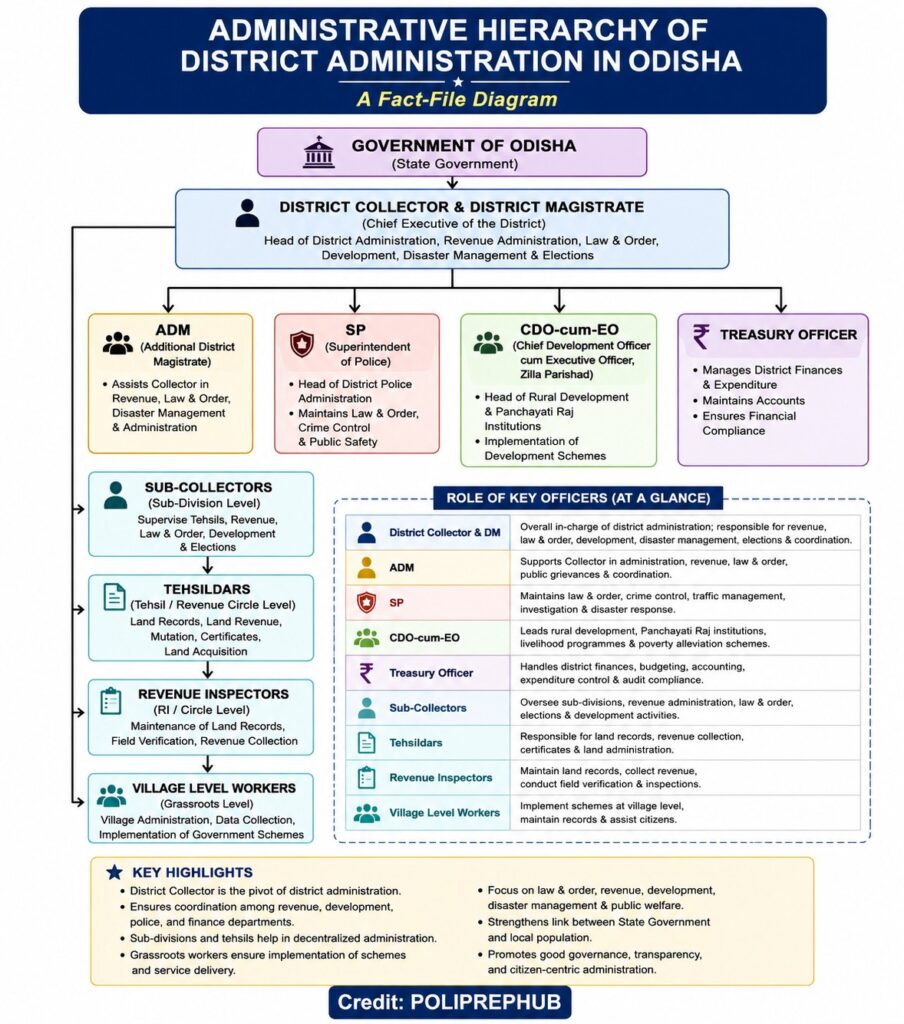
Organizational Structure of District Administration
1. District Collector & District Magistrate (DC & DM)
The District Collector is the head of district administration and is usually an IAS officer.
Major Roles
A. Revenue Administration
- Collection of land revenue
- Land acquisition
- Settlement operations
- Management of government land
- Relief distribution
B. District Magistrate
As District Magistrate, the Collector
- Maintains law and order
- Supervises Executive Magistrates
- Issues prohibitory orders under Section 163 BNSS (formerly Section 144 CrPC)
- Coordinates police administration
- Handles disaster situations
C. Development Administration
- Supervises government schemes
- Chairs District Planning Committee meetings
- Monitors MGNREGA
- PMAY
- Mission Shakti
- National Health Mission
- Jal Jeevan Mission
- Agriculture and livelihood programmes
D. Election Functions
The Collector acts as the District Election Officer.
Responsibilities include
- Electoral roll revision
- Conduct of Lok Sabha elections
- Assembly elections
- Panchayat elections
- Municipal elections
2. Additional District Magistrate (ADM)
The ADM assists the Collector in
- Revenue administration
- Law and order
- Disaster management
- Public grievance redressal
- Administrative coordination
3. Superintendent of Police (SP)
The Superintendent of Police heads the district police administration.
Functions
- Maintain law and order
- Crime prevention
- Investigation
- Traffic management
- VIP security
- Disaster response
- Cybercrime investigation
The SP works in close coordination with the District Magistrate.
4. Chief Development Officer (CDO-cum-EO, Zilla Parishad)
The CDO supervises
- Rural development
- Panchayati Raj institutions
- Livelihood programmes
- Poverty alleviation schemes
- Infrastructure development
5. Sub-Collector
Each subdivision is headed by a Sub-Collector, generally an OAS or IAS officer.
Functions
- Supervision of Tehsils
- Revenue administration
- Law and order
- Election work
- Development monitoring
- Disaster management
6. Tehsildar
The Tehsildar heads the Tehsil (Revenue Circle).
Functions
- Mutation
- Land records
- Land revenue collection
- Encroachment removal
- Issuance of caste certificates
- Income certificates
- Residence certificates
- Land acquisition support
7. Block Development Officer (BDO)
The BDO heads the Community Development Block.
Functions
- Rural development
- Panchayat administration
- MGNREGA implementation
- PMAY (Gramin)
- Watershed development
- SHG promotion
- Mission Shakti programmes
8. Executive Officers of Urban Local Bodies
Municipalities and Municipal Corporations are managed by
- Municipal Commissioner
- Executive Officer
Functions include
- Sanitation
- Water supply
- Urban infrastructure
- Property tax
- Solid waste management
- Smart City projects
9. Line Departments
Every district has officers from different departments.
Examples include
| Department | District Officer |
|---|---|
| Health | Chief District Medical & Public Health Officer (CDM & PHO) |
| Education | District Education Officer (DEO) |
| Agriculture | Deputy Director of Agriculture |
| Forest | Divisional Forest Officer (DFO) |
| Fisheries | District Fisheries Officer |
| Animal Husbandry | Chief District Veterinary Officer |
| Women & Child Development | District Social Welfare Officer |
| Rural Development | Project Director, DRDA |
| Food Supplies | District Civil Supplies Officer |
| Industries | General Manager, DIC |
Administrative Divisions within a District
The district administration is organized into several territorial and administrative units to ensure efficient governance, effective implementation of government policies, and delivery of public services. Each administrative unit is headed by a designated officer responsible for specific administrative, developmental, and regulatory functions.
| Administrative Unit | Head | Major Functions |
|---|---|---|
| District | District Collector & District Magistrate (DC & DM) | The district is the highest administrative unit below the state level. The District Collector is the chief executive of the district, responsible for revenue administration, law and order, development programmes, disaster management, elections, and coordination among all government departments. |
| Sub-Division | Sub-Collector (Sub-Divisional Magistrate) | A district is divided into one or more sub-divisions to facilitate better administration. The Sub-Collector supervises Tehsils, maintains law and order, performs executive magistracy functions, oversees revenue administration, and monitors development programmes. |
| Tehsil (Tahasil) | Tehsildar | The Tehsil is the primary revenue unit of the district. The Tehsildar manages land records, collects land revenue, conducts mutation and settlement operations, removes encroachments, issues revenue-related certificates, and assists in land acquisition and disaster relief. |
| Community Development Block (Block) | Block Development Officer (BDO) | The Block serves as the basic unit of rural development administration. The BDO implements rural development schemes, supervises Gram Panchayats, coordinates welfare programmes, promotes employment generation, and ensures effective implementation of schemes such as MGNREGA and PMAY-G. |
| Gram Panchayat | Sarpanch (Elected Head) | The Gram Panchayat is the lowest tier of the Panchayati Raj system. It prepares village development plans, provides basic civic amenities, implements rural development programmes, maintains village infrastructure, and promotes participatory local governance. The Panchayat Executive Officer (PEO) assists in administrative work. |
| Village | Ward Member / Village Functionaries | The village is the smallest administrative unit. Ward Members represent the people in the Gram Panchayat, while Village Level Workers (VLWs), Anganwadi Workers, ASHA Workers, Revenue Inspectors, and other grassroots officials assist in implementing government schemes, maintaining public records, and delivering essential services. |
Functions of District Administration
Regulatory Functions
- Law and order
- Licensing
- Disaster management
- Public safety
- Election management
Revenue Functions
- Land revenue
- Land records
- Registration
- Mutation
- Land acquisition
Development Functions
- Agriculture
- Education
- Health
- Drinking water
- Roads
- Housing
- Employment generation
- Social welfare
Welfare Functions
- Scholarships
- Pension schemes
- Public Distribution System
- Women empowerment
- Tribal welfare
- SC/ST welfare
Disaster Management
Odisha is one of India’s most disaster-prone states.
District administration plays a major role in
- Cyclone preparedness
- Flood management
- Relief distribution
- Rehabilitation
- Coordination with Odisha State Disaster Management Authority (OSDMA)
Coordination Mechanism
The Collector coordinates among
- Police Department
- Revenue Department
- Panchayati Raj Institutions
- Municipal Bodies
- Health Department
- Education Department
- Agriculture Department
- NGOs
- Disaster Management Authorities
This coordination ensures integrated governance at the district level.
Importance of District Administration
District administration occupies a central position in India’s administrative system. It serves as the primary link between the State Government and the people, ensuring effective governance, implementation of public policies, and delivery of essential services. The district is often regarded as the backbone of field administration because government programmes are implemented and monitored at this level.
- Closest level of state administration to citizens.
- Ensures implementation of government schemes.
- Maintains peace and public order.
- Promotes socio-economic development.
- Coordinates multiple departments.
- Strengthens democratic governance.
- Provides timely disaster response and relief.
| Importance | Explanation |
|---|---|
| Closest Level of State Administration to Citizens | District administration is the nearest representative of the State Government at the grassroots level. It directly interacts with citizens, addresses their grievances, and ensures that government services are accessible to the public. |
| Ensures Effective Implementation of Government Schemes | It is responsible for implementing and monitoring various Central and State Government welfare programmes such as MGNREGA, PMAY, National Health Mission, Mission Shakti, and Jal Jeevan Mission, ensuring that benefits reach the intended beneficiaries. |
| Maintains Law and Order | Through the coordinated efforts of the District Collector and the Superintendent of Police, district administration maintains peace, prevents crime, manages public order, and safeguards life and property during normal and emergency situations. |
| Promotes Socio-economic Development | District administration formulates and implements development plans in sectors such as agriculture, education, health, rural development, infrastructure, industries, and social welfare, thereby improving the quality of life of the people. |
| Coordinates Multiple Government Departments | It acts as a coordinating agency among various line departments, local bodies, and public institutions. This coordination ensures efficient implementation of development programmes and avoids duplication of efforts. |
| Strengthens Democratic Governance | District administration facilitates democratic governance by conducting free and fair elections, supporting Panchayati Raj Institutions (PRIs) and Urban Local Bodies (ULBs), encouraging citizen participation, and ensuring transparency and accountability in public administration. |
| Provides Disaster Response and Relief | Odisha is highly vulnerable to cyclones, floods, and other natural disasters. District administration plays a crucial role in disaster preparedness, early warning dissemination, evacuation, rescue operations, relief distribution, rehabilitation, and coordination with the Odisha State Disaster Management Authority (OSDMA). |
| Acts as the Nodal Agency for Public Service Delivery | District administration delivers essential public services such as education, healthcare, public distribution, drinking water, sanitation, social security pensions, and issuance of certificates including caste, income, residence, and birth/death certificates. |
| Protects Citizens’ Rights and Ensures Good Governance | It safeguards constitutional and legal rights by enforcing laws, redressing public grievances, promoting transparency, preventing corruption, and ensuring accountability in public administration. |
| Supports Economic Growth and Investment | By facilitating industrial development, land acquisition, infrastructure projects, and ease of doing business, district administration contributes to local economic development and employment generation. |
Challenges of District Administration in Odisha
Despite playing a vital role in governance and development, district administration in Odisha faces several administrative, financial, technological, and socio-economic challenges. These challenges often affect the efficiency of public service delivery and the implementation of government programmes, particularly in remote and disaster-prone areas.
- Staff shortages in field offices.
- Frequent natural disasters such as cyclones and floods.
- Inter-departmental coordination issues.
- Increasing urbanization and service demands.
- Delays in land acquisition and revenue administration.
- Digital divide in remote tribal regions.
- Infrastructure gaps in backward districts.
| Challenge | Explanation |
|---|---|
| Staff Shortages in Field Offices | Many district offices face shortages of administrative personnel, technical staff, teachers, doctors, engineers, and police personnel. Vacant posts increase the workload on existing employees, leading to delays in decision-making and service delivery. |
| Frequent Natural Disasters | Odisha is highly vulnerable to cyclones, floods, droughts, heatwaves, and lightning. District administrations are required to devote significant resources to disaster preparedness, evacuation, relief, rehabilitation, and reconstruction, often affecting routine administrative work. |
| Inter-departmental Coordination Issues | Effective governance requires coordination among various departments such as Revenue, Health, Education, Agriculture, Police, Rural Development, and Urban Development. Lack of timely communication and coordination may result in delays, duplication of work, and inefficient implementation of government schemes. |
| Rapid Urbanization and Increasing Service Demands | Growing urban populations have increased the demand for housing, sanitation, drinking water, transportation, waste management, healthcare, and public infrastructure. District administrations often face challenges in meeting these expanding urban service requirements. |
| Delays in Land Acquisition and Revenue Administration | Land acquisition for infrastructure and industrial projects is often delayed due to legal disputes, compensation issues, outdated land records, and public resistance. Revenue administration also faces challenges in mutation, settlement, and digitization of land records. |
| Digital Divide in Remote and Tribal Areas | Although Odisha has expanded e-governance initiatives, many remote tribal regions continue to experience poor internet connectivity, low digital literacy, and inadequate digital infrastructure, limiting citizens’ access to online government services. |
| Infrastructure Gaps in Backward Districts | Several districts continue to face inadequate road connectivity, healthcare facilities, educational institutions, irrigation systems, electricity, and communication infrastructure, affecting balanced regional development and service delivery. |
| Poverty and Regional Disparities | Backward and tribal districts face persistent poverty, unemployment, malnutrition, and low human development indicators. District administrations must address these disparities while ensuring inclusive growth and equitable distribution of resources. |
| Corruption and Administrative Delays | Bureaucratic red tape, procedural delays, and instances of corruption reduce administrative efficiency and public trust. Ensuring transparency and accountability remains a significant challenge. |
| Implementation Challenges in Welfare Schemes | Identifying eligible beneficiaries, preventing leakages, ensuring transparency, and monitoring the implementation of welfare programmes require continuous administrative supervision and technological support. |
| Public Grievance Redressal | The increasing expectations of citizens demand quick, transparent, and effective grievance redressal mechanisms. Delays in resolving complaints can reduce public confidence in the administration. |
| Environmental and Climate Change Challenges | Coastal erosion, rising sea levels, deforestation, water scarcity, and the increasing frequency of extreme weather events require district administrations to integrate climate resilience into planning and development. |
Measures to Strengthen District Administration
| Reform Measure | Expected Outcome |
|---|---|
| Filling vacancies and strengthening human resources | Improved administrative efficiency and service delivery |
| Expansion of e-Governance and digital infrastructure | Faster, transparent, and citizen-friendly services |
| Better inter-departmental coordination | Effective implementation of development programmes |
| Capacity building and regular training of officials | Enhanced administrative competence and professionalism |
| Strengthening disaster preparedness and climate resilience | Improved disaster response and reduced loss of life and property |
| Digitization of land records and revenue services | Faster land administration and reduced disputes |
| Citizen-centric governance and grievance redressal | Increased public trust and accountability |
| Focus on tribal and backward districts | Balanced regional development and social inclusion |
Recent Reforms in Odisha District Administration
To improve administrative efficiency, transparency, accountability, and citizen-centric governance, the Government of Odisha has introduced several reforms. These initiatives leverage technology, strengthen public service delivery, and enhance disaster preparedness, making district administration more responsive and effective.
- Mo Sarkar initiative for citizen feedback and accountability.
- 5T (Technology, Transparency, Teamwork, Time, Transformation) framework to improve governance.
- Digitization of land records through Bhulekh.
- Online public service delivery via Odisha One.
- Strengthening of disaster management systems with OSDMA.
- Expansion of e-governance and digital grievance redressal platforms.
| Reform | Explanation |
|---|---|
| Mo Sarkar Initiative | Launched in 2019, Mo Sarkar (“My Government”) is a citizen feedback and accountability initiative. Under this programme, citizens who receive public services are contacted directly to provide feedback on the behaviour and efficiency of government officials. The initiative promotes transparency, accountability, and citizen-centric governance by linking officials’ performance with public satisfaction. |
| 5T Governance Framework | The 5T Framework—Technology, Transparency, Teamwork, Time, and Transformation—was introduced to improve governance and public administration. It emphasizes timely delivery of services, use of technology, inter-departmental coordination, transparency in decision-making, and measurable improvements in administrative performance. |
| Digitization of Land Records (Bhulekh Odisha) | Bhulekh Odisha is an online land records management system that enables citizens to access Records of Rights (RoR), land maps, and ownership details digitally. The digitization of land records has improved transparency, reduced land disputes, minimized corruption, and made revenue administration more efficient. |
| Odisha One Portal | Odisha One is a unified digital platform that provides online access to numerous government services, including payment of utility bills, application for certificates, licenses, permits, and other citizen services. It has significantly reduced paperwork, waiting time, and the need for physical visits to government offices. |
| Strengthening Disaster Management through OSDMA | The Odisha State Disaster Management Authority (OSDMA) has strengthened disaster preparedness through early warning systems, community-based disaster management, evacuation planning, disaster-resilient infrastructure, and capacity building. Odisha’s disaster management model is widely recognized as one of the most effective in India. |
| Expansion of e-Governance | The Government of Odisha has expanded e-governance by introducing online file management, digital service delivery, electronic office (e-Office), online grievance redressal systems, and digital monitoring of development programmes. These initiatives have improved administrative efficiency and reduced procedural delays. |
| Integrated Government Office Management System (IGOMS) | IGOMS is an online platform that facilitates digital file processing, document management, and inter-departmental communication within government offices. It has minimized paperwork, accelerated decision-making, and enhanced administrative transparency. |
| Odisha Right to Public Services (ORTPS) | Under the Odisha Right to Public Services Act, citizens are entitled to receive notified public services within a prescribed time limit. The Act promotes accountability by fixing timelines for service delivery and providing mechanisms to address delays. |
| Digital Grievance Redressal Platforms | Online grievance portals such as CM Grievance Cell, Jan Sunani, and departmental complaint systems enable citizens to register grievances digitally and track their resolution, thereby enhancing transparency and responsiveness. |
| Mission Shakti Integration | District administrations actively implement Mission Shakti, one of Odisha’s flagship programmes for women’s empowerment. Through Self-Help Groups (SHGs), women are encouraged to participate in livelihood activities, financial inclusion, entrepreneurship, and local governance. |
District Administration in Odisha at a Glance
| Level | Officer | Major Functions |
|---|---|---|
| District | District Collector & DM | Overall administration, revenue, law & order, development |
| Police | Superintendent of Police | Law and order, crime control |
| Sub-Division | Sub-Collector | Revenue, executive magistracy, coordination |
| Tehsil | Tehsildar | Land administration and revenue |
| Block | Block Development Officer | Rural development and Panchayati Raj |
| Municipality | Executive Officer / Commissioner | Urban governance |
| Panchayat | Sarpanch | Local self-government |
UPSC/OPSC/UGC-NET Facts
- Odisha has 30 districts.
- The District Collector is the chief coordinator of district administration and generally belongs to the Indian Administrative Service (IAS).
- The District Magistrate is responsible for maintaining public order and coordinating executive magistracy.
- The Superintendent of Police (SP) heads district police administration.
- The Sub-Collector heads each revenue subdivision.
- The Tehsildar is the key officer for land revenue and land records.
- The Block Development Officer (BDO) oversees rural development and Panchayati Raj programmes.
- OSDMA (Odisha State Disaster Management Authority) is internationally recognized for Odisha’s disaster preparedness and resilience.
- The 5T framework and Mo Sarkar have significantly strengthened administrative efficiency and citizen-centric governance in Odisha.
Practice Questions
Short Answer (2–5 Marks)
- Define district administration.
- Who is the head of district administration in Odisha?
- Mention four functions of the District Collector.
- Distinguish between the roles of the District Collector and the Superintendent of Police.
Long Answer (10–15 Marks)
- Explain the structure and functions of district administration in Odisha.
- Discuss the role of the District Collector in revenue, law and order, and development administration.
- Evaluate the significance of district administration in implementing welfare programmes and disaster management in Odisha.
- Analyze the challenges faced by district administration in Odisha and suggest suitable reforms.