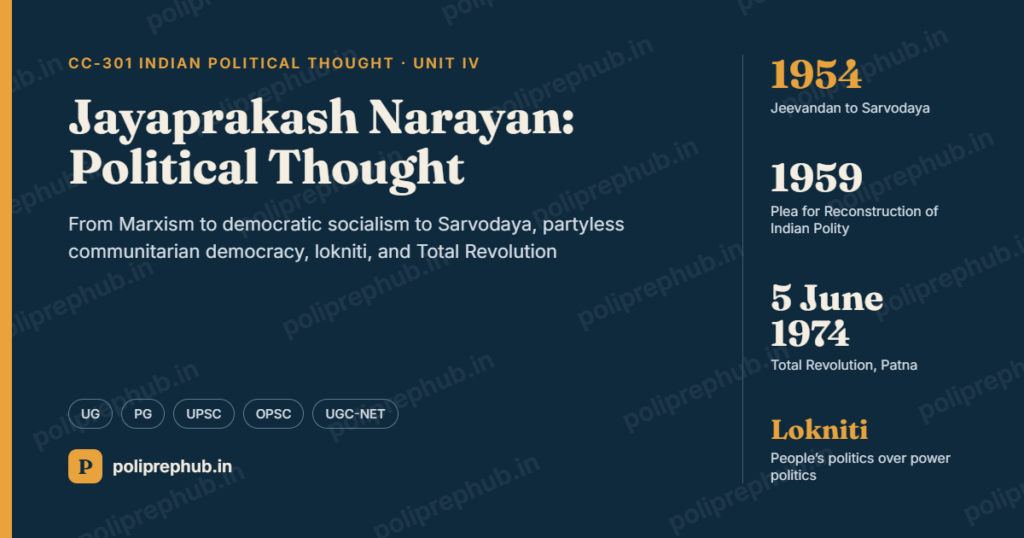
Jayaprakash Narayan (1902–1979), popularly called JP and Lok Nayak (“people’s leader”), was a freedom fighter, socialist theoretician, Sarvodaya worker and leader of the movement that ended in the defeat of the Emergency regime. His intellectual journey — from Marxism to democratic socialism, from socialism to Sarvodaya, and finally to Total Revolution — reflects a continuous search for a form of politics that would combine freedom, equality and genuine people’s power. His key ideas are communitarian / partyless democracy, lokniti (people’s politics) as against rajniti (power politics), and Sampoorna Kranti (Total Revolution). For CC-301, JP is an example of critical transformation: he moved from Western ideologies (Marxism, democratic socialism) to an Indian, Gandhian alternative while retaining liberal-democratic values.
Life
- Born on 11 October 1902 at Sitabdiara (Saran district, Bihar).
- Left college during the Non-cooperation Movement (1921); went to the USA (1922–29), where he studied at Berkeley, Iowa, Wisconsin and Ohio State University (MA in sociology), working his way through jobs in farms and factories. In America he became a Marxist under the influence of fellow students and M. N. Roy’s writings.
- Returned in 1929, joined the Congress; was imprisoned during Civil Disobedience; in jail (Nasik) he and others planned the Congress Socialist Party, of which he became general secretary (1934). Wrote Why Socialism? (1936), a classic statement of Indian Marxian socialism.
- During Quit India, he escaped from Hazaribagh jail (November 1942) and organised underground resistance (Azad Dasta) from Nepal (Topic 6 of the national movement notes).
- After independence, left the Congress (1948) with the socialists; Praja Socialist Party (1952).
- In 1954 he dedicated his life (jeevandan) to Vinoba Bhave’s Bhoodan and Gramdan movement and to Sarvodaya, withdrawing from party politics.
- Worked for peace in Nagaland (Nagaland Peace Mission, 1964), in Kashmir, and for the surrender of Chambal dacoits (1972).
- Led the Bihar movement (1974) and called for Total Revolution (Patna, 5 June 1974); his call at the Ramlila Maidan, Delhi (25 June 1975) was followed the same night by the declaration of the Emergency; he was imprisoned, and his health broke down.
- Inspired the formation of the Janata Party, which defeated the Congress in 1977.
- Died on 8 October 1979; awarded the Bharat Ratna posthumously (1999).
Major writings: Why Socialism? (1936); From Socialism to Sarvodaya (1957); A Plea for the Reconstruction of Indian Polity (1959); Swaraj for the People (1961); Towards Total Revolution (collected writings, 4 vols., 1978, ed. Brahmanand); Prison Diary (1975).
Intellectual Journey
Marxist phase (1920s–1930s)
- In Why Socialism?, JP argued that India’s poverty and inequality were rooted in private ownership and exploitation; socialism, meaning social ownership of the means of production, planning and the abolition of class, was the remedy.
- He tried to combine Marxism with the national movement through the CSP.
Disillusionment with Marxism and the shift to democratic socialism
- The Moscow trials and Stalinist purges (1936–38), the Nazi–Soviet Pact (1939), and the conduct of Indian communists (including their opposition to Quit India in 1942) disillusioned JP.
- He concluded that Marxist means — violence, dictatorship of the party, centralisation — led to tyranny and destroyed the very goals of socialism. He emphasised democratic socialism and moral values.
From socialism to Sarvodaya (1950s)
- In From Socialism to Sarvodaya (1957), JP explained his move:
- Ends and means: good ends cannot be reached by bad means; Gandhi was right that means determine ends.
- The state: state socialism concentrates power in the hands of the bureaucracy and party; it does not create a socialist human being.
- Materialism: Marxism’s materialism gives no basis for ethics; socialism needs a moral and spiritual foundation.
- Sarvodaya offers decentralisation, voluntary sharing (Bhoodan, Gramdan), and moral transformation.
- He adopted the Gandhian vision of a society based on self-governing villages, voluntary co-operation and the welfare of all.
The journey at a glance
- Marxist phase: became a Marxist as a student in the USA (1922–29); founder and general secretary of the Congress Socialist Party (1934); Why Socialism? (1936).
- Disillusionment: Stalin’s purges, the Nazi–Soviet Pact (1939) and Indian communists’ opposition to Quit India showed him that violence and party dictatorship betray socialism.
- Democratic socialism: Socialist Party (1948), Praja Socialist Party (1952).
- Sarvodaya: in 1954 he dedicated his life (jeevandan) to Vinoba Bhave’s Bhoodan–Gramdan movement. From Socialism to Sarvodaya (1957) explains why: bad means cannot give good ends; state socialism concentrates power; materialism provides no basis for ethics; socialism needs moral transformation and voluntary sharing.
- Total Revolution: in 1974 he applied Sarvodaya values to mass politics.
- Assessment: a consistent goal (freedom with equality) pursued through changing means — not inconsistency but growth.
Partyless and Communitarian Democracy
Critique of parliamentary democracy
In A Plea for the Reconstruction of Indian Polity (1959), JP criticised Western-style parliamentary democracy as practised in India:
- Party system: parties concentrate power in a small group of leaders; they divide the people, encourage factionalism, use money and muscle, and reduce citizens to passive voters who participate only once in five years.
- Centralisation: power is concentrated at the top, far from ordinary people.
- Electoral system: expensive, corrupt; produces minority governments (first-past-the-post).
- Atomised individual: Western democracy treats society as a collection of isolated individuals, ignoring community.
Communitarian democracy
JP proposed an alternative based on community rather than individuals and parties:
- The village community (gram sabha), consisting of all adults, is the basic unit; it should manage its own affairs (land, production, education, justice) through consensus.
- Higher levels — panchayat, block, district, state and nation — would be formed by indirect elections from the lower bodies, in an organic, pyramid-like structure.
- Partyless democracy: elections without political parties; candidates would be chosen by consensus or by community bodies, ending party competition and patronage.
- Power would flow from below; the role of the state would progressively decline.
- This was heavily influenced by Gandhi (gram swaraj), M. N. Roy’s radical humanism (people’s committees) and Vinoba (lokniti).
Lokniti versus rajniti
- Rajniti: politics of power, parties and the state.
- Lokniti: politics of the people — self-government, voluntary action and moral persuasion, independent of state power.
- JP sought to strengthen lokniti so that people could control the state rather than be controlled by it.
Party democracy and communitarian democracy: summary and critique
- Critique (A Plea for Reconstruction of Indian Polity, 1959): parties concentrate power in small groups, divide people, depend on money, and make citizens passive voters once in five years; centralisation keeps power away from the people; Western democracy treats society as a heap of atomised individuals.
- Communitarian democracy: the gram sabha (all adults of the village) as the base unit; higher bodies (panchayat, block, district, state, nation) formed by indirect election from below; decisions by consensus; partyless elections.
- Lokniti versus rajniti: people’s self-government and moral action rather than the politics of power.
- Critique: unclear how interests would be aggregated without parties; indirect elections may produce new oligarchies; yet it inspired Panchayati Raj and debates on electoral reform.
Total Revolution (Sampoorna Kranti)
Context
By the early 1970s, India faced inflation, unemployment, food shortages, corruption and growing authoritarian tendencies. Student protests began in Gujarat (Navnirman Andolan, 1973–74) and spread to Bihar (1974). JP agreed to lead the Bihar movement on condition that it remained non-violent.
Meaning
At a mass rally at Gandhi Maidan, Patna, on 5 June 1974, JP called for Sampoorna Kranti (Total Revolution). He explained that it was a combination of seven revolutions:
- Social — end of caste, untouchability, dowry and social injustice;
- Economic — removal of poverty and inequality, land reform, decentralised economy;
- Political — cleansing of politics, electoral reform, people’s control over representatives;
- Cultural — change in values and lifestyle;
- Ideological / intellectual — change in thinking;
- Educational — overhaul of the education system to make it relevant and value-based;
- Spiritual / moral — transformation of the individual.
Total Revolution meant a comprehensive, permanent, non-violent transformation of society and the individual — not just a change of government. It drew on Gandhi’s constructive programme and on Lohia’s Saptakranti.
Programme and methods
- Janata Sarkars / people’s committees (Jan Sangharsh Samitis) at village and block levels to watch over administration and act as people’s governments.
- Right to recall elected representatives who fail the people.
- Electoral reforms: reducing the role of money, state funding of elections, an independent Election Commission, and candidate selection by voters’ councils.
- Decentralisation of power and resources; Panchayati Raj.
- Educational reform: closure of colleges for a year to rethink education (the call to students).
- Fight against corruption and black money.
- Non-violent struggle: satyagraha, peaceful demonstrations, non-cooperation, gheraos.
The Emergency and after
- On 12 June 1975, the Allahabad High Court set aside Indira Gandhi’s election. At the Ramlila Maidan rally (25 June 1975), JP called on the people to non-cooperate with the government and asked police and army personnel not to obey illegal orders. The Emergency was declared that night (under Article 352, citing internal disturbance), and JP and opposition leaders were arrested.
- In 1977, opposition parties merged into the Janata Party, which won the elections; JP was its moral guide. But the Janata government’s infighting and collapse (1979) disappointed him.
Critical Assessment
Contributions:
- A continuing search for people’s power and a critique of party politics, centralisation and corruption.
- Total Revolution as a holistic vision of social, economic, political and moral transformation.
- Revived the Gandhian method of mass non-violent action in post-independence India and defended democracy and civil liberties against the Emergency.
- Influence on electoral reform, decentralisation and later civil-society movements (anti-corruption campaigns, Right to Information).
- Showed how Western ideas (Marxism, socialism) could be critically transformed through Gandhian and Indian ideas.
Criticisms:
- Utopian and vague: partyless democracy and Total Revolution lacked concrete institutional design; how would interests be aggregated without parties?
- Extra-constitutional methods: the call to the police and army was criticised as inviting instability; supporters reply that he asked them to disobey only illegal orders.
- Alliances: his movement included the RSS and Jana Sangh, which critics say gave them legitimacy; others note that it brought together a broad anti-authoritarian coalition.
- Janata experiment failed quickly, showing the limits of a movement-based coalition.
- Ideological inconsistency: from Marxism to Gandhism, his shifts were seen by some as lack of coherence; supporters see them as honest evolution.
JP’s Thought at a Glance
| Phase | Key ideas | Key text |
|---|---|---|
| Marxist (1920s–30s) | Class struggle, social ownership | Why Socialism? (1936) |
| Democratic socialist (1940s) | Socialism with democracy; critique of Stalinism | Writings in CSP/Socialist Party |
| Sarvodaya (1954–70s) | Bhoodan, Gramdan, decentralisation, partyless democracy | From Socialism to Sarvodaya (1957); A Plea for the Reconstruction of Indian Polity (1959) |
| Total Revolution (1974–79) | Seven revolutions, people’s committees, right to recall | Speeches; Towards Total Revolution (1978) |
Conclusion
Jayaprakash Narayan’s political thought is the story of a restless search for freedom with equality. Disillusioned by the violence and centralisation of Marxism and by the party-dominated, centralised nature of parliamentary democracy, he turned to Gandhi’s Sarvodaya and proposed a communitarian, partyless democracy built from the village upward. His call for Total Revolution sought to transform not only the government but society, culture and the individual. Though his institutional proposals remained unrealised, his defence of democracy during the Emergency and his vision of people’s power remain landmarks in Indian political thought.
Quick Revision
| Item | Key point |
|---|---|
| Dates | 11 Oct 1902 – 8 Oct 1979; Lok Nayak |
| USA | 1922–29; Marxism |
| CSP | General secretary, 1934 |
| Escape | Hazaribagh jail, Nov 1942 |
| Jeevandan | 1954, to Bhoodan/Sarvodaya |
| Books | Why Socialism? (1936); From Socialism to Sarvodaya (1957); A Plea for the Reconstruction of Indian Polity (1959) |
| Democracy | Communitarian, partyless; lokniti vs rajniti |
| Total Revolution | 5 June 1974, Gandhi Maidan, Patna; seven revolutions |
| Emergency | 25 June 1975; Janata Party 1977 |
| Bharat Ratna | 1999 (posthumous) |
Memory aid: JP’s journey = “M → DS → S → TR” (Marxism → Democratic Socialism → Sarvodaya → Total Revolution).
Exam Practice
Long-answer questions
- Trace the evolution of JP’s political thought from Marxism to Sarvodaya.
- Explain JP’s critique of parliamentary democracy and his idea of partyless democracy.
- What is communitarian democracy? Discuss its features.
- Discuss JP’s concept of Total Revolution and its relevance today.
- Compare the ideas of Lohia and JP on socialism and democracy.
- Assess the role of JP in the movement against the Emergency. Is JP’s thought a rejection, an imitation or an innovative transformation of Western political ideas? Discuss.
Short-answer questions
- What is lokniti?
- What was JP’s jeevandan?
- What are the seven components of Total Revolution?
- Why did JP reject Marxism?
- What is the right to recall?
- What is the significance of 5 June 1974?
- What did JP propose in A Plea for the Reconstruction of Indian Polity?
- What was the Bhoodan movement?
- Who founded the Congress Socialist Party?
- Why did JP criticise the party system?
Multiple-choice questions
- JP called for Total Revolution at: (a) Ramlila Maidan, Delhi (b) Gandhi Maidan, Patna (c) Sabarmati (d) Wardha. Answer: (b)
- “From Socialism to Sarvodaya” was written by: (a) Vinoba Bhave (b) JP (c) Lohia (d) Narendra Dev. Answer: (b)
- “A Plea for the Reconstruction of Indian Polity” (1959) proposed: (a) Presidential system (b) Communitarian democracy (c) Two-party system (d) Proportional representation. Answer: (b)
- JP dedicated his life to Sarvodaya in: (a) 1948 (b) 1952 (c) 1954 (d) 1962. Answer: (c)
- JP studied in the USA during: (a) 1910–15 (b) 1922–29 (c) 1930–34 (d) 1946–48. Answer: (b)
- Match the following: (A) Why Socialism? – (B) From Socialism to Sarvodaya – (C) A Plea for Reconstruction – (D) Total Revolution. (1) 1957 (2) 1974 (3) 1936 (4) 1959. Correct code: (a) A-3, B-1, C-4, D-2 (b) A-1, B-3, C-4, D-2 (c) A-3, B-4, C-1, D-2 (d) A-2, B-1, C-4, D-3. Answer: (a)
- Assertion (A): JP rejected Marxism. Reason (R): He believed violent and dictatorial means corrupt the ends of socialism. (a) Both true, R explains A (b) Both true, R does not explain A (c) A true, R false (d) A false, R true. Answer: (a)
- The politics of people as opposed to power politics is called: (a) Rajniti (b) Lokniti (c) Dandaniti (d) Arthaniti. Answer: (b)
- JP was awarded the Bharat Ratna in: (a) 1977 (b) 1990 (c) 1999 (d) 2001. Answer: (c)
- The Emergency was declared on: (a) 12 June 1975 (b) 25 June 1975 (c) 5 June 1974 (d) 21 March 1977. Answer: (b)
Previous Years’ Questions
JP is a named thinker in UGC-NET Unit 3 and in university papers; UPSC usually brings him in through Paper I Section B themes (the socialist movement, the Emergency, people’s movements). The questions below were actually set.
UGC-NET (Political Science)
- Match List I with List II: (A) Savarkar (B) M. N. Roy (C) Aurobindo Ghose (D) Jayaprakash Narayan — (i) associated with a secret society ‘Lotus and Dagger’ (ii) author of A Plea for Reconstruction of Indian Polity (iii) convicted in the Kanpur conspiracy case (iv) “Hinduise all politics…”. Answer: A–iv, B–iii, C–i, D–ii.
Competitive examinations (MCQ)
- The socialist idea of Sapta Kranti (Seven Revolutions) was proposed by — (a) Ram Manohar Lohia (b) Jawaharlal Nehru (c) M. G. Ranade (d) Jayaprakash Narayan. Answer: (a) Lohia. (CDS I, 2020) — JP is the trap option: his idea is Sampoorna Kranti (Total Revolution), proclaimed at Patna on 5 June 1974.
Frequently set descriptive themes (for practice)
- JP’s journey from Marxism to Sarvodaya.
- JP’s concept of Total Revolution and its relevance.
- JP’s critique of party democracy and his idea of communitarian democracy.
Answer pointers: JP’s concept of Total Revolution
- Context: inflation, corruption and student unrest; the Gujarat Navnirman and Bihar movements (1973–74).
- Meaning: a combination of seven revolutions — social, economic, political, cultural, ideological, educational and spiritual; a permanent, non-violent transformation of society and the individual, not merely a change of government.
- Programme: Janata Sarkars and people’s committees, right to recall, electoral reform, decentralisation, educational reform, the fight against corruption.
- Roots: Gandhi’s constructive programme and Sarvodaya, Vinoba’s lokniti, Lohia’s Saptakranti; a break with Marxist violence and party dictatorship.
- Outcome and critique: the Emergency (1975) and the Janata victory (1977); critics call it vague and extra-constitutional, and point to the Janata government’s quick collapse.
- Relevance: anti-corruption movements, RTI, electoral reform debates, civil-society politics. Conclude: JP’s thought critically transforms Western socialism and democracy through Gandhian ideas.
Suggested Readings
- Jayaprakash Narayan, From Socialism to Sarvodaya (1957); A Plea for the Reconstruction of Indian Polity (1959).
- Brahmanand (ed.), Towards Total Revolution, 4 vols. (Popular Prakashan, 1978).
- Bimal Prasad (ed.), Jayaprakash Narayan: Selected Works, 10 vols. (Manohar/NMML, 2000–08).
- Allan and Wendy Scarfe, J.P.: His Biography (Orient Longman, 1975).
- Ajit Bhattacharjea, Jayaprakash Narayan: A Political Biography (Vikas, 1975).
- Thomas Pantham and Kenneth Deutsch (eds.), Political Thought in Modern India (Sage, 1986).
- Himanshu Roy and M. P. Singh (eds.), Indian Political Thought: Themes and Thinkers (Pearson, 2017).