The District Collector is the most important administrative officer at the district level in India. The office dates back to the British period when Lord Warren Hastings introduced the system in 1772 primarily for land revenue collection. Over time, the role has evolved into a multifaceted institution responsible for revenue administration, law and order, development administration, disaster management, election management, and coordination of government policies.
The District Collector is popularly known by different names depending on the function performed:
| Designation | Function |
|---|---|
| District Collector | Revenue Administration |
| District Magistrate (DM) | Law and Order |
| Deputy Commissioner (DC) | General Administration (used in many states) |
| District Election Officer | Conduct of Elections |
| District Disaster Management Authority Chairperson (Executive Role) | Disaster Management |
Table of Contents
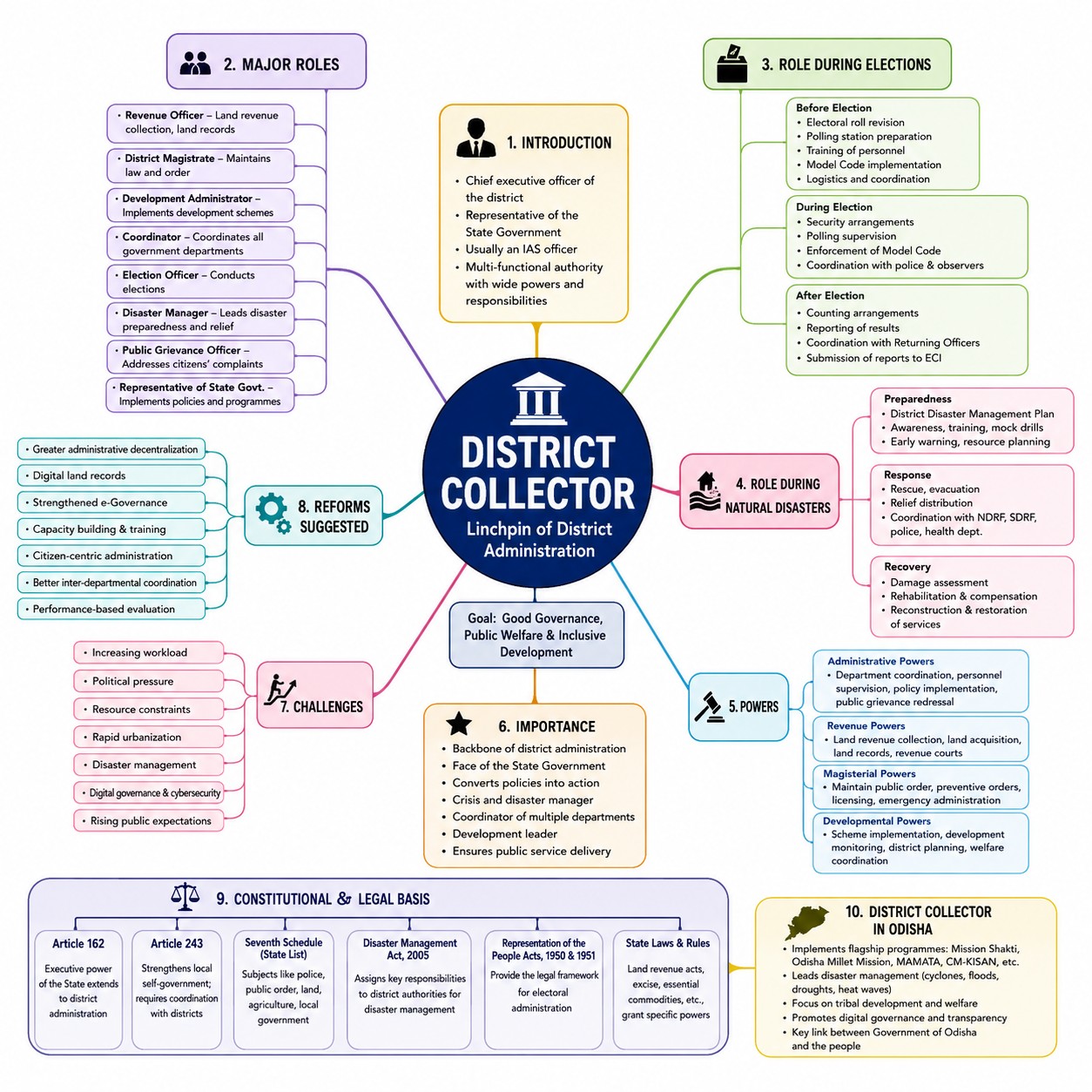
Meaning of District Collector
The District Collector is the chief executive officer of district administration and serves as the representative of the State Government at the district level. Generally, an officer of the Indian Administrative Service (IAS) is appointed as the District Collector.
According to Paul H. Appleby,
“The District Collector is the keystone of district administration.”
Similarly, the Administrative Reforms Commission (ARC) described the Collector as:
“The linchpin of district administration.”
Major Roles of the District Collector
The District Collector performs multiple roles simultaneously, acting as the chief representative of the State Government at the district level.
| Role | Description | Key Responsibilities |
|---|---|---|
| Revenue Officer (Collector) | Head of the district revenue administration. | Collection of land revenue, maintenance of land records, land acquisition, implementation of land reforms, settlement of revenue disputes. |
| District Magistrate (DM) | Responsible for maintaining law and order and public peace. | Coordinates with the police, issues preventive orders, handles public security, manages emergencies, and oversees magisterial functions. |
| Development Administrator | Chief coordinator of developmental activities in the district. | Implements Central and State welfare schemes, monitors development projects, promotes rural development, and reviews departmental performance. |
| Coordinator of District Administration | Ensures effective coordination among all government departments. | Supervises departmental officers, conducts review meetings, resolves inter-departmental issues, and ensures policy implementation. |
| District Election Officer | Conducts free and fair elections under the Election Commission of India. | Prepares electoral rolls, manages polling arrangements, trains election personnel, and ensures compliance with the Model Code of Conduct. |
| Disaster Manager | Leads disaster preparedness, response, relief, and rehabilitation. | Coordinates rescue operations, relief distribution, damage assessment, rehabilitation, and disaster mitigation measures. |
| Public Grievance Officer | Serves as the primary interface between citizens and the government. | Conducts grievance hearings, resolves public complaints, ensures transparency, and monitors service delivery. |
| Representative of the State Government | Acts as the principal executive officer of the State Government in the district. | Implements government policies, communicates state directives, supervises public administration, and reports district affairs to the State Government. |
Functions of the District Collector
1. Revenue Administration
The original and traditional responsibility of the Collector is revenue administration.
Major Functions
- Collection of land revenue
- Maintenance of land records
- Supervision of Tehsildars and Revenue Inspectors
- Land acquisition for public purposes
- Assessment of agricultural land
- Settlement of land disputes
- Distribution of government land
- Collection of other government dues
- Implementation of land reform programmes
Importance
Efficient revenue administration ensures stable government income and proper land governance.
2. Maintenance of Law and Order
As the District Magistrate, the Collector is responsible for maintaining peace and public order.
Functions
- Coordinates with Superintendent of Police (SP)
- Imposes Section 163 of the Bharatiya Nagarik Suraksha Sanhita (formerly Section 144 CrPC) when necessary
- Issues preventive orders
- Supervises prisons and detention matters (where applicable)
- Prevents communal violence
- Handles public protests and demonstrations
- Maintains internal security
- Coordinates intelligence inputs
Importance
Ensures peace, security, and protection of citizens’ rights.
3. Development Administration
The Collector acts as the chief development coordinator of the district.
Responsibilities
- Implementation of Central and State Government schemes
- Monitoring flagship programmes
- Reviewing departmental performance
- Coordinating rural development
- Supervising welfare schemes
- Promoting agriculture
- Encouraging industrial development
- Infrastructure development
Major Schemes Monitored
- MGNREGA
- PMAY
- National Health Mission
- Jal Jeevan Mission
- PM-KISAN
- National Food Security Act implementation
4. Disaster Management
The Collector is the key authority during disasters.
Functions
Before Disaster
- Disaster preparedness
- Risk assessment
- Formation of response teams
- Mock drills
During Disaster
- Rescue operations
- Evacuation
- Relief camps
- Food distribution
- Medical assistance
- Coordination among agencies
After Disaster
- Damage assessment
- Compensation
- Rehabilitation
- Reconstruction
Importance
Ensures quick response and minimizes loss of life and property.
5. Election Administration
The Collector usually functions as the District Election Officer.
Functions
- Preparation of electoral rolls
- Conduct of elections
- Appointment of polling personnel
- Training election officials
- Distribution of election materials
- Enforcement of the Model Code of Conduct
- Counting of votes
- Declaration of results (through the Returning Officer as per law)
6. Coordination Function
The Collector coordinates among numerous government departments.
Departments Coordinated
- Police
- Health
- Education
- Agriculture
- Rural Development
- Public Works
- Food Supply
- Social Welfare
- Panchayati Raj
- Municipal Administration
Importance
Ensures effective implementation of government programmes.
7. Public Grievance Redressal
The Collector serves as the primary grievance redressal authority.
Functions
- Conducts public hearings
- Receives complaints
- Monitors grievance portals
- Resolves land disputes
- Reviews welfare benefits
- Ensures accountability of officials
8. Regulatory Functions
The Collector regulates various activities under different laws.
Functions
- Issue and renewal of licenses
- Regulation of essential commodities
- Arms licensing (as provided by law)
- Environmental compliance
- Mining regulation
- Excise administration (in coordination with the concerned department)
- Public safety measures
9. Judicial and Quasi-Judicial Functions
The Collector performs several quasi-judicial functions.
Functions
- Hearing revenue appeals
- Settlement of land disputes
- Land acquisition compensation cases
- Certification under various statutes
- Enforcement of administrative laws
10. Welfare Administration
The Collector supervises welfare programmes for vulnerable sections.
Major Areas
- Scheduled Castes
- Scheduled Tribes
- Women
- Children
- Senior citizens
- Persons with disabilities
- Minority welfare
- Poverty alleviation
Role During Elections
The District Collector functions as the District Election Officer (DEO) under the supervision of the Election Commission of India (ECI). The Collector is responsible for ensuring that elections are conducted in a free, fair, transparent, and peaceful manner. The responsibilities of the Collector vary across the three phases of the electoral process.
| Stage | Role of the District Collector | Major Functions |
|---|---|---|
| Before Election | Election Planning and Preparation | Revision and publication of electoral rolls, identification and preparation of polling stations, appointment and training of polling personnel, distribution of election materials (EVMs/VVPATs), voter awareness programmes (SVEEP), implementation of Model Code of Conduct, coordination with police and civil administration, and logistical planning. |
| During Election | Conduct of Polling | Ensures peaceful polling, supervises polling stations, deploys security personnel, monitors election observers, ensures compliance with the Model Code of Conduct, resolves polling-day complaints, arranges transportation and communication facilities, and coordinates with Returning Officers and law enforcement agencies. |
| After Election | Counting and Declaration Process | Supervises counting arrangements, ensures secure storage and transportation of EVMs/VVPATs, coordinates with Returning Officers during counting, compiles election reports, addresses post-election grievances, submits reports to the Election Commission, and facilitates the smooth completion of the electoral process. |
Role During Natural Disasters
Odisha is one of India’s most disaster-prone states, frequently affected by cyclones, floods, droughts, heat waves, and lightning. Consequently, the role of the District Collector is especially significant in coordinating large-scale evacuations, operating cyclone shelters, ensuring effective disaster response, and implementing resilient recovery strategies. Odisha’s disaster management model has gained national and international recognition for its emphasis on early warning systems, community participation, and proactive evacuation, significantly reducing casualties during severe cyclonic events.
The District Collector is the chief disaster management authority at the district level and plays a pivotal role in preparedness, response, relief, rehabilitation, and reconstruction. Under the Disaster Management Act, 2005, the Collector coordinates the efforts of all government departments, local bodies, emergency services, and voluntary organizations to minimize the loss of life and property during disasters.
| Phase | Role of the District Collector | Major Responsibilities |
|---|---|---|
| Preparedness | Disaster Planning and Risk Reduction | Preparation of District Disaster Management Plans (DDMP), hazard and vulnerability assessment, public awareness campaigns, mock drills, capacity building, coordination with NDRF/SDRF, identification of shelters, stockpiling essential supplies, and establishment of early warning systems. |
| Response | Emergency Management and Relief Operations | Activation of emergency response mechanisms, evacuation of vulnerable populations, search and rescue operations, establishment of relief camps, distribution of food, water, medicines, and essential supplies, restoration of communication and transport, coordination with police, fire services, health departments, NGOs, and disaster response forces. |
| Recovery | Rehabilitation and Reconstruction | Damage and loss assessment, distribution of compensation, rehabilitation of affected families, restoration of public infrastructure and essential services, reconstruction of houses, livelihood restoration, implementation of rehabilitation schemes, and preparation of post-disaster reports for the State Government. |
Key Responsibilities of the District Collector in Disaster Management
- Prepares and implements the District Disaster Management Plan (DDMP).
- Coordinates with the State Disaster Management Authority (SDMA), National Disaster Management Authority (NDMA), NDRF, SDRF, police, health department, and local authorities.
- Ensures timely dissemination of early warning alerts to vulnerable communities.
- Organizes evacuation, rescue, relief, and rehabilitation operations.
- Maintains essential services such as electricity, drinking water, healthcare, sanitation, and communication during emergencies.
- Supervises damage assessment and recommends financial assistance to affected persons.
- Promotes community participation, disaster preparedness, and resilience through awareness campaigns and training programmes.
Disaster Management Cycle
| Stage | Objective |
|---|---|
| Mitigation | Reduce disaster risks through preventive measures such as flood control, cyclone shelters, and hazard-resistant infrastructure. |
| Preparedness | Strengthen readiness through planning, training, mock drills, early warning systems, and resource mobilization. |
| Response | Save lives and provide immediate relief through rescue, evacuation, medical aid, and emergency assistance. |
| Recovery | Restore normalcy through rehabilitation, reconstruction, compensation, and livelihood restoration. |
Powers of the District Collector
The District Collector derives powers from various laws, executive orders, and administrative rules of the State Government. As the District Collector, District Magistrate, and Chief Executive Officer of the district administration, the Collector exercises administrative, revenue, magisterial, developmental, regulatory, and emergency powers to ensure efficient governance and public welfare.
| Administrative Powers | Revenue Powers | Magisterial Powers | Developmental Powers |
|---|---|---|---|
| Coordinates the functioning of all district-level government departments. | Collects land revenue and other government dues. | Maintains public order and internal security in the district. | Supervises implementation of Central and State Government development schemes. |
| Supervises and controls district officials and government personnel. | Conducts land acquisition for public purposes under applicable laws. | Issues preventive orders under the Bharatiya Nagarik Suraksha Sanhita (BNSS) and other relevant laws. | Monitors the progress of development projects and flagship programmes. |
| Conducts public grievance hearings and ensures citizen-centric administration. | Maintains and updates land records and revenue registers. | Grants, suspends, or recommends licenses and permits under various statutory provisions. | Coordinates district planning and resource allocation for balanced development. |
| Implements government policies, executive orders, and welfare programmes. | Functions as the head of revenue administration and hears revenue appeals in quasi-judicial matters. | Exercises emergency powers during riots, communal disturbances, natural disasters, and other crises. | Coordinates welfare programmes for rural development, agriculture, health, education, women, SC/STs, and other vulnerable groups. |
Importance of the District Collector
The District Collector is regarded as the cornerstone of district administration in India. As the chief representative of the State Government at the district level, the Collector performs a wide range of administrative, developmental, regulatory, and emergency functions. The office plays a crucial role in ensuring effective governance, public service delivery, law and order, and socio-economic development.
| Importance | Explanation | Significance |
|---|---|---|
| Backbone of District Administration | Ensures the smooth functioning of all government departments and district-level institutions. | Provides administrative stability, coordination, and efficient governance. |
| Representative of the State Government | Acts as the principal executive representative of the State Government in the district. | Bridges the gap between the State Government and local administration while implementing government policies. |
| Policy Implementation | Converts government decisions, laws, and welfare schemes into effective action. | Ensures timely execution of development programmes and public policies. |
| Crisis Manager | Leads disaster management, emergency response, and law-and-order administration during crises. | Minimizes loss of life and property while maintaining public safety and order. |
| Coordinator of Government Departments | Integrates the functioning of various departments such as police, health, education, agriculture, and rural development. | Promotes inter-departmental coordination and effective public administration. |
| Development Leader | Supervises development projects and welfare programmes to promote inclusive growth. | Accelerates socio-economic development and improves the quality of life of citizens. |
| Public Service Delivery | Ensures efficient implementation of welfare schemes and grievance redressal mechanisms. | Strengthens citizen-centric governance, transparency, and accountability. |
Challenges Faced by the District Collector
The role of the District Collector has expanded significantly from traditional revenue administration to include development management, disaster response, digital governance, and citizen-centric service delivery. While the Collector remains the linchpin of district administration, the office faces numerous administrative, political, financial, technological, and social challenges that affect the efficient functioning of district governance.
| Challenge | Explanation | Impact on Administration |
|---|---|---|
| Increasing Workload | Expanding responsibilities beyond traditional revenue administration to include development, elections, disaster management, digital governance, and welfare programmes. | Overburdened administration may reduce efficiency and delay decision-making. |
| Political Pressure | Balancing administrative neutrality with political expectations while implementing government policies. | May affect impartiality, professional independence, and objective decision-making. |
| Resource Constraints | Limited financial resources, shortage of skilled personnel, and inadequate infrastructure. | Delays implementation of development projects and public service delivery. |
| Rapid Urbanization | Managing growing urban populations, infrastructure demands, housing, sanitation, and public utilities. | Increases pressure on district administration and urban governance. |
| Disaster Management | Frequent natural disasters, climate change, pandemics, and other emergencies require continuous preparedness and coordination. | Demands quick response, effective coordination, and efficient resource mobilization. |
| Digital Governance | Adapting to e-Governance initiatives, cybersecurity threats, digital literacy issues, and technological innovations. | Requires continuous modernization and capacity building of government machinery. |
| Rising Public Expectations | Citizens increasingly demand transparency, accountability, faster services, and responsive governance. | Necessitates citizen-centric administration and efficient grievance redressal mechanisms. |
Emerging Challenges in the 21st Century
| Emerging Challenge | Implications |
|---|---|
| Climate Change | Increased frequency of floods, cyclones, droughts, and heat waves requiring resilient district planning. |
| Cybersecurity Risks | Protection of digital governance platforms and citizens’ data from cyber threats. |
| Artificial Intelligence (AI) | Integration of AI and data analytics into governance while ensuring ethical and responsible use. |
| Social Media and Misinformation | Managing rumours, fake news, and misinformation that can disrupt law and order. |
| Public Health Emergencies | Coordinating responses to pandemics and disease outbreaks while maintaining essential public services. |
| Sustainable Development | Balancing economic growth with environmental protection and climate resilience. |
Reforms Suggested
The role of the District Collector has evolved from a traditional revenue administrator to a development manager, crisis leader, and coordinator of district governance. To meet the challenges of modern administration, several reforms have been suggested to enhance the efficiency, transparency, accountability, and citizen-centric functioning of the office.
| Reform | Objective | Expected Outcome |
|---|---|---|
| Greater Administrative Decentralization | Empower Panchayati Raj Institutions (PRIs) and Urban Local Bodies (ULBs) by delegating administrative and financial powers. | Reduces the Collector’s workload and strengthens grassroots democracy and local governance. |
| Digital Land Records | Computerize and modernize land records through GIS mapping and online registration systems. | Enhances transparency, minimizes land disputes, prevents fraud, and improves efficiency in revenue administration. |
| Strengthened e-Governance | Expand digital governance platforms and online public service delivery. | Ensures faster, transparent, and citizen-friendly administration while reducing delays and corruption. |
| Capacity Building and Training | Provide continuous training in leadership, technology, disaster management, cyber security, and public policy. | Enhances administrative competence, innovation, and effective decision-making. |
| Citizen-Centric Administration | Improve grievance redressal, public participation, transparency, and accountability. | Builds public trust and improves the quality of governance and service delivery. |
| Better Inter-Departmental Coordination | Strengthen coordination among district departments through integrated planning and monitoring mechanisms. | Reduces duplication, improves policy implementation, and ensures effective use of resources. |
| Performance-Based Evaluation | Introduce objective performance indicators and outcome-based assessment of district administration. | Encourages efficiency, innovation, accountability, and improved governance outcomes. |
Recommendations of Important Committees
| Committee/Commission | Major Recommendation |
|---|---|
| First Administrative Reforms Commission (1966–70) | Strengthen the coordinating role of the District Collector while promoting democratic decentralization. |
| Second Administrative Reforms Commission (2005–09) | Transform the Collector into a facilitator of development and citizen-centric governance through e-Governance and administrative reforms. |
| Punchhi Commission (2010) | Improve Centre–State and district-level administrative coordination while strengthening local self-government. |
| NITI Aayog | Promote digital governance, outcome-based administration, innovation, and data-driven decision-making at the district level. |
Emerging Reforms for the 21st Century
| Emerging Reform | Purpose |
|---|---|
| AI-enabled Governance | Improve decision-making, predictive analytics, and service delivery. |
| Integrated District Command Centres | Enhance coordination during disasters and emergencies. |
| Climate-Resilient Administration | Strengthen preparedness for climate-induced disasters and sustainable development. |
| Paperless Administration | Promote digital files, e-office systems, and electronic record management. |
| Open Government and Transparency | Increase public access to information and strengthen accountability. |
| Data-Driven Governance | Use real-time data dashboards for planning, monitoring, and evaluation of schemes. |
Constitutional and Legal Basis
The office of the District Collector is not expressly created by the Constitution of India. It is a statutory and executive institution that derives its authority from the Constitution, State laws, Central statutes, executive rules, and administrative practices. The constitutional provisions define the framework of State administration, while various laws assign specific powers and responsibilities to the District Collector in areas such as revenue administration, law and order, elections, disaster management, and local governance.
| Constitutional / Legal Provision | Significance for the District Collector | Key Functions Enabled |
|---|---|---|
| Article 162 | Extends the executive power of the State to matters within the State List and Concurrent List, forming the constitutional basis for district administration. | Implementation of State Government policies, executive administration, and district governance. |
| Articles 243 to 243-O (Part IX) & Articles 243P to 243ZG (Part IX-A) | Establish Panchayati Raj Institutions (PRIs) and Urban Local Bodies (ULBs), requiring coordination between district administration and local self-government institutions. | Supervision, coordination, and implementation of development programmes through local bodies. |
| Seventh Schedule (State List & Concurrent List) | Allocates subjects such as public order, police, land, agriculture, local government, and public health to the States. | Provides the legal basis for the Collector’s functions in revenue administration, law and order, land management, and development. |
| Disaster Management Act, 2005 | Empowers district authorities to prepare and implement disaster management plans and coordinate disaster response. | Disaster preparedness, relief, rehabilitation, reconstruction, and coordination with NDMA, SDMA, NDRF, and SDRF. |
| Representation of the People Acts, 1950 & 1951 | Provide the legal framework for electoral administration and appointment of District Election Officers. | Conduct of elections, electoral roll management, polling arrangements, and election supervision. |
Other Important Statutory and Administrative Sources
| Law / Rule | Role of the District Collector |
|---|---|
| Bharatiya Nagarik Suraksha Sanhita (BNSS), 2023 | Exercises preventive and executive magisterial powers to maintain public order. |
| State Land Revenue Acts | Collection of land revenue, maintenance of land records, settlement of revenue disputes, and land acquisition functions. |
| Essential Commodities Act, 1955 | Regulates distribution and supply of essential commodities during shortages and emergencies. |
| National Food Security Act, 2013 | Supervises implementation of the Public Distribution System (PDS) and food security schemes. |
| Environment (Protection) Act, 1986 | Coordinates enforcement of environmental regulations at the district level. |
Constitutional Position of the District Collector
| Aspect | Position |
|---|---|
| Constitutional Status | Not a constitutional office; functions within the constitutional framework of State executive administration. |
| Nature of Office | Statutory and executive office under the State Government. |
| Appointing Authority | State Government (generally appoints an IAS officer). |
| Administrative Accountability | Accountable to the State Government through the Divisional Commissioner/Principal Secretary/Chief Secretary (as per state administrative structure). |
| Jurisdiction | Entire district. |
District Collector in Odisha
In Odisha, the District Collector & District Magistrate (DC & DM) is the highest executive authority at the district level and serves as the principal representative of the Government of Odisha. Usually an Indian Administrative Service (IAS) officer, the District Collector performs multiple roles as the chief revenue officer, district magistrate, development administrator, election officer, disaster manager, and coordinator of all government departments.
Given Odisha’s geographical location and socio-economic profile, the role of the District Collector extends beyond routine administration to include disaster resilience, tribal development, welfare implementation, and digital governance.
Key Flagship Programmes Implemented by District Collectors
| Programme | Objective |
|---|---|
| Mission Shakti | Women empowerment through Self-Help Groups (SHGs). |
| Odisha Millet Mission | Promotion of millet cultivation, nutrition, and farmers’ income. |
| MAMATA Scheme | Conditional cash assistance for pregnant and lactating women. |
| CM-KISAN | Financial assistance to farmers and landless agricultural households. |
| MGNREGA | Employment generation and rural infrastructure development. |
| PMAY (Rural & Urban) | Affordable housing for eligible beneficiaries. |
| Jal Jeevan Mission | Universal access to safe drinking water through household tap connections. |
| Subhadra Yojana | Financial assistance and empowerment of eligible women beneficiaries in Odisha. |
Previous Year UPSC/OPSC/UGC-NET Questions
- Explain the changing role of the District Collector in India.
- Why is the District Collector called the “linchpin of district administration”?
- Discuss the role of the District Magistrate in maintaining law and order.
- Evaluate the role of the District Collector in development administration.
- Examine the challenges faced by District Collectors in contemporary governance.
- Discuss the role of the District Collector in disaster management with suitable examples.
- Critically examine whether the office of the District Collector remains relevant in the era of democratic decentralization.