The Block Development Officer (BDO) is the chief executive and administrative officer of the Development Block, serving as the key link between the district administration and Gram Panchayats. The BDO is responsible for implementing rural development programmes, coordinating government departments at the block level, supervising Panchayati Raj Institutions (PRIs), and ensuring effective delivery of public services.
The office of the BDO was introduced during the Community Development Programme (1952) and National Extension Service (1953) to accelerate rural development through decentralized administration.
Table of Contents
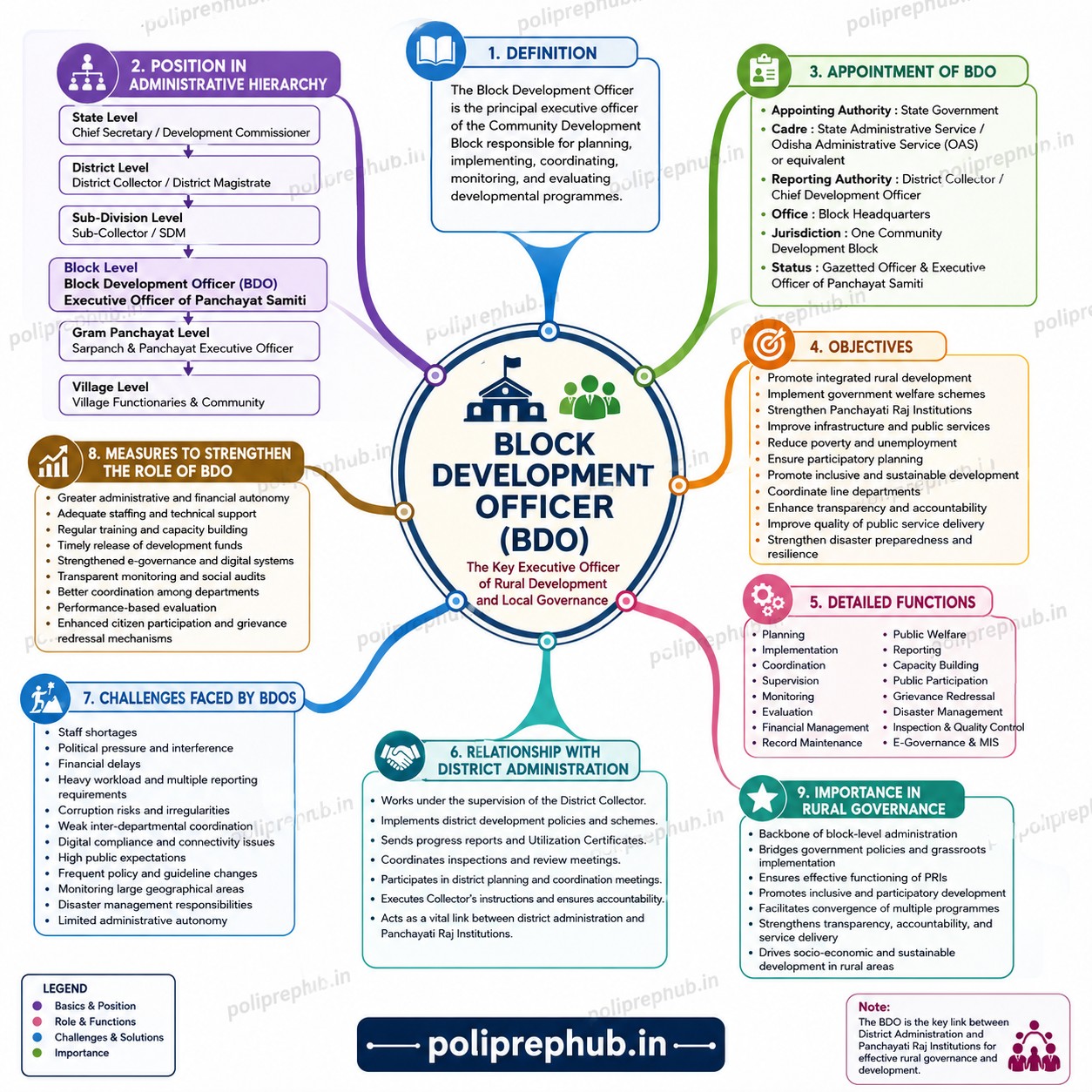
Definition
According to administrative practice,
“The Block Development Officer is the principal executive officer of the Community Development Block responsible for planning, implementing, coordinating, monitoring, and evaluating developmental programmes.
Others
A Block Development Officer (BDO) is the principal executive officer of a Community Development Block, responsible for planning, coordinating, implementing, supervising, monitoring, and evaluating rural development programmes, while ensuring effective functioning of the Panchayat Samiti and coordination among various government departments at the block level.
The Block Development Officer (BDO) is the chief administrative and executive officer of a Community Development Block who acts as the executive head of the Panchayat Samiti and is responsible for the planning, implementation, coordination, supervision, and evaluation of rural development and welfare programmes.
Position in the Administrative Hierarchy
The BDO serves as the executive head of the Panchayat Samiti.
| Administrative Level | Authority/Institution | Administrative Head | Role of BDO |
|---|---|---|---|
| State Level | State Government | Chief Secretary / Development Commissioner / Principal Secretary (Panchayati Raj & Rural Development) | Frames rural development policies and supervises implementation across the state. |
| District Level | District Administration | District Collector / District Magistrate (or Chief Development Officer in some states) | The BDO functions under the overall supervision and control of the District Collector. |
| Sub-Division Level | Sub-Divisional Administration | Sub-Collector / Sub-Divisional Magistrate (SDM) | Coordinates development activities within the subdivision and oversees law and order. |
| Block Level | Community Development Block | Block Development Officer (BDO) | Chief executive and administrative officer of the block; Executive Officer of the Panchayat Samiti responsible for planning, implementation, coordination, monitoring, and evaluation of rural development programmes. |
| Gram Panchayat Level | Gram Panchayat | Sarpanch (Elected Head) & Panchayat Executive Officer / Executive Officer | Works under the guidance and supervision of the BDO for implementation of development schemes. |
| Village Level | Village Administration | Ward Members, Village Level Workers (VLWs), Anganwadi Workers, ASHAs, etc. | Assist in the execution of government schemes and provide grassroots feedback to the BDO. |
Appointment of the BDO
The Block Development Officer (BDO) is a gazetted officer appointed by the State Government to head the administration of a Community Development Block. The appointment is made in accordance with the State Civil Services Rules, and the BDO serves as the Executive Officer of the Panchayat Samiti, responsible for implementing rural development programmes and coordinating departmental activities at the block level.
In Odisha, the Block Development Officer is generally an officer of the Odisha Administrative Service (OAS) or an equivalent State Service. The BDO:
- Is appointed by the Government of Odisha.
- Functions under the administrative supervision of the District Collector.
- Serves as the Executive Officer of the Panchayat Samiti under the Odisha Panchayat Samiti Act, 1959.
- Coordinates the implementation of Central and State-sponsored rural development schemes at the block level.
| Aspect | Details |
|---|---|
| Appointing Authority | State Government through the Department of Panchayati Raj & Rural Development or the General Administration Department |
| Recruiting Agency | State Public Service Commission (e.g., Odisha Public Service Commission for OAS officers) or State Staff Selection Commission, depending on the cadre |
| Cadre | State Civil Service / State Administrative Service (e.g., Odisha Administrative Service – OAS) or equivalent Rural Development Service |
| Method of Recruitment | Direct recruitment through competitive examination and/or promotion from subordinate administrative services (varies across states) |
| Reporting Authority | District Collector / District Magistrate or Chief Development Officer (where applicable) |
| Administrative Control | Department of Panchayati Raj and Rural Development, Government of the State |
| Office | Block Development Office located at the Community Development Block Headquarters |
| Jurisdiction | One Community Development Block comprising several Gram Panchayats and villages |
| Status | Gazetted Officer and Executive Officer of the Panchayat Samiti |
| Tenure | As determined by the State Government; subject to transfer and administrative requirements |
Objectives of the BDO
The Block Development Officer (BDO) is entrusted with promoting rural development, strengthening decentralized governance, and ensuring the effective implementation of government policies at the grassroots level. The primary objectives of the BDO are as follows:
- Promote integrated rural development.
- Coordinate government welfare schemes.
- Strengthen Panchayati Raj Institutions.
- Improve infrastructure and public services.
- Reduce poverty and unemployment.
- Ensure participatory planning.
- Promote inclusive and sustainable development.
| Objective | Explanation |
|---|---|
| Promote Integrated Rural Development | Ensure the holistic development of rural areas by integrating agriculture, infrastructure, education, health, sanitation, livelihood, and social welfare programmes. |
| Implement Government Policies and Welfare Schemes | Execute Central and State Government schemes efficiently and ensure that the intended benefits reach eligible beneficiaries. |
| Strengthen Panchayati Raj Institutions (PRIs) | Support the effective functioning of Gram Panchayats and Panchayat Samitis by promoting decentralization, local self-governance, and participatory democracy. |
| Improve Rural Infrastructure | Develop and maintain roads, drinking water facilities, irrigation systems, schools, health centres, community buildings, and other public assets. |
| Reduce Poverty and Generate Employment | Implement poverty alleviation programmes, employment generation schemes such as MGNREGA, and livelihood initiatives to improve rural incomes. |
| Promote Participatory Planning | Encourage people’s participation in identifying local needs, preparing Gram Panchayat Development Plans (GPDPs), and monitoring development projects. |
| Ensure Inclusive and Sustainable Development | Focus on the welfare of women, Scheduled Castes (SCs), Scheduled Tribes (STs), Other Backward Classes (OBCs), minorities, persons with disabilities, and other vulnerable groups while promoting environmentally sustainable development. |
| Coordinate Line Departments | Ensure effective coordination among various departments such as Agriculture, Health, Education, Rural Development, Women & Child Development, and Social Welfare for integrated service delivery. |
| Enhance Transparency and Accountability | Promote transparency in programme implementation through social audits, public grievance redressal, financial accountability, and digital governance. |
| Improve Quality of Public Service Delivery | Ensure timely, efficient, and citizen-centric delivery of government services and welfare benefits at the block level. |
| Strengthen Disaster Preparedness and Resilience | Coordinate disaster management, relief, rehabilitation, and preparedness measures to minimize the impact of natural calamities on rural communities. |
| Promote Good Governance | Foster efficiency, responsiveness, accountability, and ethical administration while ensuring that development programmes are implemented in accordance with laws, rules, and government guidelines. |
Major Roles of the Block Development Officer
1. Development Administrator
The BDO is primarily a development-oriented administrator responsible for executing rural development programmes.
Responsibilities include:
- Rural infrastructure development
- Poverty alleviation
- Agricultural development
- Irrigation
- Watershed development
- Rural housing
- Drinking water projects
- Livelihood generation
2. Executive Officer of Panchayat Samiti
The BDO acts as the Executive Officer of the Panchayat Samiti.
Functions include:
- Implements decisions of the Panchayat Samiti.
- Coordinates Standing Committees.
- Maintains official records.
- Supervises finances.
- Executes development resolutions.
3. Coordinator of Government Departments
Several line departments function at the block level.
The BDO coordinates departments such as:
- Agriculture
- Horticulture
- Veterinary
- Fisheries
- Education
- Health
- Women & Child Development
- Rural Water Supply
- Forest
- Social Welfare
4. Implementing Officer of Government Schemes
The BDO ensures proper implementation of Central and State Government programmes.
Examples include:
- MGNREGA
- PMAY-G
- National Rural Livelihood Mission (NRLM)
- Swachh Bharat Mission (Gramin)
- Jal Jeevan Mission
- PMGSY
- Poshan Abhiyaan
- PM-KISAN (coordination role)
- State-specific rural welfare schemes
5. Financial Administrator
The BDO manages block-level development funds.
Responsibilities include:
- Budget preparation
- Fund allocation
- Financial monitoring
- Audit compliance
- Utilization Certificates (UCs)
- Maintenance of accounts
6. Supervisory Officer
The BDO supervises:
- Gram Panchayats
- Panchayat Executive Officers
- Village Level Workers
- Junior Engineers
- Extension Officers
- Block-level staff
7. Planning Officer
The BDO prepares development plans based on local needs.
Planning includes:
- Annual Action Plan
- Block Development Plan
- Gram Panchayat Development Plan (GPDP) integration
- Infrastructure prioritization
- Resource mapping
8. Monitoring and Evaluation Officer
The BDO monitors:
- Physical progress
- Financial progress
- Quality of works
- Beneficiary selection
- Scheme implementation
- Social audits
- Outcome assessment
9. Disaster Management Functionary
During emergencies, the BDO performs disaster management functions such as:
- Relief distribution
- Shelter management
- Damage assessment
- Coordination with district administration
- Rehabilitation programmes
10. Public Grievance Officer
The BDO:
- Receives complaints.
- Resolves local issues.
- Conducts grievance hearings.
- Ensures transparency.
- Facilitates citizen services.
Detailed Functions of the BDO
The Block Development Officer (BDO) performs a wide range of administrative, developmental, financial, supervisory, and coordinating functions to ensure effective governance and rural development at the block level. As the Executive Officer of the Panchayat Samiti, the BDO serves as the key functionary responsible for translating government policies into action at the grassroots.
| Function | Detailed Description |
|---|---|
| Planning | Prepares Block Development Plans (BDPs) and Annual Action Plans by assessing local needs, integrating Gram Panchayat Development Plans (GPDPs), and prioritizing development projects. |
| Implementation | Executes Central and State Government schemes such as MGNREGA, PMAY-G, NRLM, SBM-G, PMGSY, Jal Jeevan Mission, and various state-sponsored programmes. |
| Coordination | Coordinates the activities of line departments, Panchayat Samiti, Gram Panchayats, NGOs, Self-Help Groups (SHGs), and other stakeholders to ensure convergence of development initiatives. |
| Supervision | Supervises the work of Extension Officers, Panchayat Executive Officers, Village Level Workers (VLWs), Junior Engineers, and other block-level officials to ensure efficient administration. |
| Monitoring | Monitors the physical and financial progress of development schemes through inspections, field visits, review meetings, Management Information Systems (MIS), and social audits. |
| Evaluation | Assesses the effectiveness, efficiency, and impact of development programmes by measuring outcomes, identifying shortcomings, and recommending corrective measures. |
| Financial Management | Prepares budgets, manages block-level development funds, maintains financial records, authorizes expenditure, ensures timely submission of Utilization Certificates (UCs), and complies with audit requirements. |
| Record Maintenance | Maintains official records, administrative files, project reports, beneficiary databases, financial statements, meeting proceedings, and statutory registers in accordance with government rules. |
| Public Welfare | Ensures timely delivery of welfare schemes related to housing, employment, pensions, health, education, sanitation, nutrition, drinking water, and social security for eligible beneficiaries. |
| Reporting | Prepares and submits periodic reports on programme implementation, financial utilization, achievements, and challenges to the District Collector and higher authorities. |
| Capacity Building | Organizes orientation programmes, workshops, and training for elected Panchayat representatives, government officials, SHGs, and community volunteers to enhance administrative and technical capacities. |
| Public Participation | Encourages people’s participation through Gram Sabhas, public consultations, awareness campaigns, beneficiary meetings, and social audits to promote transparency and participatory governance. |
| Grievance Redressal | Receives, investigates, and resolves public complaints regarding government schemes, public services, and administrative matters while ensuring transparency and accountability. |
| Disaster Management | Coordinates disaster preparedness, relief, rescue, rehabilitation, and reconstruction activities during floods, cyclones, droughts, pandemics, and other emergencies in collaboration with district authorities. |
| Panchayati Raj Administration | Functions as the Executive Officer of the Panchayat Samiti, implements its resolutions, coordinates Standing Committees, and strengthens the functioning of Panchayati Raj Institutions. |
| Inspection and Quality Control | Conducts regular inspections of development works, verifies project quality, checks adherence to technical standards, and prevents irregularities or misuse of public funds. |
| E-Governance and Digital Administration | Promotes digital governance through online monitoring systems, digital record management, Direct Benefit Transfer (DBT), e-office systems, and MIS-based reporting. |
| Resource Mobilization | Facilitates efficient utilization of financial, human, and natural resources by encouraging convergence among government departments and community participation. |
Functional Classification of the BDO
| Category | Major Functions |
|---|---|
| Administrative Functions | Office administration, supervision, coordination, record maintenance, reporting, grievance redressal |
| Developmental Functions | Planning, implementation of development schemes, infrastructure creation, poverty alleviation, livelihood promotion |
| Financial Functions | Budget preparation, fund management, accounting, auditing, financial monitoring |
| Regulatory Functions | Inspections, quality control, compliance with government rules, monitoring procurement and beneficiary selection |
| Social Functions | Community participation, social welfare, awareness generation, capacity building, empowerment of vulnerable groups |
| Disaster Management Functions | Preparedness, relief, rehabilitation, coordination during emergencies |
| Governance Functions | Strengthening Panchayati Raj Institutions, ensuring transparency, accountability, and good governance |
Administrative Functions
The BDO performs numerous administrative responsibilities:
- Office administration
- Personnel management
- Record maintenance
- Inspection of Gram Panchayats
- Conducting official meetings
- Ensuring discipline
- Compliance with government rules
Developmental Functions
Major developmental responsibilities include:
| Sector | Functions |
|---|---|
| Agriculture | Extension services, irrigation promotion |
| Education | School infrastructure support |
| Health | Health campaigns and sanitation |
| Drinking Water | Water supply projects |
| Roads | Rural connectivity |
| Housing | PMAY-G implementation |
| Employment | MGNREGA implementation |
| Women Empowerment | SHGs and Mission Shakti (Odisha) |
| Skill Development | Livelihood promotion |
| Social Welfare | Pension and welfare schemes |
Financial Functions
The BDO:
- Prepares annual budget
- Maintains accounts
- Releases funds
- Ensures financial discipline
- Conducts internal verification
- Monitors expenditure
- Prevents misuse of funds
Regulatory Functions
The BDO also exercises regulatory responsibilities.
Examples:
- Inspection of development works
- Compliance with government guidelines
- Verification of beneficiaries
- Certification of completed works
- Monitoring procurement procedures
Functions Related to Panchayati Raj Institutions
| Institution | Functions of BDO |
|---|---|
| Gram Panchayat | Guidance, supervision, technical support |
| Panchayat Samiti | Executive Officer and coordinator |
| Zilla Parishad | Implements district-level plans and reports progress |
Functions During Elections
The BDO assists the Election Commission by:
- Managing polling personnel
- Arranging polling stations
- Election logistics
- Training staff
- Conducting free and fair elections
- Coordinating with district election authorities
Functions During Disaster Management
| Stage | Role |
|---|---|
| Before Disaster | Preparedness planning, awareness campaigns |
| During Disaster | Relief operations, rescue coordination |
| After Disaster | Damage assessment, rehabilitation, reconstruction |
Relationship with District Administration
The Block Development Officer (BDO) functions as the principal executive officer of the Community Development Block and operates under the administrative supervision and control of the District Collector (District Magistrate). The BDO serves as the vital link between the District Administration and the Panchayati Raj Institutions (PRIs), ensuring that government policies, development programmes, and welfare schemes are effectively implemented at the grassroots level.
The District Collector provides policy direction, administrative guidance, and overall supervision, while the BDO translates these directives into practical action within the block.
Nature of the Relationship
| Aspect | Relationship with District Administration |
|---|---|
| Administrative Control | The BDO works under the overall supervision and control of the District Collector/District Magistrate. |
| Policy Implementation | Implements district development plans, government policies, and administrative directives issued by the District Administration. |
| Reporting | Submits periodic reports on programme implementation, financial utilization, physical progress, and administrative matters to the District Collector. |
| Coordination | Coordinates with district-level officers of various departments to ensure convergence of development programmes. |
| Monitoring and Evaluation | Facilitates inspections, field visits, and performance reviews conducted by the District Administration. |
| Financial Accountability | Maintains proper utilization of government funds and submits Utilization Certificates (UCs) and audit reports to district authorities. |
| Disaster Management | Acts as the field-level coordinator during disasters by implementing the directions of the District Disaster Management Authority (DDMA) under the leadership of the District Collector. |
| Election Administration | Assists the District Election Officer (District Collector) in conducting free, fair, and peaceful elections by managing polling arrangements and election personnel. |
| Law and Order Support | Coordinates with the District Administration during emergencies, public health crises, and special drives requiring administrative intervention. |
| Development Planning | Participates in district planning meetings and provides block-level data, proposals, and progress reports for district development planning. |
Major Responsibilities of the BDO towards the District Administration
The BDO:
- Implements district development policies and government programmes at the block level.
- Executes the instructions and directives issued by the District Collector.
- Submits periodic progress reports, utilization certificates, and administrative returns.
- Coordinates inspections conducted by the District Collector and district-level officers.
- Participates in district planning, review, and coordination meetings.
- Ensures timely implementation of Central and State Government schemes.
- Maintains financial discipline and administrative accountability.
- Coordinates disaster relief, rehabilitation, and emergency response activities.
- Assists in census operations, elections, and other statutory assignments entrusted by the District Administration.
- Provides feedback from the grassroots to help improve policy formulation and programme implementation.
Challenges Faced by BDOs
The Block Development Officer (BDO) serves as the principal development administrator at the block level and plays a crucial role in implementing rural development programmes. However, the effective discharge of these responsibilities is often constrained by administrative, financial, political, institutional, and technological challenges. Addressing these challenges is essential for strengthening grassroots governance and ensuring effective public service delivery.
| Challenge | Explanation |
|---|---|
| Staff Shortages | Shortage of technical experts, engineers, accountants, Panchayat Executive Officers, Village Level Workers (VLWs), and other support staff adversely affects programme implementation and service delivery. |
| Political Pressure and Interference | Political influence in beneficiary selection, project prioritization, fund allocation, and administrative decisions can compromise transparency, impartiality, and good governance. |
| Financial Constraints and Delays | Delay in the release of funds, inadequate financial resources, and procedural bottlenecks hinder timely execution of development projects and welfare schemes. |
| Heavy Administrative Workload | The BDO is responsible for implementing numerous Central and State Government schemes, attending meetings, conducting inspections, maintaining records, and submitting reports, resulting in excessive workload. |
| Risk of Corruption and Mismanagement | Misappropriation of public funds, fake beneficiaries, irregularities in procurement, and poor-quality execution of development works pose significant administrative challenges. |
| Weak Inter-Departmental Coordination | Lack of effective coordination among line departments often leads to duplication of efforts, delays, and poor convergence of development programmes. |
| Digital Governance and Compliance | Increasing dependence on online portals, Management Information Systems (MIS), Direct Benefit Transfer (DBT), and digital reporting creates challenges in areas with poor internet connectivity or limited digital capacity. |
| High Public Expectations | Citizens expect prompt, transparent, and efficient delivery of public services, placing considerable pressure on the BDO despite limited resources and manpower. |
| Frequent Policy Changes | Regular modifications in government guidelines, funding patterns, and programme implementation frameworks require continuous adaptation and capacity building. |
| Monitoring Large Geographical Areas | A Community Development Block often consists of numerous Gram Panchayats and villages, making field inspections and monitoring difficult within limited time and resources. |
| Disaster Management Responsibilities | During floods, cyclones, droughts, pandemics, and other emergencies, the BDO must simultaneously manage relief operations, rehabilitation, and routine administrative functions. |
| Limited Administrative Autonomy | Dependence on approvals from higher authorities for financial and administrative decisions can delay implementation of development projects. |
| Capacity Gaps among Local Institutions | Inadequate training and administrative capacity of elected Panchayat representatives and local officials may affect effective implementation of development programmes. |
| Ensuring Transparency and Accountability | Maintaining transparency in beneficiary selection, procurement, fund utilization, and grievance redressal while preventing corruption remains a continuous challenge. |
Measures to Strengthen the Role of BDO
The Block Development Officer (BDO) is the cornerstone of rural administration and decentralized governance at the block level. Given the expanding responsibilities arising from the 73rd Constitutional Amendment Act, 1992, increasing public expectations, and the growing complexity of rural development programmes, it is essential to strengthen the institutional capacity and effectiveness of the BDO. The following measures can significantly enhance the performance of BDOs.
- Greater administrative autonomy.
- Adequate staffing and technical support.
- Regular capacity-building programmes.
- Timely release of development funds.
- Strengthened e-governance systems.
- Transparent monitoring and social audits.
- Better coordination among departments.
- Performance-based evaluation.
- Enhanced citizen participation and grievance redress mechanisms.
| Measure | Explanation |
|---|---|
| Greater Administrative Autonomy | Delegate adequate administrative and financial powers to BDOs to enable quicker decision-making, reduce procedural delays, and improve responsiveness to local development needs. |
| Adequate Staffing and Technical Support | Fill vacancies and ensure the availability of engineers, accountants, IT personnel, extension officers, Panchayat Executive Officers, and other technical staff for efficient programme implementation. |
| Regular Capacity-Building Programmes | Conduct continuous training in public administration, financial management, digital governance, disaster management, project planning, leadership, and rural development to improve professional competence. |
| Timely Release of Development Funds | Ensure prompt allocation and disbursement of funds from Central and State Governments to prevent delays in implementing development projects and welfare schemes. |
| Strengthening E-Governance Systems | Expand the use of digital platforms, Management Information Systems (MIS), e-Office, Direct Benefit Transfer (DBT), GIS-based monitoring, and online grievance redressal to enhance efficiency and transparency. |
| Transparent Monitoring and Social Audits | Strengthen social audits, third-party evaluations, public disclosure of information, and regular inspections to ensure accountability and prevent corruption. |
| Better Coordination among Departments | Promote convergence among Agriculture, Health, Education, Rural Development, Women & Child Development, and other line departments to ensure integrated and holistic rural development. |
| Performance-Based Evaluation | Introduce objective performance indicators based on programme outcomes, service delivery, innovation, financial management, and citizen satisfaction rather than routine administrative compliance alone. |
| Enhanced Citizen Participation and Grievance Redressal | Strengthen Gram Sabhas, community consultations, online grievance portals, and public feedback mechanisms to make governance more participatory, transparent, and responsive. |
| Strengthening Panchayati Raj Institutions | Improve the administrative and technical capacity of Gram Panchayats and Panchayat Samitis through regular training, financial empowerment, and institutional support. |
| Improved Financial Management | Simplify financial procedures, strengthen audit systems, ensure timely submission of Utilization Certificates (UCs), and adopt digital financial management systems for greater transparency. |
| Use of Technology and Innovation | Encourage the adoption of Artificial Intelligence (AI), drones, mobile applications, GIS mapping, remote sensing, and data analytics for planning, monitoring, and evaluation of development projects. |
| Reducing Administrative Burden | Minimize repetitive reporting requirements and streamline documentation through integrated digital platforms, enabling BDOs to devote more time to field supervision and development work. |
| Strengthening Disaster Preparedness | Equip BDOs with adequate resources, emergency funds, training, and disaster management tools to improve preparedness and response during natural calamities. |
| Ensuring Political Neutrality | Protect administrative independence by minimizing undue political interference and ensuring that development programmes are implemented impartially and in accordance with legal provisions. |
Importance of the BDO in Rural Governance
The Block Development Officer (BDO) occupies a pivotal position in India’s rural administrative system. As the chief executive officer of the Community Development Block and the Executive Officer of the Panchayat Samiti, the BDO acts as the principal link between the District Administration and Panchayati Raj Institutions (PRIs). The effectiveness of rural governance largely depends on the efficiency, coordination, and leadership provided by the BDO in implementing development programmes and ensuring responsive public administration.
- Acts as the backbone of block-level administration.
- Bridges government policies and grassroots implementation.
- Ensures effective functioning of Panchayati Raj Institutions.
- Promotes inclusive and participatory development.
- Facilitates convergence of multiple development programmes.
- Strengthens transparency, accountability, and service delivery in rural areas.
| Area of Importance | Explanation |
|---|---|
| Backbone of Block-Level Administration | The BDO serves as the chief administrative and development officer of the block, coordinating all governmental activities and ensuring efficient administration. |
| Bridge Between Government and Rural Communities | Acts as the vital link between government policies and grassroots implementation by translating national and state development programmes into local action. |
| Strengthens Panchayati Raj Institutions (PRIs) | Functions as the Executive Officer of the Panchayat Samiti, provides administrative support to Gram Panchayats, and promotes democratic decentralization envisioned under the 73rd Constitutional Amendment. |
| Promotes Rural Development | Plans, implements, and monitors programmes relating to agriculture, rural infrastructure, employment, housing, sanitation, education, health, and livelihood generation. |
| Ensures Effective Delivery of Welfare Schemes | Facilitates timely implementation of schemes such as MGNREGA, PMAY-G, NRLM, Jal Jeevan Mission, and various State Government programmes to improve rural living standards. |
| Facilitates Participatory Governance | Encourages people’s participation through Gram Sabhas, community consultations, social audits, and local planning, thereby strengthening grassroots democracy. |
| Promotes Convergence of Development Programmes | Coordinates multiple government departments and stakeholders to achieve integrated and holistic rural development. |
| Ensures Financial Accountability | Oversees the utilization of public funds, maintains financial discipline, submits Utilization Certificates (UCs), and ensures transparency in public expenditure. |
| Enhances Transparency and Good Governance | Promotes accountability through regular monitoring, inspections, grievance redressal, social audits, and digital governance initiatives. |
| Supports Disaster Management | Coordinates preparedness, relief, rehabilitation, and reconstruction during natural disasters such as floods, cyclones, droughts, and other emergencies. |
| Improves Service Delivery | Ensures efficient delivery of essential public services such as drinking water, sanitation, healthcare, education, and social security benefits to rural citizens. |
| Acts as an Agent of Social Change | Promotes women empowerment, social justice, environmental sustainability, digital literacy, and inclusive development by implementing targeted welfare programmes. |
BDO at a Glance (Fact File)
| Particular | Details |
|---|---|
| Position | Chief Executive Officer of the Development Block |
| Administrative Level | Block |
| Appointed By | State Government |
| Reports To | District Collector / Chief Development Officer |
| Heads | Block Development Office |
| Works With | Panchayat Samiti, Gram Panchayats, Line Departments |
| Primary Role | Rural Development Administration |
| Main Objective | Planning, implementation, coordination, and monitoring of development programmes |
| Key Areas | Rural development, poverty alleviation, infrastructure, welfare, Panchayati Raj |
| Constitutional Context | Supports decentralized governance under the 73rd Constitutional Amendment Act, 1992 |
Previous Year Examination Questions (PYQs)
- Explain the role and functions of the Block Development Officer in rural administration. (UG/PG)
- Discuss the role of the BDO in implementing rural development programmes. (UPSC/OPSC)
- Examine the relationship between the BDO and Panchayat Samiti. (UGC-NET)
- Evaluate the importance of the Block Development Officer in decentralized governance. (UPSC)
- Discuss the administrative, developmental, and financial functions of the Block Development Officer. (PG/NET)