Ziauddin Barani was a prominent Islamic political thinker active during the period of the Delhi Sultanate. Over the course of his lifetime, he witnessed the reigns of roughly ten Delhi Sultans, an era spanning from Ghiyasuddin Balban to Firoz Shah Tughlaq. He is highly regarded for the Nasihat (advice) he provided to Muslim rulers in his text Fatwa-i-Jahandari, intended to help them become an Ideal Sultan. In alignment with other medieval writers, Barani’s political philosophy centered fundamentally around the personality of the Sultan.
His primary objective was the strict implementation of Islamic Shari’ah.
He argued that the state must strive to attain an ideal stage, which he defined as the ultimate triumph of good values over evil forces. Barani’s political thought is frequently compared to the philosophies found in Kautilya’s Arthashastra and Machiavelli’s The Prince. He also authored the Tarikh-i-Firuz-Shahi, recognized as a magnificent historical record detailing the reigns of the Delhi Sultanate.
Advice for His Ideal Sultan
- Within his book Fatawa-i-Jahandari, Barani offered instruction to Kings and Sultans on how to build an effective system of governance by applying Islamic Shari’ah.
- He delivered this instruction through the figure of Sultan Mahmud of Ghazni, whom he considered his ideal ruler.
- Barani viewed the Sultan as Zillallah, meaning an agent of God on earth.
- He acknowledged that Islam inherently opposed the system of monarchy.
- However, he reasoned that monarchy could still be maintained to meet practical administrative objectives, provided certain necessary precautions were taken.
- To guide rulers, Barani provided twenty-four specific pieces of advice, which were organized into two distinct parts.
Personal Characteristics of the Sultan
- A clear distinction must be maintained between the Sultan’s political role and his personal life.
- The Sultan must be nobly born, preferably originating directly from the monarch’s family.
- The ruler must possess the wisdom necessary to understand and navigate the conspiracies and deceptions of wicked individuals.
- The Sultan must divide his time judiciously between fulfilling his political requirements and addressing his personal needs.
- The Sultan was expected to reflect personal qualities of humility, poverty, helplessness, and supplication.
- Conversely, to achieve the objectives of Islam, the Sultan was also expected to possess commanding attributes such as terror, prestige, pride, high status, domination, and superiority.
- The Sultan must firmly desist from five mean qualities: falsehood, changeability, deception, wrathfulness, and injustice.
Principles of Statecraft: The Role and Duties of the Sultan
The Centrality of Justice
- Justice is the foundational attribute of the state, serving as the only justification for the absolute power held by the Sultan.
- Upon assuming power, a Sultan’s very first action must be to establish and structure a hierarchy of judges, positioning himself as the supreme authority at the apex of this system.
- The administration of justice requires a careful balance, obligating the Sultan to apply both forgiveness and punishment appropriately.
- The legal system must respect the populace by delivering justice in accordance with the subjects’ own religious practices.
- At the same time, the Sultan is tasked with the objective implementation of Islamic Shari’ah across all aspects of life.
Administration and Leadership Character
- A ruler must be characterized by unwavering resolve and lofty ideals, ensuring fair administration while maintaining a distinct identity from other monarchs and upholding his obligations to the people.
- The Sultan must actively maintain his royal court and essential state apparatus, which includes counselors, the military, and intelligence personnel.
- It is imperative that the systems governing administration, the military, intelligence, and justice are staffed exclusively by individuals demonstrating high integrity and strong moral character.
- The Sultan holds a protective duty toward traditional political families, ensuring they are safeguarded and never left to suffer from material deprivation.

Ziauddin Barani’s Framework for State Laws
According to the historical scholar Ziauddin Barani, the legal structure of an Islamic state is divided into two distinct categories: the Shariat and the Zawabit.
- The Foundation: The Shariat, which encompasses the teachings of the Prophet and the caliphs, is intended to serve as the ultimate bedrock of the state.
- The Role of State Law: Recognizing that specific dimensions of governance might arise where the Shariat cannot be directly applied, Barani proposed the concept of Zawabit. These are state laws drafted by the ruling monarch in collaboration with the nobility to address new societal or administrative requirements that the traditional Shariat could not fully meet.
Crucially, Barani argued that any newly formulated Zawabit must fundamentally align with the overarching spirit of the Shariat.
Four Parameters for Formulating Zawabit
To ensure that these state laws remained righteous and effective, Barani outlined four essential parameters for their creation:
- Strict Non-Contradiction: The Zawabit must never contradict the established principles of the Shariat.
- Fostering Loyalty: The enactment of these laws must successfully cultivate increased devotion and hope for the Sultan among both the common populace and the nobility.
- Rooted in Tradition: The Shariat and the examples set by the devout Caliphs must act as the primary sources of inspiration for any new state law.
- Atonement for Exigencies: In rare instances where unavoidable exigencies necessitate a departure from or rejection of the Shariat, the state must compensate for this deviation through deliberate acts of charity and restitution.
The Structure of Bureaucracy Under the Sultanate
According to the historical accounts of Ziauddin Barani, the state’s bureaucracy primarily handled land measurement and the collection of taxes. To ensure a just and equitable system, Barani outlined several key principles for bureaucratic governance:
- Equitable Taxation: Taxes were to be levied based on the citizens’ actual capacity to repay their financial obligations.
- Oversight and Protection: Barani strongly advised the Sultan to actively regulate bureaucratic officials to prevent corruption. This oversight was necessary to ensure that the vulnerable and impoverished were protected from exploitation by the powerful.
- Disaster Relief: During times of natural calamity, such as droughts or floods, Barani recommended the temporary remission of taxes to provide immediate relief to the affected population.
The Three-Tier Revenue System
Barani described the sultanate’s revenue administration as a highly structured, three-tier hierarchical system.
| Administrative Level | Revenue Department & Leadership | Subordinate Officials |
| Central | Diwan-i-Wazarat (Ministry of Revenue), led by the Wazir (Prime Minister) | Naib, Musharif-i-Mamalik, Mustawfi-i-Mamalik, and Dabirs |
| Provincial | Muqtis or Walis | Diwan (Provincial Wazir) |
| Local (Village) | Muqaddam (Village Headman) or Chaudhari | Patwari |
The Judiciary Under Ziauddin Barani’s Framework
According to the historical perspectives of Ziauddin Barani, the administration of justice was central to a functioning state.
The Supreme Authority of the Sultan
- Providing justice was viewed as an inevitable and non-negotiable responsibility of the Sultan.
- The Sultan acted as the absolute head of the judiciary.
- In this supreme role, he held the direct responsibility for appointing the state’s judges.
Legal Counsel and Assistance
- The legal system required specific expertise depending on the nature of the trial.
- When presiding over religious cases, the Sultan was to be actively assisted by specialized officials, namely the Mufti and the Sadr-us-Sadur.
- For cases involving secular matters, the Sultan was advised to seek the assistance of the Qazi-ul-Quzat.
The Importance of Competent Leadership
- Barani maintained that even if a ruler had otherwise good policies, they would all ultimately fail if he could not accomplish true justice within his domain.
- Because of this high stakes dependency on a just system, the Sultan was required to take extraordinary care when designating competent judges, qazis, and state governors.
State Context and Structure
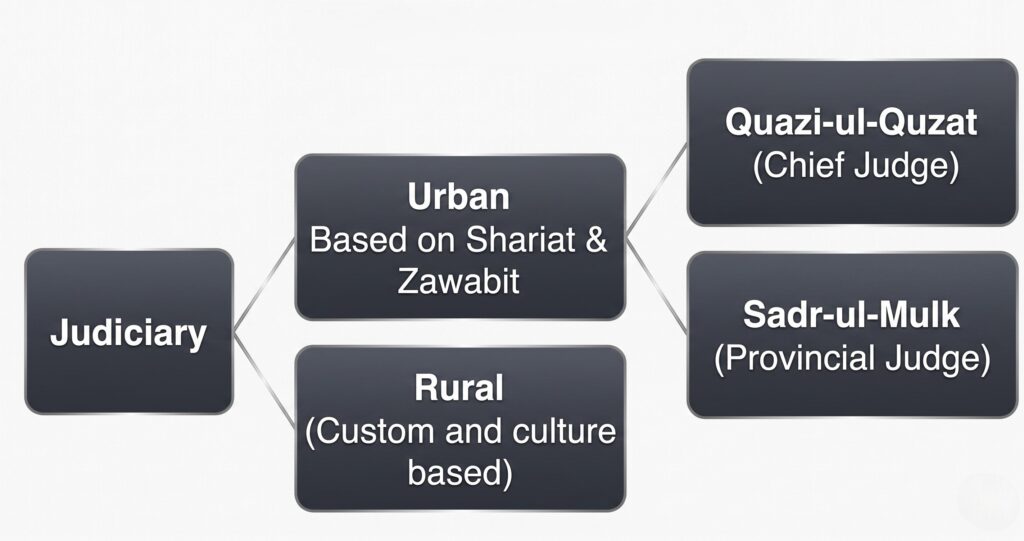
- This judicial system was implemented within the Delhi Sultanate, a state that was mainly urban in its character.
- The comprehensive structure of the judiciary suggested by Ziauddin Barani can be systematically represented based on this hierarchy of delegated authority and targeted expertise.
Controlled Markets and Social Justice
- Ziauddin Barani firmly opposed the principles of a “free market economy”.
- He asserted that the state’s primary role in maintaining social and political order was to actively regulate market prices.
- By controlling prices, the state would directly improve the general material conditions and well-being of the populace.
- To prevent inflation, Barani explicitly rejected the idea of increasing the salaries of army personnel.
- His economic philosophies were likely inspired by Alauddin Khalji, whose successful implementation of price control measures Barani viewed as highly beneficial to the common masses.
Military Administration and Army Structure
According to the historical guidance of Ziauddin Barani, a strong and well-prepared military was essential for the Sultanate’s survival and success.
Discipline and Readiness
- Barani advised the Sultan to ensure the military remained highly disciplined and up to date.
- The Sultan was expected to take every necessary precaution to keep the army well-supplied with armaments and other essential facilities.
- The ultimate goal was to maintain an “ever-ready force” capable of swiftly executing both defensive and offensive objectives.
The Turkish-Mongol Model
The army’s organizational structure was fundamentally based on the Turkish-Mongol model and was divided into four distinct branches:
- Infantry: Consisting of foot soldiers, locally referred to as payaks.
- Cavalry: Comprising the horsemen.
- War-Elephants: A critical heavy unit for the era’s warfare.
- Auxiliaries: A diverse support division that included boats, engineers, transporters, scouts, and spies.
The Sultan’s Personal Guard
- To ensure personal safety and supreme reliability, Barani highly recommended that the Sultan maintain a dedicated contingent of personal troops known as the Qalb.
- These troops were specifically intended to protect the Sultan in the event of an internal rebellion originating from within the nobility.