Kautilya, who is also known as Vishnu Gupta, was a profound and systematic philosopher in ancient India. Under the pen name Chanakya, he served as the Prime Minister to Chandra Gupta Maurya during the fourth century BCE. He played a pivotal role in the establishment of the Maurya Empire (321–297 BCE), which is recognized as the first pan-Indian state. Kautilya is distinguished as the first thinker to introduce a realist theory regarding both the State and International Relations. He authored the celebrated fourth-century BCE text, the Arthashastra, which explores the science of polity.
Overview of the Arthashastra
- In his text, Kautilya defines statecraft through the term Arthashastra, where Artha specifically denotes material well-being.
- This comprehensive work can be considered the earliest textbook on geopolitics.
- The document is highly structured, consisting of 15 parts (or books), 180 divisions, 150 chapters, and approximately 6,000 verses or shlokas.
- Within the Arthashastra, Kautilya provides detailed descriptions of several key concepts:
- The framework of a well-organized state.
- Kingship and the essential qualities required of an ideal ruler.
- The principles of practical politics, administration, and maintaining an ethical and moral order.
- Domestic and inter-state policies.
- Warfare, criminology, intelligence, and espionage.
- Beyond politics, the Arthashastra encompasses a variety of other subjects including economics, ethics, sociology, the science of education, and engineering.
- Furthermore, Kautilya identified four primary branches of knowledge as the foundation for good governance:
- Anvikasi (Philosophy): Described as the “lamp of all sciences”.
- Trayi (Three Vedas): Provides the necessary cultural context.
- Varta: Governs economic policies.
- Dandaneeti: The science of government and politics.
Theory of State
- Kautilya perceived the state as an organism, emphasizing its living nature rather than treating it as a mere mechanical institution.
- He is recognized as the first contractarian thinker in India, sharing philosophical parallels with Western thinkers such as Thomas Hobbes, John Locke, and Rousseau.
- He explicitly rejected the concept of the ‘Divine Origin of the Monarch’ and instead posited that the State is entirely a man-made institution.
- According to Kautilya, the state originated from the people’s collective desire to establish a peaceful society.
- In this system, the King is viewed as a servant of the people, and he receives taxes as payment for the services he renders to his subjects.
- As the head of State, the King acts as the ultimate upholder of law and order.
- The King’s foremost duties are Rakshana (protection) and Palana (nurture) of the state’s citizens.
- A primary responsibility of the state is to protect private property by actively punishing thieves.
- Ultimately, the singular objective of the state is to ensure the welfare of its people.
The Saptang Theory (Seven Elements of State)
- The concept of the state consisting of seven distinct elements was defined for the first time in Kautilya’s Arthashastra.
- Known as the Saptanga Siddhant, this doctrine explains the fundamental elements of a state.
- It serves as a key example of the organic theory of the state, conceptualizing the state as a cohesive system made up of seven limbs or elements of sovereignty.
- Kautilya structured these constituent elements in the following order: the Swami, the Amatyas, the Janapada, the Durgas, the Kosha, the Danda (or Bala), and the Mitra.
The Seven Constituent Elements
1. Swami (The Ruler) — Head/Soul
- The King heads the list of the state’s seven elements.
- Kautilya assigns the highest place in the body politic to the King, describing him as the main pillar of the state and the ultimate master of statecraft techniques.
- A ruler must be a scholar of high merit with comprehensive knowledge of the Vedas, the Arthashastra, Dandniti, and the science of war.
- As the absolute head of state, executive, legislative, judicial, and financial powers are entirely vested in him.
- An ideal king possesses elite qualities in leadership, intellect, energy, and personal attributes.
- The King’s happiness is deeply intertwined with the well-being of his people, an idea captured by the phrase ‘Praja Sukham Sukhe Rajya’.
2. Amatya (Ministers) — Eyes
- Amatyas are senior ministers; Kautilya preferred consulting Brahmin experts well-versed in the Vedas.
- These ministers are required to be men of wisdom, integrity, bravery, and loyalty.
- Kautilya stressed that kingship requires assistance, noting that “one wheel alone does not move the carriage”.
- While the King should regularly consult his Amatyas, he must also continuously test their integrity.
- A King should retain at least three Amatyas, because having only two makes it easy for them to conspire against the ruler.
3. Durga (Fort) — Arms
- Forts represent a necessary system for the state’s safety and protection.
- They symbolize both the offensive and defensive capabilities of the state.
- Kautilya considered forts to be as powerful and vital as the state’s people and land.
- This importance stems from the fact that no state can remain stable without external security.
- The Arthashastra details four specific types of forts:
- Audak fort: Surrounded by a water body.
- Parvat fort: Constructed amidst high mountains.
- Dhanvan fort: Situated in a desert environment.
- Van fort: Built deep within a dense forest.
4. Janapada (Population/Territory) — Legs
- The Janapada implies both the territory and the population, as a state simply cannot exist without them.
- It serves as the living space for common citizens and the primary center for economic activities.
- This element is the state’s core source of strength, revenue, and other critical commodities.
5. Bala (Force) — Brain
- Kautilya utilizes the word ‘force’ to denote the state’s army.
- He advocates for maintaining a hereditary army composed of Kshatriyas.
- The text outlines six distinct types of armies: hired troops, hereditary forces, soldiers from fighting corporations, allied troops, enemy troops, and soldiers from wild tribes.
6. Kosha (Treasury) — Mouth
- Public finance is granted utmost importance, with Kautilya noting that even a basic family cannot function without a treasury.
- The King’s foremost duty is to ensure the state’s treasury remains full and prosperous.
- The Kosha must hold sufficient funds to maintain welfare functions and successfully navigate natural calamities, emergencies, or war.
7. Mitra (Ally) — Ears
- Allies carry immense symbolic importance; possessing numerous Mitras is a direct indicator of a person’s power.
- Being a friend of the strong serves as a powerful symbol of strength.
- Kautilya categorizes Mitras into two distinct types:
- Sahaja: Inherited allies whose friendship dates back to the time of one’s father and grandfather, typically located near the territory of an immediate enemy.
- Kritrima: Acquired allies specifically forged for the protection of life and wealth.
- Kautilya maintained that the inherited ally (Sahaja) is fundamentally superior to the acquired one (Kritrima).
Mandal Siddhant (Theory of Circle)
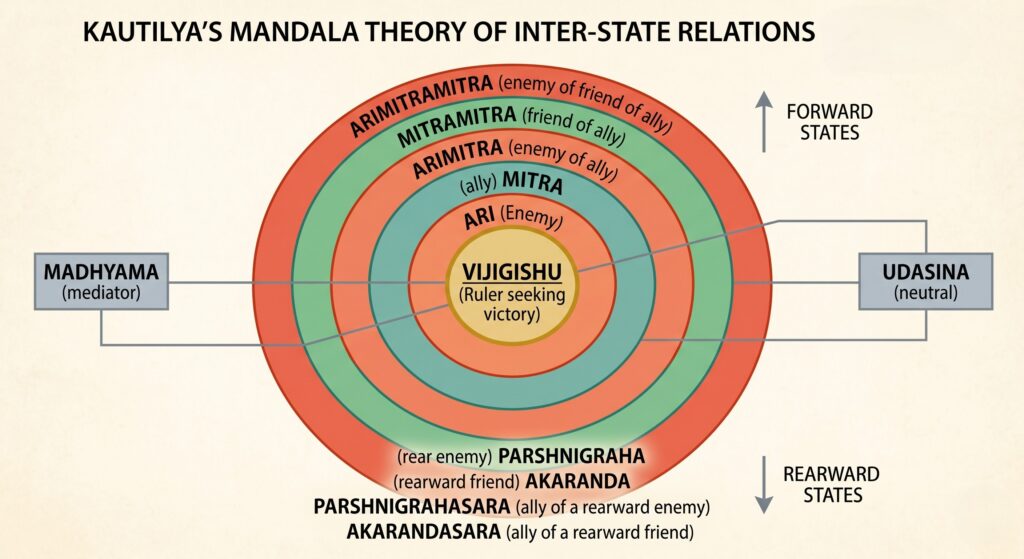
The Mandal Siddhant is a comprehensive theory of inter-state relations rooted in the concept of the “balance of power”.
- In this theory, the central King is referred to as the Vijigishu, which translates to “victory seeker”.
- Because the Kshatriya Dharma equates to war, a King is obligated to embark on an expedition shortly after his coronation.
- The theory posits that neighboring states are natural enemies because they are competing for material well-being and the exact same plot of land.
- A fundamental implication of the Mandal Siddhant is the belief that there are no permanent friends or enemies in statecraft.
The Twelve Kings (Circles of the State)
The Mandal Siddhanta structure is built around twelve kings, or twelve circles of the state.
- The foremost king in this arrangement is the Vijigishu.
- There are five kings positioned in the front: Ari, Mitra, Ari-Mitra, Mitra-Mitra, and Ari Mitra-Mitra.
- There are four kings positioned in the back: Parshvanigrah, Akaranda, Parshavanigrah-Sara, and Akaranda-Sara.
- Madhyama (Buffer State): The Vijigishu must proactively attempt to bring the Madhyama onto his side.
- Udasina (Neutral State): The Vijigishu should aim to bring the Udasina under his direct control.
- Kautilya advised that before initiating any war, the Vijigishu must carefully calculate the status of seventy-two elements of sovereignty, a figure derived by multiplying the twelve kings by the six organs of the state.
Theory of Diplomacy
Within Kautilya’s political thought, statecraft and diplomacy are firmly established on the economic and geographical foundations of the state. Kautilya outlined four Upayas—expedients or devices—that are considered the most reliable tools for effective diplomacy:
- Sama: Conciliation.
- Dana: Concession or giving a gift.
- Damda: The use of force.
- Bheda: Sowing the seeds of dissension within an enemy’s camp, a strategy also known as the policy of divide and rule.
Shada Gunya Siddhanta (Six Forms of Diplomacy)
The specific form of diplomacy a ruler employs depends on the relative strength of the opposing king, namely whether the diplomatic policy is directed toward a superior, an inferior, or an equal.
The six forms of diplomacy are:
- Sandhi (Alliance): This strategy should be adopted if the enemy is strong.
- Vigraha (War): If you possess greater strength, this policy dictates breaking the Sandhi and initiating a war.
- Yaan/Yana (Military Expedition): This entails conducting military exercises near the territory of the enemy.
- Asana (Halting): This strategy involves stationing military forces close to enemies’ territories.
- Samashrya (Seeking Protection): This approach focuses on joining hands with others who share similar aims.
- Dvedhibhaava (Duplicity): This is a dual policy that involves maintaining a temporary friendship with one enemy while simultaneously engaging in enmity with another. The core principle is to avoid opening two conflict fronts at the same time.
Kautilya’s Perspectives on Corruption
Kautilya took a pragmatic and detailed approach to the issue of corruption within the state apparatus.
- He systematically identified forty different types of corruption.
- He believed that corruption was an inevitable phenomenon, remarking that “it’s like honey on the tongue, you can’t help but taste it”.
- Despite its inevitability, Kautilya emphasized that corruption must be addressed because it actively weakens a state from both within and without.
- Corruption directly erodes the state’s fundamental ability to achieve the well-being of its people.
- It inherently lowers public morale, and this low morale makes it significantly easier for an enemy to defeat the state.
- He acknowledged the practical reality that public officials hold control over vast resources, making corrupt practices unavoidable.
- Kautilya also noted that officials might be entirely unaware they are participating in corruption, stating that “when a fish swims in water, it has no idea when it has drunk the water”.
While he admitted the immense difficulty of tackling the issue, he proposed several concrete strategies:
- Reducing the overall size of the state’s bureaucracy.
- Transferring officials at regular intervals so they do not have time to discover and exploit systemic loopholes.
- Enforcing the public humiliation of corrupt officials.
- Utilizing Suchaks, which translates to whistle-blowers.
- Ensuring that the entire chain of corruption is punished, rather than isolating the punishment solely to the corrupt official. This criminal chain includes the Dayak (the person giving the bribe), the Pratigraha (the official receiving the money), and the Nidhayak (the individual who holds or keeps the money).
Commentaries on Kautilya
Scholars and thinkers have offered various perspectives on Kautilya’s political philosophy:
- R. Shamasastry: “The theory of social contract was not unknown in the days of Chanakya”.
- B. A. Salvatore: “Of all the schools of ancient Indian political thought, the most noteworthy is that of Kautilya”.
- N. C. Bandyopadhyay: “The state according to Kautilya must be based on sound economic foundations, so as to enable men to realize the aims of life”.
- M. V. Krishna Rao: “Kautilya’s attitude to religion was secular and not apathetic”.
- Max Weber: “Machiavelli’s Prince was harmless when compared to Kautilya’s Arthashastra”.
- Amartya Sen: “Kautilya is not immoral but unmoral in his politics”.
List of Books and Authors on Kautilya
Key literature regarding Kautilya and his work includes the following publications:
- R. P. Kangle: The Kautilya Arthashastra.
- L. N. Rangarajan: Kautilya : The Arthashastra.
- Roger Boesche: The First Great Political Realist: Kautilya and his Arthashastra.
- T. N. Ramaswamy: Essentials of Indian Statecraft: Kautilya’s Arthashastra for Contemporary Readers.
- N. C. Bandopadhyay: Kautilya and an Exposition of his Social Ideal and Political Theory.
- Hari Krishna Deb: The Kautilya Arthashastra on Forms of Government.
- Narasingha Prasad Sin: Kautilya’s Arthashastra and Machiavellism: A Reevaluation.
| No. | Author | Book Title |
| 1 | R. P. Kangle | The Kautilya Arthashastra |
| 2 | L. N. Rangarajan | Kautilya : The Arthashastra |
| 3 | Roger Boesche | The First Great Political Realist: Kautilya and his Arthashastra |
| 4 | T. N. Ramaswamy | Essentials of Indian Statecraft: Kautilya’s Arthshastra for Contemporary Readers |
| 5 | N. C. Bandopadhay | Kautilya and an Exposition of his Social Ideal and Political Theory |
| 6 | Hari Krishna Deb | The Kautilya Arthashastra on Forms of Government |
| 7 | Narasingha Prasad Sin | Kautilya’s Arthashastra and Machiavellism: A Reevaluation |