The modern approaches to comparative politics are the newer ways of studying political systems. They grew mainly after the Second World War. They replaced or supplemented the traditional approaches, which dealt mostly with the law and formal organs of government. The modern approaches study how politics actually works. They look at behaviour, groups, culture, economic forces and incentives. They use concepts such as system, structure, function, culture and development. They also use surveys, statistics and models, and they try to explain and not only to describe.
The main modern approaches are the behavioural approach, the systems approach, the structural-functional approach, the political culture and political development approaches, the political economy approaches, rational choice and the new institutionalism. Together they changed the nature of the subject. Comparative politics is now a science of political systems all over the world, and it is no longer a study of a few Western constitutions.
This topic is important for every examination. UG students are asked for the features and types. PG and NET candidates are asked for the writers, their works and their ideas. OPSC and UPSC candidates are asked to give a critical view and to relate the approaches to India. This note explains each approach in simple terms. It gives the definitions that students must quote. It ends with a critical analysis, a table of authors and books, and practice questions.
1. Meaning and definitions
An approach is a way of looking at a subject. It tells us which questions to ask and which facts to use. Vernon Van Dyke called it a set of criteria for choosing problems and data. The modern approaches are the ways of looking at politics that became common after about 1945. They share a few ideas. Politics should be studied as it works in practice. Explanations should be based on evidence. Concepts should be general enough to be used for all countries. And the study should draw on other social sciences.
The word “modern” does not mean that these approaches are the last word. Some of them, such as structural-functionalism, are now out of fashion. Others, such as the new institutionalism, are still developing. The word shows only that they came after the traditional approaches and differ from them in aim and method.
| Writer | Approach | Main idea |
|---|---|---|
| David Easton | Behavioural and systems | Politics is the authoritative allocation of values; the political system receives inputs and produces outputs |
| Robert Dahl | Behavioural | The behavioural movement was a protest against the older, institutional political science |
| Gabriel Almond | Structural-functional | All political systems perform the same functions through different structures |
| Almond and Verba | Political culture | Political attitudes shape the working of democracy |
| Samuel Huntington | Political development | Political order depends on strong institutions |
| Anthony Downs | Rational choice | Voters and parties act to advance their own goals |
| Peter Hall and Rosemary Taylor | New institutionalism | There are three kinds: historical, rational choice and sociological |
Definitions by scholars
David Easton (The Political System, 1953; A Framework for Political Analysis, 1965). Easton defined politics as “the authoritative allocation of values for a society”. He saw the political system as a set of interactions through which these allocations are made. It receives demands and support from its environment and turns them into decisions. This idea is the basis of the systems approach.
David Easton (“The Current Meaning of Behavioralism”, 1962). Easton listed the main ideas of behaviouralism. They are regularities, verification, techniques, quantification, values, systematisation, pure science and integration. In simple words, behaviouralists look for patterns in political behaviour. They test their statements with evidence. They use exact methods. They keep facts apart from values.
Robert Dahl (“The Behavioral Approach in Political Science: Epitaph for a Monument to a Successful Protest”, 1961). Dahl described the behavioural approach as a protest movement. It was a protest against the older, mainly institutional and descriptive study of politics. He said the protest had largely succeeded. He also said it wanted political science to be more scientific.
Gabriel Almond and G. Bingham Powell (Comparative Politics: A Developmental Approach, 1966). A political system is a set of interacting roles and structures that perform the functions of conversion, system maintenance and adaptation, and capabilities. All systems can be compared by the way they perform these functions.
Peter Hall and Rosemary Taylor (“Political Science and the Three New Institutionalisms”, 1996). They said that there are three new institutionalisms: historical, rational choice and sociological. All of them study how institutions shape political action. They differ in how they explain the effect of institutions.
Note for the student. These definitions are given as textbooks usually report them. The main ideas are well known, but the exact wording differs between editions. In the examination, write the scholar’s name, the work and the main idea. Use quotation marks only for a phrase of which you are sure.
What the definitions share. Each of them treats politics as something that can be observed and explained. Each offers a general framework for comparison. And each moves beyond the formal organs of government. A student who remembers these three points can rebuild a definition in his own words.
2. Characteristics of the modern approaches
1. They are empirical. The modern approaches base their statements on observed facts. They ask what actually happens in politics, and not only what the law says or what ought to happen. For example, a study of voting uses survey data on how people vote. It does not only describe the electoral law. This makes it possible to test a statement. If the evidence does not support it, the statement is rejected.
2. They use scientific methods. They try to follow the logic of the natural sciences. They state a hypothesis, collect data and test the hypothesis. Easton said that political behaviour shows regularities, and that these can be stated as generalisations and verified. This gives the findings a firmer basis than personal judgement.
3. They study behaviour and processes. The unit of study is no longer only the institution. It is the behaviour of individuals and groups and the processes of politics. Examples are voting, lobbying, decision-making and communication. This shows how institutions really work. A Parliament, for example, can be studied through the actual conduct of its members and not only through its rules.
4. They are interdisciplinary. They borrow from sociology, psychology, economics, anthropology and statistics. Sociology gave the ideas of structure and function. Psychology gave the survey method. Economics gave rational choice. Anthropology gave the idea of culture. This broadens the subject. It also means that a student must understand the language of other social sciences.
5. They cover informal as well as formal politics. Parties, pressure groups, elites, the media, the army, social movements and political culture are all studied. These often decide how formal institutions work. For example, the Indian federal system cannot be understood without knowing how regional parties and coalitions operate.
6. They aim at general concepts and theory. The modern writers want concepts that can be used for every country. System, function, structure, culture and development are examples. They also try to build theories that explain many cases. The aim is to go beyond separate country studies to general knowledge.
7. They try to separate facts from values. Most behaviouralists held that empirical research should be kept apart from value judgements. They argued that a scientist should say what is, and not what ought to be. This ideal was later criticised. Easton himself said in 1969 that values cannot be ignored. But the effort to keep the two apart is still a feature of the modern approaches.
8. They use quantification and survey techniques. Many studies use statistics, surveys, interviews and computers. The Civic Culture (1963) used sample surveys in five countries. Such data allow exact comparison. They also allow the testing of statements on large numbers of cases. But numbers can be misleading if the concepts are weak.
9. They cover the whole world. The modern approaches include the developing countries of Asia, Africa and Latin America. Almond and Coleman’s The Politics of the Developing Areas (1960) is a clear example. Comparison is now truly worldwide. This has also raised the question whether concepts made in the West fit other societies.
10. They are interested in change and development. The traditional approaches were static. The modern approaches ask how societies change, why political order breaks down and how states develop. Huntington’s Political Order in Changing Societies (1968) is an example. This interest grew from the problems of the new states.
11. They stress systematic comparison. The same questions are asked about every case. The same variables are used. This makes comparison possible. In the traditional approach, each country was described in its own terms. The modern approaches use common frameworks, such as the systems approach, to avoid this.
12. They include economic and social forces. The political economy approaches link politics with class, markets and the world economy. They show that political outcomes cannot be understood without them. Moore’s study of the routes to modernity and the dependency writers’ study of the world economy are examples.
13. They are plural and varied. There is no single modern approach. Behavioural, systems, structural-functional, cultural, political economy, rational choice and institutional approaches exist together. Each answers some questions and leaves others. So students must learn the strengths and limits of each.
14. They aim at explanation and, in some cases, prediction. The older approaches mostly described. The modern approaches seek to explain why things happen. Some, such as rational choice, also try to predict. The success of prediction has been limited. The field did not foresee the fall of communism in 1989-91. But the effort has improved the understanding of causes.
3. Rise of the modern approaches and the types at a glance
The modern approaches arose from a number of causes. We can group them as follows.
- Dissatisfaction with the traditional approaches. Macridis and others said that the older study was descriptive, formal, narrow and static.
- Failure of democracies between the wars. The collapse of constitutional governments in Europe showed that the study of laws was not enough.
- The Second World War. Many political scientists worked in government. They saw the need for practical knowledge of foreign societies.
- Decolonisation. The creation of many new states in Asia and Africa needed new concepts. The old categories did not fit them.
- Growth of social science methods. Survey research, statistics and later computers made the collection and analysis of data possible.
- Foundation support. In the United States, the Social Science Research Council and large foundations funded research. The Committee on Comparative Politics of the Council, set up in 1954 under Gabriel Almond, became a centre of the new work.
- Influence of other sciences. Sociology (Parsons, Weber), psychology and systems theory supplied ideas.
The modern approaches did not appear all at once. The behavioural approach came first and gave the general spirit. The systems and structural-functional approaches gave frameworks. The culture and development approaches gave themes. The political economy approaches added class and the world economy. Rational choice and the new institutionalism came later and brought back the study of institutions in a new form. The diagram below shows the main approaches, the chief writers and the central idea of each.
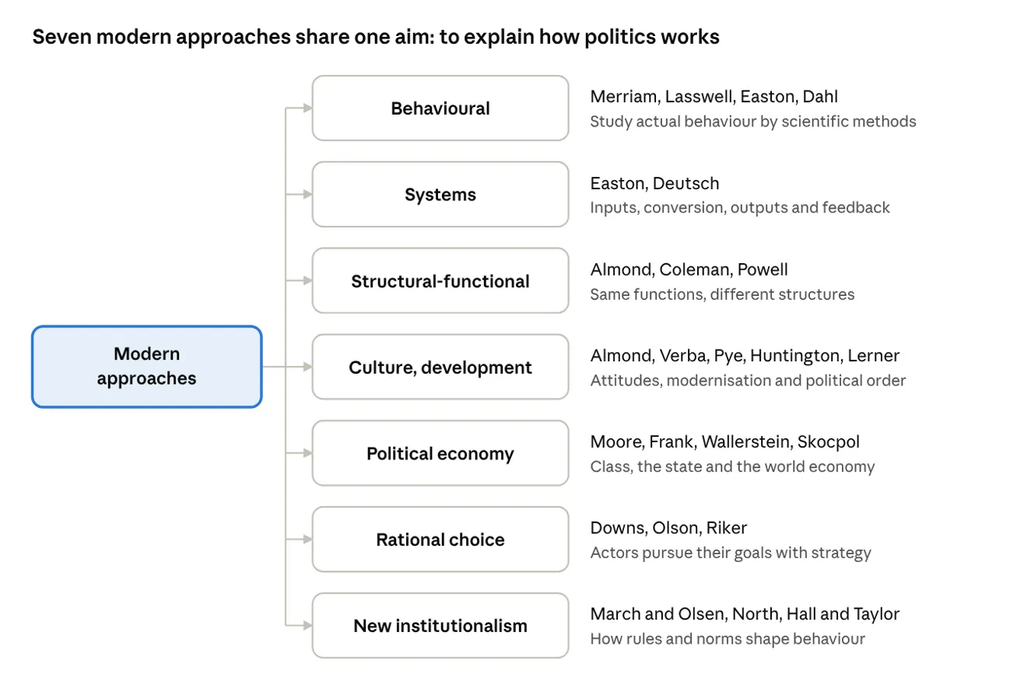
The seven approaches differ in what they study and how, but all aim to explain how political systems actually work, which marks them off from the traditional approaches.
4. The behavioural approach
The behavioural approach is the starting point of the modern approaches. It treats politics as human behaviour that can be observed, measured and explained. Its unit of study is the individual or the group acting in politics. Examples are the voter, the legislator, the party member and the pressure group. The institution is studied through the behaviour of the people who work in it.
Origin. The roots lie in the Chicago school of the 1920s and 1930s. Charles Merriam, in New Aspects of Politics (1925), urged political scientists to use the methods of psychology, statistics and sociology. His student Harold Lasswell wrote Psychopathology and Politics (1930) and Politics: Who Gets What, When, How (1936). He studied power and personality. Surveys of voting also helped. Paul Lazarsfeld’s The People’s Choice (1944) and the Michigan study The American Voter (1960) are well-known examples. V. O. Key’s Southern Politics (1949) and David Truman’s The Governmental Process (1951) studied parties and groups. The word “behavioural” came into general use in the early 1950s.
Main ideas. David Easton, in 1962, described the “intellectual foundations” of behaviouralism. In simple terms they are as follows.
- Regularities. Political behaviour shows patterns that can be stated as generalisations.
- Verification. Such statements must be tested against evidence.
- Techniques. The methods of collecting and analysing data must be exact.
- Quantification. Measurement should be used where it is possible and meaningful.
- Values. Ethical evaluation and empirical explanation are different tasks and should be kept apart.
- Systematisation. Theory and research should go together.
- Pure science. Understanding must come before application.
- Integration. Political science should use the findings of other social sciences.
Contribution to comparative politics. The behavioural approach made comparison scientific. It gave the subject surveys and data. It turned attention from the law to the actual conduct of politics. It also supported the study of non-Western countries by offering methods that could be used anywhere. The Civic Culture (1963), a five-country survey, is a famous example of cross-national work done in this spirit.
Merits. It brought rigour and evidence. It widened the subject to include voting, attitudes, groups and elites. It encouraged the building of theory. It made the discipline more open to other social sciences. Its methods are still used in election studies and in public opinion research, including studies of Indian elections.
Criticisms. Critics made several points. The approach put method before importance. It studied what could be measured, even when this was trivial. Its claim to be free of values was doubtful. The choice of topics and the reading of results involve values. Leo Strauss and Eric Voegelin said that it ignored the ethical side of politics. Bernard Crick said that it misunderstood the nature of politics. Sheldon Wolin said that it was conservative because it accepted existing arrangements. It also relied on individuals as the unit and gave too little attention to institutions and structure. Easton himself, in 1969, admitted that the new science had moved too far from urgent social problems. He called for a “post-behavioural revolution” that would give priority to relevance and action.
Place today. The behavioural approach is no longer a movement. But its methods are part of normal political science. Surveys, statistical analysis and the testing of hypotheses are now standard. The new institutionalism and rational choice also accept its stress on evidence.
5. The systems approach
The systems approach treats politics as a system. A system is a set of parts that are connected with each other and with their environment. David Easton applied this idea to politics. He described the political system as the set of interactions through which values are authoritatively allocated for a society. The idea came from general systems theory in biology and sociology. Talcott Parsons had used a similar idea for society.
Main works. Easton wrote The Political System (1953), A Framework for Political Analysis (1965) and A Systems Analysis of Political Life (1965). The last two present the full model. Karl Deutsch, in The Nerves of Government (1963), gave a related model based on communication and control. He compared the government to a steering system. It receives information, makes decisions and corrects its course.
The model. Easton’s model has a few basic parts.
- The political system is the set of interactions that allocate values authoritatively.
- The environment is everything outside the system. It includes the economy, society and other political systems.
- Inputs come from the environment. They are of two kinds. Demands are claims made on the system, such as a demand for jobs or for a law. Supports are the resources that keep the system going, such as obedience, taxes and loyalty.
- Conversion is the process inside the system. The demands are turned into decisions through the working of institutions.
- Outputs are the decisions and actions of the system. They are laws, policies, orders and services.
- Feedback is the return flow. The outputs change the environment. This produces new demands and new support or opposition. In this way the system learns and adjusts.
Easton also spoke of stress, which is a threat to the survival of the system. Examples are a sudden rise in demands or a loss of support. A system persists if it can cope with stress. It can do so by meeting the demands, by changing its structure, or by building up support. He divided support into specific support, which depends on the satisfaction with decisions, and diffuse support, which is a deeper attachment to the system itself.
An example. Take India. Groups make demands for reservations, for farm prices or for a new state. These are inputs. Parliament, the Cabinet, the courts and the bureaucracy process them. The outputs are laws, schemes and judgments. People respond to them in the next election. That response is feedback. The system may adjust its policy, or may face stress if the demands are too many.
Contribution to comparative politics. The systems approach gave a general framework that could be used for any country. It linked politics with the environment. It showed that a political system must be studied as a whole, and not as a set of separate institutions. It also drew attention to the question of why systems persist or break down.
Merits. It is simple and general. It deals with the whole political process. It shows the link between society and politics. It allows comparison among very different countries. It also gave a basis for the later approaches.
Criticisms. The model is abstract. It is hard to apply to a real case, since the terms are very general. It gives little place to conflict, power and class. It stresses persistence and stability, so critics called it conservative. It does not explain change well. It treats the state and institutions as a “black box” of conversion. It is also not clear how to measure the inputs and outputs. For these reasons, few researchers use the whole model today. But its vocabulary of inputs, outputs and feedback is in common use.
Place today. The approach is not used in its full form. Its ideas remain in policy analysis and in the study of legitimacy and regime stability.
6. The structural-functional approach
The structural-functional approach asks two questions about every political system. What structures does it have? What functions do these structures perform? A structure is a pattern of behaviour or an organisation, such as a party, a legislature or a court. A function is the contribution that a structure makes to the working of the system. The approach came from sociology and social anthropology. Bronislaw Malinowski, A. R. Radcliffe-Brown, Talcott Parsons and Robert Merton used it for the study of society.
Main works. Gabriel Almond gave the approach its place in comparative politics. He wrote the introduction to The Politics of the Developing Areas (1960), which he edited with James Coleman. Later, Almond and G. Bingham Powell wrote Comparative Politics: A Developmental Approach (1966), which gave a revised version.
Main ideas of Almond. Almond made four assumptions.
- All political systems, whether simple or complex, have political structures.
- The same functions are performed in all political systems. The structures that perform them may differ.
- Every political structure is multi-functional. It performs more than one function, even if it is specialised.
- All political systems are “mixed” in the sense of culture. They combine modern and traditional elements.
These ideas allowed comparison. Instead of comparing a legislature in one country with a legislature in another, the student could compare how a function, such as making rules, is performed. In one country it may be a legislature. In another it may be a ruling party or the army.
The functions (Almond and Coleman, 1960). Almond listed seven functions in two groups.
- Input functions: political socialisation and recruitment; interest articulation; interest aggregation; political communication.
- Output functions: rule-making; rule application; rule adjudication.
Interest articulation means the putting forward of demands. Interest aggregation means the combining of demands into policy proposals. This is usually done by parties. Rule-making is done mainly by legislatures, rule application by the executive and bureaucracy, and rule adjudication by courts.
The revised scheme (Almond and Powell, 1966). The later book arranged the functions in three levels.
- Conversion functions: interest articulation, interest aggregation, rule-making, rule application, rule adjudication and communication. These turn inputs into outputs.
- Capabilities: the abilities of the system. These are extractive (to draw resources), regulative (to control behaviour), distributive (to allot goods and honours), symbolic (to use symbols such as the flag) and responsive (to answer demands).
- System maintenance and adaptation: political socialisation and recruitment. These keep the system going and let it change.
An example. In India, interest articulation is done by trade unions, farmers’ groups and caste associations. Interest aggregation is done by parties and coalitions. Rule-making is done by Parliament and the state legislatures. Rule application is done by the civil services. Rule adjudication is done by the courts. A student can ask how well each function is performed and by which structure.
Contribution to comparative politics. The approach gave a common language for all systems. It encouraged the study of the developing countries. It moved attention from the form of institutions to what they do. It also introduced the idea of the capabilities of a system.
Merits. It is general and flexible. It helps to compare unlike systems. It draws attention to informal structures. It covers the whole political process.
Criticisms. The approach is static and favours stability. It does not explain change or conflict well. It is conservative, because it assumes that existing structures serve the system. It is also vague. It is not clear what counts as a function, and nearly any structure can be said to perform some function. Critics said that it was ethnocentric, since the list of functions was modelled on the Western democratic systems. It also tends to use circular reasoning: a structure exists because it performs a function, and the function is known from the existence of the structure. Almond and Powell tried to answer some of these criticisms by adding the idea of capabilities and development. But by the 1970s the approach had lost its leading place.
Place today. Few scholars call themselves structural-functionalists now. But its concepts, such as interest aggregation and articulation, political socialisation and political communication, are still widely used.
7. The political culture and political development approaches
These two approaches grew side by side in the 1950s and 1960s. Both were linked with the study of the new states. One asks how the attitudes of people affect politics. The other asks how societies become modern and how their politics change.
Political culture
Political culture means the pattern of attitudes, beliefs and values that people hold about politics. Gabriel Almond first used the term in 1956. It was developed fully in The Civic Culture (1963) by Almond and Sidney Verba. They surveyed people in five countries: the United States, Britain, Germany, Italy and Mexico. They described three types of political orientation.
- Parochial. People have little awareness of the national political system. Their attention is on the village, tribe or local community.
- Subject. People know the system and are aware of its decisions. But they see themselves as passive subjects and not as participants.
- Participant. People know the system and take an active part in it as citizens.
No society has only one type. Most have a mixture. Almond and Verba argued that stable democracy needs a “civic culture”. This is a mixture in which participant attitudes are balanced by subject and parochial ones. Citizens are active but also deferential. They trust the government and also keep a check on it. Britain and the United States came close to this model in their study.
Other writers developed the idea. Lucian Pye and Sidney Verba edited Political Culture and Political Development (1965). Robert Putnam, in Making Democracy Work (1993), explained the better performance of regional governments in northern Italy by their long tradition of civic engagement. He called this “social capital”. Ronald Inglehart studied changing values, such as the move to “postmaterialist” concerns.
Merits. The approach draws attention to the human side of politics. It explains why the same institutions work differently in different countries. It also provides survey data for comparison. The Indian federal and electoral systems, for example, work differently from their British models partly because of different political attitudes.
Criticisms. Critics say that the reasoning is circular. Culture is used to explain behaviour, but culture is itself shown by behaviour. The approach is also accused of treating culture as fixed and national, when it changes and varies within a country. It may lead to stereotypes. It pays little attention to institutions, class and power. And it may reflect a bias towards Anglo-American democracy as the model.
Political development and modernisation
This approach asks how traditional societies become modern and how their politics change. It arose from the problems of the new states. Several writers contributed.
- Daniel Lerner, in The Passing of Traditional Society (1958), linked modernisation with urbanisation, literacy, mass media and political participation.
- Seymour Martin Lipset, in his article of 1959 and in Political Man (1960), argued that economic development supports democracy.
- W. W. Rostow, in The Stages of Economic Growth (1960), described stages from the traditional society to high mass consumption.
- Lucian Pye, in Aspects of Political Development (1966), gave several meanings of political development.
- Samuel Huntington, in Political Order in Changing Societies (1968), gave the most important criticism of the early optimism.
Huntington said that modernisation brings social change and new demands. If the political institutions are weak, the result is instability and violence. He said that the main difference between countries is not the form of government but the degree of government. He defined political institutionalisation as the process by which organisations and procedures gain value and stability. He measured it by adaptability, complexity, autonomy and coherence. A society with high participation and weak institutions becomes a “praetorian” society, in which groups use force to press their claims. In India, Huntington’s argument helps to explain the role of the Congress party and the Constitution in handling popular demands after independence.
Leonard Binder and others, in Crises and Sequences in Political Development (1971), listed five crises that states may face. These are identity, legitimacy, participation, penetration and distribution.
Merits. The approach addressed the real problems of new states. It introduced the idea of change into the subject. It encouraged the study of the connection between economy, society and politics. Huntington’s work restored the importance of institutions.
Criticisms. The early writers assumed a single path from the traditional to the modern, with the West as the model. They treated tradition and modernity as opposites. Rudolph and Rudolph, in The Modernity of Tradition (1967), showed that traditional institutions, such as caste, can serve modern politics. The approach also ignored the effects of colonialism and the world economy. The dependency writers made this their main point. Huntington’s stress on order was criticised as favouring authoritarian regimes. By the 1970s the term “political development” had lost its place, but its questions remain.
8. The political economy approaches
The political economy approaches study the link between politics and economics. They ask how class, property, markets and the world economy shape the state and politics. They grew from dissatisfaction with the behavioural and developmental approaches, which gave little place to economic structure and conflict. Three groups are important: the Marxist approach, the dependency and world-system approaches, and the comparative-historical studies of the state.
The Marxist approach
Karl Marx explained politics by the economic base of society. The “base” is the system of production and the classes that result from it. The “superstructure” includes law, the state, politics and ideas. The state, in the classical view, is an instrument by which the ruling class protects its interests. Later Marxists developed this view. Antonio Gramsci spoke of “hegemony”, which is the leadership of a class through ideas and culture as well as force. Ralph Miliband, in The State in Capitalist Society (1969), and Nicos Poulantzas studied the capitalist state. The Marxist approach is used in the study of classes, revolutions and the state in capitalist and socialist societies. Its merits are that it draws attention to class conflict and economic power. Its weakness is that it may reduce politics to economics. Critics also say that history has not followed its predictions.
The dependency and world-system approaches
These approaches came from Latin America in the 1960s. Raul Prebisch and others had argued that the world economy works against poor countries that export raw materials. Andre Gunder Frank, in Capitalism and Underdevelopment in Latin America (1967), said that underdevelopment is not the original state of poor countries. It is produced by their links with the rich capitalist countries. Fernando Henrique Cardoso and Enzo Faletto, in Dependency and Development in Latin America (1969), gave a more careful view. They said that development is possible within dependence, and that the outcome depends on local classes and politics.
Immanuel Wallerstein, in The Modern World-System (1974), took the argument further. He said that the world economy is a single system divided into a core of rich countries, a periphery of poor ones and a semi-periphery in between. Positions in the system explain political and economic outcomes.
These approaches challenged the modernisation theory. They said that poverty is not due only to internal backwardness. They linked comparative politics with international relations. Critics say that they are too general, and that they cannot explain why some countries, such as South Korea and Taiwan, have developed rapidly. They also give too little weight to internal factors.
Comparative-historical studies of the state
Barrington Moore Jr., in Social Origins of Dictatorship and Democracy (1966), compared several countries to explain different routes to the modern world. These are the liberal democratic route, the fascist route and the communist route. He said that the outcome depends on the relations of landlords, peasants and the middle class. Theda Skocpol, in States and Social Revolutions (1979), compared the French, Russian and Chinese revolutions. She stressed the role of the state and of international pressure. She also edited Bringing the State Back In (1985) with Peter Evans and Dietrich Rueschemeyer. It argued that the state is an actor with its own interests and capacities. It is not only an arena for social groups. Chalmers Johnson, in MITI and the Japanese Miracle (1982), and Peter Evans, in Embedded Autonomy (1995), studied the “developmental state” in East Asia.
Indian examples. Pranab Bardhan’s The Political Economy of Development in India (1984) described how dominant classes shape the Indian economy. Lloyd and Susanne Rudolph’s In Pursuit of Lakshmi (1987) studied the Indian state and its relation to the economy. Atul Kohli has compared the Indian state with other developing states.
Merits. The approach joined politics and economics. It drew attention to class, inequality and the world context. It helped to explain regimes and revolutions. It gave a voice to the developing countries.
Criticisms. Some versions are too deterministic. They give less importance to ideas, culture and political choices. Different schools disagree among themselves. And their grand claims are hard to test.
9. Rational choice and the new institutionalism
These two approaches belong mainly to the period from the 1960s onward. They brought back the study of institutions, but in a new form.
Rational choice
Rational choice theory applies the logic of economics to politics. Its basic assumption is that individuals are rational. They have goals and preferences. They choose the means that best serve their goals, within the limits that they face. Politics is thus seen as a set of strategic choices by voters, parties, leaders and groups. The method is deductive. The theorist builds a model from the assumptions, often with game theory, and then tests its results.
Some important works are as follows.
- Anthony Downs, in An Economic Theory of Democracy (1957), argued that parties act like firms seeking votes. In a two-party system they move towards the median voter.
- Mancur Olson, in The Logic of Collective Action (1965), showed that rational individuals may not join a group to get a common benefit. Each hopes that others will pay for it. This is the “free-rider” problem.
- William Riker, in The Theory of Political Coalitions (1962), argued that parties form coalitions that are just big enough to win.
- Kenneth Arrow’s work on social choice showed that no voting rule can satisfy all of a set of fair conditions.
- George Tsebelis, in Veto Players (2002), studied how the number of actors who can block a change affects policy.
Merits. The approach is clear and exact. It states its assumptions openly. It can explain many types of behaviour, such as voting, coalition formation and legislative decisions. It helps in the design of institutions, because it shows how rules change incentives. For example, it helps to explain why coalitions are common in India under a first-past-the-post system with many parties.
Criticisms. Critics say that people are not always rational or self-interested. They are moved by values, habits and emotions. The approach often ignores culture and history. Its models may be too simple to explain real cases. Donald Green and Ian Shapiro, in Pathologies of Rational Choice Theory (1994), said that it is often better at building models than at explaining facts.
The new institutionalism
Institutions are the rules, procedures and norms that shape behaviour. The old institutionalism described the formal organs of government. The new institutionalism asks how institutions shape the choices and outcomes of political actors, and how institutions themselves change. James March and Johan Olsen gave it the name in an article of 1984 and in Rediscovering Institutions (1989). They said that institutions are not only a mirror of society. They shape the preferences and conduct of people. Douglass North, in Institutions, Institutional Change and Economic Performance (1990), defined institutions as the rules of the game in a society.
Peter Hall and Rosemary Taylor, in 1996, distinguished three versions.
- Historical institutionalism stresses the effects of past choices. Institutions, once set up, tend to continue. This is path dependence. Change often comes in critical junctures, when the old arrangements break down. Theda Skocpol, Paul Pierson and Kathleen Thelen belong here.
- Rational choice institutionalism says that institutions are rules that shape the incentives of rational actors. They help to solve problems of cooperation. Kenneth Shepsle and George Tsebelis are examples.
- Sociological institutionalism stresses norms, symbols and routines. Institutions provide the meanings by which people act. March and Olsen, and Paul DiMaggio and Walter Powell, are examples.
Merits. The new institutionalism restored the study of institutions with better theory. It explains why similar problems produce different outcomes in different countries. It deals with informal as well as formal institutions. It also gives a way to study institutional change and design. Studies of the Indian electoral system, federalism and the judiciary use these ideas.
Criticisms. The three versions do not agree with each other. The concept of institution is loose. It can include nearly everything. Historical institutionalism may be better at explaining stability than change. And the approach may give too little place to individual choice and power.
Place today. Rational choice and the new institutionalism are among the main approaches in the subject today. Together with the survey methods of the behavioural approach, they make up much of modern comparative politics.
10. Modern and traditional approaches compared, and criticisms of the modern approaches
The two sets of approaches compared
The modern approaches did not replace the traditional ones completely. They changed the aims, methods and scope of the subject. The table shows the main differences.
| Point | Traditional approaches | Modern approaches |
|---|---|---|
| Main focus | Formal institutions such as constitutions, legislatures and executives | Behaviour, functions, processes, culture, economy and structure |
| Unit of study | The state and its organs | Individuals, groups, the political system and society |
| Scope | Mostly Western Europe and the United States | All countries, including the new states of Asia, Africa and Latin America |
| Method | Descriptive, historical, legal and philosophical | Empirical, quantitative and often interdisciplinary |
| Values | Often mixed with facts, with a stress on the best form of government | Aim to separate facts from values, at least in the early period |
| Theory | Little general theory | Builds theories and models |
| Related fields | Law, history and philosophy | Sociology, psychology, economics and anthropology |
| Typical writers | Aristotle, Montesquieu, Bryce, Finer, Friedrich | Easton, Almond, Dahl, Verba, Huntington, Downs, Skocpol |
Some points need care. Traditional writers did not ignore facts. Montesquieu and Bryce used wide evidence. And modern writers did not give up institutions. The new institutionalism is a return to them. The better view is that the modern approaches added new tools and questions to the older ones.
Criticisms of the modern approaches
The following criticisms are often made.
- Too much theory and too little substance. Some modern studies produced elaborate models and new terms but few useful findings. Critics said that the language was often hard to follow.
- The claim of value-free study. Writers such as Leo Strauss and Christian Bay said that no political study can be free of values. The choice of what to study already reflects values.
- Western bias. Most concepts, such as the civic culture and political development, took the Western liberal democracy as the standard. The new states were measured against a model that did not fit them.
- Neglect of history and context. The search for universal laws led to a lack of attention to the history, colonial past and local conditions of each country.
- Conservative tendency. Systems and structural-functional approaches stress stability and equilibrium. They have difficulty in explaining conflict, revolution and rapid change.
- Methods ahead of problems. Critics said that researchers chose problems that suited their methods. Important questions of power, inequality and justice were left aside. David Easton accepted part of this in his call for a “post-behavioural revolution” in 1969.
- Disagreement within the modern approaches. The approaches do not form one system. Rational choice, culture and Marxism, for example, give very different accounts of the same events.
Relevance to India
The modern approaches are useful for the study of Indian politics, but they must be used with care. The behavioural approach is seen in election studies, such as those of the Centre for the Study of Developing Societies (CSDS), Delhi, and the National Election Studies. The political economy approach helps to explain the roles of class, caste and the state in development. Rational choice helps to explain coalitions and electoral strategy. The institutional approach is useful for the study of federalism, the judiciary and the Election Commission. At the same time, Indian experience has tested Western theories. India is a poor country that has kept a democracy for decades. This is not what the modernisation theory of Lipset would predict. Arend Lijphart’s idea of consociational democracy and Rajni Kothari’s studies of the Congress system are examples of theories that grew from the study of India itself.
11. Importance and limitations of the modern approaches
Importance
The modern approaches are important for the following reasons.
They widened the scope of the subject. Before the 1950s, the study dealt mainly with a few Western countries. The modern approaches brought in all regions and all levels of development. A student can now compare India, Brazil and Sweden with a common set of concepts. This is the basis of comparison in the syllabi of UG, PG and UGC NET.
They made the study more scientific. The behavioural approach introduced surveys, statistics and testable hypotheses. Claims about voting, participation and attitudes could be checked against data. This improved the quality of evidence. In answers, a student can show this by citing the work of Almond and Verba.
They brought in the idea of the political system. Easton’s systems approach showed that politics is a connected process of demands, decisions and feedback, and not only a set of institutions. This is a useful framework for analysis. It helps to explain, for example, how protests in India act as inputs that lead to new laws.
They introduced functions as a basis of comparison. The structural-functional approach asked what work is done, and not only which body does it. This allowed comparison of very different systems. A tribal council and a modern legislature can both be examined for rule-making.
They linked politics with society. Political culture, socialisation and development studies showed how class, religion, caste and education affect politics. This is important for India, where social structure affects voting and party formation.
They gave attention to the new states. The development and dependency approaches addressed the problems of poverty, state-building and instability. They gave a place to the experience of the Global South in the subject, which the older approaches had not done.
They brought in the economic dimension. The political economy approaches showed that markets, class and the world economy shape politics. This helps in the study of reform, welfare and inequality, and is useful in questions on liberalisation in India after 1991.
They revived the study of institutions with better theory. The new institutionalism explains why institutions matter, how they last and how they change. It is useful for the study of constitutional design, federalism and the electoral system.
They encouraged theory-building. Models such as the median voter and the free-rider problem gave short, testable explanations. Theory helps a student to organise facts, and not merely to memorise them.
They promoted a link with other disciplines. Sociology, psychology, economics and anthropology contributed concepts and methods. Interdisciplinary work is now normal in political science. It also helps students prepare for papers that mix subjects, such as political sociology.
They support practical decisions. Survey data, institutional design and policy analysis draw on these approaches. Governments, parties and international bodies use them in planning elections, reforms and aid.
Limitations
The approaches also have limits, which students should know.
Western origin and bias. Most modern theories were first built in the United States and Europe, and used Western democracy as the standard. They may mislead when applied to societies with different histories. The concept of political development is the clearest case.
Claim of value neutrality. The early behaviouralists said that facts can be separated from values. But the choice of topic, concepts and sources contains values. The claim hid the fact that many studies favoured the status quo.
Stress on stability. The systems and structural-functional approaches treat equilibrium as normal. They explain conflict and revolution poorly. The criticism was strong in the 1960s, when many societies were in turmoil.
Abstract language. The terms of systems theory, such as “inputs” and “boundary maintenance”, are hard to measure and hard to understand. Critics called this “jargon”. A student should explain such terms with simple examples.
Problems of measurement. Concepts such as political culture, legitimacy and development are difficult to measure. Surveys depend on how questions are worded and on honest answers. Results from one country may not be comparable with those from another.
Neglect of history and context. The search for general laws gave little place to the unique history of each country. Colonialism, for example, was largely absent from early development theory, though it shaped the new states.
Little attention to power and class. Most early approaches paid little attention to who gains and who loses. Political economy approaches tried to correct this. Even so, questions of caste, gender and race were taken up in a full way only later.
Unrealistic assumptions. Rational choice assumes that people act in a self-interested and calculating way. In real life, habits, emotions, values and group loyalty also matter. Models may then give neat but wrong predictions.
Lack of agreement. The approaches differ in their assumptions and no one of them explains everything. The new institutionalism, for example, has three versions that disagree. This gives variety but also confusion about which approach to use.
Limited predictive power. Despite the aim of science, the modern approaches could not predict major events such as the collapse of communism in 1989–91 or the Arab uprisings of 2011. Politics has too many variables and too much human choice.
Illustrations of the approaches
| Approach | Illustration | Example |
|---|---|---|
| Behavioural | Study of voters through surveys | CSDS National Election Studies in India |
| Systems | Demands from society lead to policies | Farmers’ protests leading to a change in law |
| Structural-functional | Interest articulation by groups | Trade unions, caste associations and chambers of commerce in India |
| Political culture | Attitudes to authority and participation | Civic culture in Britain; social capital in northern Italy |
| Political development | Institution-building amid new demands | The Indian Constitution and the Congress party after 1947 |
| Political economy | Class and the world economy shape the state | Dependency in Latin America; the developmental state in South Korea |
| Rational choice | Parties move towards the median voter | Coalitions in Indian elections |
| New institutionalism | Rules shape outcomes | First-past-the-post and the party system in India |
12. Using this topic in examinations
What examiners expect
| Level | Typical expectation | How to answer |
|---|---|---|
| UG (BA Political Science) | Define the approach; name the scholars; give main features | Short answer of 150 to 250 words, with two or three scholars |
| PG (MA Political Science) | Explain, compare and criticise approaches | Long answer of 800 to 1,000 words with a clear structure and critical points |
| OPSC and OCS (Mains) | Link the approaches to Indian examples | Include current examples from India and a balanced view |
| UPSC (Optional Paper I) | Analytical and comparative treatment | Conceptual clarity, key works and a critical conclusion |
| UGC NET (Paper II) | Match scholars, books and concepts | Know authors, titles, years and key terms |
Practice questions
- What is meant by the modern approaches to comparative politics? Explain why they arose.
- Discuss the behavioural approach and its criticisms.
- Explain David Easton’s systems approach. How useful is it in comparative politics?
- Describe the structural-functional approach of Gabriel Almond. What are its limitations?
- Explain the concept of political culture. What did Almond and Verba find in The Civic Culture?
- Compare the dependency approach with the modernisation approach.
- Examine the traditional and the modern approaches to comparative politics. Which is more useful today?
Answer outline
Question: Critically examine the behavioural approach to comparative politics.
Introduction
- Define the approach and say when it arose (the 1950s, in the United States).
- Name the main writers: Easton, Dahl, Almond and Lasswell.
Body
- Reasons for its rise: dissatisfaction with the formal-legal study, the Second World War, new states, and the influence of the social sciences.
- Main features: study of behaviour, empirical method, quantification, interdisciplinary outlook, value neutrality and theory-building.
- Easton’s “intellectual foundation stones” of behaviouralism (regularities, verification, techniques, quantification, values, systematisation, pure science and integration).
- Contributions: election studies, political culture, a wider scope.
- Criticisms: trivial subjects, conservative bias, impossibility of value-free study, neglect of institutions, and Easton’s post-behavioural call of 1969.
Conclusion
- The approach made the subject more scientific but was limited by its claims. The present view combines its methods with attention to values, institutions and context.
Sample answer
Question: Critically examine the behavioural approach to comparative politics.
Introduction. The behavioural approach arose in the United States in the 1950s. It holds that politics should be studied through the observable behaviour of individuals and groups, and not through the formal rules of institutions. Its main writers were David Easton, Robert Dahl, Gabriel Almond and Harold Lasswell.
Body. The approach arose because the legal-institutional study could not explain the working of politics, and because the new states needed fresh tools. Easton listed its basic ideas: regularities in behaviour, verification, quantification, and the separation of facts from values. It borrowed methods from psychology and sociology. Its main contributions were election studies and the work of Almond and Verba on political culture. However, it faced serious criticism. Critics said that it chose subjects that could be measured, even if they were trivial. They argued that value-free study is not possible. They also said that it neglected institutions and favoured the status quo. In 1969 Easton himself called for a post-behavioural revolution, giving priority to relevance and action.
Conclusion. The behavioural approach improved the standards of evidence in the subject. Its extreme claims have been dropped, but its methods remain in use, along with a renewed attention to institutions and values.
Quick check
- Who wrote The Civic Culture? Almond and Verba (1963).
- Who divided the world economy into core, periphery and semi-periphery? Immanuel Wallerstein.
- Which book by Huntington argued that political order is the key problem? Political Order in Changing Societies (1968).
- What is the median voter idea? Anthony Downs’s argument that parties move to the centre to win votes.
- Name the three versions of the new institutionalism. Historical, rational choice and sociological.
Common mistakes
- Mixing the “modern approaches” with the “new institutionalism” only. The modern approaches include many strands.
- Giving the date of the behavioural revolution without the context, the United States after the Second World War.
- Writing that the traditional approaches had no empirical content. This is not correct.
- Stating Easton’s post-behavioural call without explaining that it came from within the behavioural group.
- Using Western examples only. For OPSC and UPSC, add examples from India.
- Listing scholars without linking them to their ideas and books.
- Ending without a conclusion that gives a balanced view.
13. Critical analysis
The modern approaches should be judged by what they achieved and by what they failed to do. Five questions help a student to form a balanced view.
Did they make the subject more scientific? Partly. Surveys, statistics and models improved the quality of evidence. Yet politics involves values, meanings and choices that numbers cannot capture fully. The early claim that political science could become a science like physics was too strong. Most scholars now accept that careful, evidence-based study is possible, but that it cannot be wholly free of values.
Did they widen the subject? Yes. The study moved from a few Western states to the whole world. The developing countries became part of the subject. But the concepts used were mostly Western. The task of building concepts from the experience of Asia, Africa and Latin America remains incomplete, although studies of India by Rajni Kothari, Lloyd and Susanne Rudolph and Atul Kohli have contributed to it.
Did they explain change as well as stability? The systems and structural-functional approaches explained stability better. Political development theory, dependency theory and the comparative-historical studies tried to explain change, revolution and the state. A fair view is that no single approach explains both. A student should use more than one.
Are they rivals or partners? They are often presented as rivals, such as the culture approach against rational choice, or modernisation against dependency. Yet recent work combines them. Putnam used culture and history. Skocpol used structure and the state. Hall and Taylor compared the three institutionalisms. The present trend favours middle-range theory and the use of several approaches to fit the problem.
What is their place today? The modern approaches shaped the language and methods of the subject. Terms such as political system, culture, socialisation, institution and path dependence are in common use. The grand theories of the 1960s are less popular. Their place has been taken by narrower studies and by new subjects such as democratisation, state capacity, identity politics, populism and the effects of globalisation.
Model concluding paragraph
In conclusion, the modern approaches changed comparative politics from a descriptive study of Western institutions into a wider and more analytical subject. They gave the subject new methods, concepts and a global reach. Their weaknesses, such as Western bias, the claim of value neutrality and a lack of attention to history and power, led to criticism and revision. Today no one approach is accepted as complete. The student should therefore treat the approaches as complementary tools, and choose among them according to the problem under study, including the problems of Indian politics.
14. UGC NET: authors and books
The table lists the writers and works most often asked. Dates and titles should be checked against a standard edition before use in an examination.
| Author | Work | Idea or approach |
|---|---|---|
| David Easton | The Political System (1953); A Framework for Political Analysis (1965); A Systems Analysis of Political Life (1965) | Systems approach; inputs, outputs, feedback; post-behavioural revolution |
| Gabriel Almond and G. Bingham Powell | Comparative Politics: A Developmental Approach (1966) | Structural-functional approach; system functions and capabilities |
| Gabriel Almond and Sidney Verba | The Civic Culture (1963) | Parochial, subject and participant political culture |
| Robert Dahl | Who Governs? (1961); Polyarchy (1971) | Pluralism; polyarchy; behavioural study of power |
| Robert Dahl | A Preface to Democratic Theory (1956) | Pluralist theory of democracy |
| Harold Lasswell | Politics: Who Gets What, When, How (1936) | Power-centred and behavioural study |
| Samuel Huntington | Political Order in Changing Societies (1968) | Institutionalisation; praetorian society |
| Seymour Martin Lipset | Political Man (1960) | Economic development and democracy |
| Daniel Lerner | The Passing of Traditional Society (1958) | Modernisation; mass media and participation |
| Lucian Pye | Aspects of Political Development (1966) | Meanings of political development |
| Karl Deutsch | The Nerves of Government (1963) | Communication and cybernetics in politics |
| Andre Gunder Frank | Capitalism and Underdevelopment in Latin America (1967) | Dependency; development of underdevelopment |
| Immanuel Wallerstein | The Modern World-System (1974) | Core, periphery, semi-periphery |
| Barrington Moore Jr. | Social Origins of Dictatorship and Democracy (1966) | Routes to the modern world |
| Theda Skocpol | States and Social Revolutions (1979) | Structural study of revolutions; the state |
| Anthony Downs | An Economic Theory of Democracy (1957) | Rational choice; median voter |
| Mancur Olson | The Logic of Collective Action (1965) | Free-rider problem |
| James March and Johan Olsen | Rediscovering Institutions (1989) | New institutionalism |
| Douglass North | Institutions, Institutional Change and Economic Performance (1990) | Institutions as rules of the game |
| Robert Putnam | Making Democracy Work (1993) | Social capital; civic tradition |
| Rajni Kothari | Politics in India (1970) | The Congress system; Indian political development |
| Lloyd and Susanne Rudolph | The Modernity of Tradition (1967) | Role of tradition in modern politics |
Revision tip
Learn the approaches in the order of the diagram in the third section: behavioural, systems, structural-functional, political culture and development, political economy, rational choice and new institutionalism. For each, write one line with the main scholar, the main book, the central idea and one criticism. Practise matching writers with books, since UGC NET often asks this. Then revise the three links that examiners like: Easton with the systems approach, Almond with structural-functionalism and political culture, and Huntington with institutionalisation.
15. Key takeaways, sources and further study
Key takeaways
- The modern approaches arose after the Second World War, mainly in the United States, as a reply to the formal-legal study of the traditional approaches.
- Their main aims were wider coverage, scientific method, theory-building and attention to the new states.
- The behavioural approach studies the actual conduct of people and uses empirical methods.
- Easton’s systems approach explains politics as a process of inputs, conversion, outputs and feedback.
- Almond’s structural-functional approach asks which functions are performed by which structures.
- Political culture explains differences through attitudes; Almond and Verba described parochial, subject and participant types.
- Political development studies, especially Huntington’s, stress institutions and order.
- The political economy approaches, including Marxist, dependency and world-system studies, link politics with class and the world economy.
- Rational choice applies economic logic; the new institutionalism has historical, rational choice and sociological forms.
- All of them have limits, and the best practice is to use several approaches together.
Official and reliable sources
Students may refer to the following sources for authentic material. Always check the current version of each page.
- Constitution of India, Ministry of Law and Justice: legislative.gov.in
- Election Commission of India, for election data: eci.gov.in
- Lok Sabha: loksabha.nic.in, and Rajya Sabha: rajyasabha.nic.in
- Union Public Service Commission, for syllabus and past papers: upsc.gov.in
- Odisha Public Service Commission: opsc.gov.in
- University Grants Commission, and the National Testing Agency for UGC NET: ugc.gov.in and nta.ac.in
- Centre for the Study of Developing Societies (Lokniti programme), for survey data on Indian politics: csds.in
Twenty books for further study
- David Easton, A Systems Analysis of Political Life
- David Easton, The Political System
- Gabriel Almond and G. Bingham Powell, Comparative Politics: A Developmental Approach
- Gabriel Almond and Sidney Verba, The Civic Culture
- Samuel P. Huntington, Political Order in Changing Societies
- Robert A. Dahl, Who Governs?
- Robert A. Dahl, Polyarchy
- Seymour Martin Lipset, Political Man
- Barrington Moore Jr., Social Origins of Dictatorship and Democracy
- Theda Skocpol, States and Social Revolutions
- Immanuel Wallerstein, The Modern World-System
- Anthony Downs, An Economic Theory of Democracy
- Mancur Olson, The Logic of Collective Action
- James March and Johan Olsen, Rediscovering Institutions
- Robert Putnam, Making Democracy Work
- Peter Hall and Rosemary Taylor, “Political Science and the Three New Institutionalisms” (article)
- Rajni Kothari, Politics in India
- Lloyd and Susanne Rudolph, The Modernity of Tradition
- Jean Blondel, An Introduction to Comparative Government
- Arend Lijphart, Patterns of Democracy
Editions and publishers differ. Please check the edition before buying or citing a book.
Editorial note
This note is written for students of UG, PG, OPSC, UPSC and UGC NET preparation. It is based on standard textbooks and scholarly works. Dates, titles and details may differ between editions, so students should verify them in the prescribed texts before using them in an examination. If you find an error or wish to suggest an improvement, please write to us through the Contact Us page. The use of this material is subject to our Disclaimer.
Frequently asked questions
What are the modern approaches to comparative politics? They are the approaches that developed mainly after 1945 and use broader concepts and more systematic methods than the traditional ones. They include the behavioural, systems, structural-functional, political culture, political development, political economy, rational choice and new institutionalist approaches.
Who is considered the founder of the systems approach in political science? David Easton is the main figure. He developed it in The Political System (1953) and A Systems Analysis of Political Life (1965).
What is the difference between the traditional and the modern approaches? The traditional approaches are mainly descriptive, historical and legal, and centre on formal institutions. The modern approaches are mainly analytical and empirical, and they study behaviour, functions, culture and economic structure.
What is meant by the post-behavioural revolution? It is the call made by David Easton in 1969 for political science to be relevant to real social problems and to accept the role of values, after the earlier stress on method and value neutrality.
Which approach is most useful for studying Indian politics? No single approach is enough. Behavioural studies help in the analysis of voting. The political economy approach helps to explain class and development. Institutional approaches help to explain federalism and courts. A combined approach is best.
How should I prepare this topic for UGC NET? Learn the scholars, books and key concepts of each approach, practise matching questions, and revise the criticisms.