
Behind the language of duty and improvement lay a plainer belief: that the British were by culture, and in the later nineteenth century by race, superior to the Indians they ruled. This belief did work in colonial India. It explained why Indians could not govern themselves, why they were kept from the highest offices, why some groups were counted as warlike and others as unfit for arms, and why Europeans in India lived apart and under separate rules of privilege.
This note describes how cultural and racial superiority was asserted: its roots in European thought, its forms in language, learning, classification, the army and daily life, the stereotypes it produced, and the Indian replies. It is written in a neutral academic way. The claims of superiority are described in order to be understood and analysed, and are not endorsed. The related theme of the civilizing mission has its own note. This note belongs to Unit II (a) of Core V, Colonialism and Nationalism in India.
1. Meaning and definitions
| Writer | Work | Core idea |
|---|---|---|
| James Mill | History of British India (1817) | Indian civilisation ranked low on a scale of progress |
| T. B. Macaulay | Minute on Indian Education (1835) | European learning worth more than Indian |
| Max Müller | Writings on Sanskrit and the Aryans | Common Aryan family of Europeans and Indians |
| Herbert Risley | The People of India (1908) | Castes ranked by physical measurement |
| Rudyard Kipling | The White Man’s Burden (1899) | Empire as duty of the superior towards the inferior |
| Edward Said | Orientalism (1978) | The Orient described as the opposite of the West |
| Mrinalini Sinha | Colonial Masculinity (1995) | Colonial rule and the contrast of manly and effeminate |
| Thomas Trautmann | Aryans and British India (1997) | Aryan theory in colonial thought |
Scholar-wise definitions
Cultural superiority. The belief that one’s own religion, language, law, learning and manners are of higher worth than those of another people, and are a fit standard by which to judge them. In British India it was shown in the preference for English and for European science and in the low value put on Indian custom.
Racial superiority. The belief that peoples differ in inborn physical and mental qualities, and that some are by nature fit to rule and others to be ruled. In the later nineteenth century it was given the form of science.
James Mill. In the History of British India (1817), Mill ranked societies on a scale of civilisation by their laws, arts and customs, and placed India low. His method judged India by a European standard, and his account was widely used in schools and in official training.
T. B. Macaulay. In the Minute of 1835, Macaulay held that a single shelf of a good European library was worth the whole native literature of India and Arabia. The remark is a main source for the claim of cultural superiority in education.
Herbert Risley. In The People of India (1908), Risley, who was Census Commissioner in 1901, used body measurements, such as the nasal index, to rank castes and tribes in a scale of racial type. His work is a leading case of racial science in colonial India.
Edward Said. In Orientalism (1978), Said argued that Western writing on the East described it as unchanging and inferior, in contrast to a rational West, and that this contrast supported rule.
Mrinalini Sinha. In Colonial Masculinity (1995), Sinha showed that British officials described the English as manly and educated Bengalis as effeminate, and used this contrast to argue against equal rights.
Thomas Trautmann. In Aryans and British India (1997), Trautmann studied how the discovery of the link between Sanskrit and European languages led to the Aryan theory, and how this shaped colonial views of caste and race.
Note to the student
Cultural and racial superiority are linked but not the same. Cultural superiority judges customs and learning, and could in principle be changed by education. Racial superiority treats difference as inborn and so permanent. Historians such as Thomas Metcalf show that British thought moved from the first towards the second in the later nineteenth century. The definitions above are paraphrased and should not be quoted as exact wording.
What the definitions share
- A hierarchy is assumed, with the British at the top.
- Difference is explained by culture, religion or inborn race.
- The hierarchy is used to justify unequal rule, rights and office.
- Knowledge and classification are used to support the hierarchy.
2. Characteristics of the assertion of superiority
A claimed hierarchy of peoples. British writers and officials placed societies on a ladder, with Europe at the top and India lower down. The ladder was treated as a fact of nature or history, and not as an opinion that could be argued. This matters because a fact cannot be challenged by petition, while an opinion can. Mill’s History of British India, with its ranking of Hindu and Muslim civilisations, is a clear example. In an answer, give this as the first feature, since the others follow from it.
Judgement by European standards. Indian law, religion, learning and custom were judged against British models, and found wanting. The test was not what Indian society valued, but how far it matched Europe. This habit shaped schools, courts and administration, as the Minute of 1835 shows. For exams, note that this is a point of method: the rulers set the standard, and then declared that Indians failed it.
Language as a marker. English was treated as the language of learning and of rule, and Indian languages as inferior or limited. Speaking and writing English became a mark of status, and it opened the way to office. The change of the court language from Persian to English in 1837 made this a rule of law. A student can add that the same marker later divided Indians among themselves, between the English-educated and the rest.
Racial science. In the later nineteenth century, theories of race, such as the Aryan theory and the measurement of skulls and noses, were used to classify Indian peoples and to explain difference. Such work gave the older prejudice the look of science, and so made it harder to doubt. Herbert Risley’s surveys are the main Indian example. In an answer, link this feature with the section on race theory.
Classification by the state. The census, ethnographic surveys and gazetteers fixed castes, tribes and religions into ranked categories, and these categories were used in law, recruitment and policy. Once a group was entered in a list, it gained rights or burdens by that entry. The Census of 1901 and its ranking of castes by social precedence show the result. For NET, this is the point where the topic touches Dirks and the debate on the making of caste.
Fixed images of groups. Particular groups were described as martial, criminal, effeminate, loyal or backward, and these images guided policy, such as army recruitment and the Criminal Tribes Act. An image of a whole group was treated as true of every member. The effect was that policy was made for a type and not for persons. A good answer names at least two images and the policy each produced.
Gendered images. The contrast between manly Englishmen and effeminate Indians, especially Bengalis, and the use of the condition of women as a sign of backwardness, were part of the argument for superiority. Manliness was taken as a qualification for rule, so its supposed absence became a reason to deny self-government. Mrinalini Sinha’s study of the effeminate Bengali is the key source. Link it with the Ilbert Bill debate.
Segregation and privilege. Europeans lived in cantonments and civil lines, had their own clubs and railway compartments, and enjoyed legal privileges. This made the hierarchy part of daily life, so that an Indian met it even when no one spoke of ideas. It explains why the issue was felt by many who never read a book on race. In exams, use it to show how an idea became a habit.
Exclusion from power. Indians were kept out of the highest offices and the officer ranks of the army, with the argument that they lacked the qualities for command. The claim and the practice supported each other: since Indians were not given command, they could not show their ability, and the lack of proof was then used against them. The demand for Indianisation arose from this complaint.
Moral and literary expression. Poems, novels, travel books and newspapers, such as Kipling’s, gave the hierarchy popular and emotional form in Britain and India. Public opinion at home was shaped by such writing, and it supplied support for harsh policy. A student can use Kipling’s poem of 1899 as an example, with the caution that his own works were more varied than one poem suggests.
Variation and dissent. British views were not uniform. Some officials, missionaries and liberals criticised racial arrogance, and the strength of the belief varied by period and place. Allan Octavian Hume, who helped to found the Congress, and some missionaries are examples. A balanced answer should include this point, because it avoids the error of treating all British people as one.
Link with interest. The hierarchy supported the claims of rule, the unequal distribution of office and pay, and the need for a European elite in India. It is therefore not enough to call it prejudice; it also served interests. This is a useful closing point in a critical answer, since it joins the study of ideas with the study of power.
3. Diagram at a glance
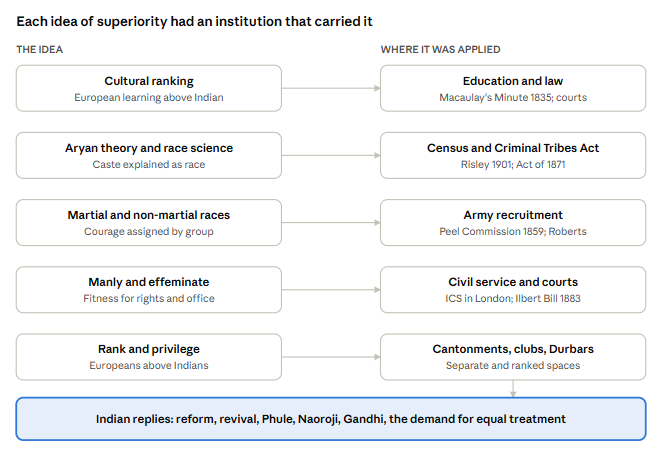
Read across each row: an idea on the left, the institution that carried it on the right, and below them the Indian replies.
4. Roots of the assertion of superiority
The belief in cultural and racial superiority came from several streams of European thought. A student should know where each came from.
Enlightenment stage theories. Eighteenth-century writers, such as Montesquieu, Adam Smith and the Scottish historians, described a progress through stages from savagery to commercial civilisation. Europe stood at the top by definition. This gave a basis for ranking other societies, since any society could be placed on the scale by its way of making a living and its laws. For India, the scale turned difference into backwardness. In an answer, give this as the intellectual base of the whole idea of a ladder.
Early encounters and travel writing. Accounts by traders, missionaries and travellers described India as a land of idolatry, despotism and strange customs. These accounts were used by writers such as James Mill who never visited India. The effect was that a few reports, often hostile or partial, became the standard picture. This shows how second-hand knowledge fed a firm judgement, and it is a useful point for source-based questions.
Evangelical judgement of Indian religion. Evangelical writers, such as Charles Grant, described Hindu and Muslim practice as morally degraded, and urged its reform. This gave a religious form to the sense of superiority, since Christianity was held to be the higher faith. It also supplied the missionary schools with their aims. For exams, link this root with the Charter Act of 1813 and with the note on the civilizing mission.
Utilitarian and liberal ranking. James Mill and later J. S. Mill held that societies could be judged by their laws and by their capacity for self-government, and found that Indian society was not ready for representative government. J. S. Mill’s view in On Representative Government (1861) that some peoples were not ready for such rule is the best-known case. The effect was that liberal principles were put aside for the colonised. Use this to show how a liberal idea supported inequality.
Philology and the Aryan theory. The discovery of the link among Sanskrit, Greek and Latin led to the idea of a family of languages and then of an Aryan race. Max Müller and others spread it, and colonial writers used it to link Europeans with the upper castes. The step from a family of languages to a race was a leap that scholars later rejected. In an answer, state both the origin of the theory and its weakness.
Race science and social Darwinism. Writers on race, such as Arthur de Gobineau, and the popularisers of Darwin, such as Herbert Spencer, held that peoples differed in inborn capacity and that struggle ranked them. Measurement of skulls and bodies, called anthropometry, was given the prestige of science. This moved the claim from custom, which can change, to blood, which was said to be fixed. It prepared the ground for Risley’s surveys in India.
Imperial culture at home. The press, schools, exhibitions and fiction in Britain taught the public to see empire as a mark of national greatness and as a duty, and gave political support to the belief. The Great Exhibition of 1851 and later imperial shows displayed colonial peoples as objects to be viewed. A student can use this root to explain why the belief was strong even among those who never saw India.
| Root | Main figures | Contribution |
|---|---|---|
| Stage theories | Montesquieu; Adam Smith | Ranked societies; Europe at the top |
| Travel and trade accounts | Travellers; missionaries | Images of idolatry and despotism |
| Evangelical thought | Charles Grant | Religious judgement of Indian society |
| Utilitarian and liberal thought | James Mill; J. S. Mill | Capacity for self-government as a test |
| Philology | Max Müller; William Jones | Aryan family of languages |
| Race science | Gobineau; Spencer | Inborn difference; struggle as a ranking |
5. Cultural superiority
The claim of cultural superiority was made in language, learning, religion, custom and the position of women. A student should know the main examples.
English and the shelf of books. In the Minute of 2 February 1835, Macaulay held that a single shelf of a good European library was worth the whole native literature of India and Arabia. Bentinck’s resolution of March 1835 accepted that education funds should go to English, and English also replaced Persian as the language of the courts in 1837. The effect was that learning in Sanskrit, Arabic and Persian lost state support, while English became the key to jobs. In an answer, quote the idea, give the dates, and add that the policy produced the class that later led the national movement.
The judgement of Indian history and religion. James Mill’s History (1817) described Hindu society as marked by caste, priestcraft and superstition, and Muslim rule as cruel, and he judged both by a standard of European progress. His scheme of Hindu, Muslim and British periods framed the schoolbook account of the past, and it later fed the idea of two separate communities. For exams, note that this book was used to train civil servants, so its judgements reached the men who ruled.
Missionary criticism. Missionaries such as Alexander Duff attacked Hindu and Muslim belief as false and called for conversion. Their schools and writings put a religious form on the claim of superiority. At the same time, missions opened schooling to groups that had been shut out, so their record is mixed. Link this point with the Charter Act of 1813 and with the reform movements that replied.
The position of women as a test. Colonial writers argued that the treatment of women, in sati, child marriage and seclusion, showed that Indian society was backward. The rescue of women became a reason for rule, though British law did not always improve their position. The Age of Consent Act of 1891 and the debates around it show how cautious the state became once opposition grew. A good answer states the claim and then tests it against the record.
Unequal law. Europeans were tried by European judges, and Indians could not try them until the Criminal Law Amendment Act of 1884, which followed the Ilbert Bill controversy. Even then the right to a jury with a majority of Europeans kept the old privilege. The principle of equality before law was in practice qualified by race. For NET and UPSC, this is the best example of a gap between a stated principle and its working.
Education as a means of making a class. Macaulay’s plan to form an English-educated class of interpreters, Indian in blood and colour but English in taste and opinions, tied cultural superiority to a policy for Indian elites. The approach drew educated Indians into the system and kept them subordinate within it. Its irony, which examiners like, is that the class so made used English ideas of rights to demand equality.
Orientalist admiration and its limits. Some British scholars, such as William Jones, praised Sanskrit and the classical past. But they often held that present Indian society had declined from that past, and that it needed British guidance. Admiration of the past did not remove the claim of superiority in the present. In an answer, use this point to show that cultural superiority was not always crude contempt.
Public display of hierarchy. Durbars, titles, honours and seating at ceremonies, such as the Delhi Durbars of 1877, 1903 and 1911, ranked Indians in relation to the Crown. Bernard Cohn has described this as the use of ceremony to express an imagined order. Princes were given gun salutes by rank, which turned status into a public, measurable scale. This shows that hierarchy was acted out as well as argued.
| Area | Example | Claim of superiority |
|---|---|---|
| Language and learning | Macaulay’s Minute (1835) | European literature worth more than Indian |
| History | James Mill (1817) | Indian society placed low on the scale of progress |
| Religion | Missionary writing; Duff | Hindu and Muslim belief held to be false or degraded |
| Women | Debates on sati and child marriage | Backward society needing guardianship |
| Law | Ilbert Bill (1883) and the Act of 1884 | Europeans kept under European judges |
| Ceremony | Durbars 1877, 1903, 1911 | Indians ranked under the Crown |
6. Race theory and classification
In the later nineteenth century, cultural judgement was joined by racial science. A student should know the main theories and how the state used them.
The Aryan theory. From the late eighteenth century, scholars found that Sanskrit, Greek, Latin and other languages were related. Max Müller and others spoke of a common Aryan family, and many writers took the Aryans to be a race that had come into India from the north-west. Colonial writers used this to explain caste as the result of the meeting of lighter Aryans and darker natives, and to link the British with the upper castes. Thomas Trautmann has traced this in Aryans and British India (1997). In an answer, state the claim, name Trautmann, and add that the racial form of the theory is no longer accepted.
Anthropometry and Risley. Herbert Risley, in The Tribes and Castes of Bengal (1891) and The People of India (1908), used measurements, such as the nasal index, to arrange castes in a scale of racial type, and held that caste ranks reflected race. He directed the Census of 1901, which tried to rank castes by social precedence. The effect was that castes began to petition the state for higher rank. This is a standard example in NET answers on the making of caste.
The census as a tool of classification. The census of 1871, 1881 and later years asked questions about religion, caste, tribe and occupation. Nicholas Dirks, in Castes of Mind (2001), argues that colonial rule fixed caste as a single ranked system through these methods. This argument is debated, since other writers hold that caste had deep older roots. A balanced answer gives Dirks first and then the objection, so that the student does not take a side too early.
Tribes and criminal castes. The Criminal Tribes Act of 1871 listed whole groups as criminal by birth, and placed them under surveillance. It rested on the belief that crime ran in the blood of certain groups. The Act was repealed in 1952, and the groups were later called denotified tribes. The example is valuable because it shows a racial idea turned directly into law, with lasting harm to the groups concerned.
Racial types and ethnography. Surveys such as the Ethnographic Survey of India, the Gazetteers and the writings of officials like Edgar Thurston, in Castes and Tribes of Southern India (1909), described Indian groups by type. They gave a veneer of science to stereotypes. Because the writers were officials, their descriptions were also used in recruitment and policing. Link this with the discussion of colonial knowledge in the next sections.
Effects on Indian society. Scholars hold that classification gave groups an interest in rank and numbers, and so strengthened identities of caste and community. Nationalists and lower-caste movements later used the same categories for their own claims, as in the demand for reservation. The point to stress is that categories made by the state did not stay in the hands of the state. Indians used them, and changed them.
Doubts and criticism. Racial science was challenged even in its own time, and later research on genetics and language rejected the idea of fixed races. The Aryan theory, in its racial form, is no longer accepted by most scholars, though debates on the origins of Indo-European languages continue. A student should end the section on this note, to show that the theory is studied now as history and not as truth.
| Idea or tool | Source | Use |
|---|---|---|
| Aryan theory | Max Müller; philologists | Explained caste; linked British and upper castes |
| Anthropometry | Risley (1891, 1908) | Ranked castes by physical type |
| Census | 1871; 1881; 1901 | Fixed castes and religions as categories |
| Criminal Tribes Act | 1871; repealed 1952 | Criminality by birth |
| Ethnographic surveys | Thurston (1909); Gazetteers | Described groups by type |
7. Martial races and the army
The Army was the place where racial thinking was turned into a rule of recruitment. A student should know the idea, its dates and its effects.
After 1857. The revolt of 1857 began in the Bengal Army. Afterwards, the British reorganised the Army. They reduced the share of high-caste soldiers from Awadh and Bihar, increased the share of European troops, and sought recruits from groups which had stayed loyal or helped to put down the revolt, such as Sikhs, Gurkhas and some Punjabi Muslims. The reason was fear, and the test of loyalty became the test of race. For exams, present 1857 as the starting point of the whole doctrine.
The Peel Commission of 1859. The Commission on the organisation of the Indian Army led to a policy of mixing castes and communities in regiments, and keeping a proportion of European troops, with a plan of balance so that no one group could rebel with ease. The method is often called divide and balance. It shows that the Army was designed for control as well as for war, which is a useful point in a critical answer.
The doctrine of martial races. In the later nineteenth century, officers such as Lord Roberts, Commander-in-Chief from 1885 to 1893, argued that some groups were naturally brave and fit for war, and others, such as Bengalis and the people of the South, were not. Recruitment moved to Punjab, the North-West Frontier, Nepal and a few other areas. Gurkha recruitment was also increased. The fear of Russia on the frontier gave the doctrine a practical reason, and the fear of a second revolt gave it a political one.
Evidence and method. The doctrine rested on ethnographic writing and the opinions of officers, and used racial and climatic explanations. Later scholars, such as Heather Streets in Martial Races (2004), show that it was a construction in which British ideas of masculinity and race were joined with the needs of control. In an answer, say that the evidence was weak, since the supposed qualities of a group were drawn from the groups that had been recruited, which made the argument circular.
Exclusion of Indians from command. Indians could not hold the King’s Commission as officers until the 1910s and after. Indian cadets were first admitted to Sandhurst in the 1910s, and the Indian Military Academy at Dehra Dun was set up in 1932. The argument was that Indians lacked the qualities of command. The result was that Indian soldiers served under British officers for decades, and the demand for Indian officers became a nationalist issue.
Effects on regions and communities. The doctrine tied Punjab’s economy to the Army, increased the weight of Punjabi Muslims and Sikhs in the forces, and made the Army unrepresentative of the country. This had effects after 1947, when the division of the Army had to follow the division of the country. A student can use this to link a colonial idea with a modern outcome.
Images that followed. The labels martial and non-martial became common in popular speech and in later politics, and influenced the self-image of groups. Many Bengali and other groups resented the label of unfit for arms, and nationalists, such as the later Indian National Army, set out to disprove it. The point shows how a label made by rulers becomes part of how people see themselves.
Variations in practice. In emergencies, such as the First World War, the Army recruited more widely. The doctrine was thus applied with some flexibility, and practical needs sometimes outweighed theory. A critical answer should note this, because it shows that the doctrine was a policy tool and not a settled science.
| Element | Date | Content | Effect |
|---|---|---|---|
| Reorganisation after 1857 | 1858 onwards | Fewer high-caste Bengal Army recruits; more Europeans | Control of the Army |
| Peel Commission | 1859 | Mixed regiments; European share kept | Balance policy |
| Martial races doctrine | 1880s onwards | Roberts and others favour Punjabis, Sikhs, Gurkhas | Narrow recruitment |
| King’s Commission | Opened slowly from the 1910s | Few Indian officers | Exclusion from command |
| Indian Military Academy | 1932 | Training of Indian officers | Late opening |
8. Racial hierarchy in everyday colonial life
Superiority was not only an idea. It shaped how Europeans and Indians lived, travelled, were judged and were paid. A student should know the main examples.
Cantonments and civil lines. Cities had separate European areas, with wide roads, bungalows and clubs. Indian quarters were treated as crowded and unhealthy. This physical separation was defended on grounds of health and order, and it expressed the gap of rank. Funds for drains, roads and water went more readily to the European area. In an answer, use this to show that the hierarchy shaped the plan of the town itself.
Clubs and social life. European clubs excluded Indians, except as servants and, much later, a few guests. The rule was one of the most resented signs of racial distance, and was strongly criticised by Indian writers. Even educated Indians who held high posts were kept out. This showed that learning and rank did not remove the barrier, which is why the matter hurt the English-educated class most.
Railways and public places. Railway compartments were divided by class and often by race, and Indians frequently met insults from Europeans. Gandhi’s ejection from a first-class compartment at Pietermaritzburg in South Africa in 1893, though outside India, is often cited as an example of this wider pattern. Examiners accept it as an illustration, if the student notes that the event was in South Africa. The point is that racial distance marked even travel.
Courts and the Ilbert Bill. In 1883, the Law Member, Courtenay Ilbert, proposed a Bill to allow Indian judges and magistrates in the districts to try European British subjects. European residents, especially in Bengal, mounted a strong protest, and the Bill was changed in 1884 so that European defendants could demand a jury with a majority of Europeans. The episode showed the strength of racial feeling and also awakened Indian opinion, and is linked with the formation of the Congress in 1885. It is among the most asked examples in this topic.
Violence and leniency. Cases in which Europeans who killed or hurt Indians received light sentences, such as the reaction to many assaults and, later, the Jallianwala Bagh massacre of 13 April 1919 and General Dyer’s support among some Europeans, showed the unequal value placed on lives. These cases caused deep resentment. A student should handle them with care, give dates and facts only, and avoid strong language.
Office, pay and the services. The Indian Civil Service, with examinations held in London, and age limits that made it hard for Indians to enter, kept high posts largely European. Satyendranath Tagore was the first Indian to enter, in 1863. The pay and leave of European officers were higher than those of Indians in similar posts. The Congress demand for simultaneous examinations in India arose from this grievance, so the point links well with Indian responses.
The Vernacular Press Act. The Act of 1878 applied only to newspapers in Indian languages, and is seen as a sign of unequal treatment of Indian opinion. It was repealed in 1881. The English-language press, mostly European, was left outside its reach. In an answer, name the Act, its date and its repeal, and say what kind of unequal treatment it showed.
Gender and the colonial household. Manuals for European wives, and the picture of the memsahib, show how the home was used to draw lines between rulers and ruled, and how fears about sexual contact led to rules on conduct. Scholars such as Ann Stoler have studied this across colonial empires. This point shows that racial hierarchy reached into private life, and it allows a student to add a gender angle to an answer.
| Area | Example | How hierarchy appeared |
|---|---|---|
| Housing | Cantonments; civil lines | Separate European areas |
| Social life | European clubs | Exclusion of Indians |
| Courts | Ilbert Bill (1883, 1884) | Right to be tried by Europeans |
| Civil service | ICS examinations in London | Few Indians entered high posts |
| Press | Vernacular Press Act (1878) | Unequal treatment of Indian-language papers |
| Violence | Jallianwala Bagh (1919) | Unequal value placed on lives |
9. Stereotypes and colonial knowledge
Claims of superiority were carried by stereotypes and by the production of knowledge. A student should know the main images and the scholars who study them.
Said and the idea of the Orient. Edward Said argued that Western scholarship and literature presented the East as unchanging, irrational, sensual and despotic, in contrast to a rational, progressive West, and that these images served the work of rule. His book dealt mainly with the Middle East. For India, it is used as a model, and a student should say that its use here is by extension. The main merit of the idea is that it links writing with power.
Ronald Inden. In Imagining India (1990), Inden argued that Indology pictured India as ruled by religion and caste, with a mind that was dreamy and irrational, and denied Indians a capacity for action. He held that this was a way of showing India as the opposite of Europe. His work is a direct application of Said’s idea to Indian studies, so the two should be given together in an answer.
The effeminate Bengali. Mrinalini Sinha showed, in Colonial Masculinity (1995), that British officials, from the nineteenth century, described educated Bengalis as effeminate, and Englishmen as manly. The image was used in the Ilbert Bill debate, in arguments against Indian self-government, and later in the politics of the martial races. The Bengali response was to take up physical culture and, in some cases, revolutionary action. This is a strong example for a question on stereotypes and gender.
The image of the tribal and the criminal. Colonial accounts described tribal groups as primitive, and some castes as criminal by birth. These images shaped laws, such as the Criminal Tribes Act, and policies of forest control and settlement. Because the image was fixed, the state treated the groups as problems of order rather than as citizens with claims. A student can link this with the later demand for the rights of denotified tribes.
The image of the village. Writers such as Henry Maine, in Village Communities in the East and West (1871), and the Gazetteers presented the Indian village as an unchanging, self-sufficient unit. This image supported ideas that India was stagnant and needed outside direction. Later research shows that villages changed with trade, revenue and migration. In an answer, give the image and then the correction.
Bernard Cohn and colonial knowledge. Cohn argued that surveys, the census, museums and histories made India knowable to the rulers and served as instruments of command. He studied the way language, dress and ritual were used to express authority. His Colonialism and Its Forms of Knowledge (1996) is the standard source. For NET, remember the phrase colonial forms of knowledge, as it is often set as a question.
C. A. Bayly’s qualification. In Empire and Information (1996), Bayly argued that colonial knowledge was built partly on Indian sources and networks, so that the picture of an all-knowing colonial state is overdrawn. The rulers depended on Indian scribes, pandits and informants, who shaped what was known. The point is useful for a critical answer, since it corrects the view that colonial knowledge was a purely British invention.
Women and the image of the oppressed Indian woman. The stereotype of the Indian woman as a victim, in works such as Katherine Mayo’s Mother India (1927), was used to argue against self-government. Indian women’s groups and nationalists criticised the book strongly, and Gandhi called it a drain inspector’s report. The case shows that the stereotype was used in the politics of the day, not only in scholarship.
Assessment. The study of stereotypes shows how knowledge and rule supported each other, but it has also been criticised for treating British writers as a single block, and for giving too little attention to Indian agency and to the variety of British views. A student should end a long answer with this balance, since it shows that the approach is a useful tool and not a final verdict.
| Stereotype | Source or example | Use |
|---|---|---|
| The Orient as inferior | Said (1978) | Justified rule through contrast |
| India as irrational and caste-bound | Inden (1990) | Denied Indian agency |
| Effeminate Bengali | Sinha (1995); Ilbert Bill | Argued against equal rights |
| Criminal by birth | Criminal Tribes Act (1871) | Surveillance of groups |
| Unchanging village | Maine (1871) | Image of a stagnant society |
| Oppressed woman | Mayo, Mother India (1927) | Argued against self-government |
10. Indian responses and scholarly critiques
Indians answered the assertion of superiority in thought and in politics, and scholars have since studied and criticised it.
Reformers and the reply of reason. Ram Mohan Roy, Vidyasagar and others argued that Indian society could reform itself from within its own traditions, and that Indians were as capable of reason as Europeans. They accepted parts of the colonial critique, such as that of sati, while rejecting the claim of inborn inferiority. In an answer, show that the reformers answered the charge of backwardness by action, and that their method was to use texts and reason.
Revivalist pride. Dayananda Saraswati, Vivekananda and others answered the charge of backwardness by pointing to the glory of the Vedic and spiritual past. This restored confidence, though it sometimes took over the idea of a fixed national essence. Vivekananda’s speech at Chicago in 1893 is the best-known example. A student can note the risk that revival accepted the colonial picture of a spiritual East.
Phule and the turning of the Aryan theory. Jotirao Phule, in Gulamgiri (1873), argued that the Aryans were conquerors who had enslaved the original people, and that Brahminical rule was therefore a foreign domination. This turned the colonial theory against the upper castes, and influenced later non-Brahmin movements. For exams, it is the key example of how a racial theory was reversed by those it was meant to rank low.
Economic and political critique. Dadabhai Naoroji, in Poverty and Un-British Rule in India (1901), and R. C. Dutt exposed the drain of wealth, and argued that the British had broken their promises of equal treatment. The Ilbert Bill episode and the demand for Indianisation of the civil service gave this a political base. The critique answered the hierarchy with figures and with the rulers’ own promises, which made it hard to dismiss.
The demand for Indianisation. The Indian Association, the Congress and others demanded simultaneous examinations for the Indian Civil Service in India, and the opening of the officer ranks of the Army to Indians. The Indianisation of the services was taken up slowly from the 1910s and 1920s. The demand tested the claim that Indians were unfit for high office, and the slow pace showed how firm the barrier was.
Gandhi, Tagore and the critique of the West. Gandhi’s Hind Swaraj (1909) rejected the claim of Western civilisation to superiority, and Tagore’s lectures on Nationalism (1917) criticised the arrogance of the West. Both argued for the dignity of Indian tradition while criticising its faults. In an answer, use them to show that the reply moved from asking for equality to questioning the standard of measurement.
Anti-colonial writers abroad. Frantz Fanon, Aimé Césaire and others wrote on race and colonial rule in other empires, and their work has influenced later study of India. Fanon’s The Wretched of the Earth (1961) and Césaire’s Discourse on Colonialism (1950) are the main texts. A student can mention them briefly to show a wider frame, without claiming that they wrote on India.
Scholarly critiques. Said, Inden, Cohn, Dirks, Sinha, Trautmann and Metcalf have studied how the assertion of superiority was made and used. Their work has drawn objections: some say that it treats the colonial state as all-powerful, that caste and religion had older roots than the colonial construction suggests, and that it neglects Indian agency. In an answer, state the strength of the approach and then the three objections.
Defences and revisionist views. Some writers, such as Niall Ferguson, argue that the British Empire also spread ideas of law and liberty that Indians themselves later used against it, and that views among the British were mixed. A student should present the debate with evidence and not take sides. This shows the examiner that the answer is balanced and based on reading.
| Respondent | Position | Main point |
|---|---|---|
| Ram Mohan Roy; Vidyasagar | Reform | Reason and reform from within Indian tradition |
| Dayananda; Vivekananda | Revival | Pride in a spiritual past |
| Jotirao Phule | Social critique | Aryan theory turned against upper castes |
| Naoroji; R. C. Dutt | Economic critique | Drain; broken promises |
| Congress and Indian Association | Constitutional | Indianisation of services |
| Gandhi; Tagore | Civilisational critique | Against Western claims to superiority |
| Said; Inden; Sinha; Dirks | Post-colonial scholarship | How the hierarchy was constructed |
| Ferguson and others | Revisionist | Mixed views; the legacy of law and liberty |
11. Importance and limitations of the study of cultural and racial superiority
Importance
Explains how unequal rule was defended. It shows why Indians were said to be unfit for self-government and high office, and how a hierarchy was used to justify unequal law and pay. Without this idea, the exclusion of Indians from the officer ranks and the top services would appear as chance. The Ilbert Bill episode is a clear example. In exams, use this point for questions on the justification of colonial rule.
Links belief with institutions. It connects ideas with the Army’s recruitment, the census, the Criminal Tribes Act, the civil service and the courts, and so shows how belief became policy. A student who can name the idea and the institution together gives a stronger answer than one who lists beliefs alone. The diagram in section 3 is built on this link.
Shows the role of race in colonial rule. It explains how racial science, the Aryan theory and the martial races doctrine shaped what the state did and how Indians were seen. Race is often thought to be a topic for Africa or America, so this point corrects that view for India. It is useful in comparative questions.
Explains the roots of nationalist resentment. The Ilbert Bill, exclusion from clubs and office, and racial violence gave Indians daily reasons to criticise the Raj, and fed the early Congress’s demands. Feelings of insult, joined with economic grievance, made a broad base for politics. This links the topic with the rise of the Congress in 1885.
Throws light on caste and community identities. It shows how colonial classification gave caste and religion new fixity, and how these categories later entered politics. Risley’s census and the system of separate representation in 1909 are examples. The point matters for questions on the making of communal and caste politics, though the extent of the colonial role is debated.
Reveals the link between knowledge and power. Study of stereotypes, surveys and ethnography shows how knowledge was used to rule, and how it affected Indian self-understanding. Cohn’s work is the main source. For NET, this is a core theme, since many questions ask how colonial knowledge worked.
Connects with gender history. The contrast of manly and effeminate, and the use of the condition of women in the argument, give a main route into the history of gender under colonial rule. Sinha’s study and the debate on Mother India are examples. This allows a student to write on gender without leaving the main topic.
Supplies concepts for post-colonial study. Orientalism, racial classification, stereotypes and the colonial archive are tools used in many fields. A student who understands them can read literature, law and anthropology with the same terms. They also appear often in the UGC NET paper.
Explains Indian answers. Reform, revival, Phule’s critique, the economic critique and Gandhi’s civilisational critique can be understood as replies to claims of superiority. The topic therefore gives a base for the later units on nationalism. A student can use it to show that Indian thought was a response and also a creation.
Trains critical reading. The topic teaches students to read official records, manuals and literature for the assumptions they contain. Risley’s tables and Macaulay’s Minute are good practice texts. The skill helps in source-based questions and in any research on the colonial period.
Limitations
Risk of treating the British as one block. British views varied by person, class and period, and some officials and liberals criticised racial arrogance. Missionaries often differed from officials, and politicians in London differed from the men on the spot. A student who describes all of them as holding one view will lose accuracy. The remedy is to name the person and the period.
Gap between theory and practice. Racial ideas were not always applied in a consistent way, and practical needs often overruled them, as in the wartime recruitment of the Army. Indians held posts of authority as clerks, judges and revenue officers. So the hierarchy cannot be taken as a complete rule of conduct, and an answer should mention exceptions.
Overstating colonial construction. Claims that caste or religious identity were largely made by colonial rule are disputed, since earlier forms of hierarchy and identity existed. Dirks’s argument is strong but not final. A student should give the view and the objection, and avoid saying that the British invented caste.
Indian agency. A study of the ideology alone may leave out how Indians used, adapted and resisted the categories. Phule and the lower-caste movements show that Indians made active use of colonial classification. If agency is left out, Indians appear as passive. A balanced answer includes both.
Sources. Most evidence comes from official and elite records, and says little about how ordinary people met these ideas. Census tables and ethnographies were written by the rulers. Oral history and vernacular writing can partly fill the gap, though they are harder to find.
Hard to measure effect. It is difficult to show how far beliefs shaped decisions, compared with cost, security and politics. The martial races doctrine, for example, had a racial basis and also a military and fiscal one. A student should avoid saying that ideas alone caused a policy.
Uneven coverage. Most studies deal with Bengal, Punjab and the north, and less is known of the South, the North-East and the princely states. The experience of tribal areas and of the hills also differed. General statements may not hold in all regions, so examples should be chosen with care.
Present-day heat. The subject touches on live questions of caste, community and identity, and a student must separate evidence from political argument. A neutral tone, careful words and clear sources are the best protection. This is especially important in examinations, where marks go for balance.
Terminology. Terms such as race, caste and tribe changed meaning over time, and using them without care can mislead. The word race, for instance, was used in the nineteenth century for nations, religions and castes alike. A student should explain the sense in which a term is used in each source.
Changing scholarship. New work on anthropology, law and the army keeps revising earlier claims. A view that was standard in the 1990s may now be qualified. For this reason, a student should note the date of a book and read more than one author.
Illustrations
| Illustration | Event or text | What it shows |
|---|---|---|
| Cultural ranking | Macaulay’s Minute (1835) | European learning placed above Indian |
| Ranking of civilisations | James Mill (1817) | Indian society placed low |
| Racial classification | Risley (1891, 1908) | Castes ranked by physical type |
| Criminality by birth | Criminal Tribes Act (1871) | Groups treated as criminal |
| Martial races | Peel Commission (1859); Roberts | Race in army recruitment |
| Racial feeling | Ilbert Bill (1883, 1884) | Resistance to equal treatment |
| Counter-argument | Phule, Gulamgiri (1873) | Aryan theory turned against upper castes |
12. Using this topic in examinations
What examiners expect
| Question type | What to do | Key points to include |
|---|---|---|
| Define cultural and racial superiority | Define, give an example of each | Macaulay 1835; Risley; Aryan theory |
| Discuss racial classification | Name the tools | Census; Risley; Criminal Tribes Act 1871 |
| Martial races | Give dates and effects | Peel Commission 1859; Roberts; Punjab |
| Everyday racial hierarchy | Give examples | Ilbert Bill 1883; clubs; ICS |
| Critically examine | Give claims and critiques | Phule; Naoroji; Said; Sinha; Dirks; revisionists |
| Short note | One idea with a date | Aryan theory; Ilbert Bill; martial races |
Practice questions
- Explain how ideas of cultural and racial superiority shaped British rule in India.
- Discuss the Aryan theory and its use in colonial thought.
- Examine the martial races theory and its effects on the Army and on Indian society.
- What was the Ilbert Bill controversy and what did it show about racial attitudes?
- How did the census and ethnography contribute to racial classification in India?
- Examine Indian responses to claims of racial and cultural superiority.
- Write short notes on: (a) Risley and the nasal index, (b) the Criminal Tribes Act, (c) the stereotype of the effeminate Bengali.
Structured outline for a long answer
Introduction. Define cultural and racial superiority, and state that they supported unequal rule and were expressed in policy and daily life.
Body. Describe the roots, cultural claims, race theory and classification, the martial races doctrine, daily racial hierarchy, stereotypes and colonial knowledge, and the Indian responses.
Conclusion. State that the assertion of superiority gave a basis to unequal rule, that it was contested and not uniform, and that its effects on categories and politics outlasted colonial rule.
Sample answer (about 200 words)
Question: Examine the martial races theory in colonial India.
The martial races theory was the colonial belief that some Indian groups were naturally brave and fit for war, and others were not. After the revolt of 1857, which began in the Bengal Army, the British reorganised the Army: they raised the share of European troops, mixed castes and communities in regiments, as the Peel Commission of 1859 advised, and looked for recruits among groups that had stayed loyal, such as Sikhs, Gurkhas and some Punjabi Muslims. In the 1880s, officers such as Lord Roberts argued that Bengalis and the people of the South were unfit for arms, and recruitment moved to Punjab, the Frontier and Nepal. The doctrine used racial and climatic explanations drawn from ethnography. Scholars such as Heather Streets show that it was a construction, joining British ideas of masculinity with the needs of control. Indians were kept from the officer ranks for long, and the Indian Military Academy was founded only in 1932. The doctrine tied Punjab to the Army and made the forces unrepresentative of the country. Nationalists, and those who were excluded, rejected the label and sought to disprove it.
13. Critical analysis
Belief and policy. A main question is how far ideas of superiority guided decisions, and how far policy followed cost and security. The evidence shows both. The martial races doctrine and the Ilbert Bill episode show belief at work, while wartime recruitment and the use of Indian officials show practical limits. A careful answer says that belief and need often pointed the same way, which is why the hierarchy lasted.
From culture to race. British thought moved in the later nineteenth century from the belief that Indians could be improved by education to a belief in lasting, inborn difference. This shift, which Metcalf traces, helps to explain the hardening of attitudes after 1857. The contrast between Macaulay’s Minute and Risley’s surveys can serve as the two ends of the change. Link this with the note on the civilizing mission.
Science and prejudice. Racial science gave prejudice the prestige of scholarship. Later research on genetics, language and anthropology has rejected the idea of fixed races, which shows how a belief held as scientific could be later set aside. A student can use this to show why scientific claims should be tested, and why authority alone is not proof.
Construction of categories. The census, ethnography and law gave castes, tribes and religions a fixity and a rank. Historians differ on whether this created them or sharpened older forms, and a careful answer should present both views. Dirks and his critics, such as Susan Bayly, are the standard pair to cite.
Stereotypes and masculinity. The contrast of manly and effeminate shaped army recruitment, civil rights and the picture of the educated Bengali. It also created a response among Indians, who tried to show courage and strength. Physical culture societies and revolutionary groups in Bengal are examples. The point shows that a stereotype could produce effects on the group it described.
Indian agency. Indians turned the colonial categories to their own ends. Phule reversed the Aryan theory, nationalists used the Ilbert Bill episode, and lower-caste movements used census categories. They also at times took over parts of the colonial scheme. The result was a mixed legacy, in which resistance and borrowing went together.
Variation among the British. Not all British writers held the same views. Some, like Hume and some Liberals in Britain, criticised racial arrogance, and missionaries often differed from officials. A student should avoid describing the British as one block. Naming a dissenting person or group is a simple way to show this.
Comparative frame. Similar hierarchies appeared in other empires, in the French, Dutch and American cases and in the history of slavery, so that the Indian case is part of a wider pattern. A short comparison shows what was shared and what was special to India, such as the role of caste and the Aryan theory.
Legacy. The categories of caste and community fixed in colonial classification, the images of martial and non-martial groups, and the habit of ranking cultures still affect debates on identity, reservation and history, which is why the topic matters beyond the colonial period. A closing sentence of this kind shows the examiner that the student sees the present relevance of the past.
Model concluding paragraph
The assertion of cultural and racial superiority gave British rule in India a hierarchy on which unequal law, office and rights could rest. It drew on Enlightenment stage theories, Evangelical judgement, Utilitarian ranking and, later, racial science and the Aryan theory, and it was expressed in the preference for English, the census and ethnographic classification, the martial races doctrine, segregation and stereotypes such as that of the effeminate Bengali. It was not uniform, since British views differed and practical needs often limited theory. Indians answered it through reform, revival, Phule’s reversal of the Aryan theory, the economic critique, the demand for equal treatment and Gandhi’s critique of Western civilisation. Scholars show that the categories it produced outlasted colonial rule, and a balanced study explains the hierarchy, its evidence and its limits without taking its claims as true.
14. UGC NET: key authors and books
| Author | Book | Year | Relevance |
|---|---|---|---|
| James Mill | The History of British India | 1817 | Ranking of civilisations |
| T. B. Macaulay | Minute on Indian Education | 1835 | Cultural superiority in education |
| Jotirao Phule | Gulamgiri | 1873 | Aryan theory turned against Brahmins |
| Herbert Risley | The People of India | 1908 | Racial ranking of castes |
| Katherine Mayo | Mother India | 1927 | Image of the oppressed Indian woman |
| Edward Said | Orientalism | 1978 | Orient as inferior opposite |
| Ronald Inden | Imagining India | 1990 | Critique of Indology |
| Mrinalini Sinha | Colonial Masculinity | 1995 | Manly and effeminate |
| Thomas Trautmann | Aryans and British India | 1997 | Aryan theory |
| Nicholas Dirks | Castes of Mind | 2001 | Caste and colonial classification |
| Heather Streets | Martial Races | 2004 | Army and race |
| Thomas Metcalf | Ideologies of the Raj | 1994 | Shift from likeness to difference |
| Bernard Cohn | Colonialism and Its Forms of Knowledge | 1996 | Colonial knowledge |
| C. A. Bayly | Empire and Information | 1996 | Indian base of colonial knowledge |
Revision tip. Make a two-column table with Idea and Institution, and fill it with the Aryan theory and philology, the census and the Criminal Tribes Act, the martial races doctrine and the Army, the Ilbert Bill and the courts, and the Indian Civil Service and the demand for Indianisation.
15. Key takeaways, sources and further reading
Key takeaways
- Cultural superiority judged Indian law, religion, learning and custom by British standards.
- Racial superiority treated difference as inborn, and gained the look of science in the later nineteenth century.
- Roots lay in Enlightenment stage theories, Evangelical judgement, Utilitarian ranking, philology and race science.
- The Aryan theory, Risley’s anthropometry, the census and the Criminal Tribes Act turned ideas into classification.
- The martial races doctrine, after 1857 and the Peel Commission of 1859, shaped Army recruitment.
- The Ilbert Bill controversy of 1883 and daily segregation showed racial feeling in practice.
- Stereotypes, such as the effeminate Bengali, and colonial knowledge supported the hierarchy.
- Indians answered through reform, revival, Phule’s reversal of the Aryan theory, economic critique and Gandhi’s critique of the West.
- British views were not uniform, and the categories produced have outlasted colonial rule.
Official sources
- Constitution of India, Legislative Department
- National Archives of India
- Ministry of External Affairs, Government of India
- Lok Sabha, Constituent Assembly Debates
Twenty books for further reading
- Edward Said, Orientalism.
- Thomas Metcalf, Ideologies of the Raj.
- Mrinalini Sinha, Colonial Masculinity: The Manly Englishman and the Effeminate Bengali.
- Thomas Trautmann, Aryans and British India.
- Nicholas Dirks, Castes of Mind: Colonialism and the Making of Modern India.
- Ronald Inden, Imagining India.
- Bernard Cohn, Colonialism and Its Forms of Knowledge: The British in India.
- C. A. Bayly, Empire and Information.
- Heather Streets, Martial Races: The Military, Race and Masculinity in British Imperial Culture.
- Ann Laura Stoler, Race and the Education of Desire.
- Susan Bayly, Caste, Society and Politics in India from the Eighteenth Century to the Modern Age.
- Sumit Sarkar, Modern India, 1885 to 1947.
- Ashis Nandy, The Intimate Enemy: Loss and Recovery of Self under Colonialism.
- Partha Chatterjee, The Nation and Its Fragments.
- Gauri Viswanathan, Masks of Conquest: Literary Study and British Rule in India.
- Jotirao Phule, Gulamgiri.
- Dadabhai Naoroji, Poverty and Un-British Rule in India.
- M. K. Gandhi, Hind Swaraj.
- Anand Yang (ed.), Crime and Criminality in British India.
- Niall Ferguson, Empire: How Britain Made the Modern World.
Editorial note
These notes are prepared for study and revision. Readers should check facts, dates and quotations against the original sources before citing them. For corrections or suggestions, please use the contact page. See also the disclaimer.
Frequently asked questions
What is the Aryan theory? It is the nineteenth-century idea of a common Aryan family or race of Europeans and Indians, which colonial writers used to explain caste and to link the British with the upper castes.
What was the martial races theory? It was the colonial belief that some groups were naturally fit for war and others were not, used in army recruitment after 1857.
What was the Ilbert Bill? It was a Bill of 1883 to let Indian judges try European British subjects, which met strong European protest and was changed in 1884.
What did Risley do? He used body measurements to rank castes and tribes in racial types, and directed the Census of 1901.
How did Indians answer claims of superiority? Through reform, revival, Phule’s reversal of the Aryan theory, the economic critique, the demand for equal treatment and Gandhi’s critique of Western civilisation.
How should a student write on this topic? With dates, names, examples, the roots of the ideas, Indian responses and scholarly critiques, in a neutral and analytical tone.


