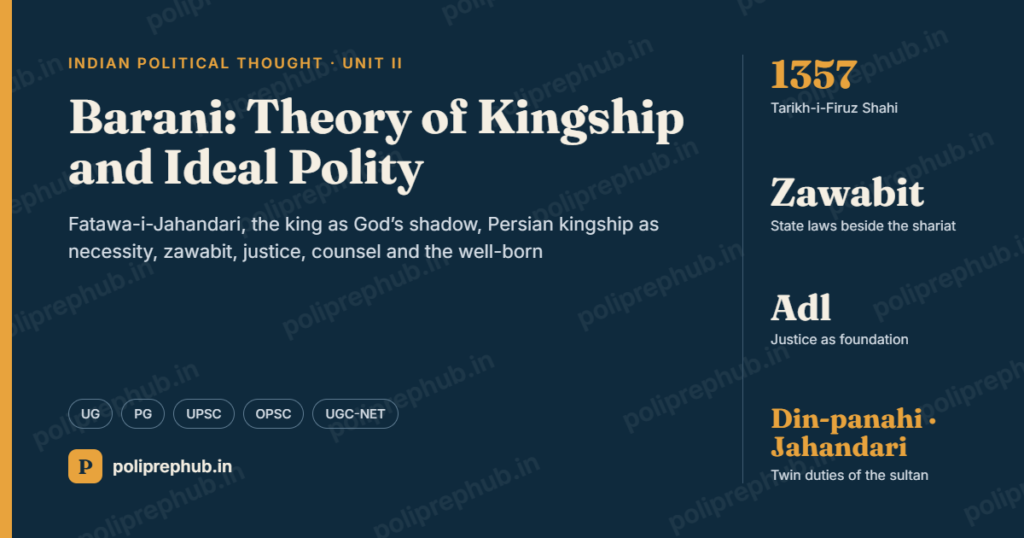
Ziauddin Barani (c. 1285–1357) is the most important political thinker of the Delhi Sultanate. A historian, courtier and moralist, he tried to answer a question that troubled Muslim rulers in India: how can a Muslim king rule a vast, mostly non-Muslim country in accordance with Islam, while also doing what is necessary to keep power? His answer — a theory of kingship that combines the Islamic shariat with Persian traditions of monarchy and the ruler’s own state laws (zawabit) — makes him a key figure in medieval Indian political thought.
Life and Works
- Barani was born at Baran (modern Bulandshahr, UP) in a family of the nobility (his father and grandfather had served the Khalji sultans).
- He was a friend of the poet Amir Khusrau and the Sufi saint Nizamuddin Auliya.
- He served as a nadim (boon companion and adviser) at the court of Sultan Muhammad bin Tughlaq (1325–51) for about seventeen years.
- Under Firuz Shah Tughlaq he fell from favour, was imprisoned for a time, and spent his last years in poverty, writing his major works partly to win back royal patronage.
Major works:
- Tarikh-i-Firuz Shahi (completed c. 1357) — a history of the Delhi Sultanate from Balban to the early years of Firuz Shah. It is not a mere chronicle but history as moral instruction: kings who followed religion and justice prospered, those who did not fell.
- Fatawa-i-Jahandari (“Rulings on Temporal Government”, c. 1358–59) — his main work of political theory, written in the form of advice (nasihat) given by Sultan Mahmud of Ghazni to his sons. It belongs to the “mirrors for princes” tradition of Persian literature. It was translated into English by Mohammad Habib and Afsar Umar Salim Khan in The Political Theory of the Delhi Sultanate (1961).
- Other works include Sana-i-Muhammadi, Salvat-i-Kabir and Hasrat-nama.
Theory of Kingship
Necessity of kingship
Barani starts from a pessimistic view of human nature: men are by nature selfish, greedy and quarrelsome; without a ruler, the strong would oppress the weak and there would be chaos. Hence kingship is necessary for order, justice and the protection of religion. Religion and government are “twin brothers”: religion cannot survive without the protection of a king, and kingship has no legitimacy without religion.
The king as God’s vicegerent
- The king is the shadow of God on earth (zill-allah) and His vicegerent (naib). His heart is “in the hands of God”.
- He therefore deserves obedience, and rebellion against him is a sin.
- But this divine position carries a duty: the king is accountable to God for protecting religion and doing justice. Kingship is a trust (amanat).
The dilemma: kingship versus the Prophet’s way
Barani faces a deep problem. The Prophet and the pious Caliphs lived in poverty and humility. Kingship as practised by Muslim sultans — with its pomp, luxury, court ceremony, prostrations before the throne and absolute power — was borrowed from the Sasanian (Persian) emperors like Jamshed and Khusrau (Chosroes). Barani admits that these practices are contrary to the sunna (the Prophet’s way) and are in a sense sinful.
Yet he argues that a Muslim ruler cannot govern without them: without awe (haibat), majesty (rob) and grandeur, a king cannot command obedience, overawe rebels, or protect Islam in a land where Muslims are a minority. So Barani accepts a necessary compromise:
- Kingship in the Persian style is a necessary evil, a kind of “lesser sin”, justified because it serves religion.
- The king must compensate for this by being sincerely devoted to religion, enforcing the shariat, protecting the faithful, punishing heresy, and practising humility and repentance in his private life.
This reconciliation of Islamic ideals and Persian monarchical practice is the central feature of Barani’s thought.
Din-panahi and jahandari
The king has two broad functions:
- Din-panahi — protection of religion: enforcing the shariat, supporting the ulema, suppressing heresy and “philosophers” (rationalists), and promoting Islam;
- Jahandari — worldly government: administration, justice, revenue, army, conquest (jahangiri) and the welfare of subjects.
Barani holds that the purpose of jahandari is to serve din-panahi: worldly power must be used for religious ends.
Qualities of the ideal king
The ideal king (Barani’s model is Mahmud of Ghazni, and to some extent Balban and Alauddin Khalji in administration) should:
- be a sincere Muslim, devoted to the shariat, and fear God;
- be just (adil): justice is the foundation of kingship; injustice brings ruin;
- possess courage, generosity, forbearance and self-control;
- maintain awe and dignity (haibat and rob) so that nobles and subjects fear him;
- consult wise and pious advisers (mashwara), while taking final decisions himself;
- keep away from low-born and irreligious people;
- be vigilant through spies and informers;
- show repentance for the un-Islamic aspects of royal life.
Barani’s Ideal Polity
Barani’s “ideal polity” is an Islamic state governed by a pious, just and powerful sultan, guided by the shariat and supplemented by state laws. Its main features:
Shariat and zawabit
- The shariat (Islamic law based on the Quran, Hadith and the consensus of jurists) is the supreme law.
- But the shariat does not provide for every administrative need of a large empire. Therefore the king may issue zawabit — state laws or regulations made by the ruler in consultation with his advisers, to meet the needs of the time.
- Conditions for zawabit: they must not contradict the shariat; they must be made for the public good; and they should be framed after consultation. Where necessity demands, a ruler may even act against the letter of the shariat, but must repent.
- The concept of zawabit is Barani’s most original contribution: it recognises a sphere of secular, state-made law within an Islamic framework — similar in spirit to Kautilya’s rajashasana.
Justice (adl)
Justice is the foundation of the ideal polity. The king must ensure that the strong do not oppress the weak, that officials are honest, and that complaints are heard. A kingdom may survive with unbelief (kufr), Barani says, echoing a well-known maxim, but not with injustice.
Counsel (mashwara)
The king must rule through consultation with wise, experienced, pious and loyal counsellors. Barani lists qualities of good advisers and warns against flatterers and “low-born” men. Consultation prevents arbitrary rule, though the king remains the final authority.
Aristocracy of birth
One of the most distinctive (and criticised) features of Barani’s polity is his insistence that only the high-born (ashraf) should hold offices of state. He divides society into the well-born (nobles, scholars, old families of foreign Muslim origin) and the low-born (ajlaf or arzal — artisans, converts from lower classes). Teaching the low-born to read and write, or giving them office, would, he argues, ruin the state. He criticised Muhammad bin Tughlaq for appointing low-born men to high posts.
Attitude to non-Muslims
Barani’s polity is intolerant: he urged the sultan to suppress Hindu chiefs, impose jizya and other burdens, and keep Hindus economically weak and politically subordinate; he regretted that the sultans could not enforce Islamic law fully because Hindus were so numerous. Historians note that actual sultans (including Muhammad bin Tughlaq) were often more pragmatic than Barani recommended.
Economic and administrative order
- Barani praised Alauddin Khalji’s market regulations (price control, fixed prices of grain and goods, control of hoarding) as measures that ensured cheap food for soldiers and subjects.
- He recommended a strong, well-paid army, efficient revenue collection, honest officials, and an effective intelligence system (barids).
- The king should suppress rebellions firmly, using punishment (siyasat) where needed.
Conquest and protection
The sultan should engage in jahangiri (conquest) and defend the realm, particularly against the Mongols. But expansion must not come at the cost of internal order and justice.
Barani’s ideal polity: a theocracy?
Scholars debate whether Barani’s state was a theocracy:
- For: it aims at the protection and promotion of Islam, gives an important role to the ulema, and discriminates against non-Muslims.
- Against: the sultan, not the ulema, holds sovereign authority; zawabit are secular state laws; Persian monarchical practices are accepted; and political necessity often prevails over religious law. Mohammad Habib argued that the Delhi Sultanate was in practice not a theocracy but a state governed by state laws, and that Barani’s own theory implicitly recognised this.
It is best described as a religiously oriented monarchy in which Islam provides legitimacy and goals, but the king’s power and state laws provide the means.
Critical Assessment
Contributions:
- A systematic Indo-Islamic theory of kingship combining Islamic law, Persian kingship and Indian realities.
- The concept of zawabit — recognition of state-made law alongside religious law.
- Emphasis on justice, consultation and good administration; awareness of the practical problems of governing a plural society.
- His Tarikh-i-Firuz Shahi is a major source for the history of the Sultanate and an early example of philosophy of history in India.
Criticisms:
- Aristocratic elitism: rigid exclusion of the low-born from education and office.
- Religious intolerance towards Hindus and towards Muslim rationalists and heretics.
- Internal contradiction between Islamic ideals and the acceptance of Persian kingship.
- His writings are coloured by personal bitterness and the desire for patronage; his account of Muhammad bin Tughlaq has been questioned.
Barani compared with Abul Fazl
| Point | Barani | Abul Fazl |
|---|---|---|
| Period | Delhi Sultanate (14th century) | Mughal Empire (Akbar, 16th century) |
| Main work | Fatawa-i-Jahandari; Tarikh-i-Firuz Shahi | Akbarnama; Ain-i-Akbari |
| Basis of kingship | God’s vicegerent; protection of Islam | Divine light (farr-i-izidi); king above sects |
| Religion | Islamic orthodoxy; intolerance of Hindus | Sulh-i-kul (universal peace); tolerance |
| Law | Shariat + zawabit | Royal authority above ulema (mahzar, 1579) |
| Society | Rule by high-born Muslims | Inclusive nobility (Rajputs, Persians, Turanis) |
Conclusion
Barani’s theory of kingship and ideal polity reflects the dilemma of Muslim rulers in medieval India: how to reconcile Islamic ideals with the realities of power in a predominantly non-Muslim land. His solution — a powerful, just sultan, ruling in the Persian style but devoted to Islam, supplementing the shariat with state laws, consulting wise advisers, and governing through a well-born elite — was both pragmatic and deeply conservative. His recognition of zawabit and of the necessity of state power marks an important step towards a more secular conception of government, even as his elitism and intolerance contrast sharply with the later Mughal ideal of Abul Fazl.
Quick Revision
| Concept | Key point |
|---|---|
| Dates | c. 1285–1357; courtier of Muhammad bin Tughlaq |
| Works | Tarikh-i-Firuz Shahi; Fatawa-i-Jahandari |
| Form of Fatawa | Advice of Mahmud of Ghazni to his sons (mirror for princes) |
| King | Shadow of God (zill-allah), vicegerent (naib) |
| Dilemma | Persian kingship un-Islamic but necessary |
| Functions | Din-panahi (protect religion) + Jahandari (govern) |
| Zawabit | State laws not contradicting shariat, for public good |
| Pillars | Justice (adl), counsel (mashwara), awe (haibat) |
| Society | Ashraf (high-born) vs ajlaf/arzal (low-born) |
| Admired | Alauddin Khalji’s market control |
Memory aid: Barani’s state = “S-Z-J-M” — Shariat + Zawabit, Justice, Mashwara.
Exam Practice
Long-answer questions
- Discuss Barani’s theory of kingship. How did he reconcile Islamic ideals with Persian traditions of monarchy?
- Explain Barani’s concept of zawabit and its significance.
- Describe the main features of Barani’s ideal polity.
- “Barani’s state was a theocracy.” Critically examine.
- Compare the political ideas of Barani and Abul Fazl.
Short-answer questions
- Name Barani’s two major works.
- What is the Fatawa-i-Jahandari?
- What is meant by zawabit?
- What are din-panahi and jahandari?
- What were Barani’s views on the high-born and low-born?
- Why did Barani consider Persian-style kingship necessary?
- Which Sultan’s market regulations did Barani praise?
- Who translated the Fatawa-i-Jahandari into English?
- What qualities did Barani want in the king’s counsellors?
- What role did justice play in Barani’s polity?
Multiple-choice questions
- Barani served at the court of: (a) Iltutmish (b) Balban (c) Muhammad bin Tughlaq (d) Akbar. Answer: (c)
- The Fatawa-i-Jahandari is presented as the advice of: (a) Alauddin Khalji (b) Mahmud of Ghazni (c) Balban (d) Firuz Shah. Answer: (b)
- State laws supplementing the shariat are called by Barani: (a) Zawabit (b) Siyasat (c) Fatwa (d) Mahzar. Answer: (a)
- According to Barani, the Persian model of kingship was: (a) Fully Islamic (b) Un-Islamic but necessary (c) To be rejected (d) Irrelevant. Answer: (b)
- Barani’s Tarikh-i-Firuz Shahi was completed in about: (a) 1325 (b) 1357 (c) 1398 (d) 1526. Answer: (b)
- Match the following: (A) Din-panahi – (B) Jahandari – (C) Haibat – (D) Mashwara. (1) Consultation (2) Protection of religion (3) Awe (4) Worldly government. Correct code: (a) A-2, B-4, C-3, D-1 (b) A-4, B-2, C-3, D-1 (c) A-2, B-3, C-4, D-1 (d) A-1, B-4, C-3, D-2. Answer: (a)
- Assertion (A): Barani’s state is not a pure theocracy. Reason (R): Barani allowed the sultan to make zawabit. (a) Both true, R explains A (b) Both true, R does not explain A (c) A true, R false (d) A false, R true. Answer: (a)
- Barani wanted state offices to be given to: (a) Hindus (b) The low-born (c) The well-born (ashraf) (d) The ulema only. Answer: (c)
- Barani was a disciple of the Sufi saint: (a) Moinuddin Chishti (b) Nizamuddin Auliya (c) Bakhtiyar Kaki (d) Salim Chishti. Answer: (b)
- The king as “shadow of God” is expressed by the term: (a) Zill-allah (b) Farr-i-izidi (c) Sulh-i-kul (d) Imam-i-adil. Answer: (a)
Suggested Readings
- Mohammad Habib and Afsar Umar Salim Khan, The Political Theory of the Delhi Sultanate (Kitab Mahal, 1961).
- Muzaffar Alam, The Languages of Political Islam: India 1200–1800 (Permanent Black, 2004).
- K. A. Nizami, Some Aspects of Religion and Politics in India during the Thirteenth Century (1961).
- Peter Hardy, Historians of Medieval India (Luzac, 1960).
- I. H. Qureshi, The Administration of the Sultanate of Delhi (1942).
- Himanshu Roy and M. P. Singh (eds.), Indian Political Thought: Themes and Thinkers (Pearson, 2017).