State and society in the Third World is the study of how the states of Asia, Africa, Latin America and the Caribbean were formed, how they work, and how they relate to the societies they govern. It asks why many of these states face weak authority, ethnic and religious divisions, poor delivery of services and frequent regime change, and why some, such as South Korea, Taiwan and, in its own way, India, have done better.
The subject is a core part of comparative politics. It joins the colonial inheritance, the theories of the post-colonial state, the nature of society, nation-building and the role of the state in the economy. Scholars such as Hamza Alavi, Joel Migdal, Partha Chatterjee, Mahmood Mamdani and Peter Evans have given the main concepts, and each is asked about regularly in examinations.
This note is written for students of UG, PG, OPSC, UPSC and UGC NET. It follows the usual order of a textbook: meaning, characteristics, theories, society, nation-building, the economy, regimes and cases, followed by exam guidance, a critical analysis and a reading list.
1. Meaning and definitions
The topic has four key terms: the state, society, the Third World, and the relation between the first two. The table gives the main writers at a glance. The paragraphs after it explain each idea in simple words. The wording is a paraphrase, so students should give the idea and not claim it as a word-for-word quotation.
| Writer | Work and year | Core idea | Position |
|---|---|---|---|
| Max Weber | Politics as a Vocation, 1919 | The state is the body that holds the legitimate monopoly of physical force in a territory | Classical sociology |
| Hamza Alavi | “The State in Post-Colonial Societies”, 1972 | The post-colonial state is overdeveloped, because it inherited a large machine that local classes cannot control | Marxist |
| Joel Migdal | Strong Societies and Weak States, 1988 | Many Third World states are weak because society has strong rival organisations that hold social control | State-in-society |
| Robert Jackson and Carl Rosberg | “Why Africa’s Weak States Persist”, 1982 | Many states survive because the world community gives them legal sovereignty, even without real capacity | International relations |
| Jean-François Bayart | The State in Africa: The Politics of the Belly, 1989 | Rulers and elites use the state to gain wealth and keep patronage networks | Africanist |
| Peter Evans | Embedded Autonomy, 1995 | A developmental state is autonomous from interest groups yet tied to society by networks | Institutionalist |
| Partha Chatterjee | The Politics of the Governed, 2004 | Most people in the Third World relate to the state through political society and not through civil society | Subaltern studies |
| Mahmood Mamdani | Citizen and Subject, 1996 | The colonial state split citizens from subjects, and this legacy shapes the present | Political scientist |
| Alfred Sauvy | “Trois mondes, une planète”, 1952 | First use of the term Third World for the countries outside the Western and Soviet blocs | Demographer |
| Immanuel Wallerstein | The Modern World-System, 1974 | The world economy has a core, a semi-periphery and a periphery, and Third World states lie mostly in the periphery | World-system theory |
The state
The state is a set of institutions, including the government, the civil service, the army, the police and the courts, that makes and enforces rules over a territory and its people. Weber’s definition is the starting point: the state is a human community that claims the monopoly of legitimate use of physical force within a territory. For the Third World, scholars add that the state is also the largest employer, the chief planner of the economy and the main source of patronage and wealth. Because of this, control of the state is the central prize of politics.
Society
Society is the whole set of social groups, classes, communities, associations and values within a territory. In the Third World, society is often plural. It contains many ethnic, religious, caste and language communities, a large rural and informal sector, and a thin layer of modern classes. Scholars such as J. S. Furnivall, who studied Burma and Java, called such societies plural societies, in which groups live side by side but meet only in the market.
The Third World
The term was first used by the French demographer Alfred Sauvy in 1952, who compared the poor countries to the Third Estate of the French Revolution, a group without power but with great potential. In the Cold War, the First World meant the capitalist West, and the Second World meant the Soviet bloc. The Third World meant the rest, mostly former colonies, and many joined the Non-Aligned Movement after the Bandung Conference of 1955. Today the term is often replaced by Global South, developing countries or low and middle income countries. The terms are loose, and scholars note that the group covers very different cases, from oil-rich Gulf states to the poorest states of the Sahel.
State-society relations
This phrase describes how the state and the groups of society affect each other. Some scholars, such as Alavi and the Marxists, see the state as shaped by class forces. Others, such as Migdal, see a struggle between the state and social organisations for the power to set the rules of daily life. Evans stresses that good outcomes need both state autonomy and links to society. In the Third World, the relation is often strained, because the state was built by outsiders and then handed over to new elites.
Scholar-wise definitions
The ideas below are in simple words, scholar by scholar. They are paraphrases, so give the idea with the name.
On the state
- Max Weber: the state is the human community that successfully claims the monopoly of the legitimate use of physical force within a given territory.
- Hamza Alavi: in post-colonial societies, the state is overdeveloped. It inherited a strong civil and military machine from the colonial rulers, and no single local class, whether the national bourgeoisie, the landlords or the foreign capitalists, is strong enough to control it. So the bureaucracy and army become relatively autonomous.
- Joel Migdal: the state is a field of power marked by the use or threat of force and by the image of a controlling organisation in a territory. In many Third World countries, strongmen, chiefs, landlords and other leaders of society keep their own rules and limit the state.
- Robert Jackson and Carl Rosberg: many African states are quasi-states. They have juridical statehood, meaning that others recognise their borders, but little empirical statehood, meaning real capacity to rule.
- Jean-François Bayart: the African state is a tool of the elite for gaining wealth and status, in a system he calls the politics of the belly.
- Peter Evans: a developmental state combines internal coherence, like a Weberian bureaucracy, with close links to industry and society. He calls this embedded autonomy.
- Theda Skocpol and Charles Tilly: the modern state is formed through war and the extraction of resources. Later writers, such as Jeffrey Herbst, argued that in Africa, low population density and few wars after independence made state-building harder.
On society
- J. S. Furnivall: a plural society is one where different communities live side by side, meet only in the market, and share no common will.
- Partha Chatterjee: in most of the world, only a small section of citizens belongs to civil society. The majority, the governed, belong to political society, where they bargain with the state for services and for the right to survive.
- Mahmood Mamdani: colonial rule created a bifurcated state, with citizens in the town under civil law and subjects in the countryside under customary law, and this pattern outlived the empire.
- Immanuel Wallerstein and Andre Gunder Frank: the poverty of Third World societies is related to their position in the world economy, as suppliers of raw materials to the rich core.
On the Third World
- Alfred Sauvy (1952): the Third World, like the Third Estate, is ignored and exploited, and wants to be something.
- Peter Worsley (The Third World, 1964): the term describes countries that took a neutral position in the Cold War and that share a colonial past and poverty.
- Bandung Conference (1955) and Non-Aligned Movement (1961): the Third World is a political bloc of states that refused to join either Cold War alliance.
Note to the student. In an answer, begin with a short definition of the state using Weber, explain that Third World states are former colonies, then name two or three theories (Alavi, Migdal, Evans) and one writer on society (Chatterjee or Mamdani). Add examples from India, Pakistan and Nigeria.
What the definitions share
All the writers agree that the Third World state cannot be understood without looking at colonial rule and at the society it governs. They differ on whether the state is too strong (Alavi), too weak (Migdal), captured by elites (Bayart) or capable of leading growth (Evans), and on whether society is a source of resistance, of support or of rivalry.
2. Characteristics of state and society in the Third World
The Third World is not one type, and exceptions exist for every point. But scholars find a common pattern, and each feature below is followed by a short example and a note on how to use it in an answer.
Colonial origin of the state
Most Third World states were created by colonial rule, or had their institutions remade by it. The bureaucracy, army, police, courts and tax system were built to rule and extract, and not to represent. After independence, new leaders inherited this machinery. The Indian Civil Service and the Indian Penal Code, and the French prefect system in West Africa, are examples. In an exam, this point is the first step of almost any answer, since it explains the later features.
Artificial borders and the gap between state and nation
Borders were drawn in European capitals, so many states contain several peoples, and some peoples are divided by borders. Nigeria joins Hausa-Fulani, Yoruba and Igbo areas, while the Kurds live in four states. Because the state came before the nation, leaders had to build national feeling from above. This is why nation-building is a central theme in the study of the Third World.
Weak state capacity in many cases
Many states cannot collect taxes, keep order in all of their territory or deliver basic services. Migdal calls them weak states, and Jackson and Rosberg call them quasi-states. In Somalia after 1991 and in parts of the Congo, the central state has hardly reached the countryside. Students should note that strength varies. India and Brazil have far more capacity than Chad or Haiti, so the word weak should be used with care.
An overdeveloped state beside a weak civil society
Alavi’s key point is that the state inherited a large machine, while local classes were too young to control it. The military and bureaucracy therefore became powerful actors in their own right. In Pakistan and Bangladesh, the army and civil service have often led politics. This explains why coups were common in the 1960s and 1970s, and links the topic to the study of military rule.
Plural and divided society
Society is split by ethnicity, religion, caste, language and region, and these lines often overlap with economic differences. In Lebanon, Sri Lanka, Nigeria, Sudan and India, such divisions have shaped party systems and conflicts. Divisions are not in themselves a cause of violence. Violence arises when the state or leaders organise politics around them, as colonial rulers did with census categories and separate electorates.
Politics of patronage and personal rule
In many states, formal rules are weaker than personal ties. Leaders keep power by sharing jobs, contracts and favours with followers, a system called patron-client politics or neo-patrimonialism. Jackson and Rosberg described personal rule in Africa, and Bayart described the politics of the belly. Examples are Mobutu’s Zaire and many one-party regimes. In an answer, link this to corruption and weak institutions, but also note that patronage can win support and keep peace.
Dependence on the world economy
Most Third World economies began with a narrow base of primary exports, such as cotton, minerals, coffee or oil, and relied on foreign capital and technology. Dependency theorists such as Frank, Amin and Cardoso argued that this limits growth. The case of Zambia and its copper, and of Nigeria and its oil, show how swings in world prices can shake a state’s budget. The East Asian cases show that dependence is not a fate, so a balanced answer mentions both.
Large informal economy and mass poverty
A large part of the workforce works in farming or in informal trade, without contracts, tax records or social security. This limits the tax base of the state and the reach of its laws. In India, more than four-fifths of workers are in the informal sector according to national surveys, and the pattern is similar in much of Africa and South Asia. Chatterjee’s idea of political society is built on this fact: the poor bargain with the state outside formal law.
Central role of the state in development
After independence, states took on the task of planning and leading development, through public enterprises, five-year plans and import substitution. India’s planning model after 1951, Egypt under Nasser, Tanzania’s ujamaa and Brazil’s state-led industrialisation are examples. The results were mixed, and the debt crisis of the 1980s led to liberalisation. The point links the topic to the political economy of development.
Frequent regime instability
Many Third World states have seen coups, civil wars, one-party rule and returns to elections. In Africa, there were dozens of successful coups between 1960 and 1990. Huntington’s argument in Political Order in Changing Societies (1968) is that rapid social change, with weak institutions, produces disorder, and that political order must come first. The waves of democratisation in the 1980s and 1990s changed this, but hybrid and authoritarian regimes remain.
Mixed legitimacy and the role of the nationalist movement
The leaders who won freedom, such as Nehru, Nkrumah, Nasser and Sukarno, gained great legitimacy and used it to build the state. When the founding leader or party weakened, legitimacy often had to be rebuilt on a new basis, such as performance, religion or ethnicity. India’s Congress system and the long rule of the African National Congress after 1994 are examples of a party that grew out of the freedom struggle. In an exam, this helps to explain why dominant-party systems are common.
The influence of external powers
The Cold War, then aid, loans and conditions from rich states and institutions, shaped the choices of many governments. The USA and the Soviet Union backed friendly regimes, for example in the Congo, Iran in 1953, Chile in 1973 and Afghanistan in the 1980s. The IMF and World Bank’s structural adjustment programmes of the 1980s and 1990s reduced the room for state policy. This feature joins the topic to neo-colonialism and dependence.
Rise of civil society and new social movements
Alongside the state, many societies have strong movements and associations, from the Chipko and Narmada movements in India to the trade union struggle in South Africa and the Landless Workers’ Movement in Brazil. They press the state for rights and accountability, and in some cases helped to end authoritarian rule. Students should mention that civil society is uneven, since it covers mainly the educated and urban classes, as Chatterjee notes.
3. Types and paths at a glance
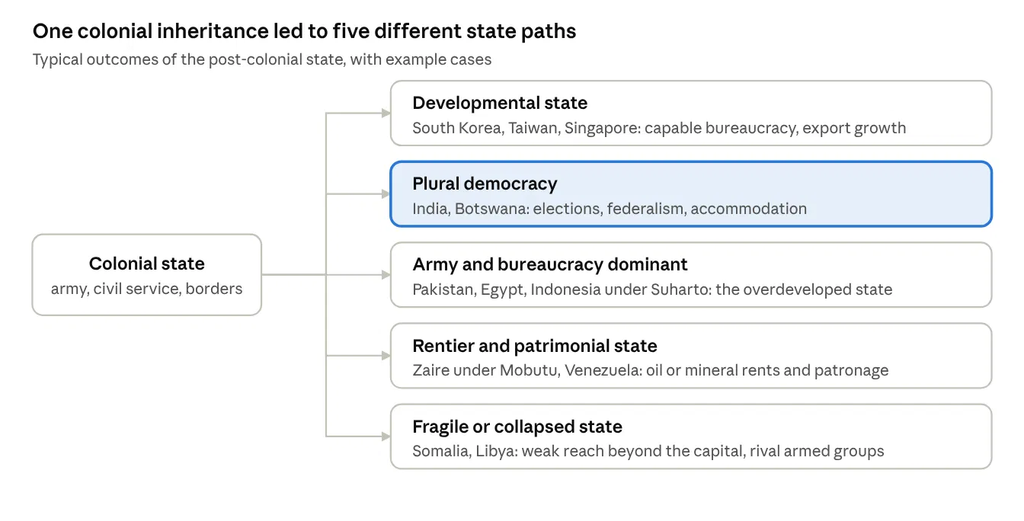
The picture shows that most Third World states began with the same colonial machinery but followed different paths, depending on their institutions, society and place in the world economy. The highlighted path is the one most examined in Indian papers. Sections 4 to 10 explain each part.
4. The idea of the Third World and the colonial inheritance
To understand the state and society of the Third World, one must start with how the group of states came to exist, and what they received from the empires that ruled them.
Origin and meaning of the term
Alfred Sauvy coined the term in 1952, in an article in the French magazine L’Observateur. In the early Cold War, the world was split between the capitalist bloc led by the United States and the communist bloc led by the Soviet Union. The newly independent states of Asia and Africa did not wish to join either. At the Bandung Conference of 1955, leaders such as Nehru, Nasser, Sukarno, Zhou Enlai and U Nu gave this group a political voice. The Non-Aligned Movement followed at Belgrade in 1961, led by Nehru, Tito, Nasser, Nkrumah and Sukarno. The Group of 77 was formed in 1964 in the United Nations to press for trade and development.
The term has been criticised. It suggests a ranking, with the Third World as third best, it joins very different states, and it lost its Cold War meaning after the Soviet collapse in 1991. Many writers now use Global South, which stresses a position in the world economy and not a bloc.
Shared features of the group
Three things were common to most of these states: a colonial past, low income and a position of weakness in the world economy, and the task of building a new state and nation together with economic development. These were not the same in every case. Latin American states became independent in the early nineteenth century and had long periods of rule by local elites, so their history differs from that of Asia and Africa.
The colonial state
Colonial states were built for control and extraction. Their features were:
- Centralised and authoritarian rule. The governor was responsible to the metropole, not to the people.
- A strong bureaucracy, army and police, and weak representative bodies.
- Law and order as the main task, with little attention to welfare.
- Separate rules for rulers and ruled, often by race.
- A narrow economic role, supporting exports of primary goods and the interests of the ruling country.
Mamdani describes the “bifurcated state” of Africa, where urban areas were ruled by civil law and rural areas by chiefs under customary law. Alavi’s overdeveloped state is a related idea. In India, the same machinery, with its district collector, its police and its laws of control, was passed on in 1947, and the Constitution of 1950 placed it under democratic control.
Colonial policies that shaped society
Colonial rulers made fixed categories out of fluid groups through the census, land records and law. They favoured some groups in the army and civil service, such as the Tutsi in Rwanda or the so-called martial races in British India. They encouraged cash crops and plantations, created new landlord classes, and brought in labour from other regions, such as Indians to Fiji, Mauritius, Malaya and Guyana. These steps changed the balance among communities and are among the roots of later conflicts.
The transfer of power and its effect on the new state
How independence was won shaped the new state. Where freedom came through a long mass movement, as in India, the leaders had experience in organising and in democratic politics, and the party became a basis of the new order. Where it came through armed struggle, as in Algeria and Vietnam, the army and the liberation party often held power afterwards. Where it came quickly and with little preparation, as in the Belgian Congo in 1960, the new state lacked trained officials and fell into crisis within weeks. Partition in India, and the divisions in Palestine, Cyprus and Korea, left permanent disputes.
The colonial inheritance in summary
| Inheritance | Effect on the post-colonial state and society |
|---|---|
| Centralised bureaucracy and army | Strong state machine, frequent military and civil service influence |
| Arbitrary borders | Weak national unity, secession and border conflicts |
| Fixed ethnic and religious categories | Politics organised around identity |
| Export-oriented economy | Dependence on a few primary products |
| Narrow educated elite | Gap between the elite and the masses |
| Limited representative institutions | Weak habit of democracy in many states, with India as a strong exception |
5. Theories of the post-colonial state
Scholars have offered several theories to explain the nature of the state in the Third World. A good answer names the theory, its author, its main claim and one criticism.
Modernisation and political development view
In the 1950s and 1960s, writers such as Gabriel Almond, Lucian Pye and David Apter treated the new states as moving from traditional to modern forms. They looked for political development, which meant a more differentiated structure, greater capacity and wider participation. Samuel Huntington, in Political Order in Changing Societies (1968), argued instead that rapid mobilisation without strong institutions leads to political decay, and that a strong party or army may be needed to keep order. Critics said that this view copied Western history and gave too little weight to colonialism and inequality.
Dependency and world-system view
Andre Gunder Frank, Samir Amin, Fernando Henrique Cardoso and Immanuel Wallerstein argued that the Third World state is part of a world capitalist system in which the periphery is held back by the core. The state, on this view, serves the interests of local elites who are tied to foreign capital. Cardoso and Faletto spoke of dependent development, in which some growth is possible, as in Brazil. Critics said that the theory cannot explain the rise of East Asia, and neglects local politics.
Alavi: the overdeveloped state
Hamza Alavi, in his essay of 1972, argued that the colonial state was created to serve the metropolitan bourgeoisie and to control the colonial society. After independence, three classes competed: the metropolitan bourgeoisie, the indigenous bourgeoisie and the landed classes. None of them could dominate, so the bureaucratic-military oligarchy gained relative autonomy and became an arbiter among them. He used the case of Pakistan and Bangladesh. Critics say that the thesis fits South Asia best, and that it has less to say on states where the military was weak.
Migdal: strong societies and weak states
Joel Migdal, in Strong Societies and Weak States (1988), asks why many states fail to reach their goals. His answer is that in societies with scattered social control, local strongmen such as landlords, clan leaders and bosses hold the keys to survival for ordinary people. They resist the state’s attempt to change the rules. Leaders respond by making deals with them, which weakens the state further. He later developed this into the state-in-society approach (State in Society, 2001), in which the state and social forces shape each other and neither is fixed.
Jackson and Rosberg: quasi-states and personal rule
Robert Jackson (Quasi-States, 1990) argued that after 1945, the international rule of non-intervention and the right of self-determination kept weak states alive, since their borders were protected by the world community. Jackson and Rosberg described four types of personal rule in Africa: princely, autocratic, prophetic and tyrannical. Critics say that the idea of quasi-state is too negative and ignores the legitimacy that some governments hold.
Bayart and neo-patrimonialism
Jean-François Bayart wrote that the African state is not an outside imposition but has been taken over by elites who use it for accumulation, in a way he called the politics of the belly. Neo-patrimonialism, a term from Weber’s ideas of patrimonial rule, describes a system in which formal rules exist but real power is in personal networks. Critics, such as Thandika Mkandawire, argue that this idea is overused and cannot explain differences among African states.
Herbst and Tilly: why state-building is hard
Charles Tilly argued that war made states in Europe and states made war. Jeffrey Herbst, in States and Power in Africa (2000), noted that in Africa, land was plentiful and people were few, and that colonial borders were fixed at independence, so rulers had less need to build a strong tax-based state to fight rivals. This is an example of how historical and geographical factors enter the theory.
Evans: embedded autonomy and the developmental state
Peter Evans, in Embedded Autonomy (1995), compared the states of South Korea, Brazil and India. He found that South Korea had a coherent, meritocratic bureaucracy, which gave it autonomy, and close ties with industrial groups, which gave it information and support. He called this embedded autonomy. Brazil had some, and India less. Chalmers Johnson (MITI and the Japanese Miracle, 1982) and Alice Amsden, Robert Wade and Atul Kohli developed the idea of the developmental state, which is linked to the next sections on the economy.
Chatterjee and Mamdani: the colonial legacy in politics
Partha Chatterjee argued that postcolonial political life is divided between civil society, made up of citizens with rights, and political society, made up of the poor who get benefits from the state by organised pressure. Mamdani showed that the legacy of indirect rule survives in the divide between citizen and subject. Both stress that the political forms of the West cannot simply be copied.
Comparing the theories
| Theory | Writer | Main claim | Chief weakness |
|---|---|---|---|
| Political development | Almond, Pye, Huntington | States move from traditional to modern; order needs strong institutions | Western bias; ignores colonialism |
| Dependency | Frank, Amin, Cardoso | The state serves local elites tied to the core | Cannot explain East Asia |
| Overdeveloped state | Alavi | Inherited machine is not controlled by any one class | Best fits South Asia |
| Strong societies, weak states | Migdal | Social strongmen limit state reach | Less on strong states |
| Quasi-state, personal rule | Jackson, Rosberg | Recognition by others keeps weak states alive | Too negative |
| Neo-patrimonialism | Bayart | State is a means of elite accumulation | Overused for all Africa |
| Embedded autonomy | Evans | Capable state needs autonomy plus social ties | Hard to copy elsewhere |
| Political society | Chatterjee | The poor deal with the state outside civil society | Mainly drawn from India |
6. Society in the Third World
Society shapes the state as much as the state shapes society. This section describes the main social forces and the ways scholars have studied them.
Ethnicity, language and religion
Ethnic, linguistic and religious identities are often the main basis of political groups. Writers differ on whether such identities are primordial, meaning old and deep, or constructed, meaning shaped by politics and colonial rule. Benedict Anderson and Eric Hobsbawm stressed construction, and Clifford Geertz, in his essay on the integrative revolution (1963), spoke of primordial attachments of blood, language and religion that compete with loyalty to the civil state. Examples include Hindu-Muslim relations in South Asia, the Hutu-Tutsi divide in Rwanda, and the Sunni-Shia lines in Iraq and Lebanon. Rajni Kothari and Paul Brass showed that elites use these identities to win votes and resources, so conflict is often about power and not only about culture.
Caste and class
In South Asia, caste is a social system that shapes politics. Kothari spoke of the caste system in politics, in which caste groups take part in elections and parties. Class is also present: landlords, rich peasants, an urban middle class, industrial workers, the urban poor and a large peasantry. Marxist writers such as Alavi, and Barrington Moore in Social Origins of Dictatorship and Democracy (1966), looked at the role of landed classes and peasants in shaping regimes. Studies by Pranab Bardhan on the dominant proprietary classes in India link class to the economy.
Patron-client networks
In weakly institutionalised politics, citizens often look for protection and services from a patron such as a landlord, a chief, a boss or a party leader, and give votes and loyalty in return. In India, the machine politics of local brokers, and in Latin America the clientelism of party bosses, are examples. Clientelism can bring in the poor, but it also ties them to the patron and weakens rights-based politics.
Plural society and consociational responses
Furnivall’s plural society describes groups meeting only in the market, as in colonial Burma. Arend Lijphart’s consociational democracy, from his study of the Netherlands and later Lebanon and other cases, suggests that deeply divided societies can keep democracy through power sharing among elites: grand coalitions, mutual veto, proportionality and group autonomy. Nigeria’s federal character principle and India’s federalism and reservations are related efforts. Donald Horowitz argued for incentives that encourage cross-ethnic voting, as in electoral rules that reward broad appeal.
Civil society and political society
Civil society is the sphere of voluntary associations, media, unions and movements between the family and the state. In the Third World, civil society helped to end authoritarian rule in places such as the Philippines (1986), South Korea (1987), South Africa and Latin America. But Chatterjee argues that civil society in postcolonial states belongs mainly to a small group of educated, mostly urban citizens. The majority, who live on the margins of legality, such as squatters, street vendors and unauthorised settlers, deal with the state through political society. They claim benefits as members of a population and as vote-holders, and the state responds by granting concessions, not by recognising rights. This concept is among the most asked topics in UGC NET and PG examinations.
Citizen and subject
Mamdani, in Citizen and Subject, shows that in Africa, colonial rule split the population. Settlers and urban natives were governed by a modern civil law, which made them citizens. The rural majority was ruled by customary law through chiefs, which made them subjects. Independence ended race-based rule but often left the rural-urban divide in place. Post-independence regimes either tried to reform it, as the radical states did, or accepted it, as the conservative states did. Mamdani adds that this explains why ethnic politics and local despotism persist.
Gender and the social order
Women in many Third World states face unequal access to land, education and office. At the same time, women played a large role in freedom movements and now in social movements, as in the Chipko movement in India and the Green Belt Movement of Wangari Maathai in Kenya. Reserved seats in local bodies in India, introduced by the 73rd and 74th Amendments (1992), are a notable policy response.
Rural and urban worlds
The rural sector holds a large share of the population in many states, and peasants have been central to revolutions, such as in China, Vietnam and Cuba, and to democratic politics, such as in India. Urbanisation has swelled cities such as Lagos, Dhaka and Mumbai, with large slums. These changes alter the basis of political parties and of demands on the state.
The informal economy
A large part of employment is in small, unregistered work. Hernando de Soto argued that the poor hold assets that lack legal title. The size of this sector limits state taxes, and shapes how the poor deal with officials, through bribes, brokers and political patrons.
Social movements and new politics
From the 1970s, movements for the environment, women, tribal rights, farmers and human rights grew. The Chipko and Narmada Bachao Andolan in India, the Zapatistas in Mexico, the landless workers of Brazil and the anti-apartheid movement in South Africa are cited as examples. Scholars such as Rajni Kothari and Ashis Nandy treated these as an alternative form of politics outside the party system, and others see them as pressure on the state for accountability.
7. Nation-building and state-building
The first task of new states was to turn a territory and a population into a nation and a working state. Scholars separate the two, though in practice they overlap.
State-building and nation-building
State-building is the creation of effective institutions: a bureaucracy, army, tax system, courts and the ability to enforce rules across the territory. Nation-building is the growth of a shared identity and loyalty above local ones. In Europe, the state mostly came first and built the nation slowly, over centuries, through schools, conscription and markets. In the Third World, both had to be done together and quickly, in a world of mass politics.
The crises of political development
In the series of studies by the Committee on Comparative Politics, including Leonard Binder, Lucian Pye, James Coleman, Sidney Verba, Joseph LaPalombara and Myron Weiner, in Crises and Sequences in Political Development (1971), the main challenges were set out as six crises:
| Crisis | Meaning | Example |
|---|---|---|
| Identity | Growth of a sense of belonging to the nation | Language and religious conflicts in Sri Lanka |
| Legitimacy | Acceptance of the right of rulers to rule | Coups and contested elections in Africa |
| Penetration | Reach of the state into the territory | Weak control in the Congo or Afghanistan |
| Participation | Demands of new groups to share in power | Mass politics in India and Latin America |
| Integration | Link between the governors and the governed, and among groups | Separatist movements in Nigeria (Biafra) |
| Distribution | Sharing of income and welfare | Land reform struggles |
The sequence in which the crises arrive, and whether they come together, shapes the outcome. Almond and Powell added the idea of state capabilities: extractive, regulative, distributive, symbolic and responsive.
Integration strategies
States have used different methods to build unity.
- Civic nationalism and a common ideology. The Indian Constitution builds on citizenship and secularism, and not on one religion or language.
- A national language or religion. Pakistan’s early choice of Urdu led to the language movement of 1952 in East Bengal, and Sri Lanka’s Sinhala Only Act of 1956 deepened conflict with Tamils.
- Federalism and autonomy. India reorganised its states on linguistic lines after 1956, which helped to ease tension. Nigeria increased its states from three regions to thirty-six. Ethiopia adopted ethnic federalism in 1995.
- Power sharing. Lebanon’s National Pact (1943) and the Taif Agreement (1989), and the 1994 constitution of South Africa, share power among groups.
- A single party and a strong leader. Tanzania under Nyerere used one party, a common language (Swahili) and the idea of ujamaa to build unity.
- Force and assimilation. Some states used the army and migration to control minorities, with mixed and often harmful results.
Secession and state failure
The attempts of regions to leave show the limits of integration. Bangladesh (1971) split from Pakistan after the denial of language and political rights to East Pakistan. Biafra (1967 to 1970) was defeated in a civil war. Eritrea became independent from Ethiopia in 1993, and South Sudan from Sudan in 2011. In other cases, such as Somalia after 1991, the state itself collapsed. The Organisation of African Unity decided in 1964 to keep colonial borders, and this rule has reduced border changes, even though it has been challenged.
Legitimacy of the new state
Legitimacy in the Third World has come from several sources. In the first years, it came from the nationalist movement and from charismatic leaders such as Nehru, Nasser and Nkrumah. Later it was sought through economic performance, elections, religion and ethnic claims. Weber’s three types of authority, traditional, charismatic and legal-rational, are useful here: many states combine them. When the leader dies or the economy fails, legitimacy must be rebuilt, which explains frequent crises.
Huntington’s argument on order
In Political Order in Changing Societies (1968), Huntington said that the gap between social mobilisation and institutional development produces instability. A rise in education, media and urbanisation increases demands, and if institutions are weak, the result is disorder, coups and revolution. His answer was a strong political party or other organisation that can absorb demands. This argument was used both to explain and to justify strong rulers, and critics have attacked it for favouring authoritarian rule.
The Indian experience
India is the largest case of state and nation-building under democracy. It used a strong constitution, universal suffrage from 1950, federalism, linguistic reorganisation, a secular state, reservations for the Scheduled Castes and Tribes and later other groups, and a mass political party. Failures and tensions also appeared: Partition, conflicts in Kashmir, the Northeast and Punjab, and communal violence. Scholars such as Rajni Kothari, Atul Kohli and Alfred Stepan have described India as a state-nation, in which many cultural communities are held together by shared political institutions and not by one culture.
8. State and economy
A main claim in the study of the Third World is that the state is the chief actor in development. The state planned, owned industry and controlled trade, and later it was asked to step back. The record shows great differences.
The early development state, 1950s to 1970s
After independence, most leaders believed that the market alone would not lift poor economies, and that colonial patterns of trade had to be changed. The common tools were:
- Planning. India’s Planning Commission (1950) and Five-Year Plans, the Soviet model, and plans in Egypt, Indonesia and Tanzania.
- Import substitution industrialisation (ISI). High tariffs and licences to protect new domestic industry. Latin America, led by thinkers such as Raul Prebisch and the UN Economic Commission for Latin America (ECLA), adopted it widely.
- Public sector. State ownership in steel, power, banks and heavy industry. India’s Mahalanobis model of the Second Plan (1956) gave priority to heavy industry.
- Land reform and cooperatives. Used with varying success, strong in South Korea, Taiwan and Japan, and weak in much of South Asia.
These policies achieved some industrial growth and built a base of technical skills, but they also brought inefficiency, rent-seeking by those who held licences, a shortage of foreign exchange and, in some cases, large debts.
The debt crisis and structural adjustment
In the 1970s, borrowing from international banks rose sharply, especially in Latin America and Africa. When interest rates rose and commodity prices fell in the early 1980s, a debt crisis began, starting with Mexico in 1982. The IMF and the World Bank offered loans on conditions known as structural adjustment programmes: cuts in government spending, removal of subsidies, privatisation, trade liberalisation and currency devaluation. Critics, such as Joseph Stiglitz, argued that these policies reduced the capacity of the state and hurt the poor. The set of ideas behind them came to be called the Washington Consensus, a phrase from John Williamson (1989).
The developmental state in East Asia
Japan, South Korea, Taiwan and later Singapore achieved rapid growth, and scholars call them developmental states. Chalmers Johnson described Japan’s Ministry of International Trade and Industry as a pilot agency. Alice Amsden (Asia’s Next Giant, 1989) and Robert Wade (Governing the Market, 1990) showed that the state in South Korea and Taiwan guided credit and investment, disciplined firms by export targets and protected selected industries. Features were a capable meritocratic bureaucracy, close but controlled ties with business, land reform, a strong focus on education and exports, and often an authoritarian political system. Evans’s concept of embedded autonomy explains why these states succeeded when others, with similar tools, did not.
The World Bank’s report The East Asian Miracle (1993) gave more credit to market-friendly policies, and the debate between the two views is a frequent exam theme.
Rentier and resource states
States that earn most of their income from oil, minerals or foreign aid, and not from taxing their citizens, are called rentier states (Hossein Mahdavy, Giacomo Luciani). Such states may spend freely and avoid pressure from society, which weakens the link between taxation and representation. Richard Auty and others spoke of the resource curse, in which rich resources go with slow growth and poor governance. Examples are Nigeria, Venezuela, the Gulf monarchies and Angola. Botswana, with diamonds, shows that the outcome depends on institutions.
Dependency and the world economy
Dependency writers argue that Third World states face unequal terms of trade, foreign control of technology and finance, and limits set by the world order. Wallerstein’s world-system theory gives the same view. The emergence of China and India as large economies, and of the newly industrialised countries, has led to debate about whether the old core-periphery picture still holds.
India: from planning to liberalisation
India is a mixed case. It used planning, a large public sector and licences from the 1950s, which brought a growth rate of about 3.5 per cent a year, often called the Hindu rate of growth, until the 1970s. Gradual changes began in the 1980s, and the balance of payments crisis of 1991 led to major liberalisation under Prime Minister P. V. Narasimha Rao and Finance Minister Manmohan Singh: removal of industrial licensing, lower tariffs, opening to foreign investment and reform of finance. Growth rose, and services, especially information technology, became leading sectors. But inequality, informal work and uneven regional growth remain, which leads to debate on the role of the state in welfare, as in schemes such as MGNREGA (2005) and the National Food Security Act (2013).
The state and welfare
Most Third World states spend a small share of income on welfare, and social protection reaches the formal sector more than the informal. Yet some have built important programmes, such as Brazil’s Bolsa Familia, Mexico’s Progresa and India’s rural employment guarantee. Scholars ask whether welfare in these states rests on rights, as in the European model, or on political bargaining and patronage, as Chatterjee suggests.
Comparing development paths
| Path | Main features | Examples | Outcome |
|---|---|---|---|
| Developmental state | Strong bureaucracy, export focus, land reform | South Korea, Taiwan, Singapore | Rapid growth |
| Import substitution and planning | Protection, public sector | India (to 1991), Brazil, Argentina, Egypt | Industry built, but inefficiency and debt |
| Socialist or ujamaa | Collectivisation, state control | Tanzania, Cuba, Vietnam before reform | Mixed; shortages |
| Resource-based rentier | Income from oil or minerals | Gulf states, Nigeria, Venezuela | Wealth, but vulnerability |
| Liberalisation after adjustment | Market reforms under outside pressure | Latin America and Africa in the 1980s and 1990s | Stability for some, hardship for many |
9. Regimes and political change
The kinds of regimes found in the Third World have changed over time. After independence, many states began with elected governments, then moved to one-party or military rule, and from the 1980s many moved back to elections.
One-party and dominant-party rule
In the first decades, many leaders argued that national unity and development needed a single party and that competition would split a young nation. Examples include Tanzania (TANU), Zambia, Ghana under Nkrumah, Egypt, Algeria and Mexico, where the Institutional Revolutionary Party (PRI) ruled from 1929 to 2000. India’s Congress dominated the first decades, but within a competitive system. Rajni Kothari called this the Congress system, a dominant party within a competitive framework. Dominant parties often decline when the founding generation passes and the economy weakens.
Military rule
Military coups were common in Latin America, Africa, the Middle East and South Asia. Reasons given include a weak civilian institution, ethnic rivalry, economic failure, the professional interest of the army, the Cold War and the example of earlier coups. Examples are Pakistan (1958, 1977, 1999), Nigeria (1966 to 1979, 1983 to 1999), Ghana, Indonesia under Suharto, Chile under Pinochet (1973 to 1990) and Brazil (1964 to 1985). Guillermo O’Donnell described the Latin American cases as bureaucratic-authoritarianism, in which the army and technocrats ruled together in the name of economic modernisation and order. Samuel Finer and Eric Nordlinger studied why armies intervene.
Personal and patrimonial rule
In some cases a single ruler dominated the state, using patronage and force. Examples are Mobutu in Zaire, Idi Amin in Uganda, Duvalier in Haiti and Marcos in the Philippines. Weber’s idea of sultanism, developed by Juan Linz and Houchang Chehabi, describes a regime in which the ruler’s personal control replaces rules.
Revolutionary and communist regimes
China (1949), Cuba (1959), Vietnam and others set up states after revolutions. Theda Skocpol, in States and Social Revolutions (1979), argued that revolutions come from the breakdown of the old state, joined by peasant revolt. These regimes tried to remake society but often at great human cost.
Democratic transitions: the third wave
Samuel Huntington, in The Third Wave (1991), counted a wave of democratisation that began with Portugal in 1974 and spread through Spain, Latin America, East Asia, the Soviet bloc and sub-Saharan Africa. Causes included economic crisis, a loss of legitimacy by authoritarian rulers, the pressure of civil society, the Church in some places, the end of the Cold War and demonstration effects. Examples are the Philippines (1986), South Korea (1987), Brazil (1985), Chile (1990), South Africa (1994) and Indonesia (1998). Juan Linz and Alfred Stepan wrote about the tasks of consolidation, and Larry Diamond and others tracked its progress.
Hybrid regimes and democratic backsliding
Not every transition led to full democracy. Many states became hybrid regimes, which hold elections but limit competition, the media and the courts. Fareed Zakaria named them illiberal democracies, Steven Levitsky and Lucan Way described competitive authoritarianism, and Guillermo O’Donnell wrote of delegative democracy, in which an elected president claims to rule without checks. In recent years, scholars, using data from V-Dem and Freedom House, have noted a slide away from democracy in several countries, including cases of populist leaders weakening checks and balances.
State failure and conflict
Some states have lost the ability to control their territory, and have suffered civil war, such as Somalia, Libya, Yemen, Syria and parts of the Sahel. Scholars use the terms failed, fragile or collapsed state. Critics note that the label can be used to justify outside intervention, and that many such states are better described by the degree of fragility than by one category.
Case table
| State | Colonial ruler | Main regime types since independence | Notes |
|---|---|---|---|
| India | Britain | Competitive democracy, with a short Emergency (1975 to 1977) | Federal, plural, strong electoral tradition |
| Pakistan | Britain | Civilian and military rule alternating | Army a major political actor; East Pakistan separated in 1971 |
| Nigeria | Britain | Civilian rule, military rule, civilian rule since 1999 | Federal; oil economy; ethnic balance |
| South Korea | Japan | Authoritarian developmental state, democracy since 1987 | Rapid growth, strong bureaucracy |
| Brazil | Portugal | Democracy, military rule (1964 to 1985), democracy | State-led industrialisation; large inequality |
| Egypt | Britain (informal) | Military-backed presidential rule | Nasser, Sadat, Mubarak, Sisi |
| Ghana | Britain | Coups and elected governments; stable elections since 1992 | First sub-Saharan state to become independent |
10. Cases and recent challenges
Comparison across cases is the method of comparative politics. This section sets out four cases in short form, then the main recent challenges.
Comparing four cases
| Feature | India | Pakistan | Nigeria | Brazil |
|---|---|---|---|---|
| Independence | 1947 | 1947 | 1960 | 1822 (from Portugal) |
| Colonial legacy | Strong civil service, army, railways, courts | The same machinery, but fewer political institutions at the start | Indirect rule; three regions with different peoples | Long period of elite rule and slavery until 1888 |
| Society | Very plural: language, religion, caste | Plural: Punjabi, Sindhi, Pashtun, Baloch; Islam as a common identity | Hausa-Fulani, Yoruba, Igbo and many others; North-South religious divide | Race, class and regional inequality |
| Regime pattern | Continuous democracy except 1975 to 1977 | Alternation of civilian and military rule | Military rule for much of 1966 to 1999; civilian rule since | Democracy, military rule 1964 to 1985, democracy since |
| State capacity | Moderate to high, uneven across regions | Army and bureaucracy strong; civilian institutions weak | Weak in many areas | Fairly high, with large inequality |
| Economy | Mixed economy; liberalisation after 1991 | Aid-dependent; weak tax base | Oil rentier economy | Large industrial base; commodity exports |
| Key lesson | Democracy can survive in a poor, plural society | Early failure to build civilian institutions and a strong army role | Federal power sharing and the resource curse | A democratic return after military rule |
India’s special features
Scholars ask why India, a poor, plural and unequal state, kept democracy while most other new states did not. Answers offered include:
- The strength of the nationalist movement and Congress, which trained leaders in democratic methods and gave the new state wide legitimacy.
- Leaders such as Nehru and Ambedkar who committed to constitutional rules, civilian control of the army and secularism.
- A Constitution drawn up by a representative Assembly and adopted with universal adult suffrage from the start.
- Federal structure and linguistic states, which gave regional groups a stake.
- A professional and neutral army, kept out of politics.
- An independent Election Commission, courts and press.
Critics, and scholars such as Atul Kohli, point to the problems: the Emergency of 1975 to 1977, the decline of party institutions, criminalisation of politics, communal violence, caste and class inequality and uneven state capacity. Kohli called the pattern one of democracy with weak institutions in a poor country. Ashutosh Varshney and others see Indian democracy as a resilient but changing system.
Pakistan
Pakistan began with the Muslim League, but the party lacked organisation in the provinces, and the founder Jinnah died in 1948. The Constitution took until 1956 to adopt. The army and civil service were the strongest inherited institutions, and the first coup came in 1958. The East-West divide led to the war of 1971 and the creation of Bangladesh. Hamza Alavi’s thesis was drawn mainly from this case. Later periods of military rule under Zia-ul-Haq (1977 to 1988) and Musharraf (1999 to 2008) used Islam and security as sources of legitimacy.
Nigeria
The British joined the north and south in 1914 and ruled through indirect rule. Independence in 1960 gave a federation of three regions, each dominated by a major group. A military coup in 1966 and the Biafran war (1967 to 1970) followed. Oil revenue from the 1970s made the federal government very powerful and dependent on rent, and the federal character principle was used to share posts among regions. The return to civilian rule in 1999 has been continuous, with problems of corruption, insurgency in the north-east by Boko Haram and conflicts in the Niger Delta.
Brazil and Latin America
Latin American states became independent in the early nineteenth century, and so their experience differs from that of Asia and Africa. They had long rule by landed and commercial elites, populist leaders such as Vargas and Peron, import-substituting industrialisation, military regimes and later democratic transitions. Cardoso and Faletto’s dependency analysis comes from this region, as does O’Donnell’s bureaucratic-authoritarian model.
Recent challenges
- Globalisation and the limits of state policy. Trade, capital flows and global rules narrow the choices of governments, but also create opportunities, as shown by India and China.
- Identity politics and populism. Leaders have used religion, ethnicity and nationalism to gain support, often attacking institutions and minorities.
- Democratic backsliding. Fall in the quality of elections, the press and the courts in several states.
- Conflict and fragile states. Civil wars and insurgencies in the Sahel, Yemen, Syria, Libya and elsewhere.
- Climate change. Poor states face floods, heat and drought with limited resources, and demands for climate finance from rich states.
- Debt and inequality. Debt burdens after the pandemic, and the gap between the rich and poor within states.
- Technology. Digital public infrastructure, such as India’s Aadhaar and UPI, changes how states deliver services, while also raising issues of privacy and control.
- The shift in the world order. The rise of China, the Global South’s voice in groupings such as BRICS and the G20, and the debate over a multipolar world.
11. Importance and limitations
Importance of the study
It covers most of the world. The majority of the world’s states and people live in what was once called the Third World. A comparative politics that looked only at Europe and North America would miss most political life. This is why every syllabus includes it.
It explains why the same institutions work differently. The same constitution or electoral rule can produce different results in India, Nigeria and Brazil. Studying state and society shows how history, class and culture shape the outcome.
It shows the long reach of colonialism. Borders, bureaucracies, identities and economic structures are traced to the colonial period, which links this topic to the study of empire and decolonisation.
It explains political instability. Coups, civil wars and secession can be understood through weak institutions, divided societies and external influence, and not only through the character of leaders.
It tests theories made in the West. Ideas such as the nation-state, civil society or the rule of law grew out of European experience. Examining how they work elsewhere shows their limits and leads to better concepts, such as political society.
It links politics and economics. Development, debt, aid, rentier income and the role of the state in the economy cannot be separated from politics. The topic joins political science with political economy.
It helps to understand democracy. India’s case, the third wave and the hybrid regimes show how democracy begins, grows and fails, with lessons for policy.
It guides policy on state-building and aid. Governments and international bodies ask how to strengthen institutions, share power and reduce conflict. Scholars of state capacity, such as Evans and Migdal, are cited in these debates.
It builds a voice for the Global South. Thinkers such as Fanon, Chatterjee, Mamdani, Rodney and Amartya Sen give viewpoints from the South, and bring new questions to the discipline.
It helps to read current events. Questions about elections in Africa, the crisis in the Sahel, India’s democracy or Latin American populism are easier to follow when one has the concepts.
It is high-yield for examinations. UPSC (Political Science optional), UGC NET, OPSC and university papers ask regularly on the post-colonial state, the political economy of development, nation-building and democratisation.
Limitations and criticisms
The term Third World is outdated and vague. It joins very different states and suggests a ranking. The use of Global South helps, but it is also general.
Risk of treating all states alike. The differences between Singapore, India, Somalia and Brazil are large. Broad statements such as weak state hide this, so a good answer must name cases.
Western bias in concepts. Many measures of the state, such as Weber’s definition or modernisation theory, are drawn from European history. Critics say that they treat the Third World as lacking something, when it may be following a different path.
Overemphasis on colonialism. Some writers blame every problem on the colonial past, while others stress local choices, leaders and institutions. South Korea, Botswana and Mauritius, with colonial pasts, did well.
Elite-centred accounts. Many studies focus on the state, the army and parties, and give less attention to ordinary people. Subaltern studies and work on social movements try to correct this.
Weak state versus strong state confusion. States can be strong in some areas, such as security, and weak in others, such as tax collection. Terms such as failed state also carry value judgements.
Limits of the dependency approach. It struggles to explain East Asian success and the growth of India and China, and may leave out local politics.
Lack of reliable data. Many states have poor statistics, which makes comparison and testing hard, so conclusions must be held with care.
Neglect of internal variation. States contain regions with very different conditions, as seen in the north and south of India or Nigeria, which national-level studies may overlook.
Changing reality. Globalisation, China’s rise and digital technology mean that older theories from the 1960s and 1970s need revision.
Normative bias towards stability or growth. Huntington’s advice for order, or the praise of the East Asian model, may support authoritarian rule, which raises ethical questions.
Illustrations
| Case | What it illustrates | Key point |
|---|---|---|
| Pakistan | Overdeveloped state | Alavi; strong army and bureaucracy, weak parties |
| Somalia | State collapse | Weak penetration; clan society |
| Zaire (Congo) | Personal rule and patronage | Mobutu; politics of the belly |
| South Korea | Developmental state | Embedded autonomy; export-led growth |
| India | Democracy in a plural society | Constitutional design; linguistic federalism |
| Nigeria | Rentier state and ethnic balance | Oil, federal character principle |
| Lebanon | Consociational power sharing | National Pact; Taif Agreement |
| Brazil | Bureaucratic-authoritarianism | O’Donnell; military rule 1964 to 1985 |
| Mexico | Dominant party | PRI rule 1929 to 2000 |
| Rwanda | Colonial ethnic categories and later violence | Belgian identity cards; genocide of 1994 |
12. How to use this topic in examinations
What each exam expects
| Exam | What is usually asked | How to prepare |
|---|---|---|
| UG university papers | Meaning of the state and Third World; characteristics; colonial legacy; nation-building | Learn definitions, clear lists and examples from India |
| PG university papers | Alavi, Migdal, Chatterjee, Mamdani; political development; developmental state; critical essays | Compare theories with strengths and weaknesses |
| OPSC (OCS/OAS) | Features of the post-colonial state, India’s experience, regional and social divisions, development | Link theory to Indian and Odisha-level examples |
| UPSC (Political Science optional; GS II) | State and society, nation-building, regimes, democracy and development, case comparison | Structured answers with thinkers, cases and a balanced conclusion |
| UGC NET Political Science | Concepts, thinkers, books: overdeveloped state, quasi-state, political society, embedded autonomy, citizen and subject | Match authors with works and ideas |
Seven practice questions
- What is meant by the Third World? Discuss the main features of the state in the Third World. (about 250 words)
- Explain Hamza Alavi’s theory of the overdeveloped post-colonial state. (about 200 words)
- Examine Joel Migdal’s thesis of strong societies and weak states. (about 200 words)
- Discuss Partha Chatterjee’s concept of political society and its use. (about 200 words)
- What are the main problems of nation-building in the Third World? Illustrate with examples. (about 250 words)
- Compare the dependency approach and the developmental state approach to the role of the state in the economy. (about 250 words)
- Why has democracy survived in India but failed in many other new states? (about 250 words)
Structured answer outline (Question 1)
Question. What is meant by the Third World? Discuss the main features of the state in the Third World.
- Introduction. Give the origin of the term (Sauvy, 1952), its Cold War meaning and today’s use as Global South. Define the state in Weber’s terms.
- Body.
- Colonial origin of the state and its inherited machinery (Alavi, Mamdani).
- Artificial borders and the gap between state and nation.
- Differences in capacity: weak states and quasi-states (Migdal, Jackson and Rosberg).
- Plural society, patronage and personal rule (Furnivall, Bayart).
- Central role in development and dependence on the world economy.
- Regime instability: coups, one-party rule, democratisation.
- One example from India or another state for each point.
- Conclusion. Say that the group is diverse and the features are tendencies, not rules, and note the contrast of East Asia and India with fragile states.
Sample answer (about 200 words)
Question. What is meant by the Third World? Discuss the main features of the state in the Third World.
Introduction. The term Third World was first used by Alfred Sauvy in 1952 for the countries outside the Western and Soviet blocs, most of them former colonies. It is now often replaced by Global South. Following Weber, the state is the body that claims the legitimate monopoly of force in a territory.
Body. First, most Third World states were created by colonial rule, and they inherited centralised bureaucracies and armies. Hamza Alavi called this the overdeveloped state, as local classes could not control it, as in Pakistan. Second, borders were drawn by imperial powers, so the state came before the nation, as in Nigeria. Third, capacity differs. Joel Migdal showed that strong social groups, such as landlords and clan heads, limit weak states, and Jackson and Rosberg called some states quasi-states, kept alive by outside recognition. Fourth, society is plural, and politics runs on patronage and personal ties, as Bayart described. Fifth, states lead development, but depend on the world economy. Sixth, regimes have been unstable, with coups and one-party rule, followed by the third wave of democratisation after 1974.
Conclusion. The Third World is diverse, so these features are tendencies. India’s democracy and South Korea’s developmental state show that history is not destiny, while Somalia shows state collapse.
Quick check
- Can I define the state with Weber and say what is added for the Third World?
- Can I state Alavi’s thesis in three lines?
- Can I explain Migdal, Jackson and Rosberg, Bayart and Evans in one line each?
- Can I explain political society and the citizen-subject divide?
- Can I list the six crises of political development?
- Can I give three reasons why democracy survived in India?
Common mistakes to avoid
- Writing that all Third World states are weak, with no mention of variation.
- Confusing Alavi’s overdeveloped state with an all-powerful state.
- Mixing up Migdal (strong societies, weak states) with Jackson and Rosberg (quasi-states).
- Giving theory without a single case example.
- Forgetting that the term Third World is itself contested.
- Writing about Africa only, with no Asian or Latin American cases.
- Ending without a conclusion that weighs the evidence.
13. Critical analysis
The study of state and society in the Third World rests on a few large debates. A student who can state the debates and take a reasoned position will do well in analytical questions.
Is the Third World state too strong or too weak?
Alavi stresses a state that is overdeveloped and relatively autonomous, while Migdal, Jackson and Rosberg stress weakness. The two views can both be true: the state can be strong in the army and the capital and weak in the village and the tax office. The better question is where and in what field the state is strong.
Does the colonial legacy explain the present?
Mamdani, Alavi and dependency writers stress it. Critics note the success of former colonies such as South Korea, Singapore and Botswana, and say that post-independence choices matter. The best view is that colonialism set limits and created problems, but that leaders, institutions and the world economy after 1945 also shaped results.
State autonomy or social embeddedness?
Evans argues that a capable state needs both. Too much autonomy leads to a predatory or distant state, and too much embeddedness leads to capture by interest groups. The East Asian cases are closer to the right balance, but it is hard to copy, and many ask whether the political conditions, including authoritarian control, are acceptable.
Civil society or political society?
Liberal writers see civil society as the basis of democracy. Chatterjee points out that most people in India and other states live outside it, and engage with the state in other ways. His concept helps explain populism, welfare schemes and the politics of slums, but it is drawn mainly from India and needs testing elsewhere.
Order or democracy first?
Huntington’s view, that order should come before participation, was used to defend strong regimes. The third wave and the later experience of India and others show that democracy can also build legitimacy. Many scholars now believe that the relationship goes in both directions, and that democracy without capable institutions is fragile.
Is development a matter of the state or the market?
The record shows both failure and success for each approach. State-led growth worked in East Asia and failed in parts of Africa and Latin America, and market reform helped India after 1991 but caused hardship in other places. The conclusion drawn by many is that the quality of institutions matters more than the label.
Do Western concepts fit?
Postcolonial writers say that concepts such as civil society, the nation-state and rule of law must be rethought, and that the Third World is not a lesser version of the West. Others say that the concepts can be adapted. A fair position is to use the concepts with care, and to build new ones, as Chatterjee and Mamdani have done.
Linking to Indian thought
Gandhi’s idea of swaraj and village self-rule, Ambedkar’s stress on social democracy and constitutional morality, and Nehru’s picture of a mixed economy and a secular state all offered Indian answers to the question of how to build a state in a plural society. They are useful for OPSC and UPSC answers, which prefer an Indian angle.
Model concluding paragraph
The state and society of the Third World are the product of colonial rule, social diversity and a place in an unequal world economy, and no single theory explains them all. The overdeveloped state of Alavi, the weak state of Migdal, the patrimonial state of Bayart and the developmental state of Evans each capture a part of the truth, and different states show different mixes. Societies divided by ethnicity, religion, caste and class have strained the work of nation-building, yet India and others show that democracy and unity can be built through institutions, federalism and accommodation. The label Third World hides this diversity, so students should reason with cases and not with slogans. The most useful lesson is that the quality of institutions, and the relation of the state to society, matters more than the size of the state.
14. Authors and books for UGC NET
| Author | Work | Key idea |
|---|---|---|
| Max Weber | Politics as a Vocation (1919) | State and the monopoly of legitimate force; three types of authority |
| J. S. Furnivall | Colonial Policy and Practice (1948) | Plural society |
| Alfred Sauvy | “Trois mondes, une planète” (1952) | Coined the term Third World |
| Clifford Geertz | “The Integrative Revolution” (1963) | Primordial attachments and the civil state |
| Samuel Huntington | Political Order in Changing Societies (1968) | Political decay; order and institutions |
| Hamza Alavi | “The State in Post-Colonial Societies: Pakistan and Bangladesh” (1972) | Overdeveloped state |
| Immanuel Wallerstein | The Modern World-System (1974) | Core, semi-periphery, periphery |
| Andre Gunder Frank | Capitalism and Underdevelopment in Latin America (1967) | Development of underdevelopment |
| Cardoso and Faletto | Dependency and Development in Latin America (1971; English 1979) | Dependent development |
| Binder, Pye, Coleman, Verba, LaPalombara, Weiner | Crises and Sequences in Political Development (1971) | Six crises of political development |
| Robert Jackson and Carl Rosberg | “Why Africa’s Weak States Persist” (1982) | Quasi-states, juridical statehood |
| Joel Migdal | Strong Societies and Weak States (1988) | Social control and state weakness |
| Jean-François Bayart | The State in Africa (1989; English 1993) | Politics of the belly |
| Rajni Kothari | Politics in India (1970) | Congress system; caste and politics |
| Mahmood Mamdani | Citizen and Subject (1996) | Bifurcated state; citizen and subject |
| Peter Evans | Embedded Autonomy (1995) | Embedded autonomy; developmental state |
| Chalmers Johnson | MITI and the Japanese Miracle (1982) | Developmental state |
| Alice Amsden | Asia’s Next Giant (1989) | Late industrialisation in South Korea |
| Robert Wade | Governing the Market (1990) | State guidance in Taiwan |
| Guillermo O’Donnell | Modernization and Bureaucratic-Authoritarianism (1973) | Bureaucratic-authoritarian regimes |
| Samuel Huntington | The Third Wave (1991) | Waves of democratisation |
| Partha Chatterjee | The Politics of the Governed (2004) | Civil society and political society |
| Atul Kohli | State-Directed Development (2004) | Types of state and development in the Third World |
| Jeffrey Herbst | States and Power in Africa (2000) | Why state-building was hard in Africa |
Revision tip. Draw four columns on one page: the state (Weber, Alavi, Migdal, Jackson and Rosberg, Bayart), society (Furnivall, Geertz, Chatterjee, Mamdani), development (Evans, Johnson, Frank, Cardoso) and regimes (Huntington, O’Donnell, Kothari). Under each name, write the one-line idea and the year, and test yourself weekly.
15. Key takeaways, sources, books and FAQ
Key takeaways
- The state is the body that claims the legitimate monopoly of force; in the Third World it is also the main planner, employer and source of patronage.
- The Third World is a Cold War term, now replaced by Global South, and it covers very diverse states with a colonial past in common.
- Most states inherited colonial machinery, artificial borders and fixed social categories, which explains many later problems.
- Key theories are Alavi (overdeveloped state), Migdal (strong societies, weak states), Jackson and Rosberg (quasi-states), Bayart (politics of the belly) and Evans (embedded autonomy).
- Society is plural, with ethnic, religious, caste and class divisions, patronage ties and a large informal sector; Chatterjee’s political society and Mamdani’s citizen and subject are central ideas.
- Nation-building faces six crises: identity, legitimacy, penetration, participation, integration and distribution.
- The state led development through planning and import substitution, then faced debt and adjustment; East Asia shows the developmental state.
- Regimes moved among one-party, military and democratic forms; the third wave brought elections but also hybrid regimes.
- India shows that democracy can survive in a poor and plural society, through institutions, federalism and accommodation.
- A good answer names the theory, the author, a case and a criticism, and ends with a balanced conclusion.
Official and reliable sources
- Constitution of India, Ministry of Law and Justice
- United Nations, Department of Economic and Social Affairs
- World Bank Open Data
- United Nations Development Programme, Human Development Reports
- Election Commission of India
- NITI Aayog, Government of India
Twenty books for further reading
- Joel Migdal, Strong Societies and Weak States
- Partha Chatterjee, The Politics of the Governed
- Mahmood Mamdani, Citizen and Subject
- Peter Evans, Embedded Autonomy
- Samuel Huntington, Political Order in Changing Societies
- Atul Kohli, State-Directed Development
- Jeffrey Herbst, States and Power in Africa
- Robert Jackson, Quasi-States: Sovereignty, International Relations and the Third World
- Jean-François Bayart, The State in Africa: The Politics of the Belly
- Rajni Kothari, Politics in India
- Barrington Moore, Social Origins of Dictatorship and Democracy
- Theda Skocpol, States and Social Revolutions
- Samuel Huntington, The Third Wave
- Larry Diamond, Developing Democracy: Toward Consolidation
- Juan Linz and Alfred Stepan, Problems of Democratic Transition and Consolidation
- Alfred Stepan, Juan Linz and Yogendra Yadav, Crafting State-Nations
- Arend Lijphart, Democracy in Plural Societies
- Atul Kohli (ed.), The State and Development in the Third World
- Christopher Clapham, Third World Politics: An Introduction
- Ashutosh Varshney, Battles Half Won: India’s Improbable Democracy
Editorial note
This note has been prepared by the PoliPrepHub editorial team from standard textbooks, primary documents and official sources, to help students of UG, PG, OPSC, UPSC and UGC NET levels. It is for educational use. Readers may confirm names, dates and figures with the sources listed above and with their own course books. For corrections or suggestions, please use the Contact Us page, and for terms of use, please read the Disclaimer.
Frequently asked questions
What is meant by the Third World? The term was coined by Alfred Sauvy in 1952 for countries that belonged to neither the Western nor the Soviet bloc, mostly former colonies. It is now often replaced by Global South or developing countries.
What is the overdeveloped state? Hamza Alavi’s idea that the post-colonial state inherited a large civil and military machine from the colonial power, which no local class could control, so the bureaucracy and army became relatively autonomous.
What is meant by strong societies and weak states? Joel Migdal’s argument that in many Third World societies, local strongmen and organisations hold social control and limit the reach of the state.
What is political society? Partha Chatterjee’s term for the sphere in which the poor, outside the formal civil society, bargain with the state for benefits as groups.
What is a developmental state? A state with a capable and autonomous bureaucracy tied to industry, which leads rapid growth, as in South Korea and Taiwan.
What are the crises of political development? Identity, legitimacy, penetration, participation, integration and distribution, as set out by the Committee on Comparative Politics in 1971.
Why did democracy survive in India? Reasons often given are the nationalist movement and its leaders, a Constitution with universal adult suffrage, federalism, civilian control of the army and independent institutions.
What is the third wave of democratisation? Samuel Huntington’s term for the movement towards democracy that began with Portugal in 1974 and spread over Southern Europe, Latin America, East Asia, Eastern Europe and parts of Africa.