South Asia is home to about one-quarter of humanity (over 2 billion people), yet it also contains the largest concentration of poor, undernourished and illiterate people in the world. At the same time, it has seen some of the fastest reductions in poverty in history.
The idea of human development is closely associated with South Asia: it was pioneered by the Pakistani economist Mahbub ul Haq and the Indian economist Amartya Sen. Their central message was that the real wealth of a nation is its people, and that development must be judged by how far it expands people’s choices and freedoms – not only by income growth. For students of International Relations, human development matters because poverty, inequality and deprivation are deeply linked to conflict, migration, governance crises and insecurity, as the earlier topics of Unit IV have shown.
The concept of human development
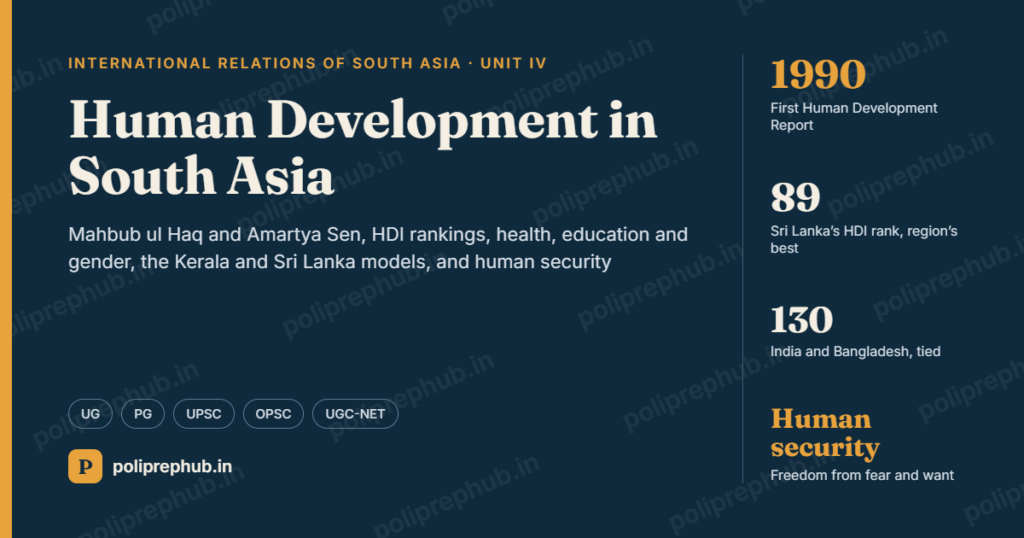
- Mahbub ul Haq launched the UNDP’s first Human Development Report (HDR) in 1990. He defined human development as “enlarging people’s choices”.
- The first HDR began with the line that people are the real wealth of a nation.
- Amartya Sen’s capability approach (Development as Freedom, 1999): development is the expansion of capabilities – the real freedoms people have to lead lives they value (to be healthy, educated, to take part in community life). Income is a means, not an end.
- Human development has four pillars: equity, sustainability, productivity and empowerment.
Measuring human development
| Index | Introduced | What it measures |
|---|---|---|
| Human Development Index (HDI) | 1990 | Geometric mean of three dimensions: health (life expectancy at birth), education (mean and expected years of schooling) and standard of living (GNI per capita, PPP $). Values from 0 to 1 |
| Inequality-adjusted HDI (IHDI) | 2010 | HDI discounted for inequality in each dimension |
| Gender Development Index (GDI) | 1995 (revised 2014) | Ratio of female to male HDI |
| Gender Inequality Index (GII) | 2010 | Reproductive health, empowerment and labour market inequality |
| Multidimensional Poverty Index (MPI) | 2010 (UNDP–OPHI) | Deprivations in health, education and living standards (10 indicators) |
| Planetary pressures-adjusted HDI (PHDI) | 2020 | HDI adjusted for carbon emissions and material use |
- HDI categories: very high (0.800 and above), high (0.700–0.799), medium (0.550–0.699), low (below 0.550).
- Since 2010 the HDI uses a geometric mean, so poor performance in one dimension cannot be fully compensated by another.
Other related ideas
- Basic needs approach (ILO, 1970s): food, shelter, health, education.
- Gross National Happiness (GNH): Bhutan’s alternative approach (see below).
- Human security (UNDP HDR 1994, also inspired by Mahbub ul Haq): security of people, not just of states (see later section).
- Sustainable Development Goals (SDGs): 17 goals for 2030 adopted in 2015.
South Asia’s Human Development Record
HDI rankings (Human Development Report 2025, data for 2023)
| Country | HDI rank (of 193) | HDI value | Category | Life expectancy (years) | Mean years of schooling | GNI per capita (2021 PPP $) |
|---|---|---|---|---|---|---|
| Sri Lanka | 89 | 0.776 | High | 77.5 | 10.8 | 12,616 |
| Maldives | 93 | 0.766 | High | 81.0 | 7.4 | 19,317 |
| Bhutan | 125 | 0.698 | Medium | 73.0 | 5.8 | 13,843 |
| Bangladesh | 130 | 0.685 | Medium | 74.7 | 6.8 | 8,498 |
| India | 130 | 0.685 | Medium | 72.0 | 6.9 | 9,047 |
| Nepal | 145 | 0.622 | Medium | – | – | – |
| Pakistan | 168 | 0.544 | Low | 67.6 | 4.3 | 5,501 |
| Afghanistan | 181 | 0.462 | Low | – | – | – |
Key observations
- Sri Lanka and the Maldives are the only South Asian countries in the high human development category. Sri Lanka has long had the region’s best social indicators despite its civil war and the 2022 economic crisis.
- India and Bangladesh are tied at rank 130. India improved from 133rd in the previous report. Bangladesh has a lower income per head than India but higher life expectancy – an example of social progress running ahead of income.
- Bhutan ranks higher than its schooling levels suggest because of relatively high income (hydropower exports) and its health system.
- Pakistan and Afghanistan are in the low human development category. Pakistan ranks well below what its income would suggest (its GNI rank is higher than its HDI rank).
- Long-term progress is real: South Asia’s HDI has risen substantially since 1990. Nepal’s HDI, for example, rose by over 50% between 1990 and 2023.
- Inequality reduces gains: India loses about 30% of its HDI value to inequality (IHDI), one of the larger losses among medium-HDI countries.
Income versus human development
- High GDP growth in India and Bangladesh has not translated equally into human development. Economists Jean Drèze and Amartya Sen (An Uncertain Glory: India and Its Contradictions, 2013) argued that India has grown fast but neglected health, education and nutrition, and compared India unfavourably with Bangladesh on several social indicators.
- Conversely, Sri Lanka and Kerala achieved high social indicators at modest income levels through public action.
Poverty trends
- South Asia has seen dramatic reductions in extreme poverty since the 1990s, especially in India and Bangladesh.
- Multidimensional poverty: according to the UNDP–OPHI global MPI, South Asia remains home to a very large share of the world’s 1.1 billion multidimensionally poor people. India’s NITI Aayog estimated that about 24.8 crore Indians escaped multidimensional poverty between 2013–14 and 2022–23.
- Climate and poverty: the 2025 global MPI found that South Asia has the highest number of poor people exposed to climate hazards – almost all of the region’s multidimensionally poor face at least one climate shock (heat, drought, floods or air pollution).
Sectoral Challenges
Health
- Life expectancy has risen across the region but varies widely (from about 67 years in Pakistan to over 77 in Sri Lanka and 81 in the Maldives).
- Maternal and child mortality have fallen sharply, but remain high in Pakistan and Afghanistan.
- Low public spending: most South Asian governments spend only around 1–2% of GDP on public health; high out-of-pocket expenditure pushes families into poverty.
- Double burden of disease: communicable diseases (TB, malaria, dengue) alongside rising non-communicable diseases (diabetes, heart disease).
- Pakistan and Afghanistan are the last countries in the world where wild polio remains endemic.
- Positive examples: India’s Ayushman Bharat health insurance and immunisation programmes; Bangladesh’s community health workers and oral rehydration; Sri Lanka’s universal free healthcare.
Nutrition
- South Asia has among the world’s highest rates of child stunting, wasting and anaemia. The so-called “South Asian enigma” refers to malnutrition being higher in South Asia than in poorer Sub-Saharan Africa.
- Causes include women’s low status and poor maternal nutrition, poor sanitation (open defecation, now reduced in India by the Swachh Bharat Mission), and dietary deficiencies.
- Programmes: India’s POSHAN Abhiyaan, mid-day meals and the public distribution system; school feeding and safety nets elsewhere.
Education
- Enrolment in primary education is now near universal in most of the region, but learning outcomes are poor (reports such as India’s ASER survey show many children cannot read basic texts).
- Mean years of schooling for adults remain low: about 7 years in India and Bangladesh, about 4 in Pakistan, compared with nearly 11 in Sri Lanka.
- Out-of-school children: Pakistan has one of the world’s largest numbers of out-of-school children. In Afghanistan, the Taliban have banned girls from secondary and higher education – the only country in the world to do so.
- Reforms: India’s National Education Policy (2020), Right to Education Act (2009); Bangladesh’s female stipend programmes.
Gender inequality
- In the WEF Global Gender Gap Index 2026, India ranked 131st of 145 (closing about 64.5% of its gender gap); Bangladesh was the region’s best performer at 79th, though it fell sharply from 24th the previous year. Southern Asia was the lowest-scoring region in economic participation and opportunity.
- Key problems: very low female labour force participation (though rising in India in recent surveys), the gender wage gap, missing women and skewed sex ratios (due to son preference), dowry and gender-based violence, child marriage (especially in Bangladesh and Nepal), and limited political representation.
- Positive trends: India’s Women’s Reservation Act (2023) (one-third of seats in Lok Sabha and state assemblies, to take effect after delimitation); women’s self-help groups and microfinance (Grameen Bank, Muhammad Yunus, Nobel Peace Prize 2006); high female literacy in Sri Lanka; women heads of government across the region.
Inequality
- Income and wealth inequality has risen in several countries, especially India (the World Inequality Lab reports high concentration of income at the top).
- Inequalities of caste, ethnicity, religion, region and gender overlap. Regional disparities are large within countries: for example, between Kerala and Bihar in India, Punjab and Balochistan in Pakistan, or Kathmandu and the far-west of Nepal.
Environment and climate
- South Asia is highly vulnerable to climate change: heatwaves, floods (Pakistan 2022), cyclones (Bangladesh, Sri Lanka’s Cyclone Ditwah 2025), glacial melt in the Himalayas and sea-level rise (Maldives, Bangladesh).
- Air pollution in South Asian cities is among the worst in the world, with severe health effects.
- Water stress: falling groundwater and transboundary river disputes (Indus, Ganga, Brahmaputra, Teesta).
- Climate change threatens to reverse human development gains (UNDP’s PHDI and the 2025 MPI report highlight this).
Success Stories and Development Models
Sri Lanka
- Sri Lanka has had universal suffrage since 1931, free education (since 1945, C. W. W. Kannangara) and free healthcare, and food subsidies since before independence.
- Result: high literacy, low maternal and infant mortality and long life expectancy at modest income levels – often cited with Kerala as a model of “support-led security” (Drèze and Sen).
- Limits: the civil war, the 2022 economic crisis and ethnic inequalities show that social achievements need economic and political stability.
Kerala (India)
- The “Kerala model”: high literacy, health and gender indicators despite modest per capita income in earlier decades.
- Causes: historical social reform movements (Sree Narayana Guru), missionary and princely state education, land reforms, strong public services, decentralised planning (People’s Plan Campaign, 1996), and political competition.
- Limits: unemployment, dependence on remittances from the Gulf, fiscal stress, and an ageing population.
Bangladesh
- Once dismissed as a “basket case” (a phrase attributed to Henry Kissinger’s team in 1971), Bangladesh made striking social progress: lower child and maternal mortality, higher life expectancy, falling fertility and girls’ education parity.
- Drivers: NGOs (BRAC, Grameen Bank), community health workers, female education stipends, the ready-made garments industry employing millions of women, and remittances.
- Challenges: governance problems (Topic 5), climate vulnerability, and dependence on garments. Bangladesh was scheduled to graduate from the UN’s Least Developed Country (LDC) category in November 2026, though some business groups called for a delay.
Bhutan and Gross National Happiness
- The idea of Gross National Happiness (GNH) was articulated by the Fourth King, Jigme Singye Wangchuck, in the 1970s: “Gross National Happiness is more important than Gross National Product.”
- GNH has four pillars: sustainable and equitable socio-economic development, environmental conservation, preservation of culture, and good governance. The GNH Index has 9 domains and 33 indicators.
- Bhutan’s constitution requires at least 60% forest cover; it is one of the few carbon-negative countries.
- Bhutan graduated from the LDC category in December 2023.
- Critiques: youth unemployment and emigration, the exclusion of the Lhotshampas, and limits of measuring happiness.
India’s welfare and digital approach
- Large programmes such as MGNREGA (2005) (rural employment guarantee), the National Food Security Act (2013), Jan Dhan–Aadhaar–Mobile (JAM) for direct benefit transfers, PM Awas Yojana (housing), Jal Jeevan Mission (tap water), Ujjwala (cooking gas) and Ayushman Bharat.
- Supporters credit these for reducing multidimensional poverty; critics point to implementation gaps, learning crises and low health spending.
Maldives
- High HDI (rank 93) driven by tourism income and good life expectancy, but inequality between Malé and the outer atolls, youth unemployment, drugs and climate vulnerability are major concerns.
Human Development and Security
The concept of human security
- The UNDP Human Development Report 1994, shaped by Mahbub ul Haq, introduced human security: security of people rather than only of territory.
- It has two aspects: “freedom from fear” (violence, conflict) and “freedom from want” (poverty, hunger, disease). Later, “freedom to live in dignity” was added.
- The 1994 HDR listed seven dimensions: economic, food, health, environmental, personal, community and political security.
- The Commission on Human Security (2003, co-chaired by Sadako Ogata and Amartya Sen) produced Human Security Now.
Why human development matters for South Asian security
- Poverty and conflict: deprivation and exclusion feed insurgencies (Maoists in India, Baloch grievances, Nepal’s People’s War) – Topic 3.
- Governance and legitimacy: failure to deliver services erodes state legitimacy and can lead to uprisings (Sri Lanka, Bangladesh, Nepal) – Topic 5.
- Migration and refugees: poverty and climate stress drive migration, which can create tensions between states – Topic 6.
- Non-traditional security threats: pandemics, climate disasters, food and water shortages affect more people than wars.
- Youth bulge: a large young population is a “demographic dividend” if educated and employed, but a source of instability if not.
Guns versus butter: defence and development
- Mahbub ul Haq and the Mahbub ul Haq Human Development Centre (in its annual Human Development in South Asia reports from 1997) argued that India and Pakistan spend heavily on arms while millions remain poor, and called for reallocating resources from defence to development (a “peace dividend”).
- India and Pakistan are among the world’s largest arms importers; India is among the top five military spenders globally.
- Counter-argument: states argue that real security threats (China, terrorism, nuclear rivals) make defence spending unavoidable, and that security is a precondition for development.
- Balanced view: security and development are complementary; the challenge is efficient spending and reducing tensions so that resources can shift to human needs.
Regional cooperation for human development
- SAARC set SAARC Development Goals (2007) and created the SAARC Development Fund (2010), a SAARC Food Bank (2007) and the South Asian University (New Delhi, 2010). Implementation has been weak because SAARC has been paralysed since 2016.
- BIMSTEC, sub-regional cooperation (BBIN: Bangladesh, Bhutan, India, Nepal) and bilateral aid (India’s development partnerships with neighbours) offer alternative routes.
- India’s “Neighbourhood First” policy includes health (COVID-19 vaccines under Vaccine Maitri, 2021), education scholarships, energy and connectivity projects.
SDGs in South Asia
- The Sustainable Development Goals (2015–2030) are the main global framework. South Asian countries have made progress on poverty (SDG 1), health (SDG 3) and electricity access (SDG 7), but lag behind on hunger and nutrition (SDG 2), quality education (SDG 4), gender equality (SDG 5), decent work (SDG 8) and climate action (SDG 13).
- India’s NITI Aayog SDG India Index ranks states, encouraging competition.
Way Forward
- Invest in people: raise public spending on health (towards 2.5–3% of GDP in India, as its National Health Policy 2017 proposed) and education, and focus on learning outcomes, not just enrolment.
- End malnutrition: integrated programmes on maternal health, sanitation, women’s education and diet diversity.
- Empower women: education, jobs, safety, property rights and political representation; this has the highest returns for human development.
- Reduce inequality: progressive taxation, social protection, land reform, inclusion of marginalised castes, ethnic groups and regions.
- Jobs for youth: labour-intensive manufacturing, skills training and support for small enterprises to use the demographic dividend.
- Climate resilience: adaptation, disaster risk reduction, clean energy and green jobs, so that climate change does not reverse gains.
- Good governance: transparent, accountable delivery of services (Topic 5); use of digital tools with privacy safeguards.
- Peace dividend: reducing interstate tensions (India–Pakistan, Pakistan–Afghanistan) and internal conflicts can free resources for development.
- Regional cooperation: revive SAARC or strengthen BIMSTEC and BBIN for trade, energy, health and disaster management; learn from regional success stories.
Conclusion
South Asia gave the world the idea of human development through Mahbub ul Haq and Amartya Sen, yet it remains home to a large share of the world’s poor, malnourished and illiterate people. The region’s record is mixed: Sri Lanka and the Maldives have high human development, India, Bangladesh and Bhutan are in the medium category with strong progress, and Pakistan and Afghanistan lag behind in the low category. Success stories – Sri Lanka’s welfare state, Kerala, Bangladesh’s social progress and Bhutan’s Gross National Happiness – show that public action, women’s empowerment and good governance can achieve much even at modest income levels.
For International Relations, human development is not a separate topic but the foundation of security. Poverty, inequality and exclusion feed insurgency, governance crises and migration; climate change threatens to reverse hard-won gains; and heavy defence spending competes with spending on people. The idea of human security reminds us that the ultimate purpose of the state – and of international relations – is the security and well-being of people.
This topic therefore brings the course full circle: from the origins and nature of South Asian states (Unit I), through structural realism, deterrence and nuclear weapons (Units II and III), to borders, governance, migration and human development (Unit IV). A strong exam answer should link human development to these themes and show that lasting security in South Asia depends on investing in its people.
Quick Revision
| Item | Key fact |
|---|---|
| First Human Development Report | 1990, UNDP (Mahbub ul Haq) |
| Definition of human development | “Enlarging people’s choices” |
| Capability approach | Amartya Sen, Development as Freedom (1999) |
| HDI dimensions | Health (life expectancy), education (mean and expected schooling), income (GNI per capita, PPP) |
| HDI method since 2010 | Geometric mean |
| IHDI / GII / MPI | 2010 |
| HDR 1994 | Introduced human security (freedom from fear and want) |
| Commission on Human Security | 2003 (Ogata and Sen) |
| HDR 2025 ranks | Sri Lanka 89, Maldives 93, Bhutan 125, India and Bangladesh 130, Nepal 145, Pakistan 168, Afghanistan 181 |
| India HDI value | 0.685 (medium); about 30% loss to inequality |
| Global Gender Gap 2026 | India 131/145; Bangladesh 79 (best in South Asia) |
| GNH | Fourth King of Bhutan, 1970s; 4 pillars, 9 domains |
| Bhutan LDC graduation | December 2023 |
| Grameen Bank / Nobel | Muhammad Yunus, 2006 |
| SAARC Development Goals / Food Bank / South Asian University | 2007 / 2007 / 2010 |
| Women’s Reservation Act (India) | 2023 |
| Global MPI 2025 | South Asia: highest number of poor exposed to climate hazards |
One-line memory aids
- Haq = choices and the HDI; Sen = capabilities and freedom.
- HDI = long life + knowledge + decent living standard.
- Human security = freedom from fear + freedom from want (+ dignity).
- Models: Sri Lanka (welfare state), Kerala (public action), Bangladesh (NGOs and women), Bhutan (GNH).
Exam Practice
Long-answer questions
- Explain the concept of human development with reference to the contributions of Mahbub ul Haq and Amartya Sen.
- Critically examine the human development record of South Asian countries.
- “High economic growth has not translated into equivalent human development in South Asia.” Discuss with reference to India and Bangladesh.
- Examine the significance of the Kerala and Sri Lanka models of human development.
- What is human security? How is it relevant to South Asia?
- Discuss the “guns versus butter” debate in South Asia.
- Evaluate Bhutan’s concept of Gross National Happiness as an alternative development model.
Short-answer questions
- Human Development Index
- Capability approach
- Multidimensional Poverty Index
- Gender Inequality Index
- Human security
- Gross National Happiness
- South Asian enigma (malnutrition)
- Kerala model
- Grameen Bank
- SAARC Development Goals
MCQs (UGC-NET / OPSC style)
- The first Human Development Report was published in:
- (a) 1985 (b) 1990 (c) 1994 (d) 2000
- Answer: (b)
- The concept of human development as “enlarging people’s choices” is associated with:
- (a) Amartya Sen (b) Mahbub ul Haq (c) Jagdish Bhagwati (d) Raul Prebisch
- Answer: (b)
- Development as Freedom (1999) was written by:
- (a) Mahbub ul Haq (b) Amartya Sen (c) Jean Drèze (d) Muhammad Yunus
- Answer: (b)
- Which of the following is NOT a dimension of the HDI?
- (a) Life expectancy (b) Education (c) GNI per capita (d) Gender equality
- Answer: (d)
- According to the Human Development Report 2025, which South Asian country had the highest HDI rank?
- (a) Maldives (b) Sri Lanka (c) Bhutan (d) India
- Answer: (b)
- The concept of human security was introduced in the UNDP Human Development Report of:
- (a) 1990 (b) 1992 (c) 1994 (d) 2003
- Answer: (c)
- Match the following:
- A. Gross National Happiness – 1. Bangladesh
- B. Grameen Bank – 2. Bhutan
- C. Free education since 1945 – 3. India (Kerala)
- D. People’s Plan Campaign (1996) – 4. Sri Lanka
- Answer: A-2, B-1, C-4, D-3
- Assertion (A): Bangladesh has a lower per capita income than India but higher life expectancy. Reason (R): Social policies, women’s empowerment and NGO-led health programmes can improve human development even at lower income levels.
- Answer: Both A and R are true, and R is the correct explanation of A.
- In the Global Gender Gap Index 2026, the best-performing South Asian country was:
- (a) India (b) Sri Lanka (c) Bangladesh (d) Nepal
- Answer: (c)
- Since 2010, the HDI is calculated as the:
- (a) Arithmetic mean (b) Geometric mean (c) Harmonic mean (d) Weighted sum
- Answer: (b)
Suggested readings
- Mahbub ul Haq, Reflections on Human Development (1995).
- Amartya Sen, Development as Freedom (1999).
- Jean Drèze and Amartya Sen, An Uncertain Glory: India and Its Contradictions (2013).
- UNDP, Human Development Report (annual), especially HDR 1990 and HDR 1994.
- Mahbub ul Haq Human Development Centre, Human Development in South Asia (annual reports).
- Commission on Human Security, Human Security Now (2003).
- Karma Ura and others, writings on Gross National Happiness (Centre for Bhutan Studies).
Sources for recent developments
- Human Development Report 2025: Statistical Annex, HDI table (UNDP)
- Nepal ranks 145th on UNDP Human Development Index for 2025 (Kathmandu Post)
- Human Development Report 2025 (Drishti IAS)
- India retains 131st rank in Global Gender Gap Index 2026 (Free Press Journal)
- Bangladesh in the Global Gender Gap Report 2026 (Prothom Alo)
- Global MPI 2025: nearly 80% of the world’s poor exposed to climate hazards (UNDP)


