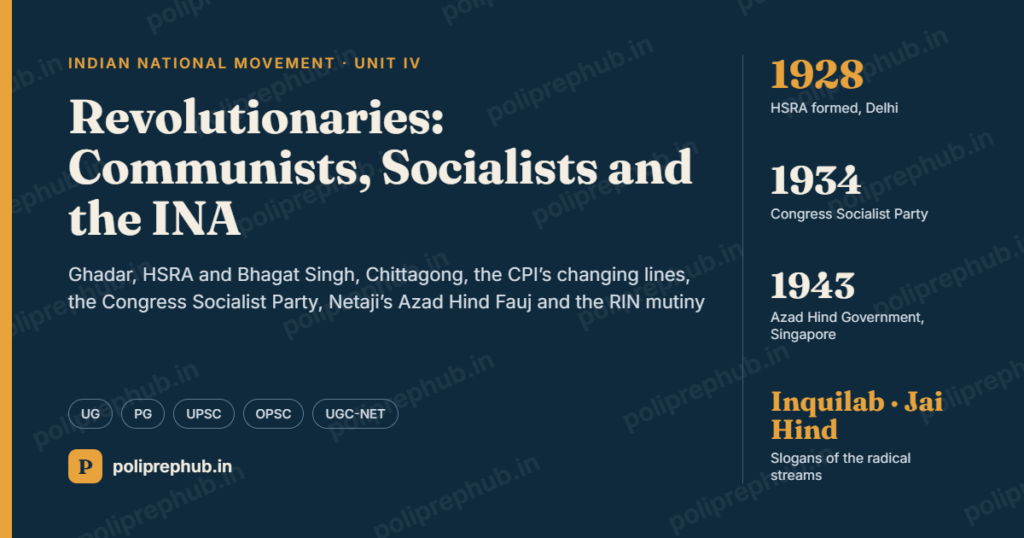
The Gandhian Congress was the mainstream of the Indian national movement, but it was never the only stream. Alongside it ran several radical currents that rejected or went beyond Gandhian non-violence and constitutional bargaining:
- revolutionary nationalists, who believed that armed action and heroic sacrifice would awaken the people and shake British rule;
- Communists, who saw national liberation as part of a world struggle against imperialism and capitalism, and sought to organise workers and peasants;
- Socialists, mostly within the Congress, who wanted the national movement to commit itself to radical social and economic change;
- the Indian National Army (INA) under Subhas Chandra Bose, which sought to liberate India by armed force with foreign help during the Second World War.
These groups differed sharply among themselves, but together they pushed the national movement leftwards, widened its social base among workers, peasants and youth, and contributed to the final crisis of British rule.
Revolutionary Nationalism
The first phase (1897–1918)
Revolutionary terrorism (the term used by contemporaries and many historians for the method of individual armed action) first appeared in the 1890s and spread after the Swadeshi Movement (Topic 2):
- Maharashtra: the Chapekar brothers killed the plague commissioner Rand (1897); V. D. Savarkar founded the Mitra Mela (1899), later Abhinav Bharat (1904); the Nasik conspiracy case (1909–10).
- Bengal: the Anushilan Samiti (1902, P. Mitra; Dhaka branch under Pulin Behari Das) and the Yugantar group (Barindra Kumar Ghosh, Bhupendranath Dutta). Khudiram Bose and Prafulla Chaki‘s attempt on Kingsford at Muzaffarpur (1908) led to the Alipore Bomb Case, in which Aurobindo Ghosh was tried and acquitted.
- Punjab and Delhi: the Delhi–Lahore Conspiracy (bomb thrown at Viceroy Hardinge, 1912; Rash Behari Bose, Basant Kumar Biswas).
- Abroad: India House in London (Shyamji Krishna Varma, 1905); Madan Lal Dhingra killed Curzon Wyllie (1909); Paris (Madame Bhikaji Cama, who unfurled an Indian flag at Stuttgart, 1907); and the Ghadar Party (San Francisco, 1913, under Lala Har Dayal, Sohan Singh Bhakna, with the paper Ghadar).
- The Ghadar movement and the First World War: Ghadarites returned to India (the Komagata Maru incident, 1914) and planned an armed uprising in Punjab for 21 February 1915, which was betrayed; the Lahore Conspiracy Case followed (Kartar Singh Sarabha hanged). The Singapore mutiny (1915), Bagha Jatin (Jatindranath Mukherjee)’s German arms plot and death at Balasore (September 1915), and the Provisional Government of India at Kabul (1915) under Raja Mahendra Pratap and Barkatullah were other wartime efforts.
The first phase was crushed by repression (Defence of India Act, 1915), and many revolutionaries joined Gandhi’s Non-cooperation Movement in 1920.
The second phase (1922–1934)
The sudden withdrawal of Non-cooperation in 1922 disillusioned many young nationalists and revived revolutionary activity. This phase was influenced by the Russian Revolution, socialist ideas, and the rise of youth and labour movements. Two main strands developed:
North India: HRA and HSRA
- The Hindustan Republican Association (HRA) was founded at Kanpur in October 1924 by Sachindranath Sanyal, Ramprasad Bismil, Jogesh Chandra Chatterjee and others, aiming to establish a Federated Republic of the United States of India through armed revolution.
- Kakori Train Robbery (9 August 1925): HRA members looted government cash from a train near Lucknow. In the Kakori Conspiracy Case, Ramprasad Bismil, Ashfaqulla Khan, Rajendra Lahiri and Roshan Singh were hanged (1927); others were imprisoned.
- The Hindustan Socialist Republican Association (HSRA) was formed at Ferozeshah Kotla, Delhi (September 1928) under Chandrashekhar Azad, with Bhagat Singh, Sukhdev, Bhagwati Charan Vohra, Bejoy Kumar Sinha and others. The addition of “Socialist” marked a shift: the aim was not just independence but a socialist society free from exploitation.
- Saunders killing (17 December 1928): Bhagat Singh, Rajguru and Azad shot J. P. Saunders, a police officer, at Lahore to avenge the death of Lala Lajpat Rai.
- Central Legislative Assembly bomb (8 April 1929): Bhagat Singh and Batukeshwar Dutt threw harmless bombs in the Assembly to protest against the Public Safety Bill and the Trade Disputes Bill, shouting “Inquilab Zindabad” and courting arrest, with the aim of using the trial for propaganda (“to make the deaf hear”).
- Jatin Das died after a 63-day hunger strike in Lahore jail (September 1929) for better treatment of political prisoners.
- In the Lahore Conspiracy Case, Bhagat Singh, Sukhdev and Rajguru were hanged on 23 March 1931. Chandrashekhar Azad died in a gunfight at Alfred Park, Allahabad (February 1931). The HSRA’s manifesto “The Philosophy of the Bomb” (1929–30) was written by Bhagwati Charan Vohra in reply to Gandhi’s article “The Cult of the Bomb”.
- Bhagat Singh’s writings (notably Why I Am an Atheist, 1930) show his turn towards Marxism and his view that the real revolution would come through mass mobilisation of workers and peasants, not individual terror.
Bengal: Chittagong and after
- Surya Sen (“Masterda”) led the Indian Republican Army in the Chittagong Armoury Raid (18 April 1930), seizing the police and auxiliary force armouries. The group fought a pitched battle with troops at Jalalabad hills. Sen was captured in 1933 and hanged in January 1934.
- Women played a prominent role: Pritilata Waddedar died leading an attack on the Pahartali European Club (1932); Kalpana Dutt was tried with Surya Sen; Shanti Ghosh and Suniti Chaudhury shot the Comilla magistrate (1931); Bina Das fired at the Bengal Governor (1932).
- The Writers’ Building attack (December 1930) by Benoy, Badal and Dinesh killed the Inspector-General of Prisons.
Assessment of revolutionary nationalism
- Revolutionaries made immense sacrifices and their courage inspired the youth and popularised slogans like “Inquilab Zindabad”.
- The HSRA, especially Bhagat Singh, broadened the goal to socialism and secularism, rejecting communal politics.
- They failed to build a mass movement: individual action could not defeat a powerful state, and the Gandhian strategy of mass mobilisation proved more effective.
- By the mid-1930s most surviving revolutionaries had turned to the Communist Party, the Congress Socialist Party, or the Congress.
The Communists
Origins
The Russian Revolution (1917) and the founding of the Communist International (Comintern, 1919) inspired a section of Indian radicals.
- M. N. Roy (Narendra Nath Bhattacharya), a former revolutionary, debated with Lenin at the Second Comintern Congress (1920) on whether communists should support bourgeois nationalist movements (Lenin) or concentrate on building independent class organisations (Roy).
- The Communist Party of India was founded at Tashkent on 17 October 1920 by M. N. Roy, Abani Mukherji, Evelyn Trent-Roy, Mohammad Ali (Ahmed Hasan) and others; this is the date accepted by the CPI(M). The CPI regards 26 December 1925, when the first all-India communist conference at Kanpur (presided over by Singaravelu Chettiar) formally founded the party in India, as its founding date.
- Early communist groups in India: S. A. Dange (Bombay; The Socialist), Muzaffar Ahmad (Calcutta), Singaravelu Chettiar (Madras), Ghulam Hussain (Lahore).
Repression: the conspiracy cases
- Peshawar Conspiracy Cases (1922–27) against muhajirs who had trained in Tashkent and Moscow.
- Kanpur (Cawnpore) Bolshevik Conspiracy Case (1924): Dange, Muzaffar Ahmad, Shaukat Usmani and Nalini Gupta were jailed.
- Meerut Conspiracy Case (1929–33): 31 leaders, including Dange, Muzaffar Ahmad, P. C. Joshi, S. V. Ghate and three Britons (Philip Spratt, Ben Bradley, Lester Hutchinson), were tried for conspiring to deprive the King of the sovereignty of India. Nehru, M. A. Ansari and others formed a defence committee; Gandhi visited the prisoners. The trial publicised communist ideas but crippled the movement for some years.
- The CPI was banned in 1934 (ban lifted in July 1942).
Workers’ and Peasants’ Parties (1926–1928)
Communists first worked through Workers’ and Peasants’ Parties (WPPs) in Bengal, Bombay, Punjab and UP, within the Congress, and through trade unions. They led the great Bombay textile strike of 1928 through the Girni Kamgar Union and gained control of the AITUC. By 1929 the WPPs were dissolved on Comintern instructions.
Changing lines
The communists’ attitude to the Congress changed with the Comintern’s line:
- 1928–1934 — “left sectarian” phase: after the Sixth Comintern Congress (1928), communists treated the Congress as a bourgeois party and Gandhi as an agent of the bourgeoisie; they stayed out of the Civil Disobedience Movement and split the AITUC (forming the Red Trade Union Congress, 1931). This isolated them.
- 1935–1939 — “united front” phase: after the Seventh Comintern Congress (1935) called for a popular front against fascism (and the Dutt–Bradley Thesis, 1936), communists worked within the Congress and the Congress Socialist Party, built the All-India Kisan Sabha (1936) and the All-India Students’ Federation (1936) and the Progressive Writers’ Association (1936).
- 1939–1941: they opposed the war as an “imperialist war”.
- 1941–1945 — “People’s War” phase: after Germany invaded the USSR (June 1941), the CPI called it a “People’s War” and supported the British war effort; it opposed the Quit India Movement. The ban was lifted in 1942. This damaged its nationalist credibility; communists were expelled from the Congress in 1945. At the same time, the CPI supported the League’s demand for Pakistan on the basis of the right of nationalities to self-determination (the Adhikari thesis, 1942).
Peasant struggles under communist leadership (1946–1951)
- Tebhaga movement (Bengal, 1946–47): sharecroppers (bargadars) demanded two-thirds (tebhaga) of the crop instead of half, as recommended by the Floud Commission; led by the Bengal Provincial Kisan Sabha.
- Telangana movement (Hyderabad state, 1946–1951): peasants rose against landlords (deshmukhs) and the Nizam’s razakars, set up village soviets (gram rajyams) in about 3,000 villages, and redistributed land. It was continued against the Indian Army after Hyderabad’s integration (1948), until it was withdrawn in 1951.
- Punnapra–Vayalar (Travancore, October 1946): armed struggle of coir and agricultural workers against the Dewan C. P. Ramaswami Iyer’s plan of an “American model” independent Travancore.
- Warli tribal revolt (Thane, 1945–47) under Godavari Parulekar.
Contribution and limitations
- Communists organised workers, peasants, students and writers on class lines, popularised the ideas of socialism and anti-imperialism, and led some of the most militant struggles of the 1940s.
- Their dependence on the Comintern and the shifting lines (especially 1942) isolated them from the mainstream national movement, and their support for the Pakistan demand was widely criticised.
- They could not provide an alternative leadership to the Congress.
The Socialists
The leftward turn of the 1920s and 1930s
From the late 1920s, a powerful left wing grew within the Congress, inspired by socialism, the Soviet experiment and the world depression:
- Jawaharlal Nehru visited the USSR (1927) and attended the Brussels Congress of Oppressed Nationalities (1927), where the League Against Imperialism was formed. As Congress president at Lahore (1929) he declared himself a socialist and republican; at Lucknow (1936) he called socialism the only key to the solution of India’s problems. His influence was seen in the Karachi Resolution (1931), the Faizpur session (1936), the first held in a village, and the National Planning Committee (1938).
- Subhas Chandra Bose was elected Congress president at Haripura (1938) and re-elected at Tripuri (1939) defeating Gandhi’s candidate Pattabhi Sitaramayya. Gandhi said Sitaramayya’s defeat was “more mine than his”. Faced with non-co-operation from the Working Committee and the Pant resolution requiring him to nominate the committee according to Gandhi’s wishes, Bose resigned and formed the Forward Bloc (1939) as a left platform within the Congress. He was expelled from Congress posts later in 1939.
- Youth leagues and students’ organisations spread radical ideas.
The Congress Socialist Party (1934)
The Congress Socialist Party (CSP) was founded at Patna in May 1934 (first conference at Bombay, October 1934) by Jayaprakash Narayan (general secretary), Acharya Narendra Dev (president), Ram Manohar Lohia, Minoo Masani, Achyut Patwardhan, Asoka Mehta, Yusuf Meherally and Kamaladevi Chattopadhyay.
Ideas and aims:
- to work within the Congress as a socialist pressure group, transforming it into a radical anti-imperialist front;
- to organise workers and peasants into class organisations and bring them into the national movement;
- to commit the Congress to a socialist programme: abolition of zamindari and princely order, nationalisation of key industries, cancellation of peasant debts, and the right to work.
The CSP drew on Marxism, though individual leaders differed (Narendra Dev was a Marxist scholar; Masani and Asoka Mehta were democratic socialists; Lohia developed his own socialist thought). It allowed communists into its ranks in 1936–40 (the united-front period), but expelled them in 1940 after tensions.
Role:
- The CSP helped organise the All-India Kisan Sabha (Lucknow, April 1936) with Swami Sahajanand Saraswati as president and N. G. Ranga as secretary. The Kisan Sabha’s Kisan Manifesto (1936) demanded abolition of zamindari, reduction of rent and revenue, and cancellation of debts.
- It worked in trade unions and among students and the youth.
- During Quit India (1942), socialists provided the underground leadership: JP, Lohia, Aruna Asaf Ali, Achyut Patwardhan, Usha Mehta (Topic 6).
- In 1948 the socialists left the Congress to form the Socialist Party; later the Praja Socialist Party (1952) and Lohia’s Samyukta Socialist Party.
Socialism and the Congress
The left did not capture the Congress, which remained under the Gandhian–right leadership (Patel, Rajendra Prasad, Rajagopalachari). Yet the left pushed the Congress to adopt pro-poor programmes (Karachi, Faizpur agrarian programme, planning) and to oppose imperialism and fascism internationally. Nehru, while sympathetic to the left, chose to stay with Gandhi to preserve the unity of the national movement — a choice historians regard as decisive in keeping the Congress a broad front.
Subhas Chandra Bose and the Indian National Army
Bose’s escape and wartime strategy
Bose believed that Britain’s difficulty was India’s opportunity and that India could be freed by armed struggle with the help of Britain’s enemies. Placed under house arrest in Calcutta in 1940, he escaped in January 1941, disguised as a Pathan (“Ziauddin”), travelled via Kabul and Moscow to Berlin (April 1941). In Germany he set up the Free India Centre and Azad Hind Radio, and raised the Indian Legion from Indian POWs. Indians began to call him “Netaji” there. Finding Germany unwilling to commit to Indian independence, he travelled by German and Japanese submarine to South-East Asia (1943).
The first INA under Mohan Singh
- The idea of an Indian army to fight the British was first developed by Captain Mohan Singh, an officer of the British Indian Army captured in Malaya, with Japanese support (Major Fujiwara) in 1941–42.
- After the fall of Singapore (February 1942), about 40,000 Indian POWs joined the first INA (formally established in September 1942).
- Rash Behari Bose, a veteran revolutionary living in Japan, formed the Indian Independence League (Tokyo conference, March 1942; Bangkok conference, June 1942).
- Differences arose between Mohan Singh and the Japanese over the INA’s independence and size; Mohan Singh was arrested in December 1942, and the first INA collapsed.
The second INA under Netaji
- Subhas Bose arrived in Singapore in July 1943. Rash Behari Bose handed over leadership of the Indian Independence League to him, and he became Supreme Commander of the INA (Azad Hind Fauj).
- On 21 October 1943 Bose proclaimed the Provisional Government of Free India (Arzi Hukumat-e-Azad Hind) at Singapore, with himself as Head of State, Prime Minister, War and Foreign Minister. It was recognised by Japan, Germany, Italy and their allies; it declared war on Britain and the USA.
- The INA was reorganised into brigades named after Gandhi, Nehru, Azad and (later) Subhas, with a women’s regiment, the Rani of Jhansi Regiment, under Captain Lakshmi Swaminathan (Sehgal).
- Recruitment included POWs and civilian Indians in South-East Asia (especially Tamil plantation workers in Malaya); the INA eventually had around 40,000–45,000 soldiers. Indians in South-East Asia contributed large funds.
- Slogans: “Delhi Chalo”, “Jai Hind”, and “Give me blood, and I will give you freedom” (Tum mujhe khoon do, main tumhe azadi doonga, July 1944).
- The Andaman and Nicobar Islands, occupied by Japan, were nominally handed over to the Provisional Government; Bose hoisted the tricolour at Port Blair (30 December 1943) and renamed them Shaheed and Swaraj islands.
Military campaign
- INA units fought alongside the Japanese in the Arakan and in the Imphal–Kohima campaign (March–July 1944). An INA unit under Col. Shaukat Malik hoisted the flag at Moirang (Manipur) in April 1944.
- The campaign failed because of the strength of the Allied forces, Japanese logistical failures, lack of air cover, the monsoon, disease and starvation.
- After Japan’s retreat from Burma (1945), the INA surrendered. Japan surrendered on 15 August 1945.
- Bose is reported to have died in an air crash at Taihoku (Taipei, Taiwan) on 18 August 1945. The circumstances of his death have been investigated by several commissions (Shah Nawaz, 1956; Khosla, 1970, which accepted the crash; the Mukherjee Commission, 2005, which rejected it); the matter remains a subject of popular controversy.
The INA trials (1945–46)
- The British decided to try INA officers for treason, murder and waging war against the King. The first and most famous trial at the Red Fort (November 1945) was of Shah Nawaz Khan, Prem Kumar Sahgal and Gurbaksh Singh Dhillon — a Muslim, a Hindu and a Sikh.
- The Congress formed an INA Defence Committee: Bhulabhai Desai (chief counsel), Tej Bahadur Sapru, Asaf Ali, Kailash Nath Katju and Jawaharlal Nehru (who put on the barrister’s gown after 25 years).
- The trials provoked an extraordinary wave of nationwide protest: INA Day (12 November 1945) and INA Week (5–11 November); huge demonstrations in Calcutta (November 1945 and February 1946, when the sentence on Abdul Rashid led to riots), and in other cities. The slogan “Lal Qila se aai awaz — Sahgal, Dhillon, Shah Nawaz” spread everywhere.
- The support cut across communities and parties, including the League and the communists, and reached the armed forces and the police.
- The three were sentenced to transportation for life, but the Commander-in-Chief Auchinleck remitted the sentences (January 1946) in view of public feeling.
The RIN Mutiny (February 1946)
- On 18 February 1946, ratings of the Royal Indian Navy on HMIS Talwar in Bombay went on strike against racial discrimination, bad food and treatment, the arrest of B. C. Dutt (who had written “Quit India” on the ship), and in solidarity with the INA prisoners.
- The revolt spread to 78 ships and 20 shore establishments, involving about 20,000 ratings in Bombay, Karachi, Calcutta, Madras and other ports. The ratings hoisted the Congress, League and Communist flags together. Workers and students in Bombay struck in support, and there were clashes with British troops.
- The Naval Central Strike Committee under M. S. Khan led the strike. Vallabhbhai Patel (Congress) and Jinnah (League) persuaded the ratings to surrender (23 February 1946), assuring them that there would be no victimisation; Aruna Asaf Ali and the communists supported the mutiny.
- There were also strikes in the Royal Indian Air Force (January 1946) and the Jabalpur Signal Corps (February 1946).
Significance of the INA
- Militarily the INA failed, but its political impact was enormous: it showed that Indian soldiers’ loyalty to the Raj could no longer be taken for granted.
- The INA trials and the RIN mutiny convinced the British that the army, the ultimate pillar of the Raj, was no longer reliable — one of the key reasons for the decision to leave quickly.
- The INA’s secular composition and its use of Hindustani, “Jai Hind” and communal kitchens offered a model of national unity.
- The Rani of Jhansi Regiment was a pioneering women’s combat unit.
- Critics argue that alliance with fascist Japan and Germany was problematic, and that a Japanese victory might have meant a new imperial master; Bose believed that he could use the Axis without being used by them.
Comparing the Radical Streams
| Point | Revolutionary nationalists | Communists | Congress Socialists | INA |
|---|---|---|---|---|
| Period | 1897–1934 | 1920 onwards | 1934–1948 (in Congress) | 1942–1945 |
| Key leaders | Savarkar, Aurobindo, Bhagat Singh, Azad, Surya Sen | M. N. Roy, Dange, Muzaffar Ahmad, P. C. Joshi | JP, Narendra Dev, Lohia, Masani | Subhas Bose, Mohan Singh, Rash Behari Bose |
| Method | Individual armed action, conspiracies | Class organisation of workers and peasants; mass struggle | Work within Congress; mass organisations | Armed liberation with foreign (Axis) help |
| Goal | Independence; later socialism (HSRA) | Socialist/communist revolution | Independence plus socialism | Independence by force |
| Relation with Congress | Outside; often critical | Fluctuating (hostile 1928–34, 1942) | Inside as pressure group | Outside; Bose ex-Congress president |
| Mass base | Small, mainly youth | Workers, peasants, students | Peasants (Kisan Sabha), youth | Soldiers, Indian diaspora in SE Asia |
| Main achievement | Inspiration and sacrifice | Class consciousness; peasant struggles | Radicalised Congress; 1942 underground | Shook army loyalty; INA trials |
Assessment
- Pushing the Congress leftwards: the radical streams made the Congress adopt socialist and pro-poor ideas (Karachi resolution, Faizpur agrarian programme, planning), and made complete independence the goal.
- Widening the social base: communists and socialists brought workers, peasants, students and women into organised politics on their own demands.
- Heroism and inspiration: Bhagat Singh, Surya Sen and Netaji became national heroes whose popularity rivalled that of the Congress leaders.
- Weakening the Raj’s coercive apparatus: the INA and the RIN mutiny exposed the unreliability of the Indian armed forces.
- Limitations: the radicals were divided, often hostile to one another, and could not build an alternative to the Gandhian Congress. The revolutionaries lacked a mass base; the communists were handicapped by the Comintern’s shifting lines; the socialists stayed under the Congress umbrella; and the INA depended on Japanese support.
Historiographical Views
- Nationalist historians (Bipan Chandra) see the left as part of the broad national movement that radicalised it, while arguing that Gandhian mass non-violent struggle was the most suitable strategy for a semi-hegemonic colonial state.
- Marxist historians (R. Palme Dutt, A. R. Desai, Sumit Sarkar) emphasise the role of class struggles and criticise the Congress leadership for restraining radical peasant and working-class movements, while also critiquing the CPI’s mistakes (1928–34 sectarianism, the 1942 line).
- Revolutionary nationalism has been reassessed by writers like Manmathnath Gupta, Shiv Verma and Chaman Lal (on Bhagat Singh’s writings), and by Kama Maclean (A Revolutionary History of Interwar India, 2015), who shows how revolutionaries and Congress shared a common political culture.
- The INA: historians like Peter Ward Fay (The Forgotten Army, 1993) and Sugata Bose (His Majesty’s Opponent, 2011) stress its role in hastening independence; others such as Joyce Lebra focus on its relationship with Japan; some critics highlight Bose’s alliance with fascist powers.
- The RIN mutiny is seen by Sumit Sarkar and others as evidence of a potentially revolutionary situation in 1945–46 which the national leadership chose to contain in favour of a negotiated transfer of power.
Conclusion
The revolutionaries, communists, socialists and the INA represented the more militant faces of Indian nationalism. They differed from the Gandhian mainstream in their methods — armed action, class struggle, socialist programmes and military liberation — and often from one another. None of them succeeded in replacing the Congress as the leader of the national movement. But they inspired generations of young people, gave voice to workers and peasants, pushed the Congress towards radical social goals, and, in the INA trials and the naval mutiny of 1945–46, helped convince the British that the foundations of their power in India had crumbled.
Quick Revision
| Year | Event |
|---|---|
| 1897 | Chapekar brothers kill Rand |
| 1902 | Anushilan Samiti |
| 1908 | Muzaffarpur bomb; Alipore Bomb Case |
| 1913 | Ghadar Party, San Francisco |
| 1915 | Ghadar rising fails; Provisional Govt at Kabul |
| 1920 | CPI founded at Tashkent (17 Oct) |
| 1924 | HRA founded, Kanpur; Kanpur Conspiracy Case |
| 1925 | Kakori train robbery; Kanpur communist conference |
| 1928 | HSRA formed; Saunders killed |
| 1929 | Assembly bomb; Meerut Conspiracy Case |
| 1930 | Chittagong Armoury Raid |
| 23 Mar 1931 | Bhagat Singh, Sukhdev, Rajguru hanged |
| 1934 | Congress Socialist Party; CPI banned |
| 1936 | All-India Kisan Sabha; Nehru’s Lucknow address |
| 1939 | Bose wins Tripuri, resigns; Forward Bloc |
| 1941 | Bose escapes to Germany; “People’s War” line |
| 1942 | First INA (Mohan Singh) |
| 21 Oct 1943 | Provisional Government of Free India, Singapore |
| 1944 | Imphal–Kohima campaign |
| 18 Aug 1945 | Bose’s reported death, Taipei |
| Nov 1945 | Red Fort INA trial |
| 18 Feb 1946 | RIN mutiny, Bombay |
| 1946–51 | Tebhaga, Telangana, Punnapra–Vayalar |
Memory aids
- HRA → HSRA: “S” for Socialist (1928, Bhagat Singh’s shift).
- CPI’s lines: Sectarian (1928) → United Front (1935) → Imperialist War (1939) → People’s War (1941).
- INA trial trio: Shah Nawaz (Muslim), Sahgal (Hindu), Dhillon (Sikh).
- INA brigades: Gandhi, Nehru, Azad, Subhas, Rani of Jhansi.
Exam Practice
Long-answer questions
- Trace the growth of revolutionary nationalism in India from 1897 to 1934. How did its ideology change in the second phase?
- Assess the contribution of Bhagat Singh and the HSRA to the Indian freedom struggle.
- Examine the role of the Communist Party of India in the national movement. Why did its relations with the Congress fluctuate?
- Discuss the formation, ideology and role of the Congress Socialist Party.
- “The Indian National Army failed militarily but succeeded politically.” Discuss.
- Examine the significance of the INA trials and the RIN mutiny in the final phase of British rule.
- Compare the methods and goals of the revolutionaries, communists, socialists and the INA.
Short-answer questions
- What was the Ghadar Party?
- What was the Kakori Conspiracy Case?
- Why did Bhagat Singh and B. K. Dutt throw bombs in the Central Legislative Assembly?
- What was the Chittagong Armoury Raid?
- What was the Meerut Conspiracy Case?
- What was the “People’s War” line of the CPI?
- Who founded the Congress Socialist Party and when?
- What was the Provisional Government of Free India?
- What was the Rani of Jhansi Regiment?
- What were the causes of the RIN mutiny?
Multiple-choice questions
- The Hindustan Socialist Republican Association was formed in 1928 at: (a) Kanpur (b) Lahore (c) Ferozeshah Kotla, Delhi (d) Allahabad. Answer: (c)
- “The Philosophy of the Bomb” was written by: (a) Bhagat Singh (b) Chandrashekhar Azad (c) Bhagwati Charan Vohra (d) Sukhdev. Answer: (c)
- The Chittagong Armoury Raid was led by: (a) Jatin Das (b) Surya Sen (c) Bagha Jatin (d) Rash Behari Bose. Answer: (b)
- The first president of the All-India Kisan Sabha (1936) was: (a) N. G. Ranga (b) Swami Sahajanand Saraswati (c) Jayaprakash Narayan (d) Acharya Narendra Dev. Answer: (b)
- The Provisional Government of Free India was proclaimed at: (a) Tokyo (b) Rangoon (c) Singapore (d) Berlin. Answer: (c)
- Match the following: (A) Meerut Conspiracy Case – (B) Kakori Case – (C) Lahore Conspiracy Case – (D) Red Fort Trial. (1) Bismil and Ashfaqulla (2) Bhagat Singh (3) Shah Nawaz, Sahgal, Dhillon (4) Communist and trade union leaders. Correct code: (a) A-4, B-1, C-2, D-3 (b) A-1, B-4, C-2, D-3 (c) A-4, B-2, C-1, D-3 (d) A-3, B-1, C-2, D-4. Answer: (a)
- Who commanded the Rani of Jhansi Regiment? (a) Aruna Asaf Ali (b) Lakshmi Swaminathan (c) Kalpana Dutt (d) Sucheta Kripalani. Answer: (b)
- Assertion (A): The CPI opposed the Quit India Movement. Reason (R): The CPI was banned by the British in 1942. (a) Both true, R explains A (b) Both true, R does not explain A (c) A true, R false (d) A false, R true. Answer: (c) — the ban was in fact lifted in July 1942.
- The RIN mutiny of 1946 began on: (a) HMIS Hindustan (b) HMIS Talwar (c) HMIS Narbada (d) HMIS Kathiawar. Answer: (b)
- Subhas Bose defeated which candidate in the 1939 Congress presidential election? (a) Rajendra Prasad (b) Pattabhi Sitaramayya (c) Maulana Azad (d) J. B. Kripalani. Answer: (b)
Suggested Readings
- Bipan Chandra et al., India’s Struggle for Independence (Penguin, 1989), chs. on revolutionary terrorism, the left, and the INA.
- Sumit Sarkar, Modern India, 1885–1947 (Macmillan, 1983).
- Sekhar Bandyopadhyay, From Plassey to Partition and After (Orient BlackSwan, 2015).
- Kama Maclean, A Revolutionary History of Interwar India (Hurst/OUP, 2015).
- Chaman Lal (ed.), The Bhagat Singh Reader (HarperCollins, 2019).
- Sugata Bose, His Majesty’s Opponent: Subhas Chandra Bose and India’s Struggle against Empire (Harvard, 2011).
- Peter Ward Fay, The Forgotten Army: India’s Armed Struggle for Independence 1942–1945 (Michigan, 1993).
- Sumit Sarkar, “Popular Movements and National Leadership, 1945–47”, EPW (1982).
- G. Adhikari (ed.), Documents of the History of the Communist Party of India (PPH).


