Centre–State relations refer to the constitutional, political, administrative, and financial interactions between the Union Government and the State Governments. The Indian Constitution establishes a federal system with a strong unitary bias, enabling the Centre to maintain national unity while granting autonomy to states.
Since Independence, Centre–State relations have undergone significant transformations due to political developments, economic reforms, judicial interventions, coalition politics, and institutional reforms. These changing patterns are collectively referred to as the trends in Centre–State relations.
Table of Contents
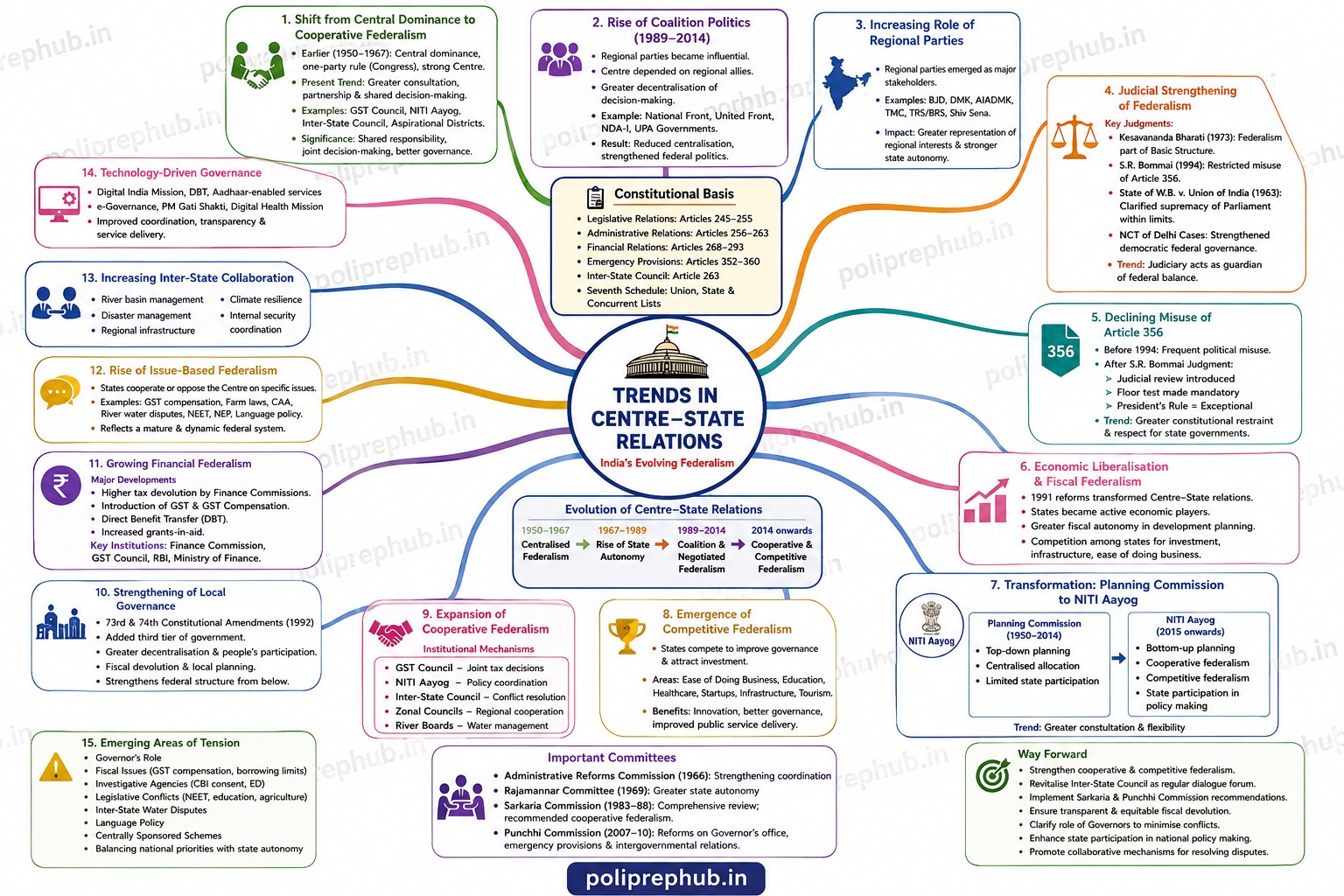
Constitutional Basis
The Constitution provides a comprehensive framework governing Centre–State relations through:
| Aspect | Constitutional Provision | Explanation |
|---|---|---|
| Legislative Relations | Articles 245–255 | These articles regulate the law-making powers of Parliament and State Legislatures. They specify the territorial jurisdiction of laws, distribution of legislative powers through the Union List, State List, and Concurrent List, and provide rules for resolving conflicts between Union and State laws. Parliament has overriding authority on matters in the Union List and, in certain situations, can legislate on State List subjects. |
| Administrative Relations | Articles 256–263 | These provisions govern the administrative relationship between the Centre and States. States are required to ensure compliance with Union laws (Article 256), and the Centre can issue directions to States under certain circumstances. They also provide for the establishment of the Inter-State Council (Article 263) to facilitate coordination and resolve disputes among states. |
| Financial Relations | Articles 268–293 | These articles deal with the distribution of financial resources between the Centre and States. They specify how taxes are levied and shared, provide for grants-in-aid, borrowing powers, and the role of the Finance Commission (Article 280) in recommending tax devolution and financial assistance to states. |
| Emergency Provisions | Articles 352–360 | These provisions empower the Centre to assume greater authority during emergencies. During a National Emergency (Article 352), Parliament can legislate on State List subjects. Under President’s Rule (Article 356), the Union takes over the administration of a state if constitutional machinery fails. Financial Emergency (Article 360) allows the Centre to control state finances if required. |
| Inter-State Council | Article 263 | Article 263 empowers the President to establish an Inter-State Council to promote cooperation between the Centre and States, discuss common issues, investigate disputes, and recommend policies for better coordination. It is an important institution of cooperative federalism. |
| Seventh Schedule | Union, State and Concurrent Lists | The Seventh Schedule is the foundation of India’s federal structure. It divides legislative subjects into three lists: Union List (currently 100 subjects) for Parliament, State List (61 subjects) for State Legislatures, and Concurrent List (52 subjects) where both can legislate. In case of conflict on Concurrent List matters, the Union law generally prevails (Article 254). |
Major Trends in Centre–State Relations
| Trend | Key Features | Significance |
|---|---|---|
| 1. Shift from Central Dominance to Cooperative Federalism | Transition from centralised governance (1950–67) to consultation, partnership, and shared decision-making through institutions like the GST Council and NITI Aayog. | Strengthened cooperation, policy coordination, and balanced Centre–State relations. |
| 2. Rise of Coalition Politics (1989–2014) | Coalition governments increased the influence of regional parties and state governments in national policymaking. | Enhanced state bargaining power and promoted negotiated federalism. |
| 3. Increasing Role of Regional Parties | Regional parties became major stakeholders representing state interests in national politics. | Strengthened state autonomy and deepened democratic federalism. |
| 4. Judicial Strengthening of Federalism | Supreme Court protected federal principles through landmark judgments such as Kesavananda Bharati and S.R. Bommai. | Safeguarded constitutional balance and limited arbitrary central intervention. |
| 5. Declining Misuse of Article 356 | Judicial review and mandatory floor tests after the S.R. Bommai judgment reduced political misuse of President’s Rule. | Protected elected state governments and strengthened cooperative federalism. |
| 6. Economic Liberalisation and Fiscal Federalism | Economic reforms (1991) encouraged states to attract investment and exercise greater fiscal autonomy. | States became active economic partners in national development. |
| 7. Transformation from Planning Commission to NITI Aayog | Replaced centralised planning with bottom-up planning, policy consultation, and cooperative federalism. | Increased state participation and flexibility in development planning. |
| 8. Emergence of Competitive Federalism | States compete in governance, investment, education, healthcare, infrastructure, and innovation. | Encouraged efficiency, innovation, and better public service delivery. |
| 9. Expansion of Cooperative Federalism | Institutional collaboration through GST Council, NITI Aayog, Inter-State Council, and Zonal Councils. | Promoted joint policymaking, consultation, and conflict resolution. |
| 10. Strengthening of Local Governance | The 73rd and 74th Constitutional Amendments established Panchayats and Municipalities as the third tier of government. | Promoted decentralisation, grassroots democracy, and local development planning. |
| 11. Growing Financial Federalism | Greater tax devolution, GST, Finance Commission recommendations, DBT, and grants-in-aid. | Strengthened fiscal cooperation and financial autonomy of states. |
| 12. Rise of Issue-Based Federalism | States cooperate or oppose the Centre based on specific policy issues such as GST, NEET, CAA, and Farm Laws. | Reflects a dynamic, mature, and negotiated federal system. |
| 13. Increasing Inter-State Collaboration | States increasingly cooperate in disaster management, water management, infrastructure, climate action, and internal security. | Strengthened interstate coordination and cooperative governance. |
| 14. Technology-Driven Governance | Digital India, DBT, Aadhaar, PM Gati Shakti, and digital governance platforms improved Centre–State coordination. | Enhanced transparency, efficiency, and citizen-centric governance. |
| 15. Emerging Areas of Tension | Conflicts over the Governor’s role, GST compensation, investigative agencies, water disputes, language policy, and centrally sponsored schemes. | Highlights continuing challenges in balancing national unity with state autonomy. |
1. Shift from Central Dominance to Cooperative Federalism
One of the most significant trends in India’s federal system is the gradual transition from centralised governance to cooperative federalism. In the early decades after Independence, the Union Government exercised dominant control over the states. Over time, political changes, economic reforms, judicial interventions, and institutional developments have encouraged greater collaboration between the Centre and the States.
Earlier Phase (1950–1967)
During the first two decades after Independence, India experienced a highly centralised form of federalism.
1. Congress ruled both the Centre and most States: From 1950 to 1967, the Indian National Congress enjoyed overwhelming electoral dominance at both the Union and State levels. Since the same party governed most states, conflicts between the Centre and States were minimal. State governments generally accepted the policies and decisions of the Union Government without significant resistance.
2. Strong Central Leadership: The leadership of Jawaharlal Nehru and later Lal Bahadur Shastri contributed to a strong and stable Union Government. The Centre played the leading role in national planning, economic development, foreign policy, defence, and major welfare programmes. The states had relatively limited influence over national policymaking.
3. States largely followed Union Policies: Although the Constitution provides autonomy to the states, in practice they largely implemented policies formulated by the Centre. Since both levels of government were controlled by the same political party, policy implementation was largely uniform across the country.
4. Planning Commission increased Central Control: The Planning Commission (1950–2014) prepared Five-Year Plans and allocated financial resources to the states. As states depended heavily on central assistance for development projects, the Centre exercised considerable influence over state priorities and expenditure. This financial dependence reinforced central dominance.
Present Trend
Since the late 1980s, Centre–State relations have gradually shifted towards cooperative federalism, where both levels of government work together to achieve common national goals while respecting constitutional autonomy.
1. Greater Consultation between the Centre and States: Instead of unilateral decision-making, the Centre increasingly consults state governments before implementing major national policies. Institutions such as the GST Council, NITI Aayog, and the Inter-State Council facilitate dialogue and consensus-building.
2. Increased Policy Coordination: Many national programmes require joint implementation by both the Centre and the States. Policies relating to health, education, infrastructure, agriculture, disaster management, and digital governance are increasingly coordinated through regular meetings, consultations, and shared administrative mechanisms.
3. Emphasis on Partnership Rather than Control: Modern federalism in India recognises that effective governance requires cooperation rather than domination. The Centre provides policy direction and financial support, while states adapt and implement programmes according to their regional needs. This collaborative approach strengthens both national integration and state autonomy.
Examples
- GST Council: Established under Article 279A, the GST Council is one of the best examples of cooperative federalism. It consists of representatives from both the Union and State Governments who jointly decide GST rates, exemptions, and tax policies through consensus.
- NITI Aayog: Replacing the Planning Commission in 2015, NITI Aayog promotes bottom-up planning, encourages state participation in policy formulation, and supports innovation and best practices among states instead of exercising financial control.
- Inter-State Council: Constituted under Article 263, the Inter-State Council provides a forum for discussion and coordination between the Centre and the States. It helps resolve disputes and promotes cooperation on matters of common interest.
- Aspirational District Programme: Launched by NITI Aayog, this programme aims to accelerate development in backward districts through close cooperation between the Centre, States, and district administrations. Progress is monitored using measurable indicators in health, education, agriculture, infrastructure, and financial inclusion.
Significance
- Shared Responsibility: National development is viewed as a joint responsibility of both the Centre and the States, rather than the Centre acting alone.
- Joint Decision-Making: Policies are increasingly formulated through consultation, negotiation, and consensus, leading to better acceptance and smoother implementation across states.
- Better Implementation of Welfare Programmes: Cooperation between different levels of government improves coordination, reduces policy conflicts, ensures efficient use of resources, and enhances the delivery of public services to citizens.
While cooperative federalism has strengthened Centre–State relations, challenges remain. Differences over GST compensation, the Governor’s role, centrally sponsored schemes, and state borrowing limits occasionally create tensions. Therefore, Indian federalism today is often described as a combination of cooperative federalism, competitive federalism, and negotiated federalism.
2. Rise of Coalition Politics (1989–2014)
The period between 1989 and 2014 marked a major transformation in India’s political system and Centre–State relations. Unlike the earlier era of single-party dominance, no single national party secured a clear majority in the Lok Sabha for long periods. Consequently, governments at the Centre were formed through coalitions comprising several national and regional parties.
The growing influence of regional parties fundamentally altered the balance of power between the Centre and the States, making Indian federalism more consultative and participatory.
Impact of Coalition Politics
1. Regional Parties Became Influential
Coalition governments relied heavily on the support of regional parties such as the DMK, AIADMK, TDP, BJD, Shiv Sena, Trinamool Congress, National Conference, and JD(U). These parties represented the interests of specific states or regions and became indispensable partners in government formation.
As a result, regional issues such as state development, special financial packages, infrastructure projects, and greater autonomy received increased attention at the national level.
2. States Gained Bargaining Power
Since coalition governments often depended on regional parties for survival, state governments acquired greater bargaining power in negotiations with the Centre.
States could demand:
- Higher financial assistance.
- Special Category or Special Assistance packages.
- Approval of state-specific development projects.
- Greater flexibility in implementing central schemes.
- Protection of regional interests in national policymaking.
This reduced the earlier dominance of the Union Government.
3. Centre Depended upon Regional Allies
Unlike the one-party dominant era, coalition governments could not make important decisions without consulting their alliance partners.
Regional parties influenced decisions relating to:
- Cabinet formation.
- Economic reforms.
- Foreign policy on neighbouring countries.
- Allocation of ministries.
- Federal financial arrangements.
- National legislation affecting states.
Thus, policymaking became more consensual rather than unilateral.
4. Greater Decentralisation of Decision-Making
Coalition politics encouraged a culture of consultation, negotiation, and consensus-building.
Instead of imposing decisions from New Delhi, the Centre increasingly considered the views of state governments before introducing major policies. This strengthened the principles of cooperative federalism and enhanced the role of states in national governance.
Examples of Coalition Governments
- National Front Government (1989–1991): Led initially by V.P. Singh and later Chandra Shekhar, the National Front Government depended on outside support from major political parties. It marked the beginning of the coalition era and increased the influence of regional parties in national politics.
- United Front Governments (1996–1998): The United Front Governments under H.D. Deve Gowda and I.K. Gujral consisted of multiple regional and national parties. These governments further strengthened the role of states in policymaking and promoted greater consultation between the Centre and regional leaders.
- NDA-I Government (1998–2004): The National Democratic Alliance (NDA-I) led by Atal Bihari Vajpayee included numerous regional parties. Despite being a coalition, it remained relatively stable and demonstrated that coalition governments could provide effective governance while accommodating regional aspirations.
- UPA Governments (2004–2014): The United Progressive Alliance (UPA) led by Dr. Manmohan Singh also depended on support from several regional parties. Many important policies, including social welfare programmes and economic reforms, were formulated through extensive consultation with coalition partners and state governments.
Result of Coalition Politics
The coalition era significantly reshaped India’s federal structure by reducing excessive centralisation and promoting greater participation of states in national governance.
Its major outcomes include:
- Strengthened cooperative federalism.
- Enhanced political importance of regional parties.
- Increased consultation between the Centre and States.
- Greater decentralisation of decision-making.
- Better representation of regional interests in Parliament.
- Expansion of democratic and negotiated policymaking.
Although coalition governments sometimes faced political instability, they contributed to making Indian federalism more balanced and inclusive by giving states a stronger voice in national affairs.
3. Increasing Role of Regional Parties
The emergence of regional political parties has been one of the most significant developments in India’s federal system. Since the late 1960s, and particularly after 1989, regional parties have become major stakeholders in national politics by representing the interests, aspirations, and identities of individual states.
The rise of coalition governments at the Centre further strengthened their influence, making Centre–State relations more consultative and decentralised. Today, regional parties play a crucial role in shaping national policies, strengthening state autonomy, and deepening Indian federalism.
Examples include:
- BJD (Odisha)
- DMK and AIADMK (Tamil Nadu)
- TMC (West Bengal)
- TRS/BRS (Telangana)
- Shiv Sena (Maharashtra)
| Regional Party | State | Major Contribution to Centre–State Relations |
|---|---|---|
| Biju Janata Dal (BJD) | Odisha | Advocated Odisha’s interests on issues such as mineral royalties, disaster management, special financial assistance, and Mahanadi river water disputes. |
| Dravida Munnetra Kazhagam (DMK) | Tamil Nadu | Strongly promoted state autonomy, federalism, linguistic rights, social justice, and greater devolution of powers to states. |
| All India Anna Dravida Munnetra Kazhagam (AIADMK) | Tamil Nadu | Focused on protecting state interests, welfare policies, and issues such as NEET exemption, Cauvery water disputes, and fiscal autonomy. |
| All India Trinamool Congress (TMC) | West Bengal | Advocated greater fiscal autonomy, opposed excessive central intervention, and defended state rights on issues relating to federal governance. |
| Telangana Rashtra Samithi (TRS) (now Bharat Rashtra Samithi – BRS) | Telangana | Raised issues concerning state finances, irrigation projects, GST compensation, and greater state autonomy after the formation of Telangana. |
| Shiv Sena | Maharashtra | Advocated Maharashtra’s regional interests, urban development, revenue sharing, and state autonomy while participating in coalition governments at the Centre. |
Impact
- Greater representation of regional interests.
- Increased negotiation between Centre and States.
- Stronger state autonomy.
| Impact | Explanation |
|---|---|
| Greater Representation of Regional Interests | Regional parties ensure that state-specific issues such as language, culture, economic development, infrastructure, river water disputes, and regional identity receive adequate attention in national policymaking. |
| Increased Negotiation between the Centre and States | Since coalition governments often depend on regional parties for parliamentary support, the Centre increasingly consults state leaders before making important policy decisions. This has strengthened cooperative and negotiated federalism. |
| Stronger State Autonomy | Regional parties consistently advocate greater decentralisation of powers, higher financial devolution, and increased administrative autonomy for states. This has reduced excessive centralisation and strengthened the federal character of the Constitution. |
4. Judicial Strengthening of Federalism
The Supreme Court of India has played a crucial role in maintaining the federal balance between the Union and the States. Through its constitutional interpretations and landmark judgments, the judiciary has protected the autonomy of states, prevented the misuse of constitutional provisions, and upheld the federal structure as one of the Basic Features of the Constitution.
Judicial intervention has transformed Indian federalism into a more balanced, accountable, and constitutionally governed system.
Important Judgments
| Case | Year | Issue | Judgment / Contribution | Significance for Federalism |
|---|---|---|---|---|
| S.R. Bommai v. Union of India | 1994 | Misuse of Article 356 (President’s Rule) | The Supreme Court held that the proclamation of President’s Rule is subject to judicial review. It ruled that the majority of a state government must be tested on the floor of the Legislative Assembly and not decided by the Governor. | Landmark judgment that curtailed the arbitrary use of Article 356 and strengthened democratic federalism by protecting elected state governments. |
| Kesavananda Bharati v. State of Kerala | 1973 | Extent of Parliament’s power to amend the Constitution | The Court evolved the Basic Structure Doctrine, holding that Parliament cannot alter the Constitution’s basic features. It declared federalism as part of the Basic Structure. | Established that the federal character of the Constitution cannot be destroyed through constitutional amendments, thereby safeguarding Centre–State balance. |
| State of West Bengal v. Union of India | 1963 | Whether Parliament could acquire property belonging to a State | The Supreme Court held that Parliament possesses legislative supremacy within the constitutional framework and may legislate on matters assigned to it by the Constitution. However, such powers are subject to constitutional limitations. | Clarified the constitutional relationship between the Union and the States while reaffirming that India’s federal system combines a strong Centre with constitutional safeguards for states. |
| Government of NCT of Delhi v. Union of India (2018, 2023) | 2018 & 2023 | Distribution of powers between the Lieutenant Governor and the elected Government of Delhi | The Supreme Court emphasised the principles of constitutional morality, representative democracy, and cooperative federalism. It held that the elected government should ordinarily have executive control over services (subject to subsequent constitutional and legislative developments). | Reinforced democratic accountability and clarified the relationship between the Union and sub-national governments, highlighting the importance of cooperative federal governance. |
Other Important Judicial Decisions
| Case | Contribution |
|---|---|
| R.C. Poudyal v. Union of India (1993) | Recognised that Indian federalism permits asymmetrical arrangements to accommodate regional diversity, such as special constitutional provisions for certain states. |
| Kuldip Nayar v. Union of India (2006) | Reiterated that Indian federalism is unique and does not follow a rigid model; the Constitution provides flexibility while maintaining a strong Union. |
| Nabam Rebia v. Deputy Speaker (2016) | Limited the discretionary powers of Governors and reinforced constitutional conventions in Centre–State relations. |
Trend
In recent decades, the judiciary has increasingly acted as the guardian of India’s federal structure by:
- Promoting cooperative federalism and democratic governance.
- Protecting the constitutional autonomy of states.
- Preventing arbitrary use of Article 356.
- Upholding federalism as part of the Basic Structure.
- Clarifying the constitutional powers of Governors and constitutional authorities.
- Resolving disputes between the Centre and States through constitutional interpretation.
5. Declining Misuse of Article 356
Article 356 of the Indian Constitution empowers the President to impose President’s Rule in a state when the constitutional machinery fails. Although this provision was intended to be used only in exceptional circumstances, it was frequently misused during the early decades after Independence for political purposes.
A major turning point came with the landmark S.R. Bommai v. Union of India (1994) judgment, which significantly curtailed the arbitrary use of Article 356 and strengthened India’s federal structure.
Before 1994
During the period from 1950 to 1994, Article 356 was invoked numerous times, often for political rather than constitutional reasons.
- Frequent political misuse.
- States often dismissed on partisan grounds.
| Feature | Explanation | Examples / Impact |
|---|---|---|
| Frequent Political Misuse | The Union Government frequently imposed President’s Rule to remove opposition-led state governments instead of addressing genuine constitutional breakdowns. | Article 356 was invoked more than 90 times before 1994, making it one of the most controversial constitutional provisions. |
| Dismissal of State Governments on Partisan Grounds | State governments were often dismissed after changes in the ruling party at the Centre, even when they enjoyed majority support in the Legislative Assembly. | Several opposition governments were dismissed during the 1970s and 1980s, particularly after changes in the Union Government following the 1977 and 1980 General Elections. |
| Weak Judicial Oversight | Presidential Proclamations under Article 356 were generally considered beyond effective judicial scrutiny. | The absence of judicial review encouraged political misuse of the provision. |
| Excessive Centralisation | Frequent use of Article 356 reinforced the dominance of the Centre over the States. | Reduced the autonomy of state governments and weakened the federal spirit of the Constitution. |
After S.R. Bommai Judgment
The S.R. Bommai v. Union of India (1994) judgment is regarded as a landmark in the evolution of Indian federalism. It imposed constitutional limitations on the exercise of Article 356 and strengthened democratic governance.
- Judicial review introduced.
- Floor test made mandatory.
- President’s Rule became an exceptional measure.
| Judicial Reform | Explanation | Significance |
|---|---|---|
| Judicial Review Introduced | The Supreme Court held that the President’s proclamation under Article 356 is subject to judicial review. Courts can examine whether the proclamation was based on relevant constitutional material. | Prevented arbitrary and politically motivated dismissal of elected state governments. |
| Floor Test Made Mandatory | The Court ruled that the majority of a state government should ordinarily be determined through a floor test in the Legislative Assembly, rather than by the Governor’s subjective assessment. | Strengthened democratic legitimacy and prevented unconstitutional removal of governments. |
| President’s Rule Became an Exceptional Measure | The Court clarified that Article 356 should be invoked only when there is a genuine breakdown of constitutional machinery and not for political disagreements. | Ensured that President’s Rule became a constitutional remedy of last resort, preserving the autonomy of states. |
| Federalism Recognised as a Basic Feature | The judgment reaffirmed that federalism is a fundamental feature of the Constitution and must be protected against arbitrary central intervention. | Reinforced constitutional balance between the Union and the States. |
Trend
| Trend | Explanation |
|---|---|
| Greater Constitutional Restraint | The Union Government now exercises greater caution while invoking Article 356 due to judicial scrutiny and constitutional limitations. |
| Respect for Elected State Governments | Democratically elected state governments are less likely to be dismissed without proving loss of majority through a floor test. |
| Strengthened Federalism | The misuse of Article 356 has significantly declined, contributing to a more balanced and cooperative federal system. |
| Judicial Safeguards | The Supreme Court continues to act as the guardian of constitutional federalism by reviewing the legality of President’s Rule. |
Comparison: Before and After S.R. Bommai
| Aspect | Before 1994 | After S.R. Bommai (1994) |
|---|---|---|
| Use of Article 356 | Frequent and politically motivated | Rare and used only in exceptional situations |
| Judicial Review | Limited judicial scrutiny | Subject to judicial review |
| Majority Test | Governor’s assessment often accepted | Floor test in the Legislative Assembly is the constitutional norm |
| State Autonomy | Frequently undermined | Better protected through constitutional safeguards |
| Nature of Federalism | Centralised and interventionist | Cooperative and constitutionally balanced |
6. Economic Liberalisation and Fiscal Federalism
The 1991 Economic Liberalisation marked a turning point in India’s economic and federal structure. The New Economic Policy (NEP), 1991, introduced under the leadership of Prime Minister P. V. Narasimha Rao and Finance Minister Dr. Manmohan Singh, shifted India’s economy from a state-controlled model to a market-oriented economy.
These reforms not only transformed India’s economy but also significantly altered Centre–State relations. States emerged as active participants in economic development, investment promotion, and policy implementation, giving rise to competitive and cooperative federalism.
Effects
- Greater competition among states.
- Increased foreign investment.
- States became active economic players.
- Greater fiscal autonomy in development planning.
| Effect | Explanation | Significance for Federalism |
|---|---|---|
| Greater Competition among States | Liberalisation encouraged states to compete with one another to attract domestic and foreign investment, improve governance, and create a business-friendly environment. | Marked the beginning of competitive federalism, where states compete to achieve better economic performance while remaining part of a unified federal system. |
| Increased Foreign Investment (FDI) | Economic reforms liberalised foreign investment policies, allowing states to directly attract Foreign Direct Investment (FDI) through industrial policies, investment summits, and infrastructure development. | Enhanced the economic role of states and reduced their dependence on the Centre for industrial growth. |
| States Became Active Economic Players | State governments assumed greater responsibility for industrial development, infrastructure creation, ease of doing business, tourism promotion, and employment generation. | Expanded the role of states from administrative units to key drivers of national economic development. |
| Greater Fiscal Autonomy in Development Planning | With economic reforms and subsequent Finance Commission recommendations, states gained greater flexibility in planning and implementing development programmes based on regional priorities. | Strengthened fiscal federalism by enabling states to allocate resources according to their developmental needs. |
States now compete in:
- Ease of Doing Business
- Industrial investment
- Infrastructure
- Digital governance
| Area of Competition | Explanation |
|---|---|
| Ease of Doing Business | States compete to simplify regulations, improve the business climate, reduce bureaucratic delays, and attract industries. Rankings prepared by DPIIT have encouraged administrative reforms. |
| Industrial Investment | States organise global investors’ summits, provide industrial incentives, develop industrial corridors, and establish Special Economic Zones (SEZs) to attract domestic and foreign investment. |
| Infrastructure Development | States compete in developing roads, airports, ports, metro rail systems, industrial parks, logistics hubs, and digital infrastructure to support economic growth. |
| Digital Governance | States increasingly adopt digital technologies for public service delivery, online approvals, e-governance, digital land records, and citizen-centric services to improve administrative efficiency. |
| Startup and Innovation Ecosystem | Many states formulate startup policies, innovation hubs, incubation centres, and research parks to attract entrepreneurs and technology companies. |
| Skill Development and Employment | States compete by improving vocational education, skill development programmes, and employment generation to attract industries and investment. |
7. Transformation from Planning Commission to NITI Aayog
One of the most significant institutional changes in India’s federal system was the replacement of the Planning Commission with the National Institution for Transforming India (NITI Aayog) on 1 January 2015. This transformation marked a shift from a centralised planning model to a system based on cooperative and competitive federalism, giving states a greater role in policymaking and development planning.
| Aspect | Planning Commission (1950–2014) | NITI Aayog (2015 onwards) |
|---|---|---|
| Establishment | Established in 1950 by a Cabinet Resolution. | Established on 1 January 2015 by a Cabinet Resolution. |
| Objective | Formulate Five-Year Plans and allocate resources for planned economic development. | Serve as a policy think tank, promote innovation, and foster cooperative and competitive federalism. |
| Planning Approach | Top-down planning—the Centre formulated plans which states largely implemented. | Bottom-up planning—states actively participate in formulating development strategies. |
| Nature of Institution | Centralised planning body. | Policy think tank and advisory institution. |
| Role of States | States had limited participation in planning and decision-making. | States actively participate through the Governing Council, regional councils, and consultations. |
| Allocation of Funds | Allocated Plan funds to states, giving the Centre significant financial control. | Does not allocate funds; financial devolution is primarily determined by the Finance Commission. |
| Decision-Making | Centralised and hierarchical. | Collaborative, consultative, and consensus-based. |
| Federal Approach | Favoured centralised federalism. | Promotes cooperative and competitive federalism. |
| Focus Areas | Five-Year Plans, public sector expansion, central planning. | Sustainable development, innovation, digital governance, SDGs, policy reforms, monitoring and evaluation. |
Trend
The replacement of the Planning Commission with NITI Aayog reflects a major shift in Centre–State relations.
| Trend | Explanation |
|---|---|
| Greater Consultation | States are consulted more frequently in national policymaking through institutional forums. |
| Greater Flexibility | States have greater freedom to formulate development strategies according to local needs rather than following uniform national plans. |
| Shared Governance | Development planning has become more collaborative, reflecting the principles of cooperative federalism. |
| Performance-Oriented Governance | States are encouraged to innovate and improve governance through healthy competition. |
8. Emergence of Competitive Federalism
Competitive federalism refers to a system in which states compete with one another to improve governance, attract investment, enhance public service delivery, and accelerate economic development, while remaining within the framework of the Indian federal system. Unlike traditional federalism, where states primarily depended on the Centre for financial assistance, competitive federalism encourages states to become proactive, innovative, and performance-oriented.
The concept gained prominence after the 1991 economic liberalisation and was further institutionalised with the establishment of NITI Aayog in 2015, which promotes healthy competition among states through performance indices and best-practice sharing.
Areas of Competition
- Ease of Doing Business
- Education
- Healthcare
- Startup ecosystem
- Infrastructure
- Tourism
| Area | Explanation | Examples / Indicators | Significance |
|---|---|---|---|
| Ease of Doing Business | States simplify regulations, improve the business environment, reduce bureaucratic delays, and provide investor-friendly policies to attract industries. | DPIIT Ease of Doing Business Reforms, Single Window Clearance Systems. | Attracts domestic and foreign investment, creates employment, and promotes industrial growth. |
| Education | States compete to improve literacy, school education, higher education, digital learning, and skill development. | National Achievement Survey (NAS), School Education Quality Index (SEQI), PM SHRI Schools. | Enhances human capital and improves educational outcomes. |
| Healthcare | States strengthen healthcare infrastructure, improve public health services, and enhance access to medical facilities. | NITI Aayog Health Index, Ayushman Bharat, Mission Indradhanush. | Improves health indicators and citizen well-being. |
| Startup Ecosystem | States formulate startup policies, establish incubation centres, innovation hubs, and provide incentives for entrepreneurs. | Startup India, Atal Innovation Mission (AIM), State Startup Policies. | Encourages innovation, entrepreneurship, and employment generation. |
| Infrastructure Development | States invest in roads, railways, airports, ports, industrial corridors, logistics parks, and urban infrastructure. | PM Gati Shakti, Bharatmala, Smart Cities Mission, Industrial Corridors. | Enhances connectivity, economic productivity, and regional development. |
| Tourism | States promote tourism through infrastructure development, heritage conservation, eco-tourism, and cultural festivals. | Dekho Apna Desh Campaign, State Tourism Policies, Eco-tourism Projects. | Generates employment, boosts local economies, and promotes cultural heritage. |
| Digital Governance | States increasingly adopt digital platforms for governance and public service delivery. | Digital India, e-Office, DigiLocker, online citizen services. | Improves administrative efficiency, transparency, and citizen satisfaction. |
| Sustainable Development | States compete to improve environmental sustainability and achieve Sustainable Development Goals (SDGs). | SDG India Index, renewable energy initiatives, climate action plans. | Promotes inclusive and sustainable development. |
Benefits
- Innovation
- Better governance
- Improved public service delivery
- Increased investment
| Benefit | Explanation |
|---|---|
| Innovation | Healthy competition encourages states to introduce innovative policies, governance models, and administrative reforms that can be replicated by other states. |
| Better Governance | States improve administrative efficiency, transparency, and accountability to enhance their performance and public image. |
| Improved Public Service Delivery | Competition motivates states to provide better education, healthcare, infrastructure, and welfare services to citizens. |
| Increased Investment | Investor-friendly policies, improved infrastructure, and ease of doing business attract domestic and foreign investment, leading to economic growth and employment generation. |
| Economic Growth | Competition encourages states to diversify their economies, increase industrial production, and improve fiscal management. |
| Citizen-Centric Administration | Governments become more responsive to citizens’ needs by improving service quality and governance standards. |
| Policy Innovation | Successful governance practices adopted by one state are often replicated by others, leading to continuous policy improvement across the country. |
9. Expansion of Cooperative Federalism
Cooperative federalism refers to a model of governance in which the Union Government and State Governments work together as partners to achieve common national objectives while respecting each other’s constitutional powers. Instead of confrontation or excessive centralisation, cooperative federalism emphasises consultation, coordination, consensus-building, and shared responsibility.
In recent years, India has witnessed a significant expansion of cooperative federalism through various constitutional and institutional mechanisms that encourage collaboration in policymaking, fiscal management, infrastructure development, and dispute resolution.
Institutional Mechanisms
| Institution | Constitutional / Legal Basis | Role | Contribution to Cooperative Federalism |
|---|---|---|---|
| GST Council | Article 279A | Joint decision-making on Goods and Services Tax (GST), including tax rates, exemptions, and revenue-sharing. | Represents the finest example of cooperative fiscal federalism, where the Centre and States jointly formulate taxation policies through consensus. |
| NITI Aayog | Cabinet Resolution (2015) | Serves as a policy think tank promoting consultation, policy coordination, and development planning. | Encourages bottom-up planning, state participation in policymaking, sharing of best practices, and healthy competition among states. |
| Inter-State Council | Article 263 | Provides a forum for consultation, coordination, and resolution of disputes between the Centre and States and among States. | Strengthens intergovernmental dialogue, promotes policy coordination, and resolves constitutional and administrative disputes. |
| Zonal Councils | States Reorganisation Act, 1956 | Facilitate regional cooperation among neighbouring states on economic, social, and security issues. | Promote regional integration, interstate coordination, and collaborative solutions to common challenges. |
| River Boards / River Water Tribunals | Article 262, River Boards Act, 1956, Inter-State River Water Disputes Act, 1956 | Coordinate river basin management and resolve disputes over inter-state river waters. | Promote cooperation in water resource management, irrigation, flood control, and sustainable utilisation of shared rivers. |
10. Strengthening of Local Governance
One of the most significant developments in the evolution of Centre–State relations was the constitutional recognition of Local Self-Government through the 73rd and 74th Constitutional Amendment Acts, 1992. These amendments established Panchayati Raj Institutions (PRIs) in rural areas and Urban Local Bodies (ULBs) in urban areas as the third tier of government, thereby strengthening democratic decentralisation.
The amendments marked a shift from a two-tier federal system (Centre and States) to a three-tier governance structure, bringing governance closer to the people and strengthening Indian federalism from the grassroots.
Result
- Greater decentralisation
- People’s participation
- Fiscal devolution
- Local planning
| Result | Explanation | Significance for Federalism |
|---|---|---|
| Greater Decentralisation | Powers, functions, and responsibilities were transferred from the Centre and States to local governments, enabling decisions to be taken closer to the people. | Strengthened democratic decentralisation and reduced excessive centralisation. |
| People’s Participation | Local governments enabled citizens to participate directly in governance through Gram Sabhas, elections, and community-based decision-making. Reservations for women, Scheduled Castes (SCs), and Scheduled Tribes (STs) further enhanced inclusive participation. | Deepened grassroots democracy and improved accountability in governance. |
| Fiscal Devolution | States were required to establish State Finance Commissions (Article 243-I and Article 243-Y) to recommend the distribution of financial resources to Panchayats and Municipalities. Local bodies also received grants from the Central Finance Commission. | Strengthened financial autonomy of local governments and improved implementation of development programmes. |
| Local Planning | Local governments were empowered to prepare and implement development plans relating to agriculture, health, education, drinking water, sanitation, roads, housing, and urban planning. | Enabled region-specific planning and improved responsiveness to local developmental needs. |
This strengthened the federal structure from below.
11. Growing Financial Federalism
Financial federalism refers to the constitutional and institutional arrangements governing the distribution of financial powers, tax revenues, grants, and fiscal responsibilities between the Union Government and the State Governments. Over the years, India’s financial federalism has evolved significantly through constitutional reforms, Finance Commission recommendations, the introduction of GST, and greater fiscal decentralisation.
The growing emphasis on fiscal cooperation aims to provide states with adequate financial resources while maintaining national economic stability.
Major Developments
| Development | Explanation | Significance for Centre–State Relations |
|---|---|---|
| Higher Tax Devolution by Finance Commissions | The Finance Commission (Article 280) periodically recommends the share of central taxes to be devolved to states. Recent Finance Commissions have increased the share of tax devolution to strengthen state finances and reduce dependence on discretionary grants. | Enhances fiscal autonomy, strengthens cooperative federalism, and enables states to finance their development programmes more effectively. |
| Introduction of the Goods and Services Tax (GST) | Introduced through the 101st Constitutional Amendment Act, 2016, GST replaced multiple indirect taxes with a unified tax system. It created a common national market while allowing both the Centre and States to jointly levy GST. | Promotes fiscal cooperation, simplifies taxation, and strengthens Centre–State coordination through the GST Council (Article 279A). |
| GST Compensation Mechanism (Initial Years) | To compensate states for potential revenue losses due to GST implementation, the Centre guaranteed compensation for five years under the GST (Compensation to States) Act, 2017. During the COVID-19 pandemic, delays in compensation led to Centre–State disagreements. | Helped states transition to the GST regime while highlighting the importance of trust and fiscal cooperation in Indian federalism. |
| Direct Benefit Transfer (DBT) | DBT enables subsidies, pensions, scholarships, and welfare benefits to be transferred directly to beneficiaries’ bank accounts through the JAM (Jan Dhan–Aadhaar–Mobile) framework. | Improves financial transparency, reduces leakages, strengthens Centre–State coordination, and enhances the efficiency of welfare delivery. |
| Increased Grants-in-Aid | Under Article 275, the Centre provides grants to states for developmental programmes, tribal welfare, disaster management, and other specific purposes. Finance Commission grants have also increased over time. | Supports financially weaker states, reduces regional disparities, and promotes balanced national development. |
| Greater Fiscal Decentralisation | Successive Finance Commissions have recommended greater financial devolution and increased untied funds for local governments following the 73rd and 74th Constitutional Amendments. | Strengthens grassroots democracy and empowers states and local bodies to address regional development needs. |
Institutions
| Development | Explanation | Significance for Centre–State Relations |
|---|---|---|
| Higher Tax Devolution by Finance Commissions | The Finance Commission (Article 280) periodically recommends the share of central taxes to be devolved to states. Recent Finance Commissions have increased the share of tax devolution to strengthen state finances and reduce dependence on discretionary grants. | Enhances fiscal autonomy, strengthens cooperative federalism, and enables states to finance their development programmes more effectively. |
| Introduction of the Goods and Services Tax (GST) | Introduced through the 101st Constitutional Amendment Act, 2016, GST replaced multiple indirect taxes with a unified tax system. It created a common national market while allowing both the Centre and States to jointly levy GST. | Promotes fiscal cooperation, simplifies taxation, and strengthens Centre–State coordination through the GST Council (Article 279A). |
| GST Compensation Mechanism (Initial Years) | To compensate states for potential revenue losses due to GST implementation, the Centre guaranteed compensation for five years under the GST (Compensation to States) Act, 2017. During the COVID-19 pandemic, delays in compensation led to Centre–State disagreements. | Helped states transition to the GST regime while highlighting the importance of trust and fiscal cooperation in Indian federalism. |
| Direct Benefit Transfer (DBT) | DBT enables subsidies, pensions, scholarships, and welfare benefits to be transferred directly to beneficiaries’ bank accounts through the JAM (Jan Dhan–Aadhaar–Mobile) framework. | Improves financial transparency, reduces leakages, strengthens Centre–State coordination, and enhances the efficiency of welfare delivery. |
| Increased Grants-in-Aid | Under Article 275, the Centre provides grants to states for developmental programmes, tribal welfare, disaster management, and other specific purposes. Finance Commission grants have also increased over time. | Supports financially weaker states, reduces regional disparities, and promotes balanced national development. |
| Greater Fiscal Decentralisation | Successive Finance Commissions have recommended greater financial devolution and increased untied funds for local governments following the 73rd and 74th Constitutional Amendments. | Strengthens grassroots democracy and empowers states and local bodies to address regional development needs. |
12. Rise of Issue-Based Federalism
One of the emerging trends in Centre–State relations is the rise of issue-based federalism, where the relationship between the Union and State Governments is determined not by political ideology or party affiliation alone but by specific policy issues. States may cooperate with the Centre on some matters while opposing it on others, depending on their regional interests, constitutional powers, financial concerns, and public opinion.
This reflects the increasing maturity and flexibility of Indian federalism, where cooperation and conflict coexist within the constitutional framework.
Examples include:
- GST compensation
- Farm laws
- CAA implementation
- River water disputes
- NEET
- National Education Policy
| Issue | Nature of the Issue | Centre–State Dynamics | Significance |
|---|---|---|---|
| GST Compensation | Under the Goods and Services Tax (GST) regime, states surrendered several taxation powers in return for assured compensation for revenue losses. Delays in compensation led to disagreements. | States demanded timely compensation, while the Centre cited revenue constraints during the COVID-19 pandemic. | Highlighted the importance of fiscal federalism and cooperative decision-making through the GST Council (Article 279A). |
| Farm Laws (2020–2021) | The Centre enacted three farm laws to reform agricultural marketing. Agriculture is primarily a State List subject, leading several states to object to central intervention. | Punjab, Rajasthan, Chhattisgarh and several other states opposed the laws, while some states supported them. The laws were later repealed in 2021. | Demonstrated how differences over legislative competence and regional interests can influence Centre–State relations. |
| Citizenship Amendment Act (CAA), 2019 | The CAA amended India’s citizenship law. Several states opposed its implementation, arguing that it affected law and order and social harmony within their jurisdictions. | Kerala, West Bengal, Punjab and some other states passed resolutions against the Act or expressed reluctance to implement certain provisions. | Raised debates on constitutional powers, federal autonomy, and the implementation of central legislation by states. |
| Inter-State River Water Disputes | States often disagree over the allocation and management of shared river waters. | Disputes such as Cauvery (Tamil Nadu–Karnataka), Krishna (Andhra Pradesh–Telangana), Mahanadi (Odisha–Chhattisgarh), and Ravi–Beas (Punjab–Haryana) require Centre-mediated resolution. | Illustrates that cooperation and negotiation are essential for managing shared natural resources in a federal system. |
| National Eligibility-cum-Entrance Test (NEET) | NEET provides a common entrance examination for medical admissions across India. Some states argue that it undermines their educational policies and disadvantages local students. | Tamil Nadu has consistently sought exemption from NEET, while many other states support a common examination system. | Highlights tensions between national standardisation and state autonomy in education. |
| National Education Policy (NEP), 2020 | The NEP introduced major reforms in school and higher education. While many states welcomed the reforms, others expressed concerns regarding language policy, curriculum, and implementation. | Some states adopted the policy with modifications, whereas others raised objections to certain provisions. | Demonstrates that education, being part of the Concurrent List, requires continuous consultation and coordination between the Centre and States. |
This reflects a mature and dynamic federal system.
13. Increasing Inter-State Collaboration
In recent years, Indian federalism has witnessed a growing trend of inter-state collaboration, where states increasingly cooperate with one another to address common developmental, environmental, security, and governance challenges. This reflects the evolution of Indian federalism from a purely Centre–State framework to one that also encourages State–State cooperation.
Such collaboration is facilitated through constitutional institutions like the Inter-State Council (Article 263), Zonal Councils, Inter-State River Water Tribunals, and various regional forums.
Examples:
- River basin management
- Disaster management
- Regional infrastructure
- Climate resilience
- Internal security coordination
| Area of Collaboration | Explanation | Examples | Significance |
|---|---|---|---|
| River Basin Management | States cooperate in the planning, conservation, and sustainable management of shared river basins. Joint efforts are essential for equitable water distribution, flood control, irrigation, and environmental protection. | Joint management of the Ganga Basin, Brahmaputra Basin, Godavari Basin; agreements through river boards and tribunals. | Promotes sustainable water management, reduces conflicts, and strengthens cooperative federalism. |
| Disaster Management | Natural disasters often affect multiple states simultaneously, requiring coordinated action in preparedness, relief, rescue, rehabilitation, and resource sharing. | Cyclone management in Odisha, Andhra Pradesh, and West Bengal; flood management in Assam and Bihar; coordination through the National Disaster Management Authority (NDMA) and State Disaster Management Authorities (SDMAs). | Improves disaster response, minimizes loss of life and property, and enhances institutional coordination. |
| Regional Infrastructure Development | States increasingly collaborate in developing transport, energy, communication, and industrial infrastructure that benefits multiple regions. | Bharatmala Project, PM Gati Shakti, Dedicated Freight Corridors, East Coast Railway projects, regional airports under UDAN. | Promotes balanced regional development, economic integration, and improved connectivity. |
| Climate Resilience and Environmental Protection | States cooperate to address climate change, biodiversity conservation, forest protection, pollution control, and sustainable resource management. | Joint coastal management initiatives, conservation of the Western Ghats, mangrove protection, renewable energy partnerships, National Clean Air Programme (NCAP). | Enhances environmental sustainability and collective response to climate change. |
| Internal Security Coordination | States coordinate with each other and the Union Government to combat terrorism, left-wing extremism, organised crime, cybercrime, and cross-border illegal activities. | Anti-Naxal operations across Chhattisgarh, Odisha, Maharashtra, Telangana and Jharkhand; intelligence sharing among police forces; coordinated cybercrime investigations. | Strengthens national security, law enforcement, and public safety through coordinated action. |
| Public Health Cooperation | States collaborate in disease surveillance, vaccination campaigns, and health emergency management. | COVID-19 management, Universal Immunisation Programme, Ayushman Bharat Digital Mission. | Improves public health preparedness and ensures effective healthcare delivery across states. |
| Trade and Economic Cooperation | States increasingly cooperate in promoting trade, investment, tourism, and industrial development through regional partnerships. | Regional industrial corridors, tourism circuits, logistics parks, interstate investment summits. | Encourages economic growth, employment generation, and regional competitiveness. |
| Digital Governance and Data Sharing | States share digital platforms, best practices, and governance innovations to improve administrative efficiency and service delivery. | Digital India Mission, PM Gati Shakti, DigiLocker integration, e-Office, integrated land records. | Enhances transparency, interoperability, and citizen-centric governance. |
14. Technology-Driven Governance
The rapid adoption of digital technologies has transformed the nature of Centre–State relations in India. Technology has enabled seamless coordination between the Union and State Governments, improved transparency, strengthened accountability, and enhanced the efficiency of public service delivery. Through various Digital India initiatives, governance has become more citizen-centric, data-driven, and collaborative, reinforcing the principles of cooperative federalism.
Examples
- Digital India Mission
- Aadhaar-enabled services
- DBT
- e-Governance
- PM Gati Shakti
- Digital Health Mission
| Initiative | Explanation | Contribution to Centre–State Relations |
|---|---|---|
| Digital India Mission | Launched in 2015, Digital India aims to transform India into a digitally empowered society and knowledge economy by expanding digital infrastructure, e-governance, and digital services. | Provides a common digital platform for the Centre and States, enabling efficient implementation of government schemes and improving administrative coordination. |
| Aadhaar-enabled Services | Aadhaar provides a unique biometric identity to residents, enabling authentication for various government services and welfare schemes. | Facilitates uniform identification across states, reduces duplication and fraud, and ensures better coordination in delivering public services. |
| Direct Benefit Transfer (DBT) | DBT transfers subsidies, pensions, scholarships, and welfare benefits directly into beneficiaries’ bank accounts using the JAM (Jan Dhan–Aadhaar–Mobile) framework. | Strengthens coordination between the Centre and States, minimizes leakages, enhances transparency, and improves the efficiency of welfare programmes. |
| e-Governance | The use of Information and Communication Technology (ICT) in public administration for delivering government services online. Examples include e-Office, DigiLocker, UMANG, and online grievance portals. | Promotes paperless governance, faster decision-making, and seamless information sharing among different levels of government. |
| PM Gati Shakti National Master Plan | A GIS-based digital platform integrating infrastructure planning across multiple ministries and state governments to improve connectivity and logistics. | Encourages coordinated planning and implementation of infrastructure projects between the Centre and States, reducing delays and improving resource utilisation. |
| Ayushman Bharat Digital Mission (ABDM) (Digital Health Mission) | Creates a nationwide digital health ecosystem through Digital Health IDs, electronic health records, and integrated healthcare services. | Enables Centre–State coordination in healthcare delivery, improves portability of health records, and strengthens public health management. |
Technology has improved coordination, transparency, and service delivery.
15. Emerging Areas of Tension
Although the Constitution envisages cooperative federalism, Centre–State relations continue to witness friction due to political, financial, administrative, and constitutional issues. These emerging areas of tension reflect the dynamic nature of Indian federalism and require institutional dialogue and constitutional balance.
| Issue | Nature of Conflict | Explanation | Recent Examples / Developments | Impact on Federalism |
|---|---|---|---|---|
| Governor’s Role | Delays in assent to Bills, political controversies | Governors are expected to function as impartial constitutional heads, but they are often accused of acting in favour of the Union Government. Delays in granting assent to Bills, reserving Bills for the President, or inviting parties to form government have generated constitutional disputes. | Delay in assent to Bills in Tamil Nadu, Kerala, Punjab and Telangana; controversies over government formation in Maharashtra and Karnataka. | Weakens mutual trust, increases Centre–State tensions, and raises concerns over constitutional neutrality. |
| Fiscal Issues | GST compensation, borrowing limits, grants | States have expressed concerns regarding delays in GST compensation, reduced fiscal autonomy, conditions attached to grants, and restrictions on borrowing under Article 293. | Disputes over GST compensation during the COVID-19 period; disagreements over Finance Commission recommendations and borrowing ceilings. | Creates fiscal stress for states and affects the principle of fiscal federalism. |
| Investigative Agencies | CBI consent, ED investigations | Several states have alleged the misuse of central investigative agencies such as the CBI and the Enforcement Directorate (ED) for political purposes. Some states have withdrawn the general consent granted to the CBI. | West Bengal, Punjab, Rajasthan, Chhattisgarh and other states withdrew general consent to the CBI; frequent ED investigations involving opposition leaders. | Leads to political confrontation and questions regarding the autonomy and impartiality of investigative agencies. |
| Legislative Conflicts | NEET, education, agriculture | Disagreements arise when the Centre legislates on matters that states consider to be within their constitutional domain or affecting their policy autonomy. | Opposition to NEET by Tamil Nadu; debates over the National Education Policy (NEP); protests against the Farm Laws (2020–21). | Generates constitutional debates over the distribution of legislative powers and state autonomy. |
| Inter-State Water Disputes | Cauvery, Krishna, Mahanadi, Ravi–Beas | Sharing of river waters remains one of the most persistent sources of conflict among states due to competing developmental and agricultural needs. | Cauvery dispute (Karnataka–Tamil Nadu); Krishna dispute (Andhra Pradesh–Telangana); Mahanadi dispute (Odisha–Chhattisgarh); Ravi–Beas dispute (Punjab–Haryana). | Affects interstate cooperation, agricultural development, and efficient water resource management. |
| Language Policy | Concerns over linguistic autonomy | Some states oppose perceived attempts to impose a particular language and seek greater protection for their linguistic identity under the Constitution. | Debates over the three-language formula, Hindi promotion, and implementation of the National Education Policy. | Strengthens regional identity politics and occasionally creates Centre–State disagreements. |
| Centrally Sponsored Schemes (CSS) | Funding patterns and implementation flexibility | States often argue that Centrally Sponsored Schemes limit their policy flexibility because many schemes require matching financial contributions and uniform implementation guidelines. | PMAY, Jal Jeevan Mission, National Health Mission, Samagra Shiksha, PMGSY. | Limits state autonomy in development planning and increases financial obligations of states. |
| Role of NITI Aayog and Planning Priorities | Differences in development priorities | While NITI Aayog promotes cooperative federalism, states sometimes seek greater influence in policy formulation and allocation of development resources. | Demands for greater consultation on national development strategies and sectoral reforms. | Highlights the need for deeper consultation and shared policymaking. |
| Implementation of Central Laws | Administrative and policy disagreements | States may refuse or delay the implementation of certain central laws or schemes due to political or administrative differences. | Citizenship Amendment Act (CAA), Ayushman Bharat, PM-KISAN, Digital Agriculture Mission. | Creates implementation gaps and affects policy uniformity across the country. |
| Use of Article 356 and Constitutional Powers | Allegations of constitutional misuse | Although its misuse has declined after the S.R. Bommai judgment (1994), concerns remain regarding the exercise of emergency powers and constitutional discretion. | Judicial scrutiny of President’s Rule and Governor’s recommendations. | Reinforces the need for constitutional restraint and judicial oversight. |
Evolution of Centre–State Relations
| Phase | Political Context | Nature of Federalism | Key Characteristics | Major Developments / Events | Impact on Centre–State Relations |
|---|---|---|---|---|---|
| 1950–1967 | Congress dominated both the Centre and most States under leaders like Jawaharlal Nehru and Lal Bahadur Shastri. | Centralised Federalism | • Strong Union Government.• One-party dominance. • States largely followed Union policies. • Heavy dependence on central financial assistance. • Limited role of regional parties. | • Adoption of the Constitution (1950). • Establishment of the Planning Commission (1950). • First, Second and Third Five-Year Plans. • States Reorganisation Act, 1956. | Centre exercised significant political, administrative and financial control. Cooperative federalism was relatively weak, with states having limited autonomy in policymaking. |
| 1967–1989 | Congress lost power in several states after the 1967 General Elections. Regional and opposition parties emerged as strong political forces. | Rise of State Autonomy | • Decline of one-party dominance. • Emergence of coalition governments in states. • Increasing demands for decentralisation. • Growing assertion of regional identities. • Beginning of competitive politics between Centre and States. | • Fourth General Election (1967). • Rajamannar Committee (1969). • Emergency (1975–77). • Janata Government (1977). • Sarkaria Commission (1983). | States became more assertive in demanding greater autonomy. Centre–State tensions increased over Article 356, Governor’s role and financial devolution, leading to debates on federal reforms. |
| 1989–2014 | Era of coalition governments at the Centre with increasing influence of regional political parties. | Coalition and Negotiated Federalism | • Coalition governments became the norm. • Regional parties gained national importance. • Centre depended on regional allies. • Greater consultation and consensus-building. • Enhanced bargaining power of states. | • National Front Government (1989). • United Front Governments (1996–98). • NDA-I (1998–2004). • UPA Governments (2004–2014). • S.R. Bommai Judgment (1994). • 73rd & 74th Constitutional Amendments (1992). | Reduced excessive centralisation and strengthened federal politics. States played a greater role in national policymaking, while judicial intervention protected the federal balance. |
| 2014 onwards | Stable majority government at the Centre alongside politically diverse state governments and increased emphasis on governance reforms. | Cooperative and Competitive Federalism with continuing debates over fiscal and institutional autonomy | • Emphasis on partnership between Centre and States. • States compete for investment and better governance. • Technology-driven governance. • Greater fiscal coordination. • Simultaneous cooperation and political competition. | • Replacement of Planning Commission by NITI Aayog (2015). • GST and GST Council (2017). • Digital India Mission. • Aspirational District Programme. • Increasing debates on GST compensation, Governors, NEET, centrally sponsored schemes and state borrowing limits. | Centre–State relations are characterised by both cooperation and contestation. Institutional mechanisms such as the GST Council and NITI Aayog promote cooperative federalism, while disputes over fiscal autonomy, the Governor’s role and legislative powers continue to shape Indian federalism. |
Important Committees
| Committee | Year & Chairman | Background / Purpose | Major Recommendations / Contributions | Significance |
|---|---|---|---|---|
| Administrative Reforms Commission (ARC) | 1966Chairman: Initially Morarji Desai (later K. Hanumanthaiya) | Constituted to recommend reforms for improving public administration and Centre–State coordination. | • Strengthen administrative cooperation between the Centre and States. • Promote regular consultation through intergovernmental institutions. • Improve coordination in planning and implementation of development programmes. • Suggested greater decentralisation and administrative efficiency. | Laid the foundation for improving Centre–State administrative coordination and influenced later commissions on federal relations. |
| Rajamannar Committee | 1969Chairman: Justice P. V. Rajamannar | Appointed by the Tamil Nadu Government to examine Centre–State relations and recommend measures for greater state autonomy. | • Transfer more subjects from the Union and Concurrent Lists to the State List. • Abolish or drastically curtail the powers of the Planning Commission. • Restrict the use of Article 356. • Establish a permanent Inter-State Council. • Increase states’ role in constitutional amendments affecting federal provisions. | First major committee to strongly advocate state autonomy and challenge excessive centralisation. Though not implemented, it influenced later debates on federal reforms. |
| Sarkaria Commission | 1983–1988Chairman: Justice R. S. Sarkaria | Constituted by the Union Government to comprehensively review Centre–State relations and recommend reforms within the constitutional framework. | • Favoured cooperative federalism rather than drastic constitutional changes. • Recommended that Article 356 be used only as a last resort. • Suggested activating the Inter-State Council under Article 263. • Recommended consultation with Chief Ministers before appointing Governors. • Supported greater financial devolution while preserving a strong Centre. • Emphasised consultation on legislation affecting states. | Considered the most authoritative report on Centre–State relations. Many recommendations, including the establishment of the Inter-State Council (1990), have influenced Indian federalism. |
| Punchhi Commission | 2007–2010Chairman: Justice Madan Mohan Punchhi | Established to review the changing dynamics of Centre–State relations in the era of coalition politics, economic liberalisation, and globalisation. | • Clearly define the powers and discretionary role of Governors. • Restrict misuse of Article 356 and recommend localised emergency instead of dissolving the entire Assembly where possible. • Strengthen mechanisms for intergovernmental cooperation. • Improve fiscal federalism and dispute-resolution mechanisms. • Address issues relating to internal security, communal violence, and river-water disputes. • Enhance the role of the Inter-State Council. | Updated the recommendations of the Sarkaria Commission to suit contemporary federal challenges. It remains an important reference for reforms relating to cooperative federalism and good governance. |
Challenges
Despite significant progress in strengthening India’s federal system, Centre–State relations continue to face several political, administrative, financial, and constitutional challenges. These issues often create tensions between the Union and State Governments and affect the effective functioning of cooperative federalism.
- Growing fiscal disputes
- Politicisation of the Governor’s office
- Regional economic disparities
- Frequent inter-state water disputes
- Expansion of centrally sponsored schemes
- Limited role of the Inter-State Council
- Balancing national priorities with state autonomy
| Challenge | Explanation | Examples / Issues | Impact on Federalism |
|---|---|---|---|
| Growing Fiscal Disputes | Differences between the Centre and States over the sharing of financial resources, tax revenues, grants, and borrowing limits have increased in recent years. | GST compensation, Finance Commission recommendations, state borrowing limits under Article 293, reduction in discretionary grants. | Weakens fiscal federalism and creates financial dependence of states on the Centre. |
| Politicisation of the Governor’s Office | Governors are often accused of acting in favour of the Union Government instead of functioning as neutral constitutional heads. | Delay in granting assent to Bills, inviting parties to form government, recommending President’s Rule, reserving Bills for the President. | Creates constitutional conflicts and strains Centre–State relations. |
| Regional Economic Disparities | Uneven economic development among states results in differing demands for financial assistance and development policies. | Backward states seeking special assistance, disputes over tax devolution, regional imbalance in infrastructure and industrial growth. | Increases regional inequalities and challenges balanced national development. |
| Frequent Inter-State Water Disputes | Several states are engaged in disputes over the sharing and management of river waters. | Cauvery, Krishna, Mahanadi, Ravi–Beas and Mahadayi river disputes. | Causes prolonged litigation, political tensions, and affects cooperative federalism. |
| Expansion of Centrally Sponsored Schemes (CSS) | The increasing number of Centrally Sponsored Schemes sometimes limits the flexibility of states in determining their own developmental priorities. | PMGSY, PMAY, Jal Jeevan Mission, National Health Mission, Samagra Shiksha. | States often argue that these schemes reduce their policy autonomy and increase financial burden through matching contributions. |
| Limited Role of the Inter-State Council | Although established under Article 263, the Inter-State Council has not been used regularly as a forum for consultation and dispute resolution. | Infrequent meetings, limited follow-up on recommendations, dependence on ad hoc consultations. | Reduces institutional dialogue and coordination between the Centre and States. |
| Balancing National Priorities with State Autonomy | The Centre seeks to maintain national unity and uniform policies, while states demand greater autonomy to address regional needs. Achieving this balance remains a continuing challenge. | NEET, National Education Policy (NEP), language policy, agricultural reforms, centrally sponsored programmes. | Generates constitutional and political debates regarding the true nature of Indian federalism. |
Way Forward
- Strengthen cooperative and competitive federalism.
- Revitalise the Inter-State Council as a regular forum for dialogue.
- Implement key recommendations of the Sarkaria and Punchhi Commissions.
- Ensure transparent and equitable fiscal devolution.
- Clarify the constitutional role of Governors to minimise conflicts.
- Enhance state participation in national policymaking.
- Promote collaborative mechanisms for resolving inter-state disputes.
| Way Forward | Explanation | Expected Outcome |
|---|---|---|
| Strengthen Cooperative and Competitive Federalism | Promote greater collaboration between the Centre and States while encouraging healthy competition in governance, investment, innovation, education, healthcare, and ease of doing business. Institutions such as the GST Council and NITI Aayog should continue to foster cooperative decision-making. | Better policy coordination, improved governance, balanced regional development, and stronger national integration. |
| Revitalise the Inter-State Council | The Inter-State Council (Article 263) should meet regularly and function as an effective forum for dialogue, consultation, and dispute resolution. Its recommendations should be implemented in a time-bound manner. | Strengthened institutional cooperation, reduced political conflicts, and enhanced cooperative federalism. |
| Implement Key Recommendations of the Sarkaria and Punchhi Commissions | Important recommendations relating to the Governor’s office, Article 356, Inter-State Council, fiscal devolution, and Centre–State consultation should be implemented to modernise India’s federal system. | Greater constitutional balance, increased state autonomy, and more harmonious Centre–State relations. |
| Ensure Transparent and Equitable Fiscal Devolution | Financial resources should be distributed fairly through the Finance Commission and the GST framework. States should receive timely tax devolution, grants-in-aid, and adequate fiscal support without political bias. | Stronger fiscal federalism, reduced financial disputes, and balanced economic development across states. |
| Clarify the Constitutional Role of Governors | The office of the Governor should function impartially as a constitutional authority. Clear guidelines should be framed regarding appointment, tenure, assent to Bills, and discretionary powers to minimise political controversies. | Reduced constitutional conflicts, enhanced trust between the Centre and States, and improved federal governance. |
| Enhance State Participation in National Policymaking | States should be actively consulted while formulating national policies on subjects affecting them, such as education, agriculture, health, environment, internal security, and digital governance. | More inclusive policymaking, greater acceptance of national policies, and improved implementation at the state level. |
| Promote Collaborative Mechanisms for Resolving Inter-State Disputes | Strengthen institutional mechanisms such as River Water Tribunals, Zonal Councils, the Inter-State Council, and mediation frameworks to resolve disputes amicably through dialogue rather than prolonged litigation. | Faster dispute resolution, stronger interstate cooperation, and greater political stability. |
| Strengthen Local Governance | Empower Panchayati Raj Institutions and Urban Local Bodies through greater financial, administrative, and functional devolution as envisaged under the 73rd and 74th Constitutional Amendments. | Deepened grassroots democracy, improved service delivery, and stronger cooperative federalism from below. |
| Promote Digital and Institutional Federalism | Expand digital governance platforms for Centre–State coordination in public service delivery, disaster management, health, education, and infrastructure planning. | Improved transparency, efficiency, real-time coordination, and evidence-based governance. |
| Build a Culture of Cooperative Constitutionalism | Both the Centre and the States should respect the constitutional division of powers and resolve disagreements through consultation, dialogue, and mutual trust rather than political confrontation. | A stable, resilient, and mature federal system that balances national unity with state autonomy. |
Conclusion
Centre–State relations in India have evolved from a highly centralised model in the early decades after Independence to a more cooperative, competitive, and consultative federal system. Judicial safeguards, coalition politics, economic reforms, the rise of regional parties, and institutions such as the GST Council and NITI Aayog have reshaped Indian federalism. While challenges relating to fiscal autonomy, the Governor’s role, and intergovernmental disputes remain, the long-term trend reflects a gradual strengthening of cooperative federalism while preserving the constitutional balance between national unity and state autonomy.
Long Answer Questions (15–20 Marks) – PG/UPSC/OPSC
- Trace the evolution of Centre–State relations in India from 1950 to the present.
- Discuss the major trends in Centre–State relations in post-independence India.
- Critically examine the changing nature of Indian federalism in the era of coalition politics.
- Analyse the shift from centralised federalism to cooperative and competitive federalism.
- Evaluate the role of NITI Aayog in promoting cooperative federalism.
- Critically examine the role of the Governor in Centre–State relations.
- Discuss the changing dimensions of fiscal federalism in India.
- Explain the constitutional and political challenges affecting Centre–State relations.
- Examine the recommendations of the Sarkaria and Punchhi Commissions. Have they been adequately implemented?
- “Indian federalism is dynamic rather than static.” Discuss with suitable examples.
UPSC/OPSC Mains Analytical Questions
- “Indian federalism has evolved from centralised federalism to cooperative and competitive federalism.” Examine.
- “Coalition politics fundamentally transformed Centre–State relations in India.” Critically analyse.
- “The success of Indian federalism depends more on political practice than constitutional provisions.” Discuss.
- “Fiscal federalism remains the biggest challenge to Centre–State relations in contemporary India.” Critically examine.
- “The Governor has become the most controversial institution in Indian federalism.” Discuss.
- “Cooperative federalism and competitive federalism are complementary rather than contradictory.” Examine.
- “The GST Council represents the finest example of cooperative fiscal federalism.” Evaluate.
- “NITI Aayog has strengthened cooperative federalism more effectively than the Planning Commission.” Critically analyse.
- “Regional parties have deepened Indian democracy by strengthening federalism.” Discuss.
- “Judicial intervention has significantly influenced the evolution of Centre–State relations in India.” Examine with reference to important Supreme Court judgments.