|
PoliPrepHub
Making Political Science Easy
|
poliprephub.in |
Indian Political Thought
B. R. Ambedkar: Political Thought
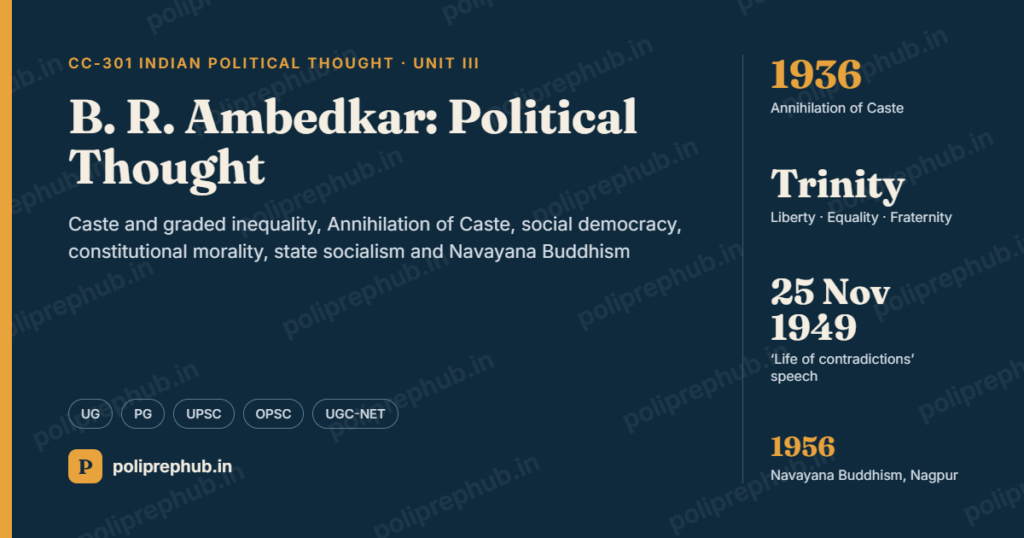
Dr Bhimrao Ramji Ambedkar (1891–1956) was a jurist, economist, social revolutionary, the principal architect of the Constitution of India and the most powerful critic of caste in modern Indian thought. For him, the central question of Indian politics was not only freedom from British rule but freedom from the internal tyranny of caste. His political thought joins three things: a sociology of caste, a theory of social democracy built on liberty, equality and fraternity, and a programme of state action and constitutional law to transform Indian society. In the language of the CC-301 objective, Ambedkar is a strong example of innovative transformation: he used Western liberal, pragmatist and socialist ideas, but reworked them through Indian experience and finally grounded them in Buddhism.
Table of Contents
Life and Works
- Born on 14 April 1891 at Mhow (Madhya Pradesh) in a Mahar family, an “untouchable” caste of Maharashtra; his father served in the army. As a child he experienced humiliating discrimination in school and society.
- Educated at Elphinstone College, Bombay; with a scholarship from the Maharaja of Baroda he studied at Columbia University (MA 1915, PhD) under John Dewey and others, and at the London School of Economics (MSc, DSc) and Gray’s Inn (Bar). He was among the most highly educated Indians of his time.
- Social movement: gave evidence to the Southborough Committee (1919) on franchise; founded the papers Mook Nayak (1920), Bahishkrit Bharat (1927), Janata and Prabuddha Bharat; formed the Bahishkrit Hitakarini Sabha (1924) with the motto “Educate, Agitate, Organise“.
- Mahad Satyagraha (1927) for the right of untouchables to use the public Chavdar tank; public burning of the Manusmriti (25 December 1927); Kalaram temple entry movement at Nasik (1930).
- Represented the Depressed Classes at the Round Table Conferences (1930–32); demanded separate electorates, which led to the Communal Award and the Poona Pact (1932) with Gandhi.
- Founded the Independent Labour Party (1936), the Scheduled Castes Federation (1942); was Labour Member of the Viceroy’s Executive Council (1942–46).
- Member of the Constituent Assembly; Chairman of the Drafting Committee (from 29 August 1947); first Law Minister of independent India. He resigned in 1951 when the Hindu Code Bill was stalled.
- In 1935 at Yeola he declared, “I was born a Hindu, but I will not die a Hindu.” On 14 October 1956 at Nagpur he embraced Buddhism with lakhs of followers, administering 22 vows. He died on 6 December 1956 (Mahaparinirvan Diwas).
Major works:
- Castes in India: Their Mechanism, Genesis and Development (1916)
- The Problem of the Rupee (1923); The Evolution of Provincial Finance in British India (1925)
- Annihilation of Caste (1936)
- Thoughts on Pakistan (1940; later Pakistan or the Partition of India, 1945)
- Ranade, Gandhi and Jinnah (1943); What Congress and Gandhi Have Done to the Untouchables (1945)
- Who Were the Shudras? (1946); The Untouchables (1948)
- States and Minorities (1947) — his blueprint for a constitution with state socialism
- Thoughts on Linguistic States (1955)
- The Buddha and His Dhamma (published 1957); Riddles in Hinduism; Philosophy of Hinduism
Intellectual influences
- John Dewey (pragmatism, democracy as a way of life, education); Ambedkar said he owed his intellectual life to Dewey.
- The Buddha (his “first guru”), Kabir (second) and Jyotirao Phule (third).
- Western liberalism (Burke, Mill), Fabian socialism, and the experience of the American and French revolutions; Marx (whom he engaged critically in Buddha or Karl Marx).
Theory of Caste
Origin and mechanism of caste (1916)
In Castes in India (a paper at Columbia, 1916), Ambedkar rejected racial and occupational theories of caste:
- Indian society shares a cultural unity; caste is a division of this homogeneous society, not a meeting of different races.
- The essence of caste is endogamy superimposed on exogamy: groups that were exogamous (marrying outside the clan) became endogamous (marrying only within the group).
- To maintain endogamy, the problem of surplus women and men (widows, widowers) had to be solved: by sati, enforced widowhood, and child marriage. Thus caste and the subordination of women are tied together.
- The Brahmins were the first to become an enclosed class; others followed by imitation and excommunication — “caste is an enclosed class”.
Caste as graded inequality
- Caste is not just inequality but graded inequality: each caste is above some and below others, so no caste combines with those below against those above. This divides the oppressed and keeps the system stable — “an ascending scale of reverence and a descending scale of contempt”.
- Untouchability is the extreme form, sanctioned by religion.
Critique of caste: Annihilation of Caste (1936)
Annihilation of Caste was written as the presidential address for the Jat-Pat Todak Mandal of Lahore (1936). The organisers objected to his attack on the Hindu scriptures and cancelled the conference; Ambedkar published the speech himself. Its main arguments:
- Social reform before political reform: political power cannot be safely given to a society divided by caste; a nation cannot be built on caste.
- Caste is not a division of labour but a division of labourers, fixed by birth, unrelated to aptitude, and graded — it is economically inefficient and kills individual initiative.
- Caste has no scientific or racial basis; it is not a eugenic device.
- Caste has destroyed public spirit, public charity and public opinion; a Hindu’s loyalty is limited to his caste. “Hindu society is a myth”; it is only a collection of castes.
- Caste prevents the Hindus from forming a society or a nation, and from converting others (since a convert has no caste).
- Chaturvarnya (the four-varna ideal defended by reformers like the Arya Samaj and Gandhi) is impracticable and harmful: it cannot be based on merit when it is fixed by birth, and it has never worked.
- The root of caste is in the religious notions of the Hindus, sanctified by the shastras. Hence: “You must destroy the sacredness and divinity of the shastras.” Hindu religion should be reformed on the basis of liberty, equality and fraternity, with a single standard book, an abolished hereditary priesthood, and priests appointed by the state through examination.
- The real remedy is inter-marriage (“the fusion of blood”); inter-dining is not enough.
- Annihilation of Caste (1936) was the undelivered address for the Jat-Pat Todak Mandal, Lahore.
- Caste is not a division of labour but a division of labourers, fixed by birth; it kills public spirit, charity and morality.
- Reformers fail because caste has the sanction of the shastras; one must destroy the belief in the sanctity of the shastras.
- Remedies: inter-caste marriage (the ‘real remedy’), inter-dining, rejection of scriptural authority, a new religion based on liberty, equality and fraternity.
- Gandhi replied defending varna (“A Vindication of Caste”); Ambedkar answered that Gandhi’s varna is caste in another name.
- Later: conversion to Buddhism as the practical path out of caste.
Gandhi–Ambedkar debate on caste
- Gandhi replied in Harijan (“A Vindication of Caste“, 1936), distinguishing varna (a healthy division of work based on birth but without hierarchy) from caste (a corruption) and holding that untouchability could be removed by a change of heart among caste Hindus. He said scriptures should be judged by the conduct of the best Hindus, and that interpolations contrary to truth and non-violence should be rejected.
- Ambedkar replied that varna was the parent of caste, that the conduct of saints had never changed the system, and that untouchability could not be removed without destroying caste and the authority of the shastras. He also rejected Gandhi’s term Harijan as patronising.
- The debate also covered representation: Ambedkar wanted separate electorates for political power (1931–32); Gandhi saw this as dividing Hindu society (Poona Pact, 1932).
Democracy
Meaning of democracy
Ambedkar defined democracy as “a form and a method of government whereby revolutionary changes in the economic and social life of the people are brought about without bloodshed“. Democracy is thus not only a form of government but a way of life and an instrument of peaceful social revolution (an idea influenced by Dewey).
Social democracy
- Political democracy (one person, one vote) cannot last unless it rests on social democracy — a way of life that recognises liberty, equality and fraternity as principles of life.
- These three form a union of trinity: liberty without equality produces the supremacy of the few; equality without liberty kills individual initiative; without fraternity, liberty and equality cannot become “a natural course of things”.
- He insisted that he took these ideals not from the French Revolution but from the teachings of the Buddha.
- Fraternity (a sense of common brotherhood) is the weakest in India because of caste. He called fraternity “another name for democracy” and saw it as the root of democratic community.
Conditions for the successful working of democracy
In his speeches (e.g., Poona, 1952), Ambedkar listed:
- No glaring inequalities in society (no privileged and oppressed classes);
- Existence of a strong opposition;
- Equality before law and in administration;
- Observance of constitutional morality;
- No tyranny of the majority over minorities;
- Functioning of a moral order in society;
- An awakened public conscience.
The “life of contradictions” (25 November 1949)
In his final speech to the Constituent Assembly, Ambedkar warned:
- On 26 January 1950 India would enter “a life of contradictions“: in politics we will have equality (one man, one vote, one value), but in social and economic life we will have inequality. If the contradiction is not removed soon, those who suffer will “blow up the structure of political democracy”.
- Indians must give up unconstitutional methods (civil disobedience, non-cooperation, satyagraha) now that constitutional methods are available — they are “the grammar of anarchy“.
- Beware of hero-worship (bhakti) in politics: “bhakti in religion may be a road to salvation, but in politics it is a sure road to degradation and to eventual dictatorship”.
- Make political democracy into a social democracy.
Constitutional morality
Drawing on the historian George Grote, Ambedkar argued that constitutional morality — respect for the forms of the constitution, combined with freedom of criticism — “is not a natural sentiment; it has to be cultivated”. Since Indians had not yet learnt it, he defended detailing administrative provisions in the Constitution itself.
Ambedkar’s ideas on constitutionalism
- Constitutional morality: respect for the forms of the Constitution and the values behind them; Ambedkar, quoting the historian Grote, said it is not natural but must be cultivated, because democracy in India is “only a top-dressing on an Indian soil which is essentially undemocratic”.
- Constitutional methods: abandon bloody methods and also civil disobedience, non-cooperation and satyagraha once constitutional methods are open — they are “the grammar of anarchy”.
- Against hero-worship: bhakti in politics leads to dictatorship.
- Rights and remedies: Article 32 (constitutional remedies) as “the very soul and heart” of the Constitution.
- Federalism with a strong centre; detailed provisions to limit misuse of power.
- Democracy as peaceful revolution: democracy is a form of government that brings revolutionary change in social and economic life without bloodshed.
Constitutionalism, State and Rights
The Constitution as a social document
Ambedkar saw the Constitution as an instrument of social transformation:
- Fundamental Rights, especially Article 17 (abolition of untouchability), equality (Articles 14–16), and protection against exploitation.
- Article 32 (right to constitutional remedies), which he called “the very soul of the Constitution and the very heart of it“.
- Directive Principles as “instruments of instructions” to future governments, pointing towards economic democracy.
- Reservations and safeguards for Scheduled Castes and Scheduled Tribes, as a means of representation and justice.
- A strong Centre (federal but with unitary features) to hold a diverse country together and to protect minorities against local majorities.
- He also stressed that “however good a Constitution may be, it is sure to turn out bad because those who are called to work it happen to be a bad lot”.
State socialism (States and Minorities, 1947)
In States and Minorities, Ambedkar proposed that state socialism be written into the constitution itself, so that it could not be changed by ordinary legislative majorities:
- Key and basic industries to be owned and run by the state;
- Insurance to be a state monopoly;
- Agriculture to be a state industry: land to be acquired by the state (with compensation) and let out to villagers for collective farming, without distinction of caste;
- The state to provide capital for agriculture and industry.
This combined parliamentary democracy with socialism: he wanted economic democracy without dictatorship, unlike the Soviet model. The Constituent Assembly did not adopt this; but the Directive Principles partly reflect his concerns.
- Set out in States and Minorities (1947), a memorandum to the Constituent Assembly on behalf of the Scheduled Castes Federation.
- Proposals: key industries to be owned and run by the state; basic industries not owned by the state to be run by state corporations; insurance to be a state monopoly; agriculture to be a state industry, with land owned by the state and cultivated collectively by villagers, without landlords or landless labourers; compensation to owners through state bonds.
- Constitutional guarantee: socialism should be written into the Constitution itself so that it cannot be changed by an ordinary legislative majority — ‘state socialism by constitutional law’, combining socialism with parliamentary democracy.
- Outcome: not adopted; partly reflected in the Directive Principles (Articles 38, 39). It shows that Ambedkar’s liberalism was economically egalitarian.
Minorities and majority
- Ambedkar distinguished a political majority (formed by opinion, changeable) from a communal majority (born, permanent). In India, the Hindu majority was a communal majority, so minorities needed constitutional safeguards.
- He defended separate representation and reservations as protection against the “tyranny of the majority”.
Labour and economic policy
- As Labour Member (1942–46), he introduced measures on working hours (reduction towards 8 hours), maternity benefit, employment exchanges, trade union recognition, and labour welfare funds.
- His economic work (The Problem of the Rupee) influenced debates on currency; his evidence to the Hilton Young Commission (1926) is often cited in the history of the Reserve Bank of India.
- He favoured industrialisation and urbanisation, and saw villages as “a sink of localism, a den of ignorance, narrow-mindedness and communalism” — a sharp contrast with Gandhi’s village ideal.
Women and the Hindu Code Bill
- “I measure the progress of a community by the degree of progress which women have achieved.”
- The Hindu Code Bill sought to give Hindu women rights to property, divorce, adoption and inheritance, and to establish monogamy. Its stalling led to his resignation (1951); it was later passed in parts (1955–56).
Ambedkar’s concept of social justice
- Meaning: social justice for Ambedkar is the removal of caste-based inequality and the creation of a society based on liberty, equality and fraternity — ideas he took from the Buddha, not from the French Revolution.
- Diagnosis: caste is a system of graded inequality, enforced by endogamy and sanctioned by the shastras; it denies Dalits education, property, dignity and even access to water (Mahad Satyagraha, 1927).
- Instruments: constitutional rights (Articles 14–17, 23, 29–30); abolition of untouchability (Article 17); reservations in legislatures, jobs and education (Articles 15(4), 16(4), 330, 332); Directive Principles; the Hindu Code Bill for women’s rights; labour rights (as Labour Member, 1942–46, he supported the eight-hour working day, maternity benefit and employment exchanges).
- Beyond law: conversion to Buddhism (1956), education (“educate, agitate, organise”), self-respect and political organisation of the oppressed.
- Distinctive: justice is social and economic, not only legal; the state must actively intervene. Compared with Rawls, Ambedkar starts from group-based injustice (caste) rather than individuals behind a veil of ignorance.
Nationalism, Pakistan and Linguistic States
- Ambedkar criticised the Congress’s nationalism for ignoring the internal colonialism of caste: “political freedom” for whom?
- In Pakistan or the Partition of India, he analysed Muslim separatism dispassionately and argued that if Muslims insisted on a separate state, partition with exchange of populations might be better than a weak, divided union; he also noted the convergence between Savarkar and Jinnah on the two-nation idea.
- In Thoughts on Linguistic States (1955), he accepted linguistic states (“one state, one language”) but warned against very large states; he proposed dividing UP, Bihar and MP into smaller states, and Hindi as the official language.
Religion and Buddhism
- For Ambedkar, religion is necessary for society, but it must be based on reason, morality and social justice, not on superstition or birth.
- He distinguished religion (based on revelation and ritual) from dhamma (a moral order governing human relations).
- In The Buddha and His Dhamma, he reinterpreted Buddhism as a social and rational teaching — Navayana (“new vehicle”): the Buddha’s message concerns suffering caused by social injustice and the need for prajna (understanding), karuna (compassion) and samata (equality). He questioned some traditional doctrines (e.g., the conventional reading of karma and rebirth) and emphasised the Buddha as a social reformer.
- Conversion was a political act: an exit from caste Hinduism and an assertion of dignity.
- In Buddha or Karl Marx, he argued that the Buddha’s way (persuasion, moral change, non-violence) was superior to the Marxist way (violence, dictatorship), though both sought to end exploitation.
Ambedkar’s critique of Marxism
Ambedkar’s main text is Buddha or Karl Marx (written 1956, published posthumously).
- Agreement: both Buddha and Marx saw suffering and exploitation, and private property as a source of sorrow; both sought an equal society.
- Disagreement on means: Marx accepts violence and the dictatorship of the proletariat; the Buddha relied on persuasion, moral teaching and love. Ambedkar argued that violence and dictatorship destroy liberty and fraternity, and that a dictatorship does not wither away.
- Caste is not only class: in Annihilation of Caste (1936), he said Indian socialists must first face the ‘monster’ of caste; workers divided by caste will not unite as a class. Economic interpretation of history is incomplete; religion and social status also shape power.
- Democracy over dictatorship: he preferred parliamentary democracy with state socialism.
- Conclusion: he accepted Marx’s goals but rejected his methods and his class reductionism — a Buddhist-democratic alternative to Marxism.
Ambedkar and Gandhi: A Comparison
| Point | Ambedkar | Gandhi |
|---|---|---|
| Caste | Must be annihilated; varna is the parent of caste | Untouchability must go; varna as ideal division of work (later views moved closer to inter-caste marriage) |
| Method | Law, constitution, state action, political power, conversion | Change of heart, moral persuasion, self-purification |
| Village | Den of localism and casteism | Ideal unit of swaraj (gram swaraj) |
| State | Positive state for social and economic justice | Decentralised minimal state; ideal of enlightened anarchy |
| Economy | Industrialisation, state socialism | Village industry, khadi, trusteeship |
| Representation | Separate electorates / reservations | Joint electorates; Poona Pact |
| Religion | Rational religion; Buddhism (Navayana) | Reformed Hinduism; equal respect for all religions |
| Terminology | Depressed Classes / Scheduled Castes; rejected “Harijan” | “Harijan” |
Critical Assessment
Contributions:
- The most rigorous sociological and moral critique of caste, linking caste with gender, religion and economy.
- A distinctive theory of social democracy and constitutional morality that remains central to Indian constitutional law (the Supreme Court frequently invokes “constitutional morality”).
- Architect of a Constitution that combines rights, social justice and democratic institutions.
- Synthesis of liberalism, socialism and Buddhism; an example of the creative transformation of Western ideas.
- Inspiration for Dalit movements, social justice politics and global anti-discrimination thought.
Criticisms:
- Some nationalists criticised his opposition to the Congress and co-operation with the British government during the war.
- Marxists have argued that he gave insufficient weight to class; others reply that he combined caste and class analysis (“Brahminism and capitalism” as twin enemies of workers, 1938).
- His heavy reliance on law and the state has been questioned by those who stress social and cultural change from below.
- His reinterpretation of Buddhism has been criticised by traditional Buddhists as departing from canonical doctrine.
- His view of villages has been called too negative by Gandhian scholars.
Conclusion
Ambedkar placed caste at the centre of Indian political theory and argued that political democracy would fail unless it rested on social and economic democracy. His idea of democracy as peaceful social revolution, his defence of liberty, equality and fraternity as an inseparable trinity, his insistence on constitutional morality and state socialism, and his turn to Buddhism as a religion of reason and equality make him one of the most original thinkers of modern India. For CC-301’s question, he represents neither rejection nor imitation of the West, but an innovative transformation: Western democratic ideals reworked through the experience of the most oppressed Indians and grounded in an Indian (Buddhist) moral tradition.
Quick Revision
| Item | Key point |
|---|---|
| Dates | 14 Apr 1891 (Mhow) – 6 Dec 1956 |
| Education | Columbia (Dewey), LSE, Gray’s Inn |
| Movements | Mahad (1927); Manusmriti burnt (25 Dec 1927); Kalaram (1930) |
| Organisations | Bahishkrit Hitakarini Sabha (1924); ILP (1936); SCF (1942) |
| Caste theory | Endogamy superimposed on exogamy; graded inequality |
| Key text | Annihilation of Caste (1936) |
| Democracy | Peaceful revolutionary change; liberty–equality–fraternity trinity |
| 25 Nov 1949 | Life of contradictions; grammar of anarchy; hero-worship |
| Article 32 | “Heart and soul” of the Constitution |
| States and Minorities | State socialism; collective farming |
| Conversion | 14 Oct 1956, Nagpur; 22 vows; Navayana |
Memory aids
- Motto: Educate, Agitate, Organise.
- Three gurus: Buddha, Kabir, Phule.
- Caste = division of labourers, not of labour.
Exam Practice
Long-answer questions
- Examine Ambedkar’s theory of the origin and mechanism of caste.
- “Caste is not a division of labour, but a division of labourers.” Elaborate with reference to Annihilation of Caste.
- Discuss Ambedkar’s concept of social democracy and the trinity of liberty, equality and fraternity.
- Explain Ambedkar’s views on constitutional morality and the conditions for the success of democracy.
- Analyse Ambedkar’s idea of state socialism in States and Minorities.
- Compare the views of Gandhi and Ambedkar on caste and untouchability.
- Assess Ambedkar’s reinterpretation of Buddhism and its political significance.
Short-answer questions
- What was the Mahad Satyagraha?
- What is meant by graded inequality?
- Why was the Annihilation of Caste speech not delivered?
- What did Ambedkar mean by “grammar of anarchy”?
- Why did Ambedkar call Article 32 the heart and soul of the Constitution?
- What is constitutional morality?
- What were Ambedkar’s views on the Indian village?
- Why did Ambedkar resign from Nehru’s cabinet?
- What is Navayana Buddhism?
- What did Ambedkar propose in Thoughts on Linguistic States?
Multiple-choice questions
- “Annihilation of Caste” was prepared for the: (a) Arya Samaj (b) Jat-Pat Todak Mandal (c) Hindu Mahasabha (d) Servants of India Society. Answer: (b)
- Ambedkar’s teacher at Columbia who deeply influenced him was: (a) Harold Laski (b) John Dewey (c) Edwin Seligman only (d) Max Weber. Answer: (b)
- Ambedkar described Article 32 as: (a) the jewel of the Constitution (b) the heart and soul of the Constitution (c) the Magna Carta (d) the key. Answer: (b)
- States and Minorities (1947) proposed: (a) Gram swaraj (b) State socialism (c) Partyless democracy (d) Trusteeship. Answer: (b)
- Ambedkar embraced Buddhism at Nagpur on: (a) 14 April 1956 (b) 14 October 1956 (c) 6 December 1956 (d) 26 January 1950. Answer: (b)
- Match the following: (A) Mook Nayak – (B) Bahishkrit Bharat – (C) Independent Labour Party – (D) Scheduled Castes Federation. (1) 1936 (2) 1920 (3) 1942 (4) 1927. Correct code: (a) A-2, B-4, C-1, D-3 (b) A-4, B-2, C-1, D-3 (c) A-2, B-1, C-4, D-3 (d) A-1, B-4, C-2, D-3. Answer: (a)
- Ambedkar said he derived liberty, equality and fraternity from: (a) the French Revolution (b) the Buddha (c) the American Constitution (d) Marx. Answer: (b)
- Assertion (A): Ambedkar warned that India would enter a life of contradictions. Reason (R): Political equality would coexist with social and economic inequality. (a) Both true, R explains A (b) Both true, R does not explain A (c) A true, R false (d) A false, R true. Answer: (a)
- According to Ambedkar, the essence of caste is: (a) Occupation (b) Race (c) Endogamy (d) Untouchability. Answer: (c)
- Ambedkar resigned from the Union Cabinet in 1951 over: (a) Kashmir (b) Hindu Code Bill (c) Linguistic states (d) Five-Year Plan. Answer: (b)
Previous Years’ Questions
These are questions actually set in earlier examinations. UPSC questions are from the Civil Services Mains, PSIR Optional, Paper I; the year is given in brackets. Ambedkar is among the five thinkers most often examined in PSIR Paper I.
UPSC Civil Services Mains (PSIR)
- Comment: Ambedkar’s concept of social justice. (2006)
- Examine Ambedkar’s critique of Marxism. (2013)
- Comment: Dr. B. R. Ambedkar’s idea of state socialism. (2016)
- “Political democracy could not last unless social democracy lay at its base.” — B. R. Ambedkar. Comment. (2017)
- Discuss Ambedkar’s ideas on ‘annihilation of caste’. (2018)
- Comment: Ambedkar’s ideas on constitutionalism. (2020)
UGC-NET (Political Science)
- Match List I with List II: (A) Fatawa-i-Jahandari (B) Thoughts on Linguistic States (C) India Independent (D) The Future of Indian Politics — (I) Charles Bettelheim (II) M. N. Roy (III) Zia Barani (IV) B. R. Ambedkar. Answer: A–III, B–IV, C–I, D–II.
University examinations
- Examine Ambedkar’s views on caste and justice. (University of Delhi, B.A. (Hons.), Indian Political Thought–II)
- Write a short note on Ambedkar’s view on social justice. (University of Delhi, B.A. (Hons.), Indian Political Thought–II)
Answer pointers: “Political democracy could not last unless social democracy lay at its base” (UPSC 2017)
- Source: Ambedkar’s last speech in the Constituent Assembly, 25 November 1949 — India was entering a ‘life of contradictions’: equality in politics, inequality in social and economic life.
- Social democracy = a way of life based on liberty, equality and fraternity as a trinity; separating them defeats democracy.
- Caste society denies fraternity and equality (graded inequality), so ‘one person, one vote’ cannot become ‘one person, one value’ without social change.
- Instruments: constitutional morality, fundamental rights, abolition of untouchability (Article 17), reservations, Directive Principles, state socialism (States and Minorities).
- Present-day relevance: caste discrimination, inequality, majoritarianism; also warnings against hero-worship (bhakti) in politics and against ‘the grammar of anarchy’.
- Conclude: Ambedkar’s insight transforms Western liberal democracy by grounding it in social reform — a strong example for the CC-301 ‘innovative transformation’ argument.
Suggested Readings
- B. R. Ambedkar, Annihilation of Caste (1936; annotated edition, ed. S. Anand, Navayana, 2014).
- Dr Babasaheb Ambedkar: Writings and Speeches (BAWS), Government of Maharashtra.
- Valerian Rodrigues (ed.), The Essential Writings of B. R. Ambedkar (OUP, 2002).
- Christophe Jaffrelot, Dr Ambedkar and Untouchability (Permanent Black, 2005).
- Eleanor Zelliot, From Untouchable to Dalit (Manohar, 1992).
- Gail Omvedt, Ambedkar: Towards an Enlightened India (Penguin, 2004).
- Aishwary Kumar, Radical Equality: Ambedkar, Gandhi, and the Risk of Democracy (Stanford, 2015).
- Bhikhu Parekh, “Ambedkar” in Thomas Pantham and Kenneth Deutsch (eds.), Political Thought in Modern India (Sage, 1986).
© PoliPrepHub · Generated on November 19, 2026