|
PoliPrepHub
Making Political Science Easy
|
poliprephub.in |
Comparative Politics
Constitutionalism and New Constitutionalism
Constitutionalism is the idea that political power must be limited by law, and that those who rule must act within rules that they cannot change at will. A country can have a written constitution and still be ruled by one person. Constitutionalism asks a further question: does the constitution really bind the rulers? If it does, the government is a constitutional one. If it does not, the constitution is only a paper.
The idea is old. Its roots lie in the Greek and Roman ideas of law and the mixed constitution, in the Indian idea of dharma as a limit on the king, and in the medieval struggle to bind kings to law, as in the Magna Carta (1215). It took its modern form in the seventeenth and eighteenth centuries through the work of Locke and Montesquieu, the English Revolution of 1688, and the American and French revolutions. In the twentieth century it spread to the new states of Asia and Africa. The Indian Constitution of 1950 is one of its great modern texts.
The phrase new constitutionalism has more than one meaning, and students must keep them apart. In the first and best-known sense, used by Stephen Gill from the 1990s, it means a set of rules and institutions that protect market freedoms and private property from democratic politics, mainly at the global level. In a second group of uses, it means a fresh style of constitution making and interpretation, which aims to change society and to widen participation. This is seen in the “transformative constitutionalism” of South Africa and in the “new Latin American constitutionalism” of Ecuador and Bolivia. This note explains the traditional idea first and then both kinds of “new” constitutionalism.
UG and PG papers ask for the meaning, features and Western growth of constitutionalism. OPSC and UPSC papers ask for its application to India, the Basic Structure doctrine and constitutional morality, and for current issues. UGC NET asks for authors, books and exact terms. A caution at the start: constitutionalism is not the same as having a constitution. This difference is a favourite question, and it is explained in section 10.
Table of Contents
1. Meaning and definitions
A constitution is the set of basic rules by which a state is organised. It says who holds power, how power is used, and what rights the citizens have. Constitutionalism is a doctrine or belief about how such rules should work. It holds that the rules must be above the rulers, that power must be divided and checked, that rights must be protected, and that the government must be answerable to the people. The word “constitutional” in this sense is a standard of judgment. We ask of a government not only whether it has a constitution, but whether it follows it and whether it is limited by it.
There is a second, wider sense. Constitutionalism also means the whole set of habits, values and institutions that make limited government work in practice. These include the independent judiciary, free elections, a free press and a general respect for the rules. A constitution may be changed by amendment, but constitutionalism lives in the public conduct that supports it.
| Writer | Work | Core idea |
|---|---|---|
| C. H. McIlwain | Constitutionalism: Ancient and Modern (1940) | Constitutionalism is a legal limit on government and the opposite of arbitrary rule |
| Carl J. Friedrich | Constitutional Government and Democracy (1937) | A system of effective and regular restraints on those who govern |
| K. C. Wheare | Modern Constitutions (1951) | Constitutional government is government under rules and limited by them |
| Giovanni Sartori | “Constitutionalism: A Preliminary Discussion” (1962) | The constitution as a guarantee against arbitrary power |
| Karl Loewenstein | Political Power and the Governmental Process (1957) | Constitutions may be normative, nominal or semantic, depending on whether they truly bind |
| B. R. Ambedkar | Constituent Assembly speech, 4 November 1948 | Constitutional morality must be cultivated among the people |
| Stephen Gill | “Globalisation, Market Civilisation, and Disciplinary Neoliberalism” (1995) | New constitutionalism locks market freedoms into rules that shield them from democratic choice |
| Karl Klare | “Legal Culture and Transformative Constitutionalism” (1998) | A constitution may be a long project to change society in a democratic and equal direction |
Definitions by scholars
C. H. McIlwain (Constitutionalism: Ancient and Modern, 1940). McIlwain held that the one quality that all true constitutionalism has is the legal limitation of government. It is the opposite of arbitrary rule, which is the rule of will in place of law. For him, a state may have a constitution in the sense of a plan of government and still lack constitutionalism, if the rulers are not bound.
Carl J. Friedrich (Constitutional Government and Democracy, 1937, and later editions). Friedrich described constitutionalism as a system of effective and regular restraints on government action. His stress is on the word “effective”: the restraints must work in practice. He gave great importance to the division of power as the means of restraint.
K. C. Wheare (Modern Constitutions, 1951). Wheare used “constitutional government” for government that is limited by rules, as against government at the will of the ruler. He said that a constitution in this sense is not merely a description of how power is organised. It is a set of rules that really governs the rulers. Wheare is often paired with Friedrich in examination questions on the difference between a constitution and constitutionalism.
Giovanni Sartori (“Constitutionalism: A Preliminary Discussion”, American Political Science Review, 1962). Sartori stressed the protective purpose of a constitution. He called a true constitution a garantiste one, which means that it guarantees the freedom of the individual by restraining power. He argued that a document that only organises power, with no limit, does not deserve to be called a constitution in the full sense.
Karl Loewenstein (Political Power and the Governmental Process, 1957). Loewenstein did not define constitutionalism in one line. He sorted constitutions by how far they work. A normative constitution actually binds the rulers. A nominal constitution is good in law but does not yet work because conditions are not ready. A semantic constitution only gives legal form to the power of those who already rule. This classification is widely used to test whether a country has constitutionalism.
B. R. Ambedkar (Constituent Assembly, 4 November 1948). Ambedkar, quoting the historian George Grote, said that “constitutional morality is not a natural sentiment. It has to be cultivated.” He meant a respect for the forms of the constitution, and a habit of settling matters by constitutional means. He warned that the form of the constitution can be kept while the spirit is lost, and that democracy in India was only a top-dressing on an undemocratic soil.
Stephen Gill (“Globalisation, Market Civilisation, and Disciplinary Neoliberalism”, Millennium, 1995). Gill used “new constitutionalism” for the project of giving a legal and institutional form to market-based capitalism, mainly at the global level. In this sense, international treaties, trade rules, central-bank independence and investor protections work like a constitution for the world economy. They limit what elected governments can do on economic policy.
Karl Klare (“Legal Culture and Transformative Constitutionalism”, South African Journal on Human Rights, 1998). Klare described transformative constitutionalism as a long-term project of making, interpreting and enforcing a constitution so as to change a country’s political and social institutions and power relations in a democratic, participatory and egalitarian direction. He wrote about the South African Constitution of 1996.
Note for the student. The words of these scholars are given as textbooks usually report them. The phrases in quotation marks are the ones most often cited, but the exact wording differs between editions and translations. In examinations, state the scholar’s name, the work and the core idea. Quote only the short phrase of which you are sure.
What the definitions share. Every definition of constitutionalism has three elements. The first is a limit: power is bound by rules. The second is a means: the limit is secured by institutions such as the separation of powers, rights and an independent judiciary. The third is effectiveness: the limit must work in practice and not only on paper. The “new” constitutionalisms add a fourth question: who benefits from the rules, and who is shut out of choice by them?
2. Characteristics of constitutionalism
1. It rests on the idea of limited government. The central claim is that no ruler has unlimited power. Every office has a defined range of powers, and acts outside that range are invalid. The reason is simple. People who hold power tend to misuse it, so the rules must restrain them before the misuse happens. For example, the Indian Parliament is supreme in making laws, but it cannot make a law that destroys the basic structure of the Constitution. This point is the first one to state in any examination answer.
2. It requires a higher law. There must be a body of rules that stands above the ordinary acts of government. Most often this is a constitution. Ordinary laws, and the actions of the executive, are tested against it. This is why a constitution is hard to change, and why courts can strike down a law that goes against it. Without a higher law, there is nothing to limit the government with.
3. It upholds the rule of law. Everyone, including officials, is subject to law, and no person is punished except for a breach of law established in the usual way. A. V. Dicey described the rule of law as the absence of arbitrary power, equality before the law and the protection of rights by ordinary courts. In India, Article 14 on equality before law and Article 21 on life and liberty work in this way. Rule of law differs from rule by law, in which law is only the tool of the ruler.
4. It divides and checks power. Power is spread among the legislature, executive and judiciary, and often between the centre and the units of a federation. Montesquieu argued that power must check power. For example, in the United States the President can veto a bill and Congress can override the veto, while the courts can review both. Such arrangements make it difficult for one body to dominate.
5. It protects the rights of individuals and minorities. A constitutional government accepts that some freedoms lie beyond the reach of majorities. These include freedom of speech, religion and association, and protection from arbitrary arrest. Part III of the Indian Constitution gives such rights, and Article 32 allows a citizen to go straight to the Supreme Court for them. The protection of minorities is a test, because majorities can protect themselves by voting.
6. It demands an independent judiciary. Courts that decide disputes on the law, free from the pressure of the executive, are the main guardians of the constitution. Judicial review lets them examine the validity of laws and executive acts. This is why the independence of judges, in matters of appointment, tenure and pay, is a constant subject of debate. For example, the debate over the collegium system in India is a debate about how to protect this independence.
7. It requires accountability to the people. Constitutionalism is not only about the limits on power. It also means that rulers answer to the ruled. Free and fair elections, a free press, parliamentary questions and audit by an independent body are examples. In this way constitutionalism links with democracy, although the two are not the same. A monarch may be bound by law without being elected, as in some older European states.
8. It stresses procedure and legality. Power must be used by the correct method. Laws must be made by the proper body, announced and applied in the same way to all. Fair procedure protects people from sudden and personal decisions. The Supreme Court of India, in Maneka Gandhi v. Union of India (1978), held that the procedure for depriving a person of liberty must be fair, just and reasonable, and not merely laid down by law.
9. It values constitutional morality. Rules alone do not work unless leaders and citizens accept them in spirit. Ambedkar said that constitutional morality has to be cultivated. It means respect for institutions, a willingness to accept defeat in an election, and the settlement of disputes by peaceful means. Where this habit is missing, the best written constitution fails.
10. It allows orderly change. A constitution that cannot change becomes outdated, and one that changes too easily gives no protection. Constitutionalism therefore provides amendment procedures that are difficult but possible. Article 368 of the Indian Constitution is an example, with the further limit that the basic structure cannot be altered. The aim is to allow change by agreed methods and not by force.
11. It is a matter of degree. No country has perfect constitutionalism. Some governments are closer to the ideal than others, and the same country may be stronger at one time and weaker at another. India during the Emergency of 1975–77 showed a sharp fall, and the later restoration showed recovery. For this reason scholars speak of the strengthening or the erosion of constitutionalism.
12. It is not tied to one form of government. Constitutionalism can exist in parliamentary and presidential systems, in federal and unitary states, and in republics and monarchies. Britain has no single written constitution, yet it is a standard example of constitutional government. This shows that constitutionalism is about how power is limited and not about the form of the document.
13. It is shaped by history and culture. Each country builds its constitutionalism from its own past. Britain developed it by slow custom and conflict between king and Parliament. The United States wrote it after a revolution. India added the experience of colonial rule and the freedom movement, and made social justice a part of it. A student should not treat one model as the only one.
14. It has a changing meaning. The older idea was mainly about limiting the state in order to protect the individual. The modern idea also covers social and economic rights, the protection of minorities, and the use of the constitution to change an unequal society. The new constitutionalisms discussed later show further shifts. The concept thus grows with the problems of each age.
3. Evolution of constitutionalism at a glance
Constitutionalism did not appear all at once. It grew over many centuries as a reply to the abuse of power, and each stage added a new idea or corrected a gap in the one before. The diagram shows the eight stages in order. The highlighted stage marks the arrival of the “new” constitutionalisms that this note explains in section 8.
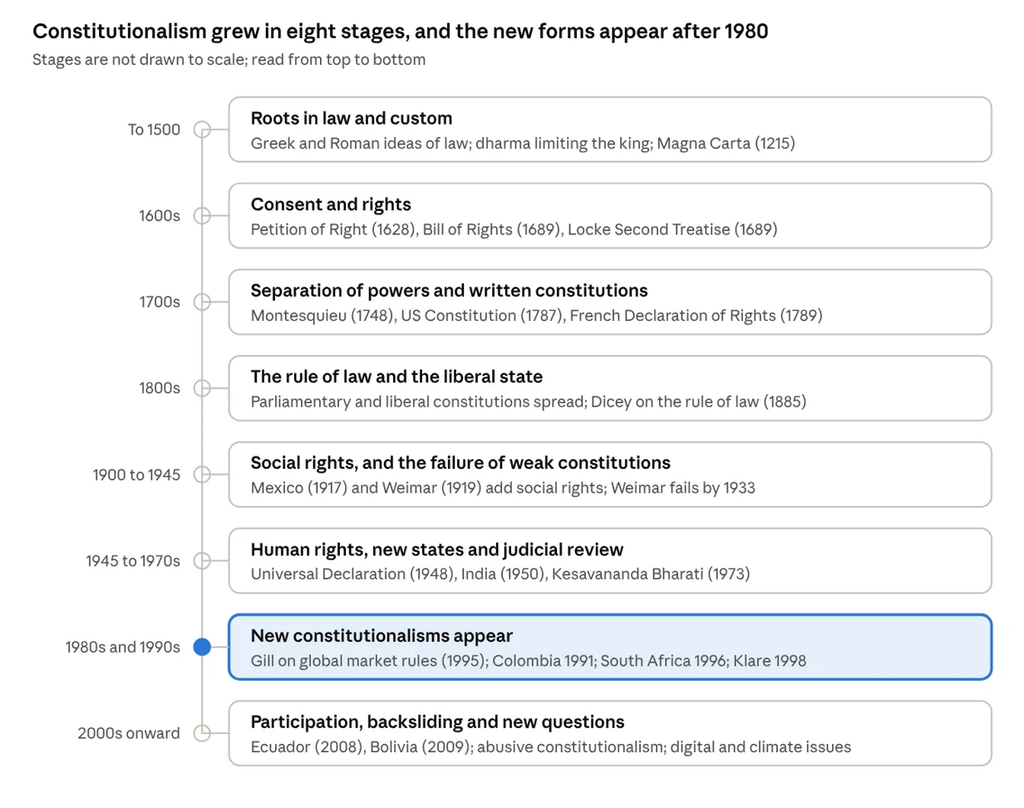
Read the diagram from top to bottom. The first four stages built the classical liberal model: law above the king, rights of the individual, divided power and the rule of law. The fifth stage shows its first big correction. Constitutions of the early twentieth century added social rights, and the failure of the Weimar constitution showed that rules without support could collapse. The sixth stage spread constitutional government, with human rights and judicial review, to the new states of Asia and Africa after 1945. India is the leading example.
The seventh and eighth stages are the subject of the “new” constitutionalisms. After 1980 the question changed from “how do we limit the ruler?” to “who is protected by the rules, and who is left out?” Gill pointed to rules that protect markets. Klare and the Latin American writers pointed to constitutions that aim to change society. The latest stage adds the problem of constitutional change used to weaken democracy, and new subjects such as digital rights and the environment.
For examinations, the stages give a ready frame for a long answer. A student can name one idea, one work and one date for each stage, and can show how each stage answered the weakness of the one before.
4. Classical liberal constitutionalism
The classical model of constitutionalism grew in Europe and North America between the seventeenth and nineteenth centuries. It is called liberal because its main aim was to protect the freedom of the individual from the state. Five ideas stand at its centre.
Government by consent and for limited ends. John Locke, in his Second Treatise of Government (1689), argued that people have natural rights to life, liberty and property. They set up a government by consent to protect these rights. If the government breaks the trust, the people may remove it. This idea gave a moral base to the limits on power. It also lay behind the English Revolution of 1688 and the American Declaration of Independence of 1776.
The rule of law. The medieval roots lie in documents such as the Magna Carta (1215), the Petition of Right (1628) and the Bill of Rights (1689). They bound the king to law. In the nineteenth century A. V. Dicey, in Introduction to the Study of the Law of the Constitution (1885), gave the rule of law three parts: the supremacy of regular law over arbitrary power, equality before the law, and rights secured by the ordinary courts. His view fits the British system well. Critics say that it ignores the wide discretion that modern administration needs.
Separation of powers and checks and balances. Montesquieu, in The Spirit of the Laws (1748), argued that liberty is safe only where power is not in the same hands. He drew on his reading of the English constitution. The framers of the American Constitution of 1787 went further. In The Federalist (No. 51), James Madison argued that “ambition must be made to counteract ambition”. Each branch was given the means to resist the others. The United States still shows this most clearly, with its veto, impeachment, Senate confirmation and judicial review.
Fundamental rights. The American Bill of Rights (1791) and the French Declaration of the Rights of Man and of the Citizen (1789) listed rights that the state may not take away. The idea is that some freedoms are not gifts of government. They come before government and limit it. Most modern constitutions, including that of India, keep a list of such rights.
Judicial review. In Marbury v. Madison (1803), Chief Justice John Marshall held that a law against the Constitution is not valid, and that it is the duty of the courts to say what the law is. This made the court a guardian of the higher law. Many countries have followed this idea, with variations. India adopted it in Articles 13, 32 and 226.
Merits and limits of the classical model. The model gave a lasting answer to the problem of arbitrary power. It produced stable institutions and protected important freedoms. But it had weaknesses. It saw rights mainly as protection from the state and paid little attention to poverty and social inequality. In practice, the vote and the rights of citizenship were at first limited to men with property. Women, workers, slaves and colonised peoples were left out. These gaps led to the later social, Marxist and postcolonial criticisms.
5. Conditions and safeguards of constitutionalism
Constitutionalism does not come from a document alone. It needs supporting conditions. The following are the main ones.
A higher and hard-to-change law. The constitution must stand above ordinary law. A rigid amendment procedure keeps the basic rules safe from the passing majority. In India, Article 368 requires a special majority of Parliament, and for some changes the consent of half the states. At the same time, the procedure must not be so hard that the constitution cannot change at all.
An independent judiciary. Judges need security of tenure, protected pay and freedom from pressure. In India, a judge of the Supreme Court can be removed only by a special process in Parliament. The independence of the bar and respect for court orders are also needed. If officials ignore judgments, judicial review has no force.
Free and fair elections. Elections let the people reward or remove the rulers. For this the electoral body must be impartial. In India the Election Commission is given this duty under Article 324. Free and fair elections also need a level field for parties, honest counting and acceptance of the result by those who lose.
A free press and an active civil society. Public criticism is a strong check. A free press brings the faults of government to light, and civil society groups, unions and movements put pressure on rulers. The Right to Information Act 2005 is an Indian example of a law that supports such scrutiny.
Separation of powers and federalism. Dividing power among organs, and between the centre and the units, makes it harder to misuse. In India, the division between the Union and the states in the Seventh Schedule, and the working of the Rajya Sabha, serve this purpose. The Supreme Court has treated federalism as part of the basic structure.
Independent oversight bodies. Bodies such as the Comptroller and Auditor General, the Election Commission, the Public Service Commissions and the Human Rights Commissions check the government without being under its control. Some scholars call these the “guarantor” or “fourth branch” institutions. Their protection of tenure and funds is important.
Limits on emergency powers. Constitutions allow special powers in a crisis, but these are a main route for the loss of liberty. Good design limits their time and scope, and keeps them under review. After the Emergency of 1975–77, the 44th Amendment (1978) made emergency declarations harder, and protected Articles 20 and 21 from suspension.
Political parties and a loyal opposition. Parties that accept the rules of the game, and an opposition that is allowed to act, are needed. Where the ruling party treats the opposition as an enemy to be removed, constitutionalism fails even if the formal rules remain.
Civic education and constitutional morality. Citizens and leaders must understand and value the rules. Schools, the media and public debate play a part. Ambedkar’s warning that constitutional morality has to be cultivated shows why this condition matters most in new democracies.
A professional and neutral civil service. Officials who serve the law and not a party give the state a stable character. Constitutional provisions on the civil services, such as Article 311, aim to give them security against arbitrary dismissal.
6. Theories and perspectives on constitutionalism
Different traditions of thought explain and judge constitutionalism in different ways. A student should know the main ones.
Liberal perspective
The liberal view is the oldest and the most common. It sees constitutionalism as the protection of individual liberty from the state, through law, rights and the division of power. Locke, Montesquieu, Madison and Dicey belong here. In the twentieth century, F. A. Hayek, in The Constitution of Liberty (1960), argued that liberty needs general and equal rules that bind the government too. James Buchanan and Gordon Tullock, in The Calculus of Consent (1962), studied constitutional rules as the agreed framework in which ordinary politics takes place. John Rawls, in Political Liberalism (1993), spoke of “constitutional essentials”, which are the basic rights and the structure of government that free and equal citizens can all accept.
Marxist critique
Marxists argue that the liberal constitution serves the interests of the owning class. Karl Marx, in On the Jewish Question (1843), said that the “rights of man” are the rights of the property-holding individual of civil society. For Marx and Lenin, the state is an instrument of class rule, and the rule of law hides this fact. Equal legal rights are formal, because workers cannot use them when they lack wealth and power. Later writers, such as Ralph Miliband and Nicos Poulantzas, studied how the capitalist state works through constitutional forms. The Marxist view is useful because it draws attention to the social base of rights. Its weakness is that it may undervalue the real protection that legal limits give, even to the poor, as shown by the loss of liberty where such limits are removed.
Social and welfare perspective
This view holds that liberty without a basic level of welfare is empty. T. H. Marshall, in Citizenship and Social Class (1950), described the growth of civil, political and social rights. Constitutions of the early twentieth century, such as the Mexican Constitution of 1917 and the Weimar Constitution of 1919, included social rights. The Indian Constitution joined civil and political rights in Part III with the Directive Principles of State Policy in Part IV, which aim at social and economic justice. The Supreme Court has read some social rights into Article 21, such as the right to education and to livelihood. The difficulty is that social rights depend on resources and are harder for courts to enforce.
Republican perspective
Republicans hold that freedom means the absence of domination, and not only the absence of interference. Philip Pettit, in Republicanism (1997), argued that a person is unfree when others have the power to interfere arbitrarily, even if they do not use it. A constitutional order should therefore give citizens a secure position by dividing power and by making officials accountable. This view explains the old republican stress on mixed government and civic virtue.
Postcolonial and transformative perspective
Scholars from the postcolonial world note that many constitutions were written in societies of deep inequality. They ask that the constitution be used to change the social order. In India, this idea appears in the constitutional promise of justice, equality and fraternity, and in provisions against untouchability (Article 17). Karl Klare described the South African Constitution in the same way, as a project of transformation. Critics warn that this role may place too much power with the courts.
Constitutional morality
This is not a school of thought in itself. It is a standard that all the schools apply. In Indian law, Ambedkar’s idea has been used by the Supreme Court in cases such as Navtej Singh Johar v. Union of India (2018), on the decriminalisation of same-sex relations. The Court held that constitutional morality, based on the values of the Constitution, must prevail over public or social morality when they conflict. Critics argue that the phrase is vague and that judges may use it to put their own views in place of the legislature’s.
7. Constitutionalism in India
The Indian Constitution came into force on 26 January 1950. It is among the longest written constitutions in the world, and it joins several ideas: parliamentary government, federalism, fundamental rights, judicial review and a programme of social change. Its framers had the experience of colonial rule, of the freedom movement and of the Partition. They wanted a government that would be strong enough to hold the country together and yet bound by law.
Features that support constitutionalism
- The Preamble and the basic values. The Preamble declares India to be a sovereign, socialist, secular, democratic republic, and promises justice, liberty, equality and fraternity. The words “socialist” and “secular” were added by the 42nd Amendment (1976).
- Fundamental rights (Part III). They bind the state, and Article 13 declares void any law that takes away or reduces them. Article 32 gives a right to move the Supreme Court for their enforcement.
- Directive Principles (Part IV). They are not enforceable by courts, but they guide the state towards social and economic justice. The courts read them together with the fundamental rights.
- Separation of powers. The Constitution does not follow a strict separation, as the executive in the parliamentary system sits in the legislature. But the courts have held that the separation of powers is part of the basic structure.
- An independent judiciary with power of judicial review. Articles 32, 226 and 13 give the Supreme Court and the High Courts this power.
- Federalism. The Seventh Schedule divides powers between the Union and the states. The Supreme Court in S. R. Bommai v. Union of India (1994) described federalism as part of the basic structure.
- Independent institutions. The Election Commission, the Comptroller and Auditor General and the Public Service Commissions have their own place in the Constitution.
The Basic Structure doctrine
The most important Indian contribution to constitutionalism is the doctrine of the basic structure. The question was whether Parliament, under Article 368, can amend any part of the Constitution, including the fundamental rights. The courts answered it in stages.
In Shankari Prasad (1951) and Sajjan Singh (1965), the Supreme Court held that Parliament could amend the fundamental rights. In Golaknath v. State of Punjab (1967), it held the opposite. Then, in Kesavananda Bharati v. State of Kerala (1973), a bench of thirteen judges held by a narrow majority that Parliament has wide power to amend the Constitution, but it cannot alter its “basic structure”. The judgment did not list the structure fully. Later cases have named several elements: the supremacy of the Constitution, the republican and democratic form of government, secularism, the separation of powers, federalism, judicial review, free and fair elections, the rule of law and the independence of the judiciary.
The doctrine shows constitutionalism in its purest form. Even the highest law-making body is bound by something higher than its own will. Its critics ask whether unelected judges should have the last word on what is basic. Its defenders reply that without it, a party with a large majority could use amendment to destroy the constitutional order from inside.
Important cases
| Case | Year | Why it matters |
|---|---|---|
| Kesavananda Bharati v. State of Kerala | 1973 | Parliament cannot change the basic structure of the Constitution |
| Indira Gandhi v. Raj Narain | 1975 | Free and fair elections and judicial review held to be part of the basic structure |
| ADM Jabalpur v. Shivkant Shukla | 1976 | Held that rights to move courts could be suspended in the Emergency; much criticised and later rejected in Puttaswamy (2017) |
| Maneka Gandhi v. Union of India | 1978 | Procedure that takes away liberty must be fair, just and reasonable |
| Minerva Mills v. Union of India | 1980 | Struck down parts of the 42nd Amendment; balance between fundamental rights and Directive Principles is basic |
| S. R. Bommai v. Union of India | 1994 | Use of Article 356 is open to judicial review; secularism and federalism are basic |
| Supreme Court Advocates-on-Record Association v. Union of India | 2015 | Struck down the constitutional amendment creating the National Judicial Appointments Commission, protecting judicial independence |
| Navtej Singh Johar v. Union of India | 2018 | Constitutional morality prevails over social morality; same-sex relations decriminalised |
The Emergency and its lessons
The Emergency of 1975–77 was the most serious test. Civil liberties were suspended, the press was censored, and the 42nd Amendment tried to put Parliament’s power above judicial review. The ADM Jabalpur decision, by which the Supreme Court held that even the right to life could not be enforced during the Emergency, is regarded as a low point of judicial conduct. The recovery that followed showed the strength of the system. The people voted out the ruling party in 1977, the 44th Amendment (1978) made it harder to declare an emergency, and the Court later gave a wide reading to Article 21. The experience proved Ambedkar’s point: written safeguards need the support of constitutional morality.
Constitutional morality in practice
The Supreme Court has used constitutional morality in several recent decisions, such as Navtej Singh Johar (2018) on same-sex relations, Joseph Shine v. Union of India (2018) on adultery, and the Sabarimala case (2018) on the entry of women to a temple. These show the Court asking the state and society to follow the values of the Constitution, even when these differ from custom. Critics ask whether such wide use of the term allows judges too much freedom.
Present issues
Students should be ready to discuss the following issues with examples.
- The balance between the judiciary and the executive in judicial appointments, including the collegium system and the 2015 decision on the NJAC.
- The role of the Governor and the use of President’s Rule in the states.
- The use of ordinances in place of laws made after debate.
- The working of the anti-defection law in the Tenth Schedule, and the powers of the Speaker.
- The protection of free speech and privacy, including the right to privacy recognised in K. S. Puttaswamy v. Union of India (2017).
- The pressure on the independence of oversight bodies and on the quality of parliamentary debate.
8. New constitutionalism
There is no single “new constitutionalism”. The phrase is used for several different developments from the 1980s onward. They have in common only that each departs from the classical liberal model of the eighteenth century. A student must say which meaning is intended, because examiners may use the phrase in any of these senses. The table gives the main ones.
| Sense | Main writers | Core idea | Example |
|---|---|---|---|
| Global economic (disciplinary) new constitutionalism | Stephen Gill, Claire Cutler | Rules that lock in market freedoms and shield them from democratic change | WTO rules, investment treaties, independent central banks, fiscal rules |
| Transformative constitutionalism | Karl Klare, Upendra Baxi, Gautam Bhatia | The constitution as a long project to change an unequal society | South Africa 1996, India |
| New Latin American constitutionalism | Roberto Gargarella, Viciano Pastor and Martinez Dalmau | Participatory constituent processes, wide rights, indigenous and nature rights | Colombia 1991, Ecuador 2008, Bolivia 2009 |
| New Commonwealth model | Stephen Gardbaum | Rights review by courts, but the legislature may have the last word | Canada s.33, UK Human Rights Act 1998, New Zealand |
| Juristocracy (a critical idea) | Ran Hirschl | Elites hand power to courts to protect their interests | Constitutional courts in many new democracies |
Gill’s new constitutionalism (global economic)
Stephen Gill, a Canadian political economist, used the term in the 1990s in articles such as “Globalisation, Market Civilisation, and Disciplinary Neoliberalism” (Millennium, 1995) and “New Constitutionalism, Democratisation and Global Political Economy” (1998). He and Claire Cutler later edited New Constitutionalism and World Order (2014). This is the sense in which the term is most often used in international political economy and in UGC NET.
Gill’s claim is that since the 1980s a set of rules, treaties and institutions has been built that protects the rights of capital and the market. These rules are made to be hard to reverse. They are “locked in”, out of reach of ordinary voters and of legislatures. He called the result “disciplinary neoliberalism”, because it disciplines governments to follow market-friendly policy. The main instruments given as examples are:
- independent central banks that are free of elected governments in monetary policy;
- rules on budget deficits and public debt, such as the convergence criteria of the Maastricht Treaty (1992);
- the rules of the World Trade Organization (1995) on trade, services and intellectual property;
- bilateral investment treaties that let foreign investors bring claims against states before arbitration panels;
- loan conditions of the International Monetary Fund and the World Bank, especially the structural adjustment programmes of the 1980s and 1990s.
The word “constitutionalism” is used on purpose. Gill points out that these rules work like a constitution for the world economy. They set limits on what governments can do, and they cannot be changed by simple majorities. But the limit is of a different kind from the classical one. The classical constitution limits the state in order to protect citizens. The new one, in this view, limits democratic choice in order to protect markets. The question of who is protected, and from whom, is reversed.
Arguments in favour. Defenders say that rules of this type give stability and credibility. Investors need to be sure that a government will not seize property or print money without limit. Central-bank independence, for example, has been linked with lower inflation. Binding trade rules reduce the chance of trade wars. Countries with firm rules may also be able to borrow more cheaply.
Arguments against. Critics make five points. The rules reduce the room for democratic choice on economic and social policy. They favour investors over workers, farmers and the poor. They are made by experts and negotiators in forums that the public cannot see. The costs of adjustment fall mainly on weaker countries. And the arrangement lacks legitimacy, since those who are affected had no voice. Some also say that Gill’s view overstates the unity of these rules, since states have also used them in their own interests.
Indian illustrations. Some features of Indian economic governance have been read in this light, though writers differ on whether the label fits. These include the Fiscal Responsibility and Budget Management Act (2003), the amendment of the Reserve Bank of India Act in 2016 to set up a Monetary Policy Committee with an inflation target, India’s membership of the WTO, and the many bilateral investment treaties signed by India, some of which it has since ended or revised. The debates over the farm laws of 2020–21, and over the terms of trade agreements, raised questions of who decides such matters.
Transformative constitutionalism
Karl Klare used this term in 1998 for the South African Constitution of 1996, which was written after the end of apartheid. Its Preamble speaks of the need to “heal the divisions of the past” and to establish a society based on democratic values, social justice and fundamental rights. The constitution does not only limit the state. It tells the state to act to change the society. It includes social and economic rights, such as the right of access to housing, health care, food and water, which the state must try to realise within its means. The Constitutional Court has enforced these rights with a test of “reasonableness”, as in Government of the Republic of South Africa v. Grootboom (2000) on housing and Minister of Health v. Treatment Action Campaign (2002) on drugs to prevent mother-to-child transmission of HIV.
In India, scholars such as Upendra Baxi and, more recently, Gautam Bhatia (The Transformative Constitution, 2019) argue that the Constitution of 1950 has the same character. The Preamble’s promise of justice, the Directive Principles, the abolition of untouchability, the provisions for the reservation of seats and posts, and the land reform amendments in the Ninth Schedule all aim at changing the social order. Ambedkar’s speech of 25 November 1949, on the contradiction between political equality and social inequality, is read in the same way. The strength of this view is that it ties the constitution to the needs of the poor. Its risks are that it may give too much power to courts, and that it may raise hopes that the state cannot meet.
New Latin American constitutionalism
From the 1990s, a group of Latin American countries wrote new constitutions: Colombia (1991), Venezuela (1999), Ecuador (2008) and Bolivia (2009). Scholars call this wave “new Latin American constitutionalism”. Its main features are:
- Participatory making. The constitutions came out of elected constituent assemblies and were approved in referendums, often after long mass mobilisation, rather than being drafted by elites.
- Wide lists of rights. They include social, cultural and collective rights, and tools for citizens to enforce them, such as the tutela action in Colombia.
- Recognition of indigenous peoples. Bolivia is declared a “Plurinational State”, and indigenous law and languages are given a place.
- Rights of nature and “buen vivir”. The Ecuadorian Constitution of 2008 gave rights to nature (Pachamama) and made the idea of “good living” (sumak kawsay) a national goal.
- Direct democracy. They provide for referendums, popular initiatives and the recall of officials.
The Argentine scholar Roberto Gargarella, in Latin American Constitutionalism 1810–2010 (2013), made an important criticism. He argued that these constitutions added many new rights, which is the “rights room” of the constitution, but left the “engine room”, which is the concentration of power in a strong president, mostly untouched. The result, he said, is a gap between high promises and a weak control of power. In some of these states, presidents used the new texts to extend their own terms and to weaken courts and the press.
The New Commonwealth model
Stephen Gardbaum, in a paper of 2001 and in his book The New Commonwealth Model of Constitutionalism (2013), described a third way between two older models. In the first, parliament is sovereign and courts cannot strike down laws, as in Britain until recently. In the second, courts have the final word, as in the United States. In the Commonwealth model, a bill of rights exists and courts can review laws against it, but the legislature has a means of having the last word. Examples are the Canadian Charter of Rights and Freedoms (1982), whose section 33 “notwithstanding clause” allows a legislature to pass a law despite certain rights for a limited period; the New Zealand Bill of Rights Act (1990); and the UK Human Rights Act (1998), under which courts may declare a law incompatible with rights, but Parliament decides whether to change it. Mark Tushnet called this “weak-form” judicial review. The model tries to keep both rights and democracy. Critics doubt that it avoids the problems of either.
Juristocracy and the judicialisation of politics
Ran Hirschl, in Towards Juristocracy (2004), studied the worldwide growth in the power of constitutional courts. He argued that political elites often support it, because when they fear losing power at the polls, they prefer to shift decisions to courts where they have influence. He called this “hegemonic preservation”. The wider process is the “judicialisation of politics”, a term associated with Tate and Vallinder (1995). Indian students link it with public interest litigation and with court orders on policy matters, such as air quality, the environment and appointments. Its value is that courts protect weak groups when other institutions fail. Its danger is that courts may take up tasks that elected bodies should do, and that courts have no direct accountability.
Other extended uses
Students may meet two more terms. Global constitutionalism asks whether international law, the United Nations and bodies such as the European Union have a constitutional character, that is, whether they limit power and protect rights at the level above the state. Digital constitutionalism asks how constitutional ideas such as rights and the limits on power apply to powerful technology firms and to state surveillance online. Both are developing fields and have no settled definitions.
9. Classical and new constitutionalism compared, and present challenges
The two compared
The table sets the classical liberal idea beside the new ones. Since the “new” forms are different from each other, the right-hand column shows the main tendency and names the sense in brackets.
| Point | Classical constitutionalism | New constitutionalism |
|---|---|---|
| Main aim | Limit the state to protect individual liberty | Fix market rules (Gill); change society (transformative); widen participation (Latin America) |
| Whom it limits | Rulers and the state | Democratic majorities and governments (Gill); the state and private power (transformative) |
| Rights | Mainly civil and political | Civil, political, social, economic, collective and environmental |
| Role of the state | Restrained; a guardian of order | Active in social change; or restricted by external rules on the economy |
| Role of courts | Guardians of the rights of the individual | Wider role, including social rights and policy; or a sharing of power with legislatures (Commonwealth model) |
| Level of operation | The nation-state | National, regional and global |
| Source of rules | Constitution and custom within the state | Also treaties, trade law, international organisations |
| Main concern | Arbitrary power of kings and executives | Inequality, market power, exclusion and the limits of democracy |
| Main writers | Locke, Montesquieu, Madison, Dicey, McIlwain, Friedrich | Gill, Klare, Gargarella, Gardbaum, Hirschl |
| Main criticism | Narrow, ignores social inequality | Too much power to courts or markets; vague; gap between promise and practice |
Abusive constitutionalism and democratic backsliding
A new problem of the present century is that the tools of constitutionalism have been used to weaken it. The legal scholar David Landau, in an article of 2013, called this abusive constitutionalism. It means the use of the methods of constitutional change, such as amendment, new constitutions and court reform, to make a government less democratic, while keeping the appearance of legality. Other writers use related terms. Kim Lane Scheppele speaks of “autocratic legalism”. Aziz Huq and Tom Ginsburg speak of “constitutional retrogression”, the slow decline of electoral competition, rights and the rule of law. Nancy Bermeo spoke of “executive aggrandizement”, the gradual weakening of checks on the executive by the executive itself. Steven Levitsky and Daniel Ziblatt, in How Democracies Die (2018), stressed that written rules need two unwritten norms: mutual toleration, which means accepting that rivals have a right to rule, and institutional forbearance, which means not using every legal power to the limit.
The usual steps in such cases are the capture of courts and oversight bodies by changes in appointment or retirement rules, the use of amendment to remove term limits or to override court decisions, pressure on the press and civil society through legal means, and the redrawing of election rules to favour the ruling party. Hungary, after the Fundamental Law of 2011, and Poland, after the judicial changes from 2015, are the cases most often cited in Europe. Venezuela is cited in Latin America. Scholars also debate whether similar patterns appear elsewhere, including in South Asia. In examination answers, India should be handled with balance and with reference to specific events, and not with general charges.
Other present challenges
- Populism. Leaders who claim to speak for “the people” often treat courts, the press and other checks as obstacles to the popular will.
- Emergency powers. The pandemic of 2020 led many states to use wide emergency powers. This showed the need for sunset clauses, legislative review and court oversight.
- Surveillance and technology. The collection of data by states and by firms raises new questions on privacy and free speech. The Indian Supreme Court’s recognition of privacy as a fundamental right in Puttaswamy (2017) is an example of constitutional response.
- Judicial overreach and judicial weakness. There is concern both about courts that take over policy, and about courts that do not defend rights when pressed. The balance is difficult.
- Economic power. Large firms and global markets can shape policy in ways that elected bodies find hard to resist. This is the main concern in Gill’s account.
- Climate and environment. Courts and constitutions are asked to protect the environment and the rights of future generations. Ecuador’s rights of nature and Indian court decisions on Article 21 and the environment are examples.
- Federal and regional tensions. The sharing of power between the centre and the units, and with local bodies, is a continuing test.
10. Constitutionalism compared with related ideas
Many examination questions ask for the difference between constitutionalism and a neighbouring idea. The table gives the main contrasts, and the notes below explain them.
| Idea | Meaning | How it differs from constitutionalism |
|---|---|---|
| Constitution | The basic rules of a state in a document or in custom | A constitution describes the arrangement of power. Constitutionalism asks whether it really limits power |
| Constitutional government | A government that works within and is limited by a constitution | It is the result that constitutionalism aims at. Constitutionalism is the belief and the set of conditions behind it |
| Constitutionality | The quality of an act or a law being in agreement with the constitution | It is a test applied to a single law or action. Constitutionalism is a wider system of values and limits |
| Rule of law | All persons, including officials, are subject to law | It is one element of constitutionalism. Constitutionalism also needs division of power and accountability |
| Rule by law | Law used as a tool by the ruler | It is the opposite of constitutionalism, since the ruler is not bound |
| Constitutional morality | Respect for the values and procedures of the constitution | It is the cultural support of constitutionalism |
| Democracy | Rule by the people through elections and participation | Democracy is about who rules. Constitutionalism is about how far they may rule |
| Liberal democracy | Democracy joined with constitutional limits and rights | The combination of the two. Each can exist without the other |
Constitutionalism and democracy. The two are often linked, but they are not the same. A democracy without constitutionalism may allow a majority to take away the rights of a minority. This has been called the “tyranny of the majority” by Tocqueville and Mill. A constitutional monarchy without full democracy may still limit the power of the ruler. There is also a standing tension between them. Constitutionalism limits what the people’s representatives can do, and democracy says the people should rule. Scholars call this the “counter-majoritarian difficulty”, a term from Alexander Bickel. Liberal democracy tries to hold both together, with elections and rights together. The Basic Structure doctrine shows the tension in an Indian form.
Constitutionalism and a written constitution. A written constitution is neither necessary nor enough. Britain has no single written text, yet its constitutional practice is stable. Many states with detailed written constitutions have ruled by decree. Loewenstein’s test of normative, nominal and semantic constitutions shows this. A student should state the point clearly: the existence of a constitution tells us what the rules are, and constitutionalism tells us whether they are obeyed.
Constitutionalism and the rule of law. The rule of law is a part of constitutionalism, and a main one. But it is possible to have rule of law in a narrow sense, with clear and stable laws, in an authoritarian state. Constitutionalism asks more: that the content and the makers of law are also limited, that rights are protected, and that power is answerable to the people.
Constitutionalism and constitutional government. Some writers use these almost as the same. A good way to separate them is to treat constitutionalism as the doctrine and constitutional government as the practice that results from it.
11. Importance and limitations of constitutionalism
Importance
It protects against arbitrary power. The first and oldest use of constitutionalism is to prevent those in power from acting by their own will. When rulers know that their acts can be tested against a higher law, they are less likely to abuse authority. The Basic Structure doctrine in India is an example of this protection working against the highest law-making body.
It protects individual rights and minority groups. A constitution that places certain rights beyond the reach of majorities gives security to those who cannot win by votes. This matters most for minorities, the poor and dissenters. The Indian fundamental rights, enforced by the Supreme Court under Article 32, are a standard illustration.
It gives stability and predictability. Citizens, businesses and officials can plan when they know the rules and expect the rules to be applied in the same way. Orderly procedures for choosing and removing rulers also lower the risk of violence. This is why countries with firm constitutional practice tend to avoid coups.
It makes government legitimate. People obey a government more willingly when it acts within rules that they regard as fair. Constitutional limits give authority a moral base that mere force does not have. Legitimacy lowers the cost of governing, because the state need not use coercion for everyday compliance.
It allows peaceful settlement of conflict. Constitutional rules give contending groups a common arena. Elections, courts and legislatures can take in disputes that might otherwise go to the streets. In deeply divided societies, such as India or South Africa, the constitution is a shared framework for different communities.
It supports democracy. Free elections, a free press and the right to organise are secured by constitutional guarantees. Without them democracy may turn into rule by the strong. In this sense constitutionalism is the base on which democratic politics stands.
It makes a peaceful transition of power possible. The rules say how power is gained and given up. Losers in an election accept the result because they know they can compete again. India’s record of transfers of power by election, including in 1977 after the Emergency, shows this value.
It makes federal and multi-level governance work. In a federation, the division of powers between the centre and the units depends on a constitution that both sides must obey. Courts settle disputes between them. Without constitutionalism, federations tend either to centralise or to break up.
It encourages accountability and transparency. Audit bodies, legislative questions, the right to information and judicial review make it possible to ask officials to explain their acts. This lowers corruption and abuse. It also allows the public to judge government performance.
It provides a means for social change by law. Modern and transformative constitutions allow reforms, such as the abolition of untouchability, equal rights for women and the protection of the environment, to be pursued within law. The Indian Constitution has been used in this way for land reform, reservation and the extension of the right to life.
It shapes the international order. States that follow constitutional rules are more reliable partners in treaties. Constitutional ideas also underlie human rights law and the work of international courts. At the global level, new constitutionalism shows how rules can govern economic life across borders.
It is useful for study and for examinations. The idea connects political theory, comparative politics, Indian polity and public law. A student who understands it can answer questions in several papers and can judge current events in a reasoned way.
Limitations
It depends on constitutional morality. Rules and institutions work only when leaders and citizens accept them. A well-written constitution can be set aside in practice. Ambedkar’s warning shows this problem, and the history of many states in which constitutions were suspended proves it.
It can protect existing inequality. Classical constitutionalism protected property and contract, and at first left out women, workers and colonised peoples. The Marxist critique makes this point. Even now, formal equality of rights may hide real differences of power and wealth.
It may give too much power to unelected judges. When courts decide basic questions, a small group of unelected persons may overrule elected bodies. Bickel called this the counter-majoritarian difficulty. Critics of the Basic Structure doctrine in India, and of juristocracy more widely, take this position.
It can make change slow and difficult. Rigid rules and veto points protect against hasty change, but they also block needed reforms. A determined minority can use them to delay measures that the majority wants. This is a criticism often made of the American system.
It is vague on key terms. Ideas such as “basic structure”, “constitutional morality” and “reasonable restriction” cannot be fixed precisely. Judges give them content case by case, and the results may be uncertain or even inconsistent. Uncertainty may weaken the claim that constitutionalism gives predictability.
It has a Western origin and bias. The classical idea was formed in Europe and North America, with their own history. Applying it as a universal model to other societies can hide local traditions of limiting power, and may impose institutions that do not fit. Postcolonial scholars make this point.
It may fail against emergencies and security threats. In a real crisis, governments claim extra powers, and courts often agree. The ADM Jabalpur case in India and the wartime measures in many countries show that rights are most at risk when they are most needed.
It can be captured or abused. The tools of amendment, court appointment and legal procedure can be used to weaken the system itself. This is the concern behind abusive constitutionalism. Law gives a cover of legitimacy to such steps.
It is costly and slow to enforce. Going to court is expensive and takes years. The poor may not be able to use the rights that the constitution gives them. Backlogs of cases in Indian courts show how delay can defeat the purpose of a right.
It may have little effect on private power. Classical constitutionalism limits the state. But large firms, powerful groups and social customs can also restrict freedom. Constitutions have been slower to deal with these. Gill’s new constitutionalism adds the problem that some constitution-like rules protect private economic power.
It cannot by itself ensure social and economic justice. Rights to housing, health and education depend on resources and on political will. Courts can order action, but they cannot create the means. Where promises are made and not kept, public trust may fall.
The new forms bring their own problems. Global economic rules reduce democratic choice. Latin American constitutions gave long lists of rights but left presidents too strong. Transformative constitutions raise hopes that may not be met. The Commonwealth model may be unstable in practice.
Illustrations
| Illustration | What it shows |
|---|---|
| Magna Carta (1215) | An early limit on the power of a king by law |
| Marbury v. Madison (1803) | Judicial review as the guardian of the higher law |
| Kesavananda Bharati (1973) | A limit on the amending power of Parliament itself |
| The Emergency (1975–77) and the election of 1977 | Erosion of constitutionalism, and recovery through elections and amendments |
| The South African Constitution (1996) | Transformative constitutionalism and enforceable social rights |
| Ecuador (2008) | New Latin American constitutionalism and the rights of nature |
| Canada’s section 33 | The Commonwealth model of shared authority between courts and legislature |
| The WTO and investment treaties | Global economic rules that work like a constitution for markets (Gill) |
| Hungary after 2011 and Poland after 2015 | Abusive constitutionalism and democratic backsliding |
12. Using this topic in examinations
What examiners expect
| Level | Typical expectation | How to answer |
|---|---|---|
| UG (BA Political Science) | Meaning, features and growth of constitutionalism; difference from constitution | Short answer of 150 to 250 words with two or three scholars |
| PG (MA Political Science) | Theories, Western growth, new constitutionalism, criticism | Long essay of 800 to 1,000 words with clear structure and critical points |
| OPSC and OCS (Mains) | Indian constitutionalism, Basic Structure, constitutional morality, current issues | Include cases and a balanced view |
| UPSC (Optional and GS II) | Analytical treatment with cases and present challenges | Concepts, cases, a critical conclusion |
| UGC NET (Paper II) | Authors, books, cases and exact terms | Know who said what, and the meanings of new constitutionalism |
Practice questions
- Define constitutionalism. Explain its essential features.
- Distinguish between constitutionalism and a constitution. How is constitutionalism related to democracy?
- Trace the growth of constitutionalism in the West from the Magna Carta to the American Constitution.
- Discuss the Basic Structure doctrine as an Indian contribution to constitutionalism.
- What is new constitutionalism? Explain its different meanings.
- Examine Stephen Gill’s idea of new constitutionalism. What are its merits and criticisms?
- “Constitutional morality is the soul of constitutionalism.” Discuss with reference to India.
Answer outline
Question: Define constitutionalism. Explain its essential features.
Introduction
- Define constitutionalism in one line, quoting McIlwain or Friedrich.
- Say that it is different from merely having a constitution.
Body
- Limited government under a higher law.
- Rule of law, with Dicey and an Indian example (Articles 14 and 21).
- Separation of powers and checks and balances (Montesquieu, Madison).
- Protection of fundamental rights and minority groups.
- Independent judiciary and judicial review (Marbury v. Madison; Indian Articles 13, 32, 226).
- Accountability through elections, press and oversight bodies.
- Constitutional morality (Ambedkar) and orderly amendment (Article 368, basic structure).
Conclusion
- Constitutionalism is a matter of degree and depends on practice as well as on text. State its value for a democracy and add one line on India.
Sample answer
Question: What is new constitutionalism? Explain its different meanings.
Introduction. Constitutionalism means limited government under a higher law. “New constitutionalism” is a label used in several senses for developments since the 1980s that depart from the classical liberal model.
Body. In the first and most common sense, used by Stephen Gill, it means a set of global rules that protect markets and capital and are hard to reverse. Examples are WTO rules, investment treaties, independent central banks and fiscal rules. Gill called this “disciplinary neoliberalism”, as it limits the choices of democratic governments. In the second sense, transformative constitutionalism, described by Karl Klare for South Africa, the constitution is used to change an unequal society, with enforceable social rights. In the third, new Latin American constitutionalism, as in Ecuador (2008) and Bolivia (2009), participatory constituent assemblies produced wide rights, plurinational recognition and rights of nature. Roberto Gargarella noted that they left presidential power largely untouched. Stephen Gardbaum’s “New Commonwealth model” allows courts to review rights while legislatures keep a final word, as in Canada’s section 33.
Conclusion. The senses differ, but each asks who is protected by constitutional rules. Students should state which sense is used and give an example of it.
Quick check
- Who wrote Constitutionalism: Ancient and Modern (1940)? C. H. McIlwain.
- Who said that “constitutional morality is not a natural sentiment”? B. R. Ambedkar, quoting Grote, on 4 November 1948.
- Who used “new constitutionalism” for global economic rules? Stephen Gill.
- Which case laid down the Basic Structure doctrine? Kesavananda Bharati v. State of Kerala (1973).
- Who wrote Towards Juristocracy (2004)? Ran Hirschl.
Common mistakes
- Treating constitutionalism and a constitution as the same thing.
- Using “new constitutionalism” in one sense only, without saying which sense is meant.
- Giving Gill’s sense as if it were praise of constitutionalism, when it is a critical idea.
- Writing the Basic Structure doctrine without the cases that built it, such as Golaknath and Kesavananda.
- Mixing constitutionalism with democracy, and ignoring the counter-majoritarian tension.
- Giving Western examples only and leaving out India.
- Ending without a conclusion that gives a balanced judgment.
13. Critical analysis
A shield for the weak, or a cover for the strong? Constitutionalism limits power, and this is its great merit. But whether it protects the weak depends on who controls the rules and the courts. Marxist and postcolonial writers show that constitutional forms have often protected property, privilege and empire. At the same time, the record of states that threw off these limits shows that the poor and the weak lose most when there are no limits at all. A balanced judgment accepts both points. Constitutionalism is a necessary protection, but it is not enough for justice.
Text and practice. The difference between a document and a working system runs through the whole topic. Loewenstein’s three types, Ambedkar’s warning and the Indian Emergency all lead to the same point: formal rules matter only when political culture supports them. This is why scholars now pay as much attention to norms, habits and the conduct of leaders as to texts and courts.
Courts and democracy. The central tension is between rule by the people and rule by law. The Basic Structure doctrine protected Indian democracy from possible abuse of amending power, but it also gave judges the final say on what is basic. The same tension is seen in the growth of judicial power across the world, which Hirschl called juristocracy. A fair view is that strong courts are needed where other institutions are weak, but they should use their power with restraint and give reasons. The Commonwealth model shows one way of sharing this authority.
Is “new constitutionalism” one idea? It is not. Gill’s economic sense, the transformative sense, the Latin American sense and the Commonwealth sense differ in aims and even point in opposite directions. Gill’s sense is critical and describes a limit on democracy, while the transformative sense is hopeful and describes a means of widening it. Sartori warned against “concept stretching”, and the term is at some risk of it. A student should therefore treat “new constitutionalism” as a family of ideas and name the member in question.
Constitutions and the global economy. Gill’s thesis draws attention to an important fact: much economic decision-making has moved to rules and bodies that are not directly accountable to voters. But the thesis can be pressed too far. States made these rules and can leave or change them, as shown by countries that have revised investment treaties, and by recent shifts in trade policy. Some rules also protect weaker countries against the powerful. The thesis is best used as a question to ask, rather than a law to apply: who made this rule, who gains, and who can change it?
The Indian experience. India has shown both the strength and the weakness of constitutionalism. The Constituent Assembly produced a text that has lasted since 1950 through many changes. The Basic Structure doctrine and the recovery after the Emergency are signs of strength. Concerns over appointments, the use of ordinances, the role of Governors and the pressure on oversight bodies are signs of strain. Students should present them as issues for debate with specific examples and fair arguments for each view.
Model concluding paragraph. In sum, constitutionalism is the old and lasting idea that power must be limited by law and held to account. It grew from the medieval limits on kings, through Locke, Montesquieu and the revolutions of the eighteenth century, into the modern constitutional state. Its marks are a higher law, the rule of law, the division of power, protected rights, independent courts and accountability. India has added the Basic Structure doctrine and a strong view of constitutional morality. The newer meanings of the term show that the idea is still changing. Gill’s new constitutionalism warns that rules can be used to protect markets from democracy. Transformative and Latin American constitutionalism seek to use rules to change society and widen participation, and the Commonwealth model seeks a balance between courts and legislatures. All forms face the same test: whether the rules really bind those who hold power, and whether they serve the many and not the few. The answer depends less on the text of a constitution than on the habits of the people who work it.
14. UGC NET: authors and books
The table lists the writers and works most often asked. Dates and titles should be checked against a standard edition before use in an examination.
| Author | Work | Idea or term |
|---|---|---|
| John Locke | Two Treatises of Government (1689) | Government by consent; natural rights; right of resistance |
| Montesquieu | The Spirit of the Laws (1748) | Separation of powers; power checks power |
| James Madison and others | The Federalist (1787–88) | Checks and balances; “ambition must be made to counteract ambition” |
| A. V. Dicey | Introduction to the Study of the Law of the Constitution (1885) | Rule of law; parliamentary sovereignty |
| C. H. McIlwain | Constitutionalism: Ancient and Modern (1940) | Constitutionalism as legal limitation of government |
| Carl J. Friedrich | Constitutional Government and Democracy (1937); Limited Government: A Comparison (1974) | Effective and regular restraints on government |
| K. C. Wheare | Modern Constitutions (1951); Federal Government (1946) | Constitutional government; federal principle |
| Karl Loewenstein | Political Power and the Governmental Process (1957) | Normative, nominal and semantic constitutions |
| Giovanni Sartori | “Constitutionalism: A Preliminary Discussion” (1962) | Garantiste constitution |
| F. A. Hayek | The Constitution of Liberty (1960) | Liberty under general rules |
| James Buchanan and Gordon Tullock | The Calculus of Consent (1962) | Constitutional choice and public choice |
| Alexander Bickel | The Least Dangerous Branch (1962) | Counter-majoritarian difficulty |
| John Rawls | Political Liberalism (1993) | Constitutional essentials |
| Philip Pettit | Republicanism (1997) | Freedom as non-domination |
| Stephen Gill | “Globalisation, Market Civilisation, and Disciplinary Neoliberalism” (1995) | New constitutionalism as global economic discipline |
| Stephen Gill and A. Claire Cutler (eds.) | New Constitutionalism and World Order (2014) | Collected studies of new constitutionalism |
| Karl Klare | “Legal Culture and Transformative Constitutionalism” (1998) | Transformative constitutionalism |
| Roberto Gargarella | Latin American Constitutionalism 1810–2010 (2013) | Rights room and engine room of the constitution |
| Stephen Gardbaum | The New Commonwealth Model of Constitutionalism (2013) | Shared authority of courts and legislature |
| Ran Hirschl | Towards Juristocracy (2004) | Hegemonic preservation; rise of judicial power |
| David Landau | “Abusive Constitutionalism” (2013) | Use of constitutional change to weaken democracy |
| Steven Levitsky and Daniel Ziblatt | How Democracies Die (2018) | Mutual toleration; institutional forbearance |
| Granville Austin | The Indian Constitution: Cornerstone of a Nation (1966) | Making of the Indian Constitution; social revolution |
| Gautam Bhatia | The Transformative Constitution (2019) | Indian Constitution as a transformative text |
| B. R. Ambedkar | Constituent Assembly speeches, 4 November 1948 and 25 November 1949 | Constitutional morality; social democracy |
Revision tip
Copy this table onto one sheet and add a column marked “sense” for the new constitutionalisms: global economic, transformative, Latin American, Commonwealth, juristocracy. Cover the last column and recall the idea from the author and work. Then cover the work and recall it from the author. For NET, practise the pairs that are often confused: Gill (global economic discipline) and Klare (transformative), Gargarella (engine room) and Gardbaum (Commonwealth model), and Dicey (rule of law) and McIlwain (legal limitation).
15. Key takeaways, sources and further study
Key takeaways
- Constitutionalism is the doctrine that power must be limited by a higher law and held to account. Having a constitution is not enough.
- Its main features are limited government, a higher law, the rule of law, division of power, protection of rights, an independent judiciary, accountability and orderly change.
- The classical liberal model grew from the Magna Carta, Locke, Montesquieu and the American and French revolutions.
- It depends on supporting conditions, above all on constitutional morality, as Ambedkar warned.
- In India, the Basic Structure doctrine of Kesavananda Bharati (1973) shows that even Parliament’s amending power is limited.
- “New constitutionalism” has several meanings: Gill’s global economic discipline, transformative constitutionalism, new Latin American constitutionalism and the New Commonwealth model. Always state which sense is meant.
- Present challenges include abusive constitutionalism, populism, emergency powers, surveillance and the growing power of courts.
Official and reliable sources
Students may refer to the following sources for authentic material. Always check the current version of each page.
- Constitution of India, Legislative Department: legislative.gov.in
- Supreme Court of India, for judgments and the Constitution Bench cases: sci.gov.in
- Parliament of India (Lok Sabha and Rajya Sabha): sansad.in
- Election Commission of India: eci.gov.in
- Law Commission of India, for reports on constitutional and legal reform: lawcommissionofindia.nic.in
- Union Public Service Commission, for the syllabus and past papers: upsc.gov.in
- Odisha Public Service Commission: opsc.gov.in
- University Grants Commission and NTA, for UGC NET: ugcnet.nta.ac.in
- Constitute Project, for comparison of the texts of constitutions: constituteproject.org
Twenty books for further study
- C. H. McIlwain, Constitutionalism: Ancient and Modern
- Carl J. Friedrich, Constitutional Government and Democracy
- K. C. Wheare, Modern Constitutions
- A. V. Dicey, Introduction to the Study of the Law of the Constitution
- Karl Loewenstein, Political Power and the Governmental Process
- F. A. Hayek, The Constitution of Liberty
- John Rawls, Political Liberalism
- Alexander Hamilton, James Madison and John Jay, The Federalist Papers
- John Locke, Two Treatises of Government
- Montesquieu, The Spirit of the Laws
- Stephen Gill and A. Claire Cutler (eds.), New Constitutionalism and World Order
- Roberto Gargarella, Latin American Constitutionalism 1810–2010
- Stephen Gardbaum, The New Commonwealth Model of Constitutionalism
- Ran Hirschl, Towards Juristocracy
- Steven Levitsky and Daniel Ziblatt, How Democracies Die
- Alexander Bickel, The Least Dangerous Branch
- Granville Austin, The Indian Constitution: Cornerstone of a Nation
- Granville Austin, Working a Democratic Constitution: A History of the Indian Experience
- Gautam Bhatia, The Transformative Constitution
- M. P. Jain, Indian Constitutional Law
Editions and publishers differ. Please check the edition before buying or citing a book.
Editorial note
This note is written for students of UG, PG, OPSC, UPSC and UGC NET preparation. It is based on standard textbooks, court judgments and scholarly works. Dates, titles and details may differ between editions, so students should verify them in the prescribed texts and in the original judgments before using them in an examination. If you find an error or wish to suggest an improvement, please write to us through the Contact Us page. The use of this material is subject to our Disclaimer.
Frequently asked questions
What is constitutionalism in simple words? It is the idea that those who rule must follow rules that limit their power, and that the rules must be above the rulers. A government is constitutional only when it really works within these limits.
What is the difference between a constitution and constitutionalism? A constitution is the set of basic rules of a state. Constitutionalism is the belief and the system by which those rules actually limit power. A country can have a constitution without constitutionalism.
What is new constitutionalism? It is a label with several meanings. In international political economy, following Stephen Gill, it means global rules that protect markets and are hard to change by democratic means. It is also used for transformative constitutionalism, new Latin American constitutionalism and the New Commonwealth model.
What is the Basic Structure doctrine? It is the principle, laid down in Kesavananda Bharati v. State of Kerala (1973), that Parliament can amend the Constitution but cannot alter its basic structure, which includes features such as the supremacy of the Constitution, democracy, secularism, federalism, judicial review and the rule of law.
What is constitutional morality? It is respect for the values and procedures of the constitution, and a habit of settling matters by constitutional means. Ambedkar said in 1948 that it has to be cultivated, and the Supreme Court has used it in cases such as Navtej Singh Johar (2018).
How should I prepare this topic for UGC NET? Learn the authors, books and key terms in the table, practise matching them, and be sure to separate the different senses of new constitutionalism.
© PoliPrepHub · Generated on October 28, 2026