|
PoliPrepHub
Making Political Science Easy
|
poliprephub.in |
Colonialism and Nationalism in India
Liberal Nationalist Approaches to the Study of Nationalism in India

How should the rise of Indian nationalism be explained? One long-standing answer is the liberal nationalist approach. It tells the story as the awakening of a people under colonial rule, led by an educated class that used the ideas of liberty, constitutional government and equal rights, first to ask for reform and then to demand freedom. It is the oldest of the schools of writing on Indian nationalism, and it began with the leaders of the movement themselves, who wrote its first histories.
This note is written for UG, PG, OPSC, UPSC and UGC NET students. It explains the liberal nationalist approach, its writers and arguments, its reading of the phases of the movement, and the criticisms made of it by the colonialist, Cambridge, Marxist, Subaltern and other schools. It belongs to Core V, Colonialism and Nationalism in India, and should be read with the notes on Nationalism and on the perspectives on colonialism.
Table of Contents
1. Meaning and definitions
The liberal nationalist approach is a way of studying Indian nationalism which treats it as the growth of national feeling and national unity among Indians in response to colonial rule, expressed mainly through the Indian National Congress and its leaders. It uses the ideas of liberal political thought, such as liberty, representation, the rule of law and secularism, and it regards the national movement as a moral and political struggle of the whole people for freedom. It is also called the nationalist school or the Congress school of Indian historiography.
| Writer | Work | Core idea |
|---|---|---|
| Surendranath Banerjea | A Nation in Making (1925) | The Congress as the work of a political awakening led by the educated |
| Annie Besant | How India Wrought for Freedom (1915) | The story of the Congress told from its records |
| Lala Lajpat Rai | Young India (1916) | A history of the nationalist movement told from within |
| Pattabhi Sitaramayya | The History of the Indian National Congress (1935, 1947) | Official history of the Congress as the history of the freedom struggle |
| Jawaharlal Nehru | The Discovery of India (1946) | India as an old, plural civilisation which awakened to freedom |
| Tara Chand | History of the Freedom Movement in India (1961 to 1972) | A full narrative of the movement as a national struggle |
| Bipan Chandra and others | India’s Struggle for Independence (1988) | Colonial exploitation and the anti-colonial unity of the Indian people |
Scholar-wise definitions
Surendranath Banerjea. Banerjea, a founder of the early Congress, described the movement as the making of a nation. He held that English education and common political grievances had given Indians a new sense of unity, so that the Congress was a gathering of a nation in the making.
Pattabhi Sitaramayya. Sitaramayya, a Congress leader, wrote that the story of the Congress is the story of India’s march to freedom. His History set out the sessions, resolutions and leaders of the Congress as the main thread of the national movement.
Jawaharlal Nehru. Nehru, writing in prison, saw Indian nationalism as the revival of an ancient civilisation with a long tradition of unity in diversity. He held that colonial rule had held India back, and that the national movement under Gandhi brought the masses into politics.
Tara Chand. Tara Chand, a historian who was also an official of the government of India after independence, treated the freedom movement as a continuous national struggle which passed through several stages, from the early reformers to the Gandhian mass movements.
Bipan Chandra. Chandra, whose work is often placed in the nationalist school with Marxist influences, held that the basic contradiction in colonial India was between the interests of the Indian people and those of colonialism. He treated the national movement as a broad movement of many classes against this contradiction.
Note to the student
The definitions above are given in substance and not as exact quotations. Many books place Bipan Chandra between the nationalist and Marxist schools, and some textbooks treat Nehru and Gandhi as part of the movement and not as historians. In an answer, name the writer, the book and the idea in your own words.
What the definitions share
- Indian nationalism is a response to colonial rule and to the economic and political injury it caused.
- The nation is taken as real and as growing in unity, in spite of diversity.
- The Indian National Congress and its leaders are placed at the centre of the story.
- The movement is read as a moral and political struggle for liberty, led by ideals and sacrifice.
- Constitutional ideas and later mass action are seen as two stages of one movement.
2. Characteristics of the liberal nationalist approach
The nation as a real and growing unity. The approach takes India as a nation, or a nation in the making, which grew in consciousness under colonial rule. Differences of language, region and religion are seen as less important than the common experience of foreign rule. This is why Banerjea could speak of a nation in the making in 1925, and it is a first point to mention in any answer.
Colonial rule as the main cause. Nationalism is explained as a reaction to the economic drain, political exclusion and racial insult of British rule. The Ilbert Bill dispute of 1883 and the Vernacular Press Act of 1878 are the usual examples. The approach therefore stresses grievances that all Indians shared.
The role of the educated middle class. The first leaders were lawyers, teachers, journalists and officials who had studied in English and read Mill, Burke and Mazzini. The approach holds that Western education gave them the language of liberty, and that they became the leaders of the national movement. This links it with the liberal view of colonial education, though the nationalists used it against the rulers.
The Congress as the main agent. The Indian National Congress, founded in 1885, is treated as the organisation which brought Indians together and led the movement through its stages. Pattabhi Sitaramayya’s official history and Besant’s account are built on the Congress record. Critics say that this leaves out other movements.
Leadership and great men. The story is told through the work of leaders such as Naoroji, Gokhale, Tilak, Gandhi, Nehru and Patel. Their ideas, sacrifices and prison terms form the thread of the account. This makes the writing readable and inspiring, but it gives less place to the common people.
Liberal political ideas. The approach uses the ideas of liberty, representation, civil rights, the rule of law and constitutional government to explain what the movement wanted. The early Congress asked for the expansion of councils, the Indianisation of the services and the separation of the judiciary from the executive. These are liberal demands.
Constitutional methods in the early phase. In the first twenty years the Moderates relied on petitions, prayers and speeches, and trusted British justice. The approach explains this as a sensible beginning, given the weakness of the movement, and as a school of political training.
Moral and economic critique of empire. The approach adopts the drain theory of Naoroji and R. C. Dutt and holds that colonial rule impoverished India. It treats this as a moral wrong and as a basic cause of the movement. Here it comes close to the Marxist view.
Unity in diversity and secularism. Nehru’s idea of India as a land of many cultures held together by a common history is central to the approach. It treats communal division as a product of colonial policy, such as separate electorates, and not as an old and natural fact.
Evolution through phases. The movement is shown as passing from the Moderate phase (1885 to 1905) to the militant phase of the Swadeshi movement and then to the Gandhian phase of mass action. Each phase is treated as an advance on the one before. This is a story of progress.
A story of ideals and sacrifice. The approach stresses the moral side: non-violence, truth, the courage of those who went to jail, and the martyrs of the movement. This gave the freedom struggle its meaning for later generations.
Use of official and Congress sources. Early writers used Congress reports, speeches, resolutions and newspapers. This gives a clear record of the leaders’ views, but it reflects their point of view.
Ending in independence and nation-building. The story reaches its natural end in 1947 and the making of the Constitution. The approach links nationalism with the democratic and secular state which followed. It therefore became the base of school textbooks in India after independence.
3. Diagram at a glance
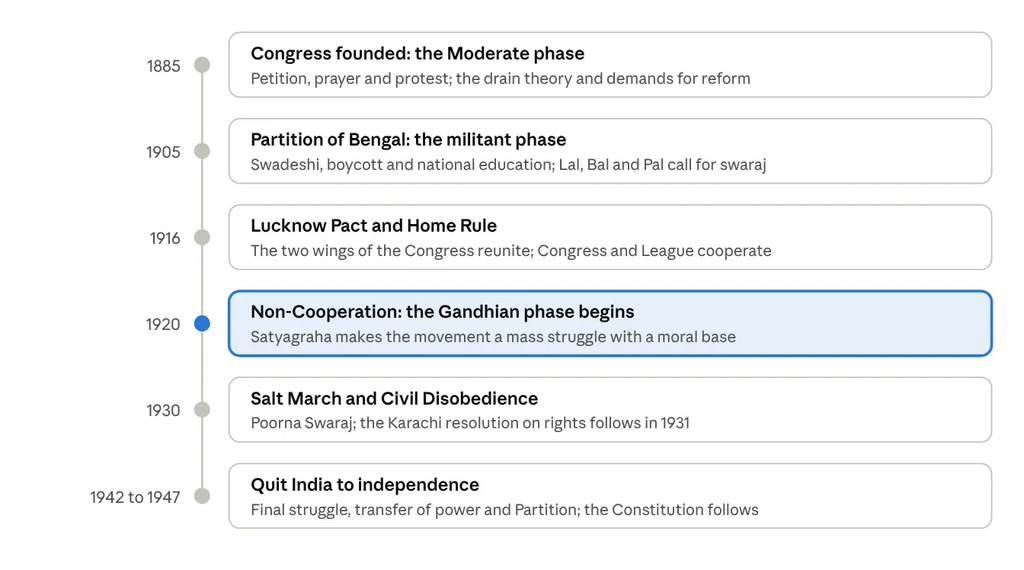
Read the timeline from top to bottom: the highlighted row marks the point at which the approach holds that the movement became a mass struggle.
4. Intellectual roots of the liberal nationalist approach
The approach grew from the ideas which educated Indians met in the nineteenth century, and from the movement for reform in India itself. A student should know where its main ideas came from.
English liberal thought. The works of John Stuart Mill, Edmund Burke, Macaulay and Gladstone’s Liberal party taught Indian students the value of free speech, representative government and the rule of law. Burke’s idea of trusteeship and the Queen’s Proclamation of 1858 were used to claim equal rights for Indians. The note on the liberal perspective on colonialism describes these ideas.
European national movements. The unification of Italy under Mazzini and Garibaldi, the Irish struggle for Home Rule and other movements gave Indian leaders models of how a people becomes a nation. Surendranath Banerjea lectured on Mazzini and on Italian unity in the 1870s. Such models explain the language of nationhood in the early Congress.
Western education and the print culture. The English schools and colleges, the universities of 1857, newspapers and printed books created a class with a common language of politics. They also allowed leaders from different provinces to compare their grievances, which gave a shared sense of belonging.
The Indian reform movements. The Brahmo Samaj of Rammohan Roy, the Prarthana Samaj, the Arya Samaj, the Ramakrishna Mission and reformers such as Vidyasagar and Ranade combined respect for Indian tradition with liberal ideas of reason and social reform. They prepared a public opinion in which political demands could grow.
The rediscovery of India’s past. The work of European Orientalists such as William Jones and Max Muller, and of Indian scholars, brought back the history of the Vedic age, the Mauryas and the Guptas. Indian writers used it to claim a long and proud history. Ranade’s Rise of the Maratha Power (1900) is an example of a nationalist history of a region.
Economic critique of British rule. Dadabhai Naoroji’s paper of 1867, England’s Debt to India, and his later book Poverty and Un-British Rule in India (1901), R. C. Dutt’s Economic History of India, and Ranade’s Essays on Indian Economics (1898) gave the movement an economic argument. It made nationalism rest on interests, and not only on feeling.
Racial discrimination and political grievances. Events such as the Ilbert Bill controversy of 1883, the reduction of the age limit for the Indian Civil Service in 1876, the Vernacular Press Act and the Arms Act of 1878 showed Indians that liberal promises were not kept. These events gave the new leaders a common cause.
Gandhi’s moral politics. Gandhi’s ideas of satyagraha and non-violence, formed in South Africa and set out in Hind Swaraj (1909), added a moral basis to the liberal tradition and widened its social base. Later writers treat this as the fullest form of the nationalist ideal.
| Source | Main idea | Effect on the approach |
|---|---|---|
| English liberal thought | Liberty, representation, rule of law | Language of early demands |
| European national movements | Making of a nation | Models of nationhood |
| Western education and print | Common political language | Unity of the educated class |
| Indian reform movements | Reason and social reform with tradition | Public opinion for reform |
| Rediscovery of the past | Pride in history | Claim to a long national past |
| Economic critique | Drain of wealth | Economic argument against rule |
| Racial grievances | Broken promises of equality | Common cause |
| Gandhi | Satyagraha; non-violence | Moral basis and mass action |
5. Liberal nationalist writers and texts
The approach was first set out by participants in the movement, and later by historians. A student should be able to name each main work and its point.
Surendranath Banerjea (1848 to 1925). Banerjea, a Moderate leader and twice President of the Congress (1895 and 1902), wrote his memoir A Nation in Making in 1925. It describes the political awakening of Bengal and India, the founding of the Indian Association (1876), the agitation against the Partition of Bengal in 1905 and the work of the Congress. It is a first-hand account of the Moderate phase.
William Wedderburn and Annie Besant. Wedderburn’s Allan Octavian Hume: Father of the Indian National Congress (1913) told of the origin of the Congress through Hume’s work. Annie Besant, who was Congress President in 1917, wrote How India Wrought for Freedom (1915), a history of the Congress based on its official records.
Lala Lajpat Rai. Lajpat Rai’s Young India (1916) gave an interpretation of the national movement from within, and examined the role of the Congress, Western education and social movements. He is also associated with the view that the Congress was founded as a safety valve for discontent. The safety valve theory is much quoted, though it is now disputed.
Pattabhi Sitaramayya. The History of the Indian National Congress, the first volume (1935) covering 1885 to 1935 and the second (1947), is the official Congress history. It narrates the sessions, resolutions and leaders, and sees the Congress as the vehicle of national feeling.
Jawaharlal Nehru. In his Autobiography (1936), Glimpses of World History (1934) and The Discovery of India (1946), Nehru gave a view of the national movement as part of a long history of India and of the world. He stressed the unity of Indian culture, the social effects of colonialism and the importance of the mass movement.
Maulana Abul Kalam Azad. In India Wins Freedom (1959), Azad, who was Congress President from 1940 to 1946, gave an inside account of the last years of the movement and the negotiations before Partition. His book shows the nationalist case for a united India.
Gandhi. Gandhi’s Hind Swaraj (1909) and An Autobiography (1927 and 1929) set out his view of freedom and of the movement. They are sources as much as histories.
Tara Chand and R. C. Majumdar. Tara Chand’s History of the Freedom Movement in India (four volumes, 1961 to 1972) was written with official support and gives a full narrative of the movement. R. C. Majumdar’s History of the Freedom Movement in India (three volumes, 1962 and 1963) was written as a rival work, and he argued that the role of Gandhi and the Congress had been overstated, and that the work of revolutionaries had been given too little credit.
Bipan Chandra and the textbook tradition. Bipan Chandra, with Mridula Mukherjee, Aditya Mukherjee, K. N. Panikkar and Sucheta Mahajan, wrote India’s Struggle for Independence (1988). This book became a standard text. It combines the nationalist view with an analysis of colonial economy and class, and treats the movement as a broad anti-colonial front.
| Writer | Work | Point |
|---|---|---|
| Surendranath Banerjea | A Nation in Making (1925) | Moderate phase and the awakening of the nation |
| Wedderburn | Allan Octavian Hume (1913) | Origin of the Congress |
| Annie Besant | How India Wrought for Freedom (1915) | History from Congress records |
| Lajpat Rai | Young India (1916) | Interpretation from within; safety valve view |
| Pattabhi Sitaramayya | History of the Indian National Congress (1935, 1947) | Official Congress history |
| Nehru | Autobiography (1936); Discovery of India (1946) | Unity in diversity; the mass movement |
| Azad | India Wins Freedom (1959) | Last phase and Partition |
| Tara Chand | History of the Freedom Movement (1961 to 1972) | Full narrative of the movement |
| R. C. Majumdar | History of the Freedom Movement (1962 to 1963) | Revolutionaries; critique of Gandhi’s credit |
| Bipan Chandra et al. | India’s Struggle for Independence (1988) | Anti-colonial front; standard text |
6. Core themes and arguments
Across the writers above, a set of themes recur. They make up the body of the liberal nationalist account, and each can be turned into an examination answer.
Colonial exploitation as the base of nationalism. The writers hold that British rule drained India’s wealth through the Home Charges, ruined handicrafts, burdened the peasant with revenue and kept Indians out of senior posts. Naoroji’s estimates and Dutt’s histories are used as proof. This economic injury is treated as the most basic reason why Indians united against the rulers.
The awakening of a new consciousness. English education, the press, railways, the postal system and public associations made it possible for Indians from different provinces to meet and compare grievances. The founding of the Indian Association (1876), the Bombay Presidency Association (1885) and the Congress is read as the sign of a new national consciousness.
The Congress as a platform of all Indians. The Congress is described as a body which spoke for the whole nation, with Hindus, Muslims, Parsis and Christians as presidents. The presidency of Badruddin Tyabji in 1887 and of George Yule in 1888 is often quoted. The approach treats the Congress as secular and national.
Moderates and militants as stages of one movement. Moderates are shown as laying the base by political education, and the militants as taking up more active demands, while Gandhi widened the base to the masses. The approach prefers continuity to a view of a break among the phases.
The role of Gandhi. Gandhi is placed at the centre of the third phase. His leadership of the Champaran satyagraha (1917), the Non-Cooperation movement (1920 to 1922), the Salt March (1930) and the Quit India movement (1942) is treated as the work which made the movement a mass struggle.
Hindu-Muslim relations and the communal question. The approach holds that communal division was not old and natural, but was encouraged by the policy of divide and rule, such as the Partition of Bengal (1905), the separate electorates of 1909 and the Communal Award (1932). It blames the colonial state and the communal parties for the final Partition.
Constitutional development. The Indian Councils Acts of 1861 and 1892, the Morley-Minto reforms (1909), the Montagu-Chelmsford reforms (1919) and the Government of India Act (1935) are described as concessions which the movement forced. The approach holds that each was less than what Indians asked, but each widened the space for politics.
The peasant and worker movements. Later writers in this tradition, such as Bipan Chandra, added accounts of peasant and tribal movements and of the working class, and saw them as part of the national struggle, though under the leadership of the Congress. This shows how the approach changed over time.
The ideal of a free, secular, democratic India. The movement is shown as carrying a vision of the future state, set out in the Karachi resolution on fundamental rights (1931), the Nehru Report (1928) and the Objectives Resolution (1946). This links the movement with the Constitution.
| Theme | Main claim | Evidence used |
|---|---|---|
| Exploitation | Drain and ruin of crafts led to unity | Naoroji; R. C. Dutt |
| Awakening | Education and press made a common consciousness | Associations; the Congress |
| Congress | A platform for all Indians | Presidents from all communities |
| Phases | Moderates, militants and Gandhians form one story | Continuity of aims |
| Gandhi | Made the movement a mass struggle | Champaran; Non-Cooperation; Salt March |
| Communal question | Division was fostered by colonial policy | Partition of Bengal; separate electorates |
| Constitutional reform | Concessions won by pressure | Acts of 1892, 1909, 1919, 1935 |
| Vision of the state | A free, secular, democratic India | Karachi resolution; Nehru Report |
7. The phases of the national movement in this reading
The approach divides the movement into three phases. This division, taken from the narratives of Banerjea, Sitaramayya and Chandra, is the framework of most textbooks and is asked about in every paper.
The Moderate phase (1885 to 1905). The Congress began at Bombay in December 1885, with 72 delegates and W. C. Bonnerjee as President, and with the help of A. O. Hume, a retired civil servant. The Moderate leaders were Naoroji, Pherozeshah Mehta, Banerjea, Gokhale, Ranade and Bonnerjee. They asked for more Indian members in the councils, for the examinations of the civil service to be held in India, for cuts in military spending and for the end of the drain. They used petitions, memorials and speeches, and trusted British justice. The approach explains this faith as the result of liberal education, and credits the Moderates with creating a national platform, training public opinion and drawing up the economic critique. Their achievements were modest, the Indian Councils Act of 1892 being the main result.
The militant or extremist phase (1905 to 1919). The Partition of Bengal in 1905 and the failure of petitions brought a more active phase. Lal, Bal and Pal, meaning Lala Lajpat Rai, Bal Gangadhar Tilak and Bipin Chandra Pal, along with Aurobindo Ghose, called for swaraj, boycott, swadeshi and national education. Tilak said that swaraj is my birthright. The Congress split at Surat in 1907, and the government used repression, along with the Morley-Minto reforms of 1909. The approach treats this phase as the move from asking to demanding, and as the time when the movement gained a wider social base. The revolutionary groups of Bengal, Maharashtra and Punjab, and the Ghadar party abroad, belong to the same period.
The Home Rule movement and the Lucknow Pact. In 1916, the two wings of the Congress were reunited, and the Congress and the Muslim League made the Lucknow Pact. Tilak and Annie Besant started the Home Rule Leagues in the same year. The Montagu declaration of August 1917 promised responsible government by stages. Writers in the approach see this as the final point of the early movement, which readied the way for mass action.
The Gandhian phase (1919 to 1947). Gandhi returned to India in 1915 and led the satyagraha at Champaran in 1917, and the movements at Kheda and Ahmedabad. After the Rowlatt Acts and the Jallianwala Bagh massacre in 1919, he led the Non-Cooperation movement (1920 to 1922), which was withdrawn after the Chauri Chaura violence. The Civil Disobedience movement began with the Dandi march of 1930, and the Quit India movement came in 1942. In between were the Simon Commission boycott (1927 to 1928), the Nehru Report (1928), the Poorna Swaraj resolution of Lahore (1929), the Round Table Conferences, the Government of India Act (1935) and the provincial ministries of 1937. The approach holds that Gandhi made the movement a mass movement, drawing in peasants, workers, women and students, and giving it a moral basis.
The last phase and independence. The Cripps Mission (1942), the Cabinet Mission (1946), the Interim Government, the rising of the Royal Indian Navy in 1946 and the Mountbatten Plan of June 1947 led to independence and Partition on 15 August 1947. The approach describes this as the culmination of the movement, and views Partition as a tragedy which was caused by colonial policy and communal politics.
| Phase | Years | Leaders | Methods | Main aim |
|---|---|---|---|---|
| Moderate | 1885 to 1905 | Naoroji, Mehta, Banerjea, Gokhale | Petition, prayer, protest | Reform and representation |
| Militant | 1905 to 1919 | Tilak, Lajpat Rai, Pal, Aurobindo | Swadeshi, boycott, national education | Swaraj |
| Home Rule | 1916 to 1919 | Tilak, Besant | Leagues, propaganda | Self-government |
| Gandhian | 1919 to 1947 | Gandhi, Nehru, Patel | Satyagraha; mass civil disobedience | Poorna Swaraj; independence |
| Final | 1942 to 1947 | Nehru, Patel, Azad | Negotiation and mass movement | Transfer of power |
8. Ideology and methods
The approach gives a detailed picture of what the nationalists believed and how they worked. This section sets out the main ideas and methods as the writers describe them.
Constitutionalism. The Moderates and later liberals held that change should come through law, debate and legislation. Gokhale, in the Imperial Legislative Council, used his speeches on the budget to question the government. Gokhale’s Elementary Education Bill of 1911 and Naoroji’s election to the House of Commons in 1892 are given as examples. The approach says that constitutional work built the habit of politics through institutions.
Faith in British justice, and its decline. The early leaders believed that the British, by their own principles, would do justice to Indians. When the Queen’s Proclamation of 1858 was not carried out, and when the Ilbert Bill was weakened, many lost this faith. The approach explains the rise of militant nationalism by this loss of faith.
The drain theory and economic nationalism. Naoroji, Dutt, Ranade, G. V. Joshi and G. Subramania Iyer wrote on the poverty of India and its causes. Their main points were the drain through the Home Charges and the salaries of foreigners, the ruin of handicrafts, the burden of the land revenue and the neglect of industry. The approach says that these ideas formed the main economic case against British rule, and led to the Swadeshi movement.
Social reform and nationalism. Leaders such as Ranade, Gokhale and later Gandhi linked political change with the removal of social evils. Ranade’s Social Conference, held with the Congress from 1887, and the work of Gokhale’s Servants of India Society (1905) are examples. The approach holds that a nation could not be free if it had untouchability, child marriage and the subjection of women.
Swadeshi and boycott. From 1905, the use of Indian goods and the boycott of British goods became a means of pressure and also of self-reliance. The approach explains the Swadeshi movement as the first step in mass politics, combining economic and moral appeal.
Satyagraha and non-violence. Gandhi’s method of truth-force held that opponents should be won by suffering and moral appeal, not by violence. The approach praises it as a form of struggle which suited the conditions of a disarmed people and drew in the masses. It also holds that it gave the movement its moral standing.
Secularism and communal harmony. The approach holds that the Congress stood for a nation of all religions, and that its leaders worked for Hindu-Muslim unity, as in the Khilafat and Non-Cooperation movements of 1920 to 1922. The Karachi resolution of 1931 promised equal rights without regard to religion or caste.
Civil liberties. Demands for the freedom of the press, the right of association and equality before the law run through the history of the movement, from the protests against the Vernacular Press Act to the Karachi resolution on fundamental rights. This is a clear mark of its liberal character.
Unity in diversity. Nehru’s Discovery of India sees Indian culture as a layered whole, in which many peoples and faiths have left their mark and in which unity does not remove difference. This idea shaped the national symbols and school texts of independent India.
| Idea or method | Main leaders | Content |
|---|---|---|
| Constitutionalism | Naoroji, Gokhale | Law, debate and legislation |
| Faith in justice | Moderates | Trust in British principles; declined after 1883 |
| Drain theory | Naoroji, Dutt, Ranade | Economic case against rule |
| Social reform | Ranade, Gokhale, Gandhi | Linking freedom with social change |
| Swadeshi and boycott | Tilak, Aurobindo, Pal | Self-reliance and pressure |
| Satyagraha | Gandhi | Non-violent mass struggle |
| Secularism | Congress leaders | Nation of all faiths |
| Civil liberties | Congress | Rights as part of freedom |
| Unity in diversity | Nehru | Layered Indian civilisation |
9. From nationalism to nation-building
The approach does not stop in 1947. It links the national movement with the aims of the new state, and so it influenced how independent India taught its own history.
The Objectives Resolution and the Constitution. Nehru moved the Objectives Resolution in the Constituent Assembly on 13 December 1946, and it was adopted on 22 January 1947. It declared India to be an independent sovereign republic with justice, liberty and equality for all. The approach regards the Constitution of 1950, with fundamental rights, parliamentary democracy and universal adult franchise, as the fulfilment of the aims of the movement.
Official history and textbooks. The history of the Congress by Pattabhi Sitaramayya, and the volumes of Tara Chand, supplied the facts for official accounts. After independence, the National Council of Educational Research and Training (founded in 1961) produced textbooks which followed the nationalist view, and Bipan Chandra’s later works became part of this tradition. The approach thus shaped how generations of students understood the freedom struggle.
National symbols and memory. The national flag, the national anthem, the commemoration of 15 August and 26 January and the memorials to the leaders reflect the image of the movement as a united struggle. The approach shows how a national story becomes a part of public life.
Nehru’s idea of a plural nation. Nehru saw the new state as secular and plural, built on the idea that all communities had a place. His speeches and The Discovery of India are the best statement of this civic idea of nationhood, in contrast to ideas of a nation based on religion or race.
Planning and modernisation. Nehru and other leaders held that the aim of independence was also economic development and social justice, through planning, industry and science. The Planning Commission was founded in 1950. The approach treats this as a continuation of the economic critique of colonial rule.
Continuities with the colonial state. Some writers in the broader tradition, and critics outside it, note that the new state kept the civil services, the police and much of the law of the colonial period, including the Government of India Act (1935). This continuity is often asked about in questions on the postcolonial state.
The place of the approach in later debates. The liberal nationalist reading is the base against which the other schools have argued. Even critics begin by stating what the nationalist version says. This makes it a necessary starting point in the study of Indian nationalism.
| Theme | Content | Link with the approach |
|---|---|---|
| Objectives Resolution, 1946 to 1947 | Sovereign republic; justice, liberty, equality | Aims of the movement as state aims |
| Textbooks | NCERT and standard histories | Nationalist narrative taught in schools |
| Symbols | Flag, anthem, national days | Public memory of a united struggle |
| Plural nation | Secular, civic nationhood | Nehru’s idea of India |
| Planning | Economic development | Continuation of the economic critique |
| Continuity | Civil services, police, law | Question of the postcolonial state |
10. Critiques of the liberal nationalist approach
Every later school of writing on Indian nationalism began as a criticism of this approach. A student should match each school with its main objection.
The colonialist critique. Writers such as Valentine Chirol, in Indian Unrest (1910), and later British officials and historians argued that Indian nationalism was the work of a small, ambitious educated class, which did not represent the people, and that India was a collection of races and religions and not a nation. The nationalist writers reply that this view served to justify British rule. Their approach arose partly as an answer to it.
The Cambridge school. Anil Seal, in The Emergence of Indian Nationalism (1968), and John Gallagher, Gordon Johnson and Seal, in the volume Locality, Province and Nation (1973), argued that early nationalism arose from competition among Indian elites for jobs, education and office, and from the structure of British rule, which gave them reason to compete and to collaborate. For them, ideals did not matter much. They also stressed local and regional politics. Critics say that they reduce ideas to interests, but their work forced the nationalist writers to look at the details of social groups.
The Marxist critique. R. P. Dutt in India Today (1940) and A. R. Desai in The Social Background of Indian Nationalism (1948) held that the nationalist account ignored class. They argued that the Congress represented the interest of the Indian capitalist class, which used the masses against imperialism while seeking a compromise. In this view, the story of unity hides the conflict of classes. The note on the Marxist perspective explains this view.
The Subaltern critique. Ranajit Guha, in the opening essay of the first volume of Subaltern Studies (1982), argued that both colonialist and bourgeois-nationalist historiography are elitist, and that the politics of the people had its own character and was not simply led by the elite. He argued that peasant and tribal revolts were not just a part of the Congress story. Partha Chatterjee added that the nationalism of the colonised was derived from European ideas.
The communal and regional critiques. Muslim writers and leaders such as Sayyid Ahmad Khan and, in a different form, the Muslim League, argued that the Congress spoke for Hindus, and that Muslims were a separate community. Later historians, among them those of the Hindu nationalist view, such as R. C. Majumdar, criticised the nationalist account for giving too much credit to Gandhi and too little to the revolutionaries. Regional and linguistic movements, such as the Dravidian movement, also objected that the story centred on North India.
The Dalit and anti-caste critique. B. R. Ambedkar, in works such as What Congress and Gandhi Have Done to the Untouchables (1945), argued that the Congress gave little place to the claims of the depressed classes, and that political freedom without social equality was of little worth. Later Dalit writers have argued that the story of the national movement leaves out the struggles against caste.
Feminist critiques. Feminist historians point out that the standard accounts give women a place as followers of male leaders, and that the work of women such as Sarojini Naidu, Aruna Asaf Ali, Kamaladevi Chattopadhyay and many local women has been given little notice. They also point out that women’s questions were often put aside for the sake of national unity.
The charge of teleology. Critics say that the approach reads the past backwards from independence, as if the nation were bound to emerge, and ignores alternative paths, such as other forms of federation or of regional states. It also treats differences among leaders, such as those between Gandhi and Subhas Bose, as less important than the final goal.
| School | Main writers | Central objection |
|---|---|---|
| Colonialist | Chirol and British officials | India not a nation; nationalists unrepresentative |
| Cambridge | Seal, Gallagher, Johnson | Elite competition, not ideals, drove nationalism |
| Marxist | R. P. Dutt, A. R. Desai | Class interest hidden; Congress as bourgeois |
| Subaltern | Guha, Chatterjee | Elitism; people’s own politics ignored |
| Communal and regional | Muslim League leaders; Majumdar | Narrow base; Gandhi’s credit overstated |
| Dalit | Ambedkar | Caste and social equality neglected |
| Feminist | Women historians | Women treated as followers |
| Critics of teleology | Various | Independence read back into the past |
11. Importance and limitations of the liberal nationalist approach
Importance
It was the first and most influential account. The approach was written by the participants and became the base of all later writing. Every other school, from the Cambridge to the Subaltern, begins by stating the nationalist version and then criticising it, so a student cannot understand them without it.
It answered the colonialist denial of nationhood. Colonial writers said that India was only a geographical expression and that nationalism was the cry of a few. By showing the growth of a common political consciousness, the approach gave the movement a strong intellectual answer to this claim.
It records the ideas and institutions of the movement. The approach preserves the resolutions, speeches, constitutional demands and organisations of the Congress. For anyone studying the political thought of the period, these records are the first source.
It explains the economic base of the grievance. By taking up the drain theory and the critique of colonial economy, the approach shows that nationalism was rooted in real injury and not only in sentiment. This earned it respect even among Marxist writers.
It stresses secular and civic nationhood. The idea of a nation of all faiths, set out by Nehru, supplied the base of the Indian Constitution and remains a main ideal in public life.
It gives weight to leadership and moral politics. Its account of Gandhi, Nehru, Gokhale and others, and of the method of non-violence, explains how a disarmed people created a mass movement. This is an important and distinct feature of the Indian case.
It links the movement with the making of the state. By tracing a line from the demands of the early Congress to the Constitution, the approach explains why India became a parliamentary democracy and not a one-party or military state.
It provides a clear framework of phases. The division into Moderate, militant and Gandhian phases, though simple, gives students a usable frame for the chronology and is still the base of school and college teaching.
It encouraged research on the national movement. The collection of documents, the writing of biographies and the official history projects after independence made a large body of material available for later researchers, including its critics.
It gave a shared national memory. By telling the freedom struggle as a common story, it helped to create a sense of belonging in the new state, which was of value in a society of great diversity.
Limitations
It treats the nation as given. By assuming that India was a nation in the making, it overlooks the differences among regions, religions and classes, and does not ask how the idea of the nation itself was formed.
It is elitist. The story centres on the educated leaders and the Congress organisation, and gives little weight to peasants, tribals, workers, women and the depressed classes, except as followers. Guha’s critique made this the best-known objection.
It gives too little attention to class conflict. By stressing the unity of the Indian people against colonialism, it tends to pass over the conflicts between landlords and tenants, mill owners and workers, which Marxist writers have studied.
It explains by ideals and leadership. The Cambridge school argues that the approach pays too little attention to interests, competition for office and local politics, and that it takes the leaders’ own words at face value.
It leans on Congress sources. Early works were written by Congress leaders from Congress records, so they reflect the viewpoint of one organisation and may give less than due credit to the revolutionaries, the Left, the Muslim League and regional parties.
It is open to hagiography. Its tone toward leaders such as Gandhi and Nehru is often admiring, and it tends to avoid their disagreements and failures. R. C. Majumdar and others have criticised this.
It places the blame for communal division mainly on colonial policy. This explanation is partly true, but critics say that it leaves out the role of the Congress’s own choices and of earlier divisions in Indian society.
It reads the past backwards. Its account runs toward independence in 1947 as if that were certain, and gives little place to roads not taken, such as other forms of federation.
It neglects caste and gender. The claims of the depressed classes and of women are treated as secondary to the national cause, as Ambedkar and feminist historians have said.
It tends to be uncritical of the state after independence. Because it links the movement with the Constitution, it gives little attention to the continuities between the colonial and the postcolonial state.
Illustrations
| Illustration | Period | What it shows |
|---|---|---|
| Indian Association founded | 1876 | Early political association of the educated |
| Ilbert Bill controversy | 1883 | Limits of racial equality; political lesson |
| Foundation of the Indian National Congress | 1885 | Moderate phase begins |
| Naoroji elected to the House of Commons | 1892 | Constitutional politics in Britain |
| Partition of Bengal and the Swadeshi movement | 1905 | Militant phase begins |
| Surat split | 1907 | Division of Moderates and extremists |
| Lucknow Pact | 1916 | Congress and Muslim League cooperation |
| Non-Cooperation movement | 1920 to 1922 | Gandhi makes it a mass movement |
| Nehru Report | 1928 | Constitutional vision of the movement |
| Salt March | 1930 | Civil Disobedience begins |
| Karachi resolution on fundamental rights | 1931 | Rights and social aims in the programme |
| Objectives Resolution | 1946 to 1947 | Link between movement and Constitution |
12. Exam use
What examiners expect
| Level | Typical demand | What a good answer includes |
|---|---|---|
| UG (short, 2 to 5 marks) | Define the liberal nationalist approach; name two writers | A clear definition; Banerjea and Pattabhi with one line each |
| UG (long, 10 to 15 marks) | Explain the liberal nationalist approach to Indian nationalism | Features, writers, phases, themes, critique |
| PG | Critically examine the nationalist historiography of the national movement | Schools compared: nationalist, Cambridge, Marxist, Subaltern; evidence |
| OPSC / UPSC | Discuss the growth of nationalism and the role of the Congress | Phases with dates, leaders, methods, a balanced view |
| UGC NET | Match writers, books and arguments | Titles, years, key terms and exact claims |
Practice questions
- Explain the main features of the liberal nationalist approach to Indian nationalism.
- Discuss the contribution of Surendranath Banerjea, Pattabhi Sitaramayya and Jawaharlal Nehru to nationalist historiography.
- How does the nationalist approach explain the Moderate, militant and Gandhian phases?
- Explain the role of economic nationalism in the liberal nationalist account.
- Compare the liberal nationalist and Cambridge schools on the origin of Indian nationalism.
- How did Marxist and Subaltern writers criticise the nationalist approach?
- Critically evaluate the liberal nationalist approach to the study of Indian nationalism.
Structured outline for a long answer
Introduction
- Define the approach and state its main claim: nationalism as the awakening of a people under colonial rule.
- Note that it is the oldest school and began with the leaders.
Body
- Roots: liberal thought, education, reform movements, economic critique.
- Writers: Banerjea, Besant, Lajpat Rai, Pattabhi Sitaramayya, Nehru, Tara Chand, Bipan Chandra.
- Themes and phases: exploitation, awakening, the Congress, Gandhi, Moderate, militant and Gandhian phases.
- Ideology and methods: constitutionalism, drain theory, satyagraha, secularism.
- Critiques: colonialist, Cambridge, Marxist, Subaltern, Dalit, feminist.
Conclusion
- Weigh its strengths and limits.
- End with a judgement on its place in the study of nationalism.
Sample answer (about 200 words)
Question: Critically evaluate the liberal nationalist approach to the study of Indian nationalism.
Introduction. The liberal nationalist approach explains Indian nationalism as the growth of a common political consciousness against colonial rule, led by the educated class and the Indian National Congress. It is the oldest school, and its first historians were the leaders themselves.
Body. It draws on liberal thought, English education and the economic critique of Naoroji and Dutt. Writers such as Banerjea, Pattabhi Sitaramayya, Nehru and Tara Chand describe three phases: the Moderate phase of petition, the militant phase of swadeshi and boycott, and the Gandhian phase of mass satyagraha. It stresses unity in diversity, secularism and the moral side of the struggle. Its critics are many. The colonialist school denied that India was a nation. The Cambridge school, led by Seal, explained nationalism by elite competition. Marxists such as Dutt and Desai pointed to class interests, the Subaltern group of Guha called it elitist, and Ambedkar and feminist writers noted the neglect of caste and gender.
Conclusion. The approach gave the movement a coherent story and a base for the Constitution. But it takes the nation as given, relies on leaders and the Congress, and tends to ignore conflict. It remains a necessary starting point, to be read with its critics.
Quick check
- Who wrote A Nation in Making? (Surendranath Banerjea, 1925)
- Which official history of the Congress appeared in 1935 and 1947? (Pattabhi Sitaramayya)
- Who wrote The Emergence of Indian Nationalism? (Anil Seal, 1968)
- Which text of 1982 called both colonial and nationalist history elitist? (Ranajit Guha, in the first volume of Subaltern Studies)
- Who wrote Poverty and Un-British Rule in India? (Dadabhai Naoroji, 1901)
Common mistakes
- Mixing up the nationalist school with the Marxist or the Cambridge school.
- Giving the Congress a founding date or president wrongly, and confusing the phases of the movement.
- Treating Nehru and Gandhi as historians in the same way as Tara Chand.
- Presenting the approach without its critics.
- Calling Bipan Chandra a pure Marxist or a pure liberal.
- Ending without a balanced judgement.
13. Critical analysis
The strength of the approach. The liberal nationalist account was the first to give the movement a clear story and to answer the claim that India was not a nation. It preserved the record of the movement, linked its demands to the economic grievances of the people, and explained why independent India chose a secular, democratic Constitution. Its picture of a movement with a common aim, against a foreign state, has strong support in the facts of mass participation in the Gandhian movements.
The weakness of the approach. The approach is weakest where it takes unity for granted. India in 1885 and in 1947 was a land of many languages, religions and interests, and the movement did not speak with one voice. By writing the history as a march of the nation, the approach hides the disputes among the leaders, the doubts of the Muslim League and the depressed classes, and the local nature of much political action.
Ideals and interests. The Cambridge school said that interests, not ideals, drove the early leaders, and nationalist writers said the reverse. A balanced view is that both were present. The Moderates were lawyers and professionals who sought office, and also believers in liberal ideas. The drain theory shows how a material grievance and a moral claim could be joined. A good answer shows this mixture.
Leadership and the masses. The approach credits Gandhi and the Congress with bringing the masses into the movement. The Subaltern critique argues that the masses entered on their own terms, with their own grievances, and that the Congress at times held them back, as in the end of Non-Cooperation after Chauri Chaura in 1922. Both views have support. The Congress did give an all-India form to local discontent, and local movements also shaped the Congress.
One school among several. The approach should be seen as a first and partial account. The Marxist school added class, the Cambridge school added local interest and the structure of British rule, and the Subaltern school added the politics of the people. Together with the postcolonial critique of colonial knowledge, they give a fuller picture than any single school.
Model concluding paragraph
To conclude, the liberal nationalist approach has given the study of Indian nationalism its basic story and many of its sources. It rightly stresses colonial exploitation, the growth of a common political consciousness, the role of the Congress and the moral force of the Gandhian movement. But it assumes the nation, leans on leaders and Congress records, and gives too little space to class, caste, gender and the politics of the people. Later schools have corrected these faults, yet they depend on the account they criticise. The approach is therefore best read as an important starting point and not as the final word.
14. UGC NET: authors and books
| Author | Work | Key point for the exam |
|---|---|---|
| Dadabhai Naoroji | Poverty and Un-British Rule in India (1901) | Drain of wealth; economic critique |
| R. C. Dutt | The Economic History of India (1901, 1903) | Decline of crafts; revenue burden |
| M. G. Ranade | Essays on Indian Economics (1898) | Economic reform and nationalism |
| William Wedderburn | Allan Octavian Hume (1913) | Origin of the Congress |
| Annie Besant | How India Wrought for Freedom (1915) | History from Congress records |
| Lala Lajpat Rai | Young India (1916) | Interpretation from within; safety valve view |
| Valentine Chirol | Indian Unrest (1910) | Colonialist view of nationalism |
| Surendranath Banerjea | A Nation in Making (1925) | Moderate phase; awakening |
| M. K. Gandhi | Hind Swaraj (1909) | Critique of modern civilisation; swaraj |
| Pattabhi Sitaramayya | History of the Indian National Congress (1935, 1947) | Official Congress history |
| Jawaharlal Nehru | Discovery of India (1946) | Unity in diversity |
| Abul Kalam Azad | India Wins Freedom (1959) | Last phase and Partition |
| Tara Chand | History of the Freedom Movement in India (1961 to 1972) | Full narrative of the movement |
| R. C. Majumdar | History of the Freedom Movement in India (1962 to 1963) | Rival account; role of revolutionaries |
| Bipan Chandra et al. | India’s Struggle for Independence (1988) | Anti-colonial front; standard text |
| Anil Seal | The Emergence of Indian Nationalism (1968) | Cambridge view: competition and collaboration |
| R. Palme Dutt | India Today (1940) | Marxist critique |
| A. R. Desai | Social Background of Indian Nationalism (1948) | Class base of nationalism |
| Ranajit Guha (ed.) | Subaltern Studies I (1982) | Critique of elitist historiography |
| Sumit Sarkar | Modern India 1885 to 1947 (1983) | Survey with critical view of nationalist history |
Revision tip. Remember writers in three groups: the nationalist makers and tellers (Banerjea, Besant, Lajpat Rai, Pattabhi, Nehru, Azad), the historians (Tara Chand, Majumdar, Bipan Chandra) and the critics (Chirol, Seal, Dutt, Desai, Guha). Pair each name with one book, one year and one phrase.
15. Key takeaways and further reading
Key takeaways
- The liberal nationalist approach explains Indian nationalism as the growth of a common political consciousness against colonial rule, led by the educated class and the Congress.
- It began with the leaders, such as Banerjea, Besant, Lajpat Rai and Pattabhi Sitaramayya, and later with Nehru, Tara Chand and Bipan Chandra.
- It uses liberal ideas, the drain theory and Gandhi’s moral politics to explain what the movement wanted and how it worked.
- It divides the movement into the Moderate, militant and Gandhian phases.
- It links the movement with the Constitution through the ideas of secular, democratic, plural nationhood.
- Its critics are the colonialist, Cambridge, Marxist, Subaltern, Dalit, feminist and communal schools.
- It is best read as a necessary starting point, to be used with its critics.
Official sources
- National Archives of India (Abhilekh Patal): colonial records and proceedings.
- Indian Culture portal, Ministry of Culture: digitised documents of the freedom movement.
- Constitution of India, Legislative Department: text of the Constitution.
- Lok Sabha Secretariat, Constituent Assembly Debates: debates of the Constituent Assembly.
- NTA UGC NET: syllabus and notices.
- Union Public Service Commission: syllabus and notices.
Twenty books for further reading
- Bipan Chandra and others, India’s Struggle for Independence (Penguin, 1988)
- Bipan Chandra, Nationalism and Colonialism in Modern India (Orient Longman, 1979)
- Sumit Sarkar, Modern India 1885 to 1947 (Macmillan, 1983)
- Sekhar Bandyopadhyay, From Plassey to Partition and After (Orient BlackSwan)
- Surendranath Banerjea, A Nation in Making (1925)
- Pattabhi Sitaramayya, History of the Indian National Congress, two volumes (1935, 1947)
- Jawaharlal Nehru, The Discovery of India (1946)
- Jawaharlal Nehru, An Autobiography (1936)
- Abul Kalam Azad, India Wins Freedom (1959)
- Tara Chand, History of the Freedom Movement in India, four volumes (Publications Division, 1961 to 1972)
- R. C. Majumdar, History of the Freedom Movement in India, three volumes (Firma KLM, 1962 to 1963)
- Dadabhai Naoroji, Poverty and Un-British Rule in India (1901)
- Bipan Chandra, The Rise and Growth of Economic Nationalism in India (1966)
- Anil Seal, The Emergence of Indian Nationalism (Cambridge University Press, 1968)
- Judith Brown, Gandhi’s Rise to Power (Cambridge University Press, 1972)
- R. Palme Dutt, India Today (1940)
- A. R. Desai, The Social Background of Indian Nationalism (1948)
- Ranajit Guha (ed.), Subaltern Studies I (Oxford University Press, 1982)
- Partha Chatterjee, Nationalist Thought and the Colonial World (Zed, 1986)
- Sumit Sarkar, Writing Social History (Oxford University Press, 1997)
Editorial note
This note is prepared for students of PoliPrepHub.in from standard textbooks and scholarly works. Please read it with your syllabus and prescribed books. For corrections or suggestions, visit the Contact Us page. For terms of use, see the Disclaimer.
Frequently asked questions
What is the liberal nationalist approach? A way of studying Indian nationalism as the growth of national consciousness against colonial rule, led by the educated class and the Congress, using ideas of liberty and constitutional government.
Who are the main liberal nationalist writers? Surendranath Banerjea, Annie Besant, Lajpat Rai, Pattabhi Sitaramayya, Jawaharlal Nehru, Tara Chand and, with qualifications, Bipan Chandra.
What are the three phases in this approach? The Moderate phase (1885 to 1905), the militant phase (1905 to 1919) and the Gandhian phase (1919 to 1947).
How does the approach explain the origin of nationalism? By colonial exploitation, English education, social reform and common political grievances, which created a shared consciousness.
How did the Cambridge school differ? It held that early nationalism grew from competition among elites for jobs and office, and not from ideals or a common national feeling.
What is the main Subaltern criticism? That the approach is elitist and ignores the independent politics of peasants, tribals and workers.
© PoliPrepHub · Generated on October 28, 2026