|
PoliPrepHub
Making Political Science Easy
|
poliprephub.in |
Colonialism and Nationalism in India
Constitutional Development and the Colonial State

The constitutional history of British India began as a story of trade and ended as a story of transfer of power. The East India Company came to India to trade, but after the battles of Plassey (1757) and Buxar (1764) and the grant of the Diwani of Bengal in 1765, it became a ruler. The British Parliament then began to ask how a trading company should govern millions of people. Each Act passed between 1773 and 1947 was an answer to a particular problem: the misuse of power by Company servants, the need for revenue, the pressure of the Indian national movement, and the changing politics of Britain itself.
This note studies the constitutional development of British India together with the nature of the colonial state. It traces the Regulating Act of 1773, the Acts of 1784, 1793, 1813, 1833 and 1853, the Government of India Act of 1858, the Indian Councils Acts of 1861, 1892 and 1909, the reforms of 1919, the Government of India Act of 1935 and the Indian Independence Act of 1947. It then asks what kind of state these laws created, who gained from them, and how scholars have explained them. The note is meant for undergraduate and postgraduate students and for those preparing for OPSC, UPSC and UGC NET. It should be read along with the notes on the national movement and on the Constitution of India, since many features of the Indian Constitution have their roots in these Acts.
Table of Contents
1. Characteristics of constitutional development under colonial rule
Gradual and piecemeal change. The British did not frame a single constitution for India. They passed one Act after another, each making a small change in the existing system. A reform of 1861 was followed by another in 1892 and then in 1909, with long gaps between them. This slow method let the rulers keep control while they appeared to be giving something. A student can use the example of the Councils Acts to show that each step was granted only when pressure from Indian opinion had grown.
Reform from above, not from below. Every major Act was made by the British Parliament in London and not by Indians. Indians were consulted, if at all, through commissions and committees chosen by the government. The Constituent Assembly demand of the 1930s was a reply to this practice. In an answer, point out that the Government of India Act of 1935 was handed down to India, and that the Congress rejected it as a charter of slavery while still contesting elections under it.
Centralisation of authority. From the Regulating Act of 1773 to the Charter Act of 1833, power moved steadily to the Governor-General in Calcutta. The Act of 1833 made him Governor-General of India and gave the Supreme Government sole law-making power. Madras and Bombay lost their right to make laws. The reason was a wish for one uniform policy and for control of revenue. The example shows that early development aimed at efficiency of rule and not at representation.
Control by Parliament over the Company. The Acts from 1773 to 1858 put the Company under growing control of the Crown and Parliament. The Board of Control of 1784 gave the government a say in political matters, and the Charter Acts removed the Company’s trade, first in India in 1813 and then in China in 1833. This shows that the British state wanted to take the benefits of empire for itself. The step ended in the Act of 1858, which abolished the Company.
Division of powers between the Crown and the Indian government. Until 1947, the final authority lay with the Secretary of State for India and the British Parliament. The Viceroy and his Council worked under their orders. The Secretary of State had the India Council to advise him. Even after 1919 and 1935 the Viceroy held special powers. The student should note that an Indian legislature could debate, but the final word was not with it.
Slow introduction of the elective principle. Elections entered the system by small steps. The Act of 1861 allowed nominated Indian members. The Act of 1892 brought in an indirect form of selection, and the Act of 1909 gave a limited right of election. The Act of 1919 widened the vote, and the Act of 1935 gave the vote to about one-sixth of the adult population. This shows that representation was granted in small doses, in step with the demand of the national movement.
Limited franchise based on property and education. The right to vote was tied to payment of tax, ownership of land and levels of education. In 1920 only a small part of the population could vote, and women were mostly left out. The reason was the belief that only a few were fit for self-government. This is a good example for the point that the colonial state justified rule by a theory of unfitness.
Use of communal and separate electorates. The Act of 1909 gave separate electorates to Muslims, and later Acts extended the idea to Sikhs, Christians, Anglo-Indians and others. The Communal Award of 1932 added the depressed classes. The British said that these steps protected minorities. Nationalists said that the steps divided the people, and that they were part of a policy of divide and rule. Students should present both views.
Dyarchy and the sharing of power with safeguards. The Act of 1919 divided provincial subjects into transferred and reserved lists, and the Act of 1935 introduced provincial autonomy with special powers of the Governor. These devices let Indians hold office without control over finance, police and the services. Dyarchy is the best example of power shared on paper while real power stayed with the rulers.
Federal idea and the princely states. The Act of 1935 proposed an All-India Federation of provinces and princely states. The scheme never started, because the princes would not agree. The idea reflected the wish of the British to balance the strength of the Congress with the conservative states. It also left a model of federalism that later influenced the Indian Constitution.
Constitutional change linked to the national movement. The Acts followed major events in the freedom struggle. The Act of 1892 came after the early years of the Congress, the Act of 1909 after the partition of Bengal and Swadeshi, the Act of 1919 after the First World War and Home Rule, and the Act of 1935 after Civil Disobedience. This pattern shows that nationalism pushed the process, while the British tried to guide it into forms they could control.
Rule of law with exceptions. The colonial state introduced courts, codes and regular procedure, yet it also kept special laws such as the Press Act, the Rowlatt Act and the Defence of India rules. The two sides existed together. A student can use this to explain why the colonial state is often called liberal in form and authoritarian in practice.
Influence on the Constitution of India. Many features of the Indian Constitution have colonial roots. The federal scheme, the Governor’s office, emergency powers, the public service commissions and much of the administrative law come from the Act of 1935. The Constituent Assembly took over what was useful and changed what it disliked. This link is an important point for questions on continuity between colonial rule and independent India.
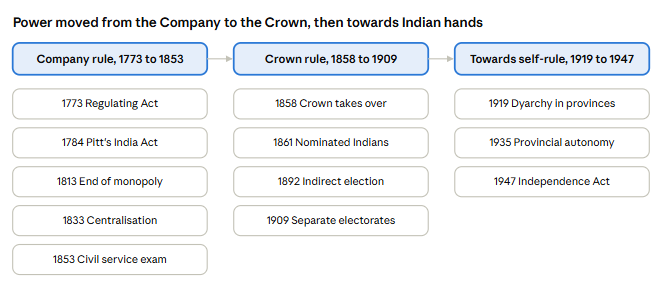
2. Diagram at a glance
The diagram below shows the main Acts in order of time, grouped by the stage of rule. Read it from left to right.
3. Company rule and the Charter Acts, 1773 to 1853
The first stage of constitutional development belongs to the Company. A student should know what each Act changed and why it was passed.
The Regulating Act of 1773. The Company was in financial trouble, and its servants were accused of corruption in Bengal. Lord North’s government passed the Act to bring the Company under some control. It made the Governor of Bengal the Governor-General of Bengal, with a Council of four, and gave him some power over Bombay and Madras. It set up a Supreme Court at Calcutta in 1774 and forbade private trade by Company servants. The Act is the first step by which Parliament took a hand in Indian affairs. Its weakness was that the Governor-General could be outvoted by his Council, which led to the quarrels between Warren Hastings and Philip Francis.
Pitt’s India Act of 1784. The Act set up a Board of Control in London, with a President who looked after political, civil and military matters, while the Company kept trade and patronage. This created a system of double government. The Governor-General’s Council was reduced to three, and he gained a casting vote in practice. The Act made the Company answerable to the Crown. Students should remember that from 1784 the Company ruled under the control of the British cabinet.
The Charter Act of 1793. The Act renewed the Company’s charter for twenty years. It gave the Governor-General the power to override his Council, confirmed the Cornwallis Code and made the salaries of the Board of Control members payable from Indian revenue. It shows that the powers of the Governor-General were growing and that the burden of rule was put on India.
The Charter Act of 1813. The Act ended the Company’s monopoly of trade with India, except in tea and trade with China. It declared the Crown’s sovereignty over the Company’s territories and set aside one lakh of rupees a year for the revival of literature and the learning of the sciences. It also allowed Christian missionaries to work in India under licence. The Act reflects the demand of British manufacturers for a free market and the growing influence of liberal and evangelical ideas.
The Charter Act of 1833. This was the most important Charter Act. It made the Governor-General of Bengal the Governor-General of India, and it made his Council the sole law-making body, taking the power away from Madras and Bombay. It ended the Company’s trade, so that it became a purely administrative body. It added a law member to the Council, with Macaulay as the first, and it declared that no Indian by reason of religion, birth or colour should be barred from office under the Company. The Law Commission was set up to codify the laws. The claim of equality in office was not carried out in practice, but it later became a base for the Indian demand for equal treatment.
The Charter Act of 1853. The last Charter Act did not set a time limit for the Company’s rule. It separated the legislative and the executive functions of the Governor-General’s Council by adding six legislative members, four of them nominated by the provinces. It opened the Indian Civil Service to competition through a public examination in London, on the advice of the Macaulay Committee. It reduced the number of Directors from twenty-four to eighteen. The Act is often seen as the start of a legislative body, since the Legislative Council began to work like a small Parliament and asked questions of the executive.
Meaning of the early Acts. The Acts from 1773 to 1853 were mainly about how the British were to rule, and not about how Indians were to take part. The reforms showed a change from a trading monopoly to a state with law, courts and a civil service. At the same time, the changes were made to meet British needs, such as control of revenue and the opening of markets.
| Act | Main provisions | Significance |
|---|---|---|
| Regulating Act, 1773 | Governor-General of Bengal; Supreme Court at Calcutta | First parliamentary control |
| Pitt’s India Act, 1784 | Board of Control; double government | Company placed under the Crown |
| Charter Act, 1793 | Governor-General can override Council | Rise of personal authority |
| Charter Act, 1813 | End of monopoly except in tea and China trade; education grant | Sovereignty of the Crown |
| Charter Act, 1833 | Governor-General of India; end of trade; law member | Centralisation and codification |
| Charter Act, 1853 | Open competition for the civil service; separate legislative council | Beginning of a legislature |
4. Crown rule and the early Councils Acts, 1858 to 1892
The Revolt of 1857 ended Company rule. The British now ruled India directly, and they began to think of how to win the loyalty of the Indian upper classes.
The Government of India Act of 1858. The Act abolished the Company and transferred its powers to the Crown. A Secretary of State for India, a member of the British cabinet, took charge, with a Council of fifteen members to advise him. The Governor-General received the new title of Viceroy. The Queen’s Proclamation of 1 November 1858 promised equal treatment, respect for the rights of princes and for religion, and admission to office without regard to race or creed. It was read as a charter of rights, and nationalists later cited it often. The Act made no change in the way India was governed on the spot, but it ended the double government of 1784.
The reasons for the change. The Revolt had shown that the Company was unable to keep order. British public opinion held the Company’s policy of annexation and of interference in social customs to be partly to blame. The government wished to reassure princes, landholders and the army. The Act therefore marks a turn from conquest to consolidation.
The Indian Councils Act of 1861. The Act restored the legislative powers of Bombay and Madras and extended the system to other provinces, which began a step of decentralisation. It enlarged the Viceroy’s Council for law-making by adding non-official members, who were nominated, and a few Indians, such as the Raja of Benares and Maharaja of Patiala, were included. It also gave the Viceroy the power to issue ordinances in an emergency, and it recognised the portfolio system started by Lord Canning. The Councils remained advisory bodies with no power over the budget. Students should remember that Indians were included as nominees of the government and not as representatives of the people.
The decade of the 1870s and 1880s. The government of Lord Ripon took some steps toward local self-government in 1882, with boards in towns and rural areas. The Vernacular Press Act of 1878 and the Arms Act of 1878 showed the other side of the colonial state. The Ilbert Bill controversy of 1883 revealed how strongly the European community opposed equality before the law. These events helped to form the Indian National Congress in 1885.
The Indian Councils Act of 1892. The Act increased the number of additional members in the Central and Provincial Councils. It gave members the right to discuss the budget, though not to vote on it, and to ask questions, with some limits. It brought in an indirect form of election, in which certain bodies such as municipalities, universities and chambers of commerce recommended names to the government, though the word election was not used. The Act met the demand of the early Congress in a small way. The Congress leaders, such as Gokhale and Pherozeshah Mehta, used the new right to criticise the government’s finance.
Nationalist response. The moderate leaders welcomed the steps as a start but called them inadequate. They demanded elected members, control over the budget and the simultaneous holding of the Indian Civil Service examination in India and in England. Dadabhai Naoroji and others made these demands before the Parliament and the public. The British, for their part, thought that Indians were not yet ready for representative government.
| Act or event | Year | Main features |
|---|---|---|
| Government of India Act | 1858 | Crown rule; Secretary of State; Viceroy |
| Queen’s Proclamation | 1858 | Promise of equal treatment and respect for rights |
| Indian Councils Act | 1861 | Nominated Indians; portfolio system; decentralisation |
| Local self-government resolution | 1882 | Boards in towns and districts |
| Indian Councils Act | 1892 | Indirect election; right to discuss the budget |
5. The Morley-Minto Reforms of 1909
The reforms of 1909 are named after John Morley, the Secretary of State, and Lord Minto, the Viceroy. They followed the partition of Bengal in 1905, the Swadeshi movement and the rise of the Extremists.
Background. The British wished to win over the Moderates and to isolate the Extremists. They also wished to give the Muslim community a means to voice its demands. In 1906 a Muslim delegation, led by the Aga Khan, met Lord Minto at Simla and asked for separate electorates and extra weight in representation. The All-India Muslim League was founded in December 1906. These events formed the setting of the Act.
Provisions of the Act. The Indian Councils Act of 1909 enlarged the Imperial Legislative Council to sixty-nine members, of whom thirty-seven were officials. It also enlarged the provincial councils and gave them an elected majority of non-officials in some provinces. Members were given the right to move resolutions on the budget and on matters of public interest, and to put supplementary questions. An Indian member, S. P. Sinha, was appointed to the Viceroy’s Executive Council as the law member in 1909.
Separate electorates. The Act gave Muslims the right to elect their own representatives from separate constituencies, and gave them more seats than their numbers justified. Lord Minto defended this as a recognition of their political importance. The effect was to link politics with religion, and it laid the base for the later demand for Pakistan. Morley himself did not wish for a parliamentary system in India, and he said so in Parliament.
Limits of the reforms. An official majority remained in the Imperial Council. The elections were indirect, through a chain of electoral colleges, and the vote was limited to men with property. The executive was not answerable to the legislature. The Congress welcomed the Act at first, but later found it disappointing, since its main gain was the principle of election together with the principle of communal representation.
Assessment. Some scholars see the reforms as a step towards a representative system. Others call them a way of dividing Indian opinion. The Cambridge School stresses that the Act was a response to local pressure and to a need for collaborators. Nationalist historians, such as Bipan Chandra, stress its divide and rule character. A balanced answer notes that both aims were present.
| Aspect | Provision of 1909 | Effect |
|---|---|---|
| Central Council | Sixty-nine members; official majority kept | Limited gain for Indians |
| Provincial Councils | Non-official majority in some provinces | Greater scope for debate |
| Budget | Right to move resolutions and ask supplementary questions | Better public scrutiny |
| Executive | First Indian member (S. P. Sinha) | Symbol of Indian entry |
| Electorate | Separate electorates for Muslims | Link of religion with politics |
6. The Montagu-Chelmsford Reforms and the Act of 1919
The First World War changed the political mood. Indians had given men and money to the war effort, and they expected a reward. The Home Rule Leagues of Tilak and Annie Besant and the Lucknow Pact of 1916 between the Congress and the Muslim League raised the demand for self-government.
The August Declaration of 1917. Edwin Montagu, the Secretary of State, announced in the House of Commons that the aim of British policy was the increasing association of Indians in every branch of the administration and the gradual development of self-governing institutions, with a view to the progressive realisation of responsible government in India. It was the first time that responsible government was named as the goal. Yet the words gradual and progressive left the timing to the British.
The Montagu-Chelmsford Report. Montagu visited India in 1917 and made a report with the Viceroy, Lord Chelmsford, in 1918. The Government of India Act of 1919 followed. The Act did not give responsible government at the centre. Its main idea was to start it in the provinces, in stages, and to test the capacity of Indians to use it.
Dyarchy in the provinces. The Act divided the provincial subjects into two lists. The transferred subjects, such as education, local self-government, public health and agriculture, were placed under Indian ministers who were responsible to the elected legislature. The reserved subjects, such as law and order, finance, land revenue and irrigation, remained with the Governor and his Executive Council. The system was called dyarchy, or the rule of two. Lionel Curtis, who proposed it, saw it as a school for self-rule. Its weakness was that ministers had no control of finance and the services, and that the Governor could overrule them.
Changes at the centre. The Act set up a bicameral legislature, with a Council of State of sixty members, of whom thirty-four were elected, and a Legislative Assembly of one hundred and forty-five members, of whom one hundred and four were elected. The Viceroy kept power to certify bills and to issue ordinances. The Executive Council had three Indian members out of eight, but they held minor posts. The central budget was partly votable and partly not, and the Viceroy could restore cuts.
Franchise and the communal principle. The vote was widened to about ten per cent of the adult population in the provinces, using property, tax and education tests. Women were not given the vote, though provinces could grant it, and Madras did so in 1921. Separate electorates were kept for Muslims and extended to Sikhs, Indian Christians, Anglo-Indians and Europeans. This continued the policy begun in 1909.
Other provisions. The Act set up the Public Service Commission in 1926 on the recommendation of the Lee Commission, separated the provincial budgets from the central one and created the post of High Commissioner for India in London. It also provided for a statutory commission after ten years to review the working of the Act. This clause led to the Simon Commission.
Indian reaction. The Congress, at its special session of 1918 in Bombay, called the reforms disappointing and unsatisfactory. The Moderates, under Surendranath Banerjea, accepted them and formed the Liberal Federation. The Rowlatt Act of 1919, the Jallianwala Bagh massacre and the Khilafat issue turned the mood against the government. Gandhi began the Non-Cooperation movement in 1920, though the Congress contested elections in 1923 through the Swaraj Party and used the councils to obstruct the government.
Working of dyarchy. Dyarchy worked poorly. Ministers had little money, since finance was reserved. The Governor and the services often did not support them. Some ministers, such as those in Madras from the Justice Party, used the system to advance non-Brahmin interests. The Muddiman Committee of 1924 and the Reforms Inquiry Committee noted its defects. The Act of 1935 ended dyarchy in the provinces.
| Feature | Provision | Weakness |
|---|---|---|
| August Declaration, 1917 | Responsible government as goal | Time left to the British |
| Dyarchy | Transferred and reserved subjects | Ministers had no control of finance |
| Central legislature | Two houses; elected majority | Viceroy’s power of certification |
| Franchise | About ten per cent of adults | Property and education tests |
| Separate electorates | Extended to Sikhs, Christians and others | Communal politics deepened |
| Statutory commission | Review after ten years | Led to the Simon Commission |
7. The Simon Commission, the Round Table Conferences and the Act of 1935
The constitutional stage of the 1930s was marked by a dispute over who should frame India’s constitution. It ended with the Government of India Act of 1935, which was the longest and most detailed of all the colonial Acts.
The Simon Commission. The commission of seven British members, headed by Sir John Simon, was appointed in 1927, earlier than the date required, to review the working of the Act of 1919. No Indian was a member. The Congress, the Muslim League under Jinnah and most groups boycotted it. It was met by black flags and the cry of Simon Go Back. Lala Lajpat Rai was hurt in a lathi charge in Lahore in 1928 and died soon after. The exclusion of Indians was a major insult and brought unity to Indian opinion.
The Nehru Report of 1928. In reply to Lord Birkenhead’s challenge to frame an agreed constitution, an all-parties committee under Motilal Nehru drew up a report. It asked for dominion status, joint electorates with reserved seats for minorities, and a declaration of rights. The Muslim League’s demand for one-third of the seats at the centre was not met, and Jinnah put forward Fourteen Points in 1929. The failure showed how deep the communal problem had become. The Congress then adopted the goal of complete independence at Lahore in 1929.
The Round Table Conferences. Three conferences were held in London between 1930 and 1932. The first, in 1930, was boycotted by the Congress, which was then in Civil Disobedience. The second, in 1931, followed the Gandhi-Irwin Pact, and Gandhi attended as the Congress representative. It failed because of disagreement on the communal question. The third, in 1932, was attended by few of the main leaders. The conferences produced a white paper in 1933, examined by a Joint Select Committee of Parliament.
The Communal Award and the Poona Pact. In August 1932 Ramsay MacDonald announced the Communal Award, which gave separate electorates to the depressed classes as well. Gandhi, then in Yeravda prison, began a fast unto death against it. The Poona Pact of September 1932, between Gandhi and B. R. Ambedkar, replaced separate electorates for the depressed classes by reserved seats in the general electorate, with a larger number of seats. The Pact is an important example of the interplay of caste, minority claims and constitutional change.
The Government of India Act of 1935. The Act had 321 sections and ten schedules. It was based on the Simon Report, the Round Table discussions, the White Paper and the Joint Committee. It proposed an All-India Federation, provincial autonomy and safeguards.
Provincial autonomy. Dyarchy was ended in the provinces. Governors were now bound to act on the advice of ministers responsible to the legislature, except where the Act gave them special powers. Provincial legislatures were enlarged, and the electorate rose to about thirty million, or about one-sixth of the adult population. Sind and Orissa were made separate provinces, and Burma was separated from India. Elections held in 1937 gave the Congress power in seven and later more provinces.
The federal scheme. The Act proposed a federation of the British Indian provinces and of such princely states as chose to join. Seats for the states in the federal houses were to be filled by the nominees of the rulers. The federation was to begin when states representing half the total population and half the seats had agreed. The condition was not met, and the federal part never came into force before 1947. The Centre worked under the old Act of 1919 with some changes.
Three lists and a federal court. The Act divided powers into a Federal List, a Provincial List and a Concurrent List, and it gave the residual power to the Governor-General. A Federal Court was set up in 1937, the forerunner of the Supreme Court of India. A Federal Public Service Commission and a Reserve Bank of India, established in 1935, were also set up.
Safeguards and special powers. The Governor-General and the Governors held special responsibilities for the safety of the state, the rights of minorities, the interests of the services, and for matters such as defence, foreign affairs and the churches. They could act in their individual judgment. The Congress ministries had therefore to work under a heavy shadow. The Congress called the Act a charter of slavery, and Jawaharlal Nehru called it a machine with strong brakes and no engine.
The Congress ministries of 1937 to 1939. The Congress first hesitated to take office, and then agreed on assurance that the Governors would not interfere. Its ministries passed laws on debt relief, tenancy, civil liberties and education. They resigned in October 1939 in protest at India being taken into the war without consultation. The Muslim League called the day of their resignation a Day of Deliverance. The episode showed both the possibilities and the limits of provincial autonomy.
| Event or provision | Year | Main point |
|---|---|---|
| Simon Commission | 1927 to 1930 | All-white commission; boycott |
| Nehru Report | 1928 | Agreed draft; dominion status |
| Round Table Conferences | 1930 to 1932 | Failed to settle communal question |
| Communal Award and Poona Pact | 1932 | Reserved seats for depressed classes |
| Government of India Act | 1935 | Provincial autonomy; federal scheme; safeguards |
| Elections | 1937 | Congress ministries in most provinces |
8. War, the Cripps Mission and the transfer of power, 1939 to 1947
The last stage of constitutional change took place amid world war, mass movement and communal conflict. The British now discussed not whether but how to leave India.
The August Offer of 1940. After the Congress ministries resigned, the Viceroy, Lord Linlithgow, made an offer in August 1940. It promised the expansion of the Executive Council with more Indians, a body to frame a constitution after the war and a promise that no future constitution would be adopted without the consent of minorities. The Congress rejected it and began Individual Satyagraha. The Muslim League welcomed the assurance to minorities, and it had adopted the Lahore Resolution in March 1940.
The Cripps Mission of 1942. Sir Stafford Cripps came to India in March 1942, when the Japanese were advancing in Burma. He offered dominion status after the war, a Constituent Assembly elected by the provincial assemblies and nominated by the princes, and the right of provinces to stay out of the Union. The Congress rejected the plan, since it gave no immediate power and allowed provinces to stay out. Gandhi is said to have called it a post-dated cheque on a failing bank. The Quit India movement followed in August 1942.
The Wavell Plan and the Simla Conference of 1945. Lord Wavell proposed an Executive Council in which Hindus and Muslims would have equal representation, with all members Indian except the Viceroy and the Commander-in-Chief. The Simla Conference of June 1945 failed because the Muslim League claimed the right to name all the Muslim members. The failure raised the importance of the League.
The Cabinet Mission of 1946. The British Labour government sent a mission of three cabinet ministers, Lord Pethick-Lawrence, Sir Stafford Cripps and A. V. Alexander. The plan rejected the demand for a separate Pakistan, and proposed a three-tier union with the Centre handling defence, foreign affairs and communications, and provinces grouped in three sections. A Constituent Assembly was to be elected by the provincial assemblies, and an interim government was to be formed. The Congress and the League both accepted the plan at first but disagreed over the grouping and the interim government. The League withdrew its acceptance in July 1946 and called for Direct Action on 16 August, followed by riots in Calcutta.
The Constituent Assembly and the interim government. Elections to the Constituent Assembly were held in July 1946, and the Congress won most of the general seats. An interim government under Nehru took office in September 1946, and the League joined in October. The Assembly first met in December 1946 without the League. The deadlock continued.
The Attlee Declaration of 1947. In February 1947 the Prime Minister, Clement Attlee, announced that Britain would leave India by June 1948 and appointed Lord Mountbatten as Viceroy. Mountbatten reached India in March 1947 and judged that waiting was dangerous.
The Mountbatten Plan of 3 June 1947. The plan proposed the partition of India and of Punjab and Bengal, and offered dominion status to the successor states. The provinces and the princely states were given choices. The date of transfer was advanced to 15 August 1947. The Congress and the League accepted the plan.
The Indian Independence Act of 1947. The British Parliament passed the Act in July 1947. It created two independent dominions, India and Pakistan, from 15 August 1947. It ended British suzerainty over the princely states, which could join either dominion. The Constituent Assembly of each dominion was given the power to make laws, and the Government of India Act of 1935 served as the interim constitution, with adaptations. The office of the Secretary of State for India was abolished. Mountbatten stayed as the first Governor-General of India, and Jinnah became Governor-General of Pakistan.
Assessment of the transfer. Historians differ about why the British left. The nationalist view puts the stress on the mass movement and the Quit India revolt. Other writers point to the weakness of Britain after the war, the unrest in the Indian army and the navy in 1946, and the change in the Labour government’s policy. The Cambridge School stresses the cost of maintaining the empire and the need to withdraw while keeping influence. A good answer weighs these causes.
| Plan or event | Year | Main proposal | Result |
|---|---|---|---|
| August Offer | 1940 | Expansion of the Council; post-war constitution body | Rejected by Congress |
| Cripps Mission | 1942 | Dominion status; right of provinces to stay out | Rejected; Quit India |
| Wavell Plan | 1945 | Parity in the Executive Council | Failed at Simla |
| Cabinet Mission | 1946 | Three-tier union; Constituent Assembly | Broke down on grouping |
| Mountbatten Plan | June 1947 | Partition and dominions | Accepted |
| Indian Independence Act | July 1947 | Two dominions from 15 August | Transfer of power |
9. The nature of the colonial state
The laws described above show how the state was framed. A student should also know what kind of state it was, and how it worked in daily life.
An imperial and extractive state. The colonial state served the interests of the British Empire. It raised revenue from the land and the tax system, used it to pay the cost of the army and the civil service, and gave Britain a market for its goods. This is the view of nationalist writers such as Dadabhai Naoroji and R. C. Dutt, who spoke of the drain of wealth. The state’s budget gave little to education, health and welfare.
The bureaucratic steel frame. The Indian Civil Service, which was thought of as the steel frame by David Lloyd George, held the main posts. It was recruited by competitive examination, mainly in London, and was almost entirely British until the 1920s. The ICS ran the districts, collected revenue and kept order. The district officer, the Collector, was the face of the state. The service was efficient but remote, and it was loyal to the Crown and not to the people.
Law, courts and order. The state introduced the Indian Penal Code of 1860, the Codes of Civil and Criminal Procedure and the High Courts of 1861. It spoke of equality before the law. Yet legal practice favoured Europeans, and the law was also used for control, as in the sedition law of Section 124A and the preventive detention and press laws. This is the double character of colonial law.
The army and the police. The army was reorganised after 1857, with Indians kept in a small proportion of the officer corps and the artillery in British hands. The army cost was a large share of the budget. The police, set up by the Act of 1861, worked as a tool of local control. These forces show that the state ultimately rested on force.
Collaboration with Indian elites. The state relied on landholders, princes, merchants and the educated groups. Zamindars and taluqdars were rewarded, the princes were protected in return for loyalty, and some Indian leaders were taken into the councils. This policy of cooperation gave stability and divided Indian opinion.
Divide and rule. The state used the differences of religion, caste and region to keep its position. The census classified communities, separate electorates gave them political form and the recruitment of the army favoured martial groups. Scholars such as Bipan Chandra stress this point. Others, such as Gyanendra Pandey, note that colonial knowledge helped to harden categories.
Hegemony or dominance. Ranajit Guha, in Dominance without Hegemony, argues that the colonial state ruled by dominance, in which force was greater than persuasion. It could not win the consent of the people as a true hegemonic state does. The point is much used in subaltern studies.
A limited and fragile state. Other scholars, such as Sumit Sarkar and Anil Seal, point out that the colonial state had few officials, a thin reach into the villages and a need for local allies. It had a limited ability to change society. Its power was real but not complete. This picture helps to explain why the state was open to bargaining and to challenge.
Liberal form and authoritarian practice. The colonial state used the language of rule of law, equal opportunity and welfare, and it also used censorship, special courts and arrests. The two were not accidents of rule. They were parts of one system, in which the claim of civilising was joined to the practice of control.
| Feature | Description | Example |
|---|---|---|
| Extractive | Revenue and trade served Britain | Home charges; drain of wealth |
| Bureaucratic | Rule through a small elite service | Indian Civil Service |
| Legal-judicial | Codes and courts with unequal practice | IPC 1860; sedition law |
| Coercive | Army and police as base of rule | Police Act 1861; post-1857 army |
| Collaborative | Support of landlords and princes | Zamindars; princely states |
| Divisive | Use of religious and caste divisions | Separate electorates; census |
10. Scholarly interpretations and critiques
Historians do not agree on the nature and meaning of colonial constitutional change. A student should know the main schools.
The imperialist or liberal view. Writers such as Reginald Coupland, Valentine Chirol and later Percival Spear saw the Acts as steps in a planned transfer of power to Indians. In this view, Britain trained Indians in self-government and left when they were ready. The view is now regarded as too favourable to the rulers.
The nationalist view. Bipan Chandra, A. R. Desai and R. C. Majumdar stress that the Acts were won by pressure of the national movement and were limited by the wish to keep control. For them each reform was too little and too late. They also stress that communal electorates divided Indian society. This view has been dominant in Indian textbooks.
The Marxist view. R. Palme Dutt, in India Today, and later writers argue that the colonial state served British capital and used constitutional change to create a class of collaborators. In this view, the reforms protected the interests of the ruling class and of Indian landlords and merchants.
The Cambridge School. Anil Seal, in The Emergence of Indian Nationalism (1968), and John Gallagher, Gordon Johnson and Judith Brown held that politics in India was shaped by competition among local elites for office and patronage. For them, the Acts were responses to this competition and to the British need of collaborators. Critics say that the school neglects ideas and mass feeling.
The Subaltern school. Ranajit Guha and other scholars hold that elite histories, both colonial and nationalist, miss the role of the people. They point out that the state ruled without winning consent, and that peasants and tribes acted by their own idea of politics.
The post-colonial and legal approaches. Scholars such as Partha Chatterjee, in The Nation and Its Fragments, argue that colonial institutions shaped the national state, and that independent India took over much of the machinery. Legal historians, such as Rohit De and Upendra Baxi, study how colonial law shaped the Constitution. Granville Austin, in The Indian Constitution: Cornerstone of a Nation (1966), traces the debt of the Constituent Assembly to the Act of 1935.
Limits of the debate. Each school captures part of the story. The study of constitutional history needs both the view of the rulers and the view of the ruled. A balanced answer should avoid a single cause and should give weight to British aims, to Indian pressure and to the conditions of the time.
| School | Main writers | Reading |
|---|---|---|
| Imperialist or liberal | Coupland, Chirol, Spear | Steps in a plan to train Indians for self-rule |
| Nationalist | Bipan Chandra, A. R. Desai, R. C. Majumdar | Reforms won by pressure and limited by interest |
| Marxist | R. P. Dutt | State served British capital and collaborators |
| Cambridge | Seal, Gallagher, Johnson, Brown | Local elite competition and the need for allies |
| Subaltern | Ranajit Guha | Dominance without hegemony |
| Post-colonial and legal | Chatterjee, Austin, De | Colonial institutions carried into the nation-state |
11. Importance and limitations
Importance
It explains the origin of Indian political institutions. The legislature, the federal structure, the civil service, the judiciary and the idea of ministers answerable to an elected house all took shape through these Acts. A student who knows the Acts can trace the roots of the Indian Constitution. In an answer, give the example of the Government of India Act of 1935.
It shows how the colonial state used law as a tool of rule. Each Act protected the interests of the Crown and Britain while speaking of progress. Studying them helps a student see how law and power were joined. The example of safeguards in 1935 makes this clear.
It links constitutional change with the national movement. Reforms came as a response to pressure from Indian opinion. The Councils Act of 1892, the reforms of 1909 and 1919 and the Act of 1935 followed major movements. The topic thus joins constitutional history with political history.
It explains the growth of communal politics. Separate electorates, the Communal Award and the Poona Pact show how religion and caste entered the field of representation. The topic helps in understanding the events that led to partition. It gives a basis for discussing minorities in the Indian Constitution.
It gives the background to federalism in India. The scheme of 1935, with its three lists and a Federal Court, was the model for the Indian federal system. The topic helps a student understand centre-state relations and the role of the Governor. It supports questions on the Constitution.
It shows the slow training of Indians in administration. Indians held office as ministers under dyarchy and provincial autonomy, and in the Congress ministries of 1937. This experience helped them to run the state after 1947. The point is useful for answers on continuity.
It explains the end of empire. The Cripps Mission, the Cabinet Mission and the Mountbatten Plan show how the transfer of power took place. The topic helps students see how war, mass movement and politics combined. It is a favourite subject in competitive examinations.
It helps to understand the nature of the colonial state. The study of the civil service, the army, the police and the courts shows how the state worked. This knowledge supports questions on colonial administration and on the legacy of the colonial period.
It trains students in using historical debate. The disputes between imperialist, nationalist, Marxist, Cambridge and subaltern writers teach students to weigh evidence. This is a skill needed in postgraduate and NET examinations.
It connects history with present-day politics. Questions on the Governor’s role, emergency powers, reservation, and the relation of Centre and states often go back to the colonial Acts. The topic therefore prepares a student for polity and governance papers.
Limitations
The Acts did not give real power to Indians. Responsible government was promised as a goal but was always deferred. Even in 1935 the Governor-General and the Governors held special powers. A student should avoid treating the Acts as a full grant of self-rule.
The franchise was very narrow. Even in 1935, only about one-sixth of adults could vote, and property and education tests excluded most women, the poor and the landless. Representation was thus partial and unequal.
The reforms were made for British purposes. The Acts were framed to meet British needs of control, of finance and of imperial security. The interests of Indians were considered mainly where they served these aims.
Communal electorates harmed national unity. Separate electorates drew the lines between communities more sharply. Many scholars think that this policy made the later settlement more difficult. This is a limitation of the whole constitutional scheme.
The federal scheme never worked. The Federation of 1935 was not brought into force because the princes did not accept it. The Centre continued under the old arrangements. A student should note that only the provincial part of the Act was applied.
Provincial autonomy was limited by safeguards. The Governors could act in their individual judgment and could take over the government if they found it necessary. The Congress ministries had to work under this check. The experience showed the gap between the form and the reality of autonomy.
The Acts were drafted without Indian participation. The Simon Commission had no Indian member, and the Round Table Conferences chose members by nomination. The Constituent Assembly demand arose because of this exclusion.
Constitutional history alone does not explain change. Economic pressure, mass movements, the world wars and the policy of the Labour government all played a part. A study of Acts alone can give a narrow view. It must be read along with social and economic history.
The record rests on official sources. Parliamentary papers, commission reports and viceroys’ letters give the view of the rulers. The voices of peasants, women and tribal people are less recorded. The student should use sources with care.
Scholars disagree on motives. Some see a plan for gradual transfer, and others see a plan to prolong rule. The evidence supports parts of both views. A balanced answer should state the debate and not choose one without reasons.
Illustrations
| Case | What it shows |
|---|---|
| Regulating Act, 1773 | First parliamentary control over the Company |
| Charter Act, 1833 | Centralisation and the promise of equal office |
| Queen’s Proclamation, 1858 | Promise of equal treatment after the Revolt |
| Councils Act, 1909 | Election with separate electorates |
| Dyarchy, 1919 | Power shared with no control of finance |
| Poona Pact, 1932 | Caste and minority claims in the constitution |
| Act of 1935 | Provincial autonomy with safeguards; model for later federalism |
| Independence Act, 1947 | End of British rule and partition |
12. Using this topic in examinations
What examiners expect
| Level | What is expected |
|---|---|
| UG | Clear account of the main Acts with dates and provisions, and of the nature of the colonial state |
| PG | Debate between schools, with evidence and the link to the national movement |
| OPSC and UPSC | Facts, a critical judgment, and links with the Indian Constitution |
| UGC NET | Names of authors, titles and the position of each school |
Practice questions
- Trace the constitutional development of British India from 1773 to 1858.
- Examine the main features of the Government of India Act of 1919. Why did dyarchy fail?
- Discuss the importance of the Morley-Minto Reforms of 1909 and the introduction of separate electorates.
- Assess the Government of India Act of 1935 and its influence on the Constitution of India.
- Explain the main proposals of the Cripps Mission and the Cabinet Mission. Why did they fail?
- Describe the nature of the colonial state in India. Was it a liberal or an authoritarian state?
- Compare the nationalist and the Cambridge School interpretations of constitutional reform.
Structured outline for a long answer
Introduction. State that constitutional development under colonial rule was gradual and made by Parliament, from the Regulating Act of 1773 to the Independence Act of 1947. Mention the link with the national movement and the debate on the nature of the colonial state.
Body. Explain the Company stage, with the Acts of 1773, 1784 and the Charter Acts. Discuss the Crown stage, with the Acts of 1858, 1861 and 1892. Describe 1909, 1919 and 1935 with their main features and limits. Add the Cripps and Cabinet Missions and the Act of 1947. Then describe the nature of the colonial state and close with the views of the main schools.
Conclusion. State that the Acts gave Indians a limited share of power by small steps and always kept real power with the British, while creating institutions that India inherited. Add that scholars differ on whether the process was a plan for gradual self-rule or a means of prolonging control.
Sample answer (about 200 words)
Introduction. The constitutional history of British India began with the Regulating Act of 1773 and ended with the Indian Independence Act of 1947. Each step was framed by the British Parliament and was linked to pressure from the national movement.
Body. The Acts of 1773 and 1784 brought the Company under the control of Parliament, and the Charter Acts of 1813, 1833 and 1853 ended its monopoly and centralised power. After the Revolt, the Act of 1858 transferred rule to the Crown. The Councils Acts of 1861 and 1892 added Indian nominees and indirect election. The reforms of 1909 gave elected members but also separate electorates. The Act of 1919 started dyarchy in the provinces, and the Act of 1935 gave provincial autonomy and a federal plan, though the Governor-General and Governors kept special powers. The Cripps and Cabinet Missions failed, and the Independence Act of 1947 created two dominions. The colonial state combined rule of law with coercion. Nationalists saw the Acts as too little and too late, the Cambridge School stressed local competition for office, and the subaltern school spoke of dominance without hegemony.
Conclusion. The Acts gave Indians a limited share in power and left control with the British. Yet they created institutions that India inherited in 1950.
Quick check
- Which Act first brought the Company under parliamentary control? The Regulating Act of 1773.
- What did the Charter Act of 1833 do for the Governor-General? It made him Governor-General of India with sole law-making power.
- Who proposed dyarchy and in which Act was it introduced? Dyarchy was introduced in the Government of India Act of 1919, and the idea is linked with Lionel Curtis.
- What was the Poona Pact? The 1932 agreement between Gandhi and Ambedkar that gave reserved seats for the depressed classes in place of separate electorates.
- Who wrote The Emergence of Indian Nationalism? Anil Seal, in 1968.
Common mistakes
Mixing the Charter Acts. Students confuse 1813, 1833 and 1853. Learn them by one point each: end of monopoly, centralisation, civil service examination.
Saying the Federation of 1935 was formed. Only the provincial part was applied. The federal part never came into force.
Treating separate electorates as only a Muslim demand. The Acts extended them to Sikhs, Christians and others, and the Communal Award included the depressed classes. State this fully.
Calling the Poona Pact a rejection of reservation. It was a compromise that gave more reserved seats in a joint electorate.
Giving dates without the cause. An answer needs the link between each Act and the events of the time, such as the partition of Bengal for 1909 and Civil Disobedience for 1935.
Ignoring the debate. A strong answer names at least the nationalist and Cambridge views and gives a judgment.
13. Critical analysis
The central issue. The main issue is whether constitutional development was a planned preparation for self-government or a series of defensive moves to hold power. A strong answer states this question and uses evidence for both sides.
Evidence for gradual preparation. The Proclamation of 1858, the August Declaration of 1917 and the growth of legislatures, elections and provincial ministries support the view that Britain gave steps towards self-rule. Indians held office and gained experience. The institutions created did survive in independent India.
Evidence for defensive strategy. The time of each Act, the use of safeguards, the reserved powers and the policy of separate electorates support the view that the aim was to keep control. Reforms came after protest and fell short of the demand. The pace was set by British interest.
The role of the national movement. The Acts were not gifts. Each followed a rise in Indian demand. The movement also used the new institutions, such as the councils of 1892 and the Swaraj Party in the 1920s, to press its case. The topic shows the interaction of resistance and reform.
Communal electorates. Separate electorates were presented as a protection of minorities, and they also divided the people. The question is whether they were a cause or a result of division. Scholars give different answers, and an examiner values a balanced account.
Continuity with independent India. The Constituent Assembly took over the Act of 1935 in large part, including the Governor’s role, emergency powers and the federal lists. This invites the question whether the Constitution was a break or a continuation. A mature answer says that it was both.
The place of Indian agency. Indian leaders were not passive. They criticised, bargained, boycotted and used the new bodies. The Poona Pact and the Nehru Report show their own constitutional thought. Recent studies stress this point.
What remains open. The effects of colonial law on local practice, the role of princely states and the experience of women and lower castes need further study. Global and legal histories are opening new ways to ask these questions.
Model concluding paragraph
Constitutional development under colonial rule was gradual, controlled and contested. The British Parliament framed each Act to meet its own needs, yet each Act also responded to the pressure of Indian opinion and created institutions that Indians learned to use. The colonial state combined the language of law and progress with the practice of control. Historians differ on whether the process aimed at self-rule or at the prolongation of power, but they agree that the structures built between 1773 and 1947 shaped the Constitution and the political life of independent India.
14. Preparing for UGC NET
| Author | Work | Main idea |
|---|---|---|
| Reginald Coupland | The Constitutional Problem in India (1944) | Imperial view of gradual constitutional growth |
| A. B. Keith | A Constitutional History of India, 1600–1935 (1936) | Standard account of Acts and institutions |
| Bipan Chandra and others | India’s Struggle for Independence (1988) | Nationalist view of reforms |
| Anil Seal | The Emergence of Indian Nationalism (1968) | Competition among local elites |
| Judith Brown | Modern India: The Origins of an Asian Democracy (1985) | Politics, reform and nationalism |
| Ranajit Guha | Dominance without Hegemony (1997) | Colonial state ruled by dominance |
| Sumit Sarkar | Modern India, 1885–1947 (1983) | Social and political history of the period |
| R. J. Moore | The Crisis of Indian Unity, 1917–1940 (1974) | Constitutional politics between the wars |
| Granville Austin | The Indian Constitution: Cornerstone of a Nation (1966) | Debt of the Constitution to the Act of 1935 |
| V. P. Menon | The Transfer of Power in India (1957) | Official account of the end of British rule |
| Partha Chatterjee | The Nation and Its Fragments (1993) | Colonial and national state forms |
| Ayesha Jalal | The Sole Spokesman (1985) | Jinnah, the League and the transfer of power |
| Bipan Chandra | Modern India (NCERT) | Textbook account of Acts and reforms |
Revision tip. Learn each Act with one feature and one reason, and arrange the writers under imperialist, nationalist, Marxist, Cambridge, subaltern and post-colonial. Remember the dates 1773, 1784, 1833, 1853, 1858, 1861, 1892, 1909, 1919, 1935 and 1947.
15. Key takeaways
- Constitutional change in British India was gradual and was made by the British Parliament.
- The Company was put under control by the Acts of 1773 and 1784, and its power ended with the Act of 1858.
- The Councils Acts of 1861, 1892 and 1909 added Indian members and slowly brought in election.
- The reforms of 1919 introduced dyarchy, and the Act of 1935 gave provincial autonomy and a federal plan with safeguards.
- Separate electorates and the Communal Award tied religion and caste to politics.
- The Cripps and Cabinet Missions failed, and the Independence Act of 1947 created two dominions.
- The colonial state combined law with coercion and relied on local allies.
- Schools differ on whether the process was a plan for self-rule or a way to prolong control.
Official sources
- National Archives of India
- Constitution of India, Ministry of Law and Justice
- Parliament of India, Constituent Assembly Debates
- Indian Culture portal, Ministry of Culture
- Press Information Bureau
- eGyanKosh
Twenty books for further reading
- A. B. Keith, A Constitutional History of India, 1600–1935 (1936)
- Reginald Coupland, The Constitutional Problem in India (1944)
- V. P. Menon, The Transfer of Power in India (1957)
- Anil Seal, The Emergence of Indian Nationalism (1968)
- R. J. Moore, The Crisis of Indian Unity, 1917–1940 (1974)
- Judith Brown, Modern India: The Origins of an Asian Democracy (1985)
- Sumit Sarkar, Modern India, 1885–1947 (1983)
- Bipan Chandra and others, India’s Struggle for Independence (1988)
- Ranajit Guha, Dominance without Hegemony (1997)
- Granville Austin, The Indian Constitution: Cornerstone of a Nation (1966)
- Partha Chatterjee, The Nation and Its Fragments (1993)
- Ayesha Jalal, The Sole Spokesman (1985)
- Sekhar Bandyopadhyay, From Plassey to Partition and After (2004)
- Percival Spear, A History of India, vol. 2 (1965)
- Anil Seal, John Gallagher and Gordon Johnson (eds.), Locality, Province and Nation (1973)
- Ramachandra Guha, India After Gandhi (2007)
- Rohit De, A People’s Constitution (2018)
- Yasmin Khan, The Great Partition (2007)
- Gyanendra Pandey, The Construction of Communalism in Colonial North India (1990)
- B. R. Ambedkar, What Congress and Gandhi Have Done to the Untouchables (1945)
Editorial note
This note is prepared for study and is revised from time to time. Readers who find an error may write through the contact page. Please also read the disclaimer.
Frequently asked questions
What was the first Act to bring the Company under parliamentary control? The Regulating Act of 1773.
What is dyarchy? It is the system of two sets of rulers in the provinces under the Act of 1919, in which some subjects were transferred to Indian ministers and others were reserved to the Governor.
Why was the Government of India Act of 1935 important? It gave provincial autonomy, set up a Federal Court and a Reserve Bank, and became the main base for the Constitution of India.
What were separate electorates? They were arrangements by which members of a community voted only for candidates of their own community. They were given to Muslims in 1909 and later extended to others.
Why did the Cripps Mission fail? It offered dominion status only after the war and allowed provinces to stay out of the Union, so the Congress found it unsatisfactory.
What did the Indian Independence Act of 1947 do? It created the dominions of India and Pakistan from 15 August 1947 and ended British rule over the princely states.
© PoliPrepHub · Generated on October 28, 2026